What's inside
- Key Takeaways
- Quick Picks
- How Did We Choose These Full-Size Desks?
- What Makes a Desk “Full” Rather Than Compact, Convertible or a Kit?
- Width or Depth: Where Should Full-Size Buyers Spend?
- Six Full Desks, From 55 Inches to a Corner
- How Do You Install a Full-Size Desk Without Drama?
- What Does a Full Desk Change About the Work Itself?
- How Do You Cable a Desk This Big?
- What Is the Total Cost of a Full Desk, Honestly Counted?
- How Should a Full Desk Be Shared, Borrowed and Inherited?
- How Do You Choose Between the Two 71-Inch Desks?
- What Should You Do in the First Month With a Full Desk?
- What Does “Full” Cost the Room, and Is It Worth Paying?
- How Does a Full Desk Change a Room’s Light and Sound?
- Comparison Table
- What Mistakes Do Full Desk Buyers Make?
- Final Recommendation
- Frequently Asked Questions
- Related Guides
As an Amazon Associate I earn from qualifying purchases. This post may contain affiliate links at no extra cost to you.
gizmoverdict.com is reader-supported. When you buy through links on our site, we may earn an affiliate commission.
Where to buy: A complete, full-size desk — frame and surface together, nothing to place on another desk — is what every pick below is, and each links to a listing verified in this site’s product pool.
The best full standing desks are defined by two words that both need defending. Full means a complete desk: legs, frame and a surface of genuine workstation acreage, arriving as furniture rather than as an accessory for furniture. That excludes the converters and risers covered elsewhere on this site — clever devices that raise a workstation on top of an existing desk, and not one of them a desk. If your search for a full standing desk has been polluted by platforms and trays wearing desk vocabulary, this guide is the correction: six complete desks, the smallest of them 55 inches wide, the largest a 71-inch expanse and an L-shaped corner workstation.
Size at this level is not vanity. A full desk is bought for a workstation that has outgrown compromise: two or three monitors that deserve to sit in a line rather than a huddle, a desktop tower that lives on the surface, speakers where speakers belong, and still — the luxury that defines the class — empty space. Depth matters as much as width here, which is why half the picks below are 30 inches deep or more: the extra inches are where viewing distance, forearms and a notebook in front of the keyboard all come from.
This is also, deliberately, not a budget argument. This site covers affordable standing desks in their own guide, and the full-size class justifies itself differently: by acreage, by load capacity stated in the listings, and by being the last desk a setup needs for years. Five of the six are electric; the sixth is a 71-inch crank desk included because a full desk is a size category, not a motor category, and its acreage earns it a hearing.
Key Takeaways
- Full means complete: every pick is a whole desk with its own frame and surface — no converters, risers or frame-only kits appear in this guide.
- The acreage ladder runs from 55×28 and 55×30 up to a 71×32 electric, a 71×30 crank desk and a 63×55 L-shaped corner workstation.
- Depth is the connoisseur’s dimension: the 30-inch-deep FEZIBO and Marsail and the 32-inch FlexiSpot give viewing distance the 24-inch class cannot.
- Stated capacities from the listings run from 220 pounds (E6 Bamboo) and 198 (FlexiSpot 71) down to 176 (FEZIBO 55×30) and 110 (VIVO crank 71) — do the sums per desk, not per category.
- The L-shaped FEZIBO is the only corner design, with a splice board top — the shape buys a second work zone, the splice is its honest construction note.
- Five electrics and one crank: at 71 inches, the choice between a motor and a handle is a legitimate one, and the reviews treat it that way.
Quick Picks
| Pick | Badge | Why it is here |
|---|---|---|
| FLEXISPOT 71×32 Electric Standing Desk | Largest electric desk in the guide | Seventy-one by thirty-two inches of dual-motor electric acreage in black walnut, rated at 198 pounds and aimed at multi-monitor studios. |
| FEZIBO L-Shaped 63×55 Electric Standing Desk | Best corner workstation | A 63-by-55-inch L-shaped electric desk in light walnut on a white frame — two work zones at right angles, one of them standing-height. |
| FEZIBO 55×30 Electric Standing Desk, Walnut | Best deep mainstream desk | Fifty-five wide and a full thirty deep, in walnut, rated at 176 pounds — the mainstream full desk with the depth the class is for. |
| Marsail 55×30 Electric Standing Desk, One-Piece | Best one-piece deep desk | A 55-by-30 with a one-piece thickened desktop and cable management in its listing — the deep desk with no seam and no cable apology. |
| FlexiSpot E6 Bamboo 55×28 Standing Desk | Best full desk as furniture | The dual-motor, three-stage E6 under a solid bamboo top, rated at 220 pounds — the full desk that belongs in a room, not just an office. |
| VIVO Manual Crank Standing Desk 71×30, Reclaimed Wood | Best full desk without a motor | Seventy-one by thirty inches of crank-lifted acreage, rated at 110 pounds — the full-size desk for rooms and owners that refuse electricity. |
How Did We Choose These Full-Size Desks?
The gate was completeness plus acreage. A candidate had to be a whole desk — surface and frame in one purchase — at 55 inches of width or more, or an L-shape of equivalent working area. That single rule excluded the converters that pad out lesser round-ups of this keyword, and it excluded compact electrics however excellent, because a 48-inch desk in a full-size guide is a category error a reader pays for. What survived is a ladder of genuine sizes with two shapes and two mechanisms among them.
Within the ladder we chose for contrast of answer. The two 55-inch electrics differ in depth and surface story; the two 71-inch desks differ in mechanism — one dual-motor electric, one hand crank — which makes the guide’s most interesting comparison; and the L-shape stands alone as the corner answer, with its splice-board construction named rather than hidden. A reader should finish the picks knowing exactly which argument each desk is making.
All figures are from the verified listing titles in our pool: the FlexiSpot 71’s 198-pound rating, the FEZIBO 55×30’s 176 pounds and extra-deep top, the E6 Bamboo’s 220 pounds, the VIVO 71’s 110 pounds and three-piece top, the L-shape’s 63-by-55 dimensions and splice board. Where a title does not state a figure — the Marsail’s load rating, for instance — the review describes the desk without borrowing one.
What Makes a Desk “Full” Rather Than Compact, Convertible or a Kit?
Four categories share the standing-desk shelves, and the vocabulary matters because each solves a different problem. A compact desk is a complete desk under roughly 48 inches, built for rooms that cannot host furniture at full scale. A convertible — a converter or riser — is not a desk at all: it is a platform that raises a workstation on top of a desk you keep. A frame kit is half a desk: motorised legs awaiting a surface you supply. A full desk is the unqualified article — complete, full-width furniture, sized for a workstation that intends to spread out and stay.
The distinctions are practical, not pedantic. A buyer who orders a converter expecting a desk receives a tray; a buyer who orders a frame kit expecting a desk receives legs and a weekend project; a buyer who orders a compact expecting acreage receives a daily negotiation. Full-size buyers have usually graduated from one of those categories — the compact that the setup outgrew, the converter that proved the posture and indicted the furniture — and this guide is written for that graduation: the purchase where the desk itself is finally the point.
Full also implies a duty of permanence. These are the heaviest, widest objects in the standing-desk world; they are assembled where they will live, levelled, loaded and left. Room measurements, door widths and the journey from hallway to office are part of the purchase in a way they never are for a riser, and the reviews below keep returning to that logistics because a 71-inch desk that cannot reach its room is a sculpture, not a workstation.
Width or Depth: Where Should Full-Size Buyers Spend?
Width is the advertised dimension and depth is the experienced one. Width decides how much sits side by side — the third monitor, the tower, the speakers — and it is the number that makes a desk feel like a command centre in photographs. Depth decides how the desk feels at hour six: whether the screens sit at a distance your eyes can rest at, whether your forearms rest fully on the surface while typing, whether a notebook can open in front of the keyboard without evicting it. The 24-inch-deep desks of the compact class force compromises in all three; the 30 and 32-inch depths in this guide are where those compromises end.
As a rule of spending: buy width for equipment, depth for comfort, and if the room forces a choice, let your monitor count arbitrate. Two screens fit honestly on 55 inches wide, and at that width the deeper 30-inch tops in this guide — the FEZIBO and the Marsail — are the connoisseur’s picks. Three screens, or two screens plus a surface-dwelling tower, push you to the 71-inch class, where the FlexiSpot’s 32-inch depth means the acreage grows in both directions at once. The L-shape plays a different game entirely, converting a corner into a second zone rather than a longer line.
Do not forget the third dimension of the purchase: the room’s depth, not the desk’s. A 32-inch-deep desk plus a chair’s working space plus passage behind it asks close to two metres of room depth for comfort. Measure the room’s appetite before the catalogue’s, because full-size desks fail by logistics more often than by quality.
Six Full Desks, From 55 Inches to a Corner
Two deep 55s, a bamboo all-rounder, two 71-inch opposites and one L — each review names the workstation the desk was built to host.

FLEXISPOT 71×32 Electric Standing Desk — Largest electric desk in the guide
The FlexiSpot 71 is the full-size idea at full stretch: a 71-by-32-inch surface — the widest and deepest electric top in this guide — on a dual-motor frame rated at 198 pounds, finished in black walnut and positioned by its listing for multi-monitor setups and creative studios. That combination of width and depth changes the workstation’s physics. Three monitors can sit in a true line with their stands unhurried; a tower can live on the surface without evicting anything; and the 32 inches of depth put the screens at a resting distance while your forearms and a notebook occupy the foreground simultaneously. It is the desk in this guide that most completely abolishes the word compromise from a setup’s vocabulary.
Its demands are proportional, and the review should make them plainly. The room must host 71 inches plus a chair’s territory; the delivery and assembly are a two-person chapter; and the 198-pound rating, while ample for monitor arrays and a tower, sits below the E6 family’s heavy-duty figures — buyers accumulating truly heavy equipment should do the arithmetic in the comparison table rather than assume the biggest desk is the strongest. Judged as acreage with a motor, though, nothing else here is in its class: this is the electric desk for the workstation that has stopped apologising for its size.
The black walnut finish deserves its sentence, because at 71 inches a desk is a room’s largest visible surface and its tone sets the room’s temperature. Walnut-dark reads serious and studio-like, pairing with the monitor array’s black geometry instead of arguing with it, and it hides the daily evidence of a working surface — cable shadows, mug rings’ ghosts — better than pale finishes do. Owners of very large desks learn that the top is effectively a wall you look down at; choosing its finish with a wall’s care is not vanity but accuracy.
A closing calibration on the 198-pound rating, since this desk invites accumulation more than any other here: keep a running census as the studio grows — the third monitor, the larger tower, the bookshelf speakers — and let the census, not the acreage, say when the surface is full. Acreage lies cheerfully about capacity; the number in the listing does not, and the FlexiSpot has room for everything except the pretence that ratings are decorative.
- Desktop: 71 x 32 inches, black walnut
- Mechanism: electric, dual motor
- Load rating: 198 lbs (per listing title)
- Positioning per listing: multi-monitor, home office and creative studio
Strengths
- Widest and deepest electric surface in the guide
- Dual-motor lift keeps a large top level
- Depth delivers real viewing distance and forearm room
Trade-offs
- Needs a room that can host 71 inches plus chair space
- 198-pound rating is not the highest here — do the load sums
- Assembly and placement are a two-person job
Best for: Three-monitor and creative-studio setups that have outgrown 55 inches entirely.
Not suited for: Rooms under genuine size pressure, or loads beyond its stated rating.

FEZIBO L-Shaped 63×55 Electric Standing Desk — Best corner workstation
The L-shaped FEZIBO answers a question the straight desks cannot: what if the workstation has two centres? Its 63-by-55-inch corner format puts the main screen run along one wing and a second zone — laptop, paperwork, a drawing or crafting station, a printer within the desk’s own borders — around the corner, all of it travelling together on the electric frame. For a corner office, the shape converts the room’s deadest square footage into its most useful, and the light walnut top on a white frame keeps a large object from darkening the corner it occupies.
The construction note belongs in the open: the top is a splice board, joined sections rather than a single slab, which at this size and shape is the normal and honest way such desks are made — an L-shaped one-piece top would be a logistics fable. In use, the joins sit where joins sit, mostly beneath equipment; plan monitor clamps away from them. The standing-desk caveat of the L format is choreography: everything on both wings rises together, so the corner zone’s contents must be as travel-ready as the main run’s. For the worker whose day genuinely has two stations, no straight desk in this guide does what this one does.
The L’s second zone develops its own culture within a month. For some owners it becomes the analogue parish — paper, notebooks, the fountain pen’s parish register — deliberately screen-free at the same standing height. For others it is the communications wing, laptop open for calls while the main run holds the deep work. Either way, the corner stops being where the desk turns and becomes where the day turns: a physical punctuation between kinds of work that a straight desk can only schedule, not embody. That punctuation is the L’s real product, and its buyers rarely go back to a line.
Corner desks also forgive a room’s worst feature — the unusable corner itself, too dark for reading, too angled for a sofa — by converting it into the office’s headquarters. A buyer with exactly one such corner and a two-zone working life does not really have six options in this guide; they have one, wearing light walnut, and it is a good one.
- Desktop: 63 x 55 inches, L-shaped, light walnut
- Top construction: splice board
- Mechanism: electric height adjustment
- Frame: white
- Format: corner desk
Strengths
- Two genuine work zones on one lifting frame
- Converts a corner from dead space to the office’s centre
- Light finishes keep a big desk visually calm
Trade-offs
- Splice-board top — joins exist, place clamps thoughtfully
- Both wings rise together; everything aboard must travel well
- Presumes a corner with two usable walls
Best for: Corner offices and two-station workers — screens on one wing, everything else around the bend.
Not suited for: Rooms without a true corner, or minimalists who want one straight line.

FEZIBO 55×30 Electric Standing Desk, Walnut — Best deep mainstream desk
The FEZIBO 55×30 makes the depth argument in its purest form. The width is the mainstream 55 inches, but the top runs a full 30 inches deep — six more than the compact class — and its listing leads with exactly that: an extra-deep desktop and a large workspace, over a stable steel frame, rated at 176 pounds, in walnut. Those six inches are where this desk’s owners live. The monitor sits back at a civilised distance on its own stand, no arm required; forearms rest wholly on the surface; a notebook opens in front of the keyboard without a negotiation. It is the difference between a desk that holds a workstation and a desk that hosts one.
Walnut is the right finish for the pitch — warm, serious, furniture-like — and the steel frame’s steadiness is the trait to verify in the first week, since depth multiplies the leverage of any wobble at standing height. The rating asks the usual honesty: 176 pounds covers dual monitors, a laptop and books with room to spare, and a heavy tower joins the surface only after the sums are done. Among the six here, this is the full desk we would hand to the two-monitor worker who has never understood why their current desk feels cramped — because the answer was never width, and this desk is the proof.
There is a posture footnote the deep desks earn together. At 30 inches, many owners find their standing position changes: with the screen farther back, they stand a step farther from the desk, weight distributed the way it is when reading a noticeboard rather than leaning over a counter. Shoulders drop, the neck’s angle softens, and the standing hours stop resembling the sitting hours stood up. It is a small, unadvertised dividend of depth, and once felt it is difficult to surrender — which is why deep-desk owners are the category’s most stubborn loyalists.
- Desktop: 55 x 30 inches, walnut
- Mechanism: electric height adjustment
- Load rating: 176 lbs (per listing title)
- Frame: steel
- Depth: extra-deep desktop per listing
Strengths
- 30-inch depth transforms comfort at a mainstream width
- Steel frame and a stated rating for honest load planning
- Walnut finish reads as furniture
Trade-offs
- 176-pound ceiling is the modest end of this guide
- No headline extras — the depth is the feature
- Too deep for genuinely shallow rooms once chair space is added
Best for: Two-monitor workers whose cramped feeling was always about depth, not width.
Not suited for: Shallow rooms, or the heaviest tower-and-array loads.

Marsail 55×30 Electric Standing Desk, One-Piece — Best one-piece deep desk
Marsail’s entry in the full class pairs the same 55-by-30 footprint as the FEZIBO with two distinguishing claims from its listing: a one-piece desktop — thickened, in the listing’s words — and cable management designed into the desk rather than left as homework. The one-piece top is the connoisseur’s detail at this size: no seam under the forearms, no joint to plan clamps around, a single uninterrupted plane for the workstation to arrange itself on. Paired with the 30-inch depth, it makes this the tidiest large surface in the guide, the one that photographs like the brochure because the cables were given somewhere to be.
The listing keeps its other claims modest — the desk arrives as frame and desktop in two packages — and this review will match that modesty: no load figure is stated in the title, so none is quoted here, and buyers running genuinely heavy arrays should choose a pick whose rating is published, as the E6 Bamboo’s and the FlexiSpot 71’s are. What can be judged is the proposition: depth, an unbroken top, and cable order, in the mainstream full size. For the worker whose setup is two screens and a laptop — most of the full-desk market — that proposition is complete, and the seam-free surface is a daily pleasure that spec sheets undersell.
The Marsail’s two-package delivery, mentioned in its specs, has a practical upside worth stating: the desktop travels flat and separate from the frame, so the largest single object in the purchase is easier to carry through a house than an assembled or single-carton rival. For flats with a stair turn that defeats long objects, that logistics detail can be the difference between a desk that arrives and a desk that is returned by the courier’s judgement. Full-size buying is full of these unglamorous deciders, and a guide does its job by naming them.
Depth, one piece, order: three quiet virtues that compound daily, which is precisely the arithmetic full-size buying is supposed to perform.
- Desktop: 55 x 30 inches, one-piece, thickened
- Mechanism: electric height adjustment
- Included per listing: cable management
- Delivery: frame and desktop in 2 packages
Strengths
- One-piece top — no seam, no joint planning
- 30-inch depth with cable management built in
- Mainstream full size that fits most offices
Trade-offs
- Listing title states no load rating — heavy-array buyers should pick a rated model
- Two packages must both arrive before assembly
- Depth still demands room depth behind the chair
Best for: Two-screen workers who want depth and an unbroken, tidy surface above all.
Not suited for: Buyers whose decision needs a published heavy load figure.

FlexiSpot E6 Bamboo 55×28 Standing Desk — Best full desk as furniture
The E6 Bamboo is this guide’s reminder that a full desk is also a full-size piece of furniture, and will be looked at more than any chair or shelf you own. Beneath the surface it is the strongest mainstream recipe here: dual motors, three-stage columns for a wide and steady height range, memory presets, and a stated 220-pound rating — the highest among this guide’s 55-inch electrics. On top sits solid bamboo over a white frame, a combination that lets a 55-inch desk live in a living room or a main bedroom without the room reading as an office that annexed it.
Its dimensions are the class’s traditional ones — 55 by 28 rather than 30 deep — and the comparison with the two deep picks above is the honest fork in this guide. Choose the FEZIBO or Marsail if depth is your deficit; choose the E6 Bamboo if mechanism and material are. Three-stage travel serves the height extremes of a household better than any other pick here, the rating carries a tower without arithmetic anxiety, and the bamboo takes years of mug rings and keyboard percussion with grace. It is the full desk for the buyer who intends the desk to be admired as well as used, and sees no contradiction in that.
A shared household tests the E6 Bamboo’s range in a way solo buyers never do: the three-stage columns serve a tall partner’s standing height and a shorter one’s sitting height from the same frame, with presets holding both biographies. Desks with narrower travel quietly ration one partner’s comfort, and the rationing is usually discovered after the return window. Households shopping together should treat the height range as a two-body specification — measure both elbows, not the average of them — and on that test this pick is the guide’s safest pair of hands.
- Desktop: 55 x 28 inches, solid bamboo
- Frame: dual motor, 3-stage, white
- Load rating: 220 lbs (per listing title)
- Controls: memory presets
- Ships in 2 boxes
Strengths
- Highest rating among the 55-inch electrics here, at 220 pounds
- Three-stage dual-motor lift with presets
- Solid bamboo surface — furniture, not equipment
Trade-offs
- 28-inch depth cedes the depth argument to the 30-inch picks
- Natural surface wants coasters and basic respect
- Two-box delivery before assembly
Best for: A main-room office needing a full desk that looks like it belongs there.
Not suited for: Depth-first buyers, who should take the FEZIBO or Marsail 55x30s.
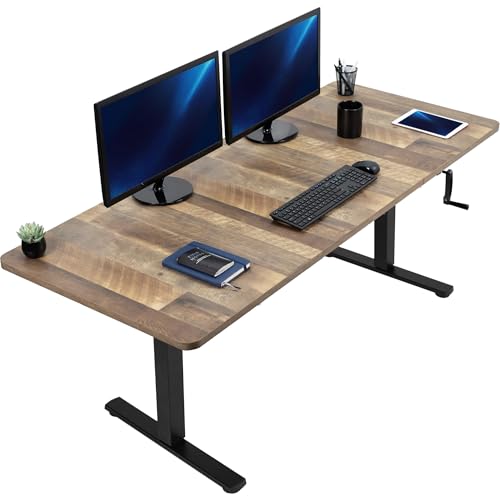
VIVO Manual Crank Standing Desk 71×30, Reclaimed Wood — Best full desk without a motor
The VIVO 71 earns its place in a full-desk guide on acreage alone: 71 by 30 inches is a genuinely large surface — wider than every electric here except the FlexiSpot, deeper than most — lifted by a foldable hand crank on the category’s surviving manual frame, rated at 110 pounds, topped in a reclaimed wood finish across three joined pieces. In a workshop, a garden studio or an off-grid office, this is not the eccentric option; it is the only full desk in the guide that works there at all, and its owners tend to regard the winding as the membership fee for a desk with nothing in it that can burn out.
The trades are stated in this guide’s crank chapter and bear repeating at this size: the top is three-piece, because single slabs at 71 inches are a fable; the lift is a ritual of winding, unsuited to hourly changers; and 110 pounds is a ceiling that a three-monitor-plus-tower array can genuinely approach, so the load sums matter more here than anywhere else in the guide. What the buyer receives in exchange is the largest cordless surface in this entire batch of guides, with a finish that suits benches, studios and farmhouse rooms. Full is a size, not a motor — and by size, this desk is as full as they come.
The crank 71’s owners form the guide’s most distinct tribe, and their reports share a theme: the desk slowed the room down, in a good way. A surface this large, raised by hand, makes posture changes deliberate and the workstation’s arrangement semi-permanent — nothing on it is casual, because everything on it must be worth its place through every winding. Makers and drafters describe the result as bench discipline, and it suits trades where the work itself is unhurried and physical. The desk is not for everyone, and was never pretending to be; for its tribe it is not a compromise at all.
- Desktop: 71 x 30 inches, reclaimed wood finish, three-piece
- Mechanism: foldable hand crank
- Load rating: 110 lbs (per listing title)
- Frame: black
Strengths
- Full 71-inch acreage with no power requirement
- Extra-deep 30-inch top
- Reclaimed finish suits workshops and studios
Trade-offs
- Three-piece top — seams are part of the design
- Winding a desk this size is a deliberate ritual
- 110-pound rating is the guide’s lowest — plan loads carefully
Best for: Off-grid rooms, workshops and acreage-first owners who change posture a few times a day.
Not suited for: Hourly changers or loads anywhere near heavy-array territory.
How Do You Install a Full-Size Desk Without Drama?
Plan the journey before the assembly. A 71-inch top will not turn every hallway corner, and an L-shaped desk has opinions about doorways, so walk the route from front door to final position with a tape measure, and decide in advance whether tops travel flat or on edge. Assemble in the room, in the desk’s final orientation, with two people for any top over 55 inches — not because the work is hard, but because a large surface is a sail, and a sail wants four hands in a doorway.
Level and load in the right order. Set the frame, level its feet on the real floor, then fit the top, then add equipment from the centre outward so the desk’s balance is never a surprise. Route every cable at the desk’s maximum height, with the tower’s leads checked for slack at full stretch, and only then programme presets and declare the installation done. On the L-shape, walk both wings through the full travel and watch the corner’s clearance against walls and radiators — a corner desk’s journey is three-dimensional in a way a straight desk’s is not.
Give the finished desk one evening of audit before the old desk leaves the house. Work a real session at sitting and standing heights, confirm the screens sit where your eyes want them, and check the floor’s verdict under load. Full desks are multi-year commitments; a single evening of honest testing is the cheapest insurance in the whole purchase.
What Does a Full Desk Change About the Work Itself?
Something subtle happens when the surface stops rationing space: the workstation’s geography stabilises. On a compact desk, objects migrate — the notebook evicts the mouse, the laptop colonises the notebook’s home — and a small tax of rearrangement is paid hourly. On a full desk everything acquires an address: screens in their line, tower in its parish, notebook in the foreground, coffee in its embassy by the edge. Work stops including furniture management, and the desk disappears from attention the way good tools do.
The second change is social and domestic. A full desk declares the office permanent, which settles arguments a converter leaves open: this room, this wall, this work. Households report that the declaration itself has value — the desk’s owner stops camping, and everyone else stops treating the setup as temporary furniture to be borrowed around. The L-shape extends the declaration to a second activity, which is why its owners describe it less as a desk than as a small premises.
And the third change is temporal. Full desks are bought in the grammar of years: the rating headroom, the surface that tolerates rearrangement, the size that the next monitor will still fit. Owners of the desks in this guide are not shopping for this year’s setup; they are ending the desk question for the decade, and the calm that comes from a closed question is, in the end, the product.
How Do You Cable a Desk This Big?
Acreage multiplies cables geometrically: three monitors are three power leads and three signal leads before the tower, the speakers, the dock and the chargers join the census, and a full desk at full travel is a machine for finding every centimetre of slack you failed to provide. The working method is a single spine: one cable tray or channel under the rear edge, one power strip riding in it, and every device plugging into the strip so that exactly one lead — the strip’s — makes the journey to the wall. The desk then travels with its whole electrical life aboard, and the wall lead’s slack is the only measurement that matters.
Route signal cables with the same discipline and one addition: service loops. A gentle loop of spare length at each monitor lets the screen be repositioned, tilted or swapped without re-cabling the desk, and at 71 inches the temptation to stretch a lead straight and taut is the enemy of every future adjustment. Label both ends of anything that disappears into the tray. The owner who labels is the owner whose year-three monitor upgrade takes twenty minutes instead of an afternoon of archaeology.
The crank VIVO in this guide is the blessed exception that proves the rule: its workstation still needs power for its devices, but the desk itself contributes no lead, no controller and no standby draw to the census. Even there, the riding strip is the right architecture — the surface’s stillness about its own needs does not excuse the equipment’s.
What Is the Total Cost of a Full Desk, Honestly Counted?
The honest ledger of a full desk has more lines than the checkout page. There is the desk; there is the chair that must now suit two heights; there is the monitor arm or riser the new depth may make unnecessary — a credit — or the longer cables the new width demands. There may be a rug to define the territory, a mat for the standing hours, and the delivery reality that large furniture sometimes charges for the stairs it climbs. None of these lines is a surprise to a buyer who writes the ledger first, and all of them together still usually undercut the alternative biography: a compact desk outgrown in two years and replaced, at full price, by the desk that should have been bought once.
Count, too, the credit side with equal honesty. A full desk retires purchases: the side table the printer needed, the shelf the tower colonised, the second small desk a partner was making do with. The L-shape in particular absorbs furniture from the room’s ledger wholesale. And the deepest credit is temporal — a desk bought at the right size ends the category’s recurring tax, the research-and-replacement cycle that smaller purchases schedule every few years.
This is not an argument that everyone should buy the largest desk. It is an argument that the comparison should be ledger against ledger across the same five years, because judged that way the full desk’s price is often the smallest number in the story — the story being everything the workstation will ask of furniture between now and the next decade.
How Should a Full Desk Be Shared, Borrowed and Inherited?
Full desks attract other people’s work the way large tables attract other people’s projects, and a household does well to write the constitution early. Whose presets are sacred, whose zone is whose on the L, what may be borrowed and what must be restored — these sound like jokes until the first deadline week, when they become the difference between a shared asset and a territorial dispute with a motor. The electric picks’ presets help: a borrower’s height can live in a spare slot rather than overwriting the owner’s, a courtesy controllers were unwittingly designed for.
Borrowing has a productive side, too. A full desk is the household’s natural site for the annual tax sorting, the school project, the repair that needs a surface and good light — and because it rises, it serves those tasks standing, at the height of the person doing them, in a way the dining table never quite does. Owners report the desk becoming the house’s workshop of first resort, which is a return on acreage no product page advertises.
And inheritance: a well-chosen full desk is among the few technology-adjacent purchases that can be handed on without embarrassment, because its value is size, surface and mechanism rather than this year’s specification. The bamboo E6 in a student’s first flat, the crank VIVO in a workshop for a second thirty years — the category’s best objects have second lives designed into them by their sheer completeness. Buy the desk your future household would thank you for; at this size, you are shopping for them as much as for yourself.
How Do You Choose Between the Two 71-Inch Desks?
This guide’s most instructive comparison deserves its own arena, because the FlexiSpot 71 and the VIVO 71 agree on acreage — seventy-one inches across, thirty or more deep — and disagree on almost everything else. One is a dual-motor electric with a 198-pound rating and a one-idea top in black walnut; the other is a hand-cranked frame with a 110-pound rating and a three-piece reclaimed-wood surface. Choosing between them is choosing a philosophy of furniture at the exact same footprint, which is why the comparison clarifies every other decision in this guide.
Run the three questions. Power: the FlexiSpot needs a socket’s permanent allegiance; the VIVO needs none, ever. Rhythm: hourly changers will be lifted by the motor and taxed by the crank, while two-posture workers will find the crank’s ritual trivial and the motor’s premium wasted. Load: the electric carries nearly twice the crank’s rating, so the heavy array’s owner has no real choice, while the moderate setup’s owner has a genuine one. Most buyers find one question answers itself decisively, and the desk follows.
What the comparison finally shows is that “full” was never a synonym for “electric” — it is a claim about completeness and acreage that a hand crank can honour as fully as a motor. The category is healthier for containing both, and the buyer is better served by a guide that puts them on the same page, at the same size, and lets the room decide.
What Should You Do in the First Month With a Full Desk?
The first month with a full desk is a negotiation between the workstation you imagined and the one you actually run, and the desk’s size makes the negotiation pleasant: there is room to try arrangements. Move the tower from left to right and notice the lift’s balance. Give the monitors a week in a line and a week in a gentle arc. Let the notebook live in the foreground, then in a drawer, and observe which biography produces finished work. A compact desk forbids these experiments by acreage; a full desk’s first gift is that it permits them.
By the second week, fix what the experiments taught. Set the presets to the heights your body actually chose — not the ones the first day’s enthusiasm suggested — and route the cables for the final arrangement, with the riding power strip and the service loops this guide described. Furniture this size should be finished deliberately, because it will not be casually rearranged later; the month of experiment is the last cheap opportunity to learn its geography.
By the month’s end, hold the audit this guide keeps recommending: full travel, full load, eyes and shoulders reporting honestly. A full desk that passes its month becomes invisible — the highest state furniture can reach — and the workstation’s owner stops thinking about desks altogether, which was the purchase’s entire purpose.
What Does “Full” Cost the Room, and Is It Worth Paying?
A full desk’s price is partly paid in room rather than money, and honest buying counts that currency too. The desk takes the wall’s best stretch, the floor’s flattest ground, and a share of the room’s light; its chair claims a territory behind it; and the household’s other furniture arranges itself around the fact. In a dedicated office that price is trivial — the room existed for this. In a multi-use room it is the real negotiation, and it should be held before the order, with the other citizens of the room consulted like the stakeholders they are.
What the room receives in exchange is a fixed point. Households consistently report that a full desk organises more than its own footprint: the office corner stops drifting, work stops colonising the dining table by inches, and the room’s other lives gain the clarity of a border. A converter negotiates that border daily; a full desk settles it once, in furniture, and the settlement itself is a kind of peace the household can feel.
The verdict this guide keeps circling is therefore domestic before it is ergonomic. If the room can grant the territory gladly, a full desk repays it for a decade. If the grant would be resented, the resentment will outlast every specification in these pages — and the compact and convertible guides on this site exist precisely for rooms whose answer is a gracious no.
How Does a Full Desk Change a Room’s Light and Sound?
Two effects of acreage go unlisted in every catalogue and are felt within a week. The first is light: a large pale top — the L’s light walnut, the bamboo E6 — is effectively a reflector the size of a table, bouncing window light up into the room and onto the worker’s face, which video calls notice before the worker does. A large dark top does the opposite, drinking light and grounding the room’s mood, which studios and evening workers often prefer. Choose the finish with the window in mind, not merely the wardrobe.
The second is sound. A full desk at standing height puts the keyboard and the calls at a new altitude in the room, and its large surface either absorbs or reflects the household’s noise depending on what lives on it — a desk mat and paper deaden; bare laminate and glassware sing. None of this is a reason to buy or reject any pick in this guide. It is a reminder that a desk this size is a piece of the room’s architecture, and architecture is allowed to be chosen deliberately.
Comparison Table
Sort by shape first — straight or L — then by the dimension your setup is starving for: width for equipment, depth for comfort, rating for load.
| Pick | Desktop | Mechanism | Defining trait |
|---|---|---|---|
| FLEXISPOT 71×32 Electric Standing Desk | 71 x 32 in | Electric, dual motor | 198 lbs, black walnut |
| FEZIBO L-Shaped 63×55 Electric Standing Desk | 63 x 55 in L-shape | Electric | Splice board, corner format |
| FEZIBO 55×30 Electric Standing Desk, Walnut | 55 x 30 in | Electric | Extra-deep top, 176 lbs |
| Marsail 55×30 Electric Standing Desk, One-Piece | 55 x 30 in | Electric | One-piece thickened top |
| FlexiSpot E6 Bamboo 55×28 Standing Desk | 55 x 28 in | Electric, dual motor, presets | Bamboo top, 220 lbs |
| VIVO Manual Crank Standing Desk 71×30, Reclaimed Wood | 71 x 30 in | Hand crank | 110 lbs, three-piece top |
What Mistakes Do Full Desk Buyers Make?
The first mistake is measuring the wall and forgetting the room. A full desk needs its width, its depth, a chair’s working territory and passage behind it; buyers who audit only the wall discover the deficit with their shins. The second is the journey: 71-inch tops and L-shaped frames have opinions about hallways and doorways, and the time to hear those opinions is with a tape measure, before the delivery, not with a sofa’s worth of furniture in a corridor.
Third, width worship. Buyers chase the longest top while their real deficit was depth — the screens still sit close, the forearms still hang — when a 55-by-30 would have transformed the day more than a 71-by-24 fantasy. Fourth, load amnesia at scale: acreage invites accumulation, and a rating is a ceiling however big the desk looks. The VIVO 71’s 110 pounds and the FlexiSpot 71’s 198 are different instruments; sums must be done per desk, not per category.
And fifth, the splice surprise: joined tops on the largest and L-shaped desks are normal engineering, named in their listings, and only a mistake when a buyer never read the listing. Read the construction as carefully as the dimensions, and nothing about a full desk need ever surprise you.
Final Recommendation
Let the deficit decide. Starved of width, take the FlexiSpot 71; starved of depth, take the FEZIBO or the Marsail 55-by-30 — one-piece tidiness or a published rating, respectively; starved of a second zone, take the L; starved of beauty in a main room, take the bamboo E6; starved of electricity itself, take the great crank VIVO and wind it with my blessing.
A full desk is the end of a series of compromises most of us did not notice we were making, and the morning you sit down at a surface where everything has its place and nothing has to move for anything else, you will understand that the acreage was never the luxury — the quiet was.
Frequently Asked Questions
What is the difference between a full standing desk and a converter?
A full desk is complete furniture — its own frame and a full-size surface — while a converter is a platform that sits on an existing desk and raises only the workstation. Nothing in this guide is a converter; if you want to keep your current desk, this site’s convertible desk guide covers that category honestly instead.
Is 55 inches wide enough, or do I need 71?
Two monitors and a laptop live well on 55 inches, especially at 30 inches deep. Three monitors, or two plus a surface tower and speakers, justify the 71-inch class. Let the equipment list, not the photograph, decide — and remember the room must host the desk plus your chair’s territory.
Why does depth matter so much?
Depth sets your viewing distance and your forearm support. At 30 to 32 inches — the FEZIBO, Marsail and big FlexiSpot here — screens sit at a resting distance on their own stands and a notebook fits in front of the keyboard. At 24 inches, common on compact desks, most people end up needing a monitor arm to recover that distance.
How much weight can a full standing desk hold?
Only the listings’ own figures should be trusted, and they vary: 220 pounds for the E6 Bamboo, 198 for the FlexiSpot 71, 176 for the FEZIBO 55×30 and 110 for the crank VIVO 71. The Marsail’s title states no rating. Add your equipment honestly and keep a margin under whichever figure applies.
Are L-shaped standing desks practical?
For two-zone work, uniquely so: one wing for screens, the other for a laptop, paperwork or a second activity, all rising together on one frame. The FEZIBO L here uses a splice-board top, as L desks do, and needs a genuine corner with two usable walls. Single-zone workers get more from a straight desk.
Can a crank desk really be a full desk?
Yes — full describes size and completeness, not the motor. The VIVO 71×30 is a complete desk of full acreage lifted by a foldable hand crank, rated at 110 pounds. It suits off-grid rooms and few-changes-a-day workers; hourly changers at this scale should take the dual-motor FlexiSpot 71 instead.
Related Guides
Keep reading with Best Chairs for Gaming Sessions: Six Chairs Judged at Hour Four Best Slim Doorbell Cameras: Narrow Bodies for Tight Door Frames Best Audio USB Headsets: Clean Signal, Honest Surround, Six Real USB Picks.
Related guides
- Best 1440p 165Hz Monitors: One Native 165Hz Pick, Three 180Hz Upgrades, an Overclock Headline and a 160Hz Ultrawide
- Best 13×19 Professional Printers
- Best 3rd Party MacBook Chargers: 96W-Class Alternatives, the 100W Cable Rule, and the Apple Benchmark
- Best Built PC: Six Prebuilt Gaming PCs Judged on Parts, Power and Upgrades


