What's inside
- Key Takeaways
- Quick Picks
- How Did We Choose These GT 1030 Cards?
- GDDR5 or DDR4: How Do You Tell the Two Families Apart?
- What Is a GT 1030 Actually Good For in 2026?
- How Does the Age of Your PC Change Which Variant Makes Sense?
- Which GT 1030 Should You Buy for Your Machine?
- What Is Daily Life With a GT 1030 Like?
- What Does a GT 1030 Do for Video, Calls and Everyday Apps?
- How Should You Tune Games for a GDDR5 GT 1030?
- How Do You Fit a GT 1030 Into an Old Prebuilt?
- How Does the GT 1030 Compare With Integrated Graphics?
- What Mistakes Do GT 1030 Buyers Keep Making?
- What Should the First Evening With the Card Look Like?
- When Should You Skip the GT 1030 Entirely?
- Final Recommendation
- Frequently Asked Questions
- Related Guides
As an Amazon Associate I earn from qualifying purchases. This post may contain affiliate links at no extra cost to you.
gizmoverdict.com is reader-supported. When you buy through links on our site, we may earn an affiliate commission.
Where to buy: the six cards below link to their Amazon listings, and in this particular guide the listing page is not a formality — it is where the single most important fact about each card lives. Read the memory line before you read anything else, because with the GT 1030, the memory decides what you actually bought.
Anyone shopping for the best 1030 graphics cards is really shopping for two different products that happen to share a name. NVIDIA’s GeForce GT 1030 launched as a small, frugal GPU for light gaming and home-theatre duty, and the original design pairs it with GDDR5 memory. Later, cheaper variants appeared wearing the same GT 1030 badge but fed by DDR4 — ordinary system-style memory with a fraction of the bandwidth. The gaming gap between those two families is not a rounding error; the GDDR5 cards can be close to twice as quick in memory-hungry moments, while the DDR4 cards sink toward the pace of the integrated graphics they were meant to replace. Same box name, same shelf, profoundly different purchase. This entire guide exists to keep you on the right side of that split.
Set the expectations honestly before we rank anything. Even the best GT 1030 is a card of its era: a home-theatre and desktop accelerator that plays older games and lightweight esports titles at modest settings, decodes video beautifully, sips power from the slot and fits into the slim office PCs that dominate the second-hand market. It is not a modern gaming card, and no variant of it will carry a current big-budget release at 1080p in a form anyone would call playable. Readers who need that should close this tab and save toward a higher class. Readers whose PCs need waking up — a dead display output replaced, a second and third monitor lit, a library of classics made smooth — are exactly who this chip serves, and for them the choice among these six cards is a real one worth making carefully. It is also a forgiving price point at which to learn the habits that protect every later hardware purchase: read the specification that matters, distrust the number printed largest, and match the tool to the job rather than to the advertisement.
Why does the little chip persist years after faster hardware buried it? Because its virtues are the ones old PCs actually need. It asks for no power connector, generates almost no heat, comes in low-profile form from nearly every maker, and costs little enough that fitting one to a donated or inherited desktop is an easy decision. Integrated graphics of its generation were weak and often limited to a single display output; a GT 1030 fixed both complaints in one slot. That rescue mission, more than gaming, is the card’s legacy — but if gaming is even part of your plan, the GDDR5 rule below is non-negotiable.
Key Takeaways
- The GT 1030 name covers two memory families: GDDR5 cards that game lightly and honestly, and DDR4 cards that mostly should not game at all.
- Identify the memory from the listing text — GDDR5, DDR4, D4 or 4GD4 in a model code — never from the capacity figure printed largest.
- A 4GB DDR4 card is slower in games than a 2GB GDDR5 card; bandwidth, not gigabytes, is what this chip starves for.
- Every card here is slot-powered and low-profile friendly, which is precisely why the model survives as the standard rescue for slim prebuilt PCs.
- Position the card truthfully: superb for HTPC, multi-monitor desktops and older games; the wrong tool for modern releases at native resolution.
- DisplayPort appears on only some variants, so multi-monitor and 4K-desktop shoppers must check the port list model by model.
Quick Picks
| Pick | Badge | Why it earns its place |
|---|---|---|
| ASUS GeForce GT 1030 2GB GDDR5 | The one to buy for gaming | Proper GDDR5 memory, a low-profile bracket in the box and ASUS behind the warranty — the reference GDDR5 1030. |
| maxsun GeForce GT 1030 2GB GDDR5 | GDDR5 for tight cases | The same correct memory in an ITX-sized, low-profile-ready board built for small-form-factor machines. |
| MSI GeForce GT 1030 4GD4 LP OC | DDR4, labelled plainly | Four gigabytes of DDR4 with DisplayPort and HDMI — a fine display and HTPC card, bought with eyes open about gaming. |
| GIGABYTE GT 1030 Low Profile D4 2G | Honest budget display card | A 2GB DDR4 low-profile card from a major maker for desktops that need screens, not frame rates. |
| MSI GeForce GT 1030 2GHD4 LP OC | Compact DDR4 alternative | MSI’s 2GB DDR4 low-profile OC model — interchangeable with the Gigabyte for pure display duty. |
| ZyzsAI GT 1030 4GB Half Height | Dual-monitor 4K desktop pick | Half-height card with HDMI and DisplayPort pitched at dual-monitor 4K video and office work, no extra power needed. |
How Did We Choose These GT 1030 Cards?
Deliberately, this guide refuses to pretend the six cards are one ladder. Two of them — the ASUS and the maxsun — carry GDDR5 and are the only ones we recommend to anyone who will play games, even light ones. Three carry DDR4 and are recommended here strictly as display and home-theatre hardware, where their slower memory barely matters because desktops and video do not stress memory bandwidth the way games do. The sixth, the ZyzsAI half-height card, is included for its port layout and dual-monitor pitch, with a caution about verifying its memory type on the listing before purchase.
That structure mirrors how the market actually sells this chip, and it lets each card be judged against its honest job. A DDR4 card marked down for weak gaming it never claimed to do well would be as misleading as a DDR4 card marketed as a gaming card in the first place. Specifications in each review are drawn from the card’s own listing — memory type and size, outputs, cooler, form factor — and where a listing leaves a fact unstated, we flag the gap rather than filling it with a guess.
One more consideration shaped the ordering: honesty of positioning in the sellers’ own listings. Cards whose titles state their memory type plainly — as the GDDR5 pair and MSI’s D4-coded models do — were favoured over listings that bury the fact, because a guide can only recommend confidently what a buyer can verify confidently. Where a listing left the type unstated, as with the ZyzsAI card, the review carries the verification task openly instead of guessing on the reader’s behalf.
Availability and maker support formed the second filter. The GT 1030’s twilight years have filled its market with anonymous boards whose sellers may not outlast the return window, so established names anchor the list: ASUS, MSI and Gigabyte between them account for four of the six picks. The two smaller brands included earn their places on form factor and ports, and their reviews say plainly that support runs through the seller.
GDDR5 or DDR4: How Do You Tell the Two Families Apart?
Learn the tells once and you will never be caught. The GDDR5 cards announce their memory proudly in the title, because it is their selling point: look for the words GDDR5 in the listing headline, as both the ASUS and maxsun listings in this guide display. DDR4 cards disclose themselves more quietly. The giveaway vocabulary includes DDR4 itself, the shorthand D4 buried in model codes — Gigabyte’s GV-N1030D4-2GL carries it openly — and MSI’s 4GD4 and 2GHD4 naming, where the D4 sits inside the string. A listing that trumpets capacity while staying vague about type is telling you the answer by omission.
Why does the difference bite so hard on this particular chip? The GT 1030’s processor is modest, but it was designed around GDDR5 bandwidth; feed it through DDR4 and the memory bus becomes a narrow door through which every texture and frame must squeeze. Games feel it immediately, because they stream assets constantly. Desktop work and video playback barely feel it at all, because their data patterns are gentler — which is the entire reason DDR4 variants can still be sensible purchases for the right job, and why this guide keeps them, labelled, rather than banishing them.
Price behaviour completes the picture. DDR4 variants usually sit a little cheaper than their GDDR5 siblings, and that small saving is the trap’s bait: a gamer saves a modest sum and loses a large share of the performance they thought they were buying. If the price gap between a DDR4 card and the ASUS GDDR5 card looks small, it is — small enough that no gaming buyer should accept it. The only readers who should pocket that saving are those who know, with certainty, that games are not part of the machine’s future.
What Is a GT 1030 Actually Good For in 2026?
Home theatre remains its most graceful role. The card decodes modern video formats in hardware, drives a television over HDMI without waking a fan’s worth of noise, and turns an elderly desktop into a media centre that handles streaming and local files with ease. In a living-room PC its low heat and low profile are not compromises but qualifications, and both memory families perform this job identically — one of the few arenas where DDR4 loses nothing.
Multi-monitor office work runs a close second. A GT 1030 gives a slim prebuilt the outputs its motherboard never had, and for documents, browsers, mail and spreadsheets the experience is indistinguishable from far stronger hardware. Buyers in this lane should shop by ports: HDMI plus DVI covers most two-screen desks, while the variants with DisplayPort — the MSI 4GD4 and the ZyzsAI below — suit newer monitors and dual-screen 4K desktop arrangements.
Gaming, finally, belongs to the GDDR5 pair and to a defined library: esports titles built for vast audiences, the great back catalogue of older releases, indie games and emulation of classic consoles. Within that library the GDDR5 cards deliver a genuinely enjoyable 1080p experience at low-to-medium settings. Outside it — current shooters with heavy engines, open-world releases from recent years — the honest advice is that this chip has retired from that duty, and pretending otherwise helps no one except the seller of a DDR4 card.
How Does the Age of Your PC Change Which Variant Makes Sense?
The GT 1030’s buyers fall into three generations of host machine, and each generation points at a different pick. The oldest hosts — desktops from the early integrated-graphics era, often running a single VGA or DVI output — gain the most from any card here, because even the DDR4 variants multiply their display options and offload video work their processors handled badly. For those machines the decision is mostly about ports and brackets, and the budget DDR4 cards are defensible, cheerful purchases.
The middle generation — machines from the middle of the last decade with early quad-core processors and a PCIe slot waiting empty — is where the GDDR5 rule bites hardest, because these PCs are exactly the ones families revive for a child’s first gaming steps. Their processors can still feed a GDDR5 GT 1030 in esports and classic titles, so the memory choice decides whether the revival delights or disappoints. Spend the small difference here; it is the highest-value decision in this entire guide.
The newest hosts need a sterner conversation. A PC built around a recent processor with modern integrated graphics may gain nothing from a GT 1030 except extra outputs, and even those can often be had from the motherboard. Before buying for such a machine, compare what your integrated GPU already does — if it drives your monitors and plays your games, the honest recommendation is to keep your money. The GT 1030 is a remedy for a specific era’s weaknesses, not a universal upgrade token.
One more host deserves mention: the small home server or NAS-adjacent box that occasionally needs a screen. A low-profile GT 1030 gives such a machine a proper display output and hardware video decoding for the odd transcode, drawing little power at idle and asking nothing of the power supply. Several readers will buy this card for a machine that never plays a game in its life, and for that duty even the humblest DDR4 variant here is entirely respectable.
Which GT 1030 Should You Buy for Your Machine?

ASUS GeForce GT 1030 2GB GDDR5 — The one to buy for gaming
This is the card the GT 1030 was meant to be. ASUS pairs the chip with 2GB of GDDR5 — the memory the design was built around — and the result is the strongest light-gaming performance this model line can offer: esports titles and older releases at 1080p with settings kept sensible, plus flawless video and desktop behaviour. The single-fan cooler is compact, the card draws everything it needs from the PCIe slot, and the low-profile bracket in the box means the slim tower gathering dust in a spare room is a valid host.
Its outputs cover the classic two-screen desk: HDMI for the modern panel, DVI-D for the veteran beside it. What it will not do is run three displays or feed a DisplayPort-only monitor, and its 2GB frame buffer asks texture settings to stay modest in the older games it plays best. None of that diminishes its position here. If a GT 1030 is entering a machine that will ever launch a game, this — or its maxsun sibling where space is tighter — is the purchase, and every alternative below should be read as a display card by comparison.
A word about pairing it with the rest of a revival project: resist the urge to overbuild around it. Owners sometimes respond to a successful GT 1030 install by planning a cascade of further upgrades, but this card’s charm is that it completes a modest machine rather than starting an ambitious one. Add the second monitor, tidy the cables, and let the PC be what it now is — a competent, quiet box for the games and work it was actually bought to do.
- GPU: NVIDIA GeForce GT 1030
- Memory: 2GB GDDR5
- Interface: PCIe 3.0, powered by the slot
- Outputs: HDMI, DVI-D
- Format: single fan, low-profile bracket included
Strengths
- GDDR5 memory delivers the full light-gaming capability of the chip
- Slot power and a low-profile bracket make it a universal fit for old desktops
- Backed by the strongest support network among these six makers
Trade-offs
- Two gigabytes limits texture settings in the games it otherwise runs well
- No DisplayPort among its outputs
- Two displays is its ceiling
Best for: anyone reviving a PC for esports, classics and everyday twin-screen work. Not suited for: triple-monitor desks or players of current releases.

maxsun GeForce GT 1030 2GB GDDR5 — GDDR5 for tight cases
Maxsun’s take on the chip is aimed at the machines with the least room to spare. Built in an ITX-friendly compact format and ready for low-profile installation, it is the GDDR5 card for small-form-factor desktops and home-theatre cases where the ASUS board’s layout might crowd a drive bay or a case wall. Crucially, shrinking the board did not shrink the memory specification: the full GDDR5 configuration is here, so its light-gaming ceiling matches the ASUS card’s frame for frame in class terms.
HDMI and DVI outputs suit the mixed-age monitor pairs that small PCs usually serve, and in a living-room role the card is effectively silent, since video workloads barely stir its fan. The honest differences from the ASUS are commercial rather than technical: maxsun is a smaller brand in Western markets, so the buying experience leans more on the marketplace seller, and checking the listing’s bracket contents before ordering is a wise two minutes. Where fit is the deciding factor, this is the GDDR5 answer.
Small-case owners should take one measurement before ordering any card in this guide: the clearance between the PCIe slot and whatever sits opposite it, because compact cases hide drive cages and front-panel wiring exactly where a cooler wants to be. Maxsun’s board is short enough to clear almost all of them, which is its quiet superpower. Pair that with a low-profile bracket and the card becomes the answer to the question slim-PC owners ask most: what actually fits in here and still plays something?
- GPU: NVIDIA GeForce GT 1030
- Memory: 2GB GDDR5, 64-bit
- Interface: PCIe 3.0
- Outputs: HDMI, DVI
- Format: ITX-sized board, low-profile ready
Strengths
- Full GDDR5 specification in the smallest board in this guide
- Ideal HTPC manners — cool, quiet and undemanding
- Fits the cramped small-form-factor cases other cards cannot
Trade-offs
- Seller-dependent support compared with the biggest brands
- Shares the chip’s universal 2GB ceiling
- Confirm the low-profile bracket is included before ordering
Best for: small-form-factor and living-room PCs that still want light gaming on the menu. Not suited for: buyers who prioritise a large vendor’s service network above fit.
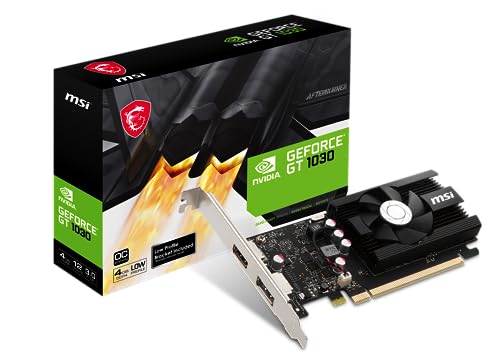
MSI GeForce GT 1030 4GD4 LP OC — DDR4, labelled plainly
Here is the DDR4 family wearing its identity in its name: 4GD4 means four gigabytes of DDR4, and this review will not dress that up. As a gaming card this MSI is dramatically weaker than the GDDR5 pair above — the memory bandwidth simply is not there, and buyers who purchase it for games will feel cheated by physics rather than by MSI. As a display and home-theatre card, though, it has a genuine case: the 4GB pool is comfortable for sprawling desktop work, and its DisplayPort-plus-HDMI pairing is the most modern output set among the DDR4 cards here.
The low-profile, single-fan design follows the class pattern — slot power, small cooler, an OC suffix that should be read as a mild factory tune rather than a transformation. For a workstation revival, a reception PC or a media box driving a 4K television at desktop refresh rates, it performs its duties without fuss and carries MSI’s name behind it. Our condition is only that the purchase be made knowingly: this card is plumbing and playback, and within those trades it is a respectable tool.
There is a fleet-buying angle to this model as well. Offices refreshing a row of ageing desktops often value the DisplayPort output above everything else on this page, because their newer monitors have standardised on it, and a single card model that can be ordered repeatedly, fitted in minutes and forgotten is worth more than a marginally cheaper mystery board. The 4GD4’s name tells the purchasing department exactly what it is, which — given this model line’s naming traps — is a small mercy.
- GPU: NVIDIA GeForce GT 1030, OC edition
- Memory: 4GB DDR4, 64-bit
- Interface: PCIe, slot-powered
- Outputs: DisplayPort, HDMI
- Format: low profile, single fan
Strengths
- DisplayPort output, rare among the DDR4 variants
- 4GB of memory suits busy multi-window desktop work
- MSI build quality in a slim, slot-powered package
Trade-offs
- DDR4 bandwidth cuts gaming performance roughly in half versus GDDR5
- The OC badge cannot compensate for the memory ceiling
- Costs close enough to GDDR5 cards that gamers should never choose it
Best for: display duty, HTPC builds and office revivals where DisplayPort is required. Not suited for: gaming in any form beyond the very lightest legacy titles.

GIGABYTE GT 1030 Low Profile D4 2G — Honest budget display card
Gigabyte’s D4 model is the DDR4 family’s most straightforward proposition: two gigabytes of the slow memory, a low-profile board, HDMI and DVI-D outputs, and a price position that usually undercuts the GDDR5 cards by a small margin. Nothing about it pretends to gaming ambition, and judged as what it is — a way to give an old desktop a modern pair of display outputs — it is a tidy piece of hardware from a maker with real support infrastructure.
The buyer this card serves has a specific shape: a slim office PC whose integrated graphics died or never supported the two monitors the desk now holds, a point-of-sale machine, a workshop computer. In those roles the DDR4 handicap is invisible, because spreadsheets and browsers do not queue for memory bandwidth. The moment games enter the conversation, walk back up this page to the GDDR5 pair; the saving this card offers is real but small, and it evaporates the first time someone installs a game on the machine.
One scenario flatters this card in particular: the hand-me-down desktop. When an old family PC passes to a relative who needs it for browsing, documents and video calls, a card like this — cheap, quiet, from a name the family recognises — refreshes the machine’s usefulness without a lecture about specifications. Nobody games on it, nobody benchmarks it, and the Gigabyte simply makes two screens work where one flickering output used to be. Hardware that disappears into a job well done has its own kind of excellence.
- GPU: NVIDIA GeForce GT 1030
- Memory: 2GB DDR4
- Interface: PCIe, slot-powered
- Outputs: HDMI, DVI-D
- Format: low profile
Strengths
- Major-maker build and support at the bottom of the model’s price range
- Low-profile fit for the slim desktops that need it most
- Completely sufficient for desktop, browser and video workloads
Trade-offs
- DDR4 memory rules out meaningful gaming
- Two outputs and no DisplayPort
- The saving over GDDR5 models is smaller than the performance gap
Best for: no-gaming desktop revivals and commercial display duty on a budget. Not suited for: any machine a game will ever be installed on.

MSI GeForce GT 1030 2GHD4 LP OC — Compact DDR4 alternative
MSI’s other DDR4 entry halves the memory to 2GB and keeps everything else in the family pattern: low-profile board, single fan, a light factory overclock and slot power. Against its 4GD4 sibling the difference matters less than the spec sheet implies, because for the desktop and video duties these cards exist to serve, two gigabytes is adequate and the shared DDR4 bandwidth — not capacity — sets the character of both cards. Choose between them on price, availability and whether the 4GD4’s DisplayPort matters to your monitors.
Where this card earns its separate listing is as the DDR4 option for buyers who want MSI’s cooler and build in the smallest, simplest form, often for fleet or repeat purchases where a known quantity matters. It shares the family warning in full: this is not the GT 1030 to buy for games, and its OC suffix describes a gentle clock bump that the memory bus immediately overrules. As honest display hardware with a good badge on the box, it does its work without complaint.
Buyers comparing the two MSI DDR4 cards often ask whether the 2GB model handicaps desktop work, and the reassuring answer is that ordinary productivity — documents, spreadsheets, a dozen browser tabs across two screens — does not press against even this modest allocation. Memory pressure in office life comes from the system RAM far sooner than from the graphics card. Choose the 4GD4 for its DisplayPort or for heavy multi-window habits; choose this one when neither applies and the price is kinder.
- GPU: NVIDIA GeForce GT 1030, OC edition
- Memory: 2GB DDR4
- Interface: PCIe, slot-powered
- Outputs: HDMI, DVI-D (per listing)
- Format: low profile, single fan
Strengths
- Simple, proven low-profile design from a top-tier board maker
- Slot power keeps installation to minutes in any prebuilt
- Quiet single-fan cooling suits office and living-room placements
Trade-offs
- DDR4 bandwidth makes it a display card, full stop
- 2GB capacity is the family’s floor
- Near-interchangeable with the Gigabyte D4 — buy on deal, not loyalty
Best for: straightforward display upgrades and repeatable fleet purchases. Not suited for: gaming, or buyers needing DisplayPort.

ZyzsAI GT 1030 4GB Half Height — Dual-monitor 4K desktop pick
The ZyzsAI card pitches itself at a specific desk: half-height, HDMI plus DisplayPort, dual-monitor support and 4K video as the headline duties, with no auxiliary power supply required. On those terms it is a sensible little board — the half-height format slides into the slimmest small-form-factor cases, and the port pairing is exactly what a modern two-screen office setup asks for. Video playback and desktop work at 4K are squarely within a GT 1030’s abilities, and this card is specced for precisely that life.
Two cautions keep it at the foot of the list. The listing emphasises its 4GB capacity without making the memory type the headline, and in this model line that omission must be resolved before purchase: find the memory specification on the listing page, and if it is DDR4 — as most capacity-led listings in this class are — file the card mentally with the display family above, not the gaming pair. Second, ZyzsAI is a small brand, so support is the seller. Neither point disqualifies it for a dual-monitor workstation; both demand a careful minute on the listing before the order goes in.
For the dual-monitor 4K desktop it targets, a few setup habits help: drive each screen at its native resolution, let the operating system handle scaling for text, and prefer the DisplayPort connection for the primary display where a choice exists. Configured that way, the card delivers the crisp, quiet, two-screen workspace its listing promises, and the GT 1030’s video decoding keeps 4K playback smooth while the processor idles. It is a narrow brief, honestly filled.
- GPU: NVIDIA GeForce GT 1030
- Memory: 4GB (confirm type on the listing before buying)
- Interface: PCIe x16, no extra power supply
- Outputs: HDMI, DisplayPort
- Format: half-height low profile for SFF cases
Strengths
- HDMI plus DisplayPort suits modern dual-monitor desks
- Half-height format fits the slimmest small-form-factor machines
- Pitched honestly at 4K video and desktop work
Trade-offs
- Memory type is not the listing’s headline — verify it before purchase
- Small-brand support runs through the marketplace seller
- Not a gaming card on any reading of its specification
Best for: dual-monitor office and media setups in very slim cases. Not suited for: gamers, or buyers unwilling to verify the memory line first.
What Is Daily Life With a GT 1030 Like?
Quiet is the headline. These cards sip power, and under the desktop, browser and video loads that fill most of their working lives, their small fans have so little heat to clear that many owners never consciously hear them. In a bedroom HTPC or a study, that silence is not a luxury feature but the difference between a machine that belongs in the room and one that gets switched off. The GDDR5 gaming pair work their fans a little harder in games, yet remain well within the manners expected of a card in this class.
Heat is equally undemanding, which matters because the typical host case has the airflow of a shoebox. A slot-powered GT 1030 adds a modest warmth that even a single tired case fan handles, and there is no auxiliary power cable to route through a cramped interior. This is a large part of why the model became the default rescue card: it asks nothing of the machine it saves — no PSU swap, no ventilation project, no bracket gymnastics beyond the low-profile swap slim cases require.
Driver life deserves a clear-eyed word. NVIDIA supports this generation on a mature branch: updates arrive for security and compatibility rather than to chase performance in new releases. For a card whose gaming library is deliberately retrospective, that cadence is appropriate, and stability matters more than novelty. Install the current driver at setup, update occasionally, and expect the arrangement to remain uneventful for years — the precise temperament a rescue component should have.
Longevity, finally, favours these small cards. With modest clocks, modest heat and fans under little stress, a GT 1030 commonly outlives the PC it was bought for and migrates onward — into a media box, a grandparent’s desktop, a workshop machine. That second and third life is a real part of the value calculation, and it quietly favours the established makers’ boards, whose fans and capacitors are the likeliest to survive the journey.
What Does a GT 1030 Do for Video, Calls and Everyday Apps?
It is easy to underrate how much of a modern PC’s life is video. Streaming services, video calls, browser tabs full of embedded clips, a second screen playing something while the first screen works — all of it leans on the GPU’s decode hardware, and ageing integrated graphics often handle it by borrowing the main processor, which is why old desktops stutter through a video call with a spreadsheet open. A GT 1030 absorbs that work into dedicated silicon and gives the processor back to the applications, a transformation owners feel within the first hour even if they never open a game.
Home-theatre use builds on the same strength. The card outputs a clean 4K desktop over HDMI or DisplayPort on the variants fitted with it, decodes the formats the big streaming platforms and local media libraries use, and does so without the fan noise that ruins a quiet scene. Paired with a media-centre application, an elderly desktop becomes a living-room appliance in the best sense: invisible, instant, and forgotten about while it works. Both memory families serve here, since video streams do not queue for gaming-style bandwidth.
Creators of a modest kind benefit too. Video editors working in HD timelines find the card’s decode and display acceleration smooths scrubbing and playback in consumer editing software, and streamers of light content — a card game, a retro title, a desktop presentation — can lean on the hardware without troubling the processor. Nobody should buy a GT 1030 as a production tool, but for the household archive of phone videos and holiday footage, it turns an old PC into a patient, adequate editing desk.
Even the humble video call improves. Modern conferencing software offloads background effects, noise cleanup visuals and multi-participant galleries to the GPU where it can; on integrated graphics of the GT 1030’s era those features either vanish or tax the whole machine. Dropping this card into a work-from-home relic will not change your camera, but it steadies everything around the call — the shared document, the second screen, the machine’s general composure under a stacked workload.
How Should You Tune Games for a GDDR5 GT 1030?
Owners of the GDDR5 pair can squeeze honest enjoyment from a defined library with a few habits. Start at 1080p with the game’s low preset, then raise texture quality one notch if the 2GB memory allows it in that title, because textures govern how a game looks more than how it runs — until the moment they exceed memory, when stutter announces the error. Shadows and post-processing effects are the first sacrifices; they cost this chip dearly and their absence is barely noticed in the fast, bright games it plays best.
Resolution scaling is the second tool. Many titles from the card’s era and after offer a render-scale slider; setting it modestly below native while keeping the interface at full resolution preserves readability and buys meaningful smoothness. Competitive players should go further and prioritise a stable frame rate over beauty, capping the rate where the card can hold it through a busy fight rather than chasing peaks it reaches only in empty corridors. The goal is not a number on a counter but a game that feels even from minute to minute.
Finally, curate the library to the hardware and the hardware will feel stronger than it is. The back catalogue available to this card is enormous — entire beloved series from the years when its class was current, plus the indie catalogue that asks almost nothing of a GPU. A player working through that inheritance with a GDDR5 1030 is not enduring a compromise; they are using the right-sized tool for a very large job.
How Do You Fit a GT 1030 Into an Old Prebuilt?
The physical job is among the easiest in PC hardware. Confirm a free PCIe x16 slot — in compact prebuilts it may be the only slot — and check whether the case needs the low-profile bracket fitted, since most slim desktops do and swapping brackets is a two-screw task best done before the card goes in. Power is a non-event: every card in this guide runs from the slot, so even the proprietary, oddly-shaped power supplies in big-brand office machines cope without adapters or anxiety.
Software asks for slightly more care. Boot with the monitor attached to the new card, not the motherboard — a cable left in the old socket is the classic cause of a black screen and a racing heart — then install NVIDIA’s current driver for the GT 1030 from the official site. If the machine previously used a different brand of graphics, a clean driver installation prevents the odd stutter or missing resolution. Finish by setting each monitor to its native resolution and checking that a video and, if relevant, your lightest game both run as expected.
How Does the GT 1030 Compare With Integrated Graphics?
Against the integrated graphics of its own era, the GDDR5 card is a revelation: those old motherboard and processor GPUs struggled with a single 1080p desktop full of windows, let alone games, and many offered one lonely output. Against the integrated graphics in current processors the picture flips — a modern iGPU can match or exceed a GT 1030, GDDR5 included, which is why nobody should buy this card to upgrade a recent machine. The GT 1030’s kingdom is the large installed base of older desktops, and inside that kingdom it remains genuinely useful.
There is one more comparison worth making, with the card’s own second-hand market. Used GT 1030s circulate cheaply, and a used GDDR5 example from a reputable seller is a rational buy; but the DDR4 confusion follows the chip into the used listings too, and there the memory type is often harder to verify. A new card with a clear listing and a return window buys certainty that a classified ad cannot, and at this end of the market certainty is worth a small premium.
There is also the question of what sits one rung up, for readers whose budget stretches slightly. The neighbouring classes — a Radeon RX 550 with GDDR5, or a modern entry card like Intel’s smallest Arc — widen the gaming library meaningfully while keeping the same slot-powered, small-case manners. If your revival project is really a gaming project in disguise, price those before committing here; the GT 1030 rewards honesty about the mission, and it punishes missions that quietly grow after purchase.
| Card | Memory | Outputs | Format | Buy it for |
|---|---|---|---|---|
| ASUS GT 1030 GDDR5 | 2GB GDDR5 | HDMI, DVI-D | LP bracket included | Light gaming plus desktop |
| maxsun GT 1030 GDDR5 | 2GB GDDR5, 64-bit | HDMI, DVI | ITX, LP ready | Tight cases, HTPC gaming |
| MSI GT 1030 4GD4 LP OC | 4GB DDR4, 64-bit | DP, HDMI | Low profile | Display duty with DisplayPort |
| GIGABYTE GT 1030 D4 2G | 2GB DDR4 | HDMI, DVI-D | Low profile | Budget display revival |
| MSI GT 1030 2GHD4 LP OC | 2GB DDR4 | HDMI, DVI-D | Low profile | Simple fleet display card |
| ZyzsAI GT 1030 4GB | 4GB, verify type | HDMI, DP | Half height | Dual-monitor 4K desktop |
What Mistakes Do GT 1030 Buyers Keep Making?
The defining mistake is the one this guide opened with: buying a DDR4 card for gaming because the headline said GT 1030 and the capacity said 4GB. It happens because nothing on a DDR4 box is false — the chip really is a GT 1030, the memory really is 4GB — while the one fact that decides gaming performance sits in smaller print. Read the memory line, decode the model string, and the trap disarms itself.
Expectation errors follow close behind. A GT 1030 of either family will not make a current open-world game pleasant, will not drive a high-refresh gaming monitor to its potential, and will not turn a bargain PC into a streaming rig for demanding titles. Buyers who internalise the card’s real era — roughly, the esports and back-catalogue years — are consistently happy with it; buyers who shop by hope are not. A subtler error is forgetting the rest of the machine: an old PC with a failing hard drive or a single stick of memory will still feel slow after the card arrives, because the card was never its only problem. Spend ten minutes with the machine before ordering — check how much system memory it carries, whether its storage is a spinning drive gasping for retirement, and whether its processor belongs to the card’s era at all. The GT 1030 fixes graphics-shaped problems; diagnosing which problems are graphics-shaped is the buyer’s half of the bargain.
Counterfeit and mislabelled cards haunt this model’s name as well. The GT 1030’s modest specification makes it a harder card to fake profitably than the famous flagships, but relabelled older chips do circulate, usually betrayed by VGA-only outputs, odd memory claims or a seller with no history. The defences are the same as everywhere at this end of the market: buy from sellers with a track record, prefer listings whose photographs show the actual board and its label, and verify the card’s reported identity with a system-information tool during the return window.
Finally, do not pay a collector’s premium for the badge. This is a commodity chip in its twilight; if a listing prices any variant as though it were scarce performance hardware, walk away and buy the sensibly-priced equivalent, because the silicon underneath is identical across makers and only memory, ports, cooler and support separate them.
What Should the First Evening With the Card Look Like?
Give the installation an unhurried hour and a small checklist. Photograph the card and its label before it goes in — in a model line built on naming subtleties, your own record of what arrived is worth having. Fit the bracket your case needs while the card is still on the desk, seat it until the slot latch clicks, and route the monitor cable to the card rather than the motherboard. Then boot, install the fresh driver, and set every connected screen to its native resolution before judging anything.
Testing should mirror the machine’s real future. Open the heaviest application the PC actually runs — for a gaming revival, the most demanding title in the intended library; for a workstation, the full sprawl of monitors, documents and a video call at once. Fifteen honest minutes under that load teaches more than an afternoon of synthetic benchmarks, and it does so while the return window is wide open. Note anything odd — a fan rattle, a flickering second screen, a resolution that will not stick — and resolve it the same evening, while every remedy is still free.
Finish with the housekeeping that future-you will appreciate: file the receipt, note which memory variant you bought somewhere you will find it, and keep the spare bracket in the case or taped inside the side panel, because slim PCs change desks and the other bracket is always the one that vanishes. A card installed this way tends to stay installed, quietly, for the rest of the machine’s natural life.
When Should You Skip the GT 1030 Entirely?
Three readers should walk past this whole model line. The first is the player whose library is current: if the games you care about launched in the last few years with modern engines, a GT 1030 of either memory family will only frustrate you, and the money is better kept toward a card from a living generation. The second is the owner of a recent PC whose integrated graphics already match this chip — for you the card buys outputs at most, and a cable or dock may solve that more cheaply. The third is the high-refresh hunter: a 1080p monitor running at very high refresh rates deserves a GPU built to feed it, and this is not one.
Everyone else — and it is a large everyone, measured in tens of millions of ageing desktops — has a legitimate errand here. The discipline is simply to run the errand knowingly: name the job, pick the memory family that matches it, verify the listing’s three key lines, and fit the card without expecting miracles. Hardware bought with clear eyes at this level rarely disappoints, because the disappointment was never in the silicon; it was in the story the buyer was told about it. This guide has tried to tell the straighter story.
Final Recommendation
Decide your family first and your brand second. If games of any kind are in the machine’s future, the ASUS GT 1030 GDDR5 is the default answer, with the maxsun as its equal where a small case demands it. If the machine’s future is screens and video, the DDR4 cards become legitimate: MSI’s 4GD4 where DisplayPort matters, the Gigabyte or MSI 2GB cards where it does not, and the ZyzsAI where two modern monitors meet a very slim case. Buy the memory your workload needs, and this elderly little chip will reward you with exactly the second life you asked of it — no more, but also no less. Keep the listing details with the receipt until the card has settled in, because in a model line where one letter inside a product code separates a gaming card from a display card, the paperwork proving which one you ordered is worth the drawer space it takes.
Frequently Asked Questions
How much slower is the DDR4 GT 1030 than the GDDR5 one?
In memory-sensitive games the difference is dramatic — the GDDR5 card can deliver close to double the frame rate in the same title, because the DDR4 variant’s memory bandwidth is a fraction of the design’s intent. In desktop work and video playback the gap shrinks to nearly nothing, which is why the DDR4 cards survive in this guide as display hardware rather than being dismissed outright.
Can a GT 1030 play games at 1080p?
The GDDR5 versions can, within a defined library: esports titles, indie games and releases from the chip’s era and before, at low-to-medium settings. Recent big-budget games are beyond both families at native resolution, and no settings menu fully changes that. The DDR4 versions should be considered 1080p desktop cards that tolerate only the lightest legacy gaming.
Does the GT 1030 need a power connector?
No. Every card in this guide draws its power from the PCIe slot, which is the foundation of the model’s usefulness in old prebuilt desktops with weak or proprietary power supplies. If a listing for a GT 1030 shows an auxiliary power connector, you are almost certainly looking at a different or mislabelled product.
Can it run two monitors, or three?
Two, comfortably — every pick here carries at least two outputs, and dual-monitor desktop work is a core strength of the class. Three simultaneous displays are beyond these particular variants; readers who need three screens should look at cards built for multi-display duty rather than stretching a GT 1030 past its design.
Is the GT 1030 good for a home-theatre PC?
It is one of the model’s best roles. Hardware video decoding, HDMI output to a television, near-silent operation under video loads and a low-profile fit for media cases make both memory families equally suitable — one of the few purchasing decisions in this guide where the GDDR5 rule can be safely relaxed.
Why do some GT 1030 listings show 4GB so prominently?
Because capacity is the easiest number to sell and, on this chip, one of the least meaningful. The 4GB variants pair that capacity with DDR4 memory whose bandwidth throttles the processor, so the big number describes a wide, slow road. Sellers are not lying — the memory is present — but the emphasis is chosen for them by what sounds impressive. Read for the memory type first and let capacity come second, and the listing’s priorities stop mattering.
What should I check on the listing before ordering?
Three lines, in this order: the memory type (GDDR5 versus DDR4, including D4 codes inside model names), the exact outputs against the inputs on your monitors, and whether the low-profile bracket is included if your case is a slim one. Those thirty seconds of reading prevent nearly every disappointment this model line is known for.
Related Guides
Readers weighing this chip against a wider field may find the neighbouring guides useful. The roundup of the best 100 dollar graphics cards places the GT 1030 beside AMD and Intel alternatives at the same budget level, the guide to the best 1080p graphics cards shows the class to graduate to when the library outgrows this chip, and anyone planning a triple-screen desk should start with the best 3 monitor gaming graphics cards instead.
Related guides
- Best Enterprise SATA SSDs: Endurance Classes, Power-Loss Protection and Fleet Sense
- Best Color Product Label Printers: Six Desktop Machines for Short-Run Product Labels
- Best Printers for Dental Practices
- Best 1440p 165Hz Monitors: One Native 165Hz Pick, Three 180Hz Upgrades, an Overclock Headline and a 160Hz Ultrawide



[…] card has revived your PC, the natural next steps are the rest of the value build. Our roundup of the best 200 dollar graphics cards shows what the next tier buys when you are ready to step up, the guide to the best 1080p graphics […]