What's inside
- Key Takeaways
- Quick Picks
- How Did We Choose These Picks?
- Why Does 5.25 Inches Keep Winning the Bookshelf Argument?
- How Do the Six Pairs Compare?
- How Do You Choose an Amplifier for Passive Bookshelf Speakers?
- Where Should Bookshelf Speakers Actually Sit?
- What Mistakes Do Bookshelf Buyers Make?
- How Should You Audition a Pair Before Committing?
- What Do Stands, Pads, and Small Treatments Actually Buy?
- How Do These Pairs Handle Television and Film Duty?
- How Long Will a Passive Pair Last, and What Ages First?
- What Does the Whole System Cost, Honestly Counted?
- Final Recommendation
- Frequently Asked Questions
- Related Guides
As an Amazon Associate I earn from qualifying purchases. This post may contain affiliate links at no extra cost to you.
gizmoverdict.com is reader-supported. When you buy through links on our site, we may earn an affiliate commission.
Where to buy: Every speaker below is sold through Amazon as a pair unless its pick text says otherwise, with availability shown before checkout. Two listings carry labels that matter — one is a Renewed product and one is the current-generation model of a famous name — and both are flagged wherever they appear, not buried in fine print.
The 5.25-inch woofer is the bookshelf speaker’s center of gravity, and shopping for the best 5.25-inch bookshelf speakers means shopping the size where physics, price, and placement flexibility reach their most useful compromise. A driver of this diameter, in a well-made two-way enclosure, reaches low enough to make music sound complete in small and medium rooms, crosses to a tweeter at a frequency where the handoff can be made graceful, and stays small enough for shelves, stands, and desks in real homes. One rule governs every pick in this guide, stated now and repeated without apology: all six are passive speakers. None contains an amplifier. Each needs an amplifier or receiver between it and your music — a stereo amp, an AV receiver, a compact desktop unit — and that component is part of every total cost discussed here. Buyers who want powered speakers have excellent options elsewhere; this guide serves the passive majority of the classic bookshelf market, and serves it honestly.
Within that rule, the six divide by intent. The ELAC Debut 2.0 B5.2 is the measured, engineered all-rounder. The Sony SSCS5 is the three-way outlier with a following that borders on folklore. The NEUMI BS5 — sold as a Renewed listing, the only form in which the passive BS5 currently reaches the market — is the value engineer’s pick. The Q Acoustics 3020c is the current-generation refinement pick, with a 4.75-inch bass driver that makes it slightly smaller than this guide’s headline size, labeled as such. The Micca RB42 is the compact specialist, built around a 4-inch woofer and labeled a size down. And the Edifier P12 is the quiet overachiever with a wall-mount bracket built in. Two of the six are, strictly, smaller than 5.25 inches; they are here because shoppers cross-shop them constantly, and they are labeled at every mention so the size ledger stays honest.
Key Takeaways
- Every pick in this guide is passive — an amplifier or receiver is a required companion purchase, and its cost belongs in your budget from the start.
- The ELAC Debut 2.0 B5.2 is the reference all-rounder of the class: a true 5.25-inch aramid woofer, balanced voicing, and no party tricks.
- The NEUMI BS5 listing in this guide is a Renewed product — the passive BS5’s new listing is gone — and it is labeled Renewed in the title, the text, and the table.
- The Q Acoustics 3020c is the current model (not the discontinued 3020i) and its bass driver is 4.75 inches — slightly under this guide’s headline size, flagged openly.
- The Micca RB42 is a compact 4-inch-woofer speaker, included as the small-room specialist and labeled as the size it is.
- The Sony SSCS5’s three-way design and the Edifier P12’s built-in wall bracket show how differently makers spend the same modest budget.
Quick Picks
| Pick | Badge | Why it is here |
|---|---|---|
| ELAC Debut 2.0 B5.2 Bookshelf Speakers | The class reference | A true 5.25-inch aramid-woofer design with the most balanced brief in the category — the pair others are measured against. |
| Sony SSCS5 3-Way Bookshelf Speaker System | The three-way folk hero | A 5-1/4-inch woofer with a super tweeter on top — a different recipe that has earned a devoted following. |
| NEUMI BS5 Passive Bookshelf Speakers (Renewed) | The value engineer — Renewed | A thoughtfully specified 5-inch-woofer pair at a value price, sold as a Renewed listing and labeled as one everywhere here. |
| Q Acoustics 3020c Bookshelf Speakers | The refined current model — 4.75-inch driver | The c-generation successor to a famous line, with finish and voicing a class up — and a driver slightly under the headline size. |
| Micca RB42 Reference Bookshelf Speakers | The compact specialist — 4-inch woofer | A small, dense, silk-dome design for desks and small rooms where a true 5.25-inch box will not fit. |
| Edifier P12 Passive Bookshelf Speakers | The wall-mount pragmatist | Honest two-way sound with a built-in wall-mount bracket, for rooms where shelves are not an option. |
How Did We Choose These Picks?
We began with the size ledger, because this search is a size search: listings were checked for actual woofer diameter, and the two undersize inclusions — the 3020c at 4.75 inches and the RB42 at 4 inches — were admitted only with their sizes declared, on the strength of how often buyers weigh them against true 5.25-inch models. We required every pick to be a current, verifiable listing of the speaker itself — no accessories, no singles masquerading as pairs — and where a model’s situation is unusual, the guide says so: the BS5’s passive version survives as a Renewed listing, and the 3020c is the living successor of a discontinued name, called by its own correct name throughout. Voicing balance, build honesty, and amplifier friendliness were weighted above headline specifications; where a figure is commonly published and stable it informs the text, and where listings disagree, the guide speaks in qualities rather than invented numbers.
We also weighed the ownership details that decide whether a pair is still loved in year three: whether the enclosure can sit near a wall without its bass bloating, whether the finish survives a real room’s light and dust, whether the terminals accept ordinary connectors without a wrestling match, and whether the maker’s voicing leaves room for the listener’s taste in amplifiers. A bookshelf pair is a decade-long roommate; this guide chose accordingly. It also chose for the rooms people describe when they write to guides like this one — the apartment with one good wall, the office that becomes a listening room after six, the bedroom where a desk does triple duty — rather than for the treated studio of a reviewer’s imagination. Every pick here has a named home in that real geography, and the verdicts are written to the address, not to the laboratory.
Why Does 5.25 Inches Keep Winning the Bookshelf Argument?
Driver diameter is a negotiation between bass and blend. Smaller woofers — the 4-inch class — cross gracefully to tweeters and image beautifully, but they ask a subwoofer to complete almost any music with low content, and they run out of composure when a room or a volume knob asks for scale. Larger woofers reach deeper and play louder, but they cost more, weigh more, beam their upper midrange more narrowly, and demand more of the crossover and the cabinet. The 5.25-inch driver sits where the negotiation settles for most rooms: genuine midbass presence without a subwoofer for much music, a crossover region where two-way designs can be made seamless, and an enclosure that still fits the furniture the category is named after. It is not magic — it is the size at which the compromises are cheapest — and the six picks below show six makers spending that advantage in six different directions.
The amplifier corollary matters as much as the driver. Passive bookshelf speakers in this class are generally undemanding loads, but “generally” hides the pairs that dip low in impedance or hoard their sensitivity, and a compact amplifier that is happy with one pick may run warm with another. The pick texts note each speaker’s general appetite so the amplifier you choose — the subject of a later section — can be chosen with the pairing in mind rather than by price alone. There is a listening corollary, too: at this size, the speaker and the room are a single instrument. The same pair that sounds lean on a stand in a large, soft room will sound full on a desk in a small, lively one, which is why this guide’s room notes are not decoration — they are half the specification, and the half no listing page will ever print for you.

ELAC Debut 2.0 B5.2 Bookshelf Speakers — The class reference
The B5.2 is what happens when a serious designer is given a modest budget and refuses to spend it on glitter. Its 5.25-inch aramid-fiber woofer and 1-inch cloth dome tweeter sit in a braced enclosure with a front-facing port — a detail with daily consequences, since front-ported speakers tolerate placement near walls and inside furniture far better than rear-ported rivals. The voicing is the story: balanced, unhurried, and free of the treble emphasis that makes budget speakers sound exciting for ten minutes and tiring for ten years. Acoustic and vocal music reveal the design’s priorities — a midrange that treats voices as the main event — and the bass, while honestly bounded by physics, is tuneful rather than boomy, the kind that makes a subwoofer an upgrade rather than a rescue.
As a passive speaker it needs an amplifier, and it rewards a decent one without demanding a heroic one; its appetite is moderate and well documented by a large owner base. On stands at ear height, given a little air behind them despite the front port’s forgiveness, the B5.2 pair images with the stability that makes listeners stop analyzing and start listening — the precise quality its designer is famous for pursuing. In surround systems it doubles gracefully as fronts or rears, and its matching center-channel sibling exists within the same Debut 2.0 family for buyers building that way.
Its compromises are the honest kind. The finish is a sober black ash that will not be the room’s jewel. The bass extension ends where a 5.25-inch driver in a compact box must end, and large rooms at high volumes will find the ceiling. And its very balance can read as restraint beside rivals tuned for showroom sparkle — a trade its owners tend to defend fiercely after a month of evenings. This is the pair to beat in the class, and in this guide, nothing quite beats it at its own brief.
- Woofer: 5.25-inch aramid fiber — a true member of the headline size
- Tweeter: 1-inch cloth dome
- Port: Front-facing — forgiving of walls and shelves
- Amplification: Passive — needs an amplifier or receiver (not included)
- Sold as: Pair
Strengths
- Balanced voicing that stays listenable for years, not minutes.
- Front port makes real-world placement unusually easy.
- Imaging and midrange treat voices as the priority they are.
Trade-offs
- Sober finish; no design flourish for the room.
- Bass extension is honest but bounded — big rooms will want a sub.
- Restraint can read as dullness in a ten-minute comparison.
Best for: Listeners building a serious small system around a good amplifier. Not suited for: Powered-speaker shoppers or bass-first listeners in large rooms.

Sony SSCS5 3-Way Bookshelf Speaker System — The three-way folk hero
Where the ELAC pursues balance, the Sony pursues range — and does it with an extra driver. The SSCS5 is a three-way design: a 5-1/4-inch woofer, a dedicated tweeter, and a super tweeter extending the top end, in a pair of enclosures that have become a fixture of budget hi-fi folklore. It is passive — amplifier required — and its following is not an accident of marketing; owners prize a treble reach and a sense of air that two-way rivals at its level rarely attempt, together with a bass output that is generous for the enclosure size. Played on stands with a competent amplifier, the Sony sounds bigger and brighter than its dimensions, and for listeners whose music lives in cymbals, strings, and atmosphere, that recipe is catnip.
The same recipe carries the pick’s cautions, and they are matters of taste stated plainly. The treble generosity that thrills one listener fatigues another, especially in reflective rooms and at close desk distances; the Sony is a speaker to audition with your own ears and your own room in mind, ideally with the amplifier you will actually use, since brighter speakers expose amplifier character more than balanced ones do. Its bass enthusiasm, similarly, can bloom near walls — placement a little into the room, or a subwoofer taking the lowest load with a sensible crossover, keeps it honest.
None of this dents the pick’s standing as the class’s great alternative recipe. If the ELAC is the reference, the SSCS5 is the argument that a reference is not the only destination — a three-way, wide-range, unabashedly lively pair that has introduced a generation of listeners to what a modest amplifier and an honest pair of speakers can do. Buy it for its character, with your eyes open about that character, and it will not disappoint.
- Woofer: 5-1/4-inch — a true member of the headline size
- Design: 3-way, with tweeter and super tweeter above the woofer
- Character: Lively, extended treble; generous bass for the size
- Amplification: Passive — needs an amplifier or receiver (not included)
- Sold as: Pair
Strengths
- Treble extension and air that two-way rivals rarely attempt.
- Sounds larger than its enclosures in medium rooms.
- A proven, widely owned design with deep community knowledge.
Trade-offs
- Brightness divides listeners — audition with your own room in mind.
- Bass can bloom near walls without placement care.
- Exposes amplifier character more than balanced rivals do.
Best for: Listeners who love sparkle and atmosphere in their music. Not suited for: Treble-sensitive listeners or very reflective small rooms.

NEUMI BS5 Passive Bookshelf Speakers (Renewed) — The value engineer, sold Renewed
The label comes first, in the headline, because it is the most important fact about this listing: the NEUMI BS5 pair offered here is a Renewed product. The passive BS5’s new listing has left the market; what remains — verified across repeated checks of the catalog — is this Renewed listing, alongside a separate powered sibling that is a different product entirely. This guide includes the BS5 because the speaker itself is one of the class’s most thoughtfully engineered budget designs, and it labels the listing’s Renewed status here, in the spec box, and in the comparison table, so that no reader can buy it under a misapprehension. Renewed means previously returned or refurbished stock brought back to saleable condition — often indistinguishable in use, never identical in provenance, and to be bought with the listing’s stated condition terms read carefully.
The speaker beneath the label deserves its reputation. A 5-inch woofer — a hair under the headline size, noted for the ledger — and a 1-inch tweeter in a ported enclosure, voiced by a small maker that publishes its design reasoning with unusual candor. The BS5’s party trick is correctness at a value price: a balanced response that takes equalization gracefully, which has made it a favorite of listeners who measure, and a forgiving partner for modest amplifiers. In a bedroom, office, or first system, it delivers the essentials of the 5.25 class — real midbass, coherent imaging, no treble misbehavior — without asking the budget to stretch toward the ELAC.
Buying discipline for this pick is specific. Read the Renewed listing’s condition description and return terms before ordering; inspect the pair on arrival, grilles, terminals, and both drivers; and run them through a full evening of varied material inside the return window. Do that, and the BS5 (Renewed) is the value pick of this guide by a wide margin. Skip it, and the same listing becomes a gamble wearing a good speaker’s name.
- Listing status: Renewed — stated in the headline, here, and in the table; the new passive listing is discontinued
- Woofer: 5-inch — marginally under the 5.25 headline size
- Tweeter: 1-inch
- Amplification: Passive — needs an amplifier or receiver (not included)
- Sold as: Pair (Renewed)
Strengths
- Engineered correctness at the guide’s friendliest price level.
- Takes equalization gracefully — a measurer’s favorite.
- Forgiving partner for modest amplifiers.
Trade-offs
- Renewed provenance — condition terms must be read and the pair inspected.
- Woofer is 5 inches, a shade under the class headline.
- Availability depends on Renewed stock, which comes and goes.
Best for: Value-first builders willing to buy Renewed with their eyes open. Not suited for: Buyers who require factory-new provenance or a gift-grade purchase.

Q Acoustics 3020c Bookshelf Speakers — The refined current model, 4.75-inch driver
Two labels ride with this pick, and both flatter it once understood. First, the name: this is the 3020c, the current generation of Q Acoustics’ beloved compact line — not the 3020i, whose listing has ended and whose name older pages still trade on. Second, the size: its bass driver is 4.75 inches, slightly under this guide’s headline, which is why it is flagged here, in the spec box, and in the table. What the 3020c offers in exchange for those two asterisks is the class’s most refined execution: cabinet work and finish a visible step above its rivals — the Claro Walnut of this listing is furniture-grade by the standards of the price — and a voicing of unusual polish, smooth through the midrange and treble in a way that makes long listening sessions feel shorter.
It is passive, amplifier required, and its character suits the rooms its size implies: studies, bedrooms, and living rooms where the speakers are seen as much as heard. The smaller driver concedes some bass weight to the true 5.25-inch picks, and the 3020c answers not by faking depth but by keeping what it does reproduce exceptionally clean; paired with a modest subwoofer, or played within its natural range, it produces the most civilized sound in this guide. Its rear port asks for a little space from the wall — the one placement demand in an otherwise accommodating design.
Buyers cross-shopping the famous older name should take the generational point seriously: the c-series is the living line, with current production, current support, and a voicing refined from everything the i-series taught its maker. Paying a scarcity premium for the discontinued name would be nostalgia spending. The 3020c is the better speaker and the honest listing, and this guide calls it by its own name so that your search, your order, and your warranty all agree.
- Model: 3020c — current generation; not the discontinued 3020i
- Bass driver: 4.75-inch — slightly under the 5.25 headline size, flagged openly
- Tweeter: 0.9-inch
- Amplification: Passive — needs an amplifier or receiver (not included)
- Sold as: Pair
Strengths
- The most polished voicing and finish in this guide.
- Current production with current support — no discontinued-name premium.
- Exceptionally clean within its natural range.
Trade-offs
- Driver is 4.75 inches — bass weight trails the true 5.25 picks.
- Rear port wants breathing room from the wall.
- Costs more than the value picks for refinement rather than scale.
Best for: Listeners who hear finish and polish as part of performance. Not suited for: Buyers needing full 5.25-inch bass or shopping on price alone.

Micca RB42 Reference Bookshelf Speakers — The compact specialist, 4-inch woofer
The RB42’s label is its size: a 4-inch woofer, a full class below this guide’s headline, declared here and everywhere it appears. It earns its place by being the best answer to the question the 5.25-inch picks cannot answer — what goes on a small desk, a narrow shelf, a bedroom dresser, where a full-size bookshelf box physically crowds the life out of the space? Micca’s answer is a small, dense, unusually ambitious enclosure: a long-throw 4-inch woofer doing improbable bass work for its diameter, a silk dome tweeter keeping the top end civilized, and a build heft that surprises everyone who lifts one. It is passive — amplifier required — and it is the pick in this guide most at home at nearfield distances, where its imaging coherence turns a desk into a listening post.
Physics collects its fee in two places. The first is efficiency: small drivers moving real bass work hard, and the RB42 asks more of an amplifier than its size suggests — pair it with an amplifier of genuine substance for its class, not the weakest desktop unit on the shelf, and it rewards you; starve it and it sounds like its dimensions. The second is scale: in a medium room at film volume, a true 5.25-inch pick simply moves more air, and no cleverness in the RB42’s design repeals that. Within its brief — nearfield, small rooms, moderate volumes — those fees buy the most complete small-speaker experience in this guide.
It also serves beautifully as the surround or desktop satellite in mixed systems, and its walnut finish is a genuine room upgrade over black-box rivals. Buy it as the specialist it is, feed it properly, and it will make larger speakers in other rooms feel clumsy by comparison — the particular magic of a small design done without apology.
- Woofer: 4-inch — a compact-class speaker, labeled as such everywhere here
- Tweeter: Silk dome
- Character: Nearfield coherence; bass ambition beyond its size
- Amplification: Passive — needs an amplifier with real substance for its class
- Sold as: Pair
Strengths
- The desk and small-shelf answer the bigger picks cannot give.
- Imaging at nearfield distances is genuinely special.
- Build density and finish punch above the price.
Trade-offs
- 4-inch woofer — a size class below the guide’s headline, by design.
- Asks more amplifier power than its size implies.
- Scale ceiling arrives early in medium rooms.
Best for: Desks, small rooms, and nearfield listeners. Not suited for: Medium-to-large rooms or weak desktop amplifiers.
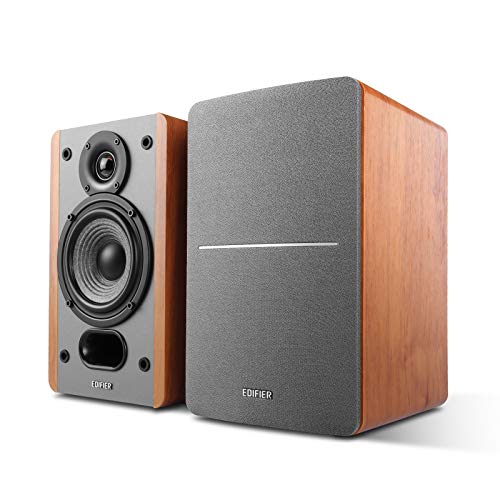
Edifier P12 Passive Bookshelf Speakers — The wall-mount pragmatist
The P12 is the pick for the room the other five cannot solve: the one with no shelf, no stand space, and no desk depth to spare. Edifier builds a wall-mount bracket into this passive two-way pair — the listing says “Needs Amplifier” in its own title, a honesty this guide appreciates and repeats: an amplifier or receiver is required — and that bracket turns kitchens, workshops, bedrooms, and surround positions into viable speaker locations. The sound brief is honest value: a 5.25-inch-class two-way design with a wood-finish enclosure that looks composed on a wall, delivering clear, balanced playback for music and television at the volumes those rooms ask for.
Wall mounting has acoustic consequences the pick text should own. A speaker on a wall gains bass support from the boundary — welcome fullness at low volume, a risk of bloom at high volume — and loses the placement adjustability that stands provide, so the bracket’s position deserves measuring before drilling: ear height at the listening position, symmetric around it, and angled where the bracket allows. Get that right and the P12 disappears into the room’s life in a way stand-mounted speakers never do, which for its buyers is not a compromise but the entire point.
Against the guide’s stars, the P12 concedes refinement: the ELAC’s balance, the Q Acoustics’ polish, and the Sony’s reach are all a class up, and critical listeners in dedicated rooms should buy accordingly. The P12’s kingdom is everywhere else — the rooms where the alternative to a wall-mounted pair is a television’s own speakers or a Bluetooth box on the counter. In those rooms it is not the budget pick; it is the correct one, and its maker’s decision to print its amplifier requirement in the product’s name deserves the final word of respect this guide can give a listing: it tells you the truth before you pay.
- Design: Passive two-way with built-in wall-mount bracket
- Amplification: Passive — needs an amplifier; the listing’s own title says so
- Placement: Wall-first; boundary bass support is part of the sound
- Finish: Wood-tone enclosure composed for visible mounting
- Sold as: Pair
Strengths
- Solves rooms with no shelf or stand space at all.
- Built-in bracket — no accessory hunt before installation.
- Listing honesty about its amplifier requirement, in the title itself.
Trade-offs
- Refinement trails the guide’s top picks — it is a pragmatist, not a star.
- Wall placement is a one-time decision; adjustability is limited.
- Boundary bass can bloom at high volumes if mounted carelessly.
Best for: Kitchens, workshops, bedrooms, and wall-only rooms. Not suited for: Dedicated listening rooms chasing the last degree of polish.
How Do the Six Pairs Compare?
| Speaker | Woofer | Design | Label to know | Best setting |
|---|---|---|---|---|
| ELAC Debut 2.0 B5.2 | 5.25″ | 2-way, front port | True headline size | Stands in small–medium rooms |
| Sony SSCS5 | 5-1/4″ | 3-way, super tweeter | True headline size | Stands, lively rooms |
| NEUMI BS5 | 5″ | 2-way | Renewed listing | Bedrooms, first systems |
| Q Acoustics 3020c | 4.75″ | 2-way | Current model (not 3020i); under headline size | Studies, refined small rooms |
| Micca RB42 | 4″ | 2-way, silk dome | Compact class | Desks, nearfield |
| Edifier P12 | 5.25″ class | 2-way, wall bracket | Needs amplifier (per its own title) | Wall-mounted rooms |
The label column is this guide’s conscience in one view: one Renewed listing, one current-generation name with a smaller driver, one compact specialist, and three true-size pairs with three different characters. Nothing in the table is hidden, which is exactly the standard to hold any listing to before money moves. Read the woofer column with the same skepticism you would bring to any headline size: marketing rounds generously, model names encode history rather than dimensions, and the only trustworthy diameter is the one in the maker’s own specification — which is why this guide checked each pick against its listing rather than against its reputation.
How Do You Choose an Amplifier for Passive Bookshelf Speakers?
Since every pick needs one, the amplifier is this guide’s invisible seventh pick, and it should be chosen by load and by life rather than by wattage headlines. For load: most pairs here are friendly to modest amplification, with two cautions — the RB42’s appetite is larger than its size, and the Sony’s brightness will report an amplifier’s treble character faithfully. A compact stereo amplifier of honest rating, or any AV receiver’s front channels, will drive the class well; what matters more than the number is that the amplifier’s rating be measured honestly by its maker, which established brands’ figures generally are. For life: count your sources before choosing. A turntable needs a phono stage somewhere; a television wants an optical or HDMI input; streaming wants a DAC or a network feature — and the amplifier that gathers your actual sources into one volume knob is worth more than a stronger amplifier that leaves you juggling.
Budget proportion is the last discipline. In this class, the speakers should usually carry the larger share of a system’s budget, with the amplifier a solid second and cables a rounding error — the reverse pyramid, amplifier-rich and speaker-poor, is the classic beginner’s allocation error, and it is audible. Buy the pair you will keep for a decade, an amplifier that serves your sources honestly, and let the upgrade itch, when it comes, spend itself on placement, a subwoofer, or room treatment before it spends itself on electronics. One more allocation deserves a line because it is so often missed: if your sources include a turntable or a television, the phono stage or the digital input that serves them belongs in the first budget, not in a later rescue — a system is only as usable as its least convenient source, and the amplifier section above is where that convenience is bought.
Where Should Bookshelf Speakers Actually Sit?
The category’s name is a trap: bookshelves are among the worst places for these speakers, enclosing them in cavities that boom and placing them at heights that aim the tweeters at the ceiling. Stands at ear height, a little distance from the wall behind them, angled toward the listening seat — that is the reference geometry, and every pick here rewards approaching it. The exceptions are designed-in: the ELAC’s front port forgives the wall, the P12 is built for the wall and gains its bass there deliberately, and the RB42 is voiced for the desk’s nearfield where the geometry compresses. Desks ask for two mercies — raise the tweeters to ear level with small stands or angled pads, and pull the speakers forward of the monitor’s shadow — and repay both with imaging that makes the category’s name forgivable. Toe-in deserves a sentence of its own: start with the pair angled so their axes cross just behind your head, then adjust by degrees across several evenings, because the right amount is the amount that locks the center image for your room’s reflections, and no two rooms in this guide’s audience will agree on the number.
Subwoofers enter this conversation as an option, not an obligation. In small rooms with the true 5.25-inch picks, much music is complete without one; films, electronic music, and larger rooms make the case, and the correct integration — crossover where the mains fade, level set against voices — matters more than the sub’s size. Add it when the content asks, not when the catalog suggests. When you do add one, place it with the same seriousness as the speakers: a corner will maximize its output and its boom in equal measure, a position along the front wall near the speakers usually integrates most cleanly, and the final level should be set so that a familiar voice recording sounds unchanged except for a new sense of floor beneath it. A subwoofer you can locate with your ears during music is a subwoofer set too high or crossed too eagerly — the correct setting is the one you notice only when it is switched off.
What Mistakes Do Bookshelf Buyers Make?
Forgetting the amplifier is the champion — passive speakers bought as if they were powered, a silence this guide’s repetition exists to prevent. Second is the bookshelf itself: enclosures entombed in furniture, tweeters at ceiling height. Third is chasing the discontinued name — paying a premium for the 3020i’s ghost when the 3020c is the living, better-supported speaker. Fourth is ignoring a Renewed label’s terms, or worse, buying the BS5’s powered sibling by mistake and wondering why this guide’s amplifier advice makes no sense. Fifth is amplifier mismatch — the weakest desktop amp on the RB42, a bright amp on the Sony in a bright room. Sixth is judging any of these pairs in the first ten minutes at showroom volume; bookshelf speakers reveal themselves across evenings, and the balanced ones win the month after losing the minute.
How Should You Audition a Pair Before Committing?
Bookshelf speakers are bought by description more often than by ear, which makes the home audition — the return window, used deliberately — the most important evaluation tool in this guide. Run the same three recordings through any pair you are deciding between, at the same volume, in your room, on your amplifier. Choose one recording for voices — a singer you know intimately, or a podcast whose speaker’s tone you could identify blindfolded — because midrange honesty is the class’s dividing line and voices expose it in seconds. Choose one for scale: a full ensemble, orchestral or otherwise, that should arrange itself in a stable space between and behind the speakers rather than collapsing into two boxes. Choose one for bass discipline: a track with real low content that should sound pitched and tuneful, not like a single resonant note wearing different costumes.
Then listen for the negatives that predict long-term fatigue, because they matter more than the positives that predict a good first impression. Treble that calls attention to itself on the voice recording will be exhausting by month two — the Sony’s fans love its air precisely where its critics find this edge, and only your ears in your room can settle which listener you are. Bass that blooms on the third recording at your actual placement is a placement problem first and a speaker problem second; pull the pair into the room, retest, and only then judge. And judge at the volume you actually live at: several picks here — the ELAC most famously — are balanced for real listening levels, while showroom tuning rewards a volume your evenings will never use. The pair that wins your room at your volume on your music is the right pair, whatever any ranking, including this one, says in the abstract. Keep notes during the audition, however brief — a line per recording per pair — because auditory memory is the most suggestible faculty you own, and the difference between two good pairs is exactly the size that memory loves to invent after the fact.
What Do Stands, Pads, and Small Treatments Actually Buy?
Less glamorous than any speaker in this guide and worth more than the price gaps between several of them: the physical layer. Stands do three things — they put tweeters at ear height, they free the enclosure from furniture resonances, and they let you place the pair at the geometry the room wants rather than the geometry the shelf allows. Foam or rubber isolation pads do a smaller version of the second job on desks and shelves, decoupling the box from a surface that would otherwise sing along. Neither is optional garnish for the true-size picks; the ELAC and the Sony on proper stands are audibly different speakers from the same pair on a bookcase, and the difference is not subtle.
Room treatment, in its domestic form, is mostly soft furnishings placed with intent: a rug between speakers and seat, curtains on the reflective wall, a sofa that absorbs rather than a leather one that mirrors. Bright speakers in hard rooms — the Sony in a glass-and-tile space — are the pairing this section exists to warn against, and the fix is furnishings before electronics. Spend in order: placement first, stands second, softening third, and only then consider whether the speakers themselves are the limitation. In most rooms they are not, which is the best news in this entire guide — the largest available improvement is usually already in your house, waiting to be rearranged. One caution keeps the section honest: treatment follows diagnosis. A room that already sounds warm will not thank you for more absorption, and a desk setup in a small furnished bedroom may need nothing at all beyond the pads — measure the problem with your ears and your three audition recordings before spending on its cure.
How Do These Pairs Handle Television and Film Duty?
Many of these pairs will spend half their lives under a television, and the passive bookshelf route to TV sound deserves its due: through an amplifier or receiver with an optical or HDMI input, a good pair delivers dialogue clarity and musical scores that soundbars in the same total budget rarely match, at the cost of the center channel’s dedicated anchor. Voices will image from the phantom center between the pair — convincing from the main seat, less so from the room’s edges — and listeners who watch mostly dialogue from a wide sofa should weigh a receiver-based 3.0 or 5.1 growth path, which several of these families support with matching centers. For the single-seat and small-room majority, a pair alone is a legitimate end state, not a compromise on the way somewhere else.
Volume manners matter here too. Television mixes swing between whispered dialogue and explosive advertisement breaks more violently than music does, and an amplifier with a night or dynamic-range mode earns its keep in apartments. The balanced picks — ELAC, NEUMI, Q Acoustics — keep whispers intelligible without heroic volume, which is the practical test to run during the home audition: a dialogue scene at evening volume, remote untouched, subtitles off. The pair that passes it will be forgiven almost anything else. Games deserve their sentence as well: a passive pair on a desk or flanking a television delivers positional cues in stereo with a physicality that headphone virtualization imitates, and for players who share the room or hate headsets, the bookshelf route is the speaker-first answer — with the RB42’s nearfield focus making it the natural gamer’s pick of this six.
How Long Will a Passive Pair Last, and What Ages First?
Passive speakers are the closest thing audio has to furniture: no firmware, no batteries, no servers to be switched off by a distant company. A pair from this guide, kept from direct sun and driven within its limits, will serve through several amplifiers and several rooms. What ages is predictable — foam surrounds on some designs soften over decades, capacitors in crossovers drift on similar timescales, and finishes fade where light falls — all of it serviceable or ignorable in a way that a dead amplifier inside a powered speaker is not. This longevity is the passive architecture’s quiet financial argument: the amplifier, the part with the shortest technological half-life, is the part you can replace alone, and the speakers — the part you chose by ear — stay.
Care is correspondingly simple. Dust with something soft, keep grilles on where children and pets vote with their fingers, and never drive a small speaker into audible distortion chasing volume — distortion is the sound of a driver asking for mercy, and the RB42’s small woofer will ask sooner than the true-size picks. If a pair ever sounds different from its twin — quieter, duller, distorted — check the wiring and the amplifier channel before condemning the speaker; in passive systems the speaker is statistically the last component to fail, which is one more reason this guide is comfortable recommending a Renewed pair among its picks: the design’s durability is the collateral. Store the packaging if you can, too — speakers move house more often than their owners predict, and the original box is the difference between a pair that travels safely and a pair that arrives with a dented tweeter and a story.
There is a seventh mistake, made quietly in bedrooms and studies everywhere: mounting or shelving the pair asymmetrically — one speaker in a corner, one in open space, one at ear height and one atop a wardrobe — because the furniture decreed it, and then judging the speakers for an image that wanders. Symmetry is not pedantry; the stereo image is built from matched arrivals, and a lopsided room will defeat the best pair in this guide. Where the furniture truly cannot move, a balance control and lowered expectations are the honest remedies, in that order.
What Does the Whole System Cost, Honestly Counted?
Plan the budget as a system and the class makes sense; plan it as a speaker price and it ambushes. The pair is the largest single item but never the only one: an amplifier of honest rating, speaker wire, and — for the stand-mounted picks — stands themselves form the rest of the honest total, with isolation pads and a subwoofer as the optional second wave. In proportional terms, a sensible first system in this class often lands with the speakers at roughly half the total, the amplifier at a third, and the physical layer making up the remainder. The Renewed BS5 shifts that arithmetic in the buyer’s favor, which is its real value argument: the money it saves buys the better amplifier or the stands that a new pair at the same speaker price would have crowded out.
Resist two false economies. The first is the amplifier bought purely on price with no regard for the pair’s appetite — the RB42 on the weakest amp in the catalog is the canonical false saving, producing a system whose speakers are blamed for their partner’s limits. The second is cable extravagance in a class where ordinary copper wire of sensible gauge is measurably sufficient; the money belongs in the room and the stands. Counted honestly and allocated in that order, a system from this guide is one of the most durable purchases in home audio — speakers for a decade, an amplifier for most of it, and evenings that repay both long after the receipts are forgotten. Keep the receipts anyway, and the Renewed listing’s terms with them; paperwork is the least musical part of the hobby and the part that rescues it when anything, however unlikely, goes wrong in the first year of ownership, which is precisely when paperwork matters most and is thought about least by buyers everywhere, in every category of considered purchase, from speakers to sofas to everything in between them, without a single exception worth naming here, in this guide, at this length.
Final Recommendation
Buy the ELAC B5.2 if you want the class’s reference balance and a pair that will anchor a system for a decade; buy the Sony SSCS5 if your ears love light and air and your room can take the sparkle. Take the NEUMI BS5 (Renewed) when value rules and you will buy its condition with open eyes, the Q Acoustics 3020c when finish and polish are part of the music, the Micca RB42 when the desk is the room, and the Edifier P12 when the wall is the only shelf you have. In every case, budget the amplifier as a partner rather than an afterthought — because a passive speaker’s sound is always a duet, and the pairs above deserve partners chosen with the same care as the speakers themselves.
Frequently Asked Questions
Do these speakers need an amplifier?
Yes — all six picks are passive. None contains an amplifier, and each needs a stereo amplifier, compact desktop amp, or AV receiver between the source and the speakers. The Edifier P12’s listing states the requirement in its own title; this guide states it for all six.
Is the NEUMI BS5 in this guide new or renewed?
Renewed. The passive BS5’s factory-new listing has left the market, and the verified listing is a Renewed one. It is labeled Renewed in the pick headline, the spec box, and the comparison table — read the listing’s condition terms and inspect the pair on arrival.
Is the Q Acoustics 3020c the same as the 3020i?
No. The 3020c is the current generation that succeeds the 3020i, whose listing has ended. This guide reviews and links the 3020c, calls it by its correct name, and notes its 4.75-inch bass driver — slightly under the 5.25-inch headline size.
Which pick is best for a desk?
The Micca RB42, designed for nearfield distances and small footprints — with the caveat that its 4-inch woofer makes it a compact-class speaker and it wants an amplifier with real substance. The ELAC B5.2 is the desk answer when space allows a true 5.25-inch pair.
Do I need a subwoofer with 5.25-inch bookshelf speakers?
Not for most music in small rooms — the true-size picks reproduce satisfying midbass on their own. Films, electronic music, and larger rooms justify one; integrate it with a crossover where the speakers fade and a level set against dialogue.
How much amplifier power do these speakers need?
Less than the marketing suggests, with one exception. Most pairs here are efficient enough for modest stereo amplifiers at real listening volumes; the Micca RB42 is the exception whose small woofer works hard and deserves an amplifier of genuine substance. Judge amplifiers by honest ratings from established makers rather than by headline numbers, and remember that placement and room size move the requirement more than the speaker choice does.
Can these speakers be used as surrounds in a home theater?
Yes — passive bookshelf pairs serve as fronts or surrounds with an AV receiver, and the P12’s wall bracket suits surround positions particularly well. Keep the front three channels from one family where possible so voices pan consistently.
Related Guides
Building the rest of the system? See our guides to the best 5.1 speakers overall, the best 5-inch studio monitors, and 5.1 home theater speakers without a receiver.


