What's inside
- Key Takeaways
- Quick Picks
- What Can This Budget Honestly Buy?
- How Do You Test a Budget Speaker on Day One?
- Where Should Budget Speakers Sit, and How Loud Should They Play?
- What Does the Frame Mean for Calls, Classes and Remote Work?
- How Should You Choose Between the Territories in This Guide?
- What About Using a Phone or a Bluetooth Adapter Instead?
- How Do You Make a Budget Pair Last Longer?
- Which Desks Benefit Most From This Class?
- How Does Stereo Separation Work at This Scale?
- What Should a Gift Buyer in This Frame Know?
- When Should You Skip This Class Entirely and Save?
- How Do You Set the Computer Itself Up for Cheap Speakers?
- Comparison Table
- What Are the Most Common Mistakes at This End of the Market?
- Final Recommendation
- Frequently Asked Questions
- Related Guides
As an Amazon Associate I earn from qualifying purchases. This post may contain affiliate links at no extra cost to you.
gizmoverdict.com is reader-supported. When you buy through links on our site, we may earn an affiliate commission.
Where to buy: A pair of picks below link to listings verified through this site’s product pool, and both are labelled with their honest relationship to this guide’s budget frame — one sits nearest to it, the other sits above it and is worth knowing about anyway. The remaining four picks are classes of speaker covered in prose only, because at this end of the market individual listings churn too fast for verification to mean anything.
The best $20 computer speakers — with the budget figure understood as the frame of the search, not as a promise printed on any box — live in the most honest corner of the audio market, because at this level nothing can be hidden. There is no money for exotic materials, clever processing or generous cabinets. What the frame buys is a pair of small powered speakers, usually fed by USB, whose job is to be clearly better than the speakers built into a laptop or a monitor. Judged by that job, some succeed surprisingly well. Judged by the standards of systems costing several times more, all of them fail, and a guide that pretends otherwise would be selling its readers a fantasy.
So this guide is written as a field manual for a small budget. It names the one verified listing that lands nearest the frame — a USB-powered pair from a maker that specialises in exactly this class — and the one verified listing that sits above the frame, labelled as such, for buyers who can stretch and want the stretch to count. It then covers, in prose, the four territories where the true budget class actually lives: a retailer’s own-label USB pair, the no-name USB soundbar sticks that flood marketplaces, an older big-brand USB design that still circulates, and the refurbished and open-box route by which better speakers sometimes fall into this frame. Each territory gets its trade-offs stated in plain language: plastic, distortion ceilings, and longevity are the currencies here.
Set expectations before the table and the category becomes almost enjoyable. Voices will be clearer than a laptop’s. Video will be watchable with company. Bass will be suggested rather than delivered, because physics charges more than this frame for real low end. Volume will fill a desk and a small room, not a party. A buyer who accepts that contract in advance will be pleased with what arrives; a buyer who expects a miniature hi-fi will be disappointed by every product in the class, including the good ones — and the good ones deserve a fairer hearing than that.
Key Takeaways
- The budget figure in this keyword is a frame for the search, not a price tag: no product prices are printed in this guide, and each pick is labelled by its position relative to the frame.
- The Creative Pebble is the verified listing nearest the frame — a USB-powered 2.0 pair that has become the class benchmark.
- The Logitech Z207 sits above the frame; it is included, labelled as over-frame, because its Bluetooth and build make the stretch rational for some buyers.
- True in-frame shopping is mostly prose territory: own-label USB pairs, no-name soundbar sticks, an older Logitech USB design, and refurbished stock.
- The class trade-offs are consistent everywhere: plastic cabinets, a low distortion ceiling, and lifespans measured in school terms rather than decades.
- At this level, the returns policy is a product feature — buy where returning is painless and test on day one.
Quick Picks
| Pick | Badge | Why it is here |
|---|---|---|
| Creative Pebble | Nearest the frame — verified | The class benchmark: USB-powered, angled for a desk, and voiced for clarity rather than spectacle. |
| Logitech Z207 | Above the frame — labelled | A step up in build with Bluetooth on board, for buyers who decide the stretch is worth it. |
| Amazon Basics-style USB speaker pair | Prose only — own-label class | The retail own-label route: basic, tidy, and bought for adequacy rather than character. |
| No-name USB soundbar sticks | Prose only — marketplace class | The single-bar USB speakers that promise everything; covered with their real compromises named. |
| Logitech S150-class USB speakers | Prose only — legacy design | The older big-brand USB pair still circulating in offices and classrooms everywhere. |
| Refurbished and open-box name-brand pairs | Prose only — the patient route | Better speakers that occasionally fall into the frame when condition, not quality, sets the cost. |
What Can This Budget Honestly Buy?
Begin with the physics, because the physics is the budget. A speaker moves air; moving more air, lower, costs cabinet volume, driver quality and amplifier power, and none of those are available here. What is available is efficiency at close range. A desk listener sits about a metre from the speakers, and at that distance even a modest powered pair produces comfortable volume and genuine clarity. The entire class is engineered around that metre: small drivers angled up at the listener, USB power drawn from the computer itself, and tuning that prioritises the midrange where voices live over the extremes where music shows off.
The honest deliverables follow. Speech — calls, lectures, podcasts, tutorials — improves dramatically over laptop speakers, because the drivers are bigger, separated into stereo, and pointed at a person. Video becomes sociable: two people can watch a screen without leaning in. Music becomes pleasant background and respectable foreground at modest volume, with the understanding that basslines are outlined rather than embodied. Games gain direction and atmosphere, though not impact. What the frame cannot buy is headroom: push any of these speakers toward their ceiling and distortion arrives as the tax, which is why the wisest owners in this class listen at the level the speakers enjoy rather than the level the dial allows.
Longevity is the third honest item. At this level, components are chosen for cost, and the realistic lifespan is a few years of daily service — a school career, a first job, a spare room’s working life — rather than the decade-plus of the flagship classes. That is not a scandal; it is the frame working as intended, converting a small sum into a few years of clearly better sound. The buying skill is to spend the frame where it lasts longest: on a design from a maker with something to lose, through a channel with a painless return, tested thoroughly on the day it arrives.
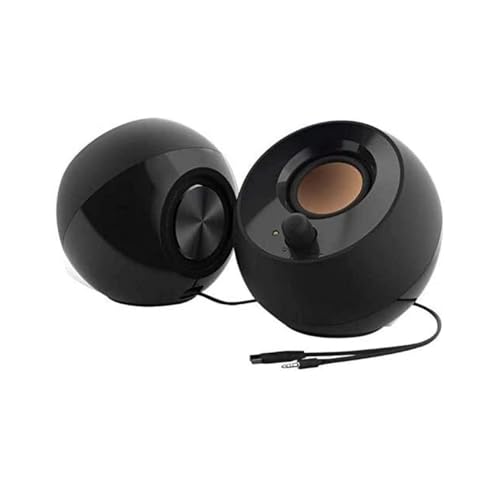
Creative Pebble — Nearest the frame — verified
The Pebble is the product this class is measured by, and its verified listing title describes it without flourish: a 2.0 USB desktop stereo pair for PC and laptop. Creative’s design insight was to take the budget’s constraints and style them — spherical cabinets angled upward at forty-five degrees, so the small drivers aim at the listener’s ears instead of at the desk surface, and a single USB connection carrying both power and, in its digital form, the audio itself. The result is the rare budget speaker that looks deliberate on a desk rather than apologetic, and that sounds clearer than its size has any right to because its drivers are pointed where they should be.
Listening bears out the design. Voices are the Pebble’s home ground: calls, lectures and podcasts come through with a clarity that embarrasses laptop speakers costing far more as computers. Music is tidy and balanced at desk volumes, with the expected absence of deep bass handled gracefully — the pair does not strain after notes it cannot reach, which is the mature behaviour cheap speakers rarely manage. A volume knob on the front of one cabinet handles the daily adjustment, and the whole setup is one cable, which in classrooms, hot-desks and spare rooms is a virtue that outweighs specifications.
Its position in this guide needs its label repeated: of the verified listings available, the Pebble sits nearest the budget frame that defines this search. Prices move and listings change, so the guide prints no figure — but as a class position, this is the benchmark purchase, the one a buyer should have a reason to deviate from. The reasons to deviate are real: no Bluetooth, no pretence of bass, a ceiling that a party would find in minutes. Within the frame’s honest contract, though, the Pebble is the fullest expression of what the money can do, and it has held that standing across many buying seasons because the design wastes nothing.
Owners’ experience adds a footnote that specifications cannot: the Pebble’s shape makes it the budget speaker people keep when they upgrade everything else. It migrates from main desk to spare desk to child’s desk, still doing its one-cable trick, still sounding clearer than whatever it replaces. Longevity in this class is usually discussed as a weakness, yet the benchmark’s design — no battery, no app, no fragile extras — gives it a working life that embarrasses flashier rivals. That afterlife is part of what the frame buys here, and it rarely appears in a comparison table.
- Format: 2.0 USB-powered desktop pair
- Position: nearest the budget frame among verified listings in this guide
- Design: angled spherical cabinets aimed at the listener
- Connection: USB for power and audio, one-cable setup
- Controls: volume knob on the cabinet
Strengths
- The clearest speech reproduction in this guide’s price territory.
- One-cable USB life suits classrooms, hot-desks and laptops perfectly.
- Angled drivers deliver a proper stereo image at a metre’s distance.
Trade-offs
- Deep bass is absent by physics, not by tuning failure.
- Maximum volume is desk-scale; distortion waits at the top of the dial.
- No wireless input — the computer is the source, by cable.
Best for: the buyer who wants the frame spent once, on the class benchmark. Not suited for: listeners who need Bluetooth, bass weight, or room-filling volume.

Logitech Z207 — Above the frame — labelled
The Z207’s badge in this guide is its most important feature, so it leads: this pair sits above the budget frame. It is included because a meaningful number of shoppers in this search can stretch, and because what the stretch buys here is unusually concrete. The verified listing title describes stereo computer speakers with Bluetooth and a ten-watt peak figure, and the product behind it is a tidier, better-built pair than the in-frame class, from a maker whose support network is a known quantity. A guide that hid the over-frame option would be protecting a keyword rather than serving a reader.
What the extra money visibly buys is construction and connection. The cabinets feel denser, the finish survives desk life better, and Bluetooth joins the wired input — which changes the pair’s daily role, because a phone can play through them without a cable while the computer stays connected. The sound follows the build: still a 2.0 pair with the format’s bass limits, but cleaner at the top of its range and calmer at the bottom of it, with speech clarity that serves a working desk all day. For a buyer whose desk is also their phone’s speaker, that dual citizenship can justify leaving the frame behind entirely.
The discipline is to make the stretch a decision rather than a drift. If the frame is a hard ceiling — a classroom set, a gift with a firm limit, a spare room’s allowance — the Pebble and the prose classes below serve it honestly, and the Z207 is simply not your product. If the ceiling is soft and the pair will be used daily for years, the over-frame route buys build and Bluetooth that the frame cannot. Either answer is respectable; the guide’s only insistence is that the label stay attached, so the choice is made with open eyes.
A further thought for the stretch decision: Bluetooth changes who the speakers belong to. A wired budget pair serves the computer; the Z207 serves the household member whose phone is in hand, which in practice means it gets used more hours per day by more people. Cost-per-hour is the honest arithmetic of audio purchases, and a pair used by a whole household across a working day can justify its over-frame position faster than a technically better pair used by one person for an hour. Count the listeners before counting the pair out of the frame.
- Format: 2.0 stereo pair, no subwoofer
- Position: above the budget frame — labelled at every appearance
- Wireless: Bluetooth, per the verified listing title
- Power note: 10W peak figure as stated in the verified listing title
- Inputs: Bluetooth plus wired connection
Strengths
- Bluetooth makes it a speaker for the phone as well as the computer.
- Build quality a visible step beyond the in-frame class.
- Calm, clear nearfield sound for all-day working listening.
Trade-offs
- It breaks the frame — buyers with a hard ceiling should look below.
- Still a 2.0 pair: the bass foundation of larger systems is absent.
- Its value case depends on daily use over years, not on a single term.
Best for: soft-ceiling buyers who will use Bluetooth and keep the pair for years. Not suited for: hard-ceiling budgets or anyone expecting subwoofer weight.
Amazon Basics-style USB speaker pair — Prose only — own-label class
Every large retailer fields an own-label USB speaker pair in this territory, and the class deserves a fair description rather than a sneer. These are simple powered pairs — small cabinets, USB power, a volume control, a design language of tidy anonymity — sold under the retailer’s own brand with the retailer’s returns machinery behind them. No individual listing is verified in this guide’s pool, and own-label line-ups change names and suppliers without ceremony, so the class is covered in prose as a route rather than as a product.
The honest assessment is adequacy with excellent logistics. Sound is a clear step over laptop speakers, thinner and less composed than the Pebble’s, with cabinets that announce their plastic honestly. What the class offers instead is frictionlessness: it is there when the basket is already open, it arrives with everything else, and if it disappoints or fails early, the return is a shrug rather than a project. For a homework desk, a reception computer, a grandparent’s video-call setup — places where sound must simply work — that combination is a legitimate purchase. For a main desk used daily for years, the class benchmark above spends the same frame with more to show for it.
There is a classroom logic to the own-label class worth acknowledging. A teacher or an office manager equipping ten desks does not need ten benchmarks; they need ten adequate, identical, replaceable pairs with one returns process. Own-label speakers are the fleet purchase of this category, and judged as fleet equipment — where a failure is a swap, not a sorrow — their compromises make complete sense. The guide’s caution applies to the single main-desk buyer, for whom the calculus reverses: one desk, used daily, deserves the frame’s best single answer rather than its most replaceable one.
- Format: 2.0 USB-powered pair, retailer own-label
- Status: class coverage in prose — no individual listing verified
- Character: adequate sound, exemplary returns logistics
- Build: lightweight plastic cabinets
- Buying route: the retailer’s own channel, tested on arrival
Strengths
- The easiest purchase in the guide — available wherever the basket already is.
- Returns and replacement are as painless as retail gets.
- Perfectly adequate speech clarity for calls and lessons.
Trade-offs
- Sound is a step below the class benchmark in body and composure.
- Own-label models change silently; reviews may describe a different unit.
- Longevity is the class’s known weakness — buy the returns policy as much as the speaker.
Best for: secondary desks and quick, low-stakes upgrades. Not suited for: a main desk expected to serve daily for many years.
No-name USB soundbar sticks — Prose only — marketplace class
The marketplace end of this frame is dominated by a distinctive shape: the single USB soundbar stick, a horizontal bar that sits under a monitor, glowing gently, promising stereo, bass and cinematic immersion in one slim package. The promises deserve translation. A single bar cannot produce real stereo separation at a metre’s distance, its bass is a small driver in a small tube doing its best, and the immersion is a volume increase over laptop speakers — which, to be fair, is real. These products are covered in prose because their listings are legion, identical-looking and mutually inconsistent; no single one was verified in this guide’s pool, and naming one would be a lottery recommendation.
Bought with clear eyes, a stick can suit a specific desk: the monitor-footprint setup with no room for separated speakers, the tidy-minded user who values one object over two, the buyer who treats the purchase as disposable. The class’s hazards are consistent — idle hiss on some units, lights that cannot be switched off, controls that live on a cable or nowhere, and build quality that varies between two examples of the same listing. The defences are equally consistent: buy where returns are painless, test at your actual listening level on day one, listen for hiss in silence, and walk away from any example that fails. The frame is small; the lesson it teaches about marketplace audio is worth more than the product.
The stick’s lighting deserves its own honest sentence, because it is the feature that sells the class and the feature owners most often regret. A glow that cannot be dimmed or extinguished is charming in a product photograph and wearing in a dark room at midnight, particularly when the bar sits directly beneath a screen used for films. Before buying any example of this class, confirm the light can be controlled; if the listing does not say, assume it cannot. Small certainties like that, checked in advance, are the difference between the marketplace class serving a desk and haunting it.
- Format: single-bar USB speaker, monitor-footprint design
- Status: class coverage in prose — no individual listing verified
- Character: one-object convenience, stereo in name more than in effect
- Common features: lighting, cable controls, optimistic descriptions
- Buying route: only with painless returns, tested immediately
Strengths
- Fits desks where two separated speakers genuinely cannot go.
- One object, one cable — the tidiest setup in the guide.
- Still a real improvement over laptop speakers for speech.
Trade-offs
- Stereo imaging is minimal; the bar shape cannot cheat distance.
- Hiss, fixed lighting and variable build are class habits.
- Two units from one listing can behave like distant cousins.
Best for: footprint-critical desks bought with returns protection. Not suited for: music lovers, the hiss-sensitive, or anyone expecting stereo.
Logitech S150-class USB speakers — Prose only — legacy design
Some designs become furniture of the working world, and Logitech’s S150 class — a slim USB-powered pair sold for years into offices, schools and call desks — is one of them. The concept is minimal: digital USB audio, small upright cabinets, a volume control and a mute, nothing else. Examples still circulate through office suppliers, surplus channels and the backs of supply cupboards, which is why the class earns a prose place in a budget guide: at this frame, the second life of a proven design is a real shopping territory. No current listing was verified in this guide’s pool, so the coverage is of the class and its buying logic, not of a clickable product.
The virtues are the virtues of maturity. The sound is speech-first and entirely adequate for the calls and training videos these speakers were bought for; the USB connection sidesteps noisy headphone sockets on ageing computers; the controls are obvious to any user who sits down at the desk. The cautions are age and condition: a hard-lived office pair may carry a crackling control or a tired cable, and the class’s slim cabinets were never built for music’s lower half. Sourced clean — ideally new-old stock or a lightly used pair from a known office — the S150 class remains a rational way to spend a small frame on a working desk. Sourced blind, it is a small gamble, priced accordingly.
The legacy class also teaches a useful reading skill: distinguishing a design’s age from a unit’s condition. The S150-class design is old in the way a good hand tool is old — settled, understood, unchanged because it works. A specific unit, though, may be young in storage or old in abuse, and the two judgements are independent. Buyers who learn to hold both ideas at once shop the second-hand territories of every category better, speakers included: respect the design, inspect the unit, and let neither judgement substitute for the other.
- Format: 2.0 USB-powered pair, legacy big-brand design
- Status: class coverage in prose — no current listing verified
- Character: speech-first, office-bred, minimal controls
- Availability: office suppliers, surplus and second-hand channels
- Buying route: clean examples only, controls tested
Strengths
- A proven design with no surprises left in it.
- USB audio bypasses the noisy outputs of older computers.
- Controls a stranger can operate without instructions.
Trade-offs
- Age and condition vary; the class is bought by inspection.
- Music’s lower registers were never part of the design brief.
- Availability is a hunt rather than a click.
Best for: office-style desks and buyers comfortable inspecting a legacy product. Not suited for: music-first listeners or anyone who wants a current listing.
Refurbished and open-box name-brand pairs — Prose only — the patient route
The final territory in this frame is not a product but a method: watching the refurbished and open-box channels of reputable retailers until a name-brand pair — a returned Pebble-class speaker, a previous season’s big-brand set, a cosmetically marked unit with full function — falls into the budget. It is covered in prose because its inventory is weather, not stock: nothing can be verified in advance, and any guide claiming a specific refurbished deal today would be inventing it. What can be taught is the method, and the method is sound.
The logic is that condition, not quality, is what the discount buys. A speaker returned because a buyer changed their mind, or carrying a scuffed cabinet, sounds exactly like its new self; the frame simply has to be in the right channel when such a unit surfaces. The disciplines are patience and hygiene: buy only where the refurbishment is described and the return is real, test everything on arrival as the Renewed routine elsewhere in this batch teaches, and refuse the false bargains — the too-cheap flagship, the listing with no condition description — that give the route a bad name. For a buyer with time, this is how the frame occasionally buys a class above itself. For a buyer with a deadline, the Pebble is waiting, and there is no shame in certainty.
Timing is the patient route’s open secret. Refurbished inventory swells after gift seasons, after new model launches push returns and trade-ins through the system, and during retailer clearance events — which means the buyer with a calendar gains an edge the buyer with a deadline cannot. Set a watch on the channels, know the exact models you would accept (the benchmark in this guide is the obvious target), and let the frame wait for its moment. Patience is the only currency this territory accepts, and it pays in a better class of speaker.
- Format: varies — name-brand pairs in refurbished or open-box condition
- Status: method coverage in prose — inventory cannot be verified in advance
- Character: quality set by the original product, cost set by condition
- Channels: retailer refurbished programmes and open-box sections
- Buying route: described condition and real returns only
Strengths
- The only route by which this frame sometimes buys a class above itself.
- Condition-based discounts do not reduce sound quality.
- Reputable programmes test function before reselling.
Trade-offs
- Availability is luck and timing; deadlines defeat the method.
- Cosmetic marks and missing accessories are part of the territory.
- Undescribed-condition listings are the route’s trap — avoid them entirely.
Best for: patient buyers with flexible timing and a good returns channel. Not suited for: gifts with a date, or anyone who needs the speakers this week.
How Do You Test a Budget Speaker on Day One?
Budget speakers deserve a stricter first day than expensive ones, because the returns window is the warranty that matters. Start with silence: with nothing playing and the volume at your normal level, listen for hiss, hum or crackle — a quiet speaker at idle is the class’s first quality signal. Then play speech at low volume and check that both cabinets match and stay clear. Then a familiar song at your real listening level, and a short push toward the top of the dial to learn where distortion begins — not to live there, but to know the ceiling. Finally, wiggle every cable gently; a connection that crackles when touched is a return, not a quirk.
Run the same five minutes on any speaker in this guide, linked or prose, and the class’s variability stops being a threat: good examples announce themselves, bad examples identify themselves while returning them is still a shrug. The habit costs nothing and converts the budget market’s biggest weakness — inconsistency — into a filter the buyer controls. Keep the packaging until the week is out, and the experiment is fully reversible.
Where Should Budget Speakers Sit, and How Loud Should They Play?
Placement is the budget buyer’s free upgrade, because small speakers are punished by bad positions more than large ones. Raise the pair so the drivers aim at your ears — books, stands, a monitor shelf — and separate them as widely as the desk allows, because stereo at this level lives or dies on separation. Keep them out of desk corners and away from walls where possible; small cabinets placed against hard surfaces gain a boomy, boxed colouration that their tuning never intended. Angle them inward slightly toward the chair, and the image snaps into focus in a way that surprises first-time owners.
Volume discipline is the second free upgrade. Every speaker in this guide has a level where it is happy — clear, composed, easy — and a level above which it is merely loud. The happy level at a desk is lower than most owners first set, because a metre is a short distance for sound to travel. Find it with speech, mark it mentally, and the speakers will sound like the class above their price while lasting like products that were never strained. Distortion is not a personality trait to tolerate; it is the sound of a budget being spent twice.
What Does the Frame Mean for Calls, Classes and Remote Work?
The budget desk’s most important job, in the years since work went home, is the human voice. A laptop’s speakers were designed for notification sounds; a budget pair is designed, whether its maker says so or not, around speech — and the difference decides how a person sounds to themselves through a long day of calls, lectures and training videos. Clearer voices are less tiring voices: listeners lean in less, replay less, and finish the day with more attention left. That is the unglamorous, decisive argument for spending this small frame at all, and it is why the guide weighs speech clarity above every other virtue in the class.
For students the arithmetic sharpens. A term of recorded lectures through laptop speakers is a term of squinting with the ears; the same lectures through an angled budget pair are simply lessons. Parents equipping a homework desk are not buying entertainment — they are buying intelligibility, and the frame buys it completely. Few technology purchases at any price deliver their entire promise this directly, which is worth remembering when the class’s plastic and ceilings invite condescension.
How Should You Choose Between the Territories in This Guide?
Decide by constraint, not by taste. If the frame is hard and the need is now, the benchmark linked pick ends the search. If the ceiling is soft and the desk is a household hub, the over-frame pick earns its label. If the purchase is one of many — a classroom, an office row — the own-label class is the rational fleet buy. If the desk has no footprint for two speakers, the stick is the honest compromise, bought with returns. If the desk is an office classic and the buyer likes a proven tool, the legacy class awaits inspection. If time is abundant and the target model is known, the refurbished route hunts. Six territories, six constraints — the buyer’s job is to name their constraint truthfully, after which the guide has usually made the decision already.
What the territories share matters as much: all of them beat the speakers built into the machine, all of them obey the same placement and volume disciplines, and all of them should pass the same day-one test. The class is a ladder with very short rungs, and the view from any of them is better than the view from the laptop.
What About Using a Phone or a Bluetooth Adapter Instead?
Two workarounds circulate in this search and deserve honest treatment. The first is skipping speakers and using a phone or a portable Bluetooth speaker already in the house. As a stopgap it works; as a desk system it fails on manners — the portable speaker wanders off, runs flat, and takes calls with it. A desk deserves a fixture, and the frame buys one. The second workaround is adding a cheap Bluetooth receiver to a wired pair, which can work but adds a box, a cable and a pairing routine to speakers bought for simplicity; buyers who know they want wireless should buy the over-frame pick that builds it in, rather than assembling it from adapters.
The deeper point is that this budget rewards directness. Every workaround spends the frame’s scarcest resource — simplicity — to save its most abundant one, which is a few units of currency. Buy the thing that does the job in one object, and the desk stays a desk instead of becoming a project.
How Do You Make a Budget Pair Last Longer?
Treat the volume ceiling as a wall, not a challenge: distortion is mechanical stress, and a pair played within its composure outlives a pair played at its limit by years. Keep the cabinets out of direct sun and away from radiator heat, both of which age plastics and adhesives. Give the USB cable slack and a gentle path, because the cable is the most common failure in the class and the least replaceable part. Dust the drivers with a soft brush rather than a vacuum, and exercise the volume knob through its travel now and then so its contacts stay clean.
None of this is preciousness — it is the arithmetic of a small frame. A budget pair that serves four years instead of two has halved its real cost, and the habits above are free. The class’s reputation for disposability is partly earned by its components and partly inflicted by its owners; a careful owner is the cheapest upgrade the frame can buy.
Which Desks Benefit Most From This Class?
The homework desk is the class’s spiritual home: a child’s first computer, a shared family machine, a spare-room laptop — places where sound must be clear, equipment must be cheap enough to risk, and nobody’s listening is critical enough to grade the treble. The rental desk runs a close second, because a one-cable pair that packs in a minute suits lives in motion. The call-centre and training desk is the third home, where speech is the entire job and identical, replaceable pairs are a feature. In each home, the class’s ceilings are irrelevant and its virtues — clarity, simplicity, price — are the whole brief.
The desk the class does not suit is equally clear: the main desk of a music lover, the film enthusiast’s screen, the gamer’s shrine. Those desks deserve the larger guides on this site, and a buyer who forces the frame onto them will spend it twice — once here, and again on the upgrade the first purchase postponed. Matching the class to the desk is the whole skill, and it is a kindness to both the budget and the listener.
How Does Stereo Separation Work at This Scale?
Small speakers produce real stereo when they are given the two things the effect requires: distance between them and a listener at the point of the triangle. A pair separated across a desk delivers genuine placement — a voice centred between the cabinets, instruments taking positions, a game’s sounds arriving from their directions. That is why this guide consistently favours pairs over bars at equal money: the bar spends its budget on shape, the pair spends it on the geometry that makes stereo exist. Owners can maximise the effect for free by widening the pair to the desk’s edges and angling each cabinet toward the chair rather than straight ahead.
At low volumes the effect holds together better than newcomers expect, because the nearfield distance keeps the direct sound dominant over the room’s reflections. It is one of the quiet pleasures of the class: a modest pair, properly placed, images more convincingly at a desk than an expensive system badly placed in a hall. Placement, once again, is the budget buyer’s superpower.
What Should a Gift Buyer in This Frame Know?
A budget speaker pair is a genuinely good gift — useful daily, easy to set up, and free of the sizing and taste risks that haunt clothing and fragrance — provided the giver respects the class’s one rule: include the receipt and choose the channel for its returns. A gift that hisses or fails in week one becomes an errand; a gift bought where swapping is painless becomes a story about a thoughtful present that was replaced without fuss. The benchmark pair is the safe gift choice, the over-frame pair the generous one, and the marketplace stick the gamble — charming if it works, awkward if the recipient must be told where to return it.
For a student leaving home, the gift carries a further virtue: it is equipment for study as much as for leisure, the difference between lectures endured and lectures heard. Few presents at this frame can say as much, and none of the guide’s cautions should obscure that simple, practical generosity.
When Should You Skip This Class Entirely and Save?
Honesty requires naming the buyer this guide cannot serve: the listener who already knows they love music at a desk, who will hear the class’s ceilings daily and resent them. For that buyer, the frame is better saved than spent — kept toward the 2.1 classes in this site’s other guides, where a subwoofer and real headroom begin. A budget purchase that postpones the right purchase is not thrift; it is a toll. The test is self-knowledge: if the speakers are for calls, classes and casual video, buy here with confidence; if they are for the albums you love most, let the frame grow until it can honour them.
The same logic, inverted, protects the class from its snobs. A buyer whose need is speech and simplicity gains nothing by being shamed into a larger system whose virtues they will never invoke. The frame is a tool with a job, and this guide’s respect for it — labels, tests, honest ceilings — is what separates a small purchase made well from a small purchase made blindly.
How Do You Set the Computer Itself Up for Cheap Speakers?
The source deserves five minutes, because budget speakers faithfully reproduce whatever the computer sends, including its mistakes. Set the operating system’s output to the speakers — after a USB pair is plugged in, systems occasionally keep routing sound to the monitor — and disable any loudness or enhancement processing that was compensating for the laptop’s old speakers, since it will now double-compensate into harshness. Keep the computer’s volume high and control listening level at the speakers’ knob where one exists, which keeps the signal strong and the noise floor low. In video-call applications, select the speakers explicitly rather than trusting a default that may point at a webcam’s microphone logic or a headset that is not plugged in.
These are small settings with an outsized effect at this level, because the class has no processing of its own to hide behind. A budget pair fed a clean, full-level signal sounds like the class benchmark it is; the same pair fed a processed whisper sounds like a cautionary tale. The computer is half the system at this price, and it is the half that costs nothing to optimise.
A shared household desk adds one more consideration that costs nothing to arrange: agree where the volume lives. A budget pair with its knob at a sensible mark, adjusted thereafter from the computer, survives a rotation of users — a parent on a call, a child in a lesson, a grandparent on a video chat — without anyone discovering the distortion ceiling by accident. The class’s simplicity is what makes such agreements possible; there are no modes to reset, no pairings to repair, no app demanding an account before the sound starts. In a busy house, that absence of administration is worth as much as the sound itself, and it is a large part of why this humble category continues to sell in a world of far cleverer speakers.
One last scenario belongs in the record: the buyer equipping a desk for someone else — an elderly relative whose video calls with grandchildren are the entire brief. For that desk, choose the pair with the simplest controls and the clearest speech, set it up for them, set the volume once, and leave the frame’s remaining lesson behind you: at this level, kindness is a specification, and it is measured in how little the equipment asks of the person using it.
Set the pair up, make the first call together, and adjust the angle of the cabinets while a familiar voice is speaking — that shared minute of setup is worth more than any feature the frame could have bought instead.
Comparison Table
| Pick | Relation to frame | Form | Connection | Best setting |
|---|---|---|---|---|
| Creative Pebble | Nearest the frame | 2.0 pair | USB | Benchmark budget desk |
| Logitech Z207 | Above the frame | 2.0 pair | Bluetooth plus wired | Soft-ceiling hybrid desk |
| Amazon Basics-style USB pair | In frame, class varies | 2.0 pair | USB | Secondary and homework desks |
| No-name USB soundbar sticks | In frame, class varies | Single bar | USB | Footprint-critical desks |
| Logitech S150-class USB speakers | In frame, by condition | 2.0 pair | USB | Office and call desks |
| Refurbished / open-box name-brand pairs | Falls into frame by chance | Varies | Varies | Patient buyers, flexible timing |
What Are the Most Common Mistakes at This End of the Market?
The first is expectation smuggling: reading reviews of systems several times the price and grading a budget pair against them, which guarantees disappointment with products that are doing their actual job well. The second is chasing the longest feature list — lights, modes, remote controls — in a class where every feature is paid for by the drivers, so the plainest speaker is often the best-sounding one. The third is ignoring the idle test: hiss that is inaudible in a shop or unnoticed on day one becomes the sound a quiet room is judged by for years.
Fourth is forgetting that at this level the channel is part of the product: the same frame spent where returns are painless is worth more than a marginally better speaker bought where returning is a battle. Fifth is volume abuse — running a small pair at its strained ceiling daily, then concluding the class is junk when it fails early. And sixth is buying a single bar while expecting stereo, a shape-versus-physics error this guide has flagged in its own section. The budget class rewards buyers who shop with their eyes open; it punishes only fantasies.
Final Recommendation
Spend the frame on the benchmark if the frame is firm: the Creative Pebble, nearest the budget among the verified listings, angled at your ears and asking one cable of your computer, is the purchase this search is really looking for. Stretch past the frame only deliberately, for the Z207’s Bluetooth and build, and only if the pair will earn the stretch back over years of daily use. Otherwise, shop the prose territories with the day-one test in hand — the own-label pair for convenience, the legacy Logitech class for office duty, the refurbished route for the patient — and treat every marketplace stick as a returns-policy purchase. A small budget spent this clearly buys exactly what it should: a desk that sounds like people, in a room that stays quiet when nothing is playing, for years that justify the modest sum many times over.
Frequently Asked Questions
Why are no product prices printed in this guide?
Because prices at this level move constantly and differ by channel, a printed figure would mislead more than it helped. The guide instead labels each pick by its position relative to the budget frame in the keyword — nearest the frame, above the frame, or in frame as a class — which stays true even as listings change.
Can speakers in this class fill a room?
They can fill a desk’s surroundings and make a small room pleasant at modest volume, which is what they are designed for. A party, a large room or a film night with several viewers will find their ceiling quickly; that job belongs to the larger systems in this site’s other guides.
Is USB power enough for real speakers?
For nearfield listening, yes — the class is engineered around the power a USB connection supplies, and at a metre’s distance that is enough for clear, comfortable volume. USB power is also the convenience: one cable, no wall socket, and a setup that travels with a laptop.
Should I buy one soundbar stick or a pair?
A pair, whenever the desk allows it. Two separated speakers produce real stereo — voices centred, instruments placed — while a single bar produces volume in a tidy shape. The bar’s case is footprint, not sound, and this guide has labelled it accordingly.
How long will a budget pair last?
Realistically, a few years of daily service — the frame buys components chosen for cost, and the honest expectation is a school term or a first job rather than a decade. Buying a proven design and treating its volume kindly stretches that lifespan considerably.
Is the over-frame pick worth it?
For the right buyer: the Z207’s Bluetooth and build are real, durable advantages, and daily use over years repays a soft-ceiling stretch. For a hard ceiling, no — the frame exists to be respected, and the in-frame picks honour it without embarrassment.
What if the speakers hiss only when the laptop charges?
That pattern points at the power supply rather than the speakers: some laptop chargers leak electrical noise into USB power, and a budget pair — with no filtering budget of its own — reproduces it faithfully. Test with the charger unplugged; if the hiss vanishes, the cures are a different USB port, a powered hub, or accepting the noise while charging as the class’s known compromise. It is worth diagnosing before returning a good pair, because its replacement, fed the same noisy power, will hiss in exactly the same way.
Related Guides
When the budget grows, the natural next reads are our roundup of best 2.1 computer speakers for the subwoofer classes, our guide to best 2.1 speakers for desk-versus-room advice, and our shortlist of best Logitech 2.1 speakers for a single-brand ladder.


