What's inside
- Key Takeaways
- Quick Picks
- How Were These Picks Chosen?
- What Does “Passive” Commit You To, Exactly?
- How Do You Match an Amplifier to Passive Cabinets?
- When Does Passive Beat Powered — and When Does It Not?
- What Jobs Do the Best 15 Inch Passive Speakers Actually Cover?
- Why Does the Used Market Matter So Much in This Category?
- What Should You Know About Speaker Cable and Connections?
- How Do the Cabinets and Classes Stack Up Against Each Other?
- How Do You Set Up a Passive Rig in the Right Order?
- How Do You Run a First Soundcheck on a Passive Rig Without Drama?
- What Mistakes Do Passive Buyers Keep Making?
- Final Recommendation
- Frequently Asked Questions
- Related Guides
As an Amazon Associate I earn from qualifying purchases. This post may contain affiliate links at no extra cost to you.
gizmoverdict.com is reader-supported. When you buy through links on our site, we may earn an affiliate commission.
Where to buy: Listings verified in this site’s product pool sit under two picks below. The other four are covered as prose-only class recommendations — named product families worth hunting down through pro-audio dealers — because no verified listing for them sits in the pool, and this guide does not attach links it cannot stand behind.
Shoppers hunting the best 15 inch passive speakers are a particular breed, and this guide respects that. A passive PA speaker is a loudspeaker cabinet with no amplifier inside it: drivers, a crossover and a pair of input jacks, nothing more. It makes no sound until an external power amplifier feeds it, which means the buyer is not shopping for a speaker so much as committing to a system architecture — one where amplification lives in a rack, speakers stay light and simple, and every part can be upgraded, repaired or replaced independently. In an era when powered speakers dominate the sales charts, choosing passive is a deliberate act, and it deserves a guide that treats it as one.
Why does the 15-inch format anchor this architecture so often? Because a 15-inch woofer in a full-range cabinet covers the frequency span most live work actually needs: vocals with body, guitars and keys with weight, and enough low end for acoustic acts, speeches and small-band reinforcement without a subwoofer joining the truck. A pair of 15-inch passive cabinets on stands, fed by one amplifier, remains the smallest complete PA that can honestly call itself complete — which is why churches, schools, rehearsal spaces, rental benches and working bands keep buying them decades after the format matured.
The six picks below are led by two Yamaha cabinets with verified listings — the CBR15 and the BR15 — because Yamaha’s passive lines are the closest thing this category has to a reference standard. Around them sit four prose-only classes that map the rest of the market honestly: the JBL JRX class of entry-level workhorses, the Behringer VP class of budget stretchers, the Seismic Audio class of direct-sold utility cabinets, and the Electro-Voice class of premium passive designs. Between the six, every budget posture and every seriousness level in passive PA is represented — and the amplifier question, which matters more than any single cabinet, gets its own full treatment before the verdicts.
Key Takeaways
- A passive speaker is only half a purchase — an external amplifier, matched per channel, is the other half and belongs in the budget from day one.
- Yamaha’s CBR15 and BR15 lead this guide because their listings are verified and their designs are the category’s long-running reference points.
- Passive architecture pays off when speakers must be light, rigs must be repairable, or one amplifier should drive several cabinets.
- Amplifier matching is qualitative before it is numerical: headroom, channel count and load behaviour matter more than chasing a watt figure.
- The 15-inch format covers most small-venue live work without a subwoofer, which is why it anchors so many installed and portable rigs.
- Four picks here are prose-only classes — honest maps of the wider market where no verified listing exists in the pool.
- Stand-mounting a 15-inch cabinet puts real weight at head height, so rated stands are part of the purchase, not an accessory.
Quick Picks
| Pick | Badge | Why it earns its place |
|---|---|---|
| Yamaha CBR15 | Reference passive 15 — verified listing | The modern Yamaha passive standard, with a 1000W peak rating in its listing and a cabinet built for portable and installed duty. |
| Yamaha BR15 | Budget Yamaha — verified listing | The BR series brings the same design lineage to a lower rung, for rigs where the amplifier budget matters as much as the speakers. |
| JBL JRX215 class | Prose-only — entry workhorse class | The shape of the classic first passive rig: widely stocked by dealers, widely understood by rental benches. |
| Behringer VP1520 class | Prose-only — budget stretcher class | For buyers whose total system budget must cover amplifier, stands and cables and still leave two cabinets standing. |
| Seismic Audio class | Prose-only — direct-sold utility class | Sold direct and priced for utility, the class that fills rehearsal rooms and second rigs across the market. |
| Electro-Voice passive class | Prose-only — premium passive class | The upper rung, where passive cabinets remain a first-choice design for serious installed and touring work. |
How Were These Picks Chosen?
The pool discipline came first. Only two 15-inch passive cabinets carried verified listings at the time of writing, both Yamaha, and a guide that invented links for the rest would be lying with its hrefs. So the remaining four slots were assigned deliberately to product classes — real, recognisable families that a shopper will encounter at any pro-audio dealer — and written as prose-only guidance: what the class is for, who builds a system around it, and where its limits sit. That structure is more useful than a fake-complete table of links, and it is honest about which recommendations carry a buy button and which carry directions to a dealer.
Within that frame, the selection maps the market’s actual shape. Yamaha occupies the verified centre because its passive cabinets have been the default answer for so long that any guide omitting them would be eccentric. The JRX class represents the traditional dealer channel’s entry point. The Behringer VP class represents the value engineering that lets a complete rig exist at a strict budget. The Seismic Audio class represents the direct-to-buyer utility tier that thrives online. And the Electro-Voice class represents the professional ceiling, included because passive architecture at the top end is not nostalgia — it is how serious systems are still built, and shoppers should see the full ladder before choosing a rung.
Every pick, linked or not, had to satisfy the same underlying test: a 15-inch two-way passive cabinet from a maker with a real support channel, in a design intended for live sound reinforcement rather than repurposed hi-fi or car audio. Party speakers with disco lights need not apply.
What Does “Passive” Commit You To, Exactly?
A passive cabinet contains the loudspeaker drivers and a passive crossover network that divides the incoming signal between the woofer and the high-frequency driver using coils and capacitors. It contains no power supply, no amplifier, no mixer, no Bluetooth and no volume knob. The input jacks — typically professional locking connectors, often with parallel pass-throughs — accept an already-amplified signal. Everything upstream is your department: a mixer to shape the sources, an amplifier to power the cabinets, and speaker cables of adequate gauge to connect them, run at speaker level rather than line level.
That division of labour is the architecture’s strength. The amplifier, which is the component most likely to age, overheat or need upgrading, sits in a rack at ground level where it can be serviced, swapped or scaled without touching the speakers flown or stood above the room. The cabinets themselves stay comparatively light, because they carry no amplifier plate and no heatsinks, and they contain almost nothing that can fail electronically — a passive crossover is among the most durable objects in audio. Rental companies and institutions love this arithmetic: one amplifier failure darkens a channel, not a cabinet, and a spare amplifier in the van rescues any show.
The commitment cuts the other way too. There is no such thing as buying one passive speaker to try out — without an amplifier it is furniture. System design becomes the buyer’s job: total power, channel allocation, cable runs and gain structure are decisions that a powered speaker’s manufacturer makes for you and a passive rig leaves on your desk. This guide treats that not as a warning but as the honest price of admission, and the next section pays it in full.
One further consequence rarely makes it into buying guides: storage and transport divide differently. The cabinets travel as pure loudspeakers, tolerant of the van, the storeroom and the occasional knock in ways that amplifier-plated powered cabinets are not, while the amplifier rides in a rack case built for the road. Owners who move their rigs weekly feel this division in their backs and their repair bills, and it quietly explains the loyalty passive users develop — the architecture respects the logistics of real work.
How Do You Match an Amplifier to Passive Cabinets?
Amplifier matching frightens newcomers out of proportion to its actual difficulty, because the underlying rule is simple to state: the amplifier should be able to deliver, per channel, power in the same neighbourhood as what the cabinet is rated to handle on a programme basis — with headroom above the level you actually intend to use. Headroom is the operative word. An amplifier cruising well below its limits sounds clean and treats drivers kindly; an amplifier run at its ceiling distorts, and distortion delivers energy in exactly the high-frequency form that damages the smaller driver in a two-way cabinet. The paradox of PA is that underpowered amplifiers run flat-out destroy more speakers than generous amplifiers run sensibly.
Channel thinking comes next. A stereo power amplifier offers two channels, and the natural passive rig assigns one cabinet to each. Add a second pair of cabinets — for a larger room, a delay fill or a monitor world — and the load per channel changes if cabinets share a channel in parallel, which halves the impedance the amplifier sees. Amplifiers are rated for minimum loads, and respecting that floor is not optional: it is the boundary between a rig that runs for years and one that protects itself into silence mid-service. Buyers planning growth should therefore choose amplification with the final system in mind, not the first pair — a four-channel amplifier, or a stereo unit comfortable with lower loads, turns a future second pair from a re-purchase into a cable run.
The Yamaha CBR15’s listing quotes a 1000-watt peak figure, and it is worth using as the worked example of how to read such numbers. Peak is a ceiling, not a diet: the cabinet’s continuous and programme ratings, found in its documentation, are the figures an amplifier should be matched against, and the sensible amplifier for a pair of such cabinets is a professional unit whose per-channel output sits in that programme neighbourhood with room to spare. For the BR15 and the prose-only classes, the same method applies with their own documentation. Anyone who matches amplifiers by comparing one peak number against another amplifier’s peak number is doing numerology, not engineering.
A word for the powered mixer, the small-rig institution that deserves its defenders. Combining mixer and stereo amplifier in one box sacrifices some flexibility and some ultimate output, but for a duo, a small church or a community hall it collapses the matching problem into a single purchase with speaker outputs on the back. The same matching logic still applies — read the per-channel output against the cabinets’ programme figures, respect the minimum load when a second pair is added — but the homework is halved, and the setup becomes a two-cable exercise. Several generations of working musicians have run entire careers on such rigs, and the format’s survival is evidence, not accident.
When Does Passive Beat Powered — and When Does It Not?
Passive wins when the system is bigger than two boxes. Installed rigs in halls, churches and schools run cable once and want amplification centralised in a rack where it can be locked, serviced and upgraded; passive cabinets make that trivially possible. Passive wins when weight on a stand matters, when cabinets must be flown, when one amplifier should drive four or six cabinets, and when the owner already owns good amplification — a common situation in the used-equipment ecosystem this category feeds on. Passive also wins on longevity: a well-built passive cabinet has no electronics to become obsolete, and a twenty-year-old example is a working speaker, not a period piece.
Powered wins the opposite cases. A solo performer with two speakers and a small mixer gets a shorter setup, no amplifier matching homework and per-cabinet processing tuned by the manufacturer. Small rooms, single-pair rigs and buyers who value setup speed over system architecture should honestly choose powered — and this site’s guide to 15-inch powered speakers exists for exactly them. The passive choice earns its keep at scale, in installations, and in the hands of owners who think in systems. Everyone else is renting advantages they will not use.
There is a hybrid worth acknowledging because real rigs drift toward it: powered mains with passive monitors, or a passive installed system in the hall and a powered pair for the youth room. Architectures are tools, not tribes, and the categories in this guide are drawn sharply only so the reasoning stays clear. The buyer who understands why each half of a hybrid is built the way it is has understood the whole subject — and will never again be sold a speaker, of either kind, by a headline wattage figure.
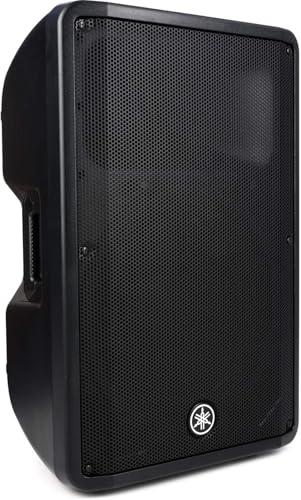
Yamaha CBR15 — The modern passive reference
The CBR15 is where a serious passive shortlist starts. Yamaha’s CBR series was designed as a portable-and-installed workhorse line, and the 15-inch model carries a 1000-watt peak rating in its listing alongside the traits that made the range a default: a cabinet light enough for one person to stand-mount without theatre, rigging points for installed work, and the even, unhyped voicing that Yamaha’s live-sound products are known for. In a category where many cabinets are voiced to impress in a shop demo — boosted edges, scooped middle — the CBR15 is voiced to work: vocals sit forward, the top end stays civil at volume, and a pair of them covers a hall without the listener fatigue that aggressive cabinets produce by the second set.
As a system anchor it is equally well-mannered. The cabinet’s power ratings give amplifier shoppers a clear programme neighbourhood to aim at, its impedance behaves predictably when a second pair shares amplifier channels, and Yamaha’s documentation and dealer network make the unglamorous parts of ownership — a replacement driver in five years, a crossover question, a flown installation’s paperwork — easy to resolve. Buyers choosing one passive 15 to build around for a decade are choosing, in effect, an ecosystem, and this is the strongest ecosystem with a verified listing in this guide.
There is also a deployment subtlety in the CBR15’s favour: it behaves predictably in pairs and in fours. Some cabinets change character when a second pair joins on shared channels or in a wide room; the Yamaha’s even dispersion and civil top end make multi-cabinet rooms easier to tune, which is precisely the scenario installed buyers are purchasing for. A cabinet that scales gracefully is worth more than one that merely sounds good alone in a showroom, and scaling is where this design quietly outclasses most of its price neighbours.
- Configuration: 15-inch two-way passive cabinet — external amplifier required
- Power figure in the listing: 1000 watts peak
- Duty: portable sound reinforcement and fixed installation
- Maker: Yamaha, CBR series
Strengths
- Balanced, work-first voicing that keeps vocals intelligible at volume instead of chasing demo-room sparkle.
- Light, riggable cabinet that moves between stand-mounted portable duty and installed work without compromise.
- Yamaha’s support depth turns long-term ownership questions into phone calls rather than research projects.
Trade-offs
- It does nothing alone — the amplifier purchase is mandatory and must be budgeted beside it.
- Its honest voicing can sound plain next to aggressively tuned rivals in a quick shop comparison.
- Buyers at the strictest budgets will feel the pull of the BR15 below or the value classes further down.
Best for: bands, churches, schools and rental benches building a passive rig meant to serve for years.
Not suited for: anyone without an amplifier budget, or anyone who secretly wants a powered speaker’s simplicity.

Yamaha BR15 — The budget rung of the Yamaha ladder
The BR15 is the older, simpler expression of the same idea: a 15-inch two-way passive loudspeaker from Yamaha’s BR series, built to put the company’s design discipline within reach of rigs where the money is genuinely tight. The BR line has served community halls, school gyms, rehearsal rooms and starter band rigs for years, and its longevity in the catalogue tells the story — this is a cabinet that institutions buy in pairs and replace in decades. Where the CBR15 adds refinement and installation polish, the BR15 concentrates on the fundamentals: a sturdy cabinet, a sensible crossover and voicing that behaves itself on an affordable amplifier.
That last pairing matters. Budget passive rigs live or die on the amplifier, and the BR15’s forgiving nature suits the modest stereo power amplifiers that starter systems actually use. It will not extract the last decibel the format allows, and it does not pretend to. What it offers is a known quantity at the bottom of a respected range: if the total budget must cover two cabinets, an amplifier, stands and cable, the BR15 is how the speaker line-item stays sane without leaving the Yamaha ecosystem — and when the rig grows, these cabinets retire gracefully to monitor or rehearsal duty rather than to a skip.
Consider also who else buys this cabinet, because it predicts your ownership experience. School districts, village halls and places of worship purchase BR-series cabinets in quantity, which means the knowledge base around them — which amplifiers behave, which stands fit, what breaks after a decade (very little) — is public and deep. A first-time passive buyer is not just purchasing a loudspeaker; they are enrolling in the largest support group in the category, and the BR15 is its membership card.
- Configuration: 15-inch two-way passive loudspeaker — external amplifier required
- Series: Yamaha BR, the range’s long-running value line
- Duty: small venues, rehearsal spaces, institutional rigs
- Position: the entry rung beneath the CBR series
Strengths
- Yamaha design discipline and support at the range’s most accessible rung.
- Forgiving behaviour on the modest amplifiers that budget rigs realistically use.
- A long catalogue life means parts, documentation and second-hand companions remain findable.
Trade-offs
- Refinement and installation features sit a clear step below the CBR15.
- Output and polish ceilings arrive sooner in larger or louder rooms.
- Like every pick here, it is silent until an amplifier joins the purchase.
Best for: starter rigs, community spaces and institutions that want Yamaha reliability inside a strict total budget.
Not suited for: larger venues, high-volume work, or buyers who will upgrade within a year anyway.
JBL JRX215 class — Prose-only: the traditional entry workhorse
The JRX class is what “first passive PA” has meant at pro-audio dealers for a generation: a 15-inch two-way passive cabinet from JBL’s entry professional line, sold through the same counters that sell the amplifier, the stands and the cable to complete it. No verified listing for this class sits in this site’s pool, so it appears here as prose-only guidance — but a shopper who walks into a dealer with a passive shortlist will meet this class within five minutes, and a guide that pretended otherwise would be incomplete.
The class’s virtues are distribution and familiarity. Sound companies know these cabinets, rental benches stock their relatives, and any working engineer has mixed on them. Voicing follows the American live-sound tradition — present, forward, built to cut through a room — and the cabinets tolerate the enthusiastic gain habits of inexperienced operators better than most. As a class recommendation it comes with one caution: entry professional lines are where specifications get quoted most creatively across the whole market, so judge this class by demonstration and documentation rather than by headline numbers, and let the amplifier matching rules in this guide do the arithmetic.
The dealer relationship is the unlisted component in this class, and for many buyers it is the deciding one. A competent dealer will steer the amplifier choice, supply cable made to length, and stand behind the system as a system — services that have genuine cash value to a first-time buyer and that no online listing replicates. If the JRX class is your destination, buy the relationship along with the cabinets and consider the small premium over the direct classes a fee for insurance.
- Configuration: 15-inch two-way passive cabinet — external amplifier required
- Channel: pro-audio dealers and rental benches; no verified pool listing
- Character: forward, present voicing in the American live tradition
- Position: entry professional, above utility tier, below premium
Strengths
- Ubiquity — dealers stock it, engineers know it, hire companies can match it.
- Forward voicing keeps vocals and speech intelligible in difficult rooms.
- A natural first rig for buyers purchasing the whole system from one knowledgeable dealer.
Trade-offs
- No verified listing here, so purchase means dealer legwork rather than a click.
- Entry-professional specification sheets across this class reward sceptical reading.
- Forward voicing can feel assertive for background-music and speech-only duty.
Best for: buyers building a first complete rig through a dealer who can demonstrate and support the system.
Not suited for: shoppers who need a verified online listing, or rooms wanting a deliberately neutral cabinet.
Behringer VP1520 class — Prose-only: the budget stretcher
Every category has a class whose entire purpose is to make the total possible, and in passive 15s that role belongs to Behringer’s VP class. These are 15-inch two-way passive cabinets engineered downward to a price with unusual determination, and their honest function is arithmetic: when the budget must stretch across two cabinets, an amplifier, stands, a mixer and cables, this class is how the speaker line shrinks until the sum works. It appears here prose-only — no verified pool listing — because its natural habitat is the value end of dealer and online pro-audio retail, where it is rarely out of stock for long.
Judged within that purpose, the class deserves respect rather than condescension. A VP-class rig that exists — set up, amplified, playing the school disco and the wedding speech — beats a premium rig that stayed a spreadsheet. The compromises live where an experienced buyer would predict: cabinet finish and hardware feel utilitarian, voicing is enthusiastic rather than refined, and long-term resale value is modest. The guidance for this class is therefore about expectations: buy it as the enabling purchase it is, pair it with an amplifier chosen for headroom rather than bravado, and it will do the job it was bought for. Buyers who know they will demand more within a year should save longer and start at the Yamaha rung instead.
One deployment note flatters this class: second rigs. Working performers and DJs often keep a value-class pair as the sacrificial system — the one that travels to the muddy field day, the school hall with the leaking roof, the gig where the good cabinets stay home. Judged as a primary system the VP class invites criticism; judged as the rig that absorbs risk so the main rig doesn’t have to, it is close to unbeatable, and many owners quietly run exactly this two-tier strategy.
- Configuration: 15-inch two-way passive cabinet — external amplifier required
- Channel: value pro-audio retail; no verified pool listing
- Character: utilitarian build, enthusiastic voicing, enabling price logic
- Position: the budget floor of the serious market
Strengths
- Makes complete passive rigs possible at budgets where the format otherwise cannot start.
- Widely available through value channels, so pairs and replacements are easy to source.
- Honest utility for rehearsal rooms, starter venues and second systems.
Trade-offs
- Fit, finish and refinement are visibly a class below the Yamaha picks.
- Voicing favours excitement over accuracy, which critical listeners will notice.
- Thin resale value means the purchase should be treated as consumption, not investment.
Best for: strictly budgeted complete rigs, rehearsal spaces and buyers who need a working system now.
Not suited for: buyers planning to upgrade soon, or listeners who prioritise refined voicing.
Seismic Audio class — Prose-only: the direct-sold utility tier
Seismic Audio built its business by selling cabinets direct, skipping the dealer network and pricing the result for utility buyers: rehearsal-room owners, houses of worship on maintenance budgets, DJs assembling a second rig, and anyone who needs a pair of 15-inch passive cabinets to simply exist and work. The class appears in this guide prose-only, without a verified pool listing, as the map of that direct-sold tier — a real and large slice of how passive speakers actually change hands, quite different from the dealer world of the JRX class above.
The utility proposition is straightforward and, within its limits, honourable. These cabinets prioritise coverage of the basics — a 15-inch two-way format, stand mounting, connections that mate with ordinary amplifiers — at prices that let a room be equipped rather than admired. What the buyer gives up is the refinement layer: voicing subtlety, hardware elegance and the dealer support relationship. The class also rewards careful reading, because direct-sold catalogues span wide quality ranges under one brand banner; the sensible purchase is the straightforward full-range cabinet with clear documentation, not the most feature-decorated variant. For a rehearsal room that will absorb a decade of enthusiastic abuse, that trade is often exactly right.
The class also illustrates a buying skill worth practising: separating the cabinet from the catalogue around it. Direct sellers surround their straightforward full-range cabinets with combination packages, lighting bundles and inflated package wattage claims. Ignore the theatre, find the plain 15-inch two-way cabinet with published documentation, pair it with an amplifier bought on headroom principles, and the utility proposition survives contact with reality. Buyers who can perform that separation get rehearsal-room sound at prices that leave money for the room’s acoustic treatment — which, veterans will confirm, improves the result more than any cabinet upgrade would.
- Configuration: 15-inch two-way passive cabinets — external amplifier required
- Channel: sold direct to buyers; no verified pool listing
- Character: utility-first, basics covered, refinement optional
- Position: direct-sold tier beneath dealer entry-professional
Strengths
- Direct pricing equips rooms that dealer-channel budgets leave silent.
- Straightforward designs suit rehearsal, utility and second-rig duty well.
- Easy to buy in matched pairs and to replace like-for-like later.
Trade-offs
- No dealer relationship means support is a shipping label, not a conversation.
- Catalogue breadth hides quality variation — the plainest documented model is the safest buy.
- Voicing and finish sit at utility level, a step below every other class here.
Best for: rehearsal rooms, utility installations and second rigs bought on direct pricing.
Not suited for: front-of-house duty in discerning rooms, or buyers who value dealer support.
Electro-Voice passive class — Prose-only: the premium passive ceiling
At the top of the passive market the architecture stops being a budget decision and becomes an engineering preference, and Electro-Voice’s passive cabinets are the clearest expression of that tier. This class — covered prose-only here, with no verified pool listing — is where passive 15-inch designs are built for serious installed and touring work: cabinets engineered for flown arrays, high-output reinforcement and rooms where the sound system is specified by consultants rather than chosen from a shelf. Including the class matters because it corrects a lazy assumption: passive is not what buyers settle for when they cannot afford powered. At this level, passive is what professionals specify when amplification strategy is part of the design.
What the premium buys is control and capacity — cabinets that hold their voicing at outputs the entry classes cannot reach, hardware built for rigging loads, and documentation thorough enough for an engineer to model a room before a cabinet ships. The costs are equally real: the cabinets themselves, the amplification worthy of them, and the expertise to deploy both. For a venue or organisation building a decade-long installation with professional help, this class is the correct destination and the Yamaha picks are the rehearsal for it. For a band buying its first rig, it is a postcard from a country they may visit later.
There is a strategic lesson in this class for buyers several rungs below it: professional passive systems are designed backwards from the room. Coverage angles, array behaviour and amplifier zoning are decided on paper before a cabinet is chosen, which is why the documentation runs so deep. A first-rig buyer cannot replicate the budget, but can absolutely replicate the method — sketch the room, mark the audience, count the cabinets, then shop. The premium class’s real export to the rest of this guide is that discipline, and it is free.
- Configuration: 15-inch two-way passive cabinets — professional amplification required
- Channel: pro-audio dealers and installers; no verified pool listing
- Character: high-output, rigging-ready, documentation-deep
- Position: the premium ceiling of the passive market
Strengths
- Output capacity and composure that entry classes cannot approach.
- Built and documented for flown, installed and professionally specified systems.
- Proof that passive architecture remains a first-choice design at the highest level.
Trade-offs
- Total system cost, amplification included, leaves casual budgets far behind.
- Deployment rewards professional help; the cabinets assume a competent system design.
- Overkill, plainly, for rehearsal rooms and starter rigs.
Best for: venues and organisations specifying a long-life installed system with professional support.
Not suited for: first rigs, tight budgets, or buyers without amplification worthy of the cabinets.
What Jobs Do the Best 15 Inch Passive Speakers Actually Cover?
It helps to name the work, because “PA” hides how varied the employment is. The classic posting is the small live venue: a pair on stands, a band or an acoustic act, an audience in the low hundreds. Here the 15-inch format’s low-end reach means kick drum and bass guitar register without a subwoofer, and the system stays a two-box carry. The second posting is speech with music around it — houses of worship, school halls, conference and ceremony work — where intelligibility is the product and the cabinets spend most of their lives flown or wall-mounted, fed from a rack nobody touches between Sundays. The third is the rehearsal room, the least glamorous and most punishing job in audio, where cabinets absorb daily volume, borrowed amplifiers and enthusiastic equalisation for years; this is where the utility classes earn their keep. The fourth is the rental bench, where a cabinet’s value is measured in hires survived, and where passive designs dominate because a rental house can standardise amplifiers and treat cabinets as durable, swappable endpoints.
Each posting bends the buying decision. Venue work rewards headroom and voicing that stays composed at volume, which points up the ladder toward the CBR15 and beyond. Speech-led installation rewards documentation, rigging hardware and dealer support, which points at Yamaha and the professional classes. Rehearsal duty rewards price and replaceability, the home turf of the VP and Seismic classes. Rental thinking rewards standardisation above all. A buyer who names their posting first will find the six picks sort themselves with surprisingly little argument.
Why Does the Used Market Matter So Much in This Category?
Passive PA is one of the healthiest used markets in all of audio, and any honest guide should say so, because a large share of real systems are assembled second-hand. The reasons are structural: passive cabinets contain almost nothing that ages electronically, brands like Yamaha have sold compatible designs for decades, and institutions regularly decommission working rigs during renovations. A used CBR-class cabinet from a cared-for installation can be a smarter purchase than a new utility-class cabinet, provided the buyer inspects like an engineer rather than a bargain hunter.
The inspection is learnable. Play each cabinet at moderate volume with familiar music and listen for rattles, buzzes and one driver working harder than its twin. Check that both drivers in each cabinet are producing sound — a silent high-frequency driver is the classic used-PA defect, usually a crossover or diaphragm story. Examine surrounds and cones for tears or repairs, terminals for damage, and cabinets for the water staining that betrays storage in damp outbuildings. Finally, buy used amplifiers with even more care than used speakers, because the amplifier is where age and heat have done their work. None of this appears in the picks above — all six are framed as new purchases or classes to shop — but the used channel is the shadow seventh pick behind every passive decision, and it is a legitimate one.
What Should You Know About Speaker Cable and Connections?
Passive rigs run on speaker-level connections, and the details are unglamorous but consequential. Professional cabinets use locking speaker connectors, often with a second socket wired in parallel so a second cabinet can be fed from the first — the physical basis of the daisy-chaining discussed earlier, and the reason impedance arithmetic matters. Cable gauge should be chosen against run length: the longer the run, the heavier the gauge required to keep resistance from eating amplifier power and softening control of the woofer. Runs inside a small hall are forgiving; runs across a festival field are not.
Two habits protect both sound and equipment. First, never substitute instrument cable or line-level interconnects for speaker cable: they are not built to carry amplifier output, and the failure mode ranges from wasted power to melted insulation. Second, make connections with the amplifier off, every time, without exception for “just a quick swap” — a shorted speaker lead at a live amplifier output is one of the few genuinely expensive accidents available in this hobby, and it is entirely optional. Label both ends of every cable with its length and destination, a five-minute discipline that repays itself at every setup in the dark.
How Do the Cabinets and Classes Stack Up Against Each Other?
| Pick | Availability | Amplifier needed | Character | Natural home |
|---|---|---|---|---|
| Yamaha CBR15 | Verified listing | Yes — stereo power amp | Balanced, work-first | Bands, churches, rental |
| Yamaha BR15 | Verified listing | Yes — modest power amp | Forgiving fundamentals | Starter and institutional rigs |
| JBL JRX215 class | Prose-only — dealers | Yes — entry pro amp | Forward, present | First dealer-bought rigs |
| Behringer VP1520 class | Prose-only — value retail | Yes — budget amp | Enthusiastic, utilitarian | Strict-budget complete rigs |
| Seismic Audio class | Prose-only — direct | Yes — utility amp | Basics covered | Rehearsal rooms, second rigs |
| Electro-Voice passive class | Prose-only — pro channel | Yes — professional amp | High-output, specified | Installed professional systems |
Every row shares the same middle column, and that is the table’s real message: the amplifier is not an accessory to any of these purchases. Read the rows instead by channel and character — where you will buy, who will support you, and how the cabinet is voiced — because those differences, not wattage folklore, are what separate the six.
How Do You Set Up a Passive Rig in the Right Order?
Order matters because each decision constrains the next. Begin with the room and the audience, since coverage needs decide whether one pair suffices or the system must grow to two. Choose the cabinets second, while the room is still the boss of the conversation. Choose the amplifier third, matched to the cabinets’ programme neighbourhood with headroom, and with enough channels — or low-enough load tolerance — for the growth the first step imagined. Buy cable fourth, at speaker level and in gauges honest about the run lengths involved; long runs of thin cable quietly tax the amplifier and dull the result. Stands, poles or rigging come fifth, rated for the cabinet weight with margin. Only then does the mixer and source gear need finalising, because everything upstream of the amplifier is comparatively interchangeable.
On the day, the sequence inverts into a signal chain: sources into the mixer, mixer into the amplifier, amplifier into the cabinets, gains staged so the mixer runs in its comfortable middle and the amplifier is the last thing turned on and the first thing turned off. That power order is not superstition — switch-on thumps travel downstream, and the amplifier is the only component that can make them dangerous. A passive rig set up in this order, with the amplifier matched as this guide describes, is not a compromise system awaiting a powered upgrade. It is a finished instrument, and it will outlast several generations of the alternatives.
How Do You Run a First Soundcheck on a Passive Rig Without Drama?
The first power-up of a newly assembled passive system deserves a ritual, because it is when wiring errors announce themselves and when a calm sequence keeps them cheap. Start with every gain control down: mixer master low, channel gains low, amplifier level controls at a modest setting rather than full. Power the chain in signal order — sources, mixer, amplifier last — and bring one source up at a time: a familiar recording first, then a microphone. Listen to each cabinet separately at conversational volume before listening to the pair. What you are screening for is not beauty but symmetry: both cabinets present, both drivers in each cabinet working, no buzz that follows the cable when you swap channels. A fault found at this volume costs a cable swap; the same fault found at show volume costs a driver.
Then set the gain structure properly, because passive rigs have no manufacturer to do it for you. The principle is that each stage should work in its comfortable middle: the mixer channel delivering a healthy signal without its meters living in the red, the master fader near its nominal mark, and the amplifier’s level controls set so the system reaches performance volume with that healthy signal — not with the mixer straining. If the room is loud enough with the amplifier controls well below maximum, that remaining travel is your headroom, and headroom is the sound of a rig that will still be composed in the final song of the night. Finish by walking the room while the recording plays: passive cabinets on stands reward a listener who checks the back rows and the corners, where a small change of angle or height can rescue intelligibility that no equaliser setting will.
One last habit separates rigs that age gracefully from rigs that accumulate mysteries: write the working settings down. Amplifier levels, mixer master position, which cable runs where — a photograph and three lines in a notebook. The next setup, possibly by different hands in a hurry, inherits a working system instead of an archaeological dig.
What Mistakes Do Passive Buyers Keep Making?
The founding mistake is buying cabinets with money that belonged to the amplifier. A pair of excellent passive speakers fed by an inadequate amplifier sounds worse — and fails sooner — than modest speakers on a proper one, yet the amplifier is the line item buyers squeeze because it photographs badly. Budget the system, not the speakers.
Second: matching by peak numbers. Peak ratings describe instants; amplifiers and cabinets live in the continuous world. Match on programme and continuous figures from documentation, with headroom, as the amplifier section of this guide lays out. Third: daisy-chaining cabinets onto one channel without doing the impedance arithmetic, until the amplifier meets a load below its floor and protects itself into silence during the event it was bought for. Fourth: using instrument or line-level cable where speaker cable belongs — the thin stuff is not rated for amplifier output and quietly wastes power as heat. Fifth: standing cabinets on whatever was nearby. A 15-inch cabinet on a wobbling stand is a safety problem wearing a sound problem as a disguise; rated stands cost less than either consequence. Sixth: assuming passive was the cheap option overall. It is the flexible option, the durable option and the scalable option — but a complete passive rig and a complete powered rig at the same quality level cost comparable money, and buyers who understand that buy once.
Final Recommendation
For most readers, the answer wears a Yamaha badge. The CBR15 is the passive 15 to build around: verified, balanced, supported, and ready to anchor anything from a band rig to a church installation for years. The BR15 serves the same loyalty at a stricter budget and asks only that your room be honest about its size. Beyond the verified pair, the classes map your alternatives truthfully — a dealer-led JRX-class rig for first-time system buyers, the VP class when the budget must stretch until it covers everything, the Seismic class for utility rooms bought direct, and the Electro-Voice class when the project is a professional installation. Whatever rung you choose, audition with programme material you know, at the volume the room will actually demand, because a passive cabinet reveals its character at working level rather than in a whispered showroom demo. Choose the cabinet after choosing the architecture and the amplifier, in that order, and a passive rig will repay the thought every time it is switched on — quietly, competently, and long after trendier systems have been replaced twice.
Frequently Asked Questions
Can I use a passive PA speaker without an amplifier?
No. A passive cabinet contains drivers and a crossover only; with no amplifier it produces essentially no sound. A mixer alone cannot power it either, unless that mixer is a powered mixer with a built-in amplifier — a legitimate and common pairing for small rigs.
What size amplifier do I need for a pair of 15-inch passive speakers?
Work from the cabinets’ documentation rather than their peak headlines: choose a professional amplifier whose per-channel output sits in the cabinets’ programme-rating neighbourhood, with headroom above your intended operating level. Headroom protects the high-frequency drivers, because a smaller amplifier driven into distortion is harder on speakers than a larger one run calmly.
Can I connect two passive cabinets to one amplifier channel?
Often yes, in parallel, but the combined load halves and must stay at or above the amplifier’s rated minimum load. Check both the cabinet impedance and the amplifier’s floor before wiring, and treat the arithmetic as mandatory rather than advisory.
Are passive speakers cheaper than powered speakers overall?
The cabinets are cheaper; the system usually is not. Once a proper amplifier, speaker cable and stands join the invoice, a passive rig and a comparable powered rig land in similar territory. Passive earns its money back in flexibility, repairability and lifespan rather than in the initial total.
Do passive speakers work for home listening?
PA cabinets are voiced for projection and durability in live rooms, which makes them blunt instruments for a living room. Home listeners are better served by hi-fi speakers — including the passive bookshelf designs covered elsewhere on this site — while PA passives belong in rehearsal, venue and event work.
How long can speaker cables be in a passive rig?
Longer runs demand heavier gauge. Short runs inside a small venue are forgiving; long runs of thin cable waste amplifier power and soften the sound. When a run must be long, step up the gauge and keep the amplifier as close to the cabinets as the room allows. As a working habit, own cables in two clearly labelled lengths — a short pair for rehearsal and small rooms, a long pair for halls — rather than one compromised length that is wrong for both, and coil them properly after every use so the copper inside survives the decade the cabinets will.
Can passive speakers serve as stage monitors too?
Yes, and this is a classic passive-rig economy: the same cabinets that work as mains in a small room can lie on their sides or stand as monitors when the main system grows, provided the cabinet shape and your amplifier’s channel count allow it. Many working rigs began as one pair doing everything and evolved exactly this way, which is another argument for buying cabinets from a line you can still match years later.
Related Guides
Comparing architectures before you commit? Continue with our guides to the best 15-inch powered speakers for plug-and-play rigs, the best passive bookshelf speakers for home listening and the best PA systems for small venues. The same passive principle at desk and shelf scale is judged in the best small bookshelf speakers.


