What's inside
- Key Takeaways
- Quick Picks
- How Did We Choose These Adventure Watches?
- What Separates a Real Adventure Watch From a Big Watch?
- How Do the Six Adventure Picks Compare on the Trail and Off It?
- How Do You Prepare an Adventure Watch for a Serious Trip?
- What Mistakes Do Adventure Watch Buyers Keep Making Outdoors?
- Final Recommendation
- Frequently Asked Questions
- Related Guides
As an Amazon Associate I earn from qualifying purchases. This post may contain affiliate links at no extra cost to you.
gizmoverdict.com is reader-supported. When you buy through links on our site, we may earn an affiliate commission.
Where to buy: The six watches below all carry links verified against this site’s own product pool. One of them, the Amazfit T-Rex 3, is a refurbished listing, and it is labelled that way in its title, its table row and its review, because condition is a fact a buyer deserves before the click, not after the delivery.
The best adventure smartwatches are bought for the days that do not go to plan. Any watch can time a sunny parkrun; an adventure watch earns its name in horizontal rain at altitude, on the third day away from a socket, under a glove, with a map on its face and a route that has stopped resembling the path. This guide gathers the six most credible answers to that brief, from Garmin’s flagship Fenix line through Amazfit’s rugged T-Rex family to Apple’s titanium Ultra, and it treats them as outdoor instruments first and smartwatches second, because the hills reverse the usual priorities without asking permission.
Three questions decide everything in this category. Can it navigate, with real maps and positioning that holds in valleys and forests? Can it endure, in battery days rather than hours and in a case that treats rock as a colleague rather than an enemy? And can you operate it with cold hands, wet hands or gloves, when a touchscreen becomes a suggestion rather than an interface? The watches below answer those questions in different dialects, and the right choice depends on whether your adventures are weekend ridges, week-long treks, ocean swims or the school run reimagined by a determined imagination.
A word on the wellness features threaded through these devices. Heart rate, recovery estimates and readiness scores appear throughout this guide as general training and wellness feedback for healthy adults, useful for pacing a big day and noticing when rest is wiser than another summit. They are not medical instruments and nothing here presents them as such. An adventure watch’s safety contribution is navigation, communication where available and honest battery; the judgement about weather, terrain and turning back remains, correctly, the human’s job.
Condition honesty also matters in this list. Five picks are standard new listings, while the Amazfit T-Rex 3 is explicitly a refurbished unit, described as such everywhere it appears. That is not a blemish on the guide but a feature of it: refurbished adventure hardware, bought knowingly, is one of the smartest routes into this expensive category, and pretending otherwise to keep a table tidy would help nobody standing in a shop with a real budget.
Key Takeaways
- The Fenix 8 is the flagship summit: AMOLED maps, titanium, dive rating and a genuinely useful flashlight that earns its place on night descents, tent tasks and every dark trailhead in between.
- The Fenix 7 Pro Sapphire Solar trades screen glamour for solar-assisted endurance on long expeditions.
- Amazfit’s T-Rex 3 Pro brings dual-band GPS and sapphire to a far friendlier tier than the flagships.
- The T-Rex 3 here is refurbished, stated openly, and is the budget route into serious rugged hardware.
- Apple Watch Ultra 2 is the adventurer’s pick only inside Apple’s world, and its battery counts in days.
- The Fenix 7S proves adventure sizing is not one-size: full Fenix depth in a smaller, sleep-friendly case that slim wrists can wear through a whole expedition without a second thought.
Quick Picks
| Pick | Badge | Why it earns its place |
|---|---|---|
| Garmin Fenix 8 47mm | Flagship of the wild | AMOLED maps, DLC titanium, dive rating and the flashlight owners refuse to give up. |
| Garmin Fenix 7 Pro Sapphire Solar | Solar endurance specialist | The previous flagship, solar-fed and expedition-minded, now the connoisseur’s Garmin buy. |
| Amazfit T-Rex 3 Pro | Rugged value challenger | Sapphire AMOLED, titanium bezel and dual-band GPS at a tier the flagships should worry about. |
| Amazfit T-Rex 3 (Refurbished) | Refurbished trail bruiser | A 48mm rugged watch with offline maps and 100m water resistance, honestly labelled refurbished. |
| Apple Watch Ultra 2 | Apple’s titanium outdoorsman | The brightest screen and deepest phone integration in a rugged titanium case. |
| Garmin Fenix 7S | Full depth, smaller case | The Fenix experience sized for slimmer wrists, silver with a graphite band. |
How Did We Choose These Adventure Watches?
Verification preceded admiration. Every watch here was confirmed through the site’s product pool with its listing title recorded in the sources file, including the condition labels that matter so much in this category: the T-Rex 3’s refurbished status is carried in its API title and repeated in this guide wherever the pick appears. No watch was promoted on a manufacturer’s promise that the listing itself did not support, and specifications in the reviews are confined to the well-established, widely documented characteristics of each model rather than invented figures.
The adventure criteria were then applied without sentimentality. Navigation had to be real, meaning maps or serious route tools rather than a breadcrumb afterthought. Positioning had to be credible in difficult terrain. The case had to be built for impact, water and grit, the battery had to survive the kind of trip the marketing photographs depict, and the controls had to work when fingers are cold and screens are wet. Watches that are merely large, or merely styled like field equipment, were excluded even when their general smartwatch credentials were impeccable.
Finally we checked the spread of the list against the spread of real adventurers. There is a flagship for the expedition calendar, a solar endurance specialist, two Amazfit answers at friendlier tiers, an Apple-native option for the iPhone committed, and a smaller-case Fenix for the wrists the category usually forgets. A guide that only served the biggest budget and the biggest wrist would be a catalogue, not a guide, and adventure itself is considerably more democratic than that.
We also weighted repairability of a bad purchase, an unfashionable criterion that matters in an expensive category. A watch bought in the wrong size or the wrong ecosystem should be returnable before it has been scarred by a mountain, which is why the reviews repeatedly advise trying cases physically and testing refurbished units inside their return windows. Adventure is a long relationship with a piece of equipment; beginning it with the right size, the right phone pairing and honest expectations is worth more than any single feature discussed in this guide.

Garmin Fenix 8 47mm — Flagship of the wild
The Garmin Fenix 8 in its 47mm sapphire form is the current summit of the adventure watch idea, and its listing title reads like a mountaineer’s packing list: AMOLED display, DLC titanium, dive rating and a built-in flashlight. That last item sounds like a gimmick until the first night it lights a tent, a bothy door lock or a trail junction at midnight, after which owners describe it as the feature they would surrender last. The AMOLED screen brings maps to life in colour that older Garmin displays could only suggest, which matters when a contour line is the difference between a valley and a wrong valley.
Underneath the hardware sits the deepest outdoor software in this guide. Routes, climbs, ski and surf and dive and hunt profiles accumulate into a catalogue that covers essentially every way a human moves through wild country, and the training side borrows the full Garmin coaching apparatus for the athlete who races as well as roams. Battery endurance remains remarkable for a screen this bright, measured in days of ordinary use and long weekends of continuous tracking, though heavy map and GPS work will always spend it faster than the brochure’s gentlest figures.
Honesty requires two caveats. The Fenix 8 is a serious financial commitment, the flagship tier of this entire category, and its 47mm case is a substantial object that smaller wrists should try before buying. It is also vastly more capable than a weekend walker will ever use, which is not a criticism so much as a sizing question for your ambitions. For the hiker, climber, diver and ultra runner whose year genuinely contains epics, this is the most complete adventure watch Garmin has made, and the one every rival below is measured against.
- Listing identity: fenix 8 Sapphire, 47mm, DLC Titanium, Black/Pebble Gray
- Named in title: AMOLED display, dive-rated construction, built-in flashlight
- Software depth: Garmin’s full outdoor and multisport catalogue
- Case character: sapphire and titanium flagship materials
Strengths
- Maps in AMOLED colour transform navigation confidence
- Flashlight proves useful every single trip, not once a year
- Training and outdoor software depth no rival here matches
Trade-offs
- Flagship-tier commitment that casual walkers cannot justify
- 47mm case overwhelms genuinely small wrists
- Capability far exceeds a gentle weekend walking life
Best for: the hiker, climber, diver or ultra runner whose year contains real epics and multi-day routes.
Not suited for: the occasional rambler, or anyone whose adventures end each evening beside a plug and a pub.

Garmin Fenix 7 Pro Sapphire Solar — Solar endurance specialist
The Fenix 7 Pro Sapphire Solar is the previous flagship generation, and in the way of Garmin flagships it has aged into one of the smartest buys in the adventure category. Its memory-in-pixel display lacks the AMOLED glamour of the Fenix 8, but it repays that modesty with sunlight readability that never washes out and battery figures that stretch toward the expedition end of the scale, helped by the solar charging ring that tops the cell up across long bright days on the hill. The built-in flashlight survives from this generation’s list of genuinely useful ideas, as does the full multisport and mapping software.
Choosing the 7 Pro over the 8 is a decision about displays and decades. The older screen asks you to accept a flatter, more utilitarian look in exchange for endurance and a gentler relationship with the charger, and many serious outdoors people prefer exactly that trade, regarding a watch that needs feeding every few days as a liability on a ten-day trek. Navigation, training and activity breadth are close enough to the newer model that the practical gap on an actual mountain is far smaller than the generational gap on a specification sheet.
The sapphire lens and solar glass make this the quietly durable choice as well, shrugging at granite and grit in the way these watches are bought to do. If your adventures are measured in weeks rather than weekends and your aesthetic runs to instruments rather than jewellery, the Fenix 7 Pro remains a completely defensible flagship purchase, and for solar devotees it may be the better Garmin in this guide outright.
- Listing identity: fenix 7 Pro Sapphire Solar, Multisport GPS, Black
- Named in title: built-in flashlight and solar charging
- Display style: sunlight-readable memory-in-pixel rather than AMOLED
- Software depth: Garmin’s full multisport and mapping suite
Strengths
- Solar assistance stretches long bright expeditions beautifully
- Sunlight readability never washes out at altitude
- Flagship depth at a previous-generation position
Trade-offs
- Display looks utilitarian beside the Fenix 8’s AMOLED
- No dive-rated headline of the newer flagship
- Still a substantial case for smaller wrists
Best for: the trekker and expedition traveller who measures trips in weeks and sunshine in charging hours.
Not suited for: the buyer who wants the brightest, prettiest screen above all other virtues.
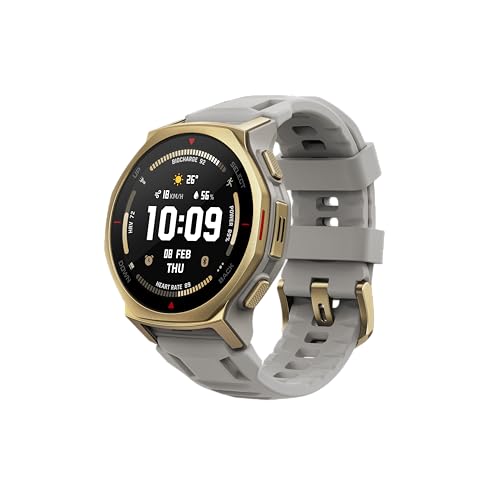
Amazfit T-Rex 3 Pro — Rugged value challenger
The Amazfit T-Rex 3 Pro arrives wearing its ambitions on its titanium bezel. A 44mm case, a sapphire AMOLED display of 1.32 inches and dual-band GPS put it technically closer to the Garmin flagships than its price tier has any right to be, and the whole design leans into the rugged military aesthetic that gives the T-Rex line its name. For the adventurer whose budget is real but whose terrain is also real, this is the watch that asks why the flagship tax needs paying at all.
Out on the trail the T-Rex 3 Pro covers the adventurer’s essentials with conviction: offline maps for country where signal is a rumour, route tracking with the accuracy dual-band positioning provides in gorges and forests, and a sport catalogue broad enough for the runner, rider, swimmer and lifter who share one wrist across a week. Battery life stretches across days of mixed use in the Amazfit tradition, which matters enormously when the nearest socket is a day’s walk behind you. The companion app presents the records cleanly, even if its training analysis stops short of Garmin’s coaching depth.
The compromises are the familiar Amazfit ones, worn openly. The app ecosystem is a shelf rather than a store, smart features are competent rather than rich, and the brand’s long-term software support is a shorter story than Garmin’s. None of that touches the watch’s core job in wild country. If your adventures are genuine but your flagship budget is not, the T-Rex 3 Pro is the most convincing argument in this guide that the gap between the two has nearly closed.
- Listing identity: T-Rex 3 Pro, 44mm, Titanium Bezel
- Named in title: 1.32-inch AMOLED sapphire display, dual-band GPS
- Navigation: offline maps for beyond-signal country
- System: Amazfit’s own platform rather than Wear OS
Strengths
- Dual-band positioning holds lines in gorges and forest
- Sapphire and titanium at this tier is remarkable
- Multi-day battery suits socket-free weekends
Trade-offs
- App catalogue is a shelf beside Garmin’s and Apple’s stores
- Training analysis stops short of flagship coaching depth
- Brand software support history is shorter than Garmin’s
Best for: the genuine adventurer with a real budget, who needs maps and accuracy more than app breadth.
Not suited for: the smartwatch-first buyer who wants payments, apps and assistants foremost.

Amazfit T-Rex 3 (Refurbished) — Refurbished trail bruiser
The Amazfit T-Rex 3 in this listing is a refurbished unit, and that word deserves the first sentence rather than a footnote: this is a previously owned watch restored and resold, not a fresh one, and it should be bought with the expectations and the savings that status implies. The hardware underneath the label is the standard T-Rex 3, a 48mm rugged watch with GPS, offline maps and 100-metre water resistance named in its listing title, built for exactly the mud, rain and river crossings that make owners nervous about delicate electronics.
As an adventure tool the T-Rex 3 covers the ground most hikers and trail runners actually cover. Offline maps keep navigation alive beyond the signal’s edge, the case shrugs at weather that cancels lesser plans, and the battery lasts across the long weekends that define most people’s adventure calendar. Its AMOLED display is larger and brighter than the Pro’s smaller sapphire screen, a genuine point in this model’s favour for map reading, even as the Pro counters with its titanium bezel and dual-band positioning for difficult terrain.
The refurbished question is therefore the whole decision. Bought from a listing you trust, with the condition stated as plainly as this one states it, a refurbished T-Rex 3 puts serious adventure hardware on wrists that could not otherwise justify it, and the environmental arithmetic of a reused watch is its own quiet virtue. Check the return terms, inspect the watch on arrival like any refurbished purchase, and then take it somewhere muddy. Adventure watches are not improved by being precious, and this one arrives pre-excused from preciousness.
- Listing identity: T-Rex 3 Rugged Military Smart Watch, 48mm, Black
- CONDITION: Refurbished/Renewed unit, as stated in the listing title
- Named in title: GPS, offline maps, 100m water resistance
- Display: large AMOLED in a 48mm rugged case
Strengths
- Serious adventure hardware at a refurbished discount
- Offline maps keep navigation alive off-grid
- Big bright display reads routes at a glance
Trade-offs
- Refurbished condition means checking returns and inspecting on arrival
- Larger 48mm case will swamp smaller wrists
- No sapphire-and-titanium specification of the Pro
Best for: the budget adventurer happy to buy refurbished knowingly, who wants real maps and real toughness.
Not suited for: the buyer who wants a brand-new unit with full retail packaging and certainty.

Apple Watch Ultra 2 — Apple’s titanium outdoorsman
The Apple Watch Ultra 2 is the adventure watch for people whose lives are already Apple-shaped, and it makes its case with the best screen in this guide, a rugged titanium case and an action button that can be taught to start a workout, mark a waypoint or fire a torch without a glance. Its 49mm presence is unapologetic, the Ocean Band in this listing is built for water, and the whole object feels like the outdoors line of a company that sweats industrial design the way Garmin sweats battery chemistry.
Outdoor credibility has grown generation by generation. Dual-frequency GPS holds a line through city canyons and wooded valleys, the compass and waypoint tools handle backcountry basics, depth features serve the recreational diver and snorkeller, and the siren is a genuinely thoughtful emergency addition for a solo hiker within earshot of help. Training software through Apple’s platform and the wider App Store covers everything from couch-to-5k to ultra plans, and the integration with an iPhone’s messages, music and payments is beyond anything else in this guide.
The limitation is famous and absolute: endurance. Where the Garmins measure battery in weeks of ordinary use, the Ultra 2 measures it in days, and a multi-day trek demands a charging plan or a power bank that the Fenix owner simply does not carry. For the adventurer whose epics fit inside long weekends and whose daily life is deeply Apple, that trade is rational and the Ultra 2 is superb. For the expedition minded, it is the wrong tool wearing exactly the right costume.
- Listing identity: Ultra 2 GPS + Cellular, 49mm, Titanium, Blue Ocean Band
- Case: rugged titanium with an assignable action button
- Positioning: dual-frequency GPS for city and valley alike
- Water story: depth features for recreational diving and snorkelling
Strengths
- Screen brightness and clarity lead this entire guide
- iPhone integration is seamless beyond rival attempts
- Action button control works without looking or touching glass
Trade-offs
- Battery counts in days where Garmins count in weeks
- Completely unavailable to Android phone owners
- Multi-day treks require a deliberate charging plan
Best for: the iPhone owner whose adventures are intense but socket-adjacent, from trail ultras to sea swims.
Not suited for: the expedition traveller who needs a fortnight between charges, or any Android household.

Garmin Fenix 7S — Full depth, smaller case
The Fenix 7S exists because adventure does not only happen on large wrists. The S in its name marks the smaller case in the Fenix 7 family, and this listing pairs a silver case with a graphite band in a combination that looks as composed in an office as it does on a ridge. Everything that made the Fenix line the default serious outdoors watch is present in miniature: multisport GPS tracking, mapping, training analysis and the kind of battery endurance that treats a week away from sockets as a normal request.
Smaller is not lesser here, merely differently proportioned. The display shrinks with the case, so map readers should know they are trading screen estate for wearability, and the solar and flashlight refinements of the Pro generation are not part of this model’s story. What remains is the essential Fenix experience, deep activity software and dependable navigation, in the only body on this page that a slim-wristed adventurer can wear all day, all night and under a cuff without negotiation.
That wearability has a data consequence owners come to appreciate: a watch comfortable enough for sleep produces continuous recovery and readiness records, and a watch light enough for daily wear produces honest activity totals rather than weekend-only samples. For the smaller-wristed hiker, runner or skier who has watched the adventure category design for other people’s arms for years, the 7S is not the compromise pick in this guide. It is the pick the category owed them, still entirely capable of a serious season in the hills.
- Listing identity: Fenix 7S, Smaller Sized Adventure Smartwatch, Silver with Graphite Band
- Software depth: Garmin multisport GPS and mapping suite
- Case character: the compact member of the Fenix 7 family
- Wearability: sized for all-day and all-night comfort on smaller wrists
Strengths
- Genuine Fenix capability without the flagship bulk
- Comfortable enough for continuous sleep and recovery records
- Looks composed from office to ridge without changing straps
Trade-offs
- Smaller display gives maps less room to breathe
- Lacks the Pro generation’s solar and flashlight refinements
- Battery trails its larger Fenix siblings
Best for: the smaller-wristed hiker, runner or skier who refuses a diluted adventure watch.
Not suited for: the map obsessive who wants the largest possible screen, or the solar devotee.
What Separates a Real Adventure Watch From a Big Watch?
Why do maps matter more than step counts outdoors?
In town, navigation is a convenience; beyond the trailhead it becomes the product. A real adventure watch carries maps or serious route tools on the device itself, because the phone is conserving battery, lacking signal or sealed in a dry bag at the bottom of a pack. Following a line on your wrist while both hands hold poles, a rope or a map case is a categorically different experience from stopping to excavate a handset, and in deteriorating weather that difference stops being about comfort at all.
Judge map quality by the moments that frighten people: the featureless moor in mist, the forest junction with four identical tracks, the descent that must not begin down the wrong valley. Colour AMOLED maps on the Fenix 8 and T-Rex models earn their keep precisely there, while simpler route displays still beat memory and hope. Whatever watch you choose, load the route before the trip, walk a familiar loop with it first, and never let a glowing line overrule a landscape that disagrees with it.
How much battery does an adventure actually need?
Work backwards from your longest plausible day, then add the night you did not plan. A summer hill day with continuous tracking can run fourteen hours; a multi-day trek multiplies that by the days between sockets; a winter trip taxes batteries with cold on top of everything. The Garmin flagships are built around this arithmetic, the Fenix 7 Pro’s solar ring exists specifically to stretch it, and the Amazfit pair respect it with multi-day endurance. The Ultra 2 answers a different question, suiting intense days that end near a charger.
Remember that headline battery figures assume gentle settings. Bright always-on maps, maximum positioning accuracy and a flashlight used freely all spend the cell faster, on every brand without exception. The experienced habit is boring and effective: start any big day at full charge, know which settings your watch can shed when the percentage worries you, and carry the cable on trips longer than the watch’s honest endurance. Adventure rewards the prepared with almost comic reliability.
Can you use it with gloves, wet hands and cold fingers?
The touchscreen is the adventure watch’s weakest citizen. Rain reads as touches, gloves read as nothing, and numb fingers cannot be trusted with a menu designed for a café. This is why physical buttons remain a serious feature rather than nostalgia: the Garmin approach of button-led control with touch as an assistant survives conditions that reduce pure-touch watches to jewellery. Apple’s action button is a step in the same direction, giving one important function a mechanical home.
Test your shortlist the way the mountain will. Run the shower test, operate the lap and waypoint functions with the gloves you actually hike in, and try reading the screen through the rain you cannot schedule away. Owners forgive a watch almost anything except failing at the moment of need, and that moment is statistically wet, cold and in a hurry. The right adventure watch is the one whose controls you trust with your worst hands, not your best.
What should water resistance mean to a swimmer or diver?
Water figures on adventure watches describe very different promises, and the listings here illustrate the range. The refurbished T-Rex 3 names 100-metre resistance, suitable for swimming and snorkelling confidence, while the Fenix 8’s title goes further and calls the watch dive-rated, reflecting built depth capability for recreational diving. The Ultra 2 likewise carries depth features aimed at the recreational diver. These are engineering statements about the case, and they should be matched to the water you actually enter rather than collected as numbers.
Practical care extends any rating’s life. Rinse salt and chlorine away, avoid pressing buttons underwater unless the maker blesses it, and remember that a refurbished watch’s seals have a history you cannot inspect, one more reason the T-Rex 3’s returns terms deserve reading. Within those ordinary cautions, every pick here will swim happily, and the divers among them will go considerably deeper than their owners should without training.
How do these watches behave on a genuine multi-day trek?
Day three is where adventure watches confess. On day one every device is charged, cheerful and recording; by the third morning the trekker learns which watch rationed itself wisely, which screen stayed readable in the tenth hour of glare, and which strap has begun a slow argument with a sweaty wrist. The Garmins are engineered for this confession and pass it easily, the Fenix 7 Pro’s solar top-up turning bright traverses into charging opportunities. The Amazfit pair also last the long weekend with dignity, while the Ultra 2 owner is by now managing a power bank with the tenderness of a Tamagotchi keeper.
Navigation fatigue is the subtler test. A watch that demands menu archaeology at every junction will be consulted less and less as the days tire its owner, until it is merely recording a route nobody is following. The interfaces that survive a trek are the blunt ones: a clear line, an honest arrow, distance to the next point in figures readable without glasses. Before any serious trip, walk a known route with your chosen watch and rehearse the three actions you will need exhausted, because the mountain is a poor classroom and fatigue is a worse teacher.
The trek also settles the size question in a way shops cannot. A 47mm or 49mm case that felt heroic in the mirror can bruise a wrist bone under a pack strap by day two, while the 7S simply vanishes into the expedition. Conversely, big screens earn forgiveness with every map glance. There is no universal answer, only the answer your own wrist files after fifty kilometres, which is why trying sizes with a pack on your back is the most underused buying advice in this entire category.
What happens when the weather closes in at altitude?
Every adventure watch in this guide will eventually meet the day the forecast lied, and that day is the truest review any of them will ever receive. Rain turns touchscreens into ouija boards, wind makes a phone call home a comedy, and the light goes the colour of wet slate an hour before it should. The watches that earn their keep in that hour share a temperament: big honest buttons, a screen that stays readable through water, and navigation simple enough to operate with the cognitive resources of a cold, tired person who is also holding a map case in their teeth.
Garmin’s button-led philosophy was designed by people who clearly have been that person. Marking a waypoint, checking the distance to the col and starting the route back to the start are all mechanical acts that numb fingers can complete. The Ultra 2’s action button gestures at the same wisdom, though its touchscreen heart still beats beneath. The Amazfit pair sit between the two philosophies, workable with care and gloves chosen for the purpose, and their owners learn the same lesson one storm earlier than most: rehearse the three functions you will need frightened, because frightened is a real operating condition outdoors.
What no watch does in that hour is equally important. None of them summons rescue from a mountainside without signal or satellite hardware doing the talking, none of them reads the sky, and none of them knows the ground the way the person standing on it can learn to. Their gift is narrower and still wonderful: they remember the way you came, they know how far the valley is, and they keep that knowledge lit on your wrist while you make the human decisions. Adventure gear at its best does not replace judgement; it buys judgement time to work.
Why do divers and swimmers read adventure watches differently?
Water people judge this category by a sterner test than hikers do, because a watch that floods at depth has failed in a way a muddy watch never can. The Fenix 8’s dive-rated billing and the Ultra 2’s depth features speak directly to that audience, promising instruments that can accompany a recreational dive and log it honestly, while the T-Rex 3’s 100-metre resistance speaks the language of surface confidence: swimming, snorkelling and white-water days where the watch will be submerged, knocked and frozen without ever pretending to be a dive computer.
The distinction matters because it maps onto training rather than toughness. A diver choosing between these watches is really choosing how much of the dive the watch should witness, and a swimmer is choosing how little they need to think about the device at all. Both are served somewhere in this list, and both should rinse, dry and inspect seals with the dull regularity that keeps water ratings true year after year, especially on a refurbished unit whose previous life is unknown.
How Do the Six Adventure Picks Compare on the Trail and Off It?
| Pick | Badge | Standout quality | Main compromise |
|---|---|---|---|
| Garmin Fenix 8 47mm | Flagship of the wild | Most complete adventure instrument available here | Highest commitment in money and wrist presence |
| Garmin Fenix 7 Pro Sapphire Solar | Solar endurance specialist | Endurance with solar top-up for long trips | Older display technology than the flagship |
| Amazfit T-Rex 3 Pro | Rugged value challenger | Near-flagship outdoor hardware, friendlier tier | Thinner smart ecosystem than the flagships |
| Amazfit T-Rex 3 (Refurbished) | Refurbished trail bruiser | Lowest-cost route to genuine rugged capability | Condition demands the usual refurbished care |
| Apple Watch Ultra 2 | Apple’s titanium outdoorsman | Finest display and integration in the wild | Shortest endurance of any pick here |
| Garmin Fenix 7S | Full depth, smaller case | Adventure depth finally sized for slim wrists | Screen estate is the price of the fit |
The table’s honest headline is that Garmin occupies three of six places because, in this specific category, Garmin’s depth is the story: flagship AMOLED ambition, solar endurance and a smaller-case classic form a range that rivals attack from different directions. Amazfit attacks on value with genuine hardware, the Pro’s dual-band sapphire specification and the refurbished T-Rex 3’s discount route into the same mountains. Apple attacks from the ecosystem, offering the adventurer who lives on iPhone a watch of real outdoor credibility attached to unmatched daily integration.
Battery is the column the table cannot show and the factor that should govern your shortlist. Ranked by endurance character rather than laboratory figures, the solar Fenix 7 Pro leads, the Fenix 8 and the Amazfit pair follow with multi-day confidence, the 7S sits close behind its siblings, and the Ultra 2 stands alone at the daily-charging end. If your adventures involve more than three consecutive nights without a socket, that single ranking eliminates half the table before features are even discussed.
Condition is the other invisible column. The refurbished T-Rex 3 is not a lesser watch smuggled into good company; it is the same rugged instrument with a past, priced accordingly, and for many readers it will be the correct purchase precisely because adventure gear is meant to be used hard rather than kept precious. Buy it with the ordinary refurbished checks, returns confirmed and unit inspected on arrival, and its value argument is very hard for the new listings to answer.
How Do You Prepare an Adventure Watch for a Serious Trip?
What should you set up the week before departure?
Load everything while you still have Wi-Fi, time and a kettle. Routes for each day, offline maps for the whole region rather than the optimistic corridor of the plan, and any music or podcasts that will live on the watch should be synced and then verified with the phone switched off, because the mountain will perform that test less kindly. Check that the watch’s storage holds what you believe it holds; a route that failed to transfer is a rumour, not a navigation tool.
Then rehearse. Walk a familiar loop using only the watch’s navigation, practise marking a waypoint, starting the return-to-start rescue, and finding the flashlight or torch with gloves on. Ten rehearsed minutes at home convert directly into calm at a misty junction. Finally, charge to full the night before, pack the cable somewhere it can be reached without unpacking the tent, and tell your route to a human being, because no watch in this guide, however magnificent, files a trip plan with the people who would come looking.
How do you stretch battery across a long route?
Every adventure watch here offers the same levers, differing only in how deep the settings menus bury them. Reduce map-checking frequency by trusting the route line at junctions rather than admiring it continuously, lower display brightness or always-on behaviour where the model allows, and choose the positioning mode that matches the terrain: full multi-band accuracy earns its cost in gorges and forests, while open ridges are tracked beautifully by thriftier settings. The Fenix 7 Pro’s solar ring quietly repays bright days, but no panel rescues a screen left glowing at maximum for a week.
The human levers matter as much. Decide in advance which recordings are essential, because tracking every dog walk around the campsite spends the same battery as the summit day. Use the flashlight in its lower modes for tent tasks and save the blaze for the moments that need it. Above all, know your watch’s honest endurance from rehearsal rather than its brochure, and plan the trip around the true number; batteries forgive optimism even less readily than weather does.
How do you care for the watch after the trip?
Adventure watches are built to be abused and built to be rinsed, and the second half of that sentence keeps the first half true. Wash salt, sunscreen and grit away in fresh water, work the buttons gently under the rinse if the maker permits, and dry the watch before it goes back on the charger. Check straps for the small cuts and stretched holes that long wet days produce, because a strap failure on the next trip is how good watches meet bad endings on rock and riverbed.
Then download and actually look at the trip’s record while memory is fresh. The route you walked, the altitude profile and the heart-effort story of the big day are the raw material of better planning next time, and reviewing them is how recreational adventurers quietly become experienced ones. Archive the route that worked, note the junction that confused everyone, and let the watch’s memory improve the human one. That debrief, more than any single feature, is what owning an adventure watch is for.
What Mistakes Do Adventure Watch Buyers Keep Making Outdoors?
Buying the flagship for a walking life that ends at a pub each evening. The Fenix 8 is a magnificent instrument whose depth a gentle rambler will never open, and the money difference buys a great deal of map, boot and bothy. Match the watch to the adventures already in your calendar, not the expedition you describe after two drinks.
Trusting the watch’s route against the evidence of the landscape. Maps age, paths move and a glowing line can be confidently wrong where a hillside has rearranged itself. The experienced adventurer treats the watch as a brilliant adviser and the terrain as the authority, and turns back on human judgement when the two disagree in dangerous country.
Ignoring the refurbished label until the box arrives. The T-Rex 3 in this guide is refurbished and says so in its title, its table row and its review; a buyer surprised by that fact has not been deceived, merely inattentive. Buy refurbished knowingly, confirm the returns route, inspect the unit on arrival, and the arrangement is a bargain rather than a grievance.
Leaving route loading until the trailhead. Signal at rural car parks is a rumour, and the watch that syncs beautifully at home will not conjure maps from a mountainside. Load routes and offline maps days ahead, verify them with the phone off, and let departure morning be about boots and weather instead of progress bars.
Forgetting that cold eats batteries. Winter trips shorten every endurance figure in this guide, sometimes dramatically, and a watch that cruised a summer trek can fade on a January ridge. Keep the watch under a cuff against your warmth, start winter days at full charge, and carry the cable on any trip where a dead watch would be more than an inconvenience.
Testing a new watch for the first time on the serious trip itself. Every interface feels intuitive in a warm kitchen and several feel foreign at a windy col, and the owner learning menus at altitude has confused the rehearsal with the performance. Walk the familiar loop, practise the rescue functions, and let the big day be about the mountain rather than the manual.
Assuming the biggest case is the most capable watch. Capability in this guide lives in software, sensors and battery chemistry, while case size mostly trades screen against comfort. The 7S on a wrist that suits it will gather more honest data in a month than a flagship abandoned for bruising its owner’s wrist bone by the second day of every trip.
Final Recommendation
For the adventurer who wants one answer, the Fenix 8 is the most complete outdoor watch in this guide, and its flashlight alone will convert you within one trip. Choose the Fenix 7 Pro instead if your journeys run long and bright and you value solar endurance over screen glamour, and choose the 7S if your wrist has been waiting for the category to remember it exists. Amazfit’s pair make the value argument with real hardware: the T-Rex 3 Pro for buyers who want new and near-flagship, the refurbished T-Rex 3 for buyers who would rather spend the difference on the trips themselves.
The Ultra 2 stands slightly apart, the right summit for the iPhone-committed adventurer whose epics end within reach of a charger and whose daily life rewards Apple’s integration hourly. Whichever name you choose, rehearse it at home, load it before the trailhead, and let it do the jobs it is genuinely great at, navigation, endurance and memory, while you keep the oldest adventure job of all: deciding, with your own eyes on the weather, whether today is a day for the summit or for the valley, and being content with either answer.
One final sizing thought before you spend anything: adventure watches are worn for the other fifty weeks too. The right pick survives the office, the school run and the sofa with the same grace it shows on the ridge, because a watch abandoned between trips gathers neither the fitness records nor the owner’s fluency that make it trustworthy when the trip finally comes. Choose the one you will actually wear in February rain as happily as on the August summit, and the adventure features will be there, practised and ready, on the day the weather turns.
Frequently Asked Questions
Which adventure watch lasts longest between charges?
The Fenix 7 Pro Sapphire Solar is the endurance specialist here, pairing an efficient display with solar top-up across bright days. The Fenix 8, the Amazfit pair and the Fenix 7S are all multi-day watches in ordinary use, while the Apple Watch Ultra 2 sits at the other end of the scale and should be planned around charging every couple of days at most. Heavy GPS and map use shortens every figure. As a rule the simpler the display and the larger the case, the longer the watch runs, which is why trying to maximise screen, brightness and endurance in one purchase always ends in a compromise somebody has chosen deliberately.
Is the refurbished T-Rex 3 a risky purchase?
It is a purchase to make knowingly rather than fearfully. The listing states its refurbished condition plainly, and the hardware is the standard rugged T-Rex 3 with offline maps and 100-metre water resistance. Confirm the returns terms before buying, inspect the watch carefully when it arrives, and test its functions within the return window. Bought that way, refurbished is a legitimate discount on serious adventure hardware.
Can the Apple Watch Ultra 2 handle a week-long trek?
Not without a charging plan. Its battery is measured in days rather than the weeks the big Garmins approach, so a week in the hills means carrying a power bank and cable and rationing features. For long weekends and daily life inside Apple’s ecosystem it is superb, but expedition travellers should take one of the Garmins or Amazfits and leave the charger arithmetic at home.
Do I need the Fenix 8, or is the Fenix 7 Pro enough?
For most adventurers the 7 Pro is genuinely enough: the same deep Garmin software, a flashlight, mapping and better endurance character, at a previous-generation position. The Fenix 8 earns its flagship status with the AMOLED map experience, dive-rated construction and newer hardware. Choose by display preference and diving ambitions rather than by fear that the older watch cannot handle your hills; it demonstrably can.
Which pick suits smaller wrists best?
The Fenix 7S was designed for exactly that question, carrying the full Fenix software depth in the family’s smaller case. The 44mm T-Rex 3 Pro is the next most manageable of the rugged options. The 47mm Fenix models, the 48mm T-Rex 3 and the 49mm Ultra 2 are all substantial objects, and smaller-wristed buyers should try them physically before committing.
Are these watches’ health features useful on expeditions?
As general training and wellness feedback, yes: heart-effort trends, recovery estimates and sleep records help pace a multi-day effort and warn when rest is the smarter summit. They are estimates for healthy adults pursuing fitness, not medical measurements, and they never substitute for judgement about altitude, weather and exhaustion. Treat the watch as an observant companion and yourself as the expedition leader, and the arrangement works exactly as it should.
Should I buy a touchscreen adventure watch for winter use?
Only if its controls do not depend on the screen. The Garmins pair touch with full button control, which is why they dominate winter shortlists, and the Ultra 2’s action button covers its most important single function. Whichever watch you choose, test it wearing your actual winter gloves before the season starts, and set up the screens and shortcuts so that the functions you need most are reachable mechanically rather than by swiping with a frozen fingertip.
Can these watches replace a phone on the trail?
For navigation, tracking and timekeeping, largely yes, and that is their purpose: the phone can stay sealed away conserving its battery for communication at camp. For calls and messages away from the handset you would need a cellular model and coverage, which mountains are famous for withholding. Carry the phone regardless, switched off or in airplane mode, and let each device do the job it is actually good at.
Related Guides
Keep exploring with solar charging watches tested across a long-distance trail and how to read offline maps on a watch when the mist arrives and choosing hiking watch sizes for smaller wrists without losing features, which sit alongside this guide in the same smartwatch collection.
Related guides
- Best Basic Phones Camera Buyers Can Trust: Flip Phones and Simple Handsets That Still Take a Photograph
- Best Sony Full Frame Cameras for Astrophotography: Sensitivity vs Resolution
- Best Affordable Android Tablets: Five True Android Slates and One Fire OS Specialist, Clearly Labelled
- Best 400 FPS High Speed Cameras: The Honest Truth About Burst Slow Motion



[…] exploring with how readiness scores from different watch brands actually compare and choosing a running watch when training moves beyond 10k and the beginner’s guide to sleep […]