Our Top Picks




What's inside
- How to Choose a Pyle Backup Camera
- Pyle Flush Mount Backup Camera Two-Pack (B0H3QFVMP2)
- Pyle Wireless Backup Camera Kit with 7-Inch Monitor (B0FQPJFFFR)
- Pyle Backup Camera and Monitor System Kit with 4.3-Inch Screen (B01K9N11V4)
- Pyle Compact Rear View Backup Camera (B07GD8DJ3V)
- Pyle 7-Inch Wireless Monitor and License Plate Camera Kit (B0BLZN5Q3S)
- Pyle PLCM10 License Plate Rear View Camera (B0013DZ9C2)
- Pyle PLCM18BC License Plate Rear View Camera (B0079R2MH6)
- Comparing the Seven Pyle Options Side by Side
- Frequently Asked Questions
- Check prices on Amazon
- Closing Thoughts and Disclosure
As an Amazon Associate I earn from qualifying purchases. This post may contain affiliate links at no extra cost to you.
Reversing is one of the few everyday driving tasks where you are asked to move a large vehicle into a space you cannot fully see. Mirrors help, and turning in your seat helps, but neither shows you the low area directly behind a bumper, the short post at the edge of a driveway, or the child-sized obstacle that sits below the rear window line. A backup camera fills that blind zone with a live view, and Pyle has sold aftermarket reversing cameras and complete camera-and-monitor kits for many years, covering everything from a simple license plate camera that feeds an existing screen to wireless kits with their own large display for trucks and trailers.
This guide looks only at Pyle’s range. That is a deliberate choice. Staying inside one brand makes the differences easier to understand, because the naming, mounting styles, and kit formats repeat across the lineup. Instead of comparing a dozen unrelated brands with different terminology, you can see how Pyle itself divides its products: camera-only units that need a display you already own or plan to add, compact wired kits with a small dashboard screen, and two wireless kits built around a 7-inch monitor for larger vehicles. If you already like the idea of a Pyle system, or you are replacing a Pyle camera and want to stay with familiar fittings and menus, this is the comparison that matters.
Seven products are covered here. Three broad groups run through them. The first group is camera-only: a flush-mount two-pack with switchable video formats, a compact universal camera with an RCA output, a license plate camera with a swivel adjustment, and an older license plate model with a stated TVL resolution and a zinc black chrome finish. These units send a picture; they do not show it. You supply the screen. The second group is a single wired kit with a 4.3-inch screen and a license plate mount camera that activates automatically in reverse. The third group is the pair of wireless kits with 7-inch monitors, one described with a 1080p HD IPS LCD for trucks, SUVs, pickups, and travel trailers, and one built around a wireless license plate camera and rated for 12/24V use in buses, trucks, trailers, vans, RVs, and campers.
Our research for this guide was based on comparing listings and specifications across the Pyle range, reading what each product title and listing actually states, and organizing those stated facts by the questions buyers ask most often: Where does the camera mount? What shows the picture? How wide is the view? What happens after dark? And what voltage and vehicle types does the listing name? Where a listing does not state a detail, this guide does not invent one. That matters with older and simpler cameras in particular, because leaving a gap is more honest than filling it with a guessed dimension, a guessed compatibility list, or a feature the manufacturer never claimed.
One more point before the details. A backup camera is an aid, not a replacement for mirrors, a shoulder check, or walking behind the vehicle before you move when the situation calls for it. The cameras here are meant to add information at the exact moment information is hardest to get. Used that way, even the simplest license plate camera on this list can change reversing from a guess into a guided maneuver, and the larger wireless kits can do the same job for vehicles where running a cable from back to front would be the hardest part of the whole installation.
best aftermarket rearview mirror backup cameras
How to Choose a Pyle Backup Camera
The most important decision comes first, and it is not about resolution or screen size. It is about whether you need a camera only, or a camera and a display together. Four of the seven products in this guide are camera-only units. They are the right purchase if your vehicle already has a screen that accepts a camera input, if you are adding a compatible head unit as part of the same project, or if you are replacing a failed camera in an existing setup. They are the wrong purchase if you expect to open the box and see a picture the same afternoon, because there is nothing in those boxes to watch the picture on. Read every camera-only section below with that in mind: the value is in the camera itself, its mount, and its output, and the display is a separate decision you control.
Kits solve the display question for you. The wired 4.3-inch kit pairs its license plate camera with a small screen and automatic reverse activation, which suits a car or SUV that has no screen at all and an owner who wants a contained, predictable setup. The two wireless 7-inch kits go further, pairing a camera with a much larger monitor and removing the long video cable run between camera and cab. That wireless link is especially relevant on trucks, trailers, and RVs, where a wired run can mean routing cable along a frame, through bulkheads, or across a hitch connection between a tow vehicle and a trailer. If your vehicle is long, or if the camera will live on a trailer rather than on the vehicle with the screen, start your shortlist with the wireless kits and work backward from there.
Mounting style decides the installation
Pyle’s range uses three mounting ideas. Flush mount, represented by the two-pack at the top of this guide, means the camera body sits in a drilled opening so only the lens face shows. Done well, it looks the most integrated and gives you freedom to place the camera where the view is best rather than where a bracket fits, but it asks you to drill, and drilling is permanent. License plate mount, used by several products here, is the opposite philosophy: the camera attaches at the plate, a location that is already centered, already at a useful height, and already surrounded by fasteners. It is the least invasive route and the easiest to understand. Compact surface-mounted cameras sit in between, small bodies that attach with a bracket and can be aimed, which suits owners who want placement flexibility without committing to a flush installation.
Viewing angle and what 170 degrees really means
Several Pyle listings state a 170° viewing angle. That is a very wide field of view, wide enough to show the full width of the vehicle and a margin on each side, which is exactly what you want when backing toward a curb, a garage wall, or another parked car. Wide lenses do stretch the edges of the picture, so objects at the far left and right can look farther away than they are. That is normal for the category and not a flaw in any one model. The practical lesson is to use the center of the image and the parking guidelines for judging distance, and use the wide edges for awareness of what is approaching or sitting off to the side. Where a listing does not state an angle, this guide does not assume it matches the 170° models.
Night vision, guidelines, and waterproofing
Night vision appears across almost the entire range here, and it matters more than many buyers expect, because a large share of awkward reversing happens in the dark: unlit driveways, rural roads, campsites, and parking areas at night. Night vision in this category generally means the camera can keep producing a usable picture in low light, often helped by the vehicle’s own reversing lights. Parking guidelines, also called distance scale lines in several Pyle listings, overlay reference marks on the picture so you can judge how close the bumper is getting. They are a guide, not a measurement, and they are most useful once you have learned how they relate to your own vehicle. Waterproof and weatherproof ratings address a simple fact of life: a rear camera lives outside, in rain, road spray, and winter slush. The listings here use different terms, including IP68, IP67, waterproof, and weatherproof, and those terms are not interchangeable, so each product section below reports exactly the term its own listing uses.
Voltage, video output, and vehicle fit
Most passenger vehicles use a 12V electrical system, but trucks, buses, and some commercial and recreational vehicles use 24V or need equipment that tolerates both. Two products in this guide state 12V-24V or 12/24V support in their listings, and that detail should be checked first if your vehicle is anything other than a standard car. Video output matters just as much on camera-only units. An RCA video output is the traditional analog connection many displays and head units accept, and one compact camera here states it directly. Another model goes further and offers switchable AHD 720P and CVBS output, which is about matching the camera to what your display expects. Matching output to input before you buy is the single easiest way to avoid a camera that physically installs perfectly and then produces no picture.
Pyle Flush Mount Backup Camera Two-Pack (B0H3QFVMP2)
This is the most distinctive product in the guide, for two reasons: it is sold as a pack of two cameras, and it is a flush mount design with an 18.5mm size stated in the listing. The full listing describes a backup camera for car, truck, SUV, and RV use, with a 170° wide angle view, switchable AHD 720P and CVBS video, an IP68 waterproof rating, night vision, parking guidelines, and 12V-24V compatibility. It is a camera-only product. There is no monitor in this package, so each camera needs a compatible display or head unit to show its picture, and that should be settled before anything else about this pack is considered.
The two-pack format opens up uses that a single camera cannot match. The obvious one is value across two vehicles: a household with a car and an SUV, or a small business with two work vehicles, can equip both from one purchase and keep the camera type consistent across them. A second use is a single vehicle with two mounting positions considered during installation, where having a matched spare removes the pressure of a one-shot decision. A third is simply having a replacement on hand. Rear cameras live in a hostile place, exposed to weather, road debris, and the occasional parking knock, and a spare that is already the correct model turns a future failure into a quick swap rather than a new shopping project. None of that requires inventing extra hardware; it follows directly from the pack containing two of the same camera.
Flush mounting is the defining installation choice here. An 18.5mm flush mount camera is designed to sit in a drilled circular opening, with the lens presented neatly at the surface rather than hanging from a bracket. On a bumper or rear panel with a suitable flat area, the result can look close to a factory installation, and the camera is less exposed to knocks than a protruding mount. The trade-off is commitment. Drilling a hole is not reversible in any practical sense, so placement has to be measured carefully, checked for what sits behind the panel, and chosen with the view in mind: centered where possible, clear of obstructions, and aimed so the bumper edge and the ground behind the vehicle are both visible. Buyers who are comfortable with that kind of work, or who are paying an installer anyway, will see the flush design as this pack’s main attraction. Buyers who are not should look at the license plate models further down, which ask far less of the vehicle.
The switchable video output deserves attention because it solves a real matching problem. The listing states AHD 720P and CVBS switchable, meaning the camera can be set to send either format. AHD is the higher-definition analog format, and CVBS is the long-established standard definition format that a huge number of displays accept. If your display supports AHD, you can use the sharper format; if it only accepts the older standard input, you can switch the camera to match instead of replacing either component. For a camera-only purchase, that flexibility is genuinely useful, because the whole risk of the category is a mismatch between camera output and display input. Always confirm which format your display expects and set the camera accordingly during installation, following the product’s own instructions.
The remaining stated features form a strong checklist for an outdoor rear camera. A 170° wide angle view covers the full rear width with margin to spare. Night vision addresses low-light reversing. Parking guidelines add the on-screen reference marks that help you judge closing distance. An IP68 waterproof rating is the strongest water-protection wording used anywhere in this guide, and it suits a camera that will live permanently in rain and road spray. Support for 12V-24V widens the vehicle list beyond standard cars to vehicles with 24V systems, which aligns with the listing naming cars, trucks, SUVs, and RVs. Taken together, this is the most feature-complete camera-only option in the Pyle range covered here, and the one to choose if you already have displays sorted and want installation flexibility across one or two vehicles.
- Sold as a pack of two flush-mount cameras
- 170° wide angle view with parking guidelines
- Switchable AHD 720P and CVBS video output
- IP68 waterproof rating and night vision
- 12V-24V compatibility; 18.5mm flush mount size
- Camera-only: a separate compatible display is required
Pyle Wireless Backup Camera Kit with 7-Inch Monitor (B0FQPJFFFR)
This kit is built around size and simplicity of connection: a rear view camera paired with a 7-inch monitor, connected wirelessly, with a 1080p HD IPS LCD stated for the display. The listing names trucks, SUVs, pickups, and travel trailers, and describes IR night vision and a waterproof camera as part of a complete camera system. Unlike the camera-only products in this guide, this is a full system. The box is intended to give you both the eye at the back and the screen at the front, which makes it the natural starting point for a vehicle that currently has no reversing display at all.
The 7-inch screen is the headline, and its size changes how the system is used. On a small dashboard display, a reversing picture is something you glance at. On a 7-inch monitor, the picture is large enough to read at a comfortable distance, to separate details like a trailer coupler, a low wall, or the edge of a loading area, and to keep using as a general rear view aid on a long vehicle where mirrors leave large blind areas. The listing specifies an IPS LCD with 1080p HD resolution. IPS panels are valued in the display category for holding their picture quality at wider viewing angles, which matters in a cab where the monitor may be mounted off to one side of the driver’s straight-ahead view rather than directly in front of the seat. The resolution figure describes the display stated in the listing; what you see in practice also depends on the camera feed and the wireless link, so the honest way to read it is that the monitor itself is a high-definition panel rather than a basic low-resolution screen.
Wireless connection is the second major idea. In a wired system, the video signal travels along a cable that must be routed the full length of the vehicle. In this kit, the camera and monitor communicate wirelessly, so the installation effort concentrates on mounting and powering each end rather than on threading a long video cable through the vehicle. For a pickup or SUV that mainly removes hassle. For a travel trailer it can remove a genuine obstacle, because a trailer is a separate structure from the tow vehicle, and any wired connection has to cross the hitch gap in a way that survives coupling, uncoupling, and turning. A wireless kit treats the trailer as its own mounting location and the cab monitor as a separate one, which is exactly how owners of trailers actually use their vehicles.
IR night vision is stated for this system, and on the vehicles named in the listing it has a particular job. Trucks and trailers reverse in places that are often poorly lit: yards, storage lots, campsites, rural properties, and the side of a road at night. A camera that keeps working after dark, together with a large screen that makes the picture easy to read, addresses the exact conditions where a long vehicle is hardest to place. The camera is described as waterproof, which fits a unit that will be mounted at the rear of a truck or trailer and stay there through every season and every wash.
Who should choose this kit over the other 7-inch wireless kit in this guide? The listing language points to trucks, SUVs, pickups, and travel trailers, and emphasizes the IPS monitor. If your vehicle is in that list, if you tow a travel trailer, or if screen quality and viewing angle from an offset mounting position matter to you, this is the kit whose stated features line up with your use. It is also the more straightforward recommendation for a buyer who wants one complete system from one box and does not want to assemble a camera and display from separate purchases. As with any wireless system, plan the monitor position before installation day, confirm how each component is powered using the product’s own documentation, and leave yourself a clear view of the screen that does not block your view of the road.
- Complete wireless kit: camera plus 7-inch monitor
- 1080p HD IPS LCD monitor stated in the listing
- IR night vision and a waterproof camera
- Named for truck, SUV, pickup, and travel trailer use
- Wireless link avoids a long video cable run
Pyle Backup Camera and Monitor System Kit with 4.3-Inch Screen (B01K9N11V4)
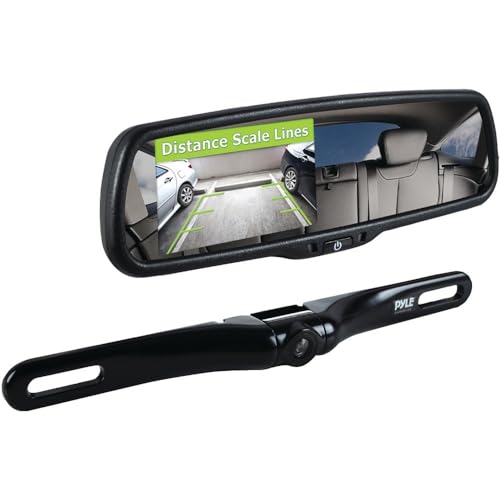
This is the compact wired kit in the range: a rearview backup parking assist camera and monitor system with a 4.3-inch screen, a waterproof license plate mount camera, night vision, a 170° angle adjustable view, auto reverse activation, and distance scale lines. Every element of that description points the same direction. This kit is for a car or SUV with no existing screen, an owner who wants the camera to appear on the display automatically when reverse is selected, and a preference for a small monitor that fits easily on a dashboard or windshield without dominating the cabin.
Auto reverse activation is the feature that defines daily life with this system. In a setup without it, a driver has to switch a display on or select an input before reversing, and a step that has to be remembered is a step that will sometimes be skipped, usually on the rushed day when the camera was most needed. Automatic activation removes the decision entirely: engage reverse and the picture appears. That is how factory reversing systems behave, and it is the behavior most drivers expect. For a shared family vehicle, where several drivers with different habits use the same car, automatic activation is arguably worth more than any single specification elsewhere in this guide, because it makes the camera part of reversing itself rather than an accessory someone has to remember.
The license plate mount keeps installation in the same low-commitment territory. The camera mounts at the rear plate, centered on the vehicle, using a location that already exists on every car. The listing describes the camera as waterproof, which suits permanent outdoor mounting, and the view is described as 170° and angle adjustable. That combination is more useful than either part alone. A wide angle shows the whole rear scene, and adjustability lets the installer tilt the view so the framing suits the vehicle’s ride height and bumper shape rather than accepting whatever a fixed bracket produces. A low car and a tall SUV present very different rear views from the same mounting height, and a small tilt adjustment is how one camera design serves both.
Distance scale lines are the other stated guidance feature, overlaying reference marks that help you judge how much space remains behind the bumper. Combined with night vision for low-light use, the kit covers the core reversing jobs: see the area, judge the distance, and do it day or night without any extra steps. The 4.3-inch screen is the deliberate trade-off. It is smaller than the 7-inch monitors in the wireless kits, so fine detail is presented on a more compact canvas, and buyers who reverse long vehicles or who want a large, easy-to-read picture should compare the wireless kits carefully. But small screens have real advantages in a car cabin: more mounting positions, less obstruction of the forward view, less visual bulk when the system is not in use, and a generally tidier result in a smaller interior.
Because this is a wired kit, the video signal travels by cable between camera and monitor. On a typical car or SUV that run is manageable and has the traditional wired benefit of a direct, stable connection that does not depend on a wireless link. The work is in the routing: cable has to travel from the rear plate area to the cabin, hidden and protected, and power connections have to be made correctly so the automatic activation works as described. None of that is unusual for the category, and it is the standard price of a wired system. Buyers who are comfortable with a methodical installation, or who are booking one, get in return the most self-contained small-car package in this Pyle guide: camera, screen, automatic activation, guidelines, and night vision, all described in one listing and designed to work together.
- Complete kit with 4.3-inch monitor screen
- Waterproof license plate mount camera
- 170° angle adjustable view with distance scale lines
- Auto reverse activation and night vision
- Wired connection between camera and monitor
Pyle Compact Rear View Backup Camera (B07GD8DJ3V)
This compact camera-only model is the universal-fit option in the range. Its listing describes a rear view backup camera for cars with distance scale lines, night vision, a 170° tilt-adjustable lens, an IP67 waterproof rating, a 12V RCA video output, and universal fit for all vehicle types. It does not include a monitor. It sends its picture through that RCA output to a compatible display or head unit that you provide, and everything about its design, from the compact body to the adjustable lens, is aimed at fitting a wide variety of vehicles without drama.
The RCA video output is worth understanding because it defines this camera’s world. RCA is the long-standing analog video connection used by generations of in-car displays, monitors, and head units. A camera that states a 12V RCA output is speaking the most widely understood language in the aftermarket camera category, which makes it a natural candidate for adding a reversing view to a vehicle that already has a screen with an RCA camera input, or for replacing an older RCA camera whose picture has degraded. The 12V part of the description matches standard passenger vehicle electrical systems. What this camera does not claim is the switchable higher-definition format of the flush-mount two-pack above, or 24V support, so buyers with a 24V vehicle or an AHD display input should look at the models whose listings state those things rather than assuming this one covers them.
Tilt adjustability is the practical highlight. The listing describes a 170° tilt-adjustable lens, and that adjustment solves the most common complaint about simple rear cameras: a fixed view that points too far down at the bumper or too far up at the horizon. Mounting surfaces differ between vehicles, plate and panel angles differ, and ride heights differ, so the ability to tilt the lens after mounting lets the installer frame the picture deliberately, low enough to see the ground immediately behind the vehicle and high enough to see approaching obstacles and the wider scene. Combined with the wide 170° angle, a correctly tilted view gives both the close-in detail and the side-to-side awareness that reversing needs.
The IP67 waterproof rating places this camera’s stated water protection a step below the IP68 wording of the flush-mount pack, and the honest reading is simply that the two listings use different ratings, each reported here as stated. IP67 is a recognized waterproof rating for equipment that lives outdoors, and for a camera mounted at the rear of a car it addresses the everyday reality of rain, spray, and washing. Distance scale lines provide the on-screen distance reference, and night vision covers low-light reversing, so the essential guidance features are all present in a compact body.
Universal fit for all vehicle types is the listing’s own claim, and it should be read sensibly: the compact size, standard 12V power, and RCA output are what make this camera broadly applicable, but universal fit never removes the need to check your own display’s input and your chosen mounting spot. This is the Pyle camera to shortlist when you already own the screen, want the simplest widely compatible connection, and prefer a small adjustable camera over a flush installation or a plate-mounted bar. It is also a sensible replacement camera, because its standard connections and compact form are the easiest to substitute into an existing wired setup. What it is not is a kit, and buyers starting from a vehicle with no display at all should begin with the 4.3-inch system or one of the wireless kits instead, then return to camera-only models like this one if they later add a head unit and want a camera to match it.
- Camera-only compact unit; display not included
- 170° tilt-adjustable lens with distance scale lines
- Night vision and IP67 waterproof rating
- 12V RCA video output for compatible displays
- Described as a universal fit for all vehicle types
Pyle 7-Inch Wireless Monitor and License Plate Camera Kit (B0BLZN5Q3S)
The second wireless kit in this guide takes a different route to the same goal. Its listing describes a 7-inch 1080P HD digital wireless monitor paired with a wireless license plate camera, in a waterproof, night vision, single channel visual assistance kit rated 12/24V for bus, truck, trailer, van, RV, and camper use. Two details separate it clearly from the other wireless kit above: the camera uses a license plate mount rather than a general rear mount, and the stated vehicle list is dominated by large and commercial-style vehicles, with the dual-voltage rating to match.
Start with that voltage rating, because for the named vehicles it can be the deciding factor. A 12/24V kit can be used on standard 12V vehicles and on 24V vehicles, which are common among buses, larger trucks, and some commercial and recreational setups. A buyer shopping for an RV, a camper, a van conversion, or a work truck cannot assume a 12V-only product is suitable, and should not have to guess. This listing states its dual-voltage support plainly, which makes the initial filtering easy: if your vehicle runs 24V, this is one of only two products in the entire guide whose listing names that support, and the only wireless monitor kit that does. Confirm your vehicle’s system and follow the kit’s own installation documentation, but begin here rather than adapting a product that never claimed to suit your vehicle.
The license plate camera is the other defining choice. On a large vehicle, a plate mount gives the installer a known, centered location without searching for a suitable panel or drilling into bodywork, and on trailers and campers the plate area is often one of the few consistently accessible mounting points at the rear. Pairing that simple mount with a wireless link is a thoughtful combination for big vehicles: the camera attaches at a familiar spot, and the signal reaches the cab without a cable run along a long chassis or across a trailer connection. For an RV or a bus, where the distance from rear camera to driver can be many times the length of a car, avoiding that cable run is not a minor convenience. It can be the difference between an afternoon project and a major installation.
The monitor is described as a 7-inch 1080P HD digital wireless display, and the kit is described as a single channel system. Single channel simply means the system is built around one camera feed rather than multiple camera inputs, which matches the job most buyers of this kit actually have: one clear rear view for reversing and monitoring what is behind a large vehicle. A single-purpose system is also simpler to live with, with one camera position to choose, one feed to check, and a screen devoted to that view. The camera is described as waterproof, and night vision is included, both of which matter for vehicles that are parked, loaded, and maneuvered outdoors at all hours, from campsites to depots.
Choosing between the two wireless kits therefore comes down to the vehicle and the mount, not to one kit being a lesser version of the other. This kit is the one whose listing speaks the language of larger vehicles: bus, truck, trailer, van, RV, and camper, with 12/24V support and a license plate camera. The other wireless kit speaks the language of trucks, SUVs, pickups, and travel trailers, with an IPS monitor panel emphasized. A travel trailer owner could reasonably consider either, and should decide by mounting preference and by which monitor description better suits the cab. An RV, bus, or 24V vehicle owner has the clearer path, and it leads to this kit. As with the other wireless system, plan monitor placement for a clear, unobstructed view, and verify power arrangements for both components from the product documentation before installation day.
- Complete wireless kit: 7-inch monitor plus license plate camera
- 7-inch 1080P HD digital wireless monitor stated
- Single channel visual assistance kit
- Waterproof camera with night vision
- 12/24V rating for bus, truck, trailer, van, RV, and camper
Pyle PLCM10 License Plate Rear View Camera (B0013DZ9C2)
The PLCM10 is the straightforward license plate camera in the range, and its listing keeps the description equally straightforward: a rear view backup parking reverse camera with a license plate mount, weatherproof construction, night vision, distance scale lines, and a swivel angle adjustable camera. It is a camera-only product, so it needs a compatible display to show its picture. Within the Pyle lineup it occupies the role of the uncomplicated plate-mounted option, for buyers who want the easiest mounting location and an adjustable view without moving up to a complete kit.
The swivel adjustment is its most useful stated feature, and it deserves more credit than a single line in a listing usually gets. License plates sit at different heights and angles on different vehicles, and a camera fixed rigidly to a plate mount inherits whatever angle that produces. On one vehicle the result is a well-framed view; on another it is a picture dominated by sky or bumper. A swivel angle adjustable camera lets the installer correct that at the source, rotating the camera so the picture shows the ground behind the vehicle and the space the vehicle is about to occupy. For a simple camera, that one adjustment does more for everyday usefulness than any number of extra menu features, because a reversing camera lives or dies by whether its fixed view happens to be the right view.
Weatherproof is the term this listing uses, rather than a numbered IP rating. That wording difference is worth respecting rather than smoothing over. The flush-mount pack states IP68 and the compact camera states IP67, which are specific standardized ratings, while this model is described in general weatherproof terms. All three descriptions address the same reality, a camera that lives outside in the weather, but they are not the same claim, and this guide reports each product in its own listing’s words. A buyer comparing strictly on stated water protection can see the difference plainly; a buyer who simply needs a plate camera described as weatherproof for normal road use will find the description matches the job.
Night vision and distance scale lines complete the core feature set, the same guidance pairing found on several models here: help seeing in low light, and reference lines for judging distance on screen. There is no viewing angle figure in the listing provided for this model, so none is claimed for it here. That restraint cuts both ways for the reader. You should not assume this camera matches the 170° models, and you should also not assume it is narrow; the listing simply does not say, and the safe approach is to treat angle as an open question to confirm from the full product documentation if that specification decides your purchase.
The PLCM10 makes the most sense in a few clear situations. It suits a vehicle that already has a display and needs a plate-mounted camera with an adjustable aim. It suits a replacement scenario, where an existing plate camera has failed and a like-for-like style of mount avoids new holes or brackets. And it suits a buyer who values simplicity, because the feature list is short, focused, and entirely concerned with the reversing job itself. If you want the camera and screen solved together, the 4.3-inch kit uses the same plate-mount idea and adds the monitor and automatic activation. If you want a plate camera for a large vehicle with a big wireless screen, the 7-inch license plate wireless kit is the step up. The PLCM10 sits between those worlds as the pure camera, and judged on that basis, its swivel adjustment and plate mount are exactly the features that matter.
- Camera-only license plate mount unit; display not included
- Swivel angle adjustable camera
- Weatherproof construction as described in the listing
- Night vision with distance scale lines
- Simple, focused feature set for parking and reversing
Pyle PLCM18BC License Plate Rear View Camera (B0079R2MH6)
The PLCM18BC is the most traditionally specified camera in this guide. Its listing describes a license plate rear view camera with built-in distance scale lines, a 420 TVL resolution and RCA output, and a zinc black chrome finish. It is a camera-only product that feeds a compatible display through its RCA connection. Where the newer models in the range are described in the language of HD formats and wireless links, this one is described in the older vocabulary of analog television lines, and understanding that vocabulary is the key to judging it fairly.
TVL, or television lines, is a traditional way of expressing analog camera resolution. The listing states 420 TVL. That figure tells you this is a standard-definition analog camera, not an HD model, and it should be compared on those terms. For the core reversing task, showing what is behind the vehicle, marking the distance with built-in scale lines, and giving the driver a clear enough picture to maneuver, a standard-definition feed has served drivers for many years and remains legible for large obstacles, curbs, walls, and other vehicles. What it will not do is match the fine detail of the higher-definition options elsewhere in this guide, and buyers who want the sharpest possible picture for reading small details at distance should weigh the flush-mount camera’s stated AHD 720P format or the 1080P monitors in the wireless kits. Honest expectations make this camera a reasonable choice; inflated expectations would make it a disappointing one.
The RCA output reinforces its role as the traditional option. RCA is the connection this camera shares with the compact universal model above, and it plugs this unit into the same wide world of compatible displays and head units with RCA camera inputs. For an older vehicle with an existing screen, or for replacing an aging analog plate camera with a unit that uses the same connection approach, that continuity is the point. The installation story stays familiar: plate mount at the rear, RCA video connection to the display, and power arranged according to the product documentation.
The zinc black chrome finish is a small detail that will matter to some buyers more than others. Most rear cameras are plain black plastic in appearance, and on many vehicles that is invisible. On a vehicle where the plate area is prominent, a metal-toned finish can blend differently with chrome trim and plate surrounds. It is a cosmetic distinction rather than a performance one, and this guide treats it that way, but appearance is a legitimate part of choosing a part that will be visible on your vehicle every day. The built-in distance scale lines, meanwhile, are pure function: reference marks generated as part of the camera’s picture, helping you judge the closing gap without any separate accessory.
Choose the PLCM18BC when your setup is analog and RCA-based, when you are replacing a similar older camera, or when its finish suits your vehicle and its stated standard-definition picture suits your needs. Skip it when you are building a new system around a high-definition display and want a camera whose stated format matches that ambition, or when you have no display at all and would be better served by one of the complete kits. In a range that now includes wireless HD systems, this model is the reminder that Pyle’s backup camera line has deep roots in simple, wired, plate-mounted hardware, and there are still vehicles and owners for whom exactly that is the right answer.
- Camera-only license plate unit; display not included
- Built-in distance scale lines
- 420 TVL resolution stated in the listing
- RCA video output for compatible displays
- Zinc black chrome finish
Comparing the Seven Pyle Options Side by Side
With all seven products described, the pattern of the range becomes clear, and it is simpler than the model names suggest. Decide the display question first. If you need a screen in the box, your choice is among three kits: the wired 4.3-inch system for a car or SUV, and the two 7-inch wireless kits for larger vehicles and trailers. If you already have a screen, your choice is among four cameras: the flush-mount two-pack, the compact universal camera, and the two license plate cameras. Every other comparison in this section only matters after that first decision, because comparing a camera-only unit with a complete kit on features alone hides the largest difference between them.
Among the kits, screen size and connection type divide the field. The 4.3-inch kit is wired, compact, and built around automatic reverse activation, which makes it the set-and-forget option for a daily-driven car. The wireless kits trade the cable run for a wireless link and give you a 7-inch monitor, which changes the picture from a glanceable aid to a large working view. Between those two, the IPS monitor kit is described for trucks, SUVs, pickups, and travel trailers, while the license plate wireless kit is described for buses, trucks, trailers, vans, RVs, and campers and adds the 12/24V rating. If your vehicle appears in only one of those lists, the range has effectively made the decision for you. If it appears in both, decide by camera mount and by whether dual voltage matters to you.
Among the camera-only models, mounting style and output format divide the field. The flush-mount two-pack is the installation-forward choice: drilled mounting, switchable AHD 720P and CVBS output, IP68 wording, 12V-24V support, and two cameras in the box. The compact camera is the compatibility-forward choice: a small tilt-adjustable body with a standard 12V RCA output and a universal fit description. The two license plate cameras are the low-commitment choices, attaching at the plate; the PLCM10 adds swivel adjustment and weatherproof wording without a stated angle or resolution figure, while the PLCM18BC states its 420 TVL analog resolution and RCA output and adds the zinc black chrome finish. A buyer replacing an existing camera should match the old unit’s mount and output first, because those two facts determine whether the replacement is a swap or a project.
Buying considerations that apply to every model
Check the display input before ordering any camera-only model. RCA, CVBS, and AHD are related analog ideas, but they are not a promise that every camera works with every screen, and the product documentation for your specific display is the authority. Check your vehicle’s voltage before ordering anything for a truck, bus, or RV; the two listings that state 24V support are the flush-mount pack and the license plate wireless kit. Think about where the camera will sit and what it will actually see, because a centered, unobstructed position with a clear view of the ground behind the bumper is worth more than a small difference in stated specifications. Finally, plan the whole installation before you begin, including cable routing on wired models, monitor placement on kits, and how power will be connected so that features like auto reverse activation work as described. Most dissatisfaction with aftermarket cameras comes from installation surprises, not from the camera itself, and nearly all of those surprises are visible in advance if the plan is made first.
It is also worth setting expectations about guidelines and night vision across the whole range. Distance scale lines and parking guidelines are reference overlays, not measuring instruments, and their relationship to real distance depends on camera height and angle on your vehicle. Learn that relationship in a safe place, with a soft obstacle, before relying on it in a tight space. Night vision helps in low light across these models, and your vehicle’s reversing lights are part of that system in practice, so keeping those lights working is part of keeping the camera useful after dark. These are category truths rather than claims about any single Pyle model, and applying them will make whichever model you choose work better.
Frequently Asked Questions
Do the camera-only Pyle models work on their own?
No. The flush-mount two-pack, the compact camera, the PLCM10, and the PLCM18BC are cameras only. Each one produces a video signal and needs a compatible display, monitor, or head unit to show a picture. If your vehicle has no screen, start with one of the three kits in this guide, which include a monitor, rather than buying a camera-only model and discovering the gap on installation day.
Which Pyle options suit a 24V vehicle?
Two listings in this guide state dual-voltage support: the flush-mount two-pack, described as 12V-24V, and the 7-inch wireless license plate kit, described as 12/24V for bus, truck, trailer, van, RV, and camper use. The other products are described around standard 12V use or do not state a voltage range in the material covered here, so 24V buyers should begin with those two and confirm details in the full product documentation.
What is the difference between the two 7-inch wireless kits?
Both pair a camera with a 7-inch monitor over a wireless link, and both state 1080P HD class monitors. The differences are in the details their listings emphasize. One describes a 1080p HD IPS LCD and names trucks, SUVs, pickups, and travel trailers, with IR night vision and a waterproof camera. The other describes a digital wireless monitor with a wireless license plate camera, a single channel design, and a 12/24V rating for larger vehicles including buses, RVs, and campers. Choose by your vehicle, your preferred camera mount, and whether the dual-voltage rating matters to you.
Why do some listings give a viewing angle and others do not?
Because the listings themselves differ. Several Pyle products here state a 170° angle, and those sections say so. The PLCM10 and PLCM18BC listings covered in this guide do not state a viewing angle, so this guide does not assign them one. If viewing angle is the deciding factor for your purchase, compare the models that state it, or confirm the figure for the others from the manufacturer’s full documentation before ordering.
Are parking guidelines the same as distance scale lines?
They serve the same purpose and the Pyle listings use both terms across different models. Both describe reference lines shown on the reversing picture to help you judge how much space is behind the vehicle. They are guides rather than exact measurements, and their accuracy in real distance depends on the camera’s mounting height and angle on your specific vehicle, so treat them as a learned reference for your own setup.
Is a wired or wireless system better for a trailer?
For most trailer situations, wireless removes the hardest part of the installation, because there is no video cable to route across the connection between the tow vehicle and the trailer. Both 7-inch wireless kits in this guide name trailer use in their listings. A wired system offers a direct cable connection and suits a single vehicle where the camera and screen stay together permanently, which is why the wired 4.3-inch kit remains a sensible choice for a car or SUV.
Check prices on Amazon
Live listings for the shortlist in this guide are pulled from Amazon below, so prices and availability are always current at the moment you look.

Closing Thoughts and Disclosure
Pyle’s backup camera range rewards buyers who decide in the right order. Settle the display question first, and the field narrows from seven products to a relevant few. Then let the vehicle decide the rest: its size points toward a compact wired kit or a large wireless one, its voltage points toward or away from the dual-voltage models, and its rear end offers either a plate mount, a bracket position, or a panel suitable for a flush installation. Follow that order and each product in this guide has a clear home, from the two-pack flush cameras for a display-equipped household with two vehicles to qualify, to the traditional PLCM18BC serving an analog setup that simply needs a working plate camera again.
If we checked one idea throughout our research, it was that honest matching beats maximum specifications. A camera whose output matches your display, whose mount matches your vehicle, and whose voltage matches your electrical system will serve you well for years, while a higher headline figure attached to a mismatched product serves no one. Use the stated facts in each section above, confirm the few details that depend on your own vehicle, and whichever Pyle option you choose will do the job it was bought for: showing you the space behind your vehicle at the moment you most need to see it.
Disclosure: Gizmo Verdict is reader-supported and may earn a commission from qualifying purchases made through links on this page, as an Amazon Associate. That relationship does not change which products this guide covers or how their stated features are described, and readers should confirm current details on the product listing before buying, since specifications and package contents can change.
Related guides
- Best Barn Cameras: 4G LTE, Long-Range Wi-Fi and Hub Systems Compared
- Best 400 FPS High Speed Cameras: The Honest Truth About Burst Slow Motion
- Best Airbnb Security Cameras: Compliant Outdoor Cameras and Noise Sensors for Hosts
- Best 1080p IP Cameras: PoE Domes, Turrets, Bullets and a PTZ That Earn Their Cable


