Our Top Picks



What's inside
- What a combo or entry set actually includes
- ANSI and BHMA grades 1, 2, and 3 explained
- Single-cylinder versus double-cylinder and the fire-code trade-off
- Measuring the door: bore, backset, thickness, and handing
- Rekeyable cylinders and keyed-alike planning for the whole house
- Bolt throw, strike reinforcement, and where security actually lives
- Finishes, matching across doors, and weathering
- Mechanical versus electronic, and why this class still wins its niche
- Installation sequence and the mistakes that cause callbacks
- How to compare sets before buying, and what to keep
- Cylinder security features: pins, drill resistance, and bump resistance
- Double doors, garage entries, and other special cases
- Maintenance, lubrication, and knowing when to replace
- Handleset, lever, or knob: choosing the lower half for daily life
- Check prices on Amazon
- Gaps, weatherstripping, and the door as a sealed system
As an Amazon Associate I earn from qualifying purchases. This post may contain affiliate links at no extra cost to you.
A deadbolt lock combo set solves a problem that buying separate hardware almost always creates. The deadbolt above and the handle or lever below it need to match in finish, align on the same door preparation, work from the same key if the household wants one-key convenience, and age at the same rate under weather and daily use. A combo set, also sold as an entry set or handleset combination, packages those pieces together from one manufacturer, in one finish, with cylinders that are keyed alike in the box or designed to be rekeyed to match. For a front door that a family uses dozens of times a day, that coordination is not cosmetic indulgence. It is the difference between hardware that feels like a single designed object and hardware that feels like two compromises bolted to the same slab of wood or fibreglass.
This guide covers the mechanical combo class specifically. The deadbolts here are turned by a key outside and a thumbturn inside, and the handles or levers below them are mechanical operators, not keypads, fingerprint readers, or motorised locks. Electronic locks have their own strengths and their own failure modes, and they are covered elsewhere. The mechanical class endures because it has no batteries to die in January, no firmware to update, no radio to pair, and a security case that rests on published grading standards, bolt geometry, and installation quality rather than on software. Choosing well within this class means understanding ANSI and BHMA grades, cylinder options, door measurements that cannot be guessed, and the unglamorous truth that the strike plate and its screws in the door frame matter as much as the lock in the door. Everything that follows is drawn from manufacturer documentation, grading standards, and established locksmith and building practice.
What a combo or entry set actually includes
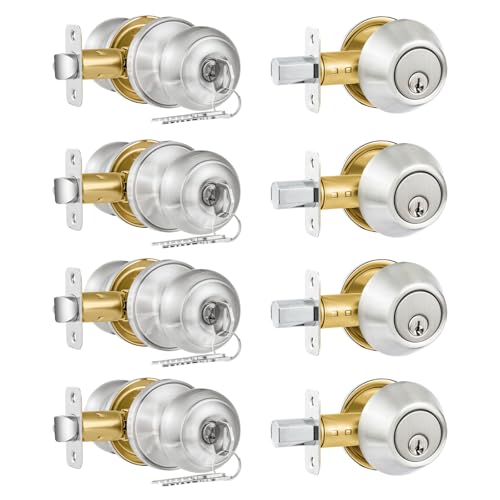
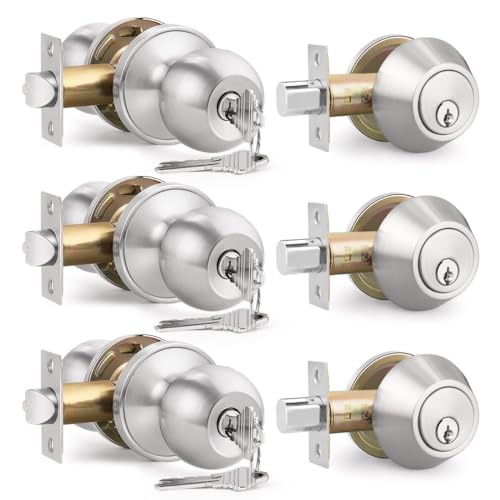
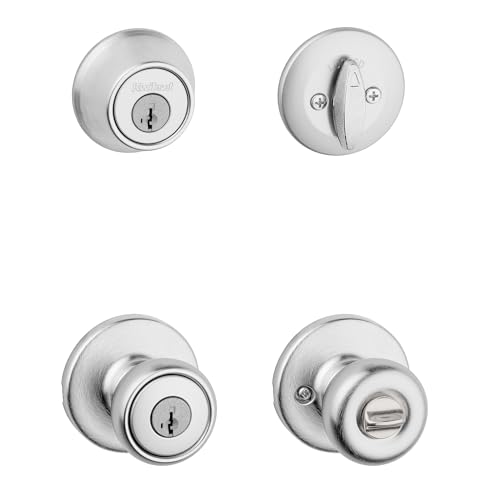
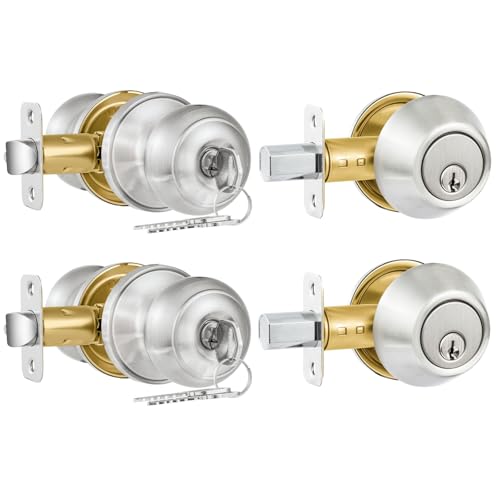
A typical front-door combo set contains a single-cylinder deadbolt for the upper bore, a handleset with an exterior grip and thumb latch or an entry lever or knob for the lower bore, an interior lever or knob, two latch and bolt mechanisms, matching strike plates for the frame, mounting screws, and one or more keys. Handlesets are the tall, architectural option. A curved or straight exterior grip mounts through the door at a lower point for rigidity, the thumbpiece operates the lower latch, and the look suits formal entries and taller doors. Lever combos pair the same deadbolt with a lever above the familiar push for accessibility, since levers can be operated with an elbow, a full hand of groceries, or limited grip strength. Knob combos remain the budget staple for side and rear doors. The deadbolt itself is usually identical across all three styles within a product family, which means the security decision and the style decision can be made almost independently.
Keyed-alike packaging deserves attention at the shelf. Some combo sets are keyed alike within the box by design, so the deadbolt and the locking lever below it share one key. Some handlesets have a non-locking lower handle, in which case only the deadbolt locks and only one cylinder exists, a configuration many households prefer because nobody can be locked out by a lever left in the locked position. Where a set has two locking cylinders, confirm from the packaging or the manufacturer keying information whether they share a key code in the box or will need a locksmith or a rekeying step to be unified. Assuming two cylinders in one box must share a key is a common and entirely avoidable disappointment, discovered at nine in the evening with the door already drilled.
Dummy and passage companions complete a household plan. Most families offer matching non-locking lever or knob sets for interior doors, dummy trim for the fixed side of double doors, and additional deadbolts keyed to the same system for the garage and rear entries. Buying into a family with those companions available, in a finish the manufacturer continues to produce, protects the matching goal over years of incremental changes. A discontinued finish or an orphan product line forces a choice between a mismatched new door and replacing hardware that still works perfectly, neither of which anyone enjoys.
ANSI and BHMA grades 1, 2, and 3 explained
The grading system administered through BHMA, the Builders Hardware Manufacturers Association, under the ANSI/BHMA A156 series of standards, is the closest thing residential locks have to an honest common language. Grade 1 is the highest residential and light commercial tier. Under the current residential deadbolt standard, Grade 1 deadbolts are subjected to the heaviest cycle testing, on the order of several hundred thousand lock and unlock cycles, the highest bolt strength and impact requirements, and the strictest tolerances for operation after abuse. Grade 2 sits in the middle, tested to fewer cycles and lower force thresholds, and suits most residential front doors very well. Grade 3 is the minimum tier, tested to the lightest duty, and is widely sold for interior and low-risk secondary doors. Exact cycle counts and force values are revised between standard editions, so the manufacturer grading certificate for the specific model, which reputable makers publish, is the document to trust over any retail summary.
What the grades mean in a kitchen-table sense is durability under repetition and resistance under attack, measured in a laboratory rather than asserted in advertising. Cycle testing opens and locks the mechanism again and again to simulate decades of family use, and a lock that binds or loosens after modest cycling will annoy its owner long before it ever meets an intruder. Strength testing applies force to the bolt, strikes the door, and attempts to defeat the cylinder by picking, drilling, and wrenching within the standard protocol. No grade makes a residential door invulnerable. A determined attack on the door slab or frame succeeds against almost any lock eventually. Grading tells you how much time, noise, and tool effort the hardware demands, and in residential security those three currencies are usually what decides whether an attempt continues or moves on.
For a primary front door, Grade 1 or a strong Grade 2 deadbolt is the sensible target, with Grade 2 being the value centre of the market where most well-made mechanical combos live. For a low-traffic side door into a garage with its own additional protections, Grade 2 remains prudent and Grade 3 is a false economy if the door is a genuine entry point, because intruders do not grade their door selection by which entrance the family considers main. Consistency matters. A house with a Grade 1 front deadbolt and an ungraded bargain deadbolt on the back door has, in practical terms, the back door level of security, dressed in front door confidence. Spend across the entry doors as a system, even if that means Grade 2 everywhere instead of Grade 1 in one place and whatever was on sale in another.
Certified grades versus grade-style marketing language
Read grading claims closely. The meaningful claim names the standard and the certifying programme, typically phrased as certified to ANSI/BHMA A156.36 for deadbolts or the corresponding standard for bored locks, with a grade number. Vague phrases about commercial-grade feel, heavy-duty construction, or meeting grade-style performance are not certification and carry no test protocol behind them. Manufacturers of genuinely certified products make the certificate easy to find, because it cost them money to earn. If a product page celebrates every attribute except a findable grade certificate, treat the omission as information. The same caution applies to handing and rekey claims examined later in this guide. Documentation that is precise where it costs the maker something is the documentation worth building a purchase around.
Single-cylinder versus double-cylinder and the fire-code trade-off
A single-cylinder deadbolt is keyed on the exterior and operated by a thumbturn on the interior. A double-cylinder deadbolt requires a key on both sides. The argument for double-cylinder is narrow and specific. If the door contains glass, or sits beside a sidelight within reach of the thumbturn, an intruder can break the glass, reach in, and rotate a thumbturn in seconds, while a double-cylinder forces them to find another way. The argument against is life safety, and it is decisive in most jurisdictions. In a fire, in smoke, in darkness, with children or guests who do not know where the interior key is kept, a double-cylinder deadbolt can trap occupants behind a locked door they cannot open. For that reason many local building and fire codes restrict or prohibit double-cylinder deadbolts on required egress doors in residences, and insurers and fire services consistently advise against them on main exits.
The modern resolution of the glass problem is usually to change the glass or the door, not the cylinder. Laminated security glazing, a door without a lite near the lock, a relocated lock position beyond arm reach through any breakable panel, or a reinforced frame all address reach-through risk without compromising escape. Where a double-cylinder is already installed and code permits it, the interior key must live in a fixed, known place immediately beside the door, never carried away, never hidden from the household, and every occupant including overnight guests needs to know the arrangement. If that discipline sounds unrealistic for your household, it is, and the honest conclusion is a single-cylinder bolt on a door whose glass problem is solved by the door itself. Check your local code before ordering, because a set that cannot legally be installed on your egress door is not a bargain at any discount.
There is a middle hardware note worth knowing. Some jurisdictions and product lines offer captive-thumbturn designs, where the interior turn piece can be removed with a key for security while occupants are away and reinstalled for normal life at home. These attempt to split the difference, and their acceptability varies by code and by inspector. Treat them as a specialist solution to discuss with the local authority and a locksmith, not as a default purchase. For the great majority of houses, the recommendation that emerges from codes, fire guidance, and locksmith practice aligns. Single-cylinder on egress doors, solve glass risk at the door, and put the saved worry into frame reinforcement, which the next sections show matters more anyway.
Measuring the door: bore, backset, thickness, and handing
Four measurements decide whether a combo set fits, and all four can be taken in five minutes with a tape measure before any order is placed. The bore diameter is the large hole through the door face that the lock body passes through. The modern standard for residential bored locks is two and one eighth inches, with older doors sometimes drilled at one and a half or one and five eighth inches. Many deadbolts include or adapt to both, but handleset bodies and rosettes assume the modern bore, and enlarging a bore cleanly in a finished door is a jig-and-hole-saw job, not an improvisation. The cross bore on the door edge, which carries the bolt itself, is usually one inch. Measure both, on every door, because previous owners and builders were not consistent and a house is under no obligation to match its own front and back preparations.
Backset is the distance from the door edge to the centre of the bore, and residential doors are prepared at either two and three eighths inches or two and three quarters inches. Most quality deadbolts and latches ship with an adjustable backset mechanism that covers both, which has made buyers careless, but adjustable mechanisms must still be set correctly before installation, and a latch installed at the wrong setting sits visibly crooked and throws the bolt at an angle to the strike. Confirm the setting against your measurement rather than assuming the factory position matches your door. Door thickness is the third measurement. Standard residential doors run from one and three eighths to one and three quarters inches, and most combo sets fit that range out of the box. Thicker architectural doors, two inches and beyond, need extension kits with longer through-bolts and tailpieces, which some manufacturers supply and others do not offer for a given model at all. A set that cannot be extended cannot be fitted to a thick door by determination.
Handing is the fourth measurement and the one that generates the most returns. A door is left-handed or right-handed depending on which side the hinges sit and the direction of swing, and levers in particular are handed because the lever shape, the return spring orientation, and any handed screw concealment assume a direction. The reliable method is to stand outside the door, on the keyed side. If the hinges are on your left, the door is left-handed. If the hinges are on your right, it is right-handed. Manufacturers publish this convention in their handing charts, though a few define it from the interior, so confirm against the chart of the brand you are buying rather than a generic diagram. Many modern levers are reversible in the field, with handing changed by swapping the levers or rotating the chassis per the instructions, which reduces ordering risk considerably. Fixed-handleset grips are inherently handed by the door itself rather than by a lever choice, but dummy and interior lever companions still need the correct call. Ordering a non-reversible lever in the wrong hand is a pure loss of a week, which is why this unglamorous measurement earns its own section in every competent installation manual.
Centre-to-centre spacing on handlesets
Handlesets add a fifth measurement that deadbolt-and-lever buyers can skip. The exterior grip mounts through the door at a point below the latch, and the distance from the centre of the latch bore to that lower mounting point, the centre-to-centre or through-bolt spacing, is fixed by the handleset design. If the door was previously drilled for a different handleset with different spacing, the existing lower hole may not align, and the choices are a set with matching or adjustable spacing, a door repair with a filler and careful refinishing, or a lever combo that needs no lower hole at all. Measure the spacing on a replacement job before falling for a design, and photograph the full door edge and both faces to compare against the manufacturer preparation diagram, which shows every required hole with dimensions. Five minutes with a tape prevents the most expensive category of mistake in this entire purchase, the beautiful set that physically cannot mount on the door you own.
Rekeyable cylinders and keyed-alike planning for the whole house
Rekeying changes which key operates a cylinder without replacing the cylinder, by rearranging the internal pin configuration to match a new key. Traditional rekeying is a locksmith task or a careful bench task with a pinning kit, performed whenever a house changes hands, a key is lost, or a contractor relationship ends. Rekeyable cylinder systems, of which the SmartKey design from Kwikset is the best-known example in manufacturer documentation, move that function into the lock itself. With the current working key inserted and a small reset tool in a dedicated slot, the cylinder can be taught a new key in under a minute, with no disassembly. Competing approaches from other makers achieve similar convenience through removable cylinders, interchangeable cores in higher tiers, or keyed-alike ordering programmes. The convenience is real and, for households that lend keys to cleaners, sitters, and tradespeople, genuinely valuable, because a lost key becomes a five-minute reset of every cylinder in the house instead of a locksmith invoice or a lingering worry.
Keyed-alike planning is where combo sets earn their keep at house scale. The goal is one key for the front deadbolt, the rear deadbolt, the garage entry, and any locking levers, so the family carries a single key and a single spare strategy. There are three routes to that goal. Buy sets that share a key code from the factory, identifiable by the code printed on the packaging in keyed-alike programmes at retailers and distributors. Buy rekeyable cylinders and teach them all one key yourself on installation day. Or buy conventional cylinders and have a locksmith pin them alike before or during fitting. Each route has a failure mode. Factory codes require finding multiple boxes with matching codes in stock. Self-rekeying requires performing the reset sequence exactly as documented, because an interrupted reset on some designs leaves the cylinder accepting neither key until serviced. Locksmith pinning adds cost but produces a verified result and a relationship with the professional you will call in an emergency anyway.
Keyway compatibility quietly governs all of this. Cylinders can only be keyed alike if they share a keyway, the profile of the key blank and the slot it enters. The two dominant residential keyways in North America are the Kwikset-style and Schlage-style profiles, and a house that mixes brands across doors may discover its front and back locks can never share a key, no matter how skilled the locksmith. When planning a whole-house set, choose one manufacturer ecosystem and one keyway for every exterior door, and note the keyway in the house records alongside the key code storage. Also consider the number of pin positions and the availability of restricted or harder-to-duplicate keys if the household threat model includes unauthorised copying, though for most families the practical risk remains the lent key that never came back, which rekeyability solves directly.
Households planning exterior monitoring at the same time often find it helpful to review placement thinking in best affordable outdoor security cameras while the door work is underway, since a camera that watches a newly reinforced entry completes the picture that the lock begins. The lock delays and resists. The record of an attempt, and the light and attention that come with visible monitoring, discourage the attempt from starting. Neither replaces the other, and sequencing the lock work first is usually right, because cameras do not hold a door closed.
Bolt throw, strike reinforcement, and where security actually lives
A deadbolt resists forced entry as a system of four parts: the bolt itself, the door material around the bore, the strike plate mortised into the frame, and the frame material behind that strike, ideally tied into the wall stud. The bolt is a solid bar of steel, typically one inch of throw, meaning it extends a full inch from the door edge into the frame when locked. That full inch matters. A bolt that only partially extends because of misalignment, a shallow strike box, or an installer shortcut may present a quarter of its designed engagement while looking perfectly locked from inside. Grade standards assume full throw. Every installation check in this guide returns, one way or another, to confirming that the bolt travels its full distance freely, with the door pulled naturally closed, not forced.
The strike is where residential security is usually lost. A standard strike plate is a small brass or steel lip held by screws of about three quarters of an inch that bite only into the door jamb, a piece of softwood trim that splits readily under a kick. Replacing those screws with three-inch screws that pass through the jamb and anchor into the wall stud behind it transforms the assembly, because the force of an impact is now shared with the building structure. A reinforced strike box, a deeper steel cup that accepts the full bolt and spreads load across a larger plate with four or more long screws, goes further and is inexpensive relative to any lock in this guide. Manufacturer and locksmith guidance agree on this hierarchy with unusual unanimity. Money spent on strike reinforcement and long screws outperforms the same money spent moving from a good Grade 2 bolt to a premium Grade 1 bolt in a weak frame, every time, because attacks defeat the weakest component and the frame is almost always that component.
Door and frame condition complete the audit. A hollow or deteriorating door slab, a split jamb from a previous attempt, a wide gap between door and frame that admits tools, or a bolt that must be lifted into alignment by hauling on the handle all announce themselves during measuring and should be repaired as part of the hardware job, not around it. Door edge reinforcement plates that wrap the bore area, and frame reinforcement kits for damaged jambs, exist precisely because locks are routinely asked to compensate for carpentry that has already failed. Stand outside at night with the door locked and look at the gap and the bolt engagement with a torch while a helper works the thumbturn. What you learn in that minute is worth more than any specification table, including the ones in this guide.
The lower latch is not a lock, and treating it as one is a mistake
The spring latch on the handle or lever below the deadbolt exists to hold the door closed against wind and to latch automatically on closing. Its angled bolt retracts when it meets the strike and can be retracted by any thin stiff object slipped into the frame gap, which is why locking levers add a small guard pin beside the latch that detects the strike and blocks that manipulation. Even with the guard, a latch is a convenience device. The deadbolt is the security device. Households that leave the lever locked and the deadbolt unthrown, because the lever felt sufficient, have protected the door with its weakest component. Build the habit the hardware assumes. The deadbolt gets thrown every time the door is meant to be secure, and the combo set layout, bolt above and handle below, is designed around exactly that routine.
Finishes, matching across doors, and weathering
Finish selection looks like a style decision and behaves like a materials decision. Common residential finishes include satin nickel, polished and satin chrome, oil-rubbed bronze, matte black, bright brass, and antique variants of each. Some are lacquered or physically vapour deposited coatings over brass, zinc, or steel substrates, and the coating system, not the colour name, determines how the finish survives a coastal winter or a sun-blasted south-facing entry. Manufacturers publish finish warranties that differ from their mechanical warranties, sometimes dramatically, and a lifetime mechanical warranty paired with a five-year finish warranty is telling you exactly which part of the product the maker expects to disappoint first. For an uncovered front door in a harsh exposure, a PVD-coated finish with a long finish warranty is worth its premium. For a covered porch in a mild climate, almost any reputable finish will outlast the household taste that chose it.
Living finishes need a specific warning. Oil-rubbed bronze and certain unlacquered brass finishes are designed to change with touch and time, developing highlights on the grip and lever where hands land. Owners who expect that evolution enjoy it. Owners who expected a fixed dark bronze are dismayed within a year. Product documentation states plainly when a finish is living, and that single line in the specification deserves more weight than a showroom photograph taken on the day of manufacture. Matching across doors also needs a dye-lot mindset. Buy all exterior sets for the house in one order where possible, because finish batches vary slightly, and a front and back set bought two years apart in the same named finish can differ visibly in daylight. Keep the finish name, the product family, and the purchase date in the house records, so a later addition starts from facts rather than a memory of something nickel-ish.
For wider views of an entry, such as a porch that spans two doors or a gate line, the field-of-view comparisons in best 4k outdoor security cameras can help a household decide how much of that newly finished hardware will actually sit inside a monitored area. Matching also extends to hinges and door viewers more often than buyers expect. A new satin nickel handleset on a door with brass hinges and a brass viewer reads as unfinished at conversational distance. Hinges are inexpensive and viewer swaps take minutes while the door hardware is already off, so include them in the plan and the order, rather than discovering the mismatch in the first photograph of the finished entry.
Mechanical versus electronic, and why this class still wins its niche
Electronic deadbolts add keypad or biometric entry, auto-locking, access codes for guests, and audit trails in connected models. Those are genuine benefits, and households that need code access for children, carers, or short-stay guests may be better served by that class. The mechanical class wins where its absences are the point. There is no battery to exhaust during a holiday, no motor to stall against a misaligned strike in a house that shifts seasonally, no keypad membrane to weather, and no account, application, or network dependency between the keyholder and their own front door. Mechanical cylinders also fail gradually and visibly, becoming stiff or reluctant over months, while electronic failures are often sudden and total. For rental properties between tenancies, for elderly relatives who want one key and no instructions, for outbuildings and second homes visited monthly, and for anyone who simply prefers a security device they can fully understand, the mechanical combo set remains the rational default, with electronics as a deliberate upgrade for a named need rather than a default assumption.
One hybrid pattern deserves mention because buyers ask about it constantly. A mechanical deadbolt above and a purely passage lever below, with access control handled by a separate system entirely, keeps the locking decision in one cylinder and one key. Conversely, mixing a smart deadbolt on the front door with mechanical combos elsewhere breaks keyed-alike unity unless the smart cylinder shares the house keyway, which some models arrange through a conventional cylinder behind the electronics and many do not. Households that value whole-house coverage of the kind described in best alexa compatible cameras for their monitoring will recognise the same principle here, since a system that shares one standard across every door is easier to live with than a showcase device on one door and orphans on the rest. Decide the house standard first, then let individual doors vary in style within it.
Installation sequence and the mistakes that cause callbacks
Fitting a combo set to a correctly prepared door is methodical rather than difficult. Remove the old hardware completely, including the old strikes, because reusing an old strike with a new bolt invites the misalignment problems below. Set the adjustable backset on both bolt and latch before they enter the door. Install the deadbolt mechanism, then the exterior and interior assemblies with the tailpiece correctly oriented through the bolt cam, a step whose orientation the instructions diagram precisely because a tailpiece ninety degrees out produces a thumbturn that locks when it should unlock. Fit the lower latch and handle with the handing configuration confirmed before the through-screws are tightened. Fit the new strikes with the door closing naturally, mark bolt contact, deepen the strike mortise or box so the bolt achieves full throw, and only then upgrade the strike screws to three-inch screws driven into the stud, taking care not to distort the jamb by overdriving into an uneven gap without shims.
Misalignment is the master fault from which most callbacks descend. If the bolt scrapes, requires the door to be pulled or lifted, or throws fully only when the weatherstrip is compressed by force, the geometry is wrong somewhere among hinge sag, strike position, latch backset setting, and frame movement. Each cause has a distinct signature. Hinge sag drops the whole door, moving both latch and bolt low together, and is fixed at the hinges with longer screws into the stud or a shim, not at the strike. A strike a few millimetres off in one axis can be corrected by enlarging the mortise in the correct direction and fitting a reinforced box that covers the work. A latch set to the wrong backset cants the bolt itself. Seasonal movement in timber doors can make a perfect January installation scrape in August humidity, which is why experienced installers leave the correct small clearances rather than chasing a silent, airtight bolt fit that the seasons will punish. Never solve misalignment by shortening the bolt, filing the bolt, or leaving the bolt partially thrown. All three convert a Grade-rated assembly into an unknown.
Wrong handing announces itself as a lever that points or springs incorrectly, a keypad-free lever whose privacy or entry function operates from the wrong side, or an interior lever that must be lifted rather than pressed. The fix is reconfiguration or exchange, not force, and it is painless before the door is finished and maddening after guests arrive. The final common mistake is overtightening. Through-screws cranked down against a slightly uneven door face bind the chassis, making keys stiff and thumbturns heavy, which owners then misdiagnose as a defective lock. Manufacturer torque guidance is unglamorous and correct. Snug, aligned, and freely operating beats tight and strained, and the operational test is simple. With the door open, the key and thumbturn should cycle the bolt through its full travel with light, even effort, and with the door closed the same effort should suffice. Any difference between those two tests is installation information, delivered free.
While the entry is stripped for hardware work, it is also the natural moment to think about what watches the door from the household side of the network, and the budget-conscious comparisons in best affordable wifi security cameras are a sensible companion read before drilling any additional holes. One coordinated project, measured once and finished properly, is the recurring theme of good door work. Every shortcut in this category is eventually paid for in the same currency, a return trip to the same door with the same tools.
How to compare sets before buying, and what to keep
Compare candidates on a written grid drawn from primary documents. Record the certified grade and the standard it was certified under, the cylinder type and whether it is owner-rekeyable, the keyway, whether keyed-alike ordering is available, the supported backsets and door thickness range and whether thick-door kits exist, whether levers are reversible or fixed-hand, the centre-to-centre spacing for handlesets, the bolt throw length, what strike is included in the box and whether a reinforced box is offered, and the separate mechanical and finish warranty terms. Add the availability of matching passage, privacy, and dummy companions in the same finish. That grid, completed from manufacturer documentation rather than retail summaries, separates serious product families from styled commodities faster than any amount of showroom handling, because the showroom cannot show you a keyway or a warranty clause.
Keep the records after installation as carefully as the keys. Note the brand, family, finish, grade, keyway, handing of each door, the key code location stored separately from the keys themselves, and the date each cylinder was last rekeyed and why. Photograph the installed strikes before the screws are painted over by time, so a future owner or locksmith can see the reinforcement that is actually present. Houses change hands, keys wander, and relatives arrive with spares cut decades earlier. A household that can answer, from its own records, exactly what hardware is on every door and which key operates it, holds an advantage that no single product purchase can provide.
Cylinder security features: pins, drill resistance, and bump resistance
Inside a pin tumbler cylinder, a row of spring-loaded pin stacks blocks the plug from rotating until the correct key lifts each stack to a shear line. Standard pins are plain cylinders, and a skilled picker manipulates them one at a time with modest difficulty. Security pins change that work. Spool and serrated driver pins catch at the shear line and give false feedback, mushroom pins resist raking, and additional pin positions increase the number of combinations and the time an attempt requires. Manufacturers describe these features in cylinder documentation with varying precision, and grading standards test picking resistance within a defined protocol and time, which is another reason the certified grade carries more information than any individual feature claim. A cylinder advertised with anti-pick pins but no grade certificate is asking you to trust a component. A certified assembly has had the whole mechanism, pins included, examined as a system.
Drill resistance is provided by hardened steel pins, plates, or ball bearings placed where a drill bit would be aimed at the shear line or the retaining screws, blunting or deflecting the bit and slowing the attack into noise and time. Bump resistance addresses a different technique, in which a specially cut key is struck to bounce the pin stacks momentarily to the shear line. Security pin geometries, tighter tolerances, and in some designs additional sidebar or finger-pin elements all reduce susceptibility. No residential cylinder is honestly described as pick-proof, drill-proof, or bump-proof, and documentation that uses proof language should be discounted accordingly. The defensible claim is resistance measured in minutes under standardised attack, and for a house those minutes, combined with a reinforced frame and a dog, a light, or a neighbour, are the actual security mechanism. Choose a cylinder whose maker describes resistance in those measured terms.
Key control is the administrative half of cylinder security. Standard residential keys can be duplicated at any kiosk from the key alone, which is convenient when a spare is needed and uncomfortable when a lent key is unaccounted for. Higher-control key systems restrict blank availability to authorised dealers who require identification or a security card before cutting, and the blanks themselves are protected by utility patents for a period. Households do not need restricted keyways to be safe, but they do need an honest inventory. Count the keys in circulation, mark them by household member rather than by door, and treat an unrecoverable key as a rekeying event. That discipline, which costs nothing, closes the most common real-world bypass of all, which is not picking or drilling but simply using a copy nobody remembered existed.
Double doors, garage entries, and other special cases
Double entry doors complicate the combo picture because one leaf is usually fixed by flush bolts at head and sill while the active leaf carries the deadbolt and handle. The deadbolt on the active leaf throws into a strike mounted on the fixed leaf or on an astragal between them, which means the strength of the whole assembly depends on how well the fixed leaf is anchored. A beautifully graded deadbolt throwing into a strike screwed only into a loosely bolted inactive leaf inherits that leaf weakness completely. Reinforce the flush bolt engagement, confirm the fixed leaf does not flex when the active door is pulled while locked, and fit a dummy handleset on the fixed leaf that matches the active set, so the entry reads as designed rather than improvised. Handing and spacing measurements multiply on double doors, and the manufacturer preparation diagrams for paired doors should be followed literally.
The door from a garage into the house is an entry door in every way that matters and is treated as a spare closet door in a surprising number of homes. Garages contain tools that assist entry, conceal an intruder from the street while they work, and often connect to an exterior door or an overhead door with its own weaknesses. Building codes in many areas already require this door to be fire-rated and self-closing, which makes it thick, heavy, and an excellent candidate for a proper Grade 2 combo set keyed alike with the rest of the house. The self-closing hinge affects lock alignment, because the door arrives at the frame with more force and less patience than a hand-closed door, so strike position and latch engagement deserve particular care there. Keying this door into the house system also removes the temptation to hide a spare key in the garage, a location every intruder checks with professional thoroughness.
Historic and non-standard doors require a slower version of the same process. Narrow stiles on older panelled doors or French doors may not accept a modern two-and-one-eighth-inch bore without weakening the rail, and mortise lock conversions exist for exactly this situation, at higher cost and with locksmith involvement. Surface-mounted rim deadbolts offer another route for doors that cannot be bored, trading the clean look of a bored combo for honest function on a door that predates the standard. The principle does not change with the door age. Measure first, respect the material, and never let a modern product dimension dictate a cut that the door itself cannot afford. A preserved historic door with a well-chosen rim bolt is better secured, and worth more, than the same door ruined by a forced modern bore.
Maintenance, lubrication, and knowing when to replace
Mechanical locks ask for very little maintenance, which makes the little they ask for easy to neglect for a decade. Cylinders should be lubricated with a dry lubricant, graphite or a modern synthetic dry film recommended by the manufacturer, never with household oil, which collects dust into an abrasive paste inside the pin chambers and eventually causes the stiffness it was meant to cure. A small application once a year, followed by working the key several times, keeps pins moving freely. Bolt and latch mechanisms benefit from the same restraint. If a key begins to require jiggling, first try a freshly cut key made from the original rather than from the worn copy, because keys wear alongside cylinders and a duplicate of a worn key reproduces the wear faithfully. Many mysterious lock faults are, on inspection, key faults wearing a disguise.
Replacement triggers are worth naming plainly. Replace or at minimum rekey cylinders on moving into any home, without exception and without weighing the previous owner character, because the key inventory of strangers is unknowable. Replace a deadbolt whose bolt no longer throws fully, whose cylinder spins or pulls, whose housing is cracked, or which has survived a genuine forced attempt, since internal damage from an attack is not reliably visible from outside. Replace hardware whose finish has failed to bare, corroding metal on an exterior door in a wet climate, because corrosion migrates from surface to mechanism. And replace any lock whose keys have proliferated beyond the household ability to count them, choosing an owner-rekeyable system this time, so the next reset is a minute of work rather than a purchase. Maintenance records, kept with the house file described earlier, turn each of these decisions from a guess into a date and a reason.
Handleset, lever, or knob: choosing the lower half for daily life
The lower half of the combo is operated far more often than the deadbolt, so its ergonomics dominate how the entry feels across a year. A handleset grip with a thumb latch suits a formal front door and gives a large, positive action that works with gloves in winter, but the thumbpiece mechanism contains a spring and a linkage that cheaper executions execute poorly, producing a loose, rattling grip within a season. A lever is the most forgiving operator for children, older hands, arthritic joints, and anyone carrying shopping, and lever return springs are the component to interrogate in documentation, because a lever that droops after two years announces tired springs every time the door is seen. A knob is compact and inexpensive and the hardest of the three to operate with full hands or reduced grip, which is why knobs have steadily retreated to interior and secondary doors in modern practice. None of these choices changes the deadbolt security decision above them, and separating the two decisions, security above, ergonomics below, simplifies the whole purchase.
Accessibility deserves a deliberate sentence in the plan rather than an afterthought. Lever handles operated without tight grasping are the recognised accessible choice, and households expecting ageing parents, recovering injuries, or simply decades of their own future use should weight levers accordingly on every exterior and interior door in the matching family. The cost difference at purchase is small. The cost of re-handing and replacing a house of knobs later, when the need has already arrived, is not. Similarly, consider the height and reach of the deadbolt thumbturn for shorter household members, and the key insertion height on the exterior, before the bores are committed. Doors forgive very little repositioning, and the measurements taken at the start of this guide are the moment when those human details can still change the outcome for free.
Check prices on Amazon
Live listings for the shortlist in this guide are pulled from Amazon below, so prices and availability are always current at the moment you look.

Amazon Basics Exterior Door Knob with Key Lock and Deadbolt, Keyed Alike, Coastal, Matte Black


Gaps, weatherstripping, and the door as a sealed system
A locked door that rattles in its frame is telling you two things. The bolt engagement is probably shallower than designed, because the door rests away from the strike at rest, and the weather seal is leaking air and water at the same gap. Correcting the latch-side gap with strike position, hinge adjustment, and fresh compression weatherstripping improves security, comfort, and energy use in a single afternoon, and it should be done before judging any new lock, because new hardware fitted to a loose door inherits the looseness and gets blamed for it. Conversely, weatherstripping so thick that the door must be slammed to latch will bend latch bolts and strain handleset linkages across a season. Aim for a door that closes with a firm push, latches with a clean click, throws its bolt with the light effort described earlier, and sits silent in a gust. That combination is the sound of a system in adjustment, and it is achievable on most doors with patience rather than parts.
Thresholds and door bottoms complete the seal and quietly support security by denying leverage and tool access at the bottom rail. A worn threshold that lets the door flex at its base undermines the frame story told throughout this guide, no matter how strong the strike at lock height. While the combo set is being fitted, inspect the threshold fixings, the door sweep, and the bottom corners of the jamb for rot or splitting, and repair what is found. Entry doors fail as assemblies, not as components, and the households that understand that sentence stop shopping for a miraculous lock and start maintaining a sound door, which is the entire philosophy of the mechanical combo class in one line.
One last habit ties the whole project together. After installation, stand outside each finished door with the household key ring in hand and work every lock slowly, front, back, and garage, in daylight and again after dark. Every cylinder should accept the same key with the same light effort, every bolt should throw fully without hauling on the door, and every lever should return level and silent. That short inspection, repeated whenever a cylinder is rekeyed, is the household proof that the system on paper is the system on the doors.
Certain purchasing links in this guide point to retailers, and Gizmo may receive a commission on qualifying purchases, at no additional cost to you, which supports the research time that documentation-heavy buying guides require. The assessments here rest on published grading standards, manufacturer specifications, and established locksmith practice, not on any representation that the writer has fitted or operated the exact set you will choose for your door, so confirm dimensions and grade certificates against the current documentation for the precise model and revision before ordering. Choose the grade honestly, reinforce the frame without exception, measure the door twice, and a mechanical combo set will quietly do its one job, every day, for longer than most of the technology elsewhere in the house.


