Our Top Picks




What's inside
- How to choose a kids science set
- The two age tiers in this guide
- The eight kits, one by one
- UNGLINGA 150 Experiments Science Kit
- National Geographic Science Magic Kit
- National Geographic Amazing Chemistry Set
- National Geographic Mega Science Lab
- National Geographic Junior Chemistry Set
- Doctor Jupiter My First Science Experiments Kit
- Butterfly EduFields Science Kit
- Science Kit for Kids with 80 Science Lab Experiments
- Safety, supervision, and good lab habits
- Getting the most learning from any kit
- Frequently asked questions
- Check prices on Amazon
- Our verdict
As an Amazon Associate I earn from qualifying purchases. This post may contain affiliate links at no extra cost to you.
A good kids science set does more than fill an afternoon. It gives a child a reason to ask what happens next, a safe way to try an idea, and a clear result to talk about afterward. The challenge for parents is that science kits look similar on the surface while aiming at very different ages, attention spans, and levels of independence. A set built for a four-year-old who is still learning to pour, stir, and watch closely is not the same purchase as a chemistry lab for a ten-year-old who can read multi-step instructions, measure carefully, and wait days for crystals to form. This guide separates those two worlds, explains what the experiment counts and theme words in each product name actually signal, and walks through eight distinct kits one by one so you can match the box to the child in front of you.
Our research for this roundup focused on three questions. First, what age does the maker actually claim in the product name, and does the activity mix fit that claim? Second, what kinds of experiments are named — volcano builds, crystal growing, magic-style chemistry, digging, reactions, physics, or earth science — because theme matters more than raw count for keeping interest alive. Third, how much adult involvement will the format realistically need? Every kit on this list benefits from an adult nearby, but the younger sets need an adult leading each step, while the older sets are designed for a child aged eight to twelve to lead, with an adult supervising, checking safety steps, and joining the discussion at the end.
One warning before the details: a bigger number on the box does not automatically mean a better kit. A focused set with fifty well-sequenced experiments for a young child can teach more than a sprawling set that a child is not yet ready to use. Count experiments as a sign of variety and longevity, then look at age fit, theme fit, and how the activities build on each other. The strongest choice is the one a child will return to for a second, third, and tenth session, not the one with the longest list on day one.
How to choose a kids science set
Start with age, and be honest about it. Age ranges in these product names are not marketing decoration. They reflect reading level, hand control, patience, and the kind of reactions involved. A kit aimed at ages four and up will use larger actions, simpler sequences, and results a young child can see quickly. A kit aimed at ages eight to twelve can assume the child can follow written steps in order, handle smaller tools, record observations, and understand that some results take time. Buying ahead of the stated age usually leads to an adult doing the whole activity while the child watches, which removes the learning the set was built to deliver. Buying below the stated age can bore an older child who finishes every activity in a single sitting and finds nothing left to explore.
Next, choose a theme your child already leans toward. A child fascinated by tricks and surprises may engage deeply with a magic-themed chemistry kit, learning the same reaction principles through performance and reveal. A child who loves rocks, soil, and the outdoors may prefer earth science and digging activities. A child who wants the full laboratory feeling — mixing, measuring, watching colour changes, and growing crystals — will likely prefer a broad chemistry set. Theme is the hook; the science is what stays. All eight kits here involve real observation and cause and effect, but they package that learning very differently, and the packaging decides whether the box gets opened again.
Then think about session length and mess. Volcano and reaction activities are exciting and often quick, with a clear climax and a cleanup job afterward. Crystal growing is the opposite rhythm: careful setup, then waiting, checking, and comparing over days. Dig activities reward patience and fine motor control. Physics activities often involve building or balancing and can be repeated with small changes. A household that wants a rainy-afternoon activity needs a different rhythm from a household building a weekend project routine. Many families do best with a kit that mixes rhythms — some fast results to build confidence and some slower projects that teach a child to return, observe, and notice change over time.
Finally, plan for storage and repeat use. Kits with many small tools and materials stay useful only if everything goes back into the box or a labelled container after each session. Before the first activity, walk through the contents together, name the tools, and agree where each item lives. Children who help organise a kit tend to treat it as their own laboratory equipment rather than a disposable toy, and that mindset changes how carefully they follow steps and clean up afterward.
The two age tiers in this guide
Ages four and up: guided first science
Two kits in this roundup belong to the younger tier. The Doctor Jupiter kit is explicitly aimed at kids ages four and up, naming ages four, five, six, seven, and eight in its title, and the National Geographic Junior Chemistry Set is positioned as an early learning lab with fifty experiments and more than twenty lab tools. For this age group, the adult is a co-experimenter, not a bystander. Expect to read every instruction aloud, pre-measure where needed, handle any step that requires precision, and narrate what is happening in simple language. Sessions should be short, with one clear result per sitting, and praise should target observation — noticing a bubble, a colour shift, a texture — rather than speed or getting an expected answer.
Young children learn science first as language and attention. They are building words such as mix, dissolve, float, sink, grow, and change, and they are learning that actions have repeatable effects. A junior lab with real tools sized for learning gives them the rituals of science — wearing the role, using equipment carefully, following a sequence — long before formal chemistry vocabulary arrives. That is genuine value, as long as expectations stay matched to the tier: wonder, vocabulary, and careful habits, not independent lab work.
Ages eight to twelve: the chemistry core
Six kits here target the eight-to-twelve band, with one extending to fourteen. This is the core chemistry age: children can read instructions independently, sequence multi-step activities, handle measuring and timing, and begin to explain why a reaction happened rather than only what happened. Kits in this tier offer one hundred or more experiments in several cases, spanning crystal growing, chemical reactions, volcano activities, magic-themed demonstrations, earth science, and physics. An adult should still supervise, check the setup before anything is mixed, and stay within earshot, but the child can and should lead.
For this age group, encourage record-keeping. A simple lab notebook — date, activity name, prediction, result, and one question for next time — turns a fun kit into a genuine introduction to scientific method. Older children in the band can also compare activities across kits: how does a crystal activity in one set differ from a crystal activity in another, or how does a magic presentation change how an audience interprets the same kind of reaction? Those comparisons build the analytical habits that school science will reward.
Families with children in both tiers sometimes ask whether one kit can serve everyone. Our research suggests choosing per child where possible. A younger sibling can watch an older child’s volcano or crystal reveal and learn plenty from watching, and an older child can help demonstrate a junior activity, which builds teaching skill. But each child deserves at least some activities pitched at their own level, where the challenge is real and the success is theirs. If science becomes a shared shelf in your home, pairing a junior set with an eight-to-twelve set covers birthdays and school years far better than a single compromise purchase, and it sits naturally alongside other hands-on learning gifts families often compare, such as the drawing tools covered in our guide to best graphic tablets for kids for creative projects at home.
The eight kits, one by one
UNGLINGA 150 Experiments Science Kit
The UNGLINGA kit makes the broadest promise in this roundup: one hundred and fifty experiments under a chemistry lab and STEM banner, with six named activity families in its title — volcano, crystal, magic, dig, reaction, and physics. That spread is its defining feature. Instead of committing to a single theme, it samples nearly every kind of activity a child in the elementary and middle years tends to ask for, which makes it a sensible first big kit for a family that does not yet know which direction a child’s curiosity will run.
The volcano and reaction activities provide the fast, dramatic results that hook new experimenters. The crystal activities slow the pace and reward returning to observe growth over time. Dig activities add a tactile, excavation-style experience that feels different from mixing and pouring, and the physics strand broadens the set beyond chemistry alone, giving children who prefer building and motion a way in. The magic strand, meanwhile, frames some activities as surprises to reveal, which can motivate a child who enjoys showing results to family members.
Because the range is so wide, this kit rewards a family that plans a loose order rather than opening activities at random. Start with quick reaction activities to learn the routine and safety habits, move to dig and physics activities to build patience and hand control, and save crystal projects for when the child is ready to set something up and wait. Working through the kit in themed runs — a volcano week, a crystal fortnight — helps a child compare similar activities and notice what changes when one variable changes.
- Experiment count: 150 experiments, the joint-highest count in this guide.
- Named themes: volcano, crystal, magic, dig, reaction, and physics activities.
- Positioning: chemistry lab and STEM toy set for kids.
- Best for: families wanting maximum variety in a single box.
The main consideration is supervision and organisation. One hundred and fifty activities means many components and many instruction sequences, so a storage routine and an adult checking setups matter more here than with a smaller, focused kit. For a child who loves variety and a household happy to treat the kit as a long-term project shelf rather than a weekend toy, this is a strong anchor purchase. For a child who already knows they only care about one theme, a focused kit below may deliver more depth where it counts.
National Geographic Science Magic Kit
This is the first of four distinct National Geographic kits in this guide, and it should not be confused with the other three. The Science Magic Kit offers more than one hundred experiments for kids aged eight to twelve, and its identity is performance: magic tricks built on chemistry activities. The science is real, but the framing is showmanship — learning how an effect works, practising it, and then presenting it to an audience that does not know the method.
That framing teaches something the other kits do not emphasise as strongly: science communication. A child performing a magic-style experiment must set up carefully, follow steps exactly, and time a reveal, all while watching an audience’s reaction. If a step is skipped, the trick fails publicly, which is a memorable and low-stakes lesson in why procedure matters. Afterwards, explaining the chemistry behind a trick to a curious friend or grandparent is an excellent exercise in turning observation into clear language.
The eight-to-twelve age claim fits the format. Performing requires reading, rehearsal, and enough hand control to execute steps smoothly, plus the social confidence to present. Younger children may enjoy watching these activities, but the kit is designed for the child who performs them. Families should expect the adult role to shift here: less hands-on help during practice, more audience duty, and a helpful agreement about which tricks get explained to family and which stay secret for the next show.
- Experiment count: more than 100 experiments.
- Stated age: kids aged 8 to 12.
- Named themes: magic tricks and chemistry activities.
- Best for: children who love performing, surprises, and showing others.
Choose this kit when personality fit matters most. A shy child who prefers quiet observation may get more from the crystal and earth science sets below, while a born performer may work through this entire box with an enthusiasm a general kit never unlocks. It also pairs well with a family culture of capturing performances — many parents who enjoy filming a child’s science show also look at our roundup at best instant print cameras for kids when they want instant photos of birthdays, shows, and project reveals to stick straight into a lab notebook.
National Geographic Amazing Chemistry Set
The second National Geographic kit here, the Amazing Chemistry Set, is the brand’s straight chemistry offer for this age band: more than one hundred experiments for ages eight to twelve, with crystal growing and chemical reactions named as its headline activities and a clear STEM positioning. Where the Science Magic Kit wraps chemistry in performance, this set presents chemistry as chemistry — mix, react, observe, and grow.
Crystal growing deserves special attention because it teaches a scientific rhythm nothing else in a kit quite matches. The setup demands care and accuracy; the result demands patience. A child learns to prepare a growing activity properly, place it somewhere undisturbed, check it on a schedule, and describe gradual change. That is a genuine introduction to how much of real science is waiting and watching, not instant spectacle. Pairing crystal projects with faster reaction activities in the same set keeps motivation balanced: something exciting today, something developing for next week.
The reaction activities supply the immediate feedback. Colour changes, bubbling, and other visible effects give children concrete events to predict and explain, and repeating a reaction while changing one element — order, amount, timing as the instructions allow — introduces the idea of variables in a natural way. For a child aged nine, ten, or eleven showing early interest in school chemistry, this is the most direct preparation among the National Geographic options here.
- Experiment count: more than 100 experiments.
- Stated age: ages 8 to 12.
- Named themes: crystal growing and chemical reactions, with a STEM focus.
- Best for: children who want the classic chemistry experience.
Compared with its siblings, this is the purist’s choice: no magic framing, no earth science detour, no junior simplification. Families choosing between the National Geographic kits should start by asking which framing their child will love, because the underlying commitment — an adult supervising, a notebook nearby, a shelf for ongoing crystal projects — is the same. Pick the framing that gets the box opened most often.
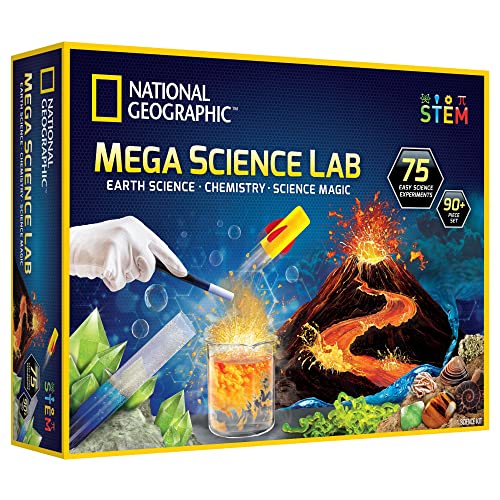
National Geographic Mega Science Lab
The third National Geographic kit, the Mega Science Lab, takes a breadth approach within the brand: seventy-five experiments for kids aged eight to twelve spanning earth science, chemistry, and science magic. The count is lower than its two siblings above, and that is not a flaw — it reflects a different design. Instead of going deep on one theme, the Mega Science Lab samples three fields in one box, which suits a child whose interests are still forming or who gets bored doing similar activities in a row.
Earth science is the differentiator here. Among the National Geographic options in this guide, this is the one that explicitly names earth science, bringing rocks, soil, and the natural world into a list otherwise dominated by bench chemistry. For a child who collects stones, asks about volcanoes in nature rather than in a model, or prefers outdoor questions to kitchen-table ones, that strand can be the reason this kit clicks. Chemistry and science magic activities round out the mix, so the box still delivers reactions and reveal-style fun alongside the earth science core.
Seventy-five experiments is also a practical size. It is substantial enough to last months of weekend sessions, yet small enough that a child can realistically finish the whole programme — and finishing matters. A child who completes a full kit gains a sense of mastery and a complete record in their notebook, which can be more motivating than owning a larger box that always feels barely started. Households with limited storage will also find a mid-sized kit easier to keep organised.
- Experiment count: 75 experiments.
- Stated age: kids aged 8 to 12.
- Named themes: earth science, chemistry set activities, and science magic.
- Best for: varied interests, nature-leaning kids, and families wanting a finishable programme.
In short, the four National Geographic kits divide cleanly: Magic for performers, Amazing Chemistry for purists, Mega Science Lab for breadth across earth science and chemistry, and the Junior set, covered next, for younger children. Treating them as interchangeable misses the point of each; treating them as a menu makes choosing easy.
National Geographic Junior Chemistry Set
The fourth National Geographic kit is the one for younger children. The Junior Chemistry Set offers fifty experiments for kids, more than twenty lab tools, and an explicit early learning lab positioning. Everything about that description signals a different tier from its three siblings: fewer experiments, more emphasis on the tools themselves, and activities designed for a child who is learning the rituals of a lab before the content of chemistry.
The twenty-plus lab tools are the heart of the offer. For a young child, holding, naming, and correctly using real lab-style equipment is the lesson. Pouring carefully, stirring deliberately, and carrying a container with two hands build motor control and respect for procedure. An adult should introduce tools one or two at a time, name each one, and let the child practise with water before any activity begins. That rehearsal turns nervous first attempts into confident ones and dramatically reduces spills during real experiments.
Fifty experiments is the right scale for this tier. Young children benefit from repetition more than novelty; doing a favourite activity three times, noticing something new each time, teaches more than racing through a huge catalogue once. Expect to revisit hits, and treat that as success. Sessions should stay short, end while the child is still interested, and always close with the same ritual: describe the result, draw it, and put every tool back in its place.
- Experiment count: 50 experiments.
- Tools: more than 20 lab tools included.
- Positioning: junior chemistry and early learning lab for younger kids.
- Best for: a first science set before the eight-to-twelve kits.
Do not buy this set for a confident ten-year-old, who will outgrow it quickly, and do not skip it for a curious five-year-old in favour of an older kit, which would frustrate everyone. Within its tier, it is the structured, brand-backed option, and it creates a natural progression: a child who grows up with this junior lab can graduate to the Amazing Chemistry Set or Mega Science Lab from the same family of kits, carrying their notebook habits and tool skills with them.
Doctor Jupiter My First Science Experiments Kit
The Doctor Jupiter kit is the most explicitly age-defined product in this guide. Its title names kids ages four and up and spells out ages four, five, six, seven, and eight, for both boys and girls, under a My First Science Experiments banner. That first-kit framing matters: this set is designed as an introduction, the box a family buys when a preschool or early-school child starts asking how and why about everyday effects.
For this age, the adult’s job is central. Read each activity aloud in short steps, demonstrate the first action, then hand over. Ask prediction questions a young child can answer with a point or a single word — will it float or sink, what colour will it become — and celebrate careful watching. Keep a simple record together: a drawing of the result with the date is a perfect lab notebook at age five, and a wall of those drawings shows a child their own progress over months.
The span up to age eight in the title also gives this kit a longer runway than a strictly preschool toy. A four-year-old will use it as guided discovery with an adult leading throughout. A seven- or eight-year-old who is new to science kits can use the same box more independently, reading steps, setting up, and explaining results, building confidence before moving to the eight-to-twelve chemistry sets. Families buying for a child on the cusp of that transition often find a first kit like this removes the intimidation factor entirely.
- Stated age: ages 4 and up, naming ages 4, 5, 6, 7, and 8.
- Audience: for boys and girls.
- Positioning: a first science experiments kit.
- Best for: introducing a young child to experiments for the first time.
The choice between this kit and the National Geographic Junior set comes down to emphasis. Doctor Jupiter leans into the first-experiments milestone and the widest stated young age span, while the Junior set leans into lab tools and early chemistry identity. Either serves the tier well; pick the one whose framing excites your child more, because at this age excitement is the curriculum. Screen-based alternatives can wait — and when families do compare tablets for this age group, note that one of our related guides is filed under the exact slug best affoedable tablets for kids in our index, spelling included, so search for it exactly as written.
Butterfly EduFields Science Kit
The Butterfly EduFields kit targets the widest older age band in this guide — kids aged eight to twelve to fourteen — and matches the highest experiment count, with more than one hundred and fifty experiments and volcano and crystal growing activities named in its title. Extending the stated range to fourteen makes this the natural choice for an older child, a pre-teen, or a family buying for siblings across the top of the elementary years and into early secondary school.
Volcano and crystal growing as the two named activities form a classic pairing. Volcano work delivers the build-and-erupt satisfaction that many children specifically request by name, often inspired by school topics or nature programmes. Crystal growing provides the slow project strand, and for an older child it can be handled with real rigour: scheduled observations, sketches or photos at set intervals, and a written conclusion comparing growth across days. The same kit therefore serves both the child who wants a spectacle this afternoon and the developing scientist who can sustain a project across a fortnight.
The count above one hundred and fifty gives this set longevity, which matters more at the top of the age range. A twelve- or thirteen-year-old works faster and thinks harder than an eight-year-old, so a smaller kit can be exhausted quickly. A deep catalogue lets an older child be selective, skip activities that look too familiar, design their own order, and return to favourites with variations. That selectivity is itself a skill: choosing what to investigate is part of doing science.
- Experiment count: more than 150 experiments.
- Stated age: kids aged 8 to 12 to 14.
- Named themes: volcano and crystal growing activities.
- Best for: older children, pre-teens, and mixed-age siblings.
If your child is eleven or older, this kit and the UNGLINGA set are the two to compare most closely: both promise one hundred and fifty or more experiments, but UNGLINGA spreads across six named themes while Butterfly EduFields headlines the volcano and crystal pairing with the older age ceiling. Theme preference and the child’s age should decide between them.
Science Kit for Kids with 80 Science Lab Experiments
The final kit takes a different route to engagement: eighty science lab experiments combined with scientist role play and educational scientific tools. The role play element is not a gimmick. Children who dress the part, adopt the title of scientist, and handle a set of scientific tools as their professional equipment approach instructions differently — more carefully, more proudly, and with more willingness to record results properly. Imaginative framing and rigorous habit-building reinforce each other at this age.
Eighty experiments is a well-judged middle count. It comfortably exceeds a starter set, giving months of sessions and enough variety to find personal favourites, without the organisational weight of the largest catalogues. For a family buying a first eight-plus kit who feels the hundred-plus sets sound overwhelming, this size is a pragmatic sweet spot: plenty to explore, still realistic to finish, and easy to store and audit before each session.
The educational learning positioning in the title signals how the set wants to be used: as a learning tool, not only entertainment. That makes it a good fit for home-schooling families and for parents who like to connect kit activities to school topics — doing a related experiment the same week a topic appears in class, then letting the child explain the kit version to the family at dinner. The role play strand also makes this the most giftable kit for a child who loves dressing up, laboratories in storybooks, or playing at professions.
- Experiment count: 80 science lab experiments.
- Format: scientist role play with scientific tools.
- Positioning: STEM educational learning.
- Best for: imaginative children and a manageable mid-sized programme.
Parents of children who split their enthusiasm between imaginative play and screen entertainment often ask how kits like this compete for attention; our research notes that a role play lab usually wins the first hour after school, while families researching a shared family device for games and videos tend to start from our guide at best affordable tablets for games and keep the science kit as the hands-on counterweight.
Safety, supervision, and good lab habits
Every kit in this guide is a children’s product, but chemistry activities always deserve structured supervision. Read each activity fully before opening any materials, set up on a tray over a washable surface, and keep food and drink away from the work area. Hands get washed after every session, materials stay in the kit rather than wandering into kitchens or bedrooms, and anything the instructions say to keep away from eyes or mouth is treated as a hard rule, not a suggestion. An adult should handle any step an instruction reserves for adults, without exception or negotiation in the moment.
Build habits in a fixed order so they become automatic. First, tie back long hair and roll sleeves. Second, lay out only the tools and materials the current activity needs, leaving the rest in the box. Third, read, predict, then begin. Fourth, never mix anything beyond what the current instructions describe — curiosity about combining leftovers is a question to discuss, not an experiment to improvise. Fifth, clean up completely and wash hands. Children who internalise this routine with a junior kit carry it into school laboratories years later, which may be the most durable thing any of these sets teaches.
Also decide in advance where ongoing projects live. Crystal growing and similar slow activities need a spot where they will not be knocked, moved, or investigated by pets and younger siblings. A labelled shelf or tray corner, agreed by the whole household, prevents the most common science kit heartbreak: a week’s careful growth tipped over during tidying. Put the lab notebook with the project, so observation notes happen at the project rather than from memory later.
Getting the most learning from any kit
Whichever set you choose, three practices multiply its value. The first is prediction. Before every activity, ask what the child expects and why, and write it down even when it is wrong — especially when it is wrong, because comparing a wrong prediction with a real result is where explanations form. The second is repetition with one change. Repeating a favourite activity while altering a single element the instructions permit teaches variables, fairness in comparisons, and the idea that a result should be reproducible. The third is teaching back. A child who explains an experiment to a sibling, grandparent, or friend — or performs it, in the case of the magic kit — consolidates understanding far beyond what doing the activity alone achieves.
Know when to move up a tier. Signs a child has outgrown a junior set include reading the instructions faster than you can, asking why at a level the activities cannot answer, and finishing sessions early while asking for more steps. Signs an eight-to-twelve child is ready for deeper work include keeping a notebook without prompting, planning the next session independently, and comparing results across activities unprompted. At those points, the next kit is not a reward for finishing; it is the correct tool for the scientist the child has become.
Frequently asked questions
Which kit is best for a five-year-old?
Choose from the younger tier: the Doctor Jupiter My First Science Experiments Kit, stated for ages four and up, or the National Geographic Junior Chemistry Set with its fifty experiments and more than twenty lab tools. Plan to lead every session, keep activities short, and focus on observation and vocabulary rather than explanations.
Which kit is best for a ten-year-old?
Any of the eight-to-twelve sets can fit, so choose by theme. Pick the Amazing Chemistry Set for classic crystal growing and reactions, the Science Magic Kit for a performer, the Mega Science Lab for earth science breadth, the UNGLINGA kit for the widest theme spread, the Butterfly EduFields kit for volcano and crystal depth with headroom to age fourteen, or the eighty-experiment role play kit for an imaginative child who loves the scientist persona.
Are the four National Geographic kits the same?
No. They are four different products from the same brand. The Science Magic Kit covers more than one hundred experiments built around magic tricks and chemistry for ages eight to twelve. The Amazing Chemistry Set covers more than one hundred experiments centred on crystal growing and chemical reactions for ages eight to twelve. The Mega Science Lab covers seventy-five experiments across earth science, chemistry, and science magic for ages eight to twelve. The Junior Chemistry Set covers fifty experiments with more than twenty lab tools as an early learning lab for younger kids.
Does a higher experiment count always mean better value?
No. Count signals variety and how long a kit can stay in rotation, but age fit and theme fit decide whether a child actually uses it. A fifty-experiment junior set used weekly teaches more than a one-hundred-and-fifty-experiment set that sits unopened because the child is too young for it. Match the tier first, then compare counts within that tier.
How much adult involvement is needed?
For the four-and-up kits, an adult should lead throughout. For the eight-to-twelve kits, an adult should read new activities with the child, check setups before mixing begins, and stay nearby, while the child leads the steps. In both tiers, the adult owns safety rules, cleanup standards, and storage of materials between sessions.
Check prices on Amazon
Live listings for the shortlist in this guide are pulled from Amazon below, so prices and availability are always current at the moment you look.


Our verdict
There is no single winner here because there is no single child. For the youngest experimenters, Doctor Jupiter offers the clearest first-kit promise for ages four and up, while the National Geographic Junior Chemistry Set suits families who want the tools and rituals of an early learning lab. For the eight-to-twelve core, the UNGLINGA one-hundred-and-fifty-experiment kit and the Butterfly EduFields kit with more than one hundred and fifty experiments offer the deepest catalogues, divided by theme spread versus a volcano and crystal focus with an age ceiling of fourteen. Within National Geographic, choose Magic for performers, Amazing Chemistry for purists, and the Mega Science Lab for earth science breadth at a finishable seventy-five experiments. The eighty-experiment role play kit rounds out the list for imaginative children who will thrive as the resident scientist.
Use the age tier as your first filter, theme as your second, and count as your third, and any kit on this list can earn its shelf space. Add a notebook, a tray, and a household agreement about where growing crystals live, and you have turned a gift into a habit — one prediction, one observation, and one careful cleanup at a time.
Affiliate disclosure: This article contains affiliate links to products discussed above. If you buy through one of those links, gizmoverdict.com may earn a commission from the retailer at no additional cost to you. That support helps fund our research and writing on guides like this one. We choose which products to cover based on our research into age fit, themes, and experiment mix, and a commission never decides whether a kit appears in this guide or how its strengths and limits are described.


