Our Top Picks



What's inside
- Quick overview of the seven hardware sets
- Imdinnogo screw assortment for Bambu Lab X1, X1C, X1E, P1P, P1S, and AMS
- Imdinnogo screw assortment for Bambu Lab A1, A1 Mini, and AMS Lite
- A1 and A1 Mini screw assortment kit with repair tools
- mxuteuk 540-piece M2 and M3 screw assortment for 3D printer DIY
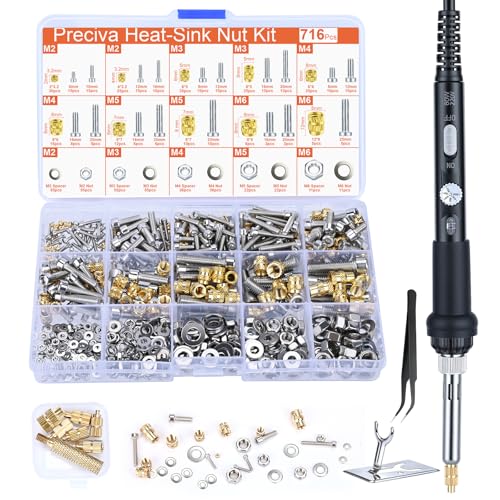
- Preciva 716-piece heat-set threaded insert set with soldering iron
- 1273-piece 410 stainless steel M2 to M5 screw kit
- M3 screw and nut assortment kit, 400 pieces with storage box
- How to choose between platform kits, assortments, and inserts
- Fastening printed parts well: threads, nuts, and tightening
- Check prices on Amazon
- Final verdict on hardware sets for 3D printing
As an Amazon Associate I earn from qualifying purchases. This post may contain affiliate links at no extra cost to you.
Finding the best hardware sets for 3d printing sounds simple until you are halfway through a build and realise the screw you need is not in the drawer. A printed bracket, an enclosure panel, a spool holder, a camera mount, or a replacement extruder part all depend on small pieces of metal that rarely get the attention given to filament, nozzles, and build plates. Yet those small pieces decide whether an assembly feels solid or loose, whether a joint can be opened and closed again without cracking, and whether a project survives daily use or fails the first time someone tightens a bolt a little too far. This guide looks at seven hardware sets that cover the two very different jobs most makers actually face: keeping a specific printer maintained with platform-matched screws, and stocking general metric hardware for the printed parts and do-it-yourself projects built around that printer.
Three of the sets in this roundup are tied to a specific printer family. The Imdinnogo assortment for the X1, X1C, X1E, P1P, P1S, and AMS is built for the Bambu Lab X1 and P1 series. The Imdinnogo assortment for the A1, A1 Mini, and AMS Lite is built for the smaller A1 series, and a second A1 series kit adds repair tools alongside its replacement screws. Those platform-specific kits answer a narrow but common problem: a screw is lost during maintenance, a fastener is damaged while swapping an extruder part, or a maker simply wants spares on hand that match the machine already on the bench. The other four sets are general metric assortments. They include an M2 and M3 cap screw kit, an M3-focused screw and nut kit, a large stainless steel assortment spanning M2 through M5, and a heat-set threaded insert system with its own soldering iron. Those general kits are not tied to one printer model. They are workshop stock for printed enclosures, multi-part assemblies, electronics housings, jigs, fixtures, and the steady stream of small projects that grows up around any working printer.
Keeping those two jobs separate is the most useful way to read this guide. A platform kit is judged on whether its stated fit matches your printer and whether it covers the fastening and maintenance tasks named in its title. A general assortment is judged on thread sizes, piece count, head styles, material and grade where the title states them, and how sensibly the mix matches the screws that printed projects actually use. A heat-set insert kit is judged on a different basis again, because inserts are not screws at all. They are brass-style threaded sleeves, in concept, that melt into a printed hole and leave a durable metal thread inside plastic, so a bolt can be removed and refitted many times without wearing the printed part itself. All three categories belong under the heading of hardware for 3D printing, but they solve different problems, and buying the wrong category is the most common mistake in this corner of the workshop.
Quick overview of the seven hardware sets
For Bambu Lab X1 and P1 series owners, the Imdinnogo kit for X1, X1C, X1E, P1P, P1S, and AMS is the direct match in this list. Its title frames it as a screws assortment for fastening and mounting 3D printed extruder parts and for supporting precise printing, which in plain terms means keeping the small fasteners that hold extruder-related assemblies together available as spares. For Bambu Lab A1 and A1 Mini owners, there are two choices with the same stated platform fit. The Imdinnogo kit for A1, A1 Mini, and AMS Lite covers maintaining and fastening printed extruder parts, while the separate A1 and A1 Mini assortment that bundles repair tools is aimed at routine maintenance. The practical difference is the tools: if you already own good drivers and picks, the screws alone may be enough, and if your toolkit is thin, the bundled tools add convenience.
For general printed projects, the mxuteuk 540-piece set covers M2 and M3 hex socket head cap screws, bolts, and nuts in 12.9 grade alloy steel with a black zinc plated finish, and it includes a hex wrench. The M3 screw and nut assortment takes a narrower approach with 400 pieces centred on M3 hex socket head cap hardware in 12.9 grade alloy steel, supplied with a storage box and also described for RC cars and broader do-it-yourself projects. The 1273-piece stainless assortment is the broadest screw kit here, spanning M2, M3, M4, and M5 in 410 stainless steel, with Allen head, flat head, and countersunk bolt styles in a silver finish, and its title explicitly names it as a 3D printer mini screw kit as well as mechanical hardware. Finally, the Preciva set takes the insert route with 716 pieces, heat-set inserts and related hardware for M2, M3, M4, M5, and M6 insert tips, plus a 60W soldering iron and holder for installing inserts into printed or other plastic parts.
No single set on this list does everything, and that is expected. A sensible workshop often pairs one platform kit matched to the printer with one general assortment matched to the projects, and adds inserts only when designs call for removable, repeatable joints. The sections that follow take each set in turn, explain where it fits, describe the fastening ideas behind it, and point out the limits stated by its own title so you can match the box on the shelf to the work on the bench.
Imdinnogo screw assortment for Bambu Lab X1, X1C, X1E, P1P, P1S, and AMS
The Imdinnogo 3D Printer Accessories Screws Assortment Kit for X1, X1C, X1E, P1P, P1S, and AMS is the platform-specific option for owners of Bambu Lab printers in the X1 and P1 lines. The full platform list in the title matters, so it is worth stating plainly: X1, X1C, X1E, P1P, P1S, and the AMS unit. That is the stated scope. The title describes the kit as supporting precision printing and as being used for fastening and mounting 3D printed extruder parts. In everyday terms, this is a spares kit for the small screws that hold extruder-area assemblies and related accessories together, kept on hand so a maintenance session does not stall because one fastener rolled off the bench or a screw head was damaged during removal.
Why keep a platform-matched spares kit at all when general metric assortments exist? The honest answer is convenience and confidence about fit. Printers in the X1 and P1 series use small fasteners in tight assemblies where length, head shape, and thread size all have to suit the part being fastened. A general assortment may well contain a screw that works, but finding it means measuring what came out of the machine and sorting through hundreds of similar pieces. A kit assembled for the platform narrows that search. When you are reassembling an extruder part after clearing a jam or swapping a component, reaching for a kit labelled for your printer family is simply faster than cross-checking a general box, and speed matters when a printer is open on the bench and small parts are already spread across a mat.
There are clear limits to state. This kit is presented for the X1 and P1 series and the AMS, and nothing in its title extends that fit to the A1 or A1 Mini, to the AMS Lite, or to printers from other makers. Do not assume cross-compatibility between Bambu Lab families, because the A1 series kits in this same guide exist precisely because the platforms differ. Equally, this is a screws assortment for the printer itself and its printed extruder parts, not a general project assortment. If your main need is hardware for enclosures, brackets, and electronics boxes of your own design, one of the metric assortments further down this guide is the better tool for that job, and this kit should be bought for the printer maintenance role it actually claims.
Imdinnogo screw assortment for Bambu Lab A1, A1 Mini, and AMS Lite
The Imdinnogo 3D Printer Accessories Screws Assortment Kit for BambuLab A1, A1 Mini, and AMS Lite mirrors the X1 and P1 kit for the smaller Bambu Lab platform. Its stated fit is the A1, the A1 Mini, and the AMS Lite filament unit, and its title describes it as being used for maintaining and fastening 3D printed extruder parts while supporting precise printing. That wording places it in the same role as its sibling kit: a set of spare screws matched to one printer family, intended to keep maintenance moving when an original fastener is lost, worn, or damaged.
The A1 series has a large owner base precisely because the machines are approachable, and approachable machines tend to be owned by people building their first serious toolkit. For a first toolkit, a platform spares kit is a forgiving purchase. It removes the need to identify every screw size on the machine before owning spares, and it means a beginner who drops a screw during a first nozzle-area or extruder-area service session has a replacement in reach instead of a half-assembled printer and a shopping delay. Experienced owners benefit too, but in a different way: they tend to service machines on a schedule, swap parts more often, and value having the right fastener immediately available over saving a small amount by hunting through a general assortment.
Maintaining and fastening, the two verbs in the title, describe the two moments this kit serves. Maintaining is the planned work: opening assemblies, cleaning, inspecting, and closing them again. Fastening is the closing step itself, where each screw needs to seat properly and clamp the part evenly. Printed extruder parts add a wrinkle, because a screw clamping a printed part should be tightened with restraint. Plastic yields under a screw head, threads formed in or held by plastic can strip, and a fastener that is slightly too long can bottom out or push through. Spares do not remove the need for restraint, but correct spares make restraint easier, because a screw of the intended size reaches its proper clamping point predictably instead of forcing you to guess whether resistance means seated or wrong.
As with the X1 and P1 kit, the boundary of fit should be respected exactly as stated. This assortment is for the A1, A1 Mini, and AMS Lite. It is not presented for the X1 series, the P1 series, or the original AMS, and it should not be bought for those machines on the assumption that small Bambu Lab screws are probably shared. They may look similar on a bench, and similar is not a standard to reassemble a printer by. If your household or workshop runs both an A1 series machine and an X1 or P1 series machine, the tidy answer is one kit per platform, labelled clearly, rather than one shared box that invites mix-ups at the worst moment.
A1 and A1 Mini screw assortment kit with repair tools
The 3D Printer Screw Assortment Kit for Bambu Lab A1, A1 Mini, and AMS Lite Parts takes the same platform as the Imdinnogo A1 kit and adds a second element: repair tools bundled with the replacement screws. The title describes the set as replacement screws with repair tools for routine maintenance accessories, which frames it clearly. This is a maintenance kit in the broad sense, screws plus the tools to work with them, aimed at owners who want one purchase to cover the small jobs that A1 and A1 Mini ownership involves.
The appeal of bundled tools is strongest for two groups. The first is the new owner whose toolkit currently consists of whatever came in the printer box and a few household items. For that owner, a kit that pairs platform screws with repair tools closes two gaps at once and avoids the common trap of owning spares you cannot fit properly because the driver at hand is worn or the wrong size. The second group is the owner who keeps a dedicated printer station, perhaps in a different room from the main workshop. A self-contained maintenance kit at the printer means routine work does not require carrying tools back and forth, and a kit that lives at the machine is a kit that gets used for small jobs before they grow into larger ones.
Routine maintenance is the right lens for judging this set. Routine work on a desktop printer includes keeping the filament path clear, keeping extruder-area parts secured, checking that fasteners have not loosened under vibration, and replacing small parts as they wear. None of that work is dramatic, and all of it goes better with the correct screws and serviceable tools. Vibration deserves a mention of its own: printers move, hour after hour, and small screws in any moving machine can relax over time. A periodic check with a properly fitting driver, snugging screws to firm rather than forcing them further, is cheap insurance against rattles, shifting parts, and print quality problems that are hard to trace because their cause is mechanical and gradual.
Choosing between this kit and the Imdinnogo A1 kit comes down to what you already own. If your drivers, tweezers, and small tools are already good and organised, the screws-only kit duplicates less. If your tools are improvised, the bundled set is the more complete answer, and the tools will also serve the general assortments in this guide, since M2 and M3 project hardware uses the same small hex drivers. What neither A1 kit should be asked to do is cover the X1 or P1 platform, or serve as a full project hardware assortment for your own printed designs. Platform kits are deliberately narrow. Their narrowness is their convenience, and the general kits below exist to cover the wide ground that platform kits leave open.
mxuteuk 540-piece M2 and M3 screw assortment for 3D printer DIY
The mxuteuk 540PCS M2 M3 Metric Screws Assortment Set is where this guide moves from platform spares to general project hardware. The title states the essentials: 540 pieces, M2 and M3 metric sizes, hex socket head cap screws with bolts and nuts, 12.9 grade alloy steel with a black zinc plated finish, a hex wrench included, and suitability for 3D printer do-it-yourself work. That combination maps closely onto the hardware that printed projects consume most. M3 is the workhorse thread of desktop 3D printing, used across printers, mounts, enclosures, and countless community designs, while M2 covers the smaller end: compact electronics, small fans, boards, and tight assemblies where an M3 screw would be oversized.
Hex socket head cap screws are a sensible default head style for printed assemblies. The cylindrical head seats well against flat printed surfaces and inside counterbores designed into many models, the hex socket accepts a compact wrench in tight spaces, and the head distributes clamping load more evenly than a tiny cross-head screw driven at an angle. When a printed part includes a designed counterbore, a cap head drops in neatly and leaves a clean, professional surface. When there is no counterbore, the cap head still works against a washer or a flat boss, provided the designer left room for the head and the wrench. The included hex wrench covers the immediate need, although most makers will quickly graduate to a small set of individual hex keys or a driver handle for comfort during longer builds.
The material and grade stated in the title are meaningful for project planning. Grade 12.9 alloy steel is a high-strength class commonly chosen for small machine screws that need to clamp firmly in compact joints, and the black zinc plated finish gives the steel a dark appearance that suits printer frames, black enclosures, and the general aesthetic of workshop equipment. High strength in the screw itself should be paired with judgement about the other side of the joint. A strong screw driven into a nut is a strong assembly. The same screw driven directly into a printed thread or an undersized printed hole can split the part long before the screw is challenged. Let the printed side set your tightening limit, use nuts or inserts where a joint will be opened repeatedly, and treat screw strength as headroom rather than an invitation to torque.
Piece count deserves a realistic reading. A 540-piece assortment spread across two thread sizes, several lengths, screws, nuts, and related pieces means each individual size is present in useful but not unlimited quantity. That is the nature of assortments: they exist so the size you need is present at all, in enough quantity for typical projects, and they reveal over time which sizes your own work consumes fastest. Many makers keep an assortment as the base stock and later top up the one or two sizes they burn through, such as mid-length M3 screws for enclosures. Starting with M2 and M3 together is efficient because project designs mix them constantly, an enclosure in M3 with a board mounted in M2 being a typical example, and a single box that covers both avoids the stop-start of ordering small parts mid-build.
For printer-focused do-it-yourself work specifically, this set suits the projects that surround the machine rather than the machine’s own platform spares. Spool holders, filament guides, camera mounts, tool holders, enclosure panels, electronics cases, cable management parts, and printed jigs all draw on M2 and M3 hardware, and most community models specify exactly those sizes in their build notes. Keep the platform kits for the printer’s own assemblies and reach for an assortment like this when the part being fastened is one you printed for your own purpose. That division keeps both boxes tidy and means the printer’s spares are still complete on the day the printer itself needs them.
Preciva 716-piece heat-set threaded insert set with soldering iron
The Preciva Threaded Inserts Set is the most conceptually different product in this guide, and for many makers it is the most transformative. The title lists 716 pieces, heat-set inserts with nuts and bolts, insert tips covering M2, M3, M4, M5, and M6, a 60W soldering iron, and a holder, for 3D printer parts or plastic parts. Instead of fastening two pieces with a screw and a loose nut, heat-set inserts give a printed part its own permanent metal thread. You design or choose a hole of the size the insert requires, heat the insert with the soldering iron tip, press it into the printed hole so the plastic melts locally and flows around the insert’s outer knurling, let it cool, and the result is a brass-toned metal thread anchored inside the print. A standard bolt then threads in and out as often as the design requires.
The reason inserts matter so much in 3D printing is the weakness they remove. A screw driven directly into printed plastic cuts or forms a thread in a material that creeps, wears, and cracks. The first assembly may feel fine. The fifth removal often does not, because each cycle wears the plastic thread, and an over-tightened screw can split a boss along layer lines. An insert moves the repeated wear onto metal threads designed for it, spreads clamping load into the surrounding plastic through its knurled outer surface, and lets a lid, panel, or housing be opened for every battery change, board swap, or cleaning session without consuming the part. Electronics enclosures are the classic use, followed by multi-part assemblies, jigs that get reconfigured, mounts that get adjusted, and any printed part with a cover that comes off more than once.
The breadth of sizes in this set, spanning M2 through M6 insert tips, covers the full practical range for desktop printing projects. M2 and M3 inserts serve compact electronics and the majority of enclosure designs. M4 and M5 inserts suit larger structural joints, bigger enclosures, furniture-like printed parts, and assemblies under more load. M6 reaches the heavy end of what most printed projects attempt. Owning the range in one set means a design is never reshaped around whichever single insert size happens to be in stock, and community designs, which specify inserts by thread size, can be built as published. The included nuts and bolts in the set round out the system, so inserts can be put to work immediately on a first enclosure rather than waiting for matching fasteners.
The bundled 60W soldering iron and holder are central to how this set is used, because heat-setting is a technique as much as a product. The iron heats the insert, typically through an insert tip matched to the size, and steady, vertical pressure lets the insert sink into the hole at the pace the plastic melts. Good results come from alignment and patience: the insert should enter straight, finish flush or just below the surface, and not be forced faster than the plastic softens, which can push a wall of melted material ahead of it and distort the hole. Practising on a scrap print in the same filament as the real part is time well spent, because different plastics soften at different rates and the feel of a correct press is learned quickly. Ventilation matters too, since melting plastic produces fumes, so work in moving air and let the iron rest in its holder between inserts rather than on the bench.
1273-piece 410 stainless steel M2 to M5 screw kit
The 1273Pcs 410 Stainless Steel M2 M3 M4 M5 Screw Kit is the largest and broadest screw assortment in this roundup. Its title describes 410 stainless steel hardware across four metric thread sizes, M2, M3, M4, and M5, in Allen head, flat head, and countersunk bolt styles, in a silver finish, with nuts and bolts for mechanical hardware, and it names the kit directly as a 3D printer mini screw kit. Where the mxuteuk set concentrates on M2 and M3 cap screws, this set trades some of that focus for range: more thread sizes, more head styles, and more than double the piece count, aimed at makers whose projects vary widely in scale.
Head style variety is this kit’s defining practical feature, because different printed joints genuinely need different heads. Allen head screws, driven by a hex key, are the general-purpose choice for accessible joints and designed counterbores. Flat head and countersunk styles sit flush with a surface when the printed part includes a countersink, which matters for panels that slide, lids that must close flat, parts that move past each other, and any surface a hand grips or a cable crosses. A flush screw cannot snag, and on an enclosure that is opened by sliding or on a fixture with moving parts, flush fastening is a functional requirement rather than a cosmetic preference. Owning cap-style and countersunk hardware in the same sizes lets you follow the design in front of you instead of redesigning around the only head style in the drawer.
The thread range from M2 to M5 covers the full span of ordinary desktop printing projects in one box. M2 handles small electronics and compact mechanisms, M3 covers the bulk of printer-adjacent work, M4 steps up for larger brackets, heavier enclosures, and joints that need more clamping area, and M5 serves the biggest printed assemblies most home workshops produce, such as substantial mounts, frames, and furniture-scale prints. For a maker whose work is growing, that range prevents the familiar pattern of owning deep stock in one size and nothing in the size a new design needs. For a shared workshop, a classroom-style bench, or a small business prototyping area, one broad kit that several people can draw on is often tidier than several narrow kits scattered across benches.
M3 screw and nut assortment kit, 400 pieces with storage box
The M3 Screw and Nut Assortment Kit for 3D Printer DIY takes the opposite approach to the broad stainless set. Instead of spreading pieces across four thread sizes, it concentrates 400 pieces on M3, the single most-used thread in desktop 3D printing, as hex socket head cap screws and nuts in 12.9 grade alloy steel, supplied with a storage box. The title also names RC cars and general do-it-yourself projects alongside 3D printer work, which is a fair reflection of how universal M3 hardware is across small mechanical hobbies. If your printing projects are typical, a deep M3-only stock may serve you more often than a shallow stock of everything.
There is a strong practical case for depth in one size. Enclosures, brackets, mounts, printer modifications, and community designs return to M3 again and again, in a handful of common lengths, with nuts to match. A kit devoted to M3 can hold more of each common length than a mixed kit can, which means the mid-length screw an enclosure needs eight of is actually present eight times. Builds stall on quantities as often as on sizes: owning two of the right screw is no better than owning none when the panel needs six. Depth also simplifies the bench. One box, one thread, one driver size family, and a builder can work quickly without cross-checking sizes, which is genuinely valuable during long assemblies with dozens of fasteners.
The hex socket head cap format matches the M3 ecosystem well. Cap heads suit the counterbores designed into many printed parts, work cleanly with hex keys and small drivers, and pair naturally with standard M3 nuts in printed nut traps, a feature designed into countless models where a nut sits in a hexagonal pocket and the screw draws the joint together. Nut traps reward exact-size hardware and punish substitutes, because a nut that is loose in its trap spins instead of tightening, and an oversized one will not enter at all. A dedicated M3 kit with matched screws and nuts keeps that system working as designers intended, and the 12.9 grade alloy steel stated in the title gives the screws themselves ample strength for the joints printed parts can support.
Know the boundary of an M3-only kit before relying on it. The first project that needs M2 for a small board, M4 for a heavy bracket, or countersunk heads for a flush panel will step outside this box, and that moment will come for most makers eventually. The sensible reading is that this kit is a core, not a complete system: deep M3 stock for the everyday majority, supplemented later by a broader assortment or an insert set as projects diversify. For a maker who knows their work is overwhelmingly M3, and especially for someone splitting time between printed projects and RC work that shares the same size, starting with depth is a rational and economical shape for a hardware drawer.
best 3d printers to use with mac
How to choose between platform kits, assortments, and inserts
Choosing well starts with naming the job in front of you. If the job is servicing a Bambu Lab printer, choose by platform and nothing else: X1, X1C, X1E, P1P, P1S, and AMS owners match to the Imdinnogo kit for that series, while A1, A1 Mini, and AMS Lite owners choose between the Imdinnogo A1 kit and the A1 kit with repair tools depending on the state of their toolkit. Platform fit is not a preference to weigh against piece count or finish. A general assortment with a thousand pieces still does not promise the specific spares a platform kit holds, and a platform kit, however convenient, is not project stock. Buy each for its own role and you will be satisfied with both; ask either to do the other’s role and you will be frustrated with both.
If the job is building your own printed projects, choose by thread size first. Survey the designs you actually print. Most makers find M3 dominating, M2 appearing in electronics, and M4 or M5 arriving with larger structural work. That survey points directly at a kit shape: the mxuteuk set for an M2 and M3 cap screw foundation with a wrench included, the M3-only kit for maximum depth in the dominant size, or the 1273-piece stainless set for the widest span of sizes and head styles including flush-fitting countersunk options. Finish and material then refine the choice: black zinc plated alloy steel for a dark, equipment-like look and high stated grade, or silver stainless for bright hardware and moisture-adjacent uses. Neither is universally better; each suits different projects, and many mature workshops eventually hold both.
If the job involves parts that come apart repeatedly, inserts change the calculation entirely. Ask of every joint: how many times will this be opened? Once, at assembly, and a screw into plastic or a nut in a trap may be perfectly adequate. Monthly, for batteries, filters, boards, or cleaning, and a heat-set insert earns its place by keeping the thread metal and the plastic intact. The Preciva set suits makers ready to adopt inserts as a standard technique, because it pairs a wide M2 to M6 size range with the iron and holder the technique requires. Pairing inserts with any of the screw assortments completes the system: inserts live in the printed part, screws from the assortment pass through the lid or mating part, and the joint can be serviced for the life of the print.
Fastening printed parts well: threads, nuts, and tightening
Whatever kit you choose, results depend on technique, and a short grounding in how fasteners meet printed plastic will improve every build. Printed plastic is layered, and its strength differs by direction: a boss loaded along its layers behaves differently from one loaded across them, and a screw that pulls a joint apart along layer lines is asking the weakest direction to do the work. Designers compensate with orientation, wall thickness, and fillets, and builders compensate by tightening evenly and moderately. Tighten screws in a panel in stages, a little at a time in a crossing pattern, so clamping load spreads evenly instead of warping one corner down while the opposite corner floats. The goal is firm and even, not maximal.
Check prices on Amazon
Live listings for the shortlist in this guide are pulled from Amazon below, so prices and availability are always current at the moment you look.


Final verdict on hardware sets for 3D printing
The best hardware sets for 3d printing are not the biggest boxes but the ones matched to real roles. For Bambu Lab X1 and P1 series owners, the Imdinnogo assortment for X1, X1C, X1E, P1P, P1S, and AMS is the platform-matched spares kit for extruder-area fastening and maintenance. For A1 and A1 Mini owners, the Imdinnogo A1, A1 Mini, and AMS Lite kit covers the same role for that platform, while the A1 assortment with repair tools suits owners who want screws and tools together for routine maintenance. Respect those platform boundaries exactly as the titles state them, and each kit does its narrow job well.
For project hardware, the choice is about shape. The mxuteuk 540-piece M2 and M3 set is a balanced foundation of hex socket head cap screws in 12.9 grade alloy steel with black zinc plating and a wrench included. The M3 screw and nut kit offers depth in the most-used size, 400 pieces with a storage box, for makers whose work lives at M3. The 1273-piece 410 stainless steel set offers the widest range, M2 through M5 with Allen, flat head, and countersunk styles in silver, for varied projects and flush finishes. And the Preciva 716-piece heat-set insert set, with M2 through M6 insert tips, a 60W soldering iron, and a holder, is the upgrade that turns printed parts into serviceable assemblies with durable metal threads. Many workshops will sensibly end up with one platform kit, one assortment, and, once designs demand it, the insert set, and that combination covers nearly everything desktop 3D printing asks of small hardware.
Affiliate disclosure: This article contains affiliate links, and we may earn a commission if you buy through them, at no extra cost to you. The product information in this guide is based on specifications and descriptions published by the manufacturers and sellers, including product titles, stated sizes, piece counts, and materials, and it is presented as published information to help you compare options, not as a description of personal use or first-hand experience with these products. Always confirm platform fit, thread size, and dimensions against your printer and your project requirements before ordering.


