Our Top Picks
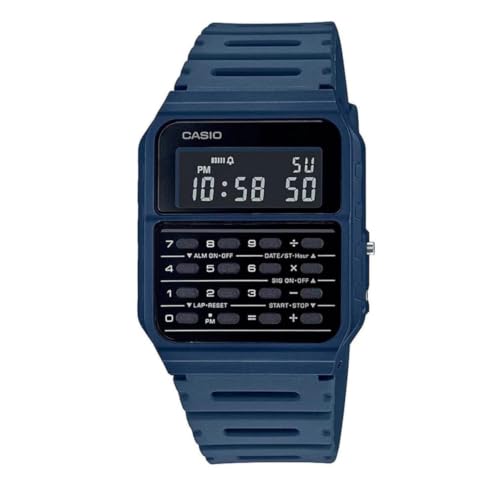
 Casio CA-53WF-3B Calculator Green Digital Mens Watch Original43.2×34.4×8.2mm0.1 poundsCheck on Amazon




What's inside
- What a calculator watch is, and why men still buy them
- A short history: from nineteen-seventies experiments to the eighties boom
- The Casio CA-53W: the reference point of the whole category
- Data Bank DBC-32 and DBC-150: when the watch remembers for you
- The keypad experience: small rubber keys, honest expectations
- Calculator watch versus phone versus smartwatch
- Durability, water and the truth about splash resistance
- The missing backlight and other quirks worth knowing
- Who these watches suit: engineers, technicians and the retro-minded
- Functions in depth: stopwatch, alarms, dual time and the calendar
- Fit, sizing and wearing a keypad watch comfortably
- Buying new today: production status, genuine stock and fair expectations
- The CMD-40 and the glorious age of doing too much
- Worked examples: a week of sums on the wrist
- Check prices on Amazon
- Care, battery changes and keeping a calculator watch alive for years
As an Amazon Associate I earn from qualifying purchases. This post may contain affiliate links at no extra cost to you.
Full disclosure before the details: this guide was assembled from manufacturer documentation, official module manuals, published specifications and the documented history of the models discussed. The writer has not worn, operated or handled any watch named below, and no statement here rests on personal use. Judgements are drawn from what the makers publish, from the arithmetic of stated dimensions and battery figures, and from widely documented owner experience in the public record. Should you buy through a retail link associated with this page, the site may earn a commission from the seller; that possibility plays no part in which models are covered or how their limits are described.
What a calculator watch is, and why men still buy them
A calculator watch puts a working numeric keypad on the wrist and pairs it with a small digital module that can add, subtract, multiply and divide without help from any other device. It sounds like a novelty that the smartphone should have buried twenty years ago, yet the leading models remain in production, remain stocked by major retailers and keep selling to men who could buy far more advanced technology for similar money. The explanation is that the calculator watch was never really competing with phones. It competes with the moment when you need a number quickly, your hands are occupied or dirty, and a self-contained tool on your wrist answers in seconds.
The modern centre of the category is Casio, whose CA-53W has become the default reference point: a black resin watch with a sixteen-key pad moulded into its face surround, an eight-digit calculator, dual time, a stopwatch and a daily alarm, running for years on a single coin cell. Above it sit the Data Bank models, the DBC-32 and DBC-150 among them, which add stored telephone numbers, schedules and a larger memory to the same keypad idea. Around those anchors orbits a penumbra of retro reissues, cheap imitations and long-discontinued curiosities that this guide will treat as context rather than recommendations.
Men buy these watches for reasons that mix utility and affection in different proportions. Field technicians and engineers like a calculator that survives a workshop and asks for nothing: no charge cable, no account, no updates, no permission to access contacts before it will divide two numbers. Warehouse and trade workers like doing stock arithmetic without setting down a box or unlocking a phone with gloved or dusty hands. A large third group simply loves the object itself, the unmistakable nineteen-eighties silhouette, the soft rubber keys, the sense that a watch can be a small machine with a job to do rather than a screen asking for attention.
Honesty about limits belongs at the front of any guide to this category. The keypads are small, the displays show one line of figures, the water resistance is modest, and the most famous model in the range has no backlight at all. A calculator watch will not replace a scientific calculator, a spreadsheet or a phone for serious work. What it offers is immediacy and independence in a narrow band of everyday arithmetic, wrapped in a watch that asks almost nothing in return. Judged on those terms, rather than against devices it never tried to be, the category still makes a persuasive case.
A short history: from nineteen-seventies experiments to the eighties boom
Electronic calculator watches appeared in the mid nineteen seventies, when LED and then LCD technology first let engineers shrink arithmetic into a case. Early examples from makers in Switzerland, Japan and the United States were expensive demonstrations as much as products, some requiring a stylus or a fingertip precision that bordered on comedy. The idea waited for cheap LCD modules and moulded resin construction to become practical, and when those arrived at the end of the decade, Casio moved with characteristic speed, applying its calculator division’s expertise to the wrist.
The nineteen eighties turned the concept into a mass phenomenon. Casio’s calculator models multiplied: keypad watches, touch-sensitive variants, and then the Data Bank line, which stored names and numbers and effectively became a tiny electronic address book years before mobile phones made that idea universal. For a schoolboy or an office worker of that era, a Data Bank watch held the phone numbers that mattered, a few schedule reminders and the quiet thrill of owning something that felt like the future. Competing makers fielded their own versions, and the category briefly sat at the centre of consumer electronics rather than at its nostalgic edge.
The same decade produced the category’s most flamboyant branch: watches that doubled as remote controls, infrared calculators and even game machines. Casio’s CMD-40, which arrived in the early nineteen nineties as the boom matured, combined a calculator keypad with a learning infrared remote able to operate televisions and video recorders. It is remembered now as a delightful marker of how far the wrist-computer ambition reached before phones absorbed it. The CMD-40 is discontinued, traded second-hand and impractical to support, yet it matters to this guide because it shows the design philosophy at full stretch: the watch as a self-contained electronic tool kit, owing nothing to any network.
What survived the smartphone era is instructive. The remote controls, games and gimmicks vanished, because phones did those jobs better. The plain calculator and the Data Bank endured in Casio’s catalogue, refreshed in details but faithful in layout, because phones never quite replicated their combination of instant access, physical keys, multi-year battery life and indifference to water splashes, dust and neglect. Survival on those terms is the strongest evidence that the category answers a real need rather than a passing fashion. Retro affection brings buyers to the listings; the underlying usefulness is what keeps the reviews kind a decade after purchase.
The Casio CA-53W: the reference point of the whole category
The CA-53W earns its central place by doing the core job with the least fuss and the longest track record. Its calculator handles eight digits, which covers the arithmetic of receipts, measurements, quantities, tips, splits and conversions that make up most real-world wrist calculations. Sixteen keys are arranged in a four-by-four grid below and beside the display: the digits, the four operations, a decimal point, a clear key and an equals key, with the layout close enough to a pocket calculator that a new owner learns it in an afternoon. The module also provides dual time for a second zone, a one-hundredth-second stopwatch, a daily alarm with an hourly signal, and an automatic calendar programmed to the end of the century’s early decades, all documented in Casio’s module manual.
Physical specifications explain much of the model’s endurance. The resin case measures roughly 43 millimetres long, about 38 millimetres wide and under 12 millimetres thick in published figures, and the whole watch weighs around 25 grams, light enough to forget during physical work. The strap is resin with a conventional buckle, the crystal is resin rather than glass, which trades scratch resistance for shatter resistance, and the battery is a CR2016 coin cell that Casio rates for about five years in the manual’s stated conditions of typical use. Every one of those choices favours toughness, low cost and long service over luxury, and the market has rewarded the priorities for decades.
The compromises are equally well documented and should be read before buying rather than discovered after. The CA-53W has no backlight: in darkness the display is unreadable, full stop, and no setting changes that. Water resistance is described by Casio in the splash and rain category, suitable for hand washing and weather, not for swimming or showering. The resin crystal will collect scratches over years of hard use, though it shrugs off impacts that would crack glass. The keys, moulded as part of the case surround, can be pressed with a fingernail or fingertip but reward a deliberate touch rather than a jab. None of this is hidden; it is printed in the maker’s own documentation, and the model’s following exists in full knowledge of it.
Choosing the CA-53W is therefore a clean decision. If your arithmetic is everyday, your work is physical, your budget is modest and your evenings do not require reading a watch in the dark, it is the category’s default answer and has been for a generation. If you need stored numbers or a lit display, the Data Bank models below exist precisely for you. If you need scientific functions, look elsewhere entirely, at a proper scientific calculator or an application, because no current production calculator watch honestly serves that need. Readers curious about how this analogue of the smartwatch world compares with fully connected wrists can start from best running smartwatches and note how different the ownership bargain is.
Data Bank DBC-32 and DBC-150: when the watch remembers for you
The Data Bank line answers a different need from the CA-53W. Its owners do not only want sums on the wrist; they want a small store of information that lives there too. The telememo function, as Casio calls it, holds names paired with numbers: telephone contacts in the era that named it, but equally door codes, account references, part numbers, locker combinations or any short string of digits a man consults often and would rather not dig out of a phone with wet or busy hands. Capacity varies by model, with the DBC-32 documented at twenty-five telememo records and the DBC-150 at a larger bank of records, each entry holding a name field and a number field within stated character limits.
The schedule function extends the idea from static data to time. Entries can carry a time and a short text label, with an alarm that sounds when the moment arrives, which turns the watch into a quiet prompting device for shift changes, medication times, meter readings, call slots or the hundred small appointments of a working day that do not justify a calendar invitation. A databank of this kind will not sync with anything, and entries are typed letter by letter on the keypad, which is a chore the first time and a triviality afterwards for the dozen entries that actually matter. The independence cuts both ways, and owners tend to love or loathe it in proportion to their feelings about phones generally.
Hardware differences between the two Data Bank models matter to a buyer choosing between them. The DBC-32 sits in a resin case in the same visual family as the CA-53W, with an LED light that answers the cheaper model’s most famous omission, and a battery life figure in Casio’s documentation of roughly three years on its stated cell under typical use. The DBC-150 presents a more formal face, commonly on a metal bracelet with a resin and metal case construction, a larger memory, and features that have included a five-language day display and LED backlight in its published specifications. Exact features shift slightly across production variants and regions, so the manual for the precise reference on sale is the document to trust.
Both models keep the calculator function that defines the category, with the same eight-digit arithmetic as the CA-53W, and both add the small quality-of-life details that owners cite most: an auto calendar, world or dual time depending on the reference, countdown or stopwatch functions and multiple alarms on the stronger variants. The right choice between them is mostly about dress and memory. A man who wants the tool in its purest black resin form, to be worn with work clothes and forgotten, belongs in the DBC-32. A man who wants the databank to pass in an office, on a bracelet, with room for more records, belongs in the DBC-150, accepting the higher price and the slightly greater weight as the cost of that polish.
The keypad experience: small rubber keys, honest expectations
Every calculator watch lives or dies at the fingertips, so this section describes the typing experience in the plain terms the specification sheets imply. The keys are small: on the CA-53W the sixteen pads sit in a grid where each key is a few millimetres across, sized for a fingernail or the very tip of a finger rather than the flat of a thumb. Presses register with a soft, slightly yielding feel because the keys are moulded rubber over the module’s contacts, not the crisp click of a desktop calculator. Accuracy improves sharply with a day or two of familiarity, as the fingers learn the grid and the eyes learn to check the display after each entry rather than trusting the press.
Certain hands suit this better than others, and there is no shame in the sorting. Men with slender fingers, short nails or experience of small instrument panels adapt quickly and often reach genuine speed on routine sums. Men with broad fingertips, long work gloves in their day, or any tremor or joint stiffness will mis-key often enough to find the experience irritating, and for them the honest advice is to enjoy these watches as timepieces with an emergency calculator, or to skip the category. Typing names into a Data Bank is the sternest test of all: letters are entered by cycling or by key combinations depending on the model, and a long contact list is an afternoon’s patience rather than a minute’s work.
Technique helps more than force. Resting the wrist on a surface steadies the watch. Working with the opposite hand’s index fingertip, nail side presented to the keys, gives the cleanest presses. Checking the running figure after each operation catches the one mis-key in twenty before it poisons a chain of arithmetic. Owners who develop these habits describe the keypad as entirely workable; owners who jab at it standing up, walking, with the watch loose on the wrist, describe it as a toy. Both reports are accurate accounts of different methods, and the difference is worth knowing before money changes hands.
It also helps to understand what the arithmetic itself can and cannot do. Eight digits with the four functions, a decimal point and, on the Data Bank models, a few refinements, covers quantities, prices without currency complications, measurements, averages built stepwise and unit conversions done in stages. It does not offer brackets, memory registers of any sophistication, percentages as a dedicated key on the simplest model, or scientific notation for very large results; overflow shows as an error and the sum must be broken into parts. Men whose work needs those features carry a scientific calculator and know it. Men whose work needs forty quick sums a day, none of them harder than a multiplication of two measurements, are the keypad’s natural constituency.
Calculator watch versus phone versus smartwatch
The obvious rival sits in every pocket, so the comparison deserves direct treatment. A phone calculator is more capable, easier to type on, backlit, and free. Against that, the watch wins on four specific grounds. It is already on the wrist, reachable in one motion with the other hand free. It works with dirty, wet or gloved-adjacent hands that a touchscreen rejects or would foul. It never interrupts a sum with a notification, a call or a low battery warning. And it leaves the phone where it belongs during physical work: in a pocket, a locker or a van, safe from drops and grime. For a two-number sum, those four grounds routinely beat raw capability, which is why the category survives.
The smartwatch comparison is subtler, because a modern smartwatch can run a calculator application with a larger display and voice input besides. What it cannot offer is the calculator watch’s indifference. A smartwatch wants charging every day or two, wants a phone nearby for full function, wants updates, accounts and permissions, and presents its calculator behind a screen wake and an application launch. The Casio approach wants a coin cell every few years and presents its calculator behind nothing at all: look down, press keys, read answer. Men who already wear a smartwatch happily will find a calculator watch redundant. Men who tried one and tired of the maintenance often describe the Casio as a relief, and the two products end up serving almost opposite temperaments. Our research notes for the connected side of that divide are gathered in best smartwatches with sleep tracking, which shows how much machinery a modern wrist device carries to do its wider job.
There is also a social and professional dimension that specifications never mention. In some settings a phone in the hand reads as distraction or disrespect: a site meeting, a classroom, an exam-adjacent training room, a workshop floor where phones are discouraged, a boat, a secure facility where cameras and radios are unwelcome. A calculator watch in those settings reads as a watch. It does arithmetic without importing the entire internet into the conversation, and for teachers, invigilators, tradespeople and field staff that discretion is not a minor benefit. Several professions restrict connected devices while permitting a plain digital watch, and a calculator model slips through that gate carrying genuinely useful function with it.
Cost of ownership completes the comparison. A calculator watch at the modest end costs less than a single phone screen repair, runs for years on a cell that costs very little, and asks for no subscription, no case, no screen protector and no insurance. When it finally fails or is lost, replacement is a small event rather than a financial one. That arithmetic explains the otherwise puzzling sight of well-paid engineers, who could wear anything, choosing a black resin Casio for site days. The watch is not a compromise they tolerate. It is the correctly sized tool for the job, and its cheapness is a feature that removes worry rather than a sign of settling.
Durability, water and the truth about splash resistance
Calculator watches are tougher than they look and weaker than their fans sometimes claim, and both halves matter. The resin construction that defines the Casio models absorbs knocks gracefully: there is no plating to chip, no glass to crack, and the case gives slightly rather than transmitting every impact to the module. Buttons and keys are sealed as part of the moulded structure. The result is a watch that survives being dropped on concrete, knocked against door frames, worn under a work glove and rinsed under a tap at the end of the day, year after year, with cosmetic scuffs as the only record. Long-term owner reports in the public record routinely describe CA-53W examples still working after a decade of such treatment.
Water is where expectations must be managed precisely. The published rating for the CA-53W class is water resistance for everyday splashes: rain, hand washing, accidental wetting. Casio’s own guidance for this class excludes swimming, showering and any immersion, and pressing keys underwater is discouraged across the digital range because it can draw moisture past the seals. The Data Bank models sit in the same broad class unless a specific reference states otherwise. A man who needs a watch to swim, dive or work in water should buy a properly rated diver style digital instead and give up the keypad, because no current calculator watch is built to that standard and pretending otherwise ends in a fogged display.
Age changes the water story further. Seals are rubber, and rubber hardens over years, especially in heat and sunlight. A five-year-old calculator watch that has baked on dashboards should be treated as splash resistant in name only until its seals are renewed at a battery change. That service point deserves emphasis: the moment the case back comes off for a new cell is the moment to ask for the gasket to be inspected or replaced, a cheap step that preserves whatever water resistance the watch still has. Owners who skip it sometimes learn about seal failure at the first hand wash after a battery swap, which is an avoidable sadness.
The strap is the other wear item. Resin straps stiffen and eventually crack at the holes and the buckle end, typically after years rather than months, with heat, sunscreen and solvents shortening the timeline. The good news is that replacement straps for the mainstream Casio models are inexpensive and widely stocked, and the spring bars are a standard arrangement that any watch counter can handle in minutes. A calculator watch is thus best understood as a durable core with two consumables, strap and seals, and an owner who accepts that rhythm will get extraordinary service life from a very modest purchase.
The missing backlight and other quirks worth knowing
No honest guide to the CA-53W can bury its most famous flaw: there is no light. The display is a plain LCD, readable in daylight and ordinary room light, and a grey void in a dark car, a night shift corridor or a cinema. Owners adapt in predictable ways, tilting the watch toward any ambient glow or simply using a phone for night hours, but a man who regularly needs the time or a sum in darkness should not buy this model and hope. He should buy a Data Bank DBC-32 or DBC-150, whose published specifications include an LED light, or accept a different digital watch entirely. Casio has kept the CA-53W lightless through decades of production, presumably in the name of cost and battery life, and the omission is now part of the model’s identity: charming to loyalists, baffling to everyone else.
Other quirks are smaller but real. The alarm on these modules is a modest beep that a heavy sleeper or a noisy workshop will swallow whole; it suits quiet offices and reminders during the day better than wake-up duty, though the hourly signal has its devotees. The auto calendar on older-specification modules assumes a calendar range that will eventually expire far in the future, a non-issue for any realistic ownership span but a favourite trivia point among collectors. The calculator’s error handling is blunt: overflow or an impossible operation clears the entry and the sum starts again, with no history tape to inspect where things went wrong.
The keypad itself ages in a specific way worth anticipating. The printed legends on the keys are part of the moulded surround on the CA-53W and stand up well, while on some older or cheaper calculator watches the key printing wears until the layout must be known by heart. Buying the genuine Casio rather than a lookalike largely removes this worry, which is one of several places where the small price gap between the real article and an imitation buys disproportionate peace of mind. Imitations also tend to skimp on the module itself, with dimmer displays and less accurate timekeeping, faults that only appear after the return window closes.
Finally, a word about the hourly signal and dual time, two features buyers overlook until they own them. Dual time earns its keep for men with family, colleagues or interests in another zone: one press shows the second zone without disturbing the home display’s settings. The hourly beep, divisive as it is, gives shift workers and anglers and night owls a gentle sense of the hours passing without a glance. Features like these explain why owners replace a dead CA-53W with another CA-53W rather than upgrading: the whole modest package, quirks included, fits a life they have organised around it. The connected equivalents of such small conveniences are surveyed in best fitness and music smartwatches, where the same jobs are done with considerably more machinery.
Who these watches suit: engineers, technicians and the retro-minded
The natural owner of a calculator watch works with numbers in physical places. Engineers on site visits check dimensions, clearances and rough quantities where they stand. Electricians estimate cable runs and conduit lengths. Carpenters and joiners convert measurements and divide boards. Warehouse staff tally stock and verify counts. Laboratory and workshop technicians record figures that need a quick cross-check before they are written down. For all of them, the pattern is the same: short sums, often repeated, performed away from a desk, with hands that have better things to hold than a phone. The watch fits that pattern like a tape measure fits a belt.
A second constituency values the databank over the arithmetic. Men who manage facilities, fleets, rentals or access systems carry a private constellation of codes, reference numbers and contact details that they consult in basements, car parks and plant rooms where a phone is slow, flat or forbidden. Storing the twenty numbers that matter on the wrist, in a device with no signal and no screen lock, is an old solution that still works exactly as documented. Privacy plays a quiet part too: the data sits on a watch, visible to nobody, synced to nothing, and lost only if the watch itself is lost, a trade-off its owners make with open eyes.
The third group buys with the heart and stays for the utility. The calculator watch is a design icon of the nineteen eighties in the way certain cameras and game consoles are, and wearing one signals membership of a culture that values functional, unpretentious objects. Film and television appearances over the decades cemented the silhouette, and the current retro wave in men’s accessories has brought younger buyers to a model older than they are. What surprises many of them, according to the pattern of long-term owner accounts, is how quickly the joke watch becomes the daily watch: it is light, it is legible, the sums turn out to be genuinely handy, and the battery never, ever asks for a cable on a Sunday night.
Equally clear is who should walk past the category. Men who need scientific functions, men whose fingers and the keypad will never agree, men who swim daily with their watch, men who need a lit display every night, and men who simply prefer a connected device should spend their money elsewhere without regret. A good guide narrows the audience as honestly as it widens it. The calculator watch is a specialist tool wearing the clothes of a general one, and the men who love it are those whose days match its specialism, or whose taste runs to the era that produced it.
Functions in depth: stopwatch, alarms, dual time and the calendar
Beyond the keypad, these modules carry a supporting cast of functions that owners use daily and listings mention only in passing. The stopwatch on the CA-53W measures to a hundredth of a second for the first hour in the documented specification, with split capability on the Data Bank variants, which suits timing pours, runs between site points, machine cycles and any process where a rough number now beats a precise number later. It will not replace a dedicated timing instrument in a laboratory, and it was never meant to. It replaces walking back to the office to fetch one.
Alarms multiply across the range in a way that rewards reading the manual for your exact module. The CA-53W keeps things simple with a daily alarm and hourly signal. The Data Bank models add schedule alarms attached to stored entries and, on stronger variants, several independent daily alarms, which lets a man separate a waking alarm from a medication prompt from a shift-end reminder by tone pattern and label. Setting them is keypad work, methodical rather than hard, and the manuals walk through each sequence with diagrams. Owners who set the watch up carefully once tend to leave the configuration alone for years, which is the highest compliment a digital interface of this vintage can earn.
Dual time and world time deserve their distinction. Dual time, on the CA-53W, tracks one additional zone alongside the home time, enough for a partner abroad or a head office on another continent. World time, on the Data Bank models, lets the wearer scroll through a list of city codes and their offsets, which serves travellers and men coordinating across several regions. Neither requires any knowledge of the underlying offset tables; the module holds them. The auto calendar, programmed with leap years across its stated range, means the date is simply right every morning, a small mercy that mechanical watch owners, with their end-of-month corrections, quietly envy.
One more function hides in plain sight: the calculator itself can serve as a scratchpad for numbers that must survive a mode change. A figure left on the calculator display stays there while the wearer checks the time and returns, within the module’s documented behaviour, which makes the watch a place to park a measurement while both hands work. Data Bank owners extend the trick by storing the figure properly. None of this appears in advertising, yet these micro-uses, accumulated over years, are what transform a novelty into a habit. A tool becomes personal through the small jobs it absorbs, and the calculator watch absorbs more of them than its price suggests.
Fit, sizing and wearing a keypad watch comfortably
A calculator watch wears differently from a plain digital because the keypad spreads the case across the wrist. The CA-53W’s published footprint, roughly 43 by 38 millimetres with a modest thickness, sits comfortably on most men’s wrists, and its roughly 25 gram weight disappears during physical work in a way a steel watch never will. The resin strap is long enough for large wrists and trims the excess in the usual keeper arrangement. Men with very slim wrists should check the lug-to-lug span against their wrist’s flat top, because a keypad case that overhangs looks and feels like a small computer strapped on, which is a look only some men are seeking.
The Data Bank models add presence. The DBC-32 stays close to the CA-53W in spirit and bulk, while the DBC-150 on its bracelet carries more weight and a more formal outline that sits better with a shirt cuff than with a work glove. Thickness across the family remains modest by modern sports watch standards, so sleeves rarely fight these watches. The keypad itself needs a little clearance in wear: a watch worn very tight can flex the wrist into the lower keys during certain movements on some owners, a quirk solved by wearing the strap one hole looser than usual, which the light weight of the resin models makes perfectly comfortable.
Legibility in real conditions rounds out the fit picture. The digits on these modules are large relative to the case because the display only ever shows one line, and the contrast of Casio’s standard LCD panels is good in daylight and under office lighting. Ageing eyes generally cope well with the time display; the smaller secondary indicators for mode and day require a closer look. The absence of a light on the CA-53W remains the binding constraint after dark, as discussed, and no fit adjustment changes it. A buyer honest about when he will wear the watch will choose correctly between the lightless classic and its lit Data Bank relatives.
Strap swaps and adjustments are refreshingly ordinary. Standard spring bars, widely available replacement resin straps, and bracelet links on the DBC-150 that a watch counter can add or remove cover nearly every fit need. Some owners fit a nylon pass-through strap for field work, which guards against a single spring bar failure dropping the watch, at the cost of a little bulk under the case. The category’s whole philosophy shows in this ordinariness: nothing proprietary, nothing precious, every wear part replaceable at any town’s watch counter for small money. Men who keep a watch for a decade value exactly that, and it is a quality the sealed, glued world of modern electronics rarely offers. The contrast with sealed connected devices is drawn out further in best android smartwatches for ios, for readers weighing both worlds.
Buying new today: production status, genuine stock and fair expectations
A reassuring fact anchors this whole category: the core models are not relics to be hunted through auction listings. The CA-53W remains a current Casio product, listed in the maker’s own catalogue with its module manual published, and stocked through authorised channels and major retailers in steady supply. The Data Bank line likewise continues in Casio’s range, with the DBC-32 and DBC-150 appearing in current listings from established sellers, though regional availability varies more than the CA-53W’s and a specific variant may need ordering rather than walking out of a shop. Buying new brings a manufacturer warranty, a fresh battery with its full rated life ahead of it, and seals at their youngest, all worth having in a watch whose virtues compound over years.
Genuine stock is easy to recognise with a few minutes of care. The model code on the case back should match Casio’s published reference for the watch in the photographs, the module number stamped beside it should correspond to the manual the maker publishes for that model, and the packaging from authorised channels carries the brand’s standard printed materials and warranty documentation. Listings that cannot name the module, show photographs of a watch whose keypad legends are misspelled, or offer the watch at a small fraction of its ordinary level from an unknown seller are describing the imitation trade, which copies the CA-53W’s silhouette energetically and its quality hardly at all.
Fair expectations complete the purchase. Expect a watch that tells excellent time, does honest arithmetic, stores its small databank faithfully, and shrugs off years of ordinary knocks, with a strap and a battery as its only scheduled consumables. Do not expect a light on the model that famously lacks one, do not expect to swim in a splash resistant case, and do not expect the keypad to flatter large fingers. Set those expectations from the published specifications before ordering and the watch that arrives will feel like a bargain rather than a compromise, which is the consistent tone of long-term owner accounts for these models.
Price positioning, described without figures because they drift, is part of the appeal and part of the risk assessment. The CA-53W sits in the impulse band of men’s accessories, cheap enough that a lost one is an annoyance rather than a claim, while the Data Bank models step up into considered-purchase territory without leaving the modest end of the watch market. That spread lets a curious man enter the category at the shallow end, live with a keypad for a season, and learn whether his fingers and his arithmetic suit the format before spending more on memory and a bracelet. Few categories of men’s gear offer so gentle an on-ramp, and fewer still reward the experiment with a tool that stays useful even if the experiment ends.
The CMD-40 and the glorious age of doing too much
Every mature product category has a exuberant ancestor that tried everything at once, and for calculator watches that ancestor is the Casio CMD-40 of the early nineteen nineties. On top of the expected eight-digit calculator and databank features, it carried an infrared transmitter with a learning function, able to record the signals of household remote controls and then operate televisions and video recorders from the wrist. Contemporary advertising treated this as the natural next step: the watch would not merely compute and remember, it would command the living room. Owners of the period genuinely used them to change channels from the sofa and, inevitably, to prank friends in electronics shops.
The CMD-40 matters to a modern buyer for three reasons beyond nostalgia. First, it proves how seriously Casio pursued the wrist tool idea when the technology was young; the calculator watch was a platform, not a gag. Second, it marks the boundary of what survived: the remote function died because phones and universal remotes did it better, while the calculator and databank lived on, which tells you where the durable value always sat. Third, it anchors the second-hand market’s upper shelf, where clean CMD-40 examples with working infrared trade among collectors at levels far above their original station, sold honestly as curiosities rather than tools, since the televisions they were built to command have largely left the world’s living rooms.
Other branches of the family tree deserve a sentence each for orientation. Touch-panel calculator watches replaced physical keys with a printed touch surface on the crystal, an elegant idea that most owners found less reliable than honest rubber keys. Game watches, melody watches and sensor watches each had their seasons. Seiko and Citizen fielded calculator models of their own during the boom years, some of them beautifully made, all now discontinued and supported only by the enthusiast community. A man tempted by any of these on the second-hand market should buy them as history, with a collector’s expectations about batteries, seals and parts, and keep a current Casio as the watch he actually relies on for sums.
Worked examples: a week of sums on the wrist
Abstract praise for quick arithmetic persuades nobody, so consider the texture of an ordinary week. A joiner on Monday divides a board run into equal spaces, checks a diagonal against the stated plan dimensions, and converts a supplier’s imperial measurements into the metric his saw prefers, all without putting the tape down. A storekeeper on Tuesday tallies a delivery against its note, works out the per-unit figure for a bulk line, and splits a cash float between two tills. A father on Wednesday divides a restaurant bill three ways, adds a tip as a staged percentage worked out in two steps, and checks a child’s homework multiplication in the car park afterwards, to the child’s theatrical disgust.
The pattern continues into the weekend. A gardener computes how many bags of compost a set of raised beds requires from their volumes, then how many fence panels fit a boundary with posts at the stated spacing. An angler converts between line strengths and lure weights bought in different unit systems. A home brewer scales a recipe from one vessel size to another, multiplying each ingredient in turn. A treasurer of a small club reconciles a cash box against a list of subs paid. None of these sums is hard. All of them arrive at moments when a desk, a counter or a charged phone is somewhere else, and the watch is simply there, which is the entire argument for the category compressed into a week of small rescues.
Notice what the week never required: no brackets, no roots, no logarithms, no stored formulae, nothing beyond the four functions and a decimal point, applied with a clear head and a glance at the display after each step. That is the honest shape of everyday arithmetic for most men, and it is why an eight-digit keypad watch, designed in another century, still clears the bar of usefulness today. The men who dismiss the category usually imagine their hardest calculation; the men who buy it think of their most frequent one. Frequency wins, and the CA-53W and its Data Bank brothers keep selling to the frequency side of the argument.
A final practical note concerns travel, where these watches quietly excel. A calculator watch crosses time zones with a button sequence rather than an automatic update, which sounds like a flaw until a traveller reflects that the watch also never lands in a new country with a flat battery, a roaming argument or a software prompt in a foreign language. Dual time keeps home hours visible while the main display follows the destination, the alarm stays faithful to whichever routine the traveller sets, and the calculator handles currency conversions in staged multiplications using a rate jotted from the airport board. Losing it would sting far less than losing any connected device, and replacing it abroad is a matter of finding any watch counter in any city, because Casio distribution reaches places that flagship phone stores do not. For men whose work or family life keeps them moving, that combination of independence and replaceability is not a compromise at all; it is the reason the watch earns its place in the bag.
Check prices on Amazon
Live listings for the shortlist in this guide are pulled from Amazon below, so prices and availability are always current at the moment you look.


Care, battery changes and keeping a calculator watch alive for years
Routine care for a resin calculator watch can be written on an index card. Rinse or wipe the case and strap when grime builds up, keep solvents, fuels and strong detergents off the resin, and dry the keypad area after wet work so grit does not lodge around the keys. A soft brush lifts debris from the key grid better than a fingernail. Store the watch away from prolonged dashboard heat, which ages resin and seals together. That is the whole liturgy. There is no winding, no special storage position, no annual ritual beyond a glance at the strap for cracks each time the seasons change.
Battery changes are the one service event, and they reward being done properly. The CA-53W’s CR2016 cell carries a rated life of about five years in Casio’s stated conditions; heavy alarm and stopwatch use shortens real life somewhat, and a dimming display or a calculator that resets under key presses are the classic signs that the end approaches. A watch counter can swap the cell in minutes. Ask, as noted earlier, for the case back gasket to be inspected or renewed at the same visit, and avoid pressing keys or exposing the watch to water until that seal is confirmed in place. Some modules require a brief reset procedure after a cell change, which the manual documents and any competent counter knows.
Data Bank owners face one extra consideration at battery time: the stored data. The telememo and schedule contents live in the module’s memory, and while many modules retain data across a prompt cell change, the safe habit is to copy the important entries onto paper before any battery swap, treating the watch as the everyday copy rather than the only copy. That small discipline, five minutes with a notebook, removes the only real data risk in the entire category. It also prompts a useful spring clean, since most databanks accumulate dead numbers over the years and a rewrite leaves the watch holding only what its owner actually consults.
End of life, when it eventually comes, is usually mechanical rather than electronic: a strap lug fatigued, a key surround worn smooth, a case cracked by the one drop too many. Modules themselves are famously long-lived, and the second-hand market is full of decades-old examples still keeping time, which is why the discontinued curiosities like the CMD-40 remote control watch still trade among collectors who accept their quirks. A man buying a new CA-53W or Data Bank today is buying into that longevity at its cheapest point, with factory support still behind the model. Look after the seals, feed it a cell every few years, and the small machine on your wrist will very likely outlast the phone in your pocket by a factor of several replacements, still ready to divide a restaurant bill or tally a stockroom shelf the moment its keys are pressed.


