Our Top Picks
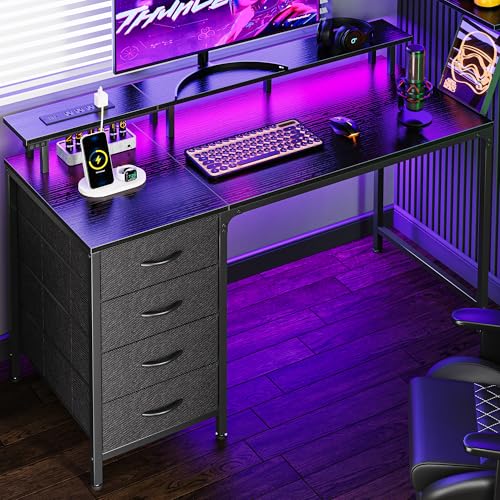
 Veken 55 Inch Large Electric Standing Desk55×23.6 Inch23.64 x 55.12 x 28.3 inches42.1 poundsCheck on Amazon


What's inside
- Why a width near sixty-two inches exists at all
- Measuring the room, the doorway, and the path between them
- Depth choices: twenty-four, thirty, and thirty-one and a half inches
- Height, legroom, and the space your knees actually get
- Top materials, cores, and the edges that take the wear
- Frame designs and the physics of racking
- Load capacity: the stated figure and the loads that actually occur
- Monitor arms, clamp limits, and rear-edge realities
- Cable trays, grommets, and power routing that stays tidy
- Assembly realities: cam locks, bolts, and the two-person lift
- Ergonomic pairing: chair height, screen height, and the whole station
- Check prices on Amazon
- A checklist to apply to any listing in this size class
As an Amazon Associate I earn from qualifying purchases. This post may contain affiliate links at no extra cost to you.
A desk that measures close to sixty-two inches across occupies a particular and very useful middle ground in home office furniture. It is noticeably wider than the compact desks sold for single laptops and spare corners, yet it stops short of the broad executive formats that can dominate a small room and complicate delivery through narrow hallways. That middle position is not an accident of marketing. Sixty-two inches, roughly one hundred fifty-seven centimetres, is about the width at which two ordinary monitors, a keyboard, a notebook, and a mug can coexist without constant shuffling, and it is also about the width at which a single ultrawide display can be flanked by printed documents, a reference book, or a drawing tablet without the edges of the work feeling crowded. This guide treats the size class seriously as a set of dimensions and engineering choices rather than as a label, because listings use the number loosely and because the difference between a desk that works for a decade and one that wobbles, sags, or traps your knees is rarely visible in a headline photograph.
Transparency matters on this page, so here is the arrangement in plain terms. Some of the outbound links in this article are affiliate links, which means that if you buy through the retailer after following one, this site may receive a commission from that purchase at no additional cost to you. That relationship does not change the dimensional standards, load figures, or material descriptions applied throughout this guide, and no maker can pay to have a weakness in frame design or finish quality described as a strength.
Everything that follows is built from manufacturer specification sheets, furniture standards, published ergonomic guidance, and the dimensional conventions used across the desk industry. Where a figure matters, such as the clamp range of a monitor arm or the knee clearance beneath an apron, the guide gives the number and explains how to verify it against a listing before money changes hands. Readers who approach a sixty-two inch desk as a measured object, with a tape in hand and a clear picture of the equipment it must carry, will find that the category rewards that care. Readers who buy on width alone often discover that depth, height, leg placement, and cable routing were the decisions that actually shaped their working days.
Why a width near sixty-two inches exists at all
The width classes of desks look arbitrary until they are mapped against the equipment people actually place on them. A typical twenty-four inch monitor is not twenty-four inches wide; the figure describes the diagonal of the panel, and the physical cabinet is usually around twenty-one to twenty-two inches across. Two such monitors side by side therefore consume roughly forty-three to forty-five inches once bezels and a small gap are counted, and angled inward for comfortable viewing they can take a little more of the front edge. Add a full-size keyboard of about seventeen to eighteen inches centred in front of the user, and the geometry starts to explain itself. The keyboard overlaps the monitors in plan view because it sits closer to the edge, but the speakers, headphone stand, desk lamp base, and the notebook that lives beside the keyboard all compete for the remaining width. On a forty-eight inch desk that remainder is a sliver. On a sixty-two inch desk it becomes two usable margins of roughly eight or nine inches each, and those margins are where daily friction either disappears or accumulates.
The second common arrangement explains the class just as well. A thirty-four inch ultrawide monitor has a cabinet width near thirty-two inches, which leaves about fifteen inches on each side of a sixty-two inch top. Fifteen inches is enough for a letter-size document laid flat, a graphics tablet, a small audio interface, or a laptop on a low stand used as a secondary screen for chat and reference material. It is not enough for a second full monitor, which is why buyers who know they will run two large separate displays should look beyond this class, but for the ultrawide-plus-documents pattern the fit is close to ideal. The width also suits a laptop-and-monitor pairing in which the laptop stays open: a fifteen or sixteen inch laptop is about fourteen inches wide, a twenty-seven inch external monitor about twenty-four inches across its cabinet, and together with a separate keyboard they fill the surface in a way that feels deliberate rather than improvised.
There is a third, quieter reason the size persists in catalogues. Sixty-two inches sits near the upper limit of what can be produced as a single flat-pack top, shipped in a carton that two people can carry, and manoeuvred through a standard interior doorway when tilted, without moving to the freight pricing and two-piece tops of larger furniture. Manufacturers design around carton dimensions and carrier limits as much as around ergonomics. That is worth knowing because it explains why so many unrelated brands converge on widths between sixty and sixty-three inches while describing them differently: the number reflects a shared set of shipping and sheet-material constraints. A top cut from a standard sheet leaves room for edging and finishing at this width, and the resulting product can still be sold with ordinary parcel delivery in most regions.
Buyers comparing neighbouring sizes should think in terms of equipment patterns rather than prestige. If a narrower desk in the class covered by best 50 inch computer desks already fits a single monitor and a laptop, the extra foot of width here buys margins and document space, not a different kind of desk. The honest question is what will occupy those margins every day. If the answer is nothing, the extra width is floor space surrendered for no return. If the answer is a second screen, a mixer, a midi controller, a stack of marked-up pages, or simply the elbow room that keeps a mouse hand from colliding with a coffee cup, then the class earns its footprint.
Measuring the room, the doorway, and the path between them
The first measurement is not the wall where the desk will stand but the route the carton and the assembled frame must travel. Interior doorways in many homes clear about thirty inches, and older housing stock can be narrower, while the diagonal of a sixty-two inch top means the panel itself must be tilted, rotated, or carried on edge through every opening. A one-piece top of this width is usually manageable on edge because its depth, not its width, then determines whether it passes: a thirty inch deep top carried vertically needs a doorway taller and wider than the path’s tightest turn allows, and stairwell corners are the usual failure point. Measure the narrowest doorway, the width of any hallway turn, and the ceiling height over stairs where a long panel must pivot. Write the numbers down. Listings will not do this work for you, and a desk that cannot reach the room is a return shipment waiting to happen.
In the room itself, start from the wall outward. The desk depth plus the space for a chair plus the space to stand up and push the chair back adds up quickly: a thirty inch deep desk, twenty-four inches of chair zone, and another eighteen inches of circulation behind the seated user already claim six feet of the room’s depth before a bookcase or door swing is considered. If the desk faces a wall, allow at least a couple of inches behind the top for cables to drop without being pinched, unless the design uses a rear cable channel that sits flush. If the desk will float in the middle of a room, the back becomes visible and cable behaviour matters aesthetically as well as practically, and a modesty panel or enclosed raceway may be worth more than it would against a wall.
Width on paper is not width in a room with skirting boards, radiators, window sills, and sockets in inconvenient places. Measure the wall run at desk height and at floor level, because legs land on the floor while the top meets the wall, and the two planes can differ by the depth of a baseboard or a pipe. Note where the electrical outlets sit relative to the planned position; a desk centred beautifully on a wall but two feet from the nearest socket creates a permanent cable bridge across the floor. Note also the swing of the room door and any wardrobe doors, since a wide desk placed near a hinged door can lose its end to a collision zone that only appears when both are moving. These are unglamorous checks, and they are exactly the ones that separate a settled installation from a week of rearrangement.
Floor condition belongs in the same survey. Long tops reveal slope: a floor that falls a few millimetres across sixty-two inches will make a rigid four-leg frame rock or leave one foot hovering, and hard floors transmit that movement as noise. Adjustable feet with a useful thread range solve most of it, but only if the design includes them on every leg. Carpet compresses under point loads, so a heavy desk settles unevenly over the first weeks and may need its feet re-levelled after the pile has taken the weight. Checking with a long level or a taut string before ordering costs minutes; correcting a twisted installation after the equipment is cabled costs an afternoon.
Depth choices: twenty-four, thirty, and thirty-one and a half inches
Depth is the dimension buyers most often underweight, because width photographs well and depth does not. Yet depth decides how far your eyes sit from the screen, how much forearm support the surface gives, and whether a monitor stand, a keyboard, and a document can occupy the same front-to-back column without overlap. The shallow end of this class, around twenty-four inches, suits a laptop-first setup or a monitor on a wall mount or arm, where the screen does not need desk depth beneath it. With the display lifted off the surface, twenty-four inches leaves room for a keyboard and a notebook in front of it, and the whole desk can sit in a shallow alcove. The same depth becomes cramped the moment a monitor on its factory stand enters the picture, because a typical stand foot extends eight to ten inches from the rear, pushing the screen forward and stealing the space where wrists and paper want to be.
Thirty inches is the depth most experienced buyers in this class settle on, and the arithmetic is straightforward. A monitor stand or the rear post of an arm occupies the back eight inches. The keyboard takes roughly six inches in the middle band. That leaves a front band deep enough for forearms to rest on the surface rather than hover at its edge, plus a strip behind the keyboard for a notebook, a phone, or a row of reference cards. Viewing distance also lands in a comfortable zone: with the screen near the back edge and the user seated at the front, eye-to-screen distance for a twenty-seven inch monitor typically falls between twenty-six and thirty-four inches depending on chair position, which matches the range most ergonomic guidance describes for general office work. Text size, scaling, and eyesight shift the ideal, but a thirty inch top gives the user room to move within that range instead of being pinned to one distance.
The deepest common option, around thirty-one and a half inches, often appears on tops dimensioned in metric at eighty centimetres. That extra inch and a half sounds trivial and is not. It is the difference between a large monitor stand fitting with a cable gap behind it and the stand dictating the layout, and it gives users of dual arms a rear working strip where a small shelf, a speaker pair on stands, or a document camera can live without crowding the screens. The cost is room depth and reach: anything stored at the back of a deep desk is a lean away, and shorter users may find that the far corners become dead zones used only for dust. Depth also interacts with top thickness and material, since a deeper span between legs sags more under the same load, a point the frame section below takes up in detail.
Curved and cut-out front edges complicate the depth figure, so read listings carefully. A desk described as thirty inches deep may reach that depth only at the centre of a curved front or at the rear corners of an L-shaped return, while the actual depth at the keyboard position is less. Conversely, an ergonomic scoop cut into the front edge brings the user closer to the screen without moving the chair, effectively shortening the working depth in a helpful way while reducing the surface available for forearms. The dimension that matters is the depth at the place where you will sit, measured from the front edge you touch to the rear edge where cables fall. If a listing gives only one depth number for a shaped top, treat that number as a maximum rather than a promise.
Height, legroom, and the space your knees actually get
Most fixed-height desks in this class stand between twenty-nine and thirty inches tall, a convention inherited from older office furniture standards that assumed a particular chair height and a particular user. That convention works well for many adults and badly for some, which is why the underside geometry deserves as much attention as the headline height. What your knees experience is not the top height but the clearance beneath the lowest obstruction: the bottom of an apron rail, a crossbar, a drawer unit, or a cable tray. A desk with a twenty-nine and a half inch top and a deep apron can offer less knee room than a slightly lower desk with an open frame. Listings that publish an under-desk clearance figure are doing you a favour; listings that publish only the overall height are asking you to guess at the dimension you will feel every day.
Thigh clearance and knee depth are different measurements. Thigh clearance is vertical, the gap between the top of your thighs and the underside obstruction, and it must accommodate both the chair’s seat height and the habit of crossing ankles or shifting posture. Knee depth is horizontal, how far your knees extend under the desk when your feet are flat and your back is against the chair’s backrest, and it is consumed by modesty panels, rear crossbars placed too low, and pedestal drawers positioned where legs want to be. For a shared or long-session desk, an open knee well across the central sitting position, free of drawers and bars for a generous width, matters more than storage built into the frame. Storage can live beside the desk; knees cannot.
Chair pairing completes the picture. A desk near thirty inches pairs naturally with a chair whose seat height adjusts through the range where feet stay flat and elbows rest near ninety degrees with shoulders relaxed. Shorter users at a fixed desk of this height often need a footrest to avoid pressure under the thigh from a seat raised to match the desk, while taller users may find the top low enough that the keyboard forces a downward wrist angle. None of this is a defect in the desk; it is the predictable result of fixed dimensions meeting varied bodies. It is also the strongest argument, for users at the extremes of stature, for choosing a frame with height adjustment or leg extenders rather than adapting their posture to a number chosen for a catalogue. Readers weighing that step will find the wider context in the guide to best 60 computer desks, where fixed and adjustable frames in the neighbouring width class are compared on the same terms.
Drawer units deserve a specific warning in this width class. A pedestal that hangs beneath one end of a sixty-two inch top can be genuinely useful, holding the printer paper, cables, and notebooks that otherwise colonise the surface. But a pedestal on the wrong side, or a pair of them, converts a wide desk into a narrow sitting tunnel. Check the width between obstructions at knee height, not just the width of the top, and picture the chair with a person in it rather than the empty product photograph. Armrests, too, must pass under the top or clear its edge when the chair rolls forward; a top height that looks generous can still clash with tall armrests, marking the edge banding with a season of small collisions.
Top materials, cores, and the edges that take the wear
The majority of tops in this class are laminate or melamine surfaces over a particleboard or medium-density fibreboard core, and that construction deserves a fair hearing rather than reflexive disdain. A well-made laminate top is flat, dimensionally stable, resistant to coffee rings and ink, and consistent from one example to the next, which is why offices buy them by the hundred. The quality questions are in the details the listing may not volunteer: the density and thickness of the core, the grade of the surface layer, and how the edges are finished. A top around one inch thick with a dense core feels and behaves differently from a thin, light panel of the same footprint, particularly between widely spaced legs where a heavier user leaning on the front edge applies real leverage. Surface grades rated for horizontal wear exist precisely because desktops abrade; a vertical-grade laminate used on a top to save cost will show wear at the keyboard zone years earlier.
Edge banding is where inexpensive tops confess. The front edge takes wrist pressure, chair-arm knocks, and the clamp loads of accessories, and it is usually finished with a strip of PVC or ABS bonded to the core. Thick banding with a slight radius survives knocks and is kinder to forearms; thin banding over a sharp core edge chips, lifts at the corners, and can feel like a knife edge under the wrist by the end of a long day. T-moulding edges, pressed into a groove, can be replaced and forgive impacts, though they sit slightly proud of the surface. Solid lipping in timber costs more and ages gracefully. When a listing shows a close photograph of a corner, look at it: the corner is where banding joints, surface wrap, and core quality are all visible at once, and makers who are proud of the edge tend to show it.
Bamboo tops occupy an interesting position in the class. The material sold for desktops is usually laminated strips or a strand-woven composite, pressed into panels that are hard, dense, and heavier than a particleboard top of the same size. Bamboo’s appeal is a combination of surface hardness, a distinctive grain, and a renewable feedstock story, though the resins and shipping involved mean the environmental account is more complicated than a single word suggests. In use, a bamboo top resists denting from dropped equipment better than softwood and takes screws for under-desk accessories well, provided pilot holes respect the material’s tendency to split near edges. It also transmits sound more than a damped laminate panel; a keyboard on a hard bamboo surface over a hollow frame can be noticeably louder, which matters in shared rooms and on calls.
Solid wood tops, whether oak, walnut, rubberwood, or acacia, bring mass, repairability, and movement. Wood expands and contracts across its width with seasonal humidity, so a solid top must be attached to its frame in a way that permits that movement: slotted holes, figure-eight fasteners, or other floating fixings rather than a rigid ring of screws. A listing that shows a solid top screwed hard to a steel frame with no allowance for movement is describing future cracks or pulled fixings, however handsome the photograph. Solid tops can be sanded and refinished when the surface tires, which no laminate can honestly promise, and their weight steadies a frame against racking. They also vary: grain, colour, and the occasional knot are part of the material, and buyers who need two identical desks should expect siblings rather than twins.
Frame designs and the physics of racking
Racking is the sideways looseness that makes a desk shimmy when you type hard, nudge it with a hip, or lean on one end while reaching for a shelf. It is the most common long-term complaint in this class because a sixty-two inch span gives movement leverage to work with: a small amount of play at each joint becomes visible travel at the far end of the top. Frame design is the main defence. Panel legs, where the legs are slabs running the depth of the desk, resist front-to-back wobble very well because the panel is stiff in its own plane, and they give a desk a furniture-like solidity. Their weaknesses are weight, a closed feeling around the feet, and vulnerability to side loads if the panel-to-top joints are only a row of small fixings; a long top on two panels still needs the joints and any cross support to handle lateral force.
Metal leg systems dominate the middle of the market, in C, T, and four-post arrangements, and the letters describe the foot and column geometry. A T leg places a column near the centre of a foot bar that runs front to back, giving good stability and clear floor space at the sides. A C leg offsets the column toward the rear, opening the front for chairs and footrests while relying on the foot’s length to prevent tipping loads from feeling vague. Four-post designs, essentially a leg near each corner joined by rails, read as the most traditional and can be the stiffest when the rails are deep and the corner joints are properly braced, or the loosest when the legs are slender tubes joined by hope and short screws. In every metal design the same variables recur: tube wall thickness, the size of the weld or bracket where column meets foot, whether the top rail spans between legs or each leg carries only its own small plate, and the quality of the fasteners into the underside of the top.
Crossbars and aprons are where stability is won quietly. A rear crossbar joining the legs near the top of the frame shortens the lever that racking works on, and a deep apron under the front edge stiffens the top itself against sag. The trade-off is the knee clearance discussed earlier: structure placed under the top spends the same space legs want. Good designs resolve this by putting the crossbar high and toward the rear, where knees rarely reach, and by making aprons shallow but wide in section so stiffness comes from geometry rather than depth. When photographs show the underside, study them. A frame whose underside is a few token brackets and a forest of nothing will behave accordingly once two monitors and a leaning adult load it asymmetrically.
Feet and floor contact complete the system. Wide feet with adjustable pads spread load and allow levelling; small glides on a long foot bar concentrate it. On hard floors, a slight compliance in the pad material damps the tiny vibrations that typing sends through a stiff frame, while on carpet the foot needs enough area not to sink a corner into the pile. Casters change the subject entirely: a desk of this width on wheels is a different product, useful in multipurpose rooms, but every wheel adds a joint that can move, and locking casters lock the wheel rather than the swivel on many designs, leaving a residual sway that typists notice. For a permanent dual-monitor station, fixed feet remain the calmer choice.
Load capacity: the stated figure and the loads that actually occur
Manufacturers state load capacities for desks in this class with little consistency about what the number covers. Sometimes it is the capacity of the frame alone on a laboratory floor with the load spread evenly; sometimes it is a marketing rounding of the top’s tolerance; occasionally it is the weight at which visible deflection begins rather than failure. The useful response is not cynicism but arithmetic. Add up your real equipment. Two monitors with stands commonly weigh between ten and twenty pounds each depending on size and construction. A desktop computer tower can weigh twenty to forty pounds if it lives on the surface rather than the floor. A laptop, a pair of speakers, a printer, books, and the accumulated geology of a working desk add more. Many complete stations in this class total somewhere between sixty and one hundred twenty pounds of static load, concentrated at the rear where the screens stand rather than spread like the test weights in a brochure.
Dynamic loads are the ones that find weak frames. Leaning on the front edge to stand up applies a large fraction of body weight through two forearms at the point furthest from the legs. A child climbing, a cat launching, a heavy box set down carelessly at one corner: these are ordinary events across a desk’s life, and they load joints in directions that static figures ignore. A sensible margin is therefore to choose a stated capacity comfortably above the summed static load, and to pay more attention to where the load sits. Weight centred over the legs is nearly free; weight cantilevered at the middle of a long span or hung off the rear edge on a clamp is expensive. Printers deserve special thought because they combine mass with vibration, and a printer at the end of a flexible top can set the whole surface trembling with each page.
Sag is the slow form of overload. A particleboard top spanning sixty-two inches between supports will deflect under a centred load, and the deflection that is invisible in month one can become a permanent set after years of humidity cycles and constant weight, a phenomenon materials science calls creep. Centre support is the cure: a fifth leg, a deep apron, or a frame rail that shortens the unsupported span. If a design has no centre support, the top’s own thickness and core density carry the whole argument, and buyers planning to park a heavy tower or a row of hardbound references at mid-span should be sceptical of thin panels. Turn the question around when reading listings: instead of asking whether the desk holds a heroic number, ask what span the number was measured across and what, structurally, prevents the middle from dipping.
Monitor arms, clamp limits, and rear-edge realities
A monitor arm is the single upgrade that most changes how a desk of this width feels, because it returns the rear strip of the surface to use and lets the screen float at a height and distance the factory stand never offered. Fitting one, though, is a mechanical negotiation with the top and the frame. Most arms attach with a clamp that grips the rear edge, and clamps have a stated thickness range, commonly spanning from about ten millimetres to somewhere between sixty and eighty-five millimetres depending on the model. The desk top must fall inside that range at the point of clamping, including any edge banding profile, and there must be clear space beneath the top for the clamp body and its screw. A deep rear apron or a frame rail placed exactly at the edge can make a nominally compatible top unclampable, which is why the underside photograph matters again.
Grommet mounting is the alternative when clamping fails or the rear edge is occupied by a cable channel. The arm’s bolt passes through a hole, either an existing cable grommet hole of suitable diameter or one drilled for the purpose. Drilling a laminate top is straightforward with the right bit and tape to prevent chipping; drilling a solid top requires respect for grain and for the movement fixings nearby. Either way, the load path changes: instead of squeezing the edge, the mount bears on a washer area around the hole, and a thin core can crush locally under a heavy screen if the hardware’s bearing surface is small. Makers of arms publish the required hole diameter and the top thickness range for through-bolt fitting, and those figures should be checked against the desk’s specification rather than assumed to overlap.
Weight and geometry interact once the arm is up. An arm rated for a given screen weight assumes the desk edge can take the torque that a screen on an extended arm applies, which is the screen’s weight multiplied by its distance from the clamp. Two screens on a dual arm, pulled forward for a closer view, can twist a thin rear edge alarmingly even when each screen is within the arm’s rating. Placing the clamp near a leg or over a frame rail shortens the top’s own lever and stiffens the installation noticeably. Users of very large ultrawides should also check the arm’s tilt range and the height of its pole against the screen’s centre of mass; a screen that can be mounted but not tilted to vertical is a compromise that shows up in neck posture within a week. For comparison of how these constraints change on a smaller footprint, the notes in best 47 inch desks cover clamp placement on narrow tops where edge space is scarcer still.
Cable behaviour changes with arms, mostly for the better. The screens rise, their cables drop from a height, and the arm’s own channels or clips can carry display and power leads down to a tray without the slack loops that stands require. Leave service slack at the screen end so the arm can move through its range without tugging connectors, and anchor the bundle at the desk so that movement happens in the intended loop rather than at the plug. An arm that will never move after installation still benefits from this care, because the day it does move, for cleaning or a new layout, is the day a tight cable pulls a port out of true.
Cable trays, grommets, and power routing that stays tidy
A dual-screen station in this width class easily generates eight or more cables: two display leads, two monitor power cords, a computer power cord, a keyboard and mouse or their charging leads, a lamp, a phone charger, speakers, and an ethernet run for anyone who prefers wire to wireless. Without a plan, that bundle hangs behind the desk in a visible curtain, collects dust at floor level, and makes every later change an excavation. The plan that works has three elements: a single power source mounted to the desk, a tray or channel that carries the slack horizontally, and short, deliberate drops from equipment to tray. When the power strip lives in the tray rather than on the floor, the whole desk has exactly one cord to the wall, and the desk can be pulled out for cleaning without unplugging the world.
Trays come in two broad kinds. An open wire tray, usually steel mesh or a formed basket hung under the rear of the top, ventilates power bricks and lets cables enter and leave anywhere along its length, which suits setups that change often. A closed channel or raceway hides its contents completely and often doubles as a structural cross member, but it punishes improvisation: cables enter at defined points, capacity is finite, and a power brick that does not fit simply does not fit. Dimensions matter more than style. Measure the largest power brick in your setup and compare it with the tray’s internal height and width before ordering, and check how the tray mounts; screws into a particleboard underside need adequate top thickness and should land away from the edge fixings and any floating brackets on a solid top.
Grommets are the small decisions that shape the surface. A round grommet near each rear corner lets monitor and lamp cables drop close to their sources instead of travelling across the top to a single central hole, and shorter surface runs look calmer and snag less. Grommet diameter, often around sixty to eighty millimetres on desks that include them, decides what passes through: a plug, a bulky connector, or only bare cable with the plug fed from below. Caps with brush or hinged covers keep the opening tidy when it is lightly used. On desks without grommets, an arm clamp at the rear edge and a tray beneath can achieve nearly the same result by taking cables straight off the back, provided the gap between desk and wall is managed so plugs are not crushed when the desk is pushed home.
Power routing has a safety layer that tidiness should not obscure. Keep total draw within the rating of the strip and the wall circuit, which for a normal office station is rarely a challenge but becomes one when a space heater or a kettle joins the same outlet in winter. Give power bricks air; a closed tray stuffed with adapters running warm is a poor idea even when each device is individually modest. Separate, where practical, the signal cables from mains leads along the tray, not because an ordinary desk run will audibly corrupt a digital signal, but because a disciplined left-for-power, right-for-data habit makes tracing faults faster. Finally, label both ends of any cable that disappears into a tray. The label feels excessive on installation day and feels like wisdom eighteen months later when one device of five needs replacing.
Assembly realities: cam locks, bolts, and the two-person lift
Flat-pack desks in this class assemble by one of two fastening philosophies, and they age differently. Cam locks, where a rotating cam in one panel captures a pin screwed into the other, are fast, forgiving of slight misalignment, and kind to manufacturers’ packing lines. Their weakness is clamping force and repeatability: a cam joint that is loosened and retightened through several house moves gradually loses its bite, particularly in particleboard where the cam’s pocket can crumble. Threaded bolts into metal inserts or directly into steel frame members are slower to assemble and far more tolerant of disassembly, which is one reason metal-frame desks dominate the segment for buyers who expect to move. Neither system is automatically superior in a desk that will be built once and left alone, but the joint type predicts how the desk will feel in year five better than the showroom photograph does.
Sequence matters more than strength. The recurring error with long tops is attaching legs to a top that rests finished-side down on a gritty floor, grinding the surface during the shuffling that alignment requires. Work on the carton or a blanket. The second error is fully tightening every fixing at first contact; long frames need to be persuaded into square, and the correct method is to start all fasteners, bring the frame upright, check the diagonals or rock the frame to seat it, and only then tighten in a pattern that pulls the joints evenly. A desk tightened crooked will hold its crookedness with impressive loyalty, and a door-frame check, measuring both diagonals of the leg rectangle and nudging until they match, takes two minutes and removes most of it.
The lift is a genuine safety consideration at this size. A sixty-two inch top in solid material or dense bamboo, with frame attached, can reach weights that one person should not rotate from floor to upright alone, not because the mass is heroic but because the leverage of a long panel twists wrists and invites the sudden set-down that chips corners and toes. Two people, a cleared rotation path, and a decision about which edge becomes the bottom during the turn are the whole technique. Wall fixings deserve mention here too: tall, shallow storage added later, or a desk placed where a child might climb, changes the tipping analysis, and some makers supply anti-tip hardware for hutch combinations that should be used rather than binned.
Spare fixings and documentation are part of the product. Keep the leftover bolts, the Allen key that actually fits, and the instruction sheet in a labelled bag taped beneath the top or filed with household papers. Cam and bolt sizes in this industry are common but not universal, and the five-minute job of tightening a loosened leg in year three becomes an archaeology project without the right key. Photograph the underside once assembled, showing tray position, clamp placement, and cable runs; that photograph is the map for every later modification, and it costs nothing on the day when everything is visible.
Ergonomic pairing: chair height, screen height, and the whole station
A desk is one term in an ergonomic equation whose other terms are the chair, the screens, and the user’s own proportions, and changing one term without the others rarely improves the sum. The working sequence used by ergonomists is to set the chair first: feet flat, knees near a right angle, seat height giving level thighs. Then the desk height should meet the forearms where they naturally rest, elbows near ninety degrees, shoulders down, wrists floating level over the keyboard rather than bent up or pressed into the edge. Then the screens come to the user: top of the visible display area near or slightly below eye level, distance set by size and text scaling, tilt adjusted so the face of the panel is roughly perpendicular to the line of sight. On a fixed desk, the chair and the arms absorb all the adjustment, which is why a good chair and a capable arm matter more to comfort than a few millimetres of top specification.
Dual monitors introduce a symmetry decision. If one screen dominates, it belongs directly ahead with the secondary angled at its side, and the keyboard follows the primary screen, not the seam between the two. If both are used equally, the seam sits ahead and each panel angles inward, accepting that the user will turn the head slightly all day in exchange for never favouring one side completely. Either arrangement fits within sixty-two inches for panels up to the common twenty-seven inch class, but the centred-seam layout consumes width symmetrically and leaves less room on the dominant-hand side for a mouse at a comfortable distance. Mouse space is an ergonomic dimension too: a wide keyboard with a number pad pushes the mouse outward into shoulder abduction, and many dual-screen users recover more comfort from a compact keyboard than from any other single change, because it returns the pointing hand to the body’s centreline.
Standing accessories interact with this class in specific ways. A desktop converter that raises keyboard and screens together needs a footprint the top can spare in both dimensions, and on a twenty-four inch deep desk the converter’s base can crowd the front edge; the deeper tops carry converters more gracefully. The converter also raises the load question, since its own weight plus equipment sits near mid-span. Buyers whose real goal is alternating posture across the day are usually better served by a height-adjustable frame under a top of this width than by stacking machinery on a fixed one, and the wider survey in best 70 computer desks sets out how the next width class handles adjustable frames when two large screens and a converter enter the same plan. The principle transfers directly: posture variety should be built into the frame, not balanced on top of it.
Light is the last ergonomic term and the easiest to fix late. A wide desk invites a wide window relationship, and a station placed with a bright window directly behind the screens will fight glare all afternoon, while a window behind the user turns the displays into mirrors. Side-on placement, a lamp with a shade that keeps light off the panels, and matte surface finishes on the top all reduce the contrast war between screen and room. Laminate sheen is worth a thought here: a high-gloss top under a bright lamp reflects into the eyes from below, a small and constant irritation that a satin or matte finish avoids entirely.
Check prices on Amazon
Live listings for the shortlist in this guide are pulled from Amazon below, so prices and availability are always current at the moment you look.


A checklist to apply to any listing in this size class
Begin with the dimensions, and distrust round numbers. A desk sold as sixty-two inches may measure sixty-one and a half, sixty, or a metric thirteen hundred seventy millimetres wearing an imperial costume, and the missing width always comes out of the margins your equipment plan was counting on. Look for the manufacturer’s own specification sheet figure, in both unit systems if offered, and for the depth and height stated to the same precision. Marketing rounding usually inflates width and understates nothing else; if the width is rounded up, assume the depth deserves a second look as well. Measure your largest single item, often a monitor’s cabinet width or a printer’s footprint with its paper tray open, against the verified figures rather than the headline.
Then read the construction claims in a fixed order: top thickness and core material, edge treatment, frame material and joint type, presence of centre support or apron, stated load capacity and the span it refers to, clamp compatibility at the rear edge, and the mounting and internal size of any cable tray. Each of these is a factual claim that can be checked against photographs of the underside and corners, and a listing that answers all of them is signalling a maker who expects scrutiny. A listing that answers none, offering lifestyle photographs and adjectives instead, is signalling something else. Neither signal is proof, but across a market they correlate strongly with the ownership experience that follows.
Warranty and parts support belong on the same checklist, because a wide desk concentrates its failures in a few replaceable components: a leg leveler that strips its thread, a cam that cracks its pocket, a tray bracket that bends under an overloaded power strip. Makers who publish a spare-parts route and a warranty term measured in years are telling you the frame was designed to be serviced rather than discarded. Ask how replacement feet, fasteners, and edge banding are obtained, and whether the top and frame are warranted separately, since a surface defect and a structural defect follow different paths. Keep the purchase record with the assembly photographs mentioned earlier, so that a claim made in year four does not depend on memory or on a listing page that may have changed twice since the order was placed.
Finally, reconcile the desk with the room survey from earlier in this guide: doorway and stair measurements against carton and panel size, wall run against verified width, outlet position against the power plan, floor level against the feet’s adjustment range, and chair dimensions against knee clearance and top height. A desk that passes the construction checks and the room checks is very likely to settle into years of unremarkable service, which is the highest praise furniture of this kind can earn. The width class rewards buyers who treat it as a measured system of top, frame, screens, chair, and room rather than as a single number, and a sixty-two inch desk chosen that way tends to disappear beneath the work itself, leaving attention free for everything the desk was bought to support.