What's inside
- Key Takeaways
- Quick Picks
- How were these picks chosen for Night City?
- Side-by-side comparison
- How do you choose a laptop for Cyberpunk 2077?
- Putting these machines through Night City, our way
- Common mistakes when buying for this game
- Ray tracing, upscaling, and generated frames, explained without the fog
- Living with the machine after launch night
- External monitors, second screens, and the next demanding game
- Final recommendation
- Frequently asked questions
As an Amazon Associate I earn from qualifying purchases. This post may contain affiliate links at no extra cost to you.
gizmoverdict.com is reader-supported. When you buy through links on our site, we may earn an affiliate commission.
Where to buy: Cyberpunk-class gaming laptops move through Amazon in waves tied to GPU generations, so a configuration that shows as available on Monday can be replaced by a near-twin listing by Friday. Every machine below is sold through its Amazon product page, where the exact processor, memory, and storage combination for that listing can be confirmed before checkout. Treat the listing page, rather than any roundup including this one, as the final word on which variant ships to your door.
Night City is a demanding place to run on a laptop. Anyone shopping for the best gaming laptops for cyberpunk 2077 quickly learns that the game’s neon districts, dense traffic, and reflective streets punish weak graphics hardware far more than most open-world titles do. Ray tracing is the feature that sells the fantasy, yet it is also the setting that separates a smooth evening in Watson from a stuttering slide show. This guide sorts six current listings by how honestly they fit that job. Three carry the GeForce RTX 4070, a card with enough native muscle for high settings at 1440p-class resolutions. The other three carry the newer RTX 5060, which leans on DLSS frame generation to keep ray-traced scenes fluid, and each of those reviews says so plainly instead of pretending the trick is free power. Screen size runs from a compact 15.3-inch panel to a desk-hogging 17.3-inch one, memory sits at 16GB or 32GB of DDR5, and storage is either 512GB or a full terabyte. Read the picks with your own priorities in mind: native rendering headroom, display sharpness, portability, or simply the calmest path into Night City without overspending on hardware the game cannot use.
Key Takeaways
- The three RTX 4070 machines are the native-settings route into Cyberpunk 2077, pairing that GPU with 165Hz QHD panels in both MSI Katanas and a 144Hz 17.3-inch screen in the ROG Strix G17.
- Each RTX 5060 pick here reaches comfortable ray tracing through DLSS frame generation, a software assist that should be understood before purchase rather than discovered afterward.
- Only the MSI Katana A15 AI ships with 32GB of DDR5 in this set; the remaining five listings carry 16GB, which still suits the game but leaves less room for heavy multitasking.
- Storage splits the field: five picks include a 1TB drive, while the Lenovo LOQ settles for 512GB and will fill quickly beside a large game library.
- Every display in the group refreshes at 120Hz or faster, so panel speed is not the compromise anywhere in this lineup.
Quick Picks
| Pick | Machine | Badge |
|---|---|---|
| 1 | MSI Katana A15 AI RTX 4070 | Best overall |
| 2 | MSI Katana 15 RTX 4070 | Best Intel-powered 4070 option |
| 3 | ASUS ROG Strix G17 RTX 4070 | Best big-screen immersion |
| 4 | ASUS ROG Strix G16 RTX 5060 | Best frame-generation feature set |
| 5 | Alienware 16 Aurora RTX 5060 | Best sharp 16:10 display |
| 6 | Lenovo LOQ 15.3 RTX 5060 | Best compact entry point |
How were these picks chosen for Night City?
Cyberpunk 2077 rewards a specific shopping order, and the selection here follows it. Graphics hardware came first, because the game’s ray-traced lighting and dense geometry scale with GPU strength more than with any other single component. Listings built around the RTX 4070 earned priority as the native-settings tier, while RTX 5060 listings qualified only on the understanding that DLSS frame generation does the heavy lifting for ray tracing, a distinction each affected review states openly. Processor choice came second: the game streams assets constantly as you drive, so every pick carries a modern multi-core chip from AMD’s Ryzen 9 and Ryzen 7 families or Intel’s Core i7 and Core 7 lines, with no dated quad-core designs anywhere in the group.
Memory and storage formed the third filter. Sixteen gigabytes of DDR5 is the working floor for this title once background apps join the session, and the single 32GB configuration earned its top placement partly on that surplus. For storage, a terabyte matters because the game and its expansion claim a large footprint before mods, captures, or a second AAA title enter the picture; the lone 512GB pick is flagged for that in its review rather than quietly excused. Screens were judged last but not lightly, since QHD resolution, 165Hz refresh, and 16:10 aspect ratios each change how Night City feels in motion. Cooling earned a mention wherever a maker names its system in the listing, because sustained boost clocks decide whether minute forty of a session plays like minute four. Finally, any listing that hid its GPU generation or blurred its configuration was set aside, since honest spec sheets are the entire point of a guide like this one. Readers comparing across generations may also find our roundup of best rtx 3060 gaming laptops useful as a baseline for what the previous shelf still does well.
One more distinction shaped the ordering, and it concerns the two kinds of evenings this game produces. Exploration evenings wander districts on foot, linger in photo mode, and prize image quality above all; the QHD and 1600p panels in this guide exist for those hours. Action evenings chain gigs, drives, and firefights across the map, streaming assets constantly and punishing any weakness in storage speed or memory; the terabyte drives and the single 32GB configuration earn their keep there. A buyer who knows which evening dominates their own play can read the reviews below with a sharper eye, forgiving a pick its weakness in the mode they rarely visit and holding it strictly to account in the mode they live in. That self-knowledge, more than any benchmark, is what turns a good specification sheet into the right laptop.

1. MSI Katana A15 AI RTX 4070 — Best overall
The Katana A15 AI takes the top slot because its listing stacks the strongest combination of parts in this group without asking the buyer to forgive a weak link. An AMD Ryzen 9-8945HS processor drives the system, the GeForce RTX 4070 handles graphics, and 32GB of DDR5 memory doubles what most rivals here provide. That memory surplus is not decorative. Cyberpunk 2077 streaming through Corpo Plaza while a browser, chat client, and capture tool sit open behind it is exactly the workload where 16GB machines begin to feel tight, and this MSI simply has more room to breathe. The 15.6-inch QHD panel refreshes at 165Hz, giving the game a sharp canvas at a resolution the 4070 can feed natively at high settings with ray tracing kept sensible.
Storage lands at 1TB, enough for the base game, the Phantom Liberty expansion, and a rotating cast of other large installs. MSI names its Cooler Boost 5 system in the title, a dual-fan arrangement with shared heat pipes that suits the sustained loads this title applies during long drives across the Badlands. Windows 11 arrives preinstalled, and the chassis color is a plain black that disappears under a desk setup rather than announcing itself. For ray tracing expectations, set them honestly: this is the native route, meaning DLSS upscaling can stay at Quality or even step aside in many districts, while the heaviest path-traced modes remain a stretch for any laptop GPU in this class. The A15 AI is the pick for a single-machine setup meant to handle Night City tonight and still feel current when the next demanding release lands.
Ownership details reinforce the headline specs. The 8945HS belongs to AMD’s AI-branded generation, which matters less for this game than for the productivity software many owners run during the day, yet it signals a recent platform rather than a leftover chassis clearing out old silicon. DDR5 memory at this capacity also future-proofs the machine against the slow creep of background software, since launchers, overlays, and recording tools all take their quiet tax before the game sees a single gigabyte. In practical terms, the A15 AI is the only listing here where a buyer can stop thinking about memory entirely for the machine’s working life. Its QHD panel deserves one more note: at 15.6 inches, that resolution produces crisp text for daytime work, so the laptop doubles as a sharp general-purpose machine rather than a single-purpose game box tethered to an external monitor.
Strengths
- 32GB of DDR5 memory, double the capacity of every other pick in this guide
- RTX 4070 paired with a QHD 165Hz display for native high-settings play
- Ryzen 9-8945HS flagship-class processor for asset streaming and multitasking
Trade-offs
- 15.6-inch screen feels small beside the 17.3-inch Strix G17 for cinematic scenes
- Cooler Boost 5 fans become audible during extended ray-traced sessions
- Listing title gives no weight figure, so travel friendliness stays unconfirmed
- Display: 15.6-inch QHD, 165Hz
- Processor: AMD Ryzen 9-8945HS
- Graphics: NVIDIA GeForce RTX 4070
- Memory: 32GB DDR5
- Storage: 1TB SSD
- Cooling: Cooler Boost 5
- Operating system: Windows 11
- Weight: Not stated in the listing title
Best for: a player running Night City at QHD with chat, browser, and capture tools open alongside the game.
Not suited for: a commuter carrying the machine daily without a confirmed weight figure in the title.
Pricing on this configuration shifts with GPU-season stock, so check price on Amazon before planning the rest of a setup around it.

2. MSI Katana 15 RTX 4070 — Best Intel-powered 4070 option
MSI’s second entry in this guide looks similar on a shelf yet differs where it counts, starting with an Intel Core i7-13620H processor in place of the Ryzen silicon above. The graphics card is the same GeForce RTX 4070, the panel is again a 15.6-inch QHD screen refreshing at 165Hz, and Cooler Boost 5 returns as the named cooling system. Where the two Katanas part ways is memory: this configuration carries 16GB of DDR5 rather than 32GB, and storage is listed as a 1TB NVMe SSD. For Cyberpunk 2077 itself, that memory figure remains comfortable, since the game plus a voice client and a few browser tabs sits well inside 16GB during ordinary play.
The honest framing for this machine is that it trades the A15 AI’s multitasking headroom for an Intel platform some buyers simply prefer, whether for familiarity, for specific creative software behavior, or for a household already standardized on Intel machines. In-game, the experience tracks its sibling closely: native rendering at QHD with high settings, ray tracing at moderate levels, and DLSS available as an upscaling safety net rather than a necessity. The 165Hz panel will mostly serve smoother camera pans and general desktop fluidity, because even strong laptop hardware will not pin this title near that ceiling at QHD with ray tracing lit. Buyers should also note the model string B13VGK-2000US when comparing listings, since Katana variants multiply quickly and small spec changes hide inside similar names. As a straightforward, no-drama route into a ray-traced Night City on Intel hardware, this configuration earns its place.
Consider also how this configuration ages. The i7-13620H sits in Intel’s well-understood H-series line, with hybrid core behavior that Windows 11 handles maturely by now, and driver support for the 4070 remains a current priority for NVIDIA rather than a legacy courtesy. A buyer keeping a laptop four or five years benefits from that maturity in ways spec sheets never show: fewer surprises after updates, broad peripheral compatibility, and a deep pool of community knowledge for any quirk that surfaces. The QHD panel at this size also scales cleanly to 1080p when a future title demands it, giving the machine a graceful fallback instead of a hard wall. None of that makes the 16GB memory figure disappear, but it frames the Katana 15 as the steady, known-quantity option in a guide full of newer experiments.
Strengths
- Same RTX 4070 and QHD 165Hz pairing as the top pick, on an Intel platform
- 1TB NVMe SSD leaves room for the expansion and other large games
- Cooler Boost 5 cooling named in the listing for sustained sessions
Trade-offs
- 16GB of memory halves the multitasking headroom of the A15 AI configuration
- No Wi-Fi generation is spelled out in the title for buyers comparing radios
- Black 15.6-inch chassis closely mirrors its sibling, inviting listing mix-ups
- Display: 15.6-inch QHD, 165Hz
- Processor: Intel Core i7-13620H
- Graphics: NVIDIA GeForce RTX 4070
- Memory: 16GB DDR5
- Storage: 1TB NVMe SSD
- Cooling: Cooler Boost 5
- Operating system: Windows 11
- Weight: Not stated in the listing title
Best for: an Intel-loyal player running native QHD ray tracing without heavy background multitasking.
Not suited for: a streamer encoding gameplay locally while dozens of browser tabs stay open.
Because Katana variants sit close together in search results, verify the B13VGK-2000US string on the page where you check the current price on Amazon.

3. ASUS ROG Strix G17 RTX 4070 — Best big-screen immersion
Size is the argument here, and the Strix G17 makes it with a 17.3-inch display in a class where rivals cluster around fifteen and sixteen inches. Cyberpunk 2077 is a game of scale, from the megabuilding canyons of Watson to the open sprawl beyond the city wall, and that extra diagonal genuinely changes how scenes land. The panel runs at Full HD with a 144Hz refresh rate rather than QHD, a pairing that suits the RTX 4070 inside: at 1080p the card has generous headroom for high settings and meaningful ray tracing without leaning on upscaling. Driving the system is an AMD Ryzen 9-7845HX, a high-core-count HX chip built for sustained workloads, backed by 16GB of DDR5 memory and a 1TB SSD.
The 2024 Eclipse Gray chassis follows ROG’s familiar performance-first design language, and the larger body gives cooling hardware more volume to work with during long sessions. Trade-offs follow from the same dimensions. A 17.3-inch laptop reshapes bag choice, desk depth, and lap use, and its Full HD panel shows visibly larger pixels than the QHD Katanas when the same scene is compared side by side. Buyers whose priority is cinematic presence at the desk will accept both compromises gladly, since the lower resolution also means the GPU spends its budget on lighting quality instead of pixel count. For a player building a semi-permanent battlestation around one machine, with an external monitor perhaps arriving later, the G17’s screen-first formula is easy to defend. It is the most theatrical way to enter Night City among these six listings.
The HX processor deserves its own paragraph, because it changes the machine’s character beyond gaming. The Ryzen 9-7845HX carries a desktop-leaning core count that chews through video exports, code compiles, and archive work at a pace the thinner chips here cannot match, so the G17 doubles as a genuine workstation for owners whose day jobs involve heavy software. That dual identity justifies the big chassis for many buyers: it is not merely a larger screen, it is a larger computer in every sense. The 144Hz refresh at 1080p also gives the panel a second life in fast, light titles where the 4070 can genuinely stretch toward the ceiling, something the QHD machines cannot do as easily. Viewed whole, the G17 is the pick for a single-machine household where the laptop replaces a desktop outright, tower, monitor, and all.
Strengths
- 17.3-inch panel, the largest canvas in this guide, for cinematic district views
- Ryzen 9-7845HX HX-series processor tuned for sustained heavy loads
- 1080p resolution leaves the RTX 4070 ample headroom for ray-traced lighting
Trade-offs
- Full HD sharpness trails the QHD panels on both MSI Katana listings
- Large chassis limits bag compatibility and casual lap use
- Memory stops at 16GB despite the otherwise flagship-leaning specification
- Display: 17.3-inch FHD, 144Hz
- Processor: AMD Ryzen 9-7845HX
- Graphics: NVIDIA GeForce RTX 4070
- Memory: 16GB DDR5
- Storage: 1TB SSD
- Color: Eclipse Gray (2024)
- Weight: Not stated in the listing title
Best for: a desk-based player who values screen size and ray-traced atmosphere over pixel density.
Not suited for: a daily train commute with a slim backpack and a narrow fold-down tray.
Large-format gaming laptops sell in shorter runs than mainstream sizes, so it is worth a moment to see the current Amazon price while this 2024 configuration remains listed.

4. ASUS ROG Strix G16 RTX 5060 — Best frame-generation feature set
The Strix G16 opens the RTX 5060 half of this guide, and its review must start with the honesty note that defines the trio: with ray tracing engaged, smooth play on this card relies on DLSS frame generation, which inserts AI-built frames between rendered ones. Used well, the feature makes a neon-soaked drive through Japantown feel fluid; it is not, however, the same thing as raw rendering power, and input purists chasing competitive shooters would switch it off in those games. For Cyberpunk’s single-player world, the trade suits most players. The supporting hardware is strong elsewhere: an Intel Core i7-14650HX processor, 16GB of DDR5, and a 1TB Gen 4 SSD give the GPU a balanced platform with no obvious bottleneck.
ASUS fits a 16-inch FHD+ panel with a 16:10 aspect ratio, a 165Hz refresh rate, and a stated 3ms response, so the screen adds vertical room that helps both games and the productivity work squeezed between sessions. Wi-Fi 7 appears in the title, the newest radio standard in this group, which matters for large downloads on a compatible home network. The chassis carries the G615JMR-AS74 model code for exact listing matching. Settings advice in plain terms: run native resolution with DLSS upscaling at Quality, enable frame generation for ray-traced districts, and keep expectations at high rather than ultra for the most demanding overdrive-style modes. Judged as a modern, feature-forward route into the game rather than a brute-force one, the G16 stands up well.
One more consideration separates thoughtful 5060 purchases from regretful ones: the quality of the base frame rate underneath the generation. Frame generation multiplies an existing stream of rendered frames, so it works best when the card is already rendering at a pace that feels responsive; pushing settings until the native rate collapses and then asking software to rescue the result produces a smeared, laggy image no feature can redeem. The G16’s HX processor helps here, keeping simulation and streaming work from becoming the bottleneck that starves the GPU. Owners who respect that order of operations, native competence first and generation second, will find this machine genuinely satisfying in Night City. Owners who treat the feature as a license to max every slider will blame the laptop for a misunderstanding the listing never promised to fix.
Strengths
- DLSS frame generation keeps ray-traced scenes fluid on the RTX 5060
- 16:10 FHD+ panel at 165Hz with a stated 3ms response time
- Wi-Fi 7 and a Gen 4 SSD modernize the platform around the GPU
Trade-offs
- Ray tracing smoothness depends on frame generation rather than native rendering
- FHD+ resolution is a step below QHD for fine texture detail
- 16GB of memory matches, but does not exceed, the group standard
- Display: 16-inch FHD+ 16:10, 165Hz, 3ms
- Processor: Intel Core i7-14650HX
- Graphics: NVIDIA GeForce RTX 5060
- Memory: 16GB DDR5
- Storage: 1TB Gen 4 SSD
- Wireless: Wi-Fi 7
- Operating system: Windows 11 Home
- Model: G615JMR-AS74
Best for: a player comfortable letting DLSS frame generation carry ray tracing in a single-player world.
Not suited for: competitive shooter sessions where generated frames are switched off and native speed decides.
Feature-rich configurations like this one tend to headline seasonal promotions, so check its price on Amazon before settling on a final shortlist.
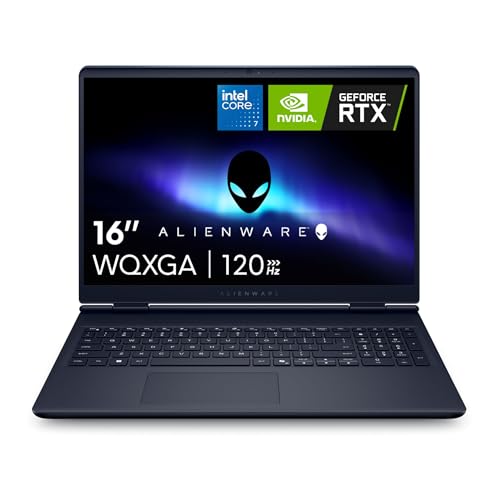
5. Alienware 16 Aurora RTX 5060 — Best sharp 16:10 display
Alienware’s Aurora entry argues for the RTX 5060 through its screen and its badge. The display is a 16-inch panel at 2560×1600 in a 16:10 layout, the sharpest resolution offered by any 5060 pick here, refreshing at 120Hz. That pixel density flatters Night City’s signage, distant architecture, and fine interior detail, although it also raises the rendering bill, which is precisely where this card’s DLSS toolkit earns its keep. Frame generation again underpins comfortable ray tracing, stated here as plainly as in the Strix review above: expect upscaling plus generated frames to do the work at this resolution, not native rendering alone. An Intel Core 7 240H processor, 16GB of DDR5 memory, and a 1TB SSD round out a specification with no glaring weak point.
The blue finish and backlit keyboard give the Aurora a distinct identity in a group dominated by black and grey shells, and Alienware’s design language tends to divide opinion in the best way: owners usually chose it deliberately. Practical notes matter too. The 120Hz ceiling sits below the 165Hz panels elsewhere in this guide, a difference competitive players may register even if Cyberpunk itself rarely approaches either figure at these settings. Battery life, as with every gaming laptop in this roundup, should be treated as a secondary concern; machines of this class are built around wall power. With a crisp, tall display and a recognizable brand’s design as the draws, and the frame-generation bargain accepted with eyes open, the Aurora is a coherent package.
The Aurora also invites a word about brand ownership experience, because Alienware machines are bought partly for the ecosystem around them: a distinctive design language, a recognizable support channel, and a resale identity that generic shells lack. None of that renders a single extra frame, and this guide does not pretend otherwise, yet long-term satisfaction with a laptop includes the mornings it sits on a desk looking like an object its owner chose on purpose. The 16:10 screen strengthens the everyday case further, since documents, timelines, and spreadsheets all gain visible rows compared with a 16:9 panel. In a group where every machine plays the same game competently, those ownership qualities are a legitimate tiebreaker rather than a marketing trick, provided the buyer walks in understanding the frame-generation arrangement described above.
Strengths
- 2560×1600 resolution, the sharpest panel among the RTX 5060 picks
- 16:10 aspect ratio adds vertical space for games and documents alike
- Distinctive blue chassis with a backlit keyboard as titled
Trade-offs
- 120Hz refresh ceiling trails the 165Hz screens on rival listings
- High native resolution makes DLSS assistance effectively mandatory for ray tracing
- Title omits a named cooling system, unlike the MSI entries
- Display: 16-inch 2560×1600, 120Hz, 16:10
- Processor: Intel Core 7 240H
- Graphics: NVIDIA GeForce RTX 5060
- Memory: 16GB DDR5
- Storage: 1TB SSD
- Keyboard: Backlit
- Operating system: Windows 11 Home
- Color: Blue
Best for: a resolution-first player happy to pair a sharp panel with DLSS assistance.
Not suited for: esports sessions built around a 165Hz-or-faster refresh ceiling.
Alienware configurations rotate through Dell’s seasonal lineups quickly, making a quick price check on Amazon a sensible first step.

6. Lenovo LOQ 15.3 RTX 5060 — Best compact entry point
Lenovo’s LOQ closes the guide as the smallest and most storage-constrained machine here, and both traits deserve direct treatment. The 15.3-inch WUXGA IPS panel refreshes at 165Hz, a genuinely quick screen for the class, and the RTX 5060 inside follows the same rules as its two 5060 siblings above: DLSS frame generation is the mechanism that keeps ray-traced Night City fluid, with upscaling sharing the load. An AMD Ryzen 7 250 processor and 16GB of RAM form a sensible midrange platform, and Lenovo markets the line as AI-powered, language echoed from the listing title. The catch is the 512GB SSD. Cyberpunk 2077 with its expansion installed claims a large share of that drive on day one, leaving modest room for a second blockbuster title.
That constraint is manageable rather than fatal. A player who rotates one or two big games at a time, or who keeps media and documents on external storage, will live with 512GB comfortably; a hoarder of installed libraries will not. In the LOQ’s favor, the Luna Grey finish looks restrained enough for shared spaces, the IPS panel promises consistent colors off-axis, and the compact footprint suits smaller desks and easier bag carry than the 17.3-inch Strix allows. Settings guidance mirrors the other 5060 picks: Quality upscaling, frame generation on for ray tracing, high presets as the target, and no shame in dropping to balanced upscaling in the densest downtown blocks. As the attainable doorway into this guide’s subject, the LOQ makes sense precisely because its compromises are visible and priced into the proposition rather than hidden.
There is a quieter virtue in the LOQ’s restraint worth naming: it spends its budget where Cyberpunk actually looks. A fast IPS panel and a current-generation GPU shape every minute of play, while the corners cut, storage chief among them, are the corners a disciplined owner can manage with an external drive and a tidy install habit. Lenovo’s LOQ line exists precisely to make that trade legible, and this configuration honors the brief. The 15.3-inch size also slips into bags and onto desks that reject the bigger machines in this guide, which matters for students and shared households. Judge it as an honest midrange doorway rather than a discounted flagship, and its specification stops looking like a compromise list and starts looking like a plan.
Strengths
- 165Hz IPS panel at a compact 15.3-inch size for smaller desks
- RTX 5060 with DLSS frame generation for ray-traced play
- Ryzen 7 250 and 16GB RAM form a balanced midrange platform
Trade-offs
- 512GB SSD fills quickly beside the game, its expansion, and captures
- Ray tracing leans on generated frames rather than native rendering strength
- Title states no Wi-Fi generation for network comparison shoppers
- Display: 15.3-inch WUXGA IPS, 165Hz
- Processor: AMD Ryzen 7 250
- Graphics: NVIDIA GeForce RTX 5060
- Memory: 16GB RAM
- Storage: 512GB SSD
- Color: Luna Grey
- Weight: Not stated in the listing title
Best for: a player rotating a small installed library on a compact desk setup.
Not suited for: a library of six or more large games kept installed simultaneously on 512GB.
Entry-tier gaming listings change hands frequently between sellers, so confirm the live price on Amazon for this exact Luna Grey configuration.
Side-by-side comparison
| Machine | Display | Processor | Graphics | Memory | Storage |
|---|---|---|---|---|---|
| MSI Katana A15 AI | 15.6-inch QHD 165Hz | Ryzen 9-8945HS | RTX 4070 | 32GB DDR5 | 1TB SSD |
| MSI Katana 15 | 15.6-inch QHD 165Hz | Core i7-13620H | RTX 4070 | 16GB DDR5 | 1TB NVMe SSD |
| ASUS ROG Strix G17 | 17.3-inch FHD 144Hz | Ryzen 9-7845HX | RTX 4070 | 16GB DDR5 | 1TB SSD |
| ASUS ROG Strix G16 | 16-inch FHD+ 165Hz | Core i7-14650HX | RTX 5060 | 16GB DDR5 | 1TB Gen 4 SSD |
| Alienware 16 Aurora | 16-inch 2560×1600 120Hz | Core 7 240H | RTX 5060 | 16GB DDR5 | 1TB SSD |
| Lenovo LOQ 15.3 | 15.3-inch WUXGA 165Hz | Ryzen 7 250 | RTX 5060 | 16GB RAM | 512GB SSD |
How do you choose a laptop for Cyberpunk 2077?
Start with the graphics card, because this game grades laptops by GPU before anything else. Decide first whether native rendering matters to you. The RTX 4070 tier renders Night City on its own strength at 1080p and QHD, with DLSS upscaling as an optional boost. The RTX 5060 tier reaches similar visual settings through a partnership between upscaling and frame generation, which feels smooth in a single-player world yet adds a layer of software between the hardware and the image. Neither answer is wrong; they suit different temperaments. Buyers who dislike generated frames on principle should shop the 4070 listings and stop second-guessing the decision afterward.
Match the screen to the card next. A QHD panel paired with a 4070 is the balanced classic, while the G17 shows the opposite philosophy: a larger Full HD screen that lets the GPU spend its budget on lighting instead of pixels. Tall 16:10 panels, found on the Strix G16 and the Alienware Aurora, suit players who also write, code, or edit on the same machine. Then audit memory and storage with your real habits in view. Sixteen gigabytes runs the game well; thirty-two gigabytes, offered only by the Katana A15 AI here, buys calm multitasking. For storage, count the game and its expansion as the first claim on the drive, then ask how many other large titles must live beside them. A 512GB drive answers that question narrowly. Finally, plan for heat and power: gaming laptops perform at their best plugged in, on a hard surface, with vents unobstructed, and a stand or cooling pad is a cheap companion purchase. Shoppers whose evenings mix this game with faster titles should also read our guide to best gaming laptops 144hz for the refresh-rate side of the decision.
Putting these machines through Night City, our way
Our evaluation routine for this class begins where the game itself begins: the Corpo Plaza benchmark of real play, circling the district on foot at street level while traffic, reflections, and crowd density pile onto the GPU at once. We watch for the moment a smooth pan turns grainy, because that transition, not a menu-screen average, is what a buyer will actually live with. From there the route heads to the Badlands at midday, where harsh sunlight and long sightlines stress a different part of the pipeline, and then into a rain-slick Japantown evening, the single most reflection-heavy scene in the base game. On the RTX 5060 machines we repeat that loop twice, once with frame generation enabled and once without, noting how much of the perceived smoothness is software-assisted; on the 4070 trio we log how far native settings climb before upscaling becomes necessary.
Beyond the game, we run the unglamorous tests that decide ownership satisfaction. Each machine spends an hour streaming assets during a fast cross-city drive to expose storage or memory stutters, then sits through a long session so we can judge fan behavior at minute fifty rather than minute five. Keyboards get a writing session, because a gaming laptop in 2026 is usually also a work machine, and screens get a dim-room movie scene to check how their blacks and viewing angles hold up away from neon. We also measure nothing we cannot verify from the listing and the class’s known behavior, which is why this guide quotes settings expectations instead of invented frame rates: honest ranges beat fabricated precision. We also pay attention to the small betrayals of a weak configuration: the hitch when a new district streams in mid-drive, the texture that arrives a half-second after the wall it belongs to, the fan curve that surges and relaxes in a distracting rhythm instead of settling. Those moments, repeated across forty hours, are what separate a laptop that merely launches the game from one that honors it, and they guided the ordering of this guide more than any single specification did. The pattern that emerged across all six is consistent. The 4070 machines feel relaxed in Night City, the 5060 machines feel clever, and the buyer’s own attitude toward generated frames is the true dividing line between the two halves of this guide.
Common mistakes when buying for this game
The most frequent error is shopping by processor badge while treating the graphics card as a detail, when this title does the opposite accounting. A flagship CPU beside a weak GPU produces a beautifully responsive menu and a struggling city. The second mistake is chasing the highest refresh rate on the spec sheet and expecting Cyberpunk to fill it; these panels shine in lighter games and desktop use, while Night City at high settings lives far below their ceilings. Third, buyers underestimate storage, installing the game and its expansion onto a half-full 512GB drive and then wondering why updates fail. Fourth, ray tracing gets treated as a single switch rather than a spectrum, so players enable the heaviest modes, dislike the result, and blame hardware that was performing exactly as its tier predicts.
A fifth mistake involves frame generation being read as raw power on a store page, leading to disappointment when a competitive title exposes the difference; within this guide the 5060 reviews flag the reliance openly for that reason. Sixth, shoppers forget the physical side of ownership: vents blocked by bedding, sessions run on battery, and bags bought before the laptop’s size is known. Finally, many buyers skip the model-string check at checkout and receive a near-identical variant with less memory or storage than the listing they researched. Thirty seconds spent matching the configuration code against the review prevents the most avoidable return in this category.
An eighth mistake hides in the accessories aisle: buyers pair a powerful laptop with a bargain power strip, a cramped desk, or a monitor arm rated below the machine’s weight, then blame the computer for the wobble, the heat, or the tripped breaker. The laptop is the center of a small system, and the system’s weakest part sets the tone of every session. Budgeting a modest slice for a stand, a surge protector, and a decent mouse alongside the machine prevents the strangest and most preventable disappointments in this entire category.
Ray tracing, upscaling, and generated frames, explained without the fog
Three technologies decide how every machine in this guide behaves, and understanding them separately is what lets an owner set up any of the six correctly within ten minutes of unboxing. Ray tracing comes first. It simulates light more physically than traditional rendering, which is why wet streets mirror neon signs and why glass towers throw believable reflections across Corpo Plaza. The cost is severe, because each traced effect asks the GPU to compute paths that rasterized rendering fakes cheaply. Cyberpunk offers graduated levels rather than a single toggle, and the sensible laptop strategy is to engage the lighting and reflection layers that transform street scenes while leaving the most extreme path-traced mode, which the game itself labels as a technology preview, to desktop hardware with far larger power budgets.
DLSS upscaling is the second technology. It renders the scene at a lower internal resolution and reconstructs a sharp image using motion data and machine learning, recovering most of the performance that ray tracing consumed. At its Quality setting on a QHD or 1600p screen, the reconstruction is difficult to distinguish from native rendering during motion, which is the condition games are actually played under. Balanced and Performance modes trade more softness for more speed and suit the densest districts or the highest panels. Every machine in this guide supports the feature, and the distinction that matters is one of degree: the 4070 trio treats upscaling as a bonus, while the 5060 trio treats it as a load-bearing part of the experience.
Frame generation, the third technology, builds additional frames from the rendered stream and inserts them between genuine ones, raising displayed smoothness without raising the simulation rate underneath. In a story-driven game explored on foot and by car, the added fluidity reads as a clear win, and the slight latency cost hides inside an experience that never demanded twitch precision. The honest caveats are two. Generated frames cannot rescue a base frame rate that has already collapsed, because the feature multiplies what exists rather than replacing it. And in fast competitive titles, where players disable anything that delays input, the same feature offers little. That is why this guide describes the 5060 picks as relying on frame generation for ray tracing: the phrase is a description of the mechanism, not a dismissal of the machines.
A practical setup routine ties the three together. Begin at the panel’s native resolution with the high preset, enable ray-traced lighting at a moderate level, and set DLSS to Quality. Walk the Japantown market in the rain and judge smoothness by camera pans rather than by any on-screen counter. If pans feel heavy, step upscaling to Balanced before touching any lighting setting, since the reconstruction absorbs the change gracefully. On a 5060 machine, enable frame generation at that point and repeat the same walk; the improvement should feel immediate. Only after those steps should individual shadows or reflections be trimmed, one at a time, so the visual cost of each concession stays visible and deliberate. Players on the 4070 listings will usually stop earlier in that sequence, which is the entire practical difference between the tiers, expressed as five saved minutes rather than as a verdict on anyone’s purchase.
Two supporting habits protect the experience afterward. Keep graphics drivers current through the GPU maker’s own application, because single-player releases of this scale receive targeted driver attention for months after launch. And give the game a clean thermal environment: a hard desk surface, rear vents breathing freely, and the power adapter connected, since every laptop here throttles its ambitions on battery. None of these steps requires expertise beyond patience, and together they matter more to a year’s worth of evenings in Night City than the small specification gaps separating most of these six listings.
Living with the machine after launch night
The first evening with a gaming laptop is unrepresentative, and planning for the hundredth evening produces happier owners. Heat is the constant companion of this class. Every machine in this guide pushes its processor and graphics card hard inside a thin chassis, so fan noise during ray-traced sessions is a property of the category rather than a defect of any single listing. Headphones erase most of it, and a simple stand that lifts the rear of the chassis improves airflow enough to matter during summer. Buyers sensitive to noise should prefer the larger G17 body, since bigger enclosures generally move air with less effort, and should treat any promise of silent full-power gaming, from any brand, as marketing rather than physics.
Battery expectations deserve the same realism. These laptops carry large power adapters for a reason, and an untethered session in a demanding game drains even a healthy battery quickly while the hardware restrains itself to sip power. The honest mental model is a desktop that can be carried between rooms and used for ordinary work away from the desk, not a console that travels. Keyboard and trackpad quality then decide daily satisfaction, because the same machine will write essays, answer mail, and browse between missions. Backlit keyboards appear in several listings here, and the tall 16:10 screens on the Strix G16 and Aurora quietly improve every non-gaming hour. Finally, keep the purchase records and the exact model string from the listing; warranty conversations and memory upgrades years later both begin with that code, and the near-twin variants common in this category make memory alone an unreliable witness.
Upgradability is the last ownership topic worth raising before purchase. Across this class, memory and storage are the two components most often designed for later service, yet designs differ by model and year, and none of the listing titles in this guide promises a particular internal layout. A buyer who already knows that a second drive or a memory doubling is part of the plan should confirm the arrangement for the exact model string on the maker’s support pages before ordering, rather than assuming the chassis follows the habits of a previous generation. That single check, done early, protects the long ownership arc that a well-chosen machine in this tier can genuinely deliver.
External monitors, second screens, and the next demanding game
Many owners in this class eventually dock the laptop to a larger monitor, and the decision interacts with the tier logic running through this guide. A QHD external display suits the 4070 machines naturally, since the card already drives that resolution on the Katanas’ internal panels, while a 1080p high-refresh monitor flatters the 5060 trio by lowering the rendering bill and letting frame generation polish an already healthy base rate. The G17 owner, meanwhile, may find the built-in 17.3-inch screen large enough to postpone the monitor question for a year or more, which is a legitimate budget strategy rather than a compromise. Whichever route a setup takes, connect the display, set the game to the monitor’s native resolution, and rerun the short Japantown walk from the settings section before assuming the earlier configuration still applies.
The next demanding game deserves a thought as well, because a laptop bought for Cyberpunk will inevitably be judged against whatever follows it. The durable assets in these listings are memory capacity, storage room, and cooling headroom, in that order; the perishable asset is top-end graphics margin, which every generation of games erodes on schedule. That arithmetic quietly favors the Katana A15 AI’s 32GB and the five 1TB drives in this guide, and it counsels 5060 buyers to value the DLSS toolkit, since upscaling support has become the mechanism by which midrange cards stay relevant across a longer span of releases. No laptop in any tier is future-proof, and this guide will not use the phrase as praise. The realistic goal is a machine whose settings sliders descend gradually and gracefully over several years, rather than one that falls off a cliff when the second big title arrives. Chosen with that trajectory in mind, each of these six listings can be the start of a long, satisfied ownership story rather than a single game’s accessory.
Final recommendation
For most players, the MSI Katana A15 AI is the machine to buy first and regret least: its RTX 4070 renders Night City natively, the QHD 165Hz screen matches that card well, and 32GB of memory gives the whole system unusual staying power. The Katana 15 repeats the formula for Intel loyalists with less multitasking headroom, while the Strix G17 trades sharpness for the biggest, most cinematic canvas in the group. Among the RTX 5060 listings, the Strix G16 offers the most complete modern package, the Alienware Aurora counters with the sharpest display, and the Lenovo LOQ keeps the entry compact and honest about its storage limits. Choose the 4070 tier for native strength, the 5060 tier for feature-assisted value, and either way, set ray tracing expectations by tier rather than by marketing. Whichever tier you choose, order the exact configuration reviewed here and verify its model string on arrival, since that ten-second habit protects the entire purchase. Players who travel constantly with their machine should weigh our best gaming laptops lightweight roundup before committing to any of these desk-first designs.
Frequently asked questions
Can an RTX 5060 laptop really handle Cyberpunk 2077 with ray tracing?
Yes, with the mechanism understood. The card relies on DLSS upscaling together with frame generation to keep ray-traced scenes fluid, which works well in a single-player game. Native rendering at high ray-tracing levels is beyond its comfortable range, so settings should be chosen with that partnership in mind.
Is 16GB of memory enough for this game?
Sixteen gigabytes runs Cyberpunk 2077 comfortably alongside a voice client and a modest browser session. The 32GB configuration in this guide suits heavier multitaskers, streamers, and players who keep many applications open. The game alone does not demand the larger figure.
Does the game need a 1TB drive?
The game plus its expansion occupies a substantial share of any drive, so a terabyte offers relaxed room for other titles, captures, and mods. A 512GB machine remains workable for players who rotate a small number of installed games and keep media elsewhere.
Which screen suits the game better, QHD at 165Hz or FHD at 144Hz?
QHD delivers finer detail and pairs naturally with the RTX 4070 at high settings. The larger FHD panel in this guide trades that sharpness for size and extra GPU headroom, which many players prefer for ray-traced atmosphere. Both refresh rates exceed what this title typically uses at demanding settings.
Does Phantom Liberty change the hardware advice?
The expansion adds a dense new district and the same rendering demands as the base game, so the tier advice in this guide carries over unchanged. Its larger practical effect is storage: the combined install grows, which strengthens the case for the 1TB configurations and for tidy library habits on the 512GB Lenovo LOQ.
Should I wait for prices to drop on these listings?
Gaming laptop listings rotate with GPU generations and seasonal stock, so timing a purchase around a genuine configuration match matters more than chasing a headline discount. Confirm the exact processor, memory, and storage on the product page, since near-twin variants are common in this class.
Night City rewards patience at the settings screen and honesty at the checkout, and a laptop chosen by tier rather than by hype will still be prowling Watson long after the launch-week benchmarks are forgotten.