What's inside
- Key Takeaways
- Quick Picks: The Best Portable Level 2 Chargers for EV Travel
- How were these six travellers chosen?
- What does portable Level 2 charging actually unlock?
- Which travelling charger matches your car and your destinations?
- How do the six compare on stated travel facts?
- How do you travel with a portable charger without drama?
- Which travel-charging mistakes strand people?
- What should a renter or apartment dweller take from this group?
- How does a portable unit behave as your only home charger?
- Why does the control box in the middle of the cable matter so much?
- What happens when the destination receptacle turns out wrong?
- How should you store and carry a portable charger between trips?
- How do weather and altitude change a travel charging session?
- What separates a good borrowed-circuit guest from a bad one?
- How do you decide between carrying one charger or owning two?
- Why do RV parks keep appearing in portable charger conversations?
- What should you check in the first session with a new portable unit?
- How does portable charging fit a road trip that mixes hotels and public chargers?
- What does the second year of carrying a portable charger teach?
- How much should the carrying case and cable bag influence the choice?
- Final Recommendation
- Frequently Asked Questions
- Related Guides
As an Amazon Associate I earn from qualifying purchases. This post may contain affiliate links at no extra cost to you.
gizmoverdict.com is reader-supported. When you buy through links on our site, we may earn an affiliate commission.
Where to buy: The six travel-ready units below each link to a separate Amazon listing, and every figure quoted in this guide — amperage, plug type, cable length, connector — comes from that listing’s title alone, so give the title one final read on the listing page before paying, especially the line that names the plug.
The best portable level 2 chargers for ev drivers solve a problem the fixed wallbox cannot: electricity exists in many places, but rarely in the shape your car wants. A portable Level 2 unit is a cable with a brain — a control box in line, a wall plug on one end, a car connector on the other — that turns a suitable 240-volt receptacle at a rental house, a workshop, a relative’s garage or an RV park into a proper overnight charge. The six below divide along lines that matter far more than brand: a Tesla-connector unit in a J1772 world, two dual-level designs that sip from ordinary outlets as willingly as from 240-volt ones, and output classes at 32 and 40 amps that decide how much of a borrowed circuit you can honestly use.
Portability changes the buying questions. A wallbox is chosen once, against a known panel and a known parking spot; a portable unit is chosen against every receptacle it might ever meet, most of them unknown at purchase time. That uncertainty rewards honest specification — titles that state their plug, their amperage and their cable length — and punishes assumptions, because the failure mode of a portable charger is not a slow charge at home but a useless one three hundred miles from it. This guide therefore reads the six titles strictly, flags every silence, and treats the connector question — Tesla’s inlet against the J1772 mainstream — as the first fork in the road rather than a footnote.
Key Takeaways
- Connector is destiny in this category: one pick is built for Tesla inlets per its title, one names J1772 outright, and the rest leave the car’s side of the cable to be confirmed in documentation before a trip depends on it.
- Two designs — the bokman and the WOLFBOX — state Level 1 and Level 2 operation in their titles, which makes them the flexible picks for buildings where a 240-volt receptacle cannot be guaranteed.
- Only three titles name their wall plug: the Disaenco and the bokman cite NEMA 14-50 formats, while the remaining units ask for a documentation check before you count on a borrowed garage.
- Output splits cleanly into a 32-amp class and a 40-amp class, and on borrowed circuits the lower class is frequently the wiser guest.
- Cable length appears in just three titles — 25 feet twice, 20 feet once — yet reach decides real-world usefulness at unfamiliar parking spots more than any other single figure.
Quick Picks: The Best Portable Level 2 Chargers for EV Travel
| Pick | Badge | Why it earns its place |
|---|---|---|
| Lectron Level 2 EV Charger | Brand-led minimalist | A portable Level 2 unit from the best-known adapter and charging-accessory name in the segment, with a title that keeps its claims to the essentials. |
| MUSTART 32A Level 2 Tesla Charger | Tesla-inlet specialist | The title names its audience directly — a 32-amp Level 2 charger built for Tesla vehicles rather than adapted to them. |
| MUSTART Level 2 EV Charger 40A | Stated reach, higher output | 40 amps at 240 volts with a 25-foot cable printed in the title — the fullest travel spec of the six. |
| Disaenco Portable Level 2 EV Charger | Fully labelled traveller | 32 amps, NEMA 14-50, 25 feet and J1772 all stated in one title line — nothing left to guess before a journey. |
| bokman Level 1 & Level 2 EV Charger | Two-level adapter kit | Dual-level charging with both a NEMA 14-50P and a 5-15 adapter named in the title, at 32 amps over a 20-foot cable. |
| WOLFBOX Portable Level 1&2 EV Charger | Dual-level 40-amp | Level 1 and Level 2 in one 40-amp unit with the J1772 connector named, model PE40 in the title. |
How were these six travellers chosen?
The shortlist had to satisfy three conditions. Each unit had to be genuinely portable — a cable-format charger that travels in a trunk or frunk, not a wallbox with ambitions. Each title had to state Level 2 operation, because a portable purchase made on a vague listing is a gamble taken at the worst possible distance from home. And the six together had to map the real decision space: the Tesla-versus-J1772 fork, the single-level versus dual-level fork, and the 32-versus-40-amp fork. A list of six near-identical 32-amp J1772 cords would have been easier to write and useless to read.
Excluded by design were fixed wall units, which belong to the home-charging guide, and any cord whose title could not confirm Level 2 capability at all. What survived is a group where the differences are functional and consequential — exactly what a traveller needs, because on the road there is no electrician to call and no second charger in the garage to fall back on.
What does portable Level 2 charging actually unlock?
The scenario that sells this category is the destination with a receptacle but no charger: the lake house with a dryer outlet in the garage, the in-laws’ workshop, the farm stay, the RV site with its heavy-duty hookup. In each place, the difference between arriving with a portable Level 2 unit and arriving without one is the difference between waking to a full battery and spending the next morning at a public charger drinking bad coffee. There is a second, quieter scenario at home: the portable unit as the household’s only charger, hung on a hook beside a 240-volt receptacle, doing wallbox duty Monday to Friday and travelling on weekends. Several of these six serve that double life well, and the reviews below note which ones carry it most convincingly.
The physics impose one discipline: a portable unit can only draw what the borrowed circuit can give, and borrowed circuits are strangers. Adjustable or conservative output is a virtue in this category, not a compromise, because the traveller rarely knows the wiring history behind a receptacle. That is the lens for the amp classes below — 32 amps is not the budget option and 40 is not the premium one; they are different levels of demand placed on infrastructure you do not own.
Which travelling charger matches your car and your destinations?
Read the six reviews as a decision tree wearing prose. The first question is the car’s inlet, the second is the receptacles your life actually contains, and only the third is speed.

Lectron Level 2 EV Charger — The recognised name with the quiet title
Lectron has become the default surname in charging accessories — adapters, extension solutions, portable cords — and this unit is the brand’s portable Level 2 entry. Its title, however, is the most reticent of the six: it confirms Level 2 operation and essentially stops there. No amperage, no plug style, no cable length, no connector named. Under this guide’s discipline, that makes the Lectron the pick requiring the most documentation homework, and the spec box below is a row of honest not-stated entries rather than borrowed figures from the brand’s wider catalogue, which contains several distinct portable models that must not be confused with one another.
Why include it at all? Because brand infrastructure is a real attribute in a product that travels: support reachability, replacement-part availability and a deep well of owner experience all attach to the name, and for a charger that will be relied upon far from home, the ability to get help matters. But the homework is non-negotiable. Amperage decides circuit compatibility, plug style decides destination compatibility, and connector decides whether the unit fits the car at all. Resolving those three facts in Lectron’s documentation earns a well-supported traveller; ordering on the strength of the badge alone is gambling with a holiday.
Treat this as the shortlist’s reputation pick: shortlisted for the company behind it, purchased only after the paperwork confirms the three physical facts its title declines to state.
- Charging level stated in title: Level 2
- Amperage: Not stated in the listing title — verify with Lectron documentation
- Plug type: Not stated in the listing title — verify with Lectron documentation
- Connector: Not stated in the listing title — verify with Lectron documentation
- Cable length: Not stated in the listing title — verify with Lectron documentation
- Voltage: Not stated in the listing title — verify with Lectron documentation
Strengths
- The strongest accessory-brand support story in portable charging
- A product line deep enough that spares and help are easy to find
- Level 2 capability confirmed in the title itself
Trade-offs
- Every physical specification requires a documentation check
- Easy to confuse with sibling models in the same catalogue
- No dual-level claim in the title for uncertain destinations
Best for: a traveller who values a large support network and is willing to confirm amps, plug and connector in the documentation before ordering.
Not suited for: a buyer requiring the listing alone to guarantee a match with car and receptacle.

MUSTART 32A Level 2 Tesla Charger — Built for one inlet, on purpose
Every other pick in this group either serves the J1772 mainstream or leaves its connector unstated; this MUSTART walks the other way and says Tesla in the title. That single word reorganises the review. A Tesla-inlet portable charger removes the adapter from the travel kit — one less component to forget, to lose at a rental, or to wonder about at a rainy hookup — and for a Tesla household, a native-connector travel cord is simply the correct tool. The stated output, 32 amps at Level 2, sits in the class that borrowed circuits tolerate best, which suits a unit designed to live on other people’s wiring.
The boundaries are equally clear. This is not a universal traveller: a household running a Tesla beside a J1772 car gets no help here for the second vehicle, and the title states neither the wall plug nor the cable length, so the destination half of the equation still needs the documentation check that this guide keeps prescribing. Tesla ownership also brings a factory travel cord ecosystem of its own, so the honest comparison for this pick is against the car’s bundled options and their adapter sets — the MUSTART’s case rests on native connection at a stated 32 amps in a single integrated unit.
Within its declared parish, though, the proposition is clean: the right connector, a sensible borrowed-circuit output, and no adapter arithmetic at the destination.
- Charging level stated in title: Level 2
- Amperage stated in title: 32A
- Vehicle fit stated in title: Tesla
- Plug type: Not stated in the listing title — verify with MUSTART documentation
- Cable length: Not stated in the listing title — verify with MUSTART documentation
- Voltage: Not stated in the listing title — verify with MUSTART documentation
Strengths
- Native Tesla fit stated in the title — no adapter in the chain
- 32-amp output is a polite guest on unfamiliar circuits
- A single-purpose tool with no configuration ambiguity at the car end
Trade-offs
- Useless to the J1772 side of a mixed household
- Plug style unstated, so destination checks remain necessary
- Cable reach must be confirmed before relying on awkward parking
Best for: a Tesla household seeking a dedicated travel cord that connects natively and draws moderately on borrowed wiring.
Not suited for: a two-brand driveway, or a traveller heading only to destinations planned around J1772 charging.
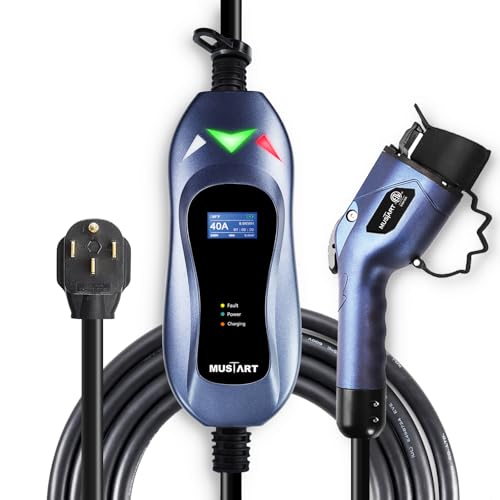
MUSTART Level 2 EV Charger 40A — The faster sibling with its reach printed
The second MUSTART in the group argues the opposite brief from its Tesla sibling: higher output, mainstream intent, and a title that does its paperwork — 40 amps, 240 volts, and a 25-foot cable all stated before the marketing adjectives begin. Twenty-five feet is the joint-longest reach claimed in this group, and in portable use reach is not a luxury; unfamiliar parking means the receptacle is rarely where the car’s port wishes it were, and every extra foot is a parking orientation you are allowed to use. The 40-amp rating, meanwhile, makes this the joint-fastest traveller here, suited to destinations whose circuits are known quantities — your own workshop, a second home, a regular relative.
The title’s silence falls on the two ends of the cable: neither plug style nor car connector is named. For a unit pitched at home-and-travel duty, the plug question is the one to close first in the documentation, because 40 amps of enthusiasm meets a hard stop at an incompatible receptacle. The connector question matters almost as much; the mainstream positioning suggests the common inlet, but suggestion is not specification, and this guide does not upgrade hints into facts.
Position it as the known-destination fast charger: the unit for the cabin you own, the garage you control, the circuit you had wired — places where 40 amps is a plan rather than a hope.
- Charging level stated in title: Level 2
- Amperage stated in title: 40A
- Voltage stated in title: 240V
- Cable stated in title: 25ft
- Plug type: Not stated in the listing title — verify with MUSTART documentation
- Connector: Not stated in the listing title — verify with MUSTART documentation
Strengths
- Top output class paired with the group’s longest stated cable
- Voltage confirmed in the title, closing one planning question
- Suits semi-permanent duty at a second property as well as travel
Trade-offs
- Both cable ends need documentation confirmation
- 40 amps is an ambitious draw on truly unknown circuits
- No Level 1 fallback claimed for receptacle-poor destinations
Best for: regular trips to a property with a known 240-volt circuit, where the long cable and higher output convert directly into shorter, easier sessions.
Not suited for: improvisational travel through unfamiliar buildings where only ordinary outlets may exist.

Disaenco Portable Level 2 EV Charger — Nothing left to guess
The Disaenco title is what every portable-charger title should look like: portable, Level 2, 32 amps, NEMA 14-50, 25 feet, J1772. Six facts, no adjectives doing load-bearing work. A buyer can plan an entire trip from that line — the car end fits the mainstream inlet, the wall end fits the most common heavy receptacle in North American garages and RV parks, the output sits in the borrowed-circuit-friendly class, and the cable reaches across the awkward parking geometry that real destinations specialise in. In a category where rivals treat specifications as spoilers, completeness itself is the feature.
The reservations are about provenance rather than specification. Disaenco carries none of the brand infrastructure of a Lectron or a MUSTART, so support depth and long-term parts availability rest on a smaller organisation, and the title offers no certification language for mark-screening buyers. Neither point diminishes what is stated; both argue for reading the listing’s full detail and the manufacturer’s documentation with the same care the title itself demonstrates.
For the traveller whose destinations are known to offer 14-50 receptacles — the RV-park circuit, the modern garage, the workshop — this is the lowest-friction purchase in the group: the only one whose title answers every planning question asked of it.
- Charging level stated in title: Level 2, portable format
- Amperage stated in title: 32A
- Plug stated in title: NEMA 14-50
- Cable stated in title: 25 ft
- Connector stated in title: J1772
- Certification language: Not stated in the listing title — verify with Disaenco documentation
Strengths
- The most completely specified title of the six — plan a trip from one line
- 32-amp draw respects borrowed circuits
- 25-foot reach matches the group’s best
Trade-offs
- Smaller brand behind it than the established names here
- Certification marks go entirely unmentioned in the title itself
- Single-level design, so ordinary outlets are out of reach
Best for: a J1772 driver whose routes run through garages and RV parks with 14-50 receptacles, and seeking zero specification homework.
Not suited for: travel plans whose destinations might offer only standard household outlets.

bokman Level 1 & Level 2 EV Charger — Two chargers in one bag
The bokman title describes an idea rather than a specification sheet: one unit, two levels of charging, with the adapter story told outright — NEMA 14-50P for the 240-volt receptacle, 5-15 for the ordinary household outlet. That duality is the most valuable travel trait in this entire group, because it converts the worst-case destination from a failure into a slow success. A cabin with only a porch outlet still yields an overnight top-up at Level 1 pace; a garage with the heavy receptacle yields full Level 2 recovery. The stated 32 amps apply to the Level 2 side of that personality, and the 20-foot cable, while the shortest stated here, remains workable for the close-quarters outlets dual-level units usually serve.
The trade-offs are the honest costs of flexibility. Twenty feet reaches less far than the 25-foot pair when the 240-volt receptacle sits awkwardly, and the connector at the car end is not named in the title — a documentation check that matters, because an adapter kit this thoughtfully specified at the wall deserves certainty at the car. The brand, like Disaenco, is a smaller name than the segment’s leaders.
None of that dims the central logic. Travel charging is insurance, and insurance is priced on coverage breadth. Measured that way, the bokman covers more of the map than anything else in this group.
- Charging levels stated in title: Level 1 and Level 2
- Amperage stated in title: 32A
- Adapters stated in title: NEMA 14-50P and 5-15
- Cable stated in title: 20ft
- Connector: Not stated in the listing title — verify with bokman documentation
- Voltage: Not stated in the listing title — verify with bokman documentation
Strengths
- Dual-level operation covers destinations with or without 240 volts
- Both adapters named in the title — the wall end is fully planned
- 32-amp Level 2 output matches the borrowed-circuit-friendly class
Trade-offs
- Shortest stated cable of the group at 20 feet
- Car-side connector needs confirming in the documentation
- Level 1 mode is a top-up pace, not a recovery pace
Best for: road trips through mixed infrastructure — cabins, older houses, farm stays — where the available receptacle is a surprise on arrival.
Not suited for: a traveller parking at distances demanding the longest possible cable run available.

WOLFBOX Portable Level 1&2 EV Charger — Flexibility at the higher output
WOLFBOX, a name built in the automotive-accessories world, enters this group with the combination nobody else quite offers: dual-level operation like the bokman, but at 40 amps, and with the car-side connector actually named — J1772, stated in the title along with the model designation PE40. That connector line matters more than it might appear to, because it closes the question the bokman leaves open: a buyer can confirm mainstream-fleet fit from the listing alone. The dual-level design keeps the insurance value of a Level 1 fallback while the 40-amp ceiling serves known, capable circuits at full pace.
The silences are at the wall. The title names neither plug nor adapters, so the exact receptacle story — which plug ships, whether a household-outlet adapter is included or separate — belongs to the documentation check, and it is a more consequential check here than the modest wording suggests: a dual-level unit’s whole value depends on what physically arrives in the bag. Cable length is likewise unstated, which leaves parking geometry unplanned until the paperwork is read.
Read generously, this is the flexibility pick for J1772 drivers who refuse to give up output; read strictly, it is a strong title with two specific homework items, both flagged in the box below.
- Charging levels stated in title: Level 1 and Level 2, portable format
- Amperage stated in title: 40 amp
- Connector stated in title: J1772
- Model stated in title: PE40
- Plug and adapter set: Not stated in the listing title — verify with WOLFBOX documentation
- Cable length: Not stated in the listing title — verify with WOLFBOX documentation
Strengths
- Dual-level flexibility without dropping to the lower output class
- J1772 connector confirmed in the title itself
- Model designation printed, easing documentation cross-checks
Trade-offs
- Adapter contents must be confirmed before the first trip
- Cable reach unstated for awkward destination parking
- 40-amp mode still demands respect on unknown wiring
Best for: a J1772 driver seeking one bag that handles both the equipped garage and the unequipped cabin, at full Level 2 pace where circuits allow.
Not suited for: a buyer requiring the plug and adapter inventory settled by the listing title alone.
How do the six compare on stated travel facts?
| Charger | Output from title | Levels from title | Plug / adapters from title | Connector from title | Cable from title |
|---|---|---|---|---|---|
| Lectron Level 2 | Not stated | Level 2 | Not stated | Not stated | Not stated |
| MUSTART Tesla 32A | 32A | Level 2 | Not stated | Tesla fit stated | Not stated |
| MUSTART 40A | 40A, 240V | Level 2 | Not stated | Not stated | 25ft |
| Disaenco Portable | 32A | Level 2 | NEMA 14-50 | J1772 | 25 ft |
| bokman Dual-Level | 32A | Level 1 and Level 2 | NEMA 14-50P / 5-15 adapters | Not stated | 20ft |
| WOLFBOX PE40 | 40 amp | Level 1 and Level 2 | Not stated | J1772 | Not stated |
The table’s pattern is the review in miniature: no title here is complete in the same places. Disaenco completes the physical circuit, bokman completes the wall end, WOLFBOX completes the car end, and the two MUSTARTs each complete a different half of the story. Choosing is therefore less about ranking than about deciding which facts you refuse to leave to a documentation check.
How do you travel with a portable charger without drama?
Scout before you roll. A photograph of the destination’s garage receptacle, requested from the host or relative a week ahead, resolves the plug question while options still exist. Carry the unit in a dedicated bag with its adapters, because a charger loose in a trunk arrives with its cable memory set to chaos and its connector cap lost. On arrival, inspect the receptacle before plugging in: scorch marks, looseness in the socket, or a receptacle that wobbles in its box are all reasons to drop to a lower level or a different outlet — borrowed infrastructure deserves a suspicious eye. Set the car’s charge limit and schedule as you would at home, and in shared spaces such as RV parks, charge during the hours your neighbours’ air conditioners are quietest.
Two habits protect the equipment itself. Never drive over the cable, and never let the control box dangle from the receptacle by its cord — support the box, because its weight on a plug is a slow mechanical insult. In wet weather, keep connections off standing water and let the car’s port and the connector stay as dry as the situation allows. Portable charging is robust, but it rewards the same respect any high-current connection deserves.
Which travel-charging mistakes strand people?
Assuming the receptacle is the expensive error: a 240-volt outlet in a strange garage might be a dryer configuration rather than the 14-50 a title names, and discovering that at midnight converts a charger into luggage. The second mistake is forgetting the connector fork — packing a Tesla-inlet unit for a trip in a borrowed J1772 car, or the reverse. Third is amperage arrogance, running a 40-amp draw on wiring of unknown vintage in a building you do not own; the polite and safe ceiling on stranger circuits is the lower setting the situation suggests. Fourth is leaving the dual-level adapter at home, which deletes the entire insurance value of the bokman and WOLFBOX designs. The last is treating the portable unit as a permanent home installation in a damp, unsecured spot — travel gear earns its keep in a bag indoors between trips, not weathering on a driveway hook through winter.
What should a renter or apartment dweller take from this group?
Portable charging is often the only charging available to households without a dedicated parking circuit, and this group maps surprisingly well onto that life. The pattern that works is a known receptacle — a landlord-approved garage outlet, a workplace hookup, a relative’s driveway on a standing invitation — paired with a unit whose plug and connector are confirmed certainties rather than hopes. On title evidence, the Disaenco’s complete specification and the bokman’s dual-level coverage are the two natural anchors for that pattern, with the WOLFBOX close behind once its adapter set is confirmed. The deeper point is permission: a portable charger makes charging negotiable in buildings where a wallbox install is not, and that negotiability is worth more to a renter than any amperage figure in this guide.
How does a portable unit behave as your only home charger?
Better than sceptics expect, with two conditions. The receptacle must be genuinely suitable for nightly high-current duty — the same industrial-grade conversation as any plug-in install — and the household must accept a small daily ritual: uncoil, plug, dock, rather than the wallbox’s walk-away permanence. In exchange, the household owns one charger that serves home and road, spends once, and moves house without an electrician’s farewell visit. Among these six, the 40-amp MUSTART with its stated 25-foot cable and the fully specified Disaenco carry the double life most convincingly on title evidence, while the dual-level pair trade a little home pace for travel breadth. It is a legitimate architecture, not a compromise to apologise for.
Why does the control box in the middle of the cable matter so much?
Every portable unit in this group carries its intelligence in an in-line box, and that box does more than blink. It performs the handshake with the car, monitors for ground faults, watches its own temperature, and decides how much current the session may draw. In a wallbox those duties live in a steel or polycarbonate enclosure bolted to a wall; in a portable unit they live in a housing that gets dropped on concrete, baked in a closed trunk in August, and chilled in a frunk in January. The box’s sealing, strain reliefs and thermal behaviour are therefore the product, in a way that feature lists rarely capture. A unit whose box runs cool at full draw on a summer night is telling you something good about its design margins; a unit that derates itself in mild weather is confessing the opposite.
This is also why the titles’ restraint deserves respect rather than suspicion. None of the six titles makes claims about the control box’s protection ratings or thermal design, and this guide will not invent any. What a buyer can legitimately do is read the manufacturer’s documentation for the box’s stated environment limits and compare them against the travel actually planned — desert crossings, northern winters, coastal damp. The charger that suits a climate-controlled garage-to-garage life and the charger that suits a ranch truck’s year are different products even at identical amperage, and the box is where that difference lives.
What happens when the destination receptacle turns out wrong?
Every experienced EV traveller owns a story about the receptacle that was not what the photograph promised: the 240-volt outlet wired for a welder’s plug pattern, the garage receptacle that turned out to be decorative, the RV pedestal already claimed by a neighbour’s rig. The portable charger’s answer to that moment is layered. The dual-level pair — bokman and WOLFBOX — fall back to an ordinary outlet and convert catastrophe into a slow night. The single-level units fall back to the public charging network, which is why trip planning with a portable charger should still mark the nearest public charger as a waypoint rather than treating the cable as a guarantee. And the traveller’s own kit matters: the correct, manufacturer-supplied adapters, carried always, not the third-party adapter bought in a panic at a hardware store near midnight.
There is a discipline worth stating plainly: never defeat a plug mismatch with force, cheater cords or homemade adapters. A receptacle configuration is a language, and it is saying something about the circuit behind the wall — its voltage, its grounding, its intended load. The chargers in this group speak the configurations their titles and documentation declare. Listening to what the wall is saying, rather than arguing with it, is the difference between travel charging as a solved problem and travel charging as a story told with hand gestures.
How should you store and carry a portable charger between trips?
The enemies of a travel charger are boring: grit in the connector, moisture in the control box, cable memory from tight coiling, and the slow abrasion of loose hardware in a trunk. Counter them boringly. Coil the cable in large loops, the way it naturally wants to lie, and let the connector ride capped or bagged so its contacts stay clean. Keep the control box from becoming the bottom layer of a luggage pile; its housing is tough, but a suitcase corner driven into it by a pothole is a load case nobody tested. Store the whole kit indoors between trips rather than in the car through a winter, because a charger treated as seasonal equipment ages like seasonal equipment — the units in this group are built for vehicles, not for being stored inside one permanently.
One more habit pays for itself: a thirty-second inspection ritual before each trip. Run a hand along the cable feeling for cuts or flat spots, look at the plug blades for discolouration, check that the connector latch still clicks with intent. Travel charging fails at departures, not destinations, when it fails from neglect — and every failure this ritual catches is caught in your own driveway, with options still open.
How do weather and altitude change a travel charging session?
A portable charger spends its working life in uncontrolled environments, and two variables follow it everywhere: temperature and weather exposure. Cold thickens cable insulation and slows the car’s own acceptance of charge, so a winter session at a mountain cabin runs long for reasons that have nothing to do with the charger’s health. Heat works the other side of the street: a control box lying in direct sun on asphalt, mid-session, in a desert rest area, is managing its own temperature while passing heavy current, and the well-designed unit protects itself by easing the session rather than by failing. Neither behaviour is a flaw; both are physics with good manners. The traveller’s contribution is placement — shade the box where shade exists, keep it off snowmelt and standing water, and never bury it under luggage mid-session where its heat has nowhere to go.
Rain deserves a calm word. Travel charging is designed for outdoor life, and the connection between car and charger is made to be used in ordinary wet weather; the sensible cautions are about extremes and improvisation. Do not make or break the connection in driving rain if waiting ten minutes is an option, do not let the wall plug sit in a puddle at an RV pedestal, and dry the connector before bagging the kit for the drive home. Altitude, by contrast, asks nothing of the charger at all — it asks things of the driver, whose range estimates shrink in the mountains, which is precisely why the overnight destination charge matters more at the cabin than it did in the suburbs.
What separates a good borrowed-circuit guest from a bad one?
Charging on someone else’s wiring is a social act wearing technical clothes. The good guest asks before plugging into anything heavier than a porch outlet, offers to cover the electricity without making it awkward, and charges at the pace the situation flatters rather than the maximum the unit allows — a 32-amp draw on a relative’s older garage wiring, sustained for nine hours, is a favour being repaid with risk. The good guest also leaves the space better arranged than the session found it: cable routed where nobody trips at midnight, control box supported rather than dangling, receptacle left clean. These courtesies sound decorative until you consider that destination charging runs on goodwill; the relative, host or campground that has one bad experience with an EV guest quietly stops offering the receptacle, and the whole informal network this category depends on gets thinner.
The units support the etiquette in different ways. The dual-level designs let a guest gracefully accept whatever outlet is offered, including the humble one. The 32-amp class asks less of old wiring than the 40-amp class does. And a stated cable length — 25 feet on the Disaenco and the faster MUSTART — lets a guest reach the receptacle without rearranging the host’s garage, which is its own form of politeness. Choose the unit that matches the guest you intend to be.
How do you decide between carrying one charger or owning two?
Some households end up with a wallbox at home and a portable in the trunk; others run one portable for everything; a third group keeps two portables, one per vehicle. The deciding factors are trip frequency, the number of cars, and how painful a forgotten charger would be. Monthly travel to the same second property often reveals an elegant answer: a portable left there permanently — which is really a wallbox with extra steps, and perfectly sensible. A household whose trips are rare and various is better served by one dual-level unit that lives in the car. Two-car households with overlapping travel should count the nights both cars are away simultaneously; if that number is more than a handful a year, the second charger stops being a luxury.
Cost logic follows the same shape as the home guide’s: the charger is the cheap part of any charging arrangement, and the expensive parts are circuits, receptacles and regret. Buying the bokman or WOLFBOX for breadth, or the Disaenco for its complete specification, and then discovering your travel pattern needed the other trait, is a modest mistake. Buying a unit whose plug or connector was never confirmed, and discovering it at a destination, is the immodest kind. The documentation checks flagged throughout this guide exist to keep every mistake you make in the cheap category.
Why do RV parks keep appearing in portable charger conversations?
Because the RV pedestal is the most widely distributed heavy receptacle network on the continent that nobody built for cars. Campgrounds wired their sites for motorhomes decades before EVs arrived, and the 14-50 receptacle that runs a coach’s air conditioners all summer will run a Level 2 charger all night with equal indifference. That accident of infrastructure makes the road-trip map look completely different to a driver carrying the right portable unit: state parks, rural campgrounds and small-town RV sites become overnight charging stations with scenery attached. It is no coincidence that the two titles in this group naming the NEMA 14-50 — Disaenco’s and bokman’s — read like they were written by people who understood exactly where these chargers get used.
Campground charging has its own manners and mechanics. Sites are booked, pedestals are shared infrastructure, and the campground’s permission is the first requirement — many welcome EV charging, some meter it, some prohibit it, and the office is the place to learn which. Electrically, a pedestal that has spent twenty seasons outdoors deserves the same suspicious inspection as any borrowed receptacle, and a charger drawing steadily through the night shares the site’s capacity with whatever else the evening demands. Arrive with the adapter story settled, ask at the desk, and the pedestal network becomes the most charming fuel infrastructure in the country.
What should you check in the first session with a new portable unit?
Commission a travel charger at home, where failures are cheap. Run a full session on your own receptacle and stay nearby for the first hour: the control box should settle into a steady state, the cable should warm evenly and mildly at most, and nothing at either connection should smell, buzz or discolour. Confirm the car reports the session the way the unit’s class predicts, and practise the full ritual — uncoil, connect, dock, coil — until it is muscle memory, because the version of you performing it at a rainy destination will be tired and holding a torch in your teeth. Photograph your own receptacle and the unit’s plug together for reference; on a future trip, comparing a strange receptacle against that photograph is faster than remembering configuration names.
Then read the documentation once, properly, with the unit in hand. This is the moment to resolve every not-stated line in the spec boxes above — the Lectron’s three open questions, the MUSTART Tesla’s plug, the WOLFBOX’s adapter inventory — while the answers can still change what you pack. A portable charger bought and commissioned this way stops being a product and becomes part of the car’s equipment, as unremarkable and as trusted as the spare tyre it increasingly replaces in the traveller’s imagination.
How does portable charging fit a road trip that mixes hotels and public chargers?
The mature pattern is layered rather than purist. Public fast charging does the long midday miles; the portable unit does the overnights wherever a receptacle exists — the motel with a workshop outlet, the friend’s driveway, the rental’s garage — and the hotel’s own destination charger, where one exists, does the nights it can. Planned this way, the portable unit is not competing with the public network; it is deleting the weakest sessions from it, the early-morning hunts for a working charger in a strange town. Its value compounds quietly: fewer detours, fuller mornings, and a car that starts each day as if it had slept at home.
Choosing within this group for that pattern favours breadth and certainty over peak speed. The dual-level pair maximise the number of overnights the layer works on; the fully specified Disaenco maximises the chance that a planned overnight works exactly as intended; the Tesla MUSTART does the same inside its own inlet’s world. Speed, the 40-amp headline, matters least in the layered pattern, because a sleeping car and a sleeping driver keep the same hours.
What does the second year of carrying a portable charger teach?
The first year teaches logistics; the second teaches judgement. By the second year, a traveller has a private atlas of receptacles — the sister’s garage, the cabin’s workshop, the three campgrounds that welcome a charging car — and the charger stops being equipment and becomes a key that fits known doors. The atlas changes purchasing hindsight, too. Owners discover whether their real bottleneck was ever amperage (rarely), cable reach (often), or adapter coverage (more often than pride predicted), and that discovery is the true review of the unit they bought. It is also why this guide weights stated facts over headline numbers: the second-year regrets are almost never about the specification that was printed largest, and almost always about the one that was never printed at all.
The second year also settles the home question for the portable-only households. Some discover the daily coil-and-dock ritual has become invisible and keep the arrangement for a decade. Others, their travel pattern now clear, promote the portable to pure travel duty and bolt a wallbox beside the receptacle it used to visit. Both outcomes are successes, and both start from the same place: a first portable unit whose plug, connector and class were verified facts rather than hopeful assumptions. Whichever of these six begins your atlas, begin it the way the spec boxes insist — with the paperwork read, the adapters inventoried, the receptacle photographed, and the first full session supervised at home, where every surprise is still a cheap one.
How much should the carrying case and cable bag influence the choice?
More than reviewers usually admit, because portable gear lives or dies by whether it is actually carried. A charger that travels in a fitted bag with its adapters corralled gets packed on every trip without a decision; a charger that lives as a loose coil on a garage hook gets left behind on exactly the trip that needed it. None of the six titles dwells on carry arrangements, so treat the bag as an accessory decision made alongside the purchase: a sturdy case sized to the coiled cable, room for the adapter set, and a handle that survives being grabbed one-handed while the other hand holds luggage. Standardise the kit — charger, adapters, a short heavy-duty extension solution only where the manufacturer sanctions one, and a torch — and destination charging becomes a routine measured in minutes. The unit matters, the titles above rank its facts, but the bag is what makes the facts available at midnight in a strange garage.
Final Recommendation
Let your destinations choose. Where 14-50 receptacles are your known landscape and your car wears the mainstream inlet, the Disaenco is the friction-free pick — the only title here that answers everything. Where destinations are uncertain, the bokman’s two-level adapter kit is the insurance policy, and the WOLFBOX offers the same breadth at 40 amps with the connector confirmed, once its adapter contents are verified. Tesla households should take the MUSTART Tesla unit’s native fit seriously and check its plug in the paperwork. The 40-amp MUSTART serves the known second property best, and the Lectron rewards brand loyalty once its documentation homework is complete. Pack the adapter kit, photograph the receptacle before you leave home, and the road stops being a charging problem — it becomes just the part between two full batteries.
Frequently Asked Questions
Can a portable Level 2 charger replace a wallbox entirely?
For many households, yes. The charging itself is equivalent; the differences are ritual and permanence. A portable unit needs coiling, carrying and a suitable receptacle, while a wallbox waits on the wall. Frequent travellers may prefer owning the portable alone.
What receptacle do I need at a destination?
Most of these units are planned around the NEMA 14-50, the common heavy-duty receptacle in modern garages and RV parks — the Disaenco and bokman titles name it directly. Older buildings may offer different configurations, which is why photographing the receptacle ahead of a trip is the single most valuable habit in this category.
Is 32 amps enough, or should I hold out for 40?
For overnight destination charging, 32 amps recovers a typical day’s driving with hours to spare, and it is gentler on unfamiliar wiring. The 40-amp class earns its place at destinations you know well and use repeatedly, where the circuit’s quality is a fact rather than a hope.
Will the Tesla-specific MUSTART work with other cars through an adapter?
Adapter chains in the wrong direction are exactly what portable charging should avoid. The Tesla MUSTART is a native-fit tool for Tesla inlets; other cars should use a J1772-native unit such as the Disaenco or WOLFBOX rather than a stack of adapters bought on optimism.
Should I tell a host or campground before plugging in?
Yes — always, for anything beyond an ordinary household outlet. A Level 2 session is a heavy, hours-long draw, and the person responsible for the building should know it is happening. Most hosts and campgrounds are glad to help once asked; the asking is also what surfaces a metered fee, a preferred receptacle, or a circuit to avoid, all of which are cheaper to learn at the desk than at midnight.
What does dual-level actually mean in practice?
The bokman and WOLFBOX titles claim both Level 1 and Level 2 operation. Level 2 on a 240-volt receptacle gives full travel-charger pace; Level 1 on an ordinary outlet gives a slow top-up that still adds useful range overnight. The value is coverage: no destination with any outlet is a zero.
Related Guides
Portable charging pairs naturally with the fixed install it so often substitutes for, and with the maintenance gear that keeps a second car alive. Continue with home Level 2 wall chargers for a permanent garage setup and solar chargers that keep devices alive when the grid is not part of the trip.


