What's inside
- Key Takeaways
- Quick Picks
- How Did We Choose These Edifier Models?
- How Do the Edifier Tiers Actually Differ for Music?
- What Should a Music Listener Check Before Choosing?
- The Six Models in Detail
- Which Sources Bring Out the Best in Each Tier?
- How Does Room Size Rewrite the Rankings?
- How Do the Six Models Compare at a Glance?
- How Should Edifier Speakers Be Positioned for Music?
- What Mistakes Do Edifier Buyers Commonly Make?
- What Is It Like to Live With These Speakers for a Year?
- How Does Bluetooth Listening Differ From Wired Listening Here?
- Why Choose Powered Speakers Over an Amplifier and Passive Pair?
- How Should Tone Controls and Volume Habits Be Handled?
- Which Genres Flatter Which Model?
- What About a Second Room or a Growing System?
- How Does the Range Handle Long, Quiet Evenings?
- Can a Turntable, a Television and a Phone Really Share One Pair?
- What Should Be Verified on the Listing Before Ordering?
- Final Recommendation
- Frequently Asked Questions
- Related Guides
As an Amazon Associate I earn from qualifying purchases. This post may contain affiliate links at no extra cost to you.
gizmoverdict.com is reader-supported. When you buy through links on our site, we may earn an affiliate commission.
Where to buy: Every model below links to its own Amazon listing, where finish options and the current box contents are set out before you commit.
The best edifier speakers for music all come from one catalogue, which makes this a different kind of comparison: not brand against brand, but tier against tier inside a single maker’s ladder. Edifier builds powered bookshelf speakers across a wide span — the approachable R series for desks and first systems, the larger R2000-class cabinets for rooms, the S series as its statement line, and the MR studio monitors borrowed from the recording world. Six of those models are gathered here, and the useful question is not which badge wins but which rung of the ladder a given room, desk and listening habit actually needs.
Powered speakers suit music listeners for a structural reason: the amplifier lives inside the cabinet, matched to the drivers at the factory, so there is no separate receiver to buy, house or wire. A phone, a laptop, a turntable with its own stage or a television feeds the speakers directly, and the system is finished. Edifier has built its reputation in exactly that format, refining the same basic recipe — a wood-finished cabinet, a silk-dome style high end, front or remote controls, Bluetooth for casual listening and wired inputs for serious sources — at several sizes and levels of ambition. The differences between the six picks below are therefore honest differences of scale, tuning intent and input count, not marketing fog.
One thread runs through the whole range and deserves naming early: these are nearfield-friendly speakers. They are voiced to sound complete at the distances people actually sit from a desk or across a small room, rather than asking for a concert hall’s worth of air. That makes them natural music speakers for apartments, studies, bedrooms and modest living rooms — the spaces where most listening now happens — and it shapes the recommendations throughout this guide.
Key Takeaways
- The range divides by intent: R-series models are the musical all-rounders, the S1000MKII is the flagship statement, and the MR4 is a studio monitor tuned for accuracy over flattery.
- Size tracks room size honestly — the compact R1280DBs serves a desk, while the R2000DB and S1000MKII carry the amplifier weight and cabinet volume for a living room.
- Bluetooth appears across the musical models for everyday convenience, while optical and analogue wired inputs carry the serious listening.
- The MR4 breaks the pattern deliberately: no Bluetooth in its brief, a flatter tuning, and a working-monitor layout aimed at creators as much as listeners.
- Every pick is powered, so no receiver or separate amplifier enters the budget or the wiring plan.
Quick Picks
| Pick | Badge | Why it earns its place |
|---|---|---|
| Edifier R1280DBs | Best desk starter | The compact, complete introduction to the range — Bluetooth, optical and remote control in a small cabinet. |
| Edifier S1000MKII | Best flagship | The S-series statement piece, built and voiced for a main listening room rather than a desk edge. |
| Edifier R1700BTs | Best angled all-rounder | A tilted front baffle aims sound up at seated listeners, with a warmer, fuller presentation than the entry models. |
| Edifier R1850DB | Best for TV and music | Optical input and a subwoofer output make it the natural bridge between a television and a music shelf. |
| Edifier R2000DB | Best room-filling R | The largest R-series voice here, with 120W RMS on its listing title and the gloss finish to match its ambitions. |
| Edifier MR4 | Best honest monitor | A 4-inch studio monitor that tells the truth about a mix — and about a recording — instead of sweetening it. |
How Did We Choose These Edifier Models?
With a single brand on the table, selection turned on coverage of the ladder. The six picks span the entry point, two mid-range steps with different shapes of talent, a subwoofer-ready television bridge, the largest musical R model, the flagship S, and the studio monitor that stands slightly outside the family portrait. Any rung left empty would have hidden a real decision, because Edifier shoppers genuinely do cross-shop these models against each other, often with the same desk in mind.
Feature claims in the sections below are kept on a short leash. Where a listing title states a figure — the R2000DB’s 120W RMS, the MR4’s 4-inch driver — the guide uses it. Where a model is widely understood to carry a feature the title does not spell out, the discussion stays at the level of the range’s general character, and the spec boxes mark unstated items plainly. Music-first judgement fills the rest: tonal balance at modest volume, clarity with voices and acoustic instruments, and how a model behaves across a long evening rather than a loud minute.
How Do the Edifier Tiers Actually Differ for Music?
The R series is the heartland. Its models share a house tuning that favours warmth and listenability — a slightly generous low end, a forgiving top, and a midrange that keeps voices forward. Within the series, money buys cabinet volume and composure: the small R1280DBs sounds tidy and close, the R1700BTs adds body and a baffle angled toward the listener, the R1850DB adds connection flexibility, and the R2000DB adds scale, sounding least troubled when a room asks for volume. None of them chases studio neutrality, and none should be judged by that standard; they are built to make a library enjoyable, and they succeed in proportion to their size.
The S series is Edifier dressing for the main room. The S1000MKII carries a larger, more elaborately built cabinet, a more ambitious driver set and a tuning with genuine audiophile intent — flatter, more extended, more revealing of recording quality. It asks more of placement and of the listener, and returns more. The MR line, represented by the MR4, comes from the opposite philosophy entirely: a studio monitor’s flat response, designed so that decisions made while mixing translate to other systems. As a pure listening speaker it divides opinion — admirers call it honest, detractors call it plain — and that divide is itself the information a shopper needs.
Understanding those three philosophies prevents the commonest Edifier mistake, which is buying by price alone inside the range. The most expensive pick is not automatically the most enjoyable for a given listener, and the monitor is not a cut-price flagship; each tier optimises a different virtue, and the sections below judge each model against its own brief.
What Should a Music Listener Check Before Choosing?
Start with distance. A desk listener sits roughly an arm’s length from the speakers, deep in the nearfield, where compact models sound full and large cabinets can overwhelm; a living-room listener sits several metres away, where the arithmetic reverses. Match the model to the chair, not to ambition. Next, count sources honestly. A phone-only listener lives happily on Bluetooth; a listener with a television, a game console and a turntable needs the optical and analogue inputs that the mid and upper models provide, plus a remote that saves the walk across the room.
Then consider the subwoofer question. Small bookshelf cabinets cannot reproduce the lowest octave of a double bass or an electronic track, and no tuning trick changes that. Models with a subwoofer output — the R1850DB is the natural example in this line-up — let a sub join later without replacing the speakers, which turns a desk system into a growing one. Listeners certain they will never add a sub should buy the cabinet size that satisfies them unaided, which usually means stepping up one rung. Finally, look at the room itself: bare walls and a hard floor brighten any speaker, soft furnishings tame the same speaker, and Edifier’s tone controls exist precisely to split that difference.
The Six Models in Detail
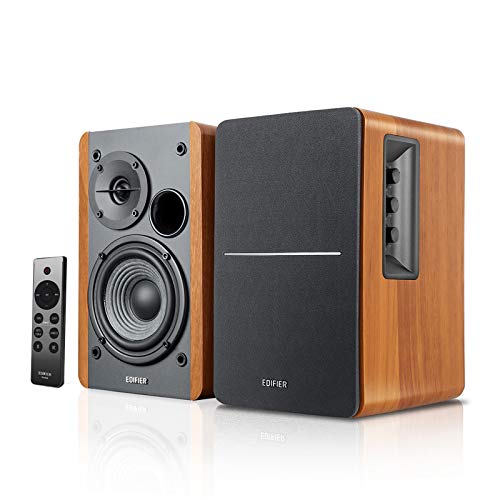
Edifier R1280DBs — Best desk starter
The R1280DBs is the model that introduces most people to powered bookshelf listening, and it earns that role by completeness rather than by any single flourish. Its listing title names it an active Bluetooth bookshelf speaker, and the package around that headline is unusually grown-up for the entry rung: wired inputs alongside the wireless one, a remote control, and tone adjustment at the speaker. On a desk it behaves exactly as a first serious speaker should — voices sit clear and close, acoustic recordings keep their shape, and the sound stays composed at the modest volumes desk listening actually uses, hour after hour.
Its musical character is tidy rather than grand. The small cabinet keeps bass in proportion instead of pretending to depths it cannot reach, which flatters singer-songwriters, jazz trios and chamber music, and keeps electronic low end polite rather than physical. In a bedroom or a small study that restraint reads as refinement. The step it cannot take is scale: a living room asks for air movement this cabinet was never sized to provide, and pushing the volume to compensate coarsens the result. Judged at its intended distance, though, the R1280DBs remains the range’s easiest recommendation — the speaker that converts headphone people into speaker people.
- Format: compact powered bookshelf pair, active design
- Wireless: Bluetooth, as the listing title states
- Inputs: Bluetooth plus wired analogue and optical connections in this model’s known configuration — confirm the current revision on the listing
- Controls: remote control and on-speaker tone adjustment
- Subwoofer output: present on the DBs variant; verify on the listing before planning a sub
Strengths
- Complete feature set at the entry rung — nothing essential held back for pricier models
- Composed, voice-friendly tuning at true desk and bedroom volumes
- Small enough for real desks, shelves and side tables
Trade-offs
- Limited scale and bass weight in rooms beyond a study or bedroom
- Remote-dependent convenience; the cabinet controls are deliberately simple
- Revealing enough to expose poor recordings, without the flagship’s finesse
Best for: a first powered system on a desk or in a small room. Not suited for: filling a living room or satisfying bass-led listening on its own.
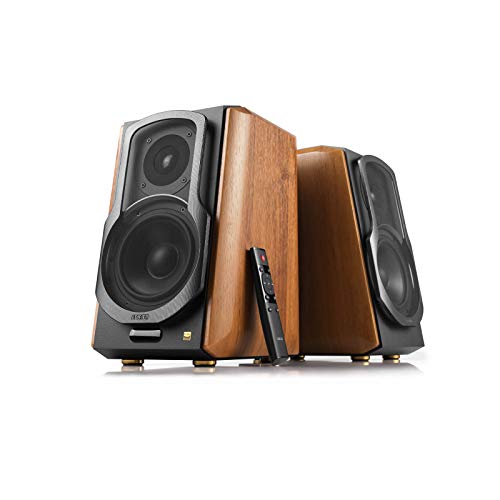
Edifier S1000MKII — Best flagship
The S1000MKII is Edifier’s argument that a powered bookshelf speaker can be the main event. Its listing title calls it an audiophile active bookshelf design, and everything about the model supports the claim: a substantially built, angled cabinet, a driver complement chosen for extension at both ends, and a tuning that aims at accuracy rather than charm. Set up on stands in a listening room, it produces the kind of presentation — stable imaging, unforced detail, bass with edges rather than fog — that listeners associate with a separate amplifier and passive speakers costing considerably more in total.
That ambition changes how it should be bought. The S1000MKII rewards placement effort, distance from walls and a chair in the right spot, and it exposes the quality of everything upstream: a well-recorded album sounds genuinely transporting, a careless one sounds careless. Bluetooth and wired inputs cover modern sources, and its output fills a proper living room without strain. On a desk it is simply too much object and too much speaker, physically and sonically; its home is the room where listening is the activity. For the Edifier loyalist stepping up, or the newcomer seeking the range’s ceiling in one purchase, this is the summit — priced like one, built like one.
- Format: large powered bookshelf pair, S-series flagship
- Wireless: Bluetooth is part of this flagship’s connection set
- Cabinet: angled, heavily built enclosure intended for stand or solid surface placement
- Tuning intent: accuracy and extension over warmth
- Room fit: medium to large listening rooms
Strengths
- The most complete sound in this guide — imaging, detail and scale together
- Build and finish at a level the R series does not attempt
- Fills a main room without a separate amplifier anywhere in the chain
Trade-offs
- Too large and too revealing for desk duty or casual background use
- Demands placement care to give back what it costs
- Unforgiving of poor recordings and noisy sources
Best for: a dedicated listening room and a library of well-recorded music. Not suited for: a desk, a shelf in a crowded kitchen, or low-key background duty.
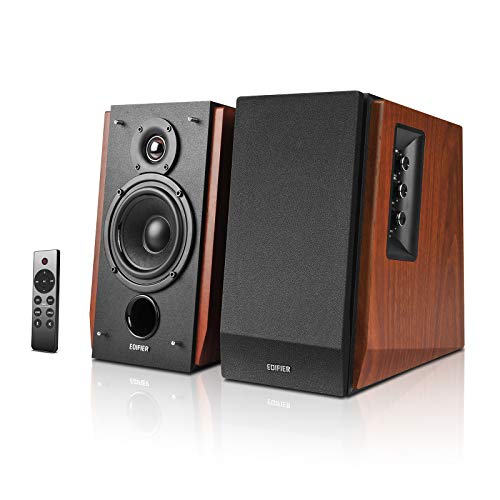
Edifier R1700BTs — Best angled all-rounder
The R1700BTs makes its case with geometry. Its front baffle tilts upward, aiming the drivers at the ears of a seated listener when the speakers sit on a low desk or media unit — a small piece of design intelligence that solves the commonest placement problem in real rooms, where speakers live below ear level and fire at stomachs. The result is a presentation that feels aimed rather than ambient: voices lock in, stereo width opens, and the listener stops unconsciously hunching toward the sound.
Sonically it sits a clear step above the entry models in body and ease. The larger cabinet gives low strings and piano left hands their weight, and the tuning keeps the R-series warmth while adding a little air on top. Bluetooth covers daily listening, wired inputs cover the rest, and the model has the headroom to serve a small living room credibly as well as a desk — the genuine all-rounder of the six. Its angled face divides taste; the look is purposeful rather than neutral, and on tall stands the tilt is unnecessary. But for the extremely common setup of speakers on a desk or a low cabinet, the R1700BTs is the model whose design seems to have visited the room first.
- Format: powered bookshelf pair with upward-angled front baffle
- Wireless: Bluetooth, named in the model’s title
- Design intent: aims drivers at seated listeners from low surfaces
- Tuning: warm R-series character with added body over the entry models
- Room fit: desks, media units and small living rooms
Strengths
- Angled baffle fixes the below-ear-level problem most setups actually have
- Fuller, more relaxed sound than the entry rung at similar volumes
- Equally plausible on a desk or in a small living room
Trade-offs
- The tilted styling is a taste commitment, not a neutral box
- On high stands the angle points sound at the ceiling’s opinion, not the listener’s
- Still a compact cabinet — deep bass remains a subwoofer’s job
Best for: speakers living on a desk or low unit, listened to from a chair. Not suited for: stand-mounted setups at full ear height, where its angle works against it.

Edifier R1850DB — Best for TV and music
The R1850DB is the diplomat of the range, equally at home under a television and beside a turntable shelf. Its listing title names Bluetooth and optical input together, and that pairing is the model’s thesis: the optical feed takes the television’s audio with a single cable, while Bluetooth and analogue inputs handle music sources, so one pair of speakers serves the room’s whole entertainment life. Dialogue clarity is the quiet triumph here — the midrange-forward balance that flatters voices in music also lifts film speech out of the effects, ending the volume-riding habit that television speakers teach.
Growth is designed in. A subwoofer output lets the system’s low end be completed later, which matters because television and film ask for exactly the deep effects this cabinet cannot produce alone; music listeners gain the same option when a room turns out hungrier than expected. As a pure music speaker the R1850DB sits near the R1700BTs in spirit — warm, capable, unpretentious — with a slightly more practical, connection-led personality. Households choosing one pair of speakers for a living room that watches as much as it listens will find this the least compromised answer in the range.
- Format: powered bookshelf pair
- Wireless: Bluetooth for daily listening
- Wired highlight: optical input, stated in the title — the television connection
- Expansion: subwoofer output for adding low end later
- Room fit: living rooms and media shelves
Strengths
- Optical input makes it the natural television upgrade in the range
- Subwoofer output keeps the system’s future open
- Voice-forward balance flatters both dialogue and sung vocals
Trade-offs
- Film bass still needs that optional subwoofer to convince
- Its talents are breadth rather than the flagship’s depth
- Remote becomes essential furniture in a TV setup — keep it findable
Best for: one pair of speakers covering television and music in a living room. Not suited for: a purist two-channel corner where the television never goes.

Edifier R2000DB — Best room-filling R
The R2000DB is the R series with its sleeves rolled up. Its listing title states 120W RMS and names Bluetooth among its connections, and the gloss-finished cabinet around that amplifier is the largest of the musical R models here — a speaker pair intended to fill a room rather than accompany a desk. The sound follows the specification’s promise: this is the R tuning with genuine scale, able to hold a party-level volume in a living room without the hardening that smaller cabinets develop near their limits, and to give orchestral and electronic music a physical foundation the compact models gesture toward.
Versatility keeps pace with the power. Optical and analogue inputs sit alongside Bluetooth, so a television, a streamer and a phone can all live here, and the remote-led control scheme suits across-the-room listening. What the R2000DB does not attempt is the S1000MKII’s refinement — its presentation is generous rather than forensic, preferring momentum and warmth to the last degree of detail. Many listeners honestly prefer exactly that trade, especially with rock, pop and film scores. In the range’s geography, the R2000DB is the biggest easy pleasure: the model for a room that wants to feel music as much as hear it, without stepping onto the flagship’s more demanding ground.
- Format: large powered bookshelf pair, gloss finish
- Power: 120W RMS, as printed in the model’s title
- Wireless: Bluetooth for casual sources
- Inputs: optical and analogue wired connections alongside wireless
- Room fit: medium and larger living rooms
Strengths
- Real room-filling output with the R-series warmth intact
- Connection set covers television, streamer and phone without swapping cables
- Gloss cabinet looks like furniture rather than equipment
Trade-offs
- Size and power are wasted — and potentially overwhelming — on a small desk
- Presentation favours generosity over the flagship’s fine detail
- Gloss finish shows dust and fingerprints honestly
Best for: a living room that listens at real volume across mixed sources. Not suited for: nearfield desk duty or a listener chasing studio accuracy.
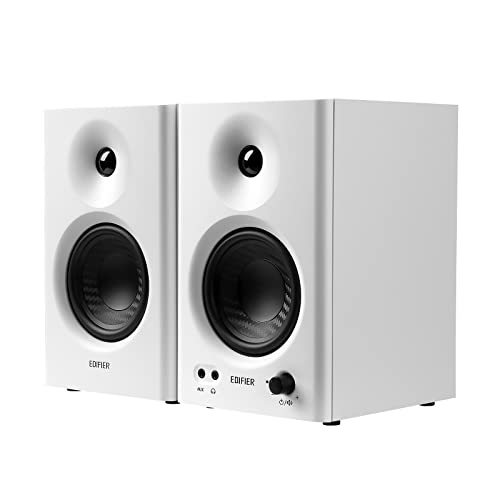
Edifier MR4 — Best honest monitor
The MR4 arrives from a different building. Its listing title calls it a powered studio monitor with a 4-inch active near-field design, and studio monitors obey a different commandment from music speakers: reveal, do not flatter. The MR4’s tuning is correspondingly flat and uncoloured, presenting a recording’s balance as it was made — the vocal exactly as loud as the engineer left it, the bass exactly as deep and no deeper. For listeners raised on warm hi-fi, the first hour can feel plain; by the third hour, many find the plainness addictive, because nothing in the presentation is asking to be liked.
Its working layout suits creators: connections and controls arranged for a desk where sources change and levels are set deliberately, and a nearfield focus that assumes a listener an arm’s length away, on axis. As a music speaker it shines with well-made recordings and shows no mercy to bad ones — a thin stream sounds thin, a compressed remaster sounds compressed. Bluetooth is absent from its brief, a deliberate omission in a tool meant to be wired to an interface or a computer. Buy the MR4 as an instrument for hearing clearly, whether the material is a mix in progress or a beloved album under new light, and it will seem inexpensive for the honesty it provides. Buy it expecting the R series’ warmth and it will seem broken, when in fact it is the most truthful speaker in this guide.
- Format: powered studio monitor pair with 4-inch drivers
- Design brief: active near-field monitoring, as its title describes
- Tuning: flat, uncoloured reference balance
- Wireless: Bluetooth not part of this model’s brief — wired sources expected
- Room fit: desks and small studios at close distance
Strengths
- The most accurate, least coloured presentation of the six
- Reveals recording quality honestly — a teacher as much as a speaker
- Compact nearfield design suits creator desks and small studios
Trade-offs
- No Bluetooth convenience; sources connect by cable
- Flatters nothing, including favourite but poorly made recordings
- Small drivers and nearfield focus limit room-filling ambitions
Best for: creators, mixers and listeners who prize accuracy over warmth. Not suited for: casual wireless listening or a large room’s main system.
Which Sources Bring Out the Best in Each Tier?
Powered speakers simplify the chain, but the source still sets the ceiling. A phone streaming over Bluetooth is the universal starting point, and through the R-series models it is a satisfying one, because their forgiving tuning smooths the rough edges of casual streaming. Stepping to a wired feed from a computer or a dedicated streamer tightens everything slightly — imaging steadies, quiet passages clean up — and the improvement grows more audible as the tier rises. The S1000MKII sits at the top of that sensitivity curve: feed it a careless source and it reports the fact without cruelty but without concealment, while a good recording through a clean wired feed is where its price becomes legible.
Turntables deserve a specific note, because vinyl tempts many Edifier shoppers. A turntable needs a phono stage somewhere in the chain — built into the deck, or in a separate small box — before its signal suits the line-level inputs these speakers expect. None of the picks should be assumed to contain that stage unless its own current listing says so; the safe planning assumption is that the deck or an external stage provides it. Once that piece is in place, the pairing is natural: the warm R models flatter vinyl’s character, while the MR4 reports a pressing’s quality with a clinician’s honesty, surface noise included.
Television and film sources reward the optical-equipped models for a mundane reason: the connection is fixed, digital and immune to the pairing rituals that wireless audio occasionally demands at the worst moment of a film night. Computers reward the opposite flexibility — a wired feed for the desk setup, Bluetooth for the laptop that arrives and leaves. Matching source habits to model strengths is most of what separates a system that feels inevitable from one that feels improvised.
How Does Room Size Rewrite the Rankings?
Every ranking in this guide quietly assumes a room, and changing the room reshuffles it. In a small study, the order nearly inverts: the R1280DBs and MR4 lead because their scale matches the air they must fill, the R1700BTs follows closely, and the two large models crowd both the furniture and the sound. Move the same listener to a family living room and the compact pair becomes the supporting act — pleasant at low volume, visibly effortful when the room fills with people and conversation raises the required level. The R2000DB and S1000MKII exist for that second room, and the R1850DB with a subwoofer bridges the two worlds better than either extreme.
Volume habits matter as much as square metres. A listener whose evenings run at conversation level will never touch the headroom that separates the large models from the small, and should spend the difference on the tier whose tuning suits them — or on the records themselves. A listener who hosts, who plays film scores at scale, who treats the living room as a venue, needs the headroom daily and should buy it without guilt. The honest self-portrait — room, distance, volume, repertoire — predicts satisfaction more reliably than any single specification in this guide, which is why the pick sections keep returning to those four coordinates.
How Do the Six Models Compare at a Glance?
| Model | Tier | Wireless | Standout trait | Natural home |
|---|---|---|---|---|
| R1280DBs | R series, entry | Bluetooth | Complete features, compact size | Desk, bedroom |
| S1000MKII | S series, flagship | Bluetooth | Audiophile build and tuning | Listening room |
| R1700BTs | R series, mid | Bluetooth | Upward-angled baffle | Desk or low unit |
| R1850DB | R series, mid | Bluetooth | Optical input, subwoofer output | TV and music room |
| R2000DB | R series, large | Bluetooth | 120W RMS per its title, gloss cabinet | Living room |
| MR4 | MR studio line | None in its brief | Flat monitor accuracy, 4-inch drivers | Studio desk |
The pattern to carry away is that Edifier’s prices track cabinet and purpose, not a single quality dial. The MR4 is not a worse S1000MKII; it is a different tool. The R1280DBs is not a failed R2000DB; it is the same idea at desk scale. Choosing well means naming the room and the job first, then finding the rung built for it.
How Should Edifier Speakers Be Positioned for Music?
Two placement rules deliver most of the available improvement. First, raise the tweeters toward ear height relative to the listening seat — stands, a shelf, or the R1700BTs’ built-in tilt — because high frequencies travel in a beam and a speaker firing at chest height leaves its detail on the listener’s shirt. Second, give the cabinets air: a hand’s breadth or more from the wall behind them keeps bass from thickening, and angling the pair slightly toward the chair sharpens the stereo image into a centre that voices can stand in.
Stands deserve a sentence of their own, because they are the cheapest upgrade in the entire guide. A pair of plain stands lifts a bookshelf speaker off a resonant cabinet, sets the tweeter at the height the designer assumed, and frees the cabinet to sit at the distance from the wall that its bass prefers. Owners routinely report that stands improved a mid-range model more than stepping up a tier would have — an exaggeration with a solid core of truth, since placement governs the sound that actually reaches the chair more than any single component choice.
Desks add one complication, reflections. A bare desktop bounces sound up into the direct path and smears it; isolation pads or angled stands under the speakers calm the effect noticeably, and the monitor-minded MR4 benefits most of all. Finally, use the tone controls as the last step rather than the first: place the speakers well, listen for a week, and only then trim bass or treble to the room’s character. Settings chosen on day one usually compensate for placement that a free afternoon would have fixed.
What Mistakes Do Edifier Buyers Commonly Make?
The recurring error is scale confusion in both directions: the flagship parked on a desk, where its output overwhelms the nearfield and its price buys nothing the room can use, or the entry model exiled to a living room and condemned for lacking the scale it never claimed. Second is judging the MR4 by hi-fi manners — returning an accurate monitor for sounding insufficiently warm is returning a thermometer for failing to heat the room. Third is ignoring the input count until the television, console and turntable queue up at a speaker with one wired door. Fourth is placing any of these models inside a closed cabinet or hard against a wall and then blaming the tuning. And the quietest mistake is skipping the remote’s batteries and the cable drawer audit until installation day, when every setup in audio history has stalled on exactly that.
What Is It Like to Live With These Speakers for a Year?
Ownership sorts the range differently from auditioning. The remote control, a trivial line in a feature list, becomes the most touched object in the system — which is why the models that include one and keep its layout sane earn quiet loyalty. Power behaviour matters in the same unglamorous way: speakers that wake politely with the television or the computer disappear into the furniture of daily life, while any model that demands a ritual earns a sigh each time. The R series’ appeal compounds here; its members ask little, connect to everything ordinary, and keep their tuning pleasant at the low volumes that dominate real evenings.
Durability of delight is the other long-term test. Warm, forgiving speakers age gracefully with a mixed library because they never make listening feel like homework, and that is the R-series’ deepest strength across a year of Tuesdays. The MR4 ages differently: it becomes a reference point, the speakers through which new purchases and old favourites are re-judged, and owners often keep it even after adding a warmer pair elsewhere. The S1000MKII’s year is about occasions — the albums saved for it, the chair, the deliberate hour — and a flagship that creates occasions has justified itself in a way specifications cannot measure. None of the six asks for maintenance beyond dust and the occasional cable check, which suits a category whose owners would rather listen than tinker.
How Does Bluetooth Listening Differ From Wired Listening Here?
Bluetooth is the convenience layer on the musical models, and for everyday listening — playlists while cooking, a podcast across the morning, a guest’s phone at dinner — its quality is entirely fit for purpose through speakers of this size. Wired connections earn their keep in deliberate sessions: an optical feed from a television locks dialogue to the picture without wireless negotiation, and an analogue feed from a good source gives the amplifier the cleanest signal the chain can offer. The practical rhythm most owners settle into is Bluetooth by default and a cable for the album that deserves the chair. The MR4, lacking the wireless layer entirely, simply starts every session at the deliberate end of that spectrum.
Why Choose Powered Speakers Over an Amplifier and Passive Pair?
The comparison matters because Edifier’s entire range bets on one side of it. A traditional setup separates the decisions: an amplifier chosen for its power and features, passive speakers chosen for their voice, cables between them, and a shelf that holds the stack. That route offers endless combination and a clear upgrade path for each half. The powered route collapses the decision into one box per channel, with the amplifier engineered for exactly the drivers it drives — no mismatch, no cable debate, no second remote — at the cost of that combinatorial freedom. For a desk, a bedroom or a first living-room system, the collapsed route wins on money, space and sanity in most honest accounting.
Edifier’s longevity in the format shows in the details traditionalists forget to price: the remote in the box, the tone controls that replace an amplifier’s, the optical input that replaces a receiver’s. The S1000MKII presses the argument furthest, delivering a result that embarrasses many amplifier-and-speaker combinations at its total cost, while the MR4 borrows the studio world’s settled answer — in professional rooms, active monitors won this argument years ago, because engineers value a known amplifier-driver marriage over theoretical flexibility. The passive route retains one genuine crown: when a component fails or tastes change, half the system can be replaced. Powered owners accept the whole-pair commitment in exchange for everything above, and the six picks here suggest most music listeners should.
How Should Tone Controls and Volume Habits Be Handled?
Every musical model here offers some way to trim bass and treble, and the controls are best treated as room correction in miniature. A speaker near a wall gains bass whether it wants it or not; a step back on the bass control restores the balance the designer intended. A heavily furnished room drinks treble; a small lift returns the air. The error is using the controls to redesign the speaker’s personality — cranking both ends into a smile that impresses for one song and fatigues for an album. Small adjustments, made after placement is settled and revisited after a week, are the professional habit.
Volume habits interact with tier more than shoppers expect. Compact models sound their best in the lower two-thirds of their range, where their composure lives; asking the R1280DBs to party is asking outside its design. The large models invert the advice — they need a little level to wake their drivers up, and at whisper volume a flagship can sound oddly restrained next to a perky compact. Matching the model’s happy volume zone to the household’s real listening level is one more version of the guide’s recurring lesson: the room, the chair and the evening decide, and the catalogue merely obeys.
Which Genres Flatter Which Model?
Repertoire is a legitimate shortcut through the range. Vocal music — folk, soul, singer-songwriters, choral work — lives in the midrange, and every R model treats that territory kindly; the R1280DBs at a desk with an acoustic playlist is one of the reliable small pleasures in audio. Jazz rewards the middle rungs: the R1700BTs gives a double bass its woody body while keeping cymbals polite, and the R1850DB with a subwoofer completes the trio sound that small cabinets approximate. Classical music at scale asks the most, because an orchestra’s dynamic range punishes compression and small drivers alike; the S1000MKII is the pick that keeps a quiet string passage and a full-orchestra arrival in the same believable frame, with the R2000DB as the warmer, less forensic alternative.
Electronic and hip-hop listeners should read the subwoofer paragraphs twice. The lowest synth lines and kick weight in those genres live below the honest reach of every cabinet here, the large ones included; the systems that satisfy are the ones with a subwoofer added or planned, which points at the R1850DB’s output or at pairing the bigger models with a sub through a source that provides one. Rock and pop, the centre of most libraries, forgive almost everything and reward volume headroom and midrange energy — R2000DB territory, with the R1700BTs covering smaller rooms. Spoken word, from audiobooks to talk radio, is the MR4’s secret second career and the R1280DBs’ home turf: clarity at low volume, nothing added, nothing hidden.
What About a Second Room or a Growing System?
Powered speakers multiply gracefully because each pair is self-sufficient. A household can begin with the R1280DBs at a desk, discover the habit, and add the R1850DB at the television without anything becoming obsolete — the first pair keeps its job forever. That independence is the format’s structural charm, and it changes buying psychology: the first purchase carries less dread because it is not the foundation stone of an amplifier-centred system, merely a good pair of speakers that will always be a good pair of speakers somewhere in the house.
Growth also runs downward in size. Owners of the flagship sometimes add the MR4 at a creator desk, not as a downgrade but as a second opinion; owners of the R2000DB add the R1280DBs to a bedroom for the same warm voice in miniature. The discipline worth keeping is per-room honesty: each space gets the rung its size and purpose dictate, rather than a uniform fleet bought for tidiness. A house of mixed Edifiers, each matched to its room, sounds better than a house of identical speakers matched to a spreadsheet.
How Does the Range Handle Long, Quiet Evenings?
Most speaker judgement happens at demonstration volume, and most speaker life happens far below it. Late-evening listening — the album at a level that lets a household sleep beyond the door — is a sterner test than it sounds, because many systems lose their balance as the volume falls: bass retreats, voices thin, and the listener keeps nudging the control upward. The R series’ warmth earns its keep precisely here, holding a full-bodied shape at low level, which is one reason the small models satisfy owners out of proportion to their size. The MR4 at low level stays accurate and a little austere, a monitor keeping professional hours. The large models need a touch more level to open up, and in a thin-walled apartment that single fact can rationally steer a night-owl listener down the range rather than up it.
There is also the question of what these speakers do to a room’s social life. A pair that sounds good quietly gets used constantly — under conversation, under cooking, under the ordinary noise of a home — and constant use is the real return on any audio purchase. Systems that only impress loudly get reserved for occasions and slowly become furniture. By that measure the mid-range R models may be the range’s true centre of gravity: enough scale for a Friday, enough manners for a Tuesday, and a price that leaves money for the music itself. The flagship and the monitor serve narrower, deeper callings; the middle serves the calendar.
Can a Turntable, a Television and a Phone Really Share One Pair?
Yes, and the sharing pattern is where the mid and upper models justify their input panels. A typical living-room arrangement gives the television the optical input permanently, keeps the turntable chain on an analogue input, and lets the phone arrive by Bluetooth whenever it pleases; the remote or the speaker’s own control cycles between them, and no cable is ever re-plugged in anger. The discipline that makes it pleasant is naming and habit — the household learns which input number belongs to which source the way it learned the television’s own inputs, in about a week. Where two analogue sources compete for one analogue door, a small input switcher solves the queue for very little money, and the speakers never know the difference.
The desk version of the same trick pairs a computer on the wired input with a phone on Bluetooth, so work audio and personal audio take turns without a settings dive. Creators add the MR4’s wired discipline to the picture, keeping the monitor on the interface feed where levels are deliberate. In every version, the principle is constant: inputs are cheap doors, and the model with the right doors for the household’s actual sources is the right model, whatever the tier ladder says.
What Should Be Verified on the Listing Before Ordering?
Edifier revises long-running models quietly — an input added, a remote redesigned, a suffix letter changed — and several picks here have lived long enough to exist in more than one revision. The DB and DBs suffixes in this range are exactly that kind of marker, signalling feature revisions within a familiar model name. Before ordering, read the listing’s own connection list and box contents rather than relying on any review, this one included, and confirm the three things a setup cannot improvise later: the inputs the household’s sources need, the presence of a subwoofer output if one is planned, and the cabinet dimensions against the shelf that waits at home. A tape measure has saved more speaker purchases than any review ever written.
Finish choice deserves the same unglamorous attention. The range’s wood finishes, black cabinets and the R2000DB’s gloss each behave differently in real light and real dust; gloss shows every fingerprint in a sunlit room, pale wood warms a dark corner, black disappears beside a television. None of this affects sound, and all of it affects whether the speakers still please their owner in year three. Since a good powered pair tends to stay in service longer than the phone that feeds it, choosing the finish for the room rather than the photograph is a legitimate part of choosing well.
Final Recommendation
Match the rung to the room and this range stops being a maze. A desk or a small bedroom should start at the R1280DBs and stop apologising for it; a desk on a low surface, or a small living room, belongs to the angled R1700BTs. The television-centred room takes the R1850DB and its optical door, with a subwoofer pencilled into its future, while the room that listens loudly and often takes the R2000DB and its stated 120W of headroom. The listener building a real chair-and-stands setup should save toward the S1000MKII, the one model here that behaves like a destination. And the creator, or the listener curious about how recordings actually sound, should choose the MR4 and accept its beautiful lack of flattery. Edifier’s ladder is honest at every rung — the only wrong step is climbing to a tier whose job was never yours.
Frequently Asked Questions
Do Edifier powered speakers need an amplifier or receiver?
No. Every model in this guide is an active, powered design with its amplification built into the cabinet and matched to its drivers at the factory. A phone, computer, television or turntable setup feeds the speakers directly, which is the format’s whole appeal.
Which Edifier is best for a small desk?
The R1280DBs is the natural desk starter, with the MR4 beside it for accuracy-led listening and creation work. The R1700BTs also thrives on desks — especially low ones — because its angled baffle aims the sound up at a seated listener.
Can these speakers connect to a television?
Yes, most comfortably through the models with an optical input, the R1850DB being the guide’s clearest example since its listing title names that connection. A single optical cable carries the television’s audio, and the speakers’ voice-friendly balance improves dialogue immediately.
Is the MR4 good for ordinary music listening?
It is good for honest music listening. Its flat monitor tuning presents recordings without added warmth, which many listeners come to prefer and others find plain. It also expects wired sources, so it suits a desk where the computer or interface is always connected.
Do these speakers work for vinyl?
Yes, provided the phono stage question is settled first: the turntable itself or a small external stage must bring the signal to line level before the speakers’ analogue input will treat it properly. With that piece in place, the pairing is a natural one — the warmer R models suit vinyl’s character, and the larger cabinets give records the scale they deserve.
How far apart should a pair of bookshelf speakers sit?
A useful starting point is an equilateral triangle: the distance between the speakers roughly equal to the distance from each speaker to the listener’s chair, with both angled slightly inward. Desks shrink the triangle, living rooms stretch it, and the image snaps into focus when the geometry is close — voices centre themselves and the speakers seem to disappear behind the music.
Are the more expensive Edifier models always better for music?
They are more capable, which is not the same thing in every room. The flagship’s scale and revelation are wasted at a small desk, where the compact models sound more balanced at real listening distances, and the MR4’s accuracy serves a creator better than the flagship’s presentation would. Price in this range buys size, finish and a particular virtue — match the virtue to the job.
When does a subwoofer become necessary?
When the room or the repertoire asks for the lowest octave — film effects, electronic music, large-room listening. Compact cabinets cannot move that air alone. A model with a subwoofer output, such as the R1850DB, lets the subwoofer arrive later without replacing the speakers.
Related Guides
Listeners building outward from a first pair can explore powered speakers for a turntable setup, compare the value end of the market in desktop speakers for a computer, and plan the low end properly with adding a subwoofer to bookshelf speakers.


