What's inside
- Key Takeaways
- Quick Picks
- How Were These Cards Chosen for a Television-Only Setup?
- How Do the Six Cards Compare on a Television?
- Which Television Settings Make a PC Picture Look Right?
- What About the Rest of the Living-Room Chain: Receivers, Soundbars and Consoles?
- How Is a TV-Only PC Set Up From Card to Couch?
- Which Mistakes Do TV-Only Buyers Make?
- How Long Will a Card Chosen for a Television Last in That Role?
- Final Recommendation
- Frequently Asked Questions
- Related Guides
As an Amazon Associate I earn from qualifying purchases. This post may contain affiliate links at no extra cost to you.
gizmoverdict.com is reader-supported. When you buy through links on our site, we may earn an affiliate commission.
Where to buy: The six cards below are drawn from this site’s verified pool and sold on Amazon by ASUS, MSI and Maxsun. One listing states its HDMI count outright — four ports — while several others leave their port mix to be confirmed on the listing page, and each review below is careful about which is which.
Searching for the best graphics cards with hdmi out for tv only describes a household arrangement that has become quietly normal: a PC whose only display is a television. No monitor on a desk, no second screen — the computer lives beside or beneath the TV, in a media cabinet or a small case, and everything it shows appears on the big panel in the room. That arrangement changes what a graphics card is for. Raw gaming pace matters less than it does at a desk; what matters is a clean HDMI connection that carries picture and sound down one cable, outputs the TV actually accepts, quiet behaviour in a room where people watch films, and enough graphics capability for the streaming, browsing, photo and light-gaming life a living-room PC actually leads.
The six picks here span that life honestly. At one end sits a card with four HDMI ports stated in its title, built for a TV and its neighbouring screens. In the middle sit the GT 1030 pair and an RX 550 — the workhorse class for media PCs — and a modern RTX 3050 6GB for the household that also games from the sofa. At the far end sits a genuinely old, silent card that this guide includes with its eyes open and its limitations stated in full, because for one narrow job — putting a basic picture on a TV, in complete silence — it remains a rational buy. The reviews sort them by job, and the port counts are claimed only where the listing titles claim them.
A note on the television side of the bargain: a TV is not a monitor with a bigger panel. It expects certain resolutions and refresh rates, it processes its picture in ways a monitor does not, and its HDMI ports may span several generations of the standard in a single row. The guide’s later sections cover the TV settings that make a PC look right on one — because half the disappointed living-room PC owners in the world are one menu option away from a picture they would have been happy with all along.
Key Takeaways
- For a TV-only PC, the HDMI connection is the product: one cable carrying picture and sound is the entire point of the setup.
- Only the ASUS GT 730’s title states a port count — four HDMI ports; the other picks’ exact mixes must be confirmed on their listings.
- The HD 6450 is basic display hardware from an older era, included for silent, simple TV output and explicitly not for gaming.
- The RTX 3050 6GB is the pick where sofa gaming joins the brief; the GT 1030 and RX 550 class covers media life for far less.
- Television picture settings — game mode, correct colour format, overscan — decide how good any of these cards look in practice.
Quick Picks
| Pick | Badge | Why it earns the slot |
|---|---|---|
| ASUS GeForce GT 730 with 4X HDMI Ports | Best for TV plus extra screens | Four HDMI ports stated in the title, on a quiet single-slot card for a media cabinet. |
| Maxsun GeForce GT 1030 2GB GDDR5 | Best simple media-PC card | The proven low-power media GPU in a compact ITX body, with GDDR5 memory. |
| MSI GeForce GT 1030 4GB DDR4 DP/HDMI | Best for memory over pace | Four gigabytes and both DP and HDMI named in the title, for undemanding TV duty. |
| Maxsun AMD Radeon RX 550 4GB Low Profile | Best low-profile media pick | A 4GB Radeon in small-form-factor dress for slim media cases. |
| Maxsun GeForce RTX 3050 6GB | Best for sofa gaming | Modern RTX rendering and 6GB for the living-room PC that also plays games. |
| ASUS HD 6450 Silent with HDMI Support | Best for silent basic output | A fanless, silent heatsink card for a basic TV picture — and nothing more demanding. |
How Were These Cards Chosen for a Television-Only Setup?
The first criterion was the connection itself. A TV-only machine has no fallback display, so the card’s HDMI output is not one feature among many — it is the machine’s whole visual existence. Cards were favoured where their titles or designs speak directly to that duty: the GT 730 that names four HDMI ports, the GT 1030 whose title names HDMI among its outputs, the HD 6450 whose title names HDMI support outright. Where a title is silent about ports — the RX 550 and the RTX 3050 in this pool — the pick is included for its other virtues and its review instructs the buyer to confirm the port mix on the listing before ordering, because a TV-only buyer cannot shrug at that detail.
There was also a deliberate breadth decision: the pool for this keyword spans an unusually wide range of eras and abilities, from a legacy silent card to a current gaming GPU, and the guide kept that breadth rather than narrowing it. A television-only PC is not one kind of machine — it is a media box in one house, a games machine in another, a silent display driver in a third — and a guide that only served the middle of that range would fail two households to flatter one. The reviews therefore work harder at boundaries than at rankings: each card’s ceiling is stated so plainly that a reader can reject it in seconds if it is wrong for their room, and that fast, confident rejection is a service in itself.
The second criterion was behaviour in a living room. Noise carries in a room built for listening, so fanless and gently cooled designs were weighted heavily, and physical size mattered because media cabinets and slim HTPC cases are unforgiving hosts. Power draw mattered too, in a softer way: a machine that may run all evening, every evening, should sip rather than gulp, and every pick here is modest by gaming-card standards.
The third criterion was honesty about capability. A TV-only library is mostly streaming, browsing, photographs, video files and light games, and the guide refused to pretend that library needs flagship hardware — while also refusing to let the oldest card here borrow credibility it has not earned. Each review therefore states its pick’s ceiling in plain terms, so the household can match the card to the life the PC will actually lead.

ASUS GeForce GT 730 with 4X HDMI Ports — Best for TV plus extra screens
Four HDMI ports on one small card is an unusual specification, and for a television-centred setup it is a genuinely useful one. The obvious use is the TV itself; the less obvious uses accumulate quickly — a second smaller screen near a seating position, a projector for film nights, an AV receiver that wants its own feed, a capture or preview display. ASUS built this GT 730 variant precisely for multi-display media duty, and its title is admirably blunt about the recipe: 4X HDMI Ports, a PCIe 2.0 interface and 2GB of GDDR5 in a compact card. That combination — many ports, modest pace, small body — defines the pick completely, and a buyer can understand the entire product from those three facts without reading another word.
The GT 730’s graphics capability should be understood as desktop-class. It renders the operating system, browsers, streaming interfaces and video playback without complaint, and it will run older and lighter games at modest settings. It will not run current demanding titles in any way their makers intended, and this guide will not dress it up as a gaming card. Its contest is not with the RTX 3050 below; it is with the problem of connecting several HDMI screens to one quiet PC, and at that problem it is the strongest tool in this article.
For the TV-only household, the practical reading is this: if the PC’s life is media and the screen count may grow — a TV today, a TV and a projector tomorrow — this card buys the ports once and ends the question. Its PCIe 2.0 interface is old on paper and irrelevant in practice for display duty, and its 2GB of GDDR5 is sized for desktops and video rather than textures. Confirm the physical bracket and slot arrangement against the case from the listing, as with every pick here, and the installation is otherwise the simplest in the guide.
There is also a tidiness dividend to a card like this in a media cabinet. Four screens fed from one card means four cables from one bracket, in one place, instead of a splitter, a second adapter or a daisy-chain of compromises behind the television. Living-room cabling has a way of becoming archaeology; a card that answers the port question at the source keeps the cabinet honest, and whoever has traced a mystery cable behind a TV stand at midnight will price that virtue correctly.
- HDMI ports: four, stated outright in the title — the only pick here whose count is printed
- Memory: 2GB GDDR5, per the title
- Interface: PCIe 2.0, per the title — ample for display and media duty
- Form: single-slot class ASUS design; the title names a single fan arrangement — check the listing for the exact cooler and bracket
- Graphics class: GT 730 desktop-class rendering — streaming, desktop and light older games
Strengths
- Four HDMI ports, a specification no other pick here can match.
- Small, single-slot design suits media cabinets and slim cases.
- Built for exactly the multi-screen media duty this guide is about.
Trade-offs
- Desktop-class pace; modern gaming is outside its brief entirely.
- 2GB of memory is for displays and video, not game textures.
- An older interface and architecture, bought for ports rather than speed.
Best for: a media PC feeding a television with a projector, receiver or second screen likely to join it, in a slim or single-slot case.
Not suited for: a sofa-gaming PC chasing current titles, where the card’s rendering class — not its excellent port count — decides the experience.

Maxsun GeForce GT 1030 2GB GDDR5 — Best simple media-PC card
The GT 1030 is the media PC’s default card for good reason, and Maxsun’s version keeps the formula compact: an ITX-sized body, 2GB of GDDR5 — the faster of the two memory types this GPU ships with, and the one worth insisting on — and a low power draw that asks nothing of a small media-case supply. In a TV-only machine its job is to make the television a proper display: crisp desktop, smooth streaming playback, a browser that scrolls like a browser should, and light gaming in the older and indie corners of the library. It does that job without noise, heat or ceremony.
The listing title is cut short at the point where the port details would appear, so this review states the position plainly: the exact output mix of this specific card is not stated in the title available here, and the buyer should confirm an HDMI output on the listing page before ordering — for a TV-only machine that confirmation is the purchase, not a formality. GT 1030 designs conventionally centre on HDMI, and Maxsun’s own description points at HD output, but a guide that prints port counts only from titles does not upgrade convention into fact.
Against the MSI GT 1030 below, this card is the GDDR5-and-simplicity choice: less memory, faster memory, a compact body. Against the ASUS GT 730 above, it is meaningfully quicker as a GPU while offering fewer stated ports. The TV-only buyer choosing between them is really choosing a priority — ports, or pace — and for a single television and a media library, pace in the interface and in video playback is usually the priority that shows every evening.
Maxsun as a maker deserves a sentence of orientation, since it appears three times in this guide. It is a value-focused board partner whose cards trade elaborate packaging and software suites for straightforward hardware at keen prices — a trade a media PC, which will never open the box again, is well suited to accept. The support trail is thinner than ASUS’s or MSI’s, and those who value a large maker’s documentation library should weigh that; a focus on the hardware itself will find this card exactly as described.
- Memory: 2GB GDDR5 on a 64-bit interface, per the title
- Interface: PCIe 3.0, per the title
- DirectX 12 support named in the title
- Outputs: the title truncates before the port list — confirm HDMI on the listing page before ordering for TV duty
- Form factor: ITX-sized design, per the title’s own description
Strengths
- The proven media-PC GPU, in its faster GDDR5 form.
- Compact ITX body and tiny power draw suit media enclosures.
- Smooth desktop and streaming behaviour on a television.
Trade-offs
- Port mix must be confirmed on the listing; the title does not state it.
- 2GB limits it to light gaming, as with every card of its class.
- No advantage over the GT 730 pick if multiple HDMI screens are the plan.
Best for: a single-television media PC in a compact case, once the listing confirms the HDMI output the setup requires.
Not suited for: a multi-screen media wall, where the four-port GT 730 above is the card actually designed for the job.
MSI GeForce GT 1030 4GB DDR4 DP/HDMI — Best for memory over pace
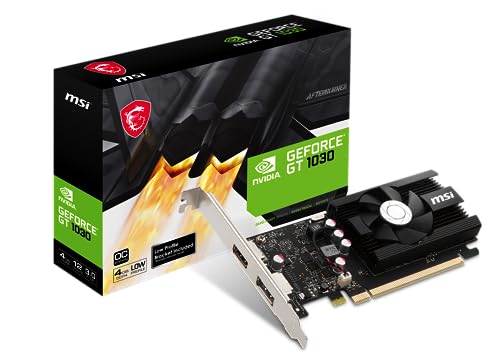
This MSI card is the GT 1030’s other personality: where the Maxsun above pairs the GPU with 2GB of fast GDDR5, MSI pairs it with 4GB of DDR4 and names both of its output families in the title — DisplayPort and HDMI. For a television-only machine, the HDMI in that title is the operative word, stated rather than assumed, and the 4GB figure serves the desktop side of the job: many windows, many browser tabs, photo libraries and light content work spread across a big 4K television’s canvas. Memory capacity and memory speed are different virtues, and this card has chosen capacity.
The trade should be priced honestly. DDR4 is markedly slower than GDDR5 as graphics memory, and in games the difference shows — this is the weaker gaming card of the two GT 1030s here, full stop. But a TV-only PC’s evenings are rarely games at the margin of memory bandwidth; they are interfaces, video and browsing, where the extra capacity is felt and the bandwidth largely is not. MSI also specifies HDCP support in the title, a detail that matters specifically to this guide’s audience: protected streaming content cares about the whole chain being compliant, and a card that states its support saves a troubleshooting evening.
The single-fan OC design keeps the card compact and cool-running, and its power draw is of the same modest class as every GT 1030. Buyers choosing between this and the Maxsun are choosing between a stated HDMI with more, slower memory, and an unstated port list with less, faster memory. For a television that is the only display the machine will ever know, the stated port and the capacity make a coherent case — provided gaming stays in the light category this card is honest about.
MSI’s software and support polish is the quiet extra here. Of the makers in this guide, MSI’s documentation, driver pages and utility support are among the most developed, and in a household PC — often maintained by whichever family member drew the short straw — a card whose maker explains itself well is worth something real. Combined with the stated HDMI and HDCP support, this is the pick where the fewest open questions remain in the entire purchase, and is willing to trade gaming pace to close them.
- Memory: 4GB DDR4 on a 64-bit interface, per the title
- Outputs: DP and HDMI both named in the title — the HDMI count beyond that is not specified there
- HDCP support stated in the title — relevant to protected streaming services
- Cooler: single fan, OC edition, per the title
- DirectX 12 named in the title
Strengths
- HDMI stated in the title, with HDCP support for streaming duty.
- 4GB of memory suits a big television used as a desktop canvas.
- Compact single-fan design, cool and quiet in media service.
Trade-offs
- DDR4 memory makes it the weaker gaming card of the GT 1030 pair.
- Exact HDMI port count is not given in the title.
- Capacity over pace is the wrong trade if games lead the brief.
Best for: a television-only PC used heavily as a big-screen desktop — browsing, photos, streaming — where the stated HDMI and HDCP support settle the connection question.
Not suited for: sofa gaming beyond the lightest titles, where the DDR4 memory’s pace, not its capacity, is what the games will feel.

Maxsun AMD Radeon RX 550 4GB Low Profile — Best low-profile media pick
The RX 550 brings something the GT cards cannot: a step up in genuine graphics capability while staying in the low-profile, small-form-factor world. Maxsun’s version is explicitly a low-profile card for small cases, with 4GB of memory, and in a slim media PC it covers the whole living-room brief with more headroom than the GT 1030 pair — smoother high-resolution desktop behaviour, more comfortable light gaming, and AMD’s media handling for the video library. It is the pick for the slim machine whose owner keeps saying the words “and a bit of gaming, too”.
The title describes the card as a gaming card for computer gaming, and that claim needs the guide’s calibration rather than its repetition: the RX 550 plays older, lighter and indie titles happily at a television’s distance, and it is not a card for current demanding releases at native resolution. Within that honest band, though, it is a real step above the GT class, and on a TV — where viewing distance forgives what a desk monitor would expose — its light gaming looks better than its specifications suggest.
Ports require the same candour as the Maxsun GT 1030: the title does not enumerate them, so the buyer must confirm the HDMI output on the listing before ordering, full stop. Low-profile ownership adds its usual footnote — confirm the bracket arrangement for the slim case from the listing details. Neither check is onerous, and both are the price of a category where the title leads with the form factor instead. What the title does promise, low profile and 4GB in a small case, is exactly the combination slim media PCs are short of.
AMD’s side of the media story is worth a line for households with mixed libraries. Radeon cards of this class handle the common streaming and local-video formats without fuss, and FreeSync support — present across this GPU family — pairs with the growing number of televisions that accept a variable-refresh signal, smoothing the light gaming this card is bought for. A TV that supports it and a card that speaks it make the sofa library feel a class above the hardware’s price, which is the RX 550’s whole argument in one sentence.
- Memory: 4GB, per the title
- Form factor: low profile, small form factor — both stated in the title
- Graphics class: Radeon RX 550 — a genuine step above the GT class for light gaming
- Outputs: not enumerated in the title — confirm HDMI on the listing before ordering for a TV-only setup
- Bracket: low-profile fitting is the card’s premise; confirm the bracket contents in the listing for the specific case
Strengths
- More real graphics capability than the GT picks, still low-profile.
- 4GB of memory for high-resolution desktop and light gaming.
- Built for the slim enclosures media PCs actually live in.
Trade-offs
- HDMI must be confirmed on the listing; the title is silent on ports.
- Light gaming only, despite the title’s gaming language.
- Bracket contents need confirming for the target case.
Best for: a slim, low-profile media PC under the television that also plays older and lighter games from the sofa.
Not suited for: current demanding titles at native TV resolution, where its capability — honestly stated — runs out well before the panel does.

Maxsun GeForce RTX 3050 6GB — Best for sofa gaming
Every guide like this one has a pick that changes the subject, and here it is the RTX 3050 6GB. The other five cards treat the television as a display for a media PC; this one treats it as a gaming screen. RTX architecture, 6GB of GDDR6 and DLSS upscaling make it a real 1080p gaming card, and on a television — where the household’s gaming is done from a sofa, at a forgiving distance, often at the TV’s native gaming settings — that capability translates into the living-room PC that no longer apologises for its games library. If the TV-only machine in question is also the household’s games machine, this is the card the rest of the list is a prelude to.
Maxsun’s title keeps to the essentials — the GPU, the 6GB, GDDR6, gaming intent — and does not enumerate the outputs, so the standing instruction of this guide applies with its full force: confirm the HDMI output on the listing before ordering, because a TV-only machine has no second display to fall back on if the port mix surprises. The card’s other characteristics need no such caution. Its power draw is modest by gaming standards, its size suits ordinary and many compact cases, and DLSS gives it a second wind in demanding titles that the older cards here simply do not possess.
The honest boundary is resolution ambition. On a 1080p television, or a 4K set using its gaming features with upscaling doing the heavy lifting, this card delivers a thoroughly enjoyable sofa library. Native 4K gaming in current titles is a different tier’s work, and the guide’s final section says so plainly. Within the living room’s real terms — big screen, controller in hand, a few metres of forgiving air — the RTX 3050 6GB is the strongest card this category can offer, and the only one here bought for frame rates first and ports second.
It also future-proofs the room in a way the media cards cannot. A television bought today will serve for a decade, and the household’s demands on the PC beneath it tend to grow toward gaming rather than away from it — children age into games, a partner discovers a series, a console generation ends and its library migrates. The card that already plays games absorbs that growth silently. The media cards are the right buy for the household certain of its habits; this is the right buy for the household honest about how habits change.
- Memory: 6GB GDDR6, per the title
- Architecture: NVIDIA RTX 30 series, with DLSS upscaling
- Intended use: gaming PC graphics, per Maxsun’s title
- Outputs: not enumerated in the title — HDMI confirmation on the listing is mandatory for a TV-only build
- Form factor: the title’s “Mini” wording suggests a compact design — verify exact dimensions on the listing against the media case
Strengths
- Real modern gaming capability, alone in this guide at its level.
- 6GB of GDDR6 and DLSS suit a television gaming setup.
- Modest power and size for a card of its capability.
Trade-offs
- Port mix unstated in the title; the HDMI check is on the buyer.
- Native 4K gaming in current titles is beyond its tier.
- Costs gaming money in a guide where media cards cost far less.
Best for: a television-only PC that is also the household’s games machine, played from the sofa at 1080p or with upscaling on a 4K set.
Not suited for: a pure media box, where its gaming premium buys capability the streaming library will never call upon.

ASUS HD 6450 Silent with HDMI Support — Best for silent basic output
This card requires the most honest review in the guide, and it gets it. The HD 6450 is a genuinely old, entry-level GPU — the listing’s own model code carries 512MB of memory — from an era before several of this guide’s readers bought their current televisions. It is not a gaming card in any modern sense, its driver support belongs to a legacy branch, and it should never be bought in the expectation of performance. What it is, uniquely here, is silent: the title’s 0dB silent heatsink means no fan at all, and its HDMI support is stated outright. For the narrow job of putting a basic desktop picture on a television from a PC that must make no sound whatsoever, it remains a coherent purchase.
That job exists and is not rare. A PC driving a TV in a bedroom, a quiet study, a place of worship’s display, a signage screen, an elderly relative’s simple computer-on-the-TV — in these settings the requirements are a picture, silence, and nothing else, and every stronger card in this guide answers them with a fan the room did not want. The HD 6450’s low profile and tiny power draw suit the small, old, quiet machines that hold these roles, and its price class reflects its position without apology.
The cautions must be as clear as the case for it. Modern streaming services, browsers and operating systems have all grown heavier since this card’s era, and a machine built around it should be expected to do simple things simply — a desktop, basic video, documents — not to juggle a modern media library. Buyers whose needs are even slightly larger should take the GT 1030 picks, which are this card’s modern successors in every way but silence. Bought with its limits understood, though, the HD 6450 is not a compromise; it is the only card in the guide that makes literally no noise, and for its one job that is the whole specification.
There is a certain respect due to hardware that has found its final form. This card’s design has not needed to change because its job has not changed: a silent heatsink, a stated HDMI output, a picture. It will not be improved by a successor, because the successor would be a different product for a different brief. Buyers who recognise their own requirement in that description — a picture, in silence, indefinitely — are not settling for the oldest card in the guide. They are the only readers for whom the guide’s oldest card is, without qualification, its best.
- Memory: 512MB, per the model code in the title (DI/512MD)
- Cooling: 0dB silent heatsink, stated in the title — no fan, no noise
- HDMI support stated outright in the title
- Graphics class: entry-level legacy GPU — basic display output only
- Driver position: legacy support branch; suitable for simple, stable duty rather than new features
Strengths
- Completely silent — the only fanless pick in the guide.
- HDMI support stated in the title, no verification dance required.
- Tiny power draw and low profile suit old, small, quiet machines.
Trade-offs
- Legacy-era performance: basic display work only, no modern gaming.
- 512MB of memory, the smallest allowance here by a wide margin.
- Legacy drivers; modern media demands will outgrow it quickly.
Best for: a silent PC whose whole job is a basic picture on a television — a bedroom, study or signage display — with no gaming or heavy media ambition.
Not suited for: any gaming at all in the modern sense, or a media library of high-resolution streaming, where its era shows in every frame.
How Do the Six Cards Compare on a Television?
| Card | Memory | HDMI position | Cooling | TV-only job |
|---|---|---|---|---|
| ASUS GT 730 4X HDMI | 2GB GDDR5 | Four ports, stated | Compact single-fan class | TV plus extra screens |
| Maxsun GT 1030 | 2GB GDDR5 | Not stated in title — verify | Compact cooler | Simple media PC |
| MSI GT 1030 4GB | 4GB DDR4 | HDMI named in title | Single fan | Big-screen desktop |
| Maxsun RX 550 LP | 4GB | Not stated in title — verify | Low-profile cooler | Slim media plus light games |
| Maxsun RTX 3050 6GB | 6GB GDDR6 | Not stated in title — verify | Gaming cooler | Sofa gaming |
| ASUS HD 6450 Silent | 512MB | HDMI support stated | Fanless heatsink | Silent basic output |
The middle column is this guide’s conscience. Three cards state their HDMI position in their titles and three do not, and the guide has treated that difference as information rather than embarrassment: a TV-only buyer should always know whether the port is promised or merely probable. Read the table by job first and by that column second, and the right card usually names itself.
Which Television Settings Make a PC Picture Look Right?
More living-room PC disappointment is caused by television settings than by graphics cards, and the fixes are free. First, find the TV’s game mode or PC mode for the HDMI input the computer uses: televisions process their picture heavily by default — smoothing, sharpening, noise reduction — and those processes add delay and a processed look that makes a desktop feel wrong. PC mode typically disables the processing and, just as importantly, enables the full colour resolution a desktop needs for crisp text; without it, text on a TV often looks faintly smeared no matter which card renders it.
Second, kill overscan. Televisions historically zoom the picture slightly, cutting off the edges of the desktop — the taskbar half-hidden, the corners gone. The setting hides under names like “just fit”, “screen fit” or “1:1” in the aspect-ratio menu, and setting it correctly returns the whole desktop at once. Third, match the output to the panel: set the PC’s resolution to the TV’s native resolution, and its refresh rate to what that HDMI input actually accepts, which may differ between ports on the same set — many televisions give their best PC behaviour on one specific input, and the manual says which.
Colour deserves a check of its own on a television, because a set can accept a PC’s signal in more than one colour format and does not always choose the best by default. If text shows coloured fringing or fine detail looks soft in a way resolution does not explain, the output format is the suspect: the graphics control panel’s output colour settings, matched against what the TV’s PC mode expects, resolve it. This is the least-known of the television adjustments and, for a machine used heavily as a desktop, often the most satisfying one to get right.
Finally, sound deserves its own check, because HDMI carries it and televisions route it. Confirm the PC’s audio output is set to the HDMI device, and if an AV receiver or soundbar sits between the PC and the TV, decide deliberately which device the cable meets first — the receiver, for the best audio formats, with the picture passed onward. These are ten minutes of menus, once, and they are worth more to the finished picture than the difference between any two cards in this guide.
What About the Rest of the Living-Room Chain: Receivers, Soundbars and Consoles?
A television-only PC rarely connects to the TV entirely alone, and the chain around it decides several questions the card cannot. If an AV receiver or soundbar is present, the natural wiring is PC to receiver to television, which lets the receiver take the audio in its best form and pass the picture onward — but it adds a link that must agree with the others about HDCP and resolution, and older receivers can cap the picture the TV could otherwise accept. A household meeting a resolution ceiling it cannot explain should test the PC wired directly to the TV; if the ceiling lifts, the receiver was the lid, and the audio can be returned to it over the TV’s audio-return connection instead.
Consoles sharing the television matter for a simpler reason: inputs. A TV’s HDMI ports are finite, they are not all equal, and the PC is usually the device most tolerant of which port it gets — provided the port’s PC behaviour is checked, as this guide’s settings section describes. Give the best input to the device that needs it most, let the PC take the input its settings can civilise, and label the cables. The household that labels its HDMI cables is the household that never loses an evening to the wrong input, and it is a two-minute habit this guide endorses without reservation.
How Is a TV-Only PC Set Up From Card to Couch?
Install the card as in any small PC: power off, unplug, seat the card, fit the low-profile bracket first if the case is slim and the card offers one, and connect a single HDMI cable from the card to the television — choosing, where the TV offers several inputs, the one its manual recommends for PC use. Boot with the TV on and set to that input, since a television that is asleep or on another input is the most common cause of a “dead” first boot that is nothing of the kind. Install the current driver from the GPU maker, then work through the television settings in the section above before judging the picture.
The living-room layer comes next. Set the operating system’s display scaling generously — a television is read from metres away, and the scaling that feels large at a desk feels correct from a sofa. Choose an input method that suits the room: a wireless keyboard with a trackpad, a media remote, or a game controller for a gaming-leaning setup, and set the machine’s sleep behaviour deliberately, because a media PC that sleeps mid-film or refuses to wake for a scheduled recording is a settings problem, not a hardware one. If the PC will record or serve media, give those tasks a wired network connection where possible; the television’s picture deserves better than a struggling wireless link.
Power behaviour in the room is worth arranging at the same sitting. A media PC should wake cleanly from sleep with the television, or be set never to sleep during viewing hours, according to the household’s habits — and the graphics driver keeps its own power settings that can blank a screen the operating system intended to keep. Align the two once, and the machine stops having opinions about when the film ends. It is a small thing, and like most small things in a living room, it is the difference between technology that serves the evening and technology that interrupts it.
Close the loop with the household test: play the darkest film scene in the library, the brightest sports broadcast, and a page of small text, from the actual seats. A television setup is correct when all three are comfortable from the couch — and that test, done once with the settings above in place, settles questions that no specification sheet in this guide can answer from a desk.
Which Mistakes Do TV-Only Buyers Make?
The first is buying a gaming card for a streaming life — or its opposite, expecting a display card to game. This guide’s six picks span a wide capability range on purpose, and the mistake is not choosing any one of them; it is choosing one while imagining another’s job. The second mistake is assuming the HDMI port rather than confirming it, on the cards whose titles do not state their mix. In a desk setup a surprise port costs an adapter; in a TV-only setup it costs the machine’s only picture, and the listing check takes a minute.
A further mistake is neglecting the distance between the specification and the seat. Buyers pore over resolution support and then sit four metres from a screen whose desktop text no card can make legible at 100 percent scaling — a settings matter, again, solved by display scaling rather than by hardware. The television rewards a different kind of optimisation from the monitor: bigger interface elements, a launcher or big-picture mode for games, a browser zoomed to reading size. Setting those once will get more from the humblest card here than buying the strongest card and squinting at it ever will.
The third mistake is blaming the card for the television’s settings — returning a perfectly good card because text looked smeared under the TV’s default processing, when PC mode would have fixed it for free. And the fourth is forgetting the room: a card with a small, hard-working fan is inaudible at a desk and distinctly audible in a quiet living room at night, which is why this guide weighs cooling behaviour as heavily as it does, and why its oldest, weakest pick still earns its place for the one job where silence is the specification.
How Long Will a Card Chosen for a Television Last in That Role?
Longer than a desk card usually lasts in its role, because the television’s demands move slowly. A panel’s resolution and inputs are fixed for its life — often a decade — and the media formats a household streams change at the pace of services, not of game releases. The GT-class cards in this guide will drive a television’s desktop and video for as long as the PC around them survives, which is why the category rewards buying the right job rather than the most power: an overpowered media card in year five is simply an older gaming card, while a right-sized one is still doing exactly what it was bought to do.
The exception is the household whose PC drifts toward gaming, as the RTX 3050 review described — there, the card’s ceiling is met by the library’s growth rather than the television’s age, and the upgrade path is a card swap within the same case and cable. The comforting constant is that the connection survives every version of the plan: HDMI out, one cable, the television none the wiser. Choose the port with care today, and the rest of the machine can evolve around it for years.
Final Recommendation
For the straightforward TV-only media PC, take one of the GT 1030 picks — the Maxsun for its GDDR5 pace in a compact body, the MSI where the stated HDMI, HDCP support and 4GB canvas suit a big-screen desktop — after confirming the port on the listing where the title leaves it unstated. Take the ASUS GT 730 where the screen count will grow, the RX 550 where a slim case and light gaming meet, and the RTX 3050 6GB where the television is a games screen and the PC must honour that. The HD 6450 stands apart, for the silent and the simple, and this guide recommends it only inside that honest boundary. A television asks a graphics card for different things than a monitor does — a promised port, a quiet cooler, a picture the set’s own settings are allowed to show properly — and a card chosen on those terms disappears into the room, which is exactly what living-room technology is supposed to do.
Frequently Asked Questions
Should the PC be left on all the time in a TV-only setup?
It is a matter of household rhythm rather than hardware. These cards draw little at idle, and a media PC set to sleep after a period of inactivity and wake on demand costs very little to keep ready; a machine that also records television or serves files to the house may justify staying awake on a schedule. What matters is that the behaviour is chosen — sleep timers set deliberately, wake sources agreed — rather than inherited from defaults that were written for an office. The card itself is indifferent; the household should not be.
Does HDMI carry sound from the PC to the television as well as picture?
Yes — that is one of the reasons HDMI is the right connection for this setup. A single cable carries both the picture and the PC’s audio to the television, and from there to a soundbar or receiver if one is connected. After installing the card, set the HDMI device as the PC’s audio output; that one setting is the step most often missed, and its absence is the usual reason a newly built media PC is silent on its first evening.
Why do some reviews here refuse to state an HDMI port count?
Because the listing titles for those cards do not state one, and this guide claims port counts only from titles. A television-only machine lives or dies by its HDMI connection, so the guide marks the unstated cases clearly and directs the buyer to the listing page, where the port mix is shown, rather than printing a probable number as though it were a promised one. The cards whose titles do state their HDMI position are identified just as clearly.
Can a TV-only PC use a 4K television properly?
Yes, with expectations matched to the card. All of these cards can put a desktop on a 4K television for browsing, streaming and media, where the panel’s size makes the resolution welcome. Gaming at native 4K is a different demand, and only the RTX 3050 pick approaches it — with upscaling rather than native rendering in current titles. Set the PC’s output to the panel’s native resolution and let the card’s job, as described in its review, decide the rest.
Is the HD 6450 a mistake in a modern guide?
It would be a mistake if it were recommended for modern work, and it is not. It is included for one narrow, real job — a basic picture on a television from a PC that must be completely silent — and its review states its age, its 512MB of memory and its legacy position in full. A household whose needs are even slightly larger is directed to the GT 1030 picks, which are better in every way except the one the HD 6450 is bought for: it has no fan, and therefore no fan noise, ever.
My television has several HDMI ports. Does it matter which one the PC uses?
It can. Many televisions give one input their best PC behaviour — full colour resolution, the lowest processing delay, the widest format support — and reserve different capabilities for the others, and the manual identifies the recommended input for a computer. ARC and eARC capability also lives on a specific port, which matters if a soundbar is in the chain. Plug the PC into the input the manual names for it, set that input to its PC or game mode, and the picture problems this guide’s settings section fixes will mostly never occur.
What cable should connect the PC to the television?
A standard HDMI cable of reasonable quality and the shortest length that reaches comfortably. Exotic cables add nothing to a digital signal at living-room distances; what matters is that the cable is rated for the resolution and refresh rate being sent, and that it lands in the television input the set’s manual recommends for a PC. If the picture misbehaves, the television’s input settings — covered in this guide — are a likelier cause than the cable.
Related Guides
Households building out a living-room setup may also find our guide to graphics cards for home-theatre PCs useful, alongside the roundup of low-profile cards for slim cases and the walkthrough of television settings for PC gaming that expands on this guide’s picture advice. Between them they cover the whole living-room chain — the card, the case it sits in, and the television it feeds — because a TV-only setup succeeds or fails as a chain, and the strongest link was never the point — the evening’s viewing was, and every link in that chain earns its place by disappearing into it completely, quietly and without demanding attention ever again from anyone in the room, in any season, at any hour, during any film the household gathers around it to watch together.


