What's inside
- Key Takeaways
- Quick Picks: The Best Headsets for Seniors Using iPhone and Television
- How Were These Six Sorted Into Routes?
- Why Does the Route Matter More Than the Brand?
- The Six Picks, Labelled by the Road They Travel
- What Should Families Set Up Before Handing Over a Headset?
- How Do the Six Compare on Route and Control?
- What Mistakes Do Families Make When Buying Listening Headsets?
- Field Notes: The First Week With a Listening Headset
- How Does an iPhone Fit Into a Senior’s Listening Day?
- How Much Volume Is Enough, and Who Decides?
- What Happens When the Television Itself Is Replaced?
- Final Recommendation
- Frequently Asked Questions
- Related Guides
As an Amazon Associate I earn from qualifying purchases. This post may contain affiliate links at no extra cost to you.
gizmoverdict.com is reader-supported. When you buy through links on our site, we may earn an affiliate commission.
Where to buy: the six products below are Amazon listings, and each name in this guide links to its listing so that connection types, included transmitters and battery arrangements can be checked carefully before buying — ideally with the television and the iPhone that the headset must serve both in view.
Shopping for the best headsets for seniors using iphone requires one honest clarification at the outset, because the product class is mostly not about phones. The headsets built for older listeners are overwhelmingly television listening systems: they take their sound from the TV, through a transmitter, a base station or a long cord, and their comfort and volume features are designed around an evening’s viewing. An iPhone cannot receive those RF signals and has no use for a TV transmitter. So this guide labels every pick’s route plainly — Bluetooth models pair with an iPhone; RF, base-station and wired models are TV routes and are described as such — and the reader who wants one headset for both the phone and the television should watch for the two picks whose titles genuinely offer both.
The features that define this class deserve the same plainness. Listings speak of clear voice, loud volume, dialogue clarity, balance and tone controls — the vocabulary of making speech easier to follow at a volume the listener chooses, without turning the whole room up with it. This guide describes those features exactly as the listings frame them, and makes no medical or hearing-treatment claims of any kind: these are listening products, not treatment devices, and anyone whose hearing difficulty is new or worsening deserves a professional’s assessment alongside any purchase made here.
Why does the television dominate a guide nominally about a phone? Because that is where the hours are. A senior’s iPhone carries calls, family video chats and perhaps a radio app; the television carries the news, the serial, the Sunday film — the long listening sessions where straining to follow dialogue genuinely erodes pleasure. The sensible purchase therefore starts from the TV chair and checks the phone pairing as a valued second route, which is the order this guide’s verdicts follow.
Key Takeaways
- Only two picks pair with an iPhone as titled: the SIMOLIO Bluetooth model, and the SIMOLIO RF & Bluetooth model in its Bluetooth mode, which its title says works with phone and tablet.
- The Avantree Duet, the wired SIMOLIO and the PROW are television routes — RF transmitter, long cord and TV-input connections respectively — and cannot pair with an iPhone.
- Balance and tone controls recur across the SIMOLIO picks: left/right audio balance appears in three titles, tone control in two.
- Soundbar passthrough or bypass is named in three titles, for households where a soundbar already serves the room.
- Replaceable parts appear where they matter: the Bluetooth SIMOLIO names replaceable battery and earpads in its title.
Quick Picks: The Best Headsets for Seniors Using iPhone and Television
| Pick | Badge | Why it made the cut |
|---|---|---|
| SIMOLIO Bluetooth TV Headphones | The iPhone-pairing pick | A Bluetooth model titled for TV and PC with clear voice, loud volume, left/right balance, ambient mode and replaceable battery and earpads. |
| Avantree Duet Dual TV Headphones | The two-listener TV route | Dual wireless headphones on a 2.4GHz RF transmitter with charging dock, titled for clear voice and loud volume with plug-and-play setup. |
| SIMOLIO Amplified Wired Headphones | The long-cord wired route | Wired TV headphones with an 18-foot coil cord, volume control with clip and clear-dialogue positioning for seniors. |
| SIMOLIO SM-823D Pro | The tone-and-balance TV route | Wireless TV headphones with loud and clear voice, balance and tone control, soundbar compatibility, ambient mode and a stated 164ft range. |
| SIMOLIO RF & Bluetooth Headset | The both-routes pick | A 2-in-1 RF and Bluetooth headset: RF for the television, Bluetooth for phone and tablet, with three tone modes and independent volume. |
| PROW One-Button TV Headphones | The one-button TV route | Exclusively TV headphones with a single-button design, loud clear sound and USB, optical, RCA and 3.5mm TV connections as titled. |
How Were These Six Sorted Into Routes?
The sorting question was asked of every title in one breath: what does this product connect to, and by what road? Bluetooth in a title means the iPhone door is open — the phone pairs directly, and the same headset usually serves a tablet or computer. RF with a transmitter means the sound begins at the television and travels on the maker’s own radio link, a road the iPhone cannot join. A cord means the oldest road of all, with its own virtues of simplicity and its own geography of reach. Where a title offered two roads, the pick is labelled both-routes and the verdict separates which mode serves which device.
Within each route, the titles were read for the features older listeners actually ask about. Can the volume go where the listener needs it without a fight? Can the balance between ears be adjusted, for the many listeners whose ears differ? Can tone be shifted toward speech? Does the headset cooperate with a soundbar the household already owns, or demand the room be rearranged around it? And can the parts that wear out — battery, earpads — be replaced, or does the whole product retire when they tire? Those questions, answered only from the titles, structure every spec box below.
Comfort claims were handled with restraint. No title here prints a weight, so none is invented; instead the verdicts reason from design facts that titles do state — over-ear wired, dual headphone sets, one-button operation — and flag the rest with the caution line. Families buying for a parent should also browse the wider shelf in our best headsets for listening to tv guide, where the television side of this class is covered without the iPhone question narrowing it.
Why Does the Route Matter More Than the Brand?
Because a route mismatch is the one failure no quality can rescue. A beautifully made RF television headset, bought in the hope that it will pair with an iPhone, will sit in its dock forever, technically excellent and practically useless for half its intended job. Families discover this in the worst order — gift given, box opened, pairing menu searched, disappointment shared. Reading the route first, before any feature list, is the entire defence, and it costs nothing but the order in which a listing is read.
The routes also divide by living arrangement in ways worth picturing. Bluetooth belongs to the listener who moves between phone, tablet and television across a day. RF with a charging dock belongs to the fixed favourite chair, where range and a permanent home matter more than portability. The long cord belongs to the listener who distrusts batteries on principle — often wisely, since a cord never once needed charging at the exact moment the film began. None of these is the senior route; each is a household’s route, and the six picks below are best read as six answers to six different homes.
The Six Picks, Labelled by the Road They Travel

SIMOLIO Bluetooth TV Headphones — The iPhone-pairing pick
Route: Bluetooth — this is the pick that pairs with an iPhone. SIMOLIO titles these as wireless TV headphones for seniors, Bluetooth for PC, and the Bluetooth road is the one that matters for this guide’s question: pair it with the iPhone for calls, video chats and listening around the house, and with a television or computer that offers Bluetooth for viewing. The titled feature list reads like a summary of the class’s best ideas — clear voice and loud volume, left/right audio balance so each ear can be given its own level, an ambient mode, and optical/auxiliary passthrough to a soundbar, so the television’s existing speaker setup is not orphaned by the headphones’ arrival.
The detail that earns this pick its place at the head of the guide is at the end of its title: battery and earpads replaceable. Listening products for older users live long lives in favourite chairs, and the two parts that age — the cell that stops holding an evening’s charge and the pads that soften against the skin — are precisely the two this design lets you renew. That is a dignity feature as much as an economic one: a familiar, adjusted, comfortable headset should not have to be replaced wholesale because its battery tired, forcing its owner to learn a new product’s buttons and fit from the beginning.
- Route: Bluetooth, pairing with iPhone, TV and PC as titled
- Voice features: clear voice and loud volume, per the title
- Balance: left/right audio balance control
- Modes: ambient mode named in the title
- Soundbar: optical/auxiliary passthrough to a soundbar
- Serviceability: battery and earpads replaceable, as titled
Strengths
- The straightforward iPhone route: Bluetooth pairing with no transmitter in between.
- Per-ear balance respects the reality that two ears often need different volumes.
- Replaceable battery and earpads extend the product’s working life in a favourite chair.
Trade-offs
- Television use depends on the TV’s own Bluetooth or an added transmitter, unlike the RF picks’ included bases.
- Bluetooth pairing, while simple, is a menu task some listeners will want set up for them once.
- Range is the Bluetooth room-scale, not the long stated ranges of the RF models.
Best for: a senior whose listening moves between an iPhone and a screen, and who values per-ear balance. Not suited for: a television with no Bluetooth output and no plan to add a transmitter, because this pick brings no base station of its own. Its Amazon listing confirms which television connections the passthrough supports in practice.
Set this headset up once, properly, and its daily life is graceful: it remembers the phone, it remembers the television if the set supports it, and the listener’s whole interaction becomes putting it on and choosing a volume. Families configuring it for a parent should do the pairing at the parent’s chair, with the parent’s phone, and write the two or three steps on a card kept by the dock — because the best accessibility feature in this entire category is a grandchild who documented the setup before leaving.
Ambient mode, listed quietly among its features, solves the Bluetooth headset’s one social problem: sealed ears in a shared room. A listener who can let the room back in at a touch — to hear a spouse, a doorbell, a kettle’s click — stays part of the household while wearing the headset, rather than visiting from inside it. For seniors whose reluctance about listening products is really reluctance about isolation, that single mode can be the difference between a headset worn daily and one politely shelved, and its presence in this title is a mark of design that thought about the room as carefully as the ears.

Avantree Duet Dual TV Headphones — The two-listener TV route
Route: television only — a 2.4GHz RF transmitter serves the TV; this set does not pair with an iPhone. The Duet’s idea is companionship: two wireless headphones fed by one transmitter, so two people can each set their own volume for the same programme. Anyone who has watched a couple negotiate a single television volume — one straining, one wincing — understands the product instantly. Each listener gets clear voice and loud volume as titled, at the level their own ears prefer, while the television itself can stay low or silent for the rest of the household.
The titled setup promise is easy plug and play, and the charging dock completes the fixed-chair picture: the headphones live on the dock, charged, in the room where they are used, with no cable ritual and no pairing menu in daily life at all. That last point deserves emphasis in a guide about older users. Once installed, an RF dock system asks less of its owner than any Bluetooth product does — no settings, no device list, no wondering which gadget the sound thinks it belongs to. The iPhone’s absence from this arrangement is a real limitation for this guide’s named question, stated plainly; judged as television equipment for two, the Duet is the most complete answer here.
- Route: 2.4GHz RF from a TV transmitter — television only
- Listeners: dual headphones, two included as titled
- Voice features: clear voice and loud volume, per the title
- Base: transmitter with charging dock
- Setup: easy plug and play, as titled
- iPhone pairing: not offered — this is a TV route
Strengths
- Two listeners each control their own volume for the same programme.
- The dock removes charging cables and pairing menus from daily life.
- Plug-and-play positioning suits households that want installation to happen once.
Trade-offs
- No iPhone route exists in this product at all.
- Two headphones serve the television room and travel nowhere else.
- The transmitter claims a television output and a permanent spot near the set.
Best for: couples who watch together at different comfortable volumes, in one settled viewing room. Not suited for: any listening on an iPhone, because the RF transmitter system has no Bluetooth road to the phone. The Amazon listing details which television outputs the transmitter accepts.
There is a kindness embedded in the dual design that goes beyond volume. Hearing differences between partners can become a nightly small friction, even a source of embarrassment for the one who needs the set louder. Two headphones dissolve the negotiation entirely — nobody is the reason the television is blaring, nobody is missing the dialogue — and that social repair is, for many households, worth more than any specification in this guide. The Duet should be bought as that repair, with the iPhone question answered by a different product or accepted as out of scope.
The dock deserves one more consideration, because it quietly sets the household’s geography. A transmitter lives where the television is, which means the Duet’s home is the main viewing room and its range is that room’s world. Households whose viewing migrates — a set in the kitchen, a set in the bedroom — should picture which room gets the Duet before ordering, since a second room would need its own arrangement. Within its chosen room, though, the system’s completeness is hard to argue with: two charged headphones, waiting on their dock, asking nothing of anybody until the programme starts.

SIMOLIO Amplified Wired Headphones — The long-cord wired route
Route: wired television — an 18-foot cord to the TV; no iPhone pairing, and no battery to charge for the listening itself. In a guide full of radios, the cord is almost radical: SIMOLIO’s wired headphones plug into the television and simply work, at a distance the title quantifies as an 18ft, 5.5-metre long coil cord. The coil is the thoughtful part — it stretches across the space between set and chair and contracts when not needed, rather than trailing a fixed length of cable across the carpet as a trip hazard and a vacuum cleaner’s enemy.
The titled controls suit the wired philosophy: a volume control with a clip, so the adjustment rides on the listener’s clothing within hand’s reach instead of on a remote across the room, and clear-dialogue positioning aimed at the eternal problem of speech buried under music and effects. The title also states 40 hours of playtime, which this guide reports as printed while noting that a wired headphone’s amplification evidently carries its own power arrangement — the listing’s full page is the place to understand exactly what that figure describes before purchase. What the cord guarantees, regardless, is the end of the dead-battery evening: if the television is on, the headphones work.
- Route: wired to the television — no iPhone pairing
- Cord: 18ft / 5.5M long coil cord, as titled
- Controls: volume control with clip
- Positioning: clear dialogue, over-ear wired TV headphones for seniors
- Stated playtime: 40 hours, as printed in the title
- Television connection type: Not stated in the listing title — verify with the maker’s documentation
Strengths
- A cord cannot run out of charge mid-film and never needs pairing.
- The coiled 18-foot reach covers real chair-to-television distances.
- A clipped volume control stays at the listener’s hand all evening.
Trade-offs
- The cord tethers the listener to the chair’s neighbourhood.
- No phone, tablet or second-room use is possible on this route.
- Any cord across a walking path needs routing with care in a senior’s home.
Best for: a single favourite chair, a listener who values never charging anything, and dialogue-first viewing. Not suited for: listening while moving about the house, because the cord’s 18 feet define the world it serves. Check the Amazon listing for the television connector the cord expects.
Wired listening also has an underappreciated reliability argument in homes where several wireless products already compete. No interference, no dropouts when the microwave runs, no mystery silence because a tablet upstairs claimed the connection — the cord’s physics are beneath all of that. For a listener whose confidence with technology has been bruised by exactly those mysteries, a product whose behaviour can be explained in one sentence — it is plugged into the television — carries a reassurance that no feature list can match.
Route the cord with the same care as the purchase, because a senior’s room is a walking environment. Along the chair’s side, behind the side table, never across the path to the door — five minutes with a cable clip at installation is the whole safety conversation this product asks for, and it should be had at installation rather than after the first tug. With that done, the wired pick becomes the most predictable object in the house: same chair, same cord, same clear dialogue, every evening, with nothing whatsoever to remember.

SIMOLIO SM-823D Pro — The tone-and-balance TV route
Route: television — a wireless TV system with a stated range of 164 feet; the title names no Bluetooth phone pairing, so the iPhone is not served here. The SM-823D Pro is the adjustment-rich end of the television route: loud and clear voice as titled, left/right balance and tone control both present, compatibility with a soundbar, an ambient mode, and a rechargeable battery stated at 14 hours. Tone control is the feature to dwell on, because it addresses the commonest dialogue complaint with more precision than volume alone: speech that is present but muffled can be shifted toward clarity, while a harsh soundtrack can be softened, each listener tuning the television’s voice to their own ears.
The stated range — 164 feet as titled — redraws the product’s map from chair to house. A listener can keep the programme in their ears while making tea, letting the dog out or answering the door, which changes television from a place into an accompaniment. Ambient mode belongs to the same philosophy: the world outside the programme — a doorbell, a spouse’s question, a kettle — can be allowed back in without removing the headphones. Fourteen hours of stated battery covers several evenings between charges, and the soundbar compatibility means the household’s existing speaker investment is respected rather than bypassed.
- Route: wireless television system — no iPhone pairing stated
- Range: 164ft, as titled
- Battery: 14 hours rechargeable, as titled
- Controls: left/right balance and tone control
- Modes: ambient mode named in the title
- Soundbar: works with soundbar, per the title
Strengths
- Tone control tunes speech clarity rather than merely raising everything.
- The stated range frees the listener from the chair for the length of a programme.
- Balance, ambient mode and soundbar compatibility complete a thoughtful feature set.
Trade-offs
- The iPhone question is unanswered by this product entirely.
- Fourteen stated hours is the shortest battery claim among the wireless picks here.
- Adjustment richness means more controls for a listener who prefers utter simplicity.
Best for: a television listener who roams the house during programmes and wants tone and balance tuned to their own ears. Not suited for: pairing with an iPhone, because no Bluetooth phone route is stated in its title. Its Amazon listing explains the transmitter’s television connections and charging arrangement.
Consider the household routine this product quietly transforms: the evening news no longer requires attendance. The listener who cooks through the headlines, folds laundry through the weather and returns to the chair for the interview is not watching less television — they are watching it in the pattern of a life rather than the pattern of a seat. Range figures in listings are usually read as technical boasts; here the honest reading is domestic. One hundred and sixty-four stated feet is not about distance records, it is about the kitchen being inside the programme’s reach.
Fourteen stated hours of battery should be planned around honestly. At an evening’s viewing per charge cycle of several days, the rhythm is a twice-weekly docking habit — best attached to an existing routine, the way a phone charges by the bed. Listeners who know their own habits to be irregular might weigh the longer-lived or corded picks; listeners with a tidy routine will never think about the figure again. Either way, the number is in the title where a buyer can plan with it, which is all this guide asks of any specification.

SIMOLIO RF & Bluetooth Headset — The both-routes pick
Route: both — and the title itself assigns each mode its job. The RF side serves the television across a stated 164FT/50M range; the Bluetooth side, in the title’s own words, works with phone and tablet, which is the iPhone door. Three tone modes with clear dialog, a bypass to the soundbar, balance and independent volume control complete a specification that reads like a deliberate answer to this guide’s entire premise: one headset, the television through its base, the iPhone through Bluetooth, no compromises disguised.
Independent volume control deserves its sentence, because it names a refinement the other picks imply: the listener’s level is theirs alone, decoupled from the room’s speaker volume, so the household’s soundbar can play at a sociable level while the headset wearer listens at theirs. The bypass wording matters for the same reason — the television’s sound can pass to the soundbar while the headset is in use, so one person’s clarity aid does not silence everyone else’s evening. Households are systems, and this title, more than any other here, was written by someone who understood that the headset succeeds only if the room still works around it.
- Routes: RF for television, Bluetooth for phone and tablet — both as titled
- Range: 164FT / 50M, as stated
- Tone: 3 tone modes with clear dialog
- Soundbar: bypass to soundbar, per the title
- Controls: balance and independent volume control
- Battery life: Not stated in the listing title — verify with the maker’s documentation
Strengths
- The only pick whose title serves the iPhone and the television in their own modes.
- Independent volume lets the room and the listener each keep their level.
- Three tone modes give dialogue tuning more than one flavour.
Trade-offs
- Two modes mean a mode concept for the listener or family to set up clearly.
- Battery endurance is not stated in the title for planning charging.
- The RF base still claims a television output and a permanent place.
Best for: a household running one single headset answering both the iPhone and the television together. Not suited for: single-purpose listening through a dedicated product with nothing at all to switch, because two routes are this pick’s entire design. The Amazon listing sets out how the modes are selected, which is the detail to rehearse at setup.
The setup conversation for this headset should happen in plain words at the kitchen table: television mode when you are watching, phone mode when your granddaughter calls, and here is the one control that moves between them. Written on the card, practised twice together, that sentence is the difference between a both-routes product that delights and one that bewilders. The technology in the title is genuinely accommodating; it asks only that a human introduce it properly, once.
One question families should settle before ordering is which device the headset lives nearest. The RF base anchors it to the television room; the Bluetooth side frees it to follow the phone anywhere — but a headset can only be in one place when a call comes in. Households that keep it by the television and fetch it for calls have chosen television-first, which suits most; households where the phone calls are the day’s highlights may dock it by the phone’s charging spot instead and let the RF range, stated generously in the title, cover the distance to the set. The product supports either philosophy; the family merely has to pick one consciously.
PROW One-Button TV Headphones — The one-button TV route
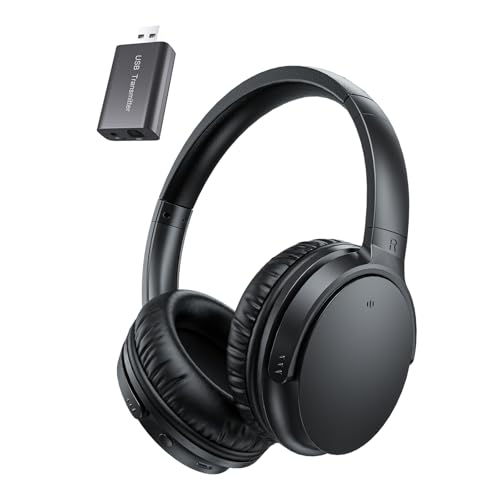
Route: television exclusively — the title says so in those words, and this guide honours it: despite the phrase “Bluetooth headset” appearing in the listing, the product is framed by its maker as exclusively for TV watching, connecting to the set by USB, optical, RCA or 3.5mm as titled, and it should not be bought expecting an iPhone pairing. What the PROW sells instead is the most radical simplicity in this guide: one button. Power and operation reduced to a single control is a design philosophy aimed at listeners for whom every additional button is a small tax on confidence, and the rechargeable, loud and clear positioning completes the thought.
The connection list is the other half of its practicality. Televisions in older listeners’ homes are often older televisions, and a product offering USB, optical, RCA and 3.5mm roads into the set is a product that expects to meet whatever the back panel provides — including the RCA sockets of a set that predates the streaming era entirely. The listing frames the product for private watching where mild hearing difficulty makes the room’s volume a negotiation; this guide describes that positioning as the maker states it, and repeats that the product is a listening aid for enjoyment, not a medical device of any kind.
- Route: television exclusively, as the title states
- Operation: easy one-button design
- Sound: loud and clear, per the title
- TV connections: USB, optical, RCA and 3.5mm, all named
- Power: rechargeable, as titled
- iPhone pairing: not offered — exclusively a TV product
Strengths
- One-button operation is the simplest control story in this guide.
- Four television connection types cover old and new sets alike.
- Private watching at the listener’s own volume is the product’s clear purpose.
Trade-offs
- The iPhone is entirely outside this product’s world.
- A single button means fewer adjustments — no balance or tone controls are titled.
- Rechargeable power reintroduces a charging habit the wired pick avoids.
Best for: television listening reduced to one single button, on whatever set the house already owns and uses daily. Not suited for: any use with an iPhone, because the product is titled exclusively for television. Confirm on the Amazon listing which connection your television will use before ordering.
Simplicity of this order is easy to underrate from outside and impossible to overrate from inside the experience it serves. A listener who has quietly stopped watching favourite programmes because the equipment felt like an examination does not need more features; they need the obstacle count reduced to one. The PROW’s wager is that a single button, honestly arrived at, restores the evening — and for the households it fits, that wager is the most humane proposition in this entire guide.
The four connection types carry a second, quieter benefit: this is the pick most likely to survive the next television. Sets are replaced on their own schedule, and a headset tied to one exotic input can be orphaned by an upgrade, while a product fluent in USB, optical, RCA and the humble 3.5mm socket has a road into virtually any successor. For a listener who dislikes relearning equipment, that continuity across the household’s next decade of televisions is a genuine form of future-proofing — bought, for once, without a single smart feature.
What Should Families Set Up Before Handing Over a Headset?
Do the installation as an act of translation, not delivery. Connect the transmitter or pair the Bluetooth at the actual chair, with the actual television and the actual iPhone, and then watch the listener use it — unaided — through one full programme and one full phone call. Every hesitation in that rehearsal is a setup task still unfinished: a control too small to find by touch, a mode left unexplained, a volume default set for the installer’s ears rather than the listener’s. Fix those on the spot, because a headset returned to its box after one confusing evening rarely comes back out.
Then reduce the whole arrangement to a card. Three lines suffice for most of these products: how it turns on, where the volume lives, what to do when there is no sound — which, in practice, means checking the television’s output setting and the headset’s mode before suspecting breakage. Keep the card where the headset lives. The products in this guide were designed with genuine thought about older listeners; the card is how a family honours that thought instead of defeating it with an undocumented handover. Our cluster companion on the best bluetooth one ear headsets for macbook softphone shows, by contrast, how a working-age audience’s setup expectations differ — a useful calibration for families tempted to assume one explanation fits everyone.
How Do the Six Compare on Route and Control?
| Pick | Route | Pairs with iPhone | Balance or tone | Distinguishing titled feature |
|---|---|---|---|---|
| SIMOLIO Bluetooth TV Headphones | Bluetooth | Yes | Left/right balance | Replaceable battery and earpads |
| Avantree Duet | RF transmitter, TV only | No | Per-headphone volume | Two headphones, one dock |
| SIMOLIO Amplified Wired | Wired cord, TV only | No | Clipped volume control | 18ft coil cord |
| SIMOLIO SM-823D Pro | Wireless TV system | No | Balance and tone control | 164ft stated range |
| SIMOLIO RF & Bluetooth | RF for TV, Bluetooth for phone | Yes, in Bluetooth mode | Balance, 3 tone modes | Independent volume, soundbar bypass |
| PROW One-Button | TV exclusively | No | Not titled | One-button operation, four TV inputs |
The middle column is this guide in miniature: two yeses, four honest nos. Anyone reading only that column will choose more wisely than someone reading a dozen feature lists elsewhere, because the route question decides whether the product can do the job at all, while every other column merely decides how pleasantly it does it.
What Mistakes Do Families Make When Buying Listening Headsets?
The first is the route mistake in its gift-wrapped form: buying a television system for a parent whose stated wish was to hear the grandchildren’s calls better, or a Bluetooth headset for a parent whose real grief is the evening news. The fix is a single question asked before any shopping — show me where you will be sitting and what you will be listening to — and the discipline to let the answer, rather than the marketing, choose the route. This guide’s labels exist to make that discipline easy to keep.
The second mistake is setting the volume for the listener rather than with them. Balance and tone controls only help when the person whose ears they serve does the adjusting, across several programmes, because dialogue clarity is personal in a way no installer can guess. Families should resist the loving urge to pre-tune everything; hand over the controls, stay for the first evening’s experiments, and let the listener’s own preferences — recorded on the setup card — become the defaults.
A fourth mistake is buying on a visit’s urgency. A family notices the problem during a holiday stay, orders whatever arrives fastest, and leaves before the setup is truly finished — returning months later to find the headset in a drawer, defeated by one unexplained silence. The products here are not difficult, but they reward a completed installation and a practised first week. When time is short, choose the simplest route that fits — the one-button PROW or the dock-based Duet ask the least of a hurried handover — and schedule the follow-up call that checks the headset is actually being worn.
The third is neglecting the room’s other listeners. A headset that silences the television for everyone else, in a house where a spouse watches too, trades one person’s clarity for another’s exclusion. The picks that pass sound through to a soundbar, or serve two headphones from one transmitter, exist because households are shared systems; choosing among them with the whole room in mind is the difference between a product that integrates and one that quietly rearranges a marriage’s evenings.
Field Notes: The First Week With a Listening Headset
Day one is usually about the news. The listener puts the headset on for the bulletin — the programme where dialogue is densest and least forgiving — and the family’s first data point arrives in the form of a sentence like “I heard the weather town names for the first time in years.” That sentence should be believed precisely as far as it goes: the product made speech easier to follow at a comfortable volume, which is its whole promise, and no larger claim about hearing itself is needed or made anywhere in this guide.
By midweek the adjustments begin, and they are the healthy kind: the balance nudged toward the stronger ear, the tone shifted a step, the volume default discovered. Listeners who were expected to resist the equipment often become its defenders once those personal settings exist, because the headset has stopped being a product and become their product. Families should schedule the midweek visit or call deliberately — it is when small confusions surface, and when the setup card earns its place by the dock.
The week’s quiet victory, when it comes, is a programme watched together again: the soundbar at a gentle level for the room, the headset carrying the dialogue clearly for one listener, nobody negotiating, nobody excluded. Every route in this guide — Bluetooth, RF, cord — is ultimately a road back to that shared evening, and judging the six picks by how directly they lead a particular household there is the soundest method this guide can offer.
How Does an iPhone Fit Into a Senior’s Listening Day?
Honestly, and more modestly than its name in this guide’s title suggests. The iPhone’s listening jobs are calls with family, video chats where a grandchild’s voice matters more than any broadcast, and perhaps a familiar voice reading the news aloud through an app. A Bluetooth headset serves those jobs anywhere in the house or garden, which is why the two Bluetooth-capable picks matter despite television dominating the class. The phone also rewards a setup favour: pair the headset once, then practise answering a call with it together, because the first solo attempt should not coincide with the call that matters.
Video calls deserve a specific word, since they are where the iPhone and the headset meet most tenderly and most technically. The headset’s microphone carries the senior’s voice back to the family; its earpieces carry the family’s voices at the senior’s chosen volume, free of the room’s echo. Families who make that call a weekly ritual will find the Bluetooth picks repaying their setup patience every single week — and readers equipping the wider household can compare the very different priorities in our best cell phone headsets for sales reps, where the same Bluetooth basics are judged by a working day’s demands instead.
How Much Volume Is Enough, and Who Decides?
The listener decides — that is the entire philosophy of this product class, and it is worth stating as a principle rather than a preference. Loud volume appears in title after title here because the historic alternative was a household volume set by whoever heard least well, imposed on everyone else in the room. Personal listening returns the decision to the person it belongs to, at the level their ears and the programme require, and the soundbar passthroughs and dual headsets in this guide exist to protect everyone else’s evening from that decision.
Families can support that autonomy with one habit: never adjust another adult’s headset “to a sensible level.” Set it with them, write their settings on the card, and then leave the controls in their hands, because the confidence to command one’s own listening is precisely what these products restore. A headset whose volume keeps being corrected by relatives becomes a symbol of dependence; the same headset, self-governed, becomes what it was designed to be — a private volume in a shared room, and a small daily proof that the room still belongs to its listener.
What Happens When the Television Itself Is Replaced?
Sooner or later the set at the centre of these systems is upgraded, and the listening arrangement faces its one predictable disruption. The household’s defence is the connection inventory gathered at purchase: a headset whose transmitter accepts the connections the new set offers — or whose Bluetooth simply pairs afresh — survives the change with an evening’s re-setup, while a product married to a single vanished socket does not. This is the practical reason the PROW’s four titled inputs and the Bluetooth picks’ transmitter-free design keep earning mentions in this guide: they are insurance policies written in connectors.
When the day comes, repeat the original ritual rather than improvising: install at the chair, test with the listener, update the card. New televisions also bury their audio-output settings in new menus, and the commonest post-upgrade complaint — the headset silent while the set plays happily to itself — is a settings matter, not a breakage. Families who know that in advance skip the panic and the premature replacement order, and the listening life of the house continues uninterrupted into its next decade.
Final Recommendation
Let the route choose first and the features choose second. If the iPhone genuinely matters — calls, video chats, listening beyond the television — the shortlist is two: the SIMOLIO Bluetooth model for a phone-and-screen life with replaceable parts and per-ear balance, and the SIMOLIO RF & Bluetooth for the household that wants the television served properly by its own base while the phone joins by Bluetooth. If the television is the whole story, choose by household shape: the Avantree Duet for two listeners, the wired SIMOLIO for the never-charge chair, the SM-823D Pro for tone tuning and house-wide range, and the PROW where one button is worth more than every adjustment in this guide combined. Set whichever you choose up at the chair, with its owner, on a card — because in this category the best product is the one still being worn, happily, a month after the box was opened, and a headset that restores the evening news to someone who had quietly given it up has done everything its listing ever promised.
Frequently Asked Questions
Which of these headsets actually pair with an iPhone?
Two, as titled. The SIMOLIO Bluetooth TV Headphones pair by Bluetooth, and the SIMOLIO RF & Bluetooth headset pairs in its Bluetooth mode, which its title says works with phone and tablet. The other four are television routes — RF transmitter, wired cord or TV-input systems — and cannot connect to an iPhone.
Why are most senior headsets made for television instead of phones?
Because the long listening hours in most older households are television hours, and the class was designed around them: transmitters fed by the TV, volume and dialogue features tuned for programmes, docks that live by the set. The iPhone’s jobs — calls and video chats — are served by the Bluetooth picks here rather than by the TV systems.
What do balance and tone controls do?
Balance sets the volume of each ear separately, useful when one ear hears less readily than the other. Tone control shifts the sound’s character, typically toward clearer speech or a softer presentation. Both appear in several titles here, always described as the listening-comfort features they are; neither is a medical treatment, and this guide makes no hearing-treatment claims for any product in it.
Can the rest of the household still hear the television?
With the right pick, yes. The Avantree Duet serves two headphone listeners at their own volumes. The SIMOLIO Bluetooth model offers passthrough to a soundbar, the RF & Bluetooth model a bypass, and the SM-823D Pro states soundbar compatibility — each a different mechanism for keeping the room’s sound alive while one listener uses a headset.
Is a wired headset old-fashioned in a way that matters?
Only in its tether. The wired SIMOLIO never needs charging, never pairs and never drops its connection, and its coiled cord reaches 18 feet as titled. For a settled chair and a listener who values certainty over mobility, those are contemporary virtues wearing an old-fashioned connector.
Should a senior with worsening hearing just turn one of these up?
These products make programmes easier to enjoy at the listener’s chosen volume, and that is the extent of what they claim and what this guide claims for them. Hearing that is changing deserves a professional assessment in its own right; a listening headset is a comfort purchase for the television and the phone, not a substitute for that conversation.
How do I know which television output my set has?
Look at the back or side panel of the television, or its manual, for the sockets the titles name: optical, RCA, a 3.5mm headphone or audio-out socket, USB, or an HDMI port marked for audio return. Most sets offer at least one. The picks divide on exactly this inventory — the PROW covers four connection types, the RF systems bring their own transmitters, and the Bluetooth SIMOLIO can bypass the question entirely where the set offers Bluetooth. Matching the socket list to the listing before ordering prevents the one disappointment this category reliably produces.
What if there is no sound on the first evening?
Work through the short list before suspecting the product: the television’s audio output setting, the headset’s mode, the transmitter’s power, and the volume at both ends. Nearly every silent first evening in this category resolves at one of those four stations, most often the television’s output setting, which many sets bury several menus deep. This is exactly the troubleshooting the setup card should record, in the order that worked, so the second occurrence — months later, after a television update — is a two-minute matter rather than a fresh mystery.
Related Guides
The wider television-listening shelf is surveyed in the best wireless tv headsets dolby 5 1, hearing-aid wearers have their own Bluetooth questions answered in the best bluetooth headsets for hearing aids, and the tablet side of a senior’s setup is covered by the best ipad and tablets for seniors.