What's inside
- Key Takeaways
- Quick Picks
- How Did We Choose These Picks?
- Why Build a PC Shaped Like a Console at All?
- Which Flat Case Matches the Machine You Want to Live With?
- How Do the Six Cases Compare Side by Side?
- What Must You Plan Before Building Flat?
- How Do You Game Comfortably from a Console-Style PC?
- What Mistakes Do First-Time Flat Builders Make?
- Why Does a Riser Cable Decide So Much in a Flat Build?
- How Does Heat Actually Leave a Case Lying Flat?
- Console or Console-Style PC — What Does the Flat PC Do Differently?
- How Long Does a Console-Style Build Stay Current — and What Gets Upgraded?
- What Does a Flat Build Sound and Feel Like in Daily Use?
- Final Recommendation
- Frequently Asked Questions
- Related Guides
As an Amazon Associate I earn from qualifying purchases. This post may contain affiliate links at no extra cost to you.
gizmoverdict.com is reader-supported. When you buy through links on our site, we may earn an affiliate commission.
Where to buy: Each case below links to its own Amazon listing. Form factors, the ML08B-H’s handle and the ML09B’s SFX power-supply support are stated in the listing titles; beyond those stated facts, the reviews judge each design on its shape and role rather than on invented dimensions.
The games console taught the living room a shape, and the best console style pc cases are the PC’s answer to it: flat, wide, low machines that slide into a TV stand’s shelf, sit comfortably under a screen, and contain — this is the part the consoles cannot match — a real, upgradeable computer. The appeal is not merely cosmetic. A console-style case puts a gaming PC where gaming increasingly happens, on the big screen with a controller in hand, without asking the room to accommodate a tower or the owner to accept a console’s closed garden.
Building flat imposes the category’s defining disciplines. Everything inside lies in one shallow plane, so graphics cards mount with risers or lie along the case’s length, coolers are chosen by millimetres of height rather than by review scores, and the power supply shrinks to the small-form-factor units the ML09B’s title names. Heat, which in a tower rises away through a tall chimney, in a console case must be escorted out sideways by design. The six cases here are the ones that make those disciplines feel like a genre rather than a punishment — two Fractal designs that treat the flat PC as furniture, and four Silverstone Milo-family cases that have been refining the slim form for longer than anyone.
A note on expectations before the picks, because this genre attracts two opposite misunderstandings. The first is that a flat PC is a weakened PC — a media toy dressed as a computer. The Ridge and Milo 12 exist to refute it: with measured components, these are gaming machines in full, and their owners concede nothing at the screen except the tower’s bulk. The second misunderstanding is the mirror image — that because the shape is console-like, the build will be console-easy, a matter of dropping parts into a friendly box. It will not be. Flat builds are the most measurement-intensive builds in this entire batch of guides, and the cases below reward the careful and expose the casual with equal efficiency. Enter the genre with a tape measure and a parts list checked twice, and it will treat you as well as it treats its best owners.
Who is this for? The living-room gamer who wants PC libraries and PC prices on the television. The small-desk owner whose “desk” is a dining table. The traveller and the LAN visitor, for whom the ML08B-H’s handle is not a styling cue but a feature with a job. And the minimalist, who looks at a tower’s glowing acreage and sees only clutter. If any of those is you, the flat cases below are not a compromise version of a PC. They are the version designed for your room.
Key Takeaways
- Console-style cases trade height for width: everything inside lies flat, so cooler height and card layout must be planned in millimetres.
- The Fractal Ridge is the category’s reference design for a TV-stand gaming PC; the Terra rethinks the flat form as a piece of furniture.
- Silverstone’s Milo line spans the whole genre — the handled ML08B-H for travel, the Milo 12 for slim performance, the Milo 11 in micro-ATX for office and home theater, and the ML09B with stated SFX support.
- Small-form-factor power supplies are part of the genre’s budget: the ML09B’s title names SFX support explicitly.
- Thermals in a flat case are escorted, not vented — fan layout and shelf ventilation decide whether a powerful build stays quiet.
Quick Picks
| Pick | Badge | Why it earns its place |
|---|---|---|
| Fractal Design Ridge Black | Best console-style gaming case | The reference flat design for a TV-stand PC that plays like a full gaming machine. |
| Fractal Design Terra Jade | Best-looking flat PC | A furniture-grade small-form-factor case in Jade that treats the PC as a designed object. |
| Silverstone Technology ML08B-H | Best for travel | Slim Mini-ITX case with a handle — the LAN and carry-on build’s natural home. |
| Silverstone Technology Milo 12 | Best slim performance | A high-performance slim Mini-ITX enclosure from the Milo line’s modern end. |
| Silverstone Technology Milo 11 | Best for office and theater | Slim, compact micro-ATX enclosure aimed at office and home-theater duty. |
| Silverstone Technology ML09B | Best compact classic | Small-form-factor Mini-ITX case whose title states SFX power-supply support. |
How Did We Choose These Picks?
Shape came first: a pick had to be genuinely console-proportioned — flat enough for a TV stand shelf or slim enough to stand unnoticed beside one — rather than a small tower wearing the label. That test admits the Fractal pair and the four Milos, each flat or slim by design, and it is why no merely compact tower appears here.
Second, we divided the list by the jobs console-style PCs actually do. Living-room gaming at full ambition is the Ridge’s brief. Design-led small-form-factor building is the Terra’s. Portability is the ML08B-H’s, stated in its title’s handle. Slim performance, office-and-theater versatility, and compact value are the Milo 12, Milo 11 and ML09B’s respective territories — with the ML09B’s stated SFX support marking the power-supply planning every buyer in this genre must do. Third, we favoured makers with a track record in the form: Fractal and Silverstone have iterated these designs across generations, and in a category ruled by millimetres, iteration is the difference between a case that fits the plan and a case that revises it at midnight.
Why Build a PC Shaped Like a Console at All?
Because the room asked for it. The television is the largest, best screen in most homes, and the games that reward it most are no longer console exclusives in spirit — PC libraries, PC settings and PC upgrade paths all play beautifully from a sofa, provided the machine can live where the sofa faces. A console-style case is the bridge: PC substance in the one shape the TV stand was built to receive. Owners consistently report the same surprise — the machine stops being “the computer” and becomes part of the entertainment furniture, used more, by more of the household, than the tower in the spare room ever was.
There is also a discipline argument that desk builders come to respect. A flat case forces honest component choices: the card that fits, the cooler that clears, the storage that matters. Nothing is bought “for later” because there is no later space to put it in. The resulting machines are unusually coherent — every part present because it earned its millimetres — and unusually satisfying to own, the way a well-packed suitcase is satisfying. The genre’s fans are not settling. They are practising a form with rules, and the six cases below are its best current instruments.
Which Flat Case Matches the Machine You Want to Live With?
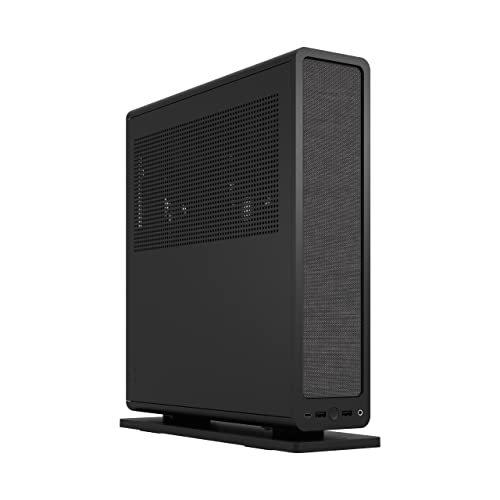
Fractal Design Ridge Black — Best console-style gaming case
The Ridge is the case that made the modern console-style gaming PC credible. Fractal Design took the flat, TV-stand silhouette seriously as a gaming platform rather than as a media-pc apology: a slim black enclosure designed to lie or stand in an entertainment unit while housing a build that plays current games properly. When builders in this genre say “the obvious choice,” this is the case they are describing — the reference against which every other flat gaming case is measured.
The Ridge also settled a question the genre had argued about for years: whether a flat gaming PC had to look like a piece of audio equipment to be welcome in the living room. Its answer — that a slim, quiet, honestly technological object earns its place by proportion rather than by disguise — moved the category’s centre of gravity. The HTPC cases elsewhere in this batch imitate hi-fi; the Ridge simply behaves like furniture, which is a more durable kind of welcome. Owners place it beside televisions costing ten times its price and the composition holds, because restraint scales in a way that imitation does not.
Its design intelligence is in the layout. The Ridge’s interior divides the shallow volume so the graphics card and the motherboard each get their own territory and their own air, which is how a case this flat cools components this serious without turning the TV stand into a wind tunnel. Standing vertically, it reads as a minimalist monolith beside the television; lying flat, it disappears into the stack. Either way, the room sees furniture and the owner gets a gaming PC — the genre’s founding bargain, executed with Fractal’s usual restraint.
The Ridge asks the genre’s standard homework in return: components chosen by measurement, a small-form-factor power supply planned into the budget, and a cooler selected for the clearance the case allows rather than the one a review site crowned. Builders who do that homework get the list’s most complete answer — the console-style build with the fewest apologies, equally at home under a television or standing on a desk where its slimness frees space a tower would eat.
- Form factor: Slim console-style (Mini-ITX class)
- Colour: Black
- Orientation: Horizontal or vertical
- Design family: Fractal Design Ridge
- Intended role: Living-room gaming PC
Strengths
- The reference flat gaming design, with an interior layout that gives the card its own air.
- Works lying in a TV stand or standing beside it, without looking improvised either way.
- Fractal’s restrained styling suits rooms that reject gaming-tower aesthetics.
Trade-offs
- Components must be chosen by measurement — cooler and card clearances are the plan, not a detail.
- Small-form-factor parts, including the power supply, carry their usual premium over ATX equivalents.
- Its flat interior rewards a single, finished build rather than continual parts swapping.
Best for: a living-room gaming PC that must live in or beside the TV stand. Not suited for: a frequently reconfigured test-bench build, because the Ridge’s flat, measured interior is designed for a finished machine rather than weekly component swaps.

Fractal Design Terra Jade — Best-looking flat PC
The Terra starts from a question the Ridge does not ask: what if the small PC were designed the way a chair or a lamp is designed — as an object whose materials and colour are the point? In Jade, the Terra is quite simply the most beautiful case in this guide, a compact small-form-factor design whose finish belongs to the world of interiors rather than of peripherals. It is the pick for the builder whose PC will sit in a considered room and is expected to hold its own there.
Beneath the surface, the Terra is a serious small-form-factor instrument, with an interior concept built around an adjustable spine that lets the builder trade space between the graphics card side and the cooler side — an elegant answer to the genre’s eternal millimetre negotiation. That adjustability makes the Terra unusually honest about the flat build’s central trade: you cannot maximise both the card and the cooler, so the case lets you choose your balance deliberately, per build, rather than fixing it at the factory.
It helps to understand what the Terra is reacting against. Small-form-factor cases spent a decade apologising for existing — black boxes designed to be hidden behind monitors, their makers assuming the owner’s highest wish was invisibility. The Terra’s wager is the opposite: a PC this small can be shown, the way a well-made speaker or a ceramic lamp is shown, and its Jade finish is the wager made visible. In a market of anonymous rectangles, that confidence is a design position, and it has quietly shifted what buyers expect from the whole category — the Ridge’s furniture manners owe something to the same realisation, arriving from the living-room side.
Choose the Terra when the build is a known quantity — this card, this cooler, this room — and when the object’s presence matters as much as its performance. It is not the case for sprawling storage, for the largest cards in existence, or for owners who rebuild seasonally. It is the case for the person who believes a computer can be a piece of furniture without ceasing to be a computer, and who will enjoy proving it every time a guest asks what the green object is.
- Form factor: Small form factor (Mini-ITX class)
- Colour: Jade
- Interior concept: Adjustable central spine
- Design family: Fractal Design Terra
- Intended role: Design-led compact builds
Strengths
- Furniture-grade design and colour that no other pick here attempts.
- Adjustable spine lets each build choose its own card-versus-cooler balance.
- Compact footprint suits desks and shelves where a tower would dominate.
Trade-offs
- The card-versus-cooler trade is real: maximum examples of both cannot coexist.
- Storage and expansion are compact-class — plan a lean component list.
- Its design premium buys beauty and engineering, not extra room.
Best for: a considered, design-first compact build for a room that notices objects. Not suited for: the largest graphics cards paired with tall coolers, since the Terra’s adjustable spine requires each build to divide a finite interior between the two.
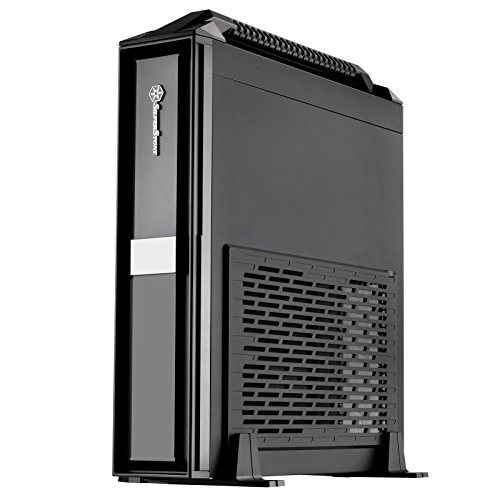
Silverstone Technology ML08B-H — Best for travel
The ML08B-H’s listing title contains the genre’s most practical word: handle. This slim Mini-ITX small-form-factor case was designed to be carried — to LAN gatherings, to a friend’s house for the weekend, between a dorm room and home, into the living room for game night and back to the desk afterwards. The handle transforms the console-style idea: not just a PC shaped for the TV stand, but a PC that visits TV stands.
Silverstone’s Milo line has served this portable-slim niche across many generations, and the ML08B-H shows the lineage’s lessons — a flat profile that slips into a bag or a car’s footwell, a layout that puts a real graphics card into a briefcase-class volume, and construction meant to be moved rather than merely admired. For students, competitors, and anyone whose gaming life happens in more than one postcode, it answers a question the furniture cases never ask.
There is a ritual dimension to the handled case that its owners treasure. A tower gamer arriving at a LAN brings a project; the ML08B-H’s owner arrives with a bag, sets the machine beside a screen, and is playing while the tower is still being unwrapped from its blanket. That ease changes the social life of the PC — it gets invited. Game nights, family visits, a second home’s television across a season: the handled slim case is the only gaming PC in this guide whose biography is written in journeys rather than in rooms, and for the right owner that biography is worth more than any specification on the list.
Portability taxes the build in familiar coin: components chosen for clearance, cooling planned for a case that will sometimes sit in less-than-ideal airflow — a friend’s carpeted floor is not a TV stand — and a protective routine for transport, because a carried PC meets doorframes. Owners who accept the taxes get something no tower can offer: the same machine, with the same library and saves, wherever the evening is happening. In a list of cases designed to sit beautifully, the ML08B-H is the one designed to arrive.
- Form factor: Slim Mini-ITX small form factor
- Feature stated in title: Handle (ML08B-H)
- Colour: Black
- Design family: Silverstone Milo ML08
- Intended role: Portable and LAN builds
Strengths
- The handle makes a genuine gaming PC a carry-it-anywhere object.
- Slim profile travels in bags and footwells that exclude every tower.
- Milo lineage brings generations of slim-layout refinement to the design.
Trade-offs
- A carried case needs transport care — it will meet the world’s doorframes.
- Slim clearances demand measured component choices, as with all flat cases.
- Its talents are wasted on a machine that will never leave one shelf.
Best for: a gaming build that travels — LANs, dorms, second homes and game nights elsewhere. Not suited for: a permanently installed media-room machine, because the Ridge and the Milo 12 serve a fixed TV stand with layouts optimised for staying put.

Silverstone Technology Milo 12 — Best slim performance
The Milo 12 — SST-ML12B — represents the Milo line’s modern, performance-minded end: its title promises a high-performance slim Mini-ITX enclosure, and that pairing of words is the genre’s frontier. Slim cases historically meant modest hardware; the Milo 12’s brief is to push a genuinely capable gaming build into the flat silhouette, for the owner who wants the TV-stand shape without the performance asterisk that used to come with it.
A word about what “high performance” honestly means in a slim enclosure, because the Milo 12’s title invites the question. It does not mean the absolute fastest components in existence — those belong to towers with radiators the size of briefcases. It means the flat build’s own frontier: a current, capable gaming configuration, cooled properly, at noise levels a living room accepts, in a case the width of a shelf. Judged against towers, that is a compromise. Judged against the room it serves — where the alternative is a console’s fixed hardware or no PC at all — it is the performance that matters, delivered in the only shape the room would accept. The Milo 12’s buyers understand that exchange, and the case respects them by not pretending the exchange is free.
Within Silverstone’s own range, the Milo 12 is where a builder lands when the ML09B’s compact classicism feels limiting and the Ridge’s furniture minimalism is not the house style. It keeps the Milo family’s shelf manners — slim, black, unobtrusive — while aiming its interior at stronger components and the cooling they require. The planning disciplines of the genre still apply in full: measure the card, measure the cooler, respect the airflow path. The Milo 12 simply raises the ceiling on what obedience to those disciplines can buy.
That makes it the connoisseur’s Silverstone pick — less famous than the Ridge, less specialised than the handled ML08, and arguably the most balanced expression of what its maker has learned across the Milo generations. If your console-style build’s shopping list starts with performance and ends with a case that can contain it gracefully, the Milo 12 is where the list and the shelf shake hands.
- Form factor: Slim Mini-ITX enclosure
- Model: SST-ML12B
- Positioning stated in title: High performance
- Design family: Silverstone Milo 12
- Intended role: Slim living-room performance builds
Strengths
- The Milo line’s performance flagship — slim shape, serious build brief.
- Keeps the family’s shelf manners while raising the component ceiling.
- A balanced middle path between compact classics and furniture minimalism.
Trade-offs
- Slim-case discipline applies fully: card and cooler are chosen by measurement.
- Less of a design statement than the Terra for rooms that want an object.
- No handle — it is built to live on its shelf, not to travel like the ML08B-H.
Best for: a performance-first slim build for the TV stand. Not suited for: a design-led desk setup, where the Terra’s furniture finish serves the room better than the Milo 12’s purposeful plainness.

Silverstone Technology Milo 11 — Best for office and theater
The Milo 11 widens the genre’s door: a slim and compact micro-ATX enclosure whose title names office and home theater as its intended territories. Micro-ATX is the quietly radical choice here. The boards cost less than Mini-ITX, offer more slots and ports, and free the builder from the small-form-factor premium that taxes every other pick in this guide — while the case stays slim enough for the shelf, the reception desk and the meeting room.
Consider the reception-area test, which the Milo 11 passes and most gaming hardware fails: a PC that clients, patients or customers see all day must communicate tidiness and calm, must not glow, whir or bristle with angles, and must keep working for years with minimal ceremony. The Milo 11’s slim enclosure and mainstream platform were practically drafted by that test. The same machine then goes home in spirit — the home-theater half of its title — because the living-room shelf asks for the same virtues in a different accent. Few cases in any category serve two rooms this different with one design; the Milo 11 does it by being, deliberately, the least dramatic object in this guide.
That combination redraws who the console-style PC is for. The Milo 11’s natural builds are the office machine that must not look like one, the home-theater front-end assembled from sensible parts, the small-business PC that sits in public view. Its slim enclosure keeps those machines furniture-quiet in appearance, and the micro-ATX platform keeps their budgets and expansion honest in a way the ITX picks cannot match. In a list dominated by gaming ambitions, the Milo 11 is the working machine — and there are more working machines in the world than gaming ones.
Its ceiling is the mirror of its virtue: this is not the case for a flagship graphics card or a showcase build, and its compact interior asks the usual measured planning for coolers and cards. But as the genre’s value-and-versatility answer — slim shape, mainstream platform, two named jobs done well — the Milo 11 may be the most broadly useful case in this entire guide.
- Form factor: Slim micro-ATX enclosure
- Positioning stated in title: Office or home theater
- Design family: Silverstone Milo 11
- Intended role: Work, media front-ends, public-facing PCs
- Colour: As listed
Strengths
- Micro-ATX platform avoids the Mini-ITX premium across board and parts.
- Slim, presentable shape suits offices and shelves where a tower looks wrong.
- Named versatility: one case serves office duty and home-theater duty equally.
Trade-offs
- Not a flagship gaming case — card and cooler ceilings are compact-class.
- Its plain working brief offers little for showcase-minded builders.
- Compact interior still requires measured component planning.
Best for: a slim office or home-theater PC built on affordable micro-ATX parts. Not suited for: a high-end living-room gaming build, because the Milo 11’s compact micro-ATX interior is drawn for sensible components rather than flagship cards.
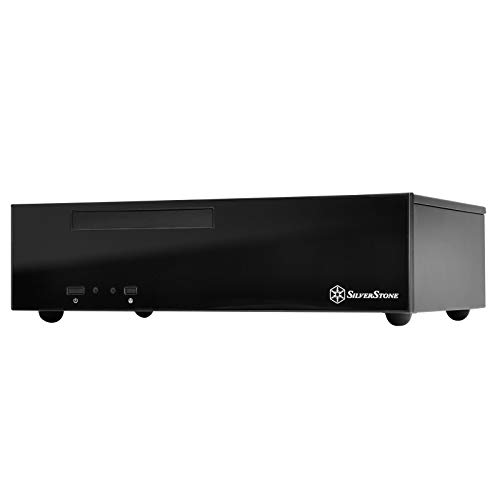
Silverstone Technology ML09B — Best compact classic
The ML09B is the Milo line’s compact classic: a small-form-factor Mini-ITX case whose listing title states SFX power-supply support — a small phrase that tells the experienced builder the case’s whole layout philosophy. SFX is the compact supply standard this genre runs on, and a case that names it is a case designed around the real dimensions of a slim build rather than adapted from a tower with fingers crossed.
There is a particular household the ML09B serves better than any flagship here: the one-PC-lighter household, where the second screen — a bedroom television, a study monitor, a child’s first desk — needs a real computer that takes no room and makes no fuss. A compact classic, bought once and reassigned as the household’s needs rotate, is the genre’s quiet workhorse, and its low profile is precisely what lets it fit the leftover spaces where second machines actually live. Not every case must aspire; some must simply fit, work and be forgotten, and the ML09B’s long Milo lineage suggests a great many households have asked exactly that of it.
As a design, the ML09B represents the genre before it became fashionable: slim, black, unpretentious, engineered to take a modest but complete Mini-ITX build and sit somewhere unobtrusive while it works. Its natural machines are the secondary PC, the media front-end, the compact desktop for a small room — builds whose owners value the space returned to them more than any specification. In a category increasingly about statements, the ML09B is content to be a solution.
Its honesty extends to its limits. This is the list’s most compact canvas, and it should be bought by builders whose component list is correspondingly lean — integrated graphics or a modest low-profile card, storage in small numbers, a cooler chosen from the low shelf. Asked to be that machine, the ML09B is dependable Milo engineering at the genre’s accessible end. Asked to be a flagship, it will decline — politely, and in millimetres.
- Form factor: Small form factor Mini-ITX
- Power supply stated in title: SFX support
- Colour: Black (ML09B)
- Design family: Silverstone Milo ML09
- Intended role: Compact media and desktop builds
Strengths
- Stated SFX support confirms a layout designed for genuine slim builds.
- The most compact footprint here — space returned to the room is its feature.
- Unpretentious Milo engineering at the accessible end of the genre.
Trade-offs
- The leanest component ceiling on the list: modest cards and low coolers only.
- Storage room is compact-class — libraries belong on a server or external drives.
- SFX supply and ITX platform carry the small-form-factor premium.
Best for: a lean, compact Mini-ITX build where space saved matters more than power. Not suited for: a large graphics card, because the ML09B’s compact slim interior and low-profile layout cannot house full-size gaming hardware.
How Do the Six Cases Compare Side by Side?
| Case | Platform | Defining trait | Natural setting |
|---|---|---|---|
| Fractal Design Ridge | Mini-ITX class | Reference flat gaming layout | TV stand, living room |
| Fractal Design Terra | Mini-ITX class | Jade furniture design, adjustable spine | Designed interiors |
| Silverstone ML08B-H | Mini-ITX | Handle for carrying | LANs, dorms, travel |
| Silverstone Milo 12 | Mini-ITX | High-performance slim brief | Performance TV-stand build |
| Silverstone Milo 11 | Micro-ATX | Office and home-theater brief | Work and media shelves |
| Silverstone ML09B | Mini-ITX | SFX support, compact classic | Small rooms, front-ends |
Read the list as a map of the genre’s territory. Fractal holds the design heights — gaming reference and furniture object. Silverstone holds everything else: travel, performance, work and value, in a Milo family whose depth no rival matches. The platform column hides the budget story: five Mini-ITX builds pay the small-form-factor premium for their shape, while the micro-ATX Milo 11 trades a little slimness for mainstream prices — the right trade for many real households.
What Must You Plan Before Building Flat?
Measurements, in an order that cannot be shuffled. Card first: length, height and thickness against the case’s stated clearances, including the riser arrangement flat cases use to lay the card along the body. Cooler second: height in millimetres against the case’s ceiling, with the Terra’s adjustable spine turning that figure into a negotiation you conduct deliberately. Power supply third: the SFX-class unit the ML09B’s title names is the genre’s standard, and it belongs in the budget from the first spreadsheet, not discovered at checkout.
Airflow planning is the flat build’s quiet art. With no vertical chimney, each component’s air must be given an entrance and an exit by layout: intakes where the case provides them, exhaust paths that do not recirculate into a closed TV cabinet, and a shelf arrangement that leaves the case’s vents the room they need. A console-style PC inside a sealed entertainment unit is a PC in an oven with good styling; leave the cabinet’s back open, or choose a ventilated stand, and the same build runs as its designer intended.
Cable planning shrinks with the case. There is no rear chamber to absorb optimism, so buy the cables the build needs at the lengths the build needs, route them along the case’s edges, and accept that the flat interior will show your work to anyone who opens it. The reward for the discipline is the genre’s signature satisfaction: a machine with nothing wasted in it, that slides into its shelf like a book into a shelf’s last gap.
How Do You Game Comfortably from a Console-Style PC?
The living-room layer deserves the same planning as the hardware. A controller-first setup — the machine waking to a game-library interface, navigable entirely from the sofa — is what makes a console-style PC feel like a console rather than like a desk that wandered in. Keep a compact wireless keyboard within reach for the exceptions, set the machine to sleep and wake with the television’s rhythm, and let the case’s quiet manners do the rest: a flat PC that can be forgotten between games is the genre working exactly as designed.
Display and audio handshakes are the other sofa-side details. The run from case to television should be a single, adequate cable rather than a chain of adapters; the audio path — television speakers, soundbar or receiver — should be decided once and left alone. None of this is case shopping, but all of it is console-style ownership, and the builders who plan it are the ones whose flat PCs get used nightly instead of admired occasionally.
What Mistakes Do First-Time Flat Builders Make?
The first is ordering components by reputation and discovering clearances by collision — in this genre, the tape measure outranks the review score. The second is forgetting the power supply’s form factor until the ATX unit in the parts bin meets the SFX-shaped hole. The third is sealing the case in furniture: a beautiful flat build inside a closed cabinet, throttling politely through every summer evening. The fourth is buying the Terra for its looks and a flagship card for its benchmarks without checking whether the spine’s negotiation can honour both ambitions.
A sixth mistake belongs to the shopping phase rather than the build: choosing the case by photograph alone, without checking it against the television stand’s actual shelf in the actual room. Photographs flatter proportions; a case that looks slim beside a monitor in a studio shot may be deeper than the stand it must live on, or taller than the shelf gap between the television and the soundbar. The genre’s dimensions are its destiny, and the only photograph that matters is the one your own room takes after delivery — arrange, with the tape measure, for it to be a flattering one.
The fifth mistake is subtler — treating the finished build as a first draft. Flat cases reward commitment: they are at their best as finished machines, opened rarely, their interiors composed once and well. Builders who love weekly tinkering should keep a bench tower for the hobby and let the console-style machine do its one job beautifully, the way the consoles it imitates do.
Why Does a Riser Cable Decide So Much in a Flat Build?
Open a console-style case and the component doing the conceptual heavy lifting is a cable most tower builders never meet: the riser. To lay a graphics card flat along the case’s body — parallel to the motherboard instead of perpendicular to it — the card’s connection to the board is extended by a flexible riser, and that single part determines the build’s geometry. It is why the Ridge can be a hand’s breadth thick while holding a serious card, and why the Terra’s spine can offer its space negotiation at all. The flat form is, in a literal sense, built around a ribbon.
The riser deserves respect at purchase time. It must match the PCIe generation the board and card will negotiate, because a riser that trains the link down a generation can cost real performance with fast cards and storage-adjacent workloads; it must be routed without sharp folds, since the ribbon’s conductors dislike creases; and it should be treated as part of the case’s engineering rather than as an accessory to be substituted casually. The good news is that the makers in this guide design their layouts around quality risers — the part is specified as carefully as the steel. The builder’s job is simply not to undermine it: no forcing, no folding, no swapping in a bargain ribbon of unknown pedigree because it was nearer to hand.
There is a maintenance corollary worth knowing before you build. In a flat case, the card sits on the riser rather than in a slot, so card swaps are a slightly more deliberate operation — panels off, riser handled with the care a ribbon deserves, clearances re-measured for the new card’s dimensions. It is not difficult; it is merely not casual. Owners who change cards annually adapt quickly. Owners who change cards monthly keep a tower for that habit, and let the flat machine be the finished object it wants to be.
How Does Heat Actually Leave a Case Lying Flat?
Towers cheat with physics: hot air rises, so a tower’s layout mostly supervises a journey the air wanted to take anyway. A flat case gets no such assistance, and its designers answer with compartmentalisation. The Ridge’s approach — separate territories with separate air for board and card — is the genre’s signature move: each hot component breathes from its own intake zone and exhausts without warming the other’s supply. The Milo cases pursue the same goal through vent placement refined across generations, which is why the family’s longevity matters; airflow in a shallow box is learned, not guessed.
The shelf completes the system, and it is the half owners control. A flat case exhausts sideways and upwards through its panels, so the furniture must offer those directions an exit: an open-backed stand, a cabinet with ventilation slots, or simple open air on a media console. Given that exit, a console-style build’s temperatures settle into comfortable territory and stay there across a long session. Denied it, the case recirculates its own exhaust in a slowly warming loop, and no internal layout can rescue physics. This is why the guide repeats the furniture advice in every article of this batch’s family: in flat computing, the room is a component.
Fan behaviour in a shallow case also has its own character. The fans are necessarily smaller or thinner than tower fans, and a small fan asked to move air quickly makes a higher-pitched sound than a large fan moving the same air slowly. Good flat builds therefore run their fans against temperature curves tuned for the room — gentle at menu screens and video playback, purposeful in games, never frantic — and components are chosen with the same ear: a card whose cooler is content at moderate fan speeds is worth more in a TV stand than a theoretically faster card that must shout to stay cool. Silence, in this genre, is a specification you assemble from choices, and the case is only one of them.
Console or Console-Style PC — What Does the Flat PC Do Differently?
The honest comparison flatters both. A games console is an appliance: it wakes instantly, updates itself, plays its library with zero configuration, and asks nothing of its owner for a hardware generation. A console-style PC is a computer wearing the appliance’s shape: it needs the usual PC care — drivers, launchers, the occasional settings menu — and in exchange it offers what no console can. The library is yours across decades and storefronts. The settings are yours, frame by frame. The machine upgrades in pieces, on your schedule, and doubles as the household’s media player, workstation and server whenever the games are off.
The cases in this guide exist to narrow the appliance gap from the hardware side. A Ridge under the television, waking with the screen and controlled from the sofa, delivers most of the console experience while keeping the PC’s freedoms intact — and the remaining gap is software, which the owner closes once, at setup, with a controller-friendly interface and disciplined sleep settings. What the flat PC will never be is sealed and single-purpose, and its owners should count that as the feature it is: the ML08B-H can be carried to a friend’s house and opened for a repair on their kitchen table; the Milo 11 can retire from the theater shelf to a desk job. Consoles are replaced. These machines are reassigned.
Cost honesty completes the comparison. A console-style build costs more than a console and, part for part, a little more than the same PC in a tower — the small-form-factor premium again. What the premium buys is placement: the best screen in the house, the sofa, the room where people actually gather. Judged as a computer, the flat build is a tower with constraints. Judged as the machine that brings a PC library to the room that matters, it has no tower-shaped rival at all.
How Long Does a Console-Style Build Stay Current — and What Gets Upgraded?
The flat build’s upgrade story is narrower than a tower’s and, for most owners, sufficient. The graphics card is the upgrade that matters — it is where gaming years are bought — and every gaming pick here was chosen with a successor card in mind: the discipline is simply that the new card must pass the same measurement test as the old one, in length, thickness and power appetite. The power supply’s ceiling, set on build day, is the quiet governor of that story, which is why experienced flat builders buy the SFX unit with headroom rather than the one that merely covers today’s list.
Storage and memory upgrade on the motherboard’s terms, which in Mini-ITX form means planning the board’s slots as a finite resource: the fast drive you install first will likely be joined by exactly one companion, not three. Micro-ATX, in the Milo 11, relaxes that arithmetic a little — one of its unglamorous advantages. The processor is the upgrade flat builders make least often, because cooler clearances bind the choice and because the genre’s machines are usually GPU-led. None of this is a flaw in the form; it is the form’s contract, visible in advance, and the cases above state its terms honestly in their dimensions.
What the flat build offers in place of endless upgradability is longevity of role. A console-style machine that ages out of front-line gaming does not become e-waste with a handle or a Jade finish — it becomes the household’s media PC, the second room’s machine, the office’s presentable desktop, exactly the migrations the Milo line’s variety anticipates. Towers get parted out. Flat machines get inherited. Plan the first build well, and the case you choose from this list may serve three roles across a decade, which reframes its price rather handsomely.
What Does a Flat Build Sound and Feel Like in Daily Use?
Daily life with a console-style PC has a texture towers never develop. The machine is within arm’s reach of the sofa, so its manners are personal: the soft click of wake, a fan voice that stays beneath the television’s, a power light that does not interrogate the room during a night scene. Owners tune these things once and then forget them, which is the goal — the flat PC’s triumph is to be experienced as part of the furniture’s behaviour, like a good receiver, rather than as a computer that happens to be nearby.
The genre also changes how a household shares a PC. A tower in a study belongs to whoever sits at the desk; a flat machine under the television belongs to the room, and rooms are communal. Game libraries get browsed by visitors, media gets played by whoever holds the remote, and the machine accumulates the household’s shared history in a way a personal tower never does. Several picks here seem designed by people who understood that social fact — the Milo 11’s office-and-theater double life, the ML08B-H’s willingness to be carried to wherever the people are. The console shape is not only a dimension. It is an invitation, and rooms respond to it.
Final Recommendation
For the living-room gaming brief, the Fractal Ridge is the reference answer, and the Milo 12 is its performance-minded Silverstone counterpart. The Terra is the choice when the room’s design matters as much as the frame rate; the ML08B-H when the machine must travel; the Milo 11 when micro-ATX value and office manners matter; and the ML09B when compact and lean is the whole brief. Measure everything, plan the air, and the flat machine you build will earn the compliment this genre lives for — a guest, halfway through the evening, asking which console that is, and not believing the answer — that the slim black shape under the screen is a full computer, upgradeable, personal and quietly more capable than the console it impersonates, is the moment the flat build’s whole argument lands at once.
Frequently Asked Questions
Can a console-style PC really play modern games well?
Yes — the Ridge and Milo 12 exist precisely to house genuine gaming builds in a flat shape. The limits are physical, not conceptual: the card and cooler must fit the case’s clearances, and the shelf must let the case breathe. Within those two disciplines, performance is a component choice, not a form-factor tax.
Why do these cases use SFX power supplies?
Because a full-size ATX supply would consume the interior volume that makes the flat shape possible. SFX is the compact standard the genre is designed around — the ML09B states SFX support in its title — and it should be budgeted as part of the build from the start.
Which pick is best for a small apartment?
The ML09B for the smallest footprint, or the Milo 11 if the machine must also be the household’s general PC on a micro-ATX budget. Both return desk and shelf space that a tower would claim, and both stay visually quiet in a room that serves several purposes.
Is the Terra’s adjustable spine difficult to use?
No — it is a deliberate, set-once adjustment made during assembly, dividing the interior between the graphics card side and the cooler side. Its purpose is to let each build choose its own balance; once the components are chosen, the correct position follows from their measurements.
Can I carry the ML08B-H on a plane or to a LAN?
That is what its handle is for. Treat it as you would any valuable equipment — a padded bag, sensible handling, and a check that internal components are secured before travel. Its slim profile is designed for exactly this life, unlike a tower pressed into service as luggage.
Can a console-style case stand vertically instead of lying flat?
Several can — the Ridge is designed to work in both orientations, reading as a slim monolith when stood beside a television. Check the specific case’s intended orientations and its vent layout before standing it up, since a case whose intake lives on what becomes the bottom face will not thank you for the improvisation.
What size television stand shelf do these cases need?
Measure the shelf’s height and depth against the case you choose, and leave air room around the vents — the flat designs are compact, but they are not zero-clearance appliances. The slim Milo models fit the tightest shelves; the gaming-class Ridge and Milo 12 deserve a shelf that lets their side vents breathe freely.
Do flat cases run hotter than towers?
They run differently: without a vertical chimney, airflow must be escorted by layout, and the shelf must not trap heat. A well-planned flat build with a ventilated stand runs comfortably; the same components sealed in a closed cabinet will struggle in any case shape.
Related Guides
Continue with our guides to small form factor power supplies explained, low-profile CPU coolers for slim builds and living-room gaming PC setups, each written for builders who measure before they order, because in the flat and the slim, the millimetre is the unit of honesty — the difference between a machine that slides into its shelf and sings, and a beautiful case waiting on a part that will never fit, is almost always a number somebody estimated instead of checking.


