What's inside
- Key Takeaways
- Quick Picks
- How did we sort the locks before the phones for this guide?
- How do the six prepaid phones line up on lock, bundle and storage?
- What does a network lock actually prevent, day to day?
- How should a household read a bundled year of service?
- Which prepaid habits waste the most money?
- How does activation day actually unfold for a prepaid phone?
- When is the unlocked route worth its extra homework?
- What should be written down before the old phone is retired?
- Final Recommendation
- Frequently Asked Questions
- Related Guides
As an Amazon Associate I earn from qualifying purchases. This post may contain affiliate links at no extra cost to you.
gizmoverdict.com is reader-supported. When you buy through links on our site, we may earn an affiliate commission.
Where to buy: The six handsets below are current Amazon listings for prepaid service — five of them sold locked to the prepaid network named on the box, and one fully unlocked phone that can carry a pay-as-you-go SIM from several networks.
There is a particular calm to the best smartphones that are pay as you go, and it has nothing to do with the handsets themselves. It is the calm of paying in advance: the month of calls, messages and data is bought before it is used, the spending stops being a bill that arrives as a surprise and becomes a decision made deliberately at a counter or on a screen. No contract stretches ahead, no early-exit penalty lurks in the small print, and when life changes — a move, a quieter season, a tighter budget — the arrangement can shrink or pause with it.
That calm comes with one piece of vocabulary that decides everything else in this guide: locked. Five of the six phones below are sold locked to a specific prepaid network, and their listing titles say exactly which one and, in the most important case, what the phone is not. A handset locked to Verizon Prepaid is not a Verizon phone in the general sense; one of these listings states in capital letters that it is not compatible with Verizon’s postpaid service. A Tracfone handset belongs to Tracfone’s world of airtime cards and bundled minutes. None of this is a defect — the lock is precisely why these phones are sold the way they are — but it must be understood before money changes hands, because a locked phone on the wrong network is not a bargain at any price.
The sixth pick breaks the pattern on purpose. The Nokia G100 is an unlocked phone whose title names three major networks, and it represents the other way of living pay as you go: own the handset outright, then buy prepaid service for it wherever the coverage and the month’s budget point. Both philosophies are represented here because both are legitimate, and the right one depends on whether you value the simplicity of a phone and its service arriving as one package, or the freedom to move the service while keeping the phone. Neither answer marks a household as savvy or naive; prepaid serves both temperaments well, which is more than the contract world ever offered.
Our Top Picks
Key Takeaways
- Locked means loyal: each locked pick here works only on the prepaid network its title names.
- The Verizon Prepaid Moto G Play listing explicitly excludes Verizon postpaid service — prepaid and postpaid are separate worlds.
- Two Tracfone picks bundle a year of service allowances with the handset, changing the true first-year cost.
- The TCL K33’s listing states a 365-day network lock alongside its bundled first-year plan.
- The Nokia G100 is the unlocked route: one handset, prepaid service from whichever named network suits.
- Storage is 64GB on the Moto and TCL picks and 128GB on the Samsung and Nokia picks — check before photographs pile up.
Quick Picks
| Pick | Badge | Why it earns its place |
|---|---|---|
| Verizon Prepaid Motorola Moto G Play 2026, 64GB (Locked to Verizon Prepaid) | The Verizon Prepaid starter | A 120Hz display and a 5100mAh battery inside Verizon Prepaid’s walled garden, with the lock stated plainly. |
| Tracfone Motorola Moto G Play 2026 5G, 64GB Storage (Locked to Tracfone) | The Tracfone twin | The same Moto formula pointed at Tracfone’s airtime ecosystem instead, quad-pixel camera included. |
| Tracfone Samsung Galaxy A16 5G SmartPhone | The year-included Samsung | Galaxy hardware with 128GB of storage and a bundled year of minutes, texts and data in the box. |
| Verizon Prepaid Samsung Galaxy A16 5G, 128GB (Locked to Verizon Prepaid) | The Verizon Prepaid Samsung | A Super AMOLED screen and a 50MP triple camera for households committed to Verizon Prepaid. |
| Tracfone TCL K33 5G Prepaid Smartphone, 64GB, 13MP Camera-Locked to Carrier | The big-screen Tracfone | TCL’s 6.75-inch NXTVISION display with a first-year plan folded into the activation promotion. |
| Nokia G100 | The unlocked escape hatch | An unlocked handset naming Verizon, T-Mobile and AT&T, with a three-day battery claim and 128GB aboard. |
How did we sort the locks before the phones for this guide?
The first sort was not by screen or camera but by allegiance. Each candidate’s title was read for its lock status, its network, and any service bundled into the box, because in prepaid those three facts decide whether the phone can be used at all, while a camera can only decide how well. Two phones that look identical on a shelf — and this guide contains a near-matching pair of Moto G Plays — turned out to belong to different service universes, and presenting them as interchangeable would have been the easiest way to waste a reader’s money.
Bundled service was weighed as part of the handset rather than as a footnote. A phone that arrives with a year of minutes, texts and data already attached is a different purchase from a bare handset that needs a plan chosen and bought on day one, even before any prices enter the discussion. The listings’ own figures for those bundles are quoted exactly as printed, and where a title is silent — about RAM, for instance, on several of these prepaid models — the spec boxes say so instead of estimating. Prepaid shoppers are, by temperament, people who like knowing exactly what a thing commits them to; this guide tries to honour that temperament in every paragraph.
One further sorting principle deserves stating, because it explains the guide’s shape: no pick was rewarded for being unlocked or punished for being locked. The two conditions serve different households, and a guide that treated freedom as automatically superior would mislead the many readers for whom a bundled, locked, single-decision phone is the genuinely better tool. Each pick below is therefore judged inside its own philosophy — the locked phones on the clarity of their terms and the quality of their hardware, the unlocked Nokia on the breadth of its welcome — and the final recommendation sorts readers by temperament rather than declaring a single winner.

Verizon Prepaid Motorola Moto G Play 2026, 64GB (Locked to Verizon Prepaid) — The Verizon Prepaid starter
Start with the warning, because Motorola’s listing does: this Moto G Play 2026 is locked to Verizon Prepaid, and it is not compatible with Verizon postpaid. That second clause is the one that catches households out. A family with a long-standing Verizon contract account cannot add this phone to it, however familiar the logo on the box looks; prepaid and postpaid at the same carrier are parallel services with separate tills. Buy this handset as the front door to Verizon’s prepaid service specifically, and it makes complete sense. Buy it as a cheap Verizon phone in general, and it makes none.
Inside that boundary, the specification is cheerfully modern for the prepaid shelf. The title lists a 6.7-inch HD+ display refreshing at 120Hz, which is the kind of smoothness once reserved for far grander phones, and it makes the daily scroll through messages and news feel unhurried rather than stuttering. A 32MP camera handles the photographic duties, 64GB of storage holds the essentials with room for a sensible photo library, and the 5100mAh battery is generously sized for a handset whose owner may not charge on a religious schedule. It is a 5G phone, so it speaks the current network language on the service it belongs to.
The household this suits best is one already decided on Verizon Prepaid — perhaps for its coverage on a particular commute or in a particular valley — and wanting the phone and the service to arrive as one uncomplicated decision. There is no carrier shopping left to do after this purchase, no compatibility matrix to decode, and that finality is itself a feature for anyone who finds the modern phone market exhausting. What must be checked before ordering is simply that the decision is real: prepaid, Verizon’s prepaid, for the foreseeable life of the handset.
One more scene is worth picturing before the box is opened. This is the phone that gets handed to a teenager as a first handset on a service the parents control month by month, or carried by a tradesperson whose work number should never touch the family contract. In both scenes the lock reads differently: not as a restriction but as the boundary that keeps the arrangement clean, the spending prepaid and the number separate. The Moto’s hardware — smooth screen, big battery, honest camera — is modern enough that neither carrier of it feels they drew the short straw, which is exactly what a boundary phone needs to be.
- Lock status: locked to Verizon Prepaid, per the listing title
- Explicit exclusion: not compatible with Verizon postpaid, stated in the title
- Display: 6.7-inch HD+ at 120Hz, per the title
- Camera: 32MP, per the title
- Storage: 64GB, per the title
- Battery: 5100mAh, per the title; RAM is not stated in the listing title — verify on the listing page
Strengths
- Lock terms printed with unusual bluntness, postpaid exclusion included
- 120Hz display smoothness at the prepaid end of the market
- Large battery for an owner who charges opportunistically
Trade-offs
- Useless on any other service, including its own carrier’s contract side
- 64GB asks for occasional photo housekeeping
- RAM figure requires a separate check on the listing page
Best for: a household committed to Verizon Prepaid that wants phone and service settled in one box
Not suited for: a spare line on an existing Verizon contract account, which this handset refuses by design
The lock wording deserves one last read before checkout, in the listing’s own words: review the Moto G Play 2026 prepaid listing slowly.

Tracfone Motorola Moto G Play 2026 5G, 64GB Storage (Locked to Tracfone) — The Tracfone twin
Hold this phone beside the pick above and the family resemblance is total: same Moto G Play 2026 name, same 6.7-inch 120Hz HD+ display family, same 5100mAh battery figure, same 64GB of storage. Then read the titles again and the resemblance ends, because this one is locked to Tracfone. The two handsets are a standing lesson in prepaid shopping — the hardware is the least important part of the purchase, and the network named in the title is the product. Anyone who has ever bought the right phone for the wrong service has learned this lesson at a returns counter.
Tracfone’s world runs on a different rhythm from the big prepaid brands. Its appeal has always been to lighter, steadier users: the phone that lives in a glovebox or a kitchen drawer, the second line for a small business, the first phone for a teenager whose usage is still being negotiated. Service is bought in chunks of minutes, texts and data with their own service days, and the ecosystem rewards people whose usage is modest and predictable. This Moto brings that world a thoroughly current handset — 5G connectivity, a quad-pixel 32MP camera that bins pixels for brighter everyday shots, and a screen that would not embarrass a phone sold through far more fashionable channels.
Choosing between this pick and its Verizon Prepaid twin is therefore not a hardware decision at all. It is a decision about which service’s coverage reaches the places the phone will actually live, and which service’s way of selling airtime matches the household’s habits. Answer those two questions honestly and the twin picks sort themselves. What neither twin offers is an exit: both are locked, both stay loyal, and both should be bought with the same clear-eyed commitment you would bring to choosing the service itself — because that is, in truth, what you are choosing.
Tracfone also has a particular social footprint worth knowing about: it is the service of grandparents’ kitchen-drawer phones, of hunting cabins and spare cars, of numbers that have stayed the same for a decade because the service made keeping them cheap. A household joining that world with this Moto is buying into a mature, unhurried ecosystem whose airtime cards hang in every supermarket in America. The handset being thoroughly modern — 5G, a fast screen, a battery that shrugs off a weekend — quietly upgrades that world without asking its citizens to change their habits, and there is real design wisdom in that restraint.
- Lock status: locked to Tracfone, per the listing title
- Display: 6.7-inch HD+ at 120Hz, per the title
- Camera: 32MP quad pixel, per the title
- Storage: 64GB, per the title
- Battery: 5100mAh, per the title
- Service style: Tracfone airtime ecosystem; RAM is not stated in the listing title — verify on the listing page
Strengths
- Current 5G hardware inside Tracfone’s light-usage ecosystem
- Quad-pixel camera aimed at brighter everyday photographs
- Same generous battery and smooth display as its prepaid twin
Trade-offs
- Tracfone lock is absolute for the phone’s working life
- Airtime-chunk service suits light users better than heavy streamers
- Nearly identical name to a phone locked to a different network
Best for: a light, steady user whose life fits Tracfone’s airtime rhythm
Not suited for: heavy daily data use, which Tracfone’s chunk-based service serves poorly
Given the twin problem, read the network name in the title one final time before ordering: confirm the Tracfone Moto G Play listing.

Tracfone Samsung Galaxy A16 5G SmartPhone — The year-included Samsung
This listing changes the prepaid calculation by folding the first year into the box. The title describes the Galaxy A16 5G with 128GB of storage, sold as an activation promotion bundled with 1500 minutes, texts and data for 365 days of service, locked to the carrier. Unpack that slowly. The handset is a current Samsung with double the storage of the Moto picks above. The service is a year of allowances sized for a light, traditional pattern of use — calls and messages first, data as a seasoning rather than a staple. And the lock is the lock: Tracfone’s network, for keeps.
For the right household, that bundle is a small masterpiece of simplicity. Consider the phone bought for a parent who calls daily, texts the family thread, and uses data the way earlier generations used a road atlas — occasionally, and mostly to settle an argument. A year of that life is inside the box; there is nothing to shop for, nothing to set up beyond activation, and no monthly decision to revisit until the year turns. Gift-givers in particular should note the shape of this purchase: it is one of the very few phones that can be given complete, with its running costs for a full year already settled.
The discipline is to read the allowances as a budget rather than a slogan. Fifteen hundred minutes across a year is a gentle ration for a devoted daily caller, and the data allowance will not carry a streaming habit; households should match the bundle to the person with the same honesty they would bring to any prepaid arithmetic. What the bundle cannot be accused of is hiding: the figures are in the title, the lock is in the title, and the phone underneath is a respectable Samsung with room for photographs. Buy it with eyes open and it delivers exactly the year it describes.
There is a calendar habit that makes this bundle sing: activate it at a natural boundary. A phone given at Christmas and switched on that week carries its included year to the following Christmas; a phone bought for a school year in September runs to the next September. Bundles reward households that think in seasons, because the renewal conversation then arrives at a moment when the family is already gathered and already reviewing the year. Set a reminder a month before the year turns, compare how the allowances were actually used, and the second year’s decision — repeat, top up differently, or move networks with a new handset — becomes a five-minute conversation instead of a lapsed-line emergency.
- Lock status: locked to carrier (Tracfone), per the listing title
- Bundled service: 1500 min/text/data for 365 days of service, as stated in the title
- Storage: 128GB, per the title
- Model: Samsung Galaxy A16 5G, per the title
- RAM: not stated in the listing title — verify on the listing page
- Role: the complete first year in a single purchase
Strengths
- First year of light service included, ending plan-shopping at the box
- 128GB of storage, double the Moto picks in this guide
- Samsung’s familiar interface and support ecosystem
Trade-offs
- Bundled allowances suit light use; heavy callers will outrun them
- Tracfone lock leaves no network alternative
- Year two needs a fresh service decision and purchase
Best for: a gift phone whose first year of service should arrive already settled
Not suited for: a heavy talker or streamer, who will exhaust the bundled allowances early
Bundle terms are the whole product here, so read them in the seller’s own wording: open the Tracfone Galaxy A16 bundle listing.
Verizon Prepaid Samsung Galaxy A16 5G, 128GB (Locked to Verizon Prepaid) — The Verizon Prepaid Samsung
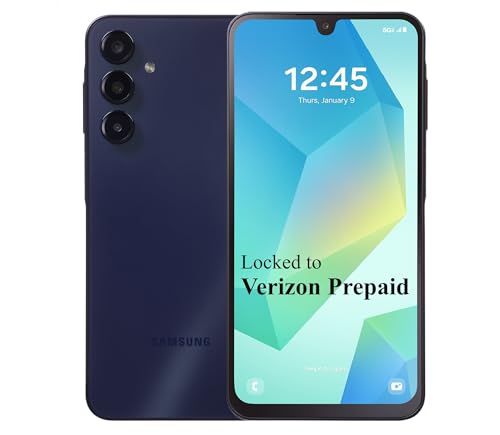
Same Galaxy name as the pick above, different universe — this A16 5G wears Verizon Prepaid colours, and its title spends its words on hardware rather than bundles. The headline is the screen: a 6.5-inch FHD+ Super AMOLED panel refreshing at 90Hz, which is the most refined display in this guide by a comfortable distance. Prepaid phones are not supposed to look like this; the deep contrast and fine resolution make photographs, maps and video calls visibly richer than the HD+ panels around it, and anyone who reads a great deal on their phone will feel the difference in the first evening.
The camera claim is the other headline: a 50MP triple camera, where the Moto picks make do with single main sensors in the low thirties. Triple here means flexibility — a main camera for the everyday, support lenses for the wider scene and the closer detail — and 50MP means photographs that survive being cropped when the grandchild was further away than the moment allowed. Storage matches the Tracfone Samsung at 128GB, the battery is described in the title only as long-lasting, and the lock is stated without decoration: locked to Verizon Prepaid. As with its Moto stablemate, that means Verizon’s prepaid service specifically, chosen deliberately.
This is the pick for the household that has already settled the network question in Verizon Prepaid’s favour and now wants the best handset that world offers in this guide. The absence of a bundled year is the honest difference from the Tracfone Samsung: service here is bought separately, on Verizon Prepaid’s own terms, which suits households whose usage is heavier or less predictable than a fixed bundle assumes. Hardware people and service people will choose differently between these two A16s, and both will be right — which is precisely why the guide presents the lock before the phone in every single review.
The display deserves one more paragraph, because it changes who this phone is for. FHD+ resolution on a 6.5-inch panel means small text stays crisp rather than fuzzy, which matters to anyone reading long articles, following a recipe thread or reviewing photographs for the one worth framing. Super AMOLED’s contrast does similar work outdoors, where prepaid phones so often live — on sidelines, in gardens, at bus stops. Among locked handsets in this guide, this is the only screen that competes with phones sold far outside the prepaid aisle, and for a reader-heavy household that single fact can settle the choice between the two Samsung A16s before the bundle question is even asked.
- Lock status: locked to Verizon Prepaid, per the listing title
- Display: 6.5-inch FHD+ Super AMOLED at 90Hz, per the title
- Camera: 50MP triple camera, per the title
- Storage: 128GB, per the title
- Battery: described as long-lasting in the title; capacity figure not stated — verify on the listing page
- Bundled service: none stated in the title; service is arranged on Verizon Prepaid separately
Strengths
- Finest display in this guide, with AMOLED contrast and FHD+ detail
- 50MP triple camera outclasses the single-sensor prepaid norm
- 128GB of storage matches the roomiest locked picks here
Trade-offs
- No service bundled, so day one needs a Verizon Prepaid arrangement
- Verizon Prepaid lock excludes every other network
- Battery capacity must be confirmed on the listing page
Best for: a committed Verizon Prepaid household that reads and photographs a lot
Not suited for: anyone wanting the first year of service included in the box
Screen claims are worth seeing in the full listing context: look over the Verizon Prepaid Galaxy A16 listing.

Tracfone TCL K33 5G Prepaid Smartphone, 64GB, 13MP Camera-Locked to Carrier — The big-screen Tracfone
TCL builds televisions for a living, and the K33’s title leads with the screen that heritage produces: a 6.75-inch NXTVISION display, the largest panel in this guide, on a 5G prepaid handset with 64GB of storage. For an owner whose phone doubles as the household’s window on photographs, video calls and the evening news, those extra fractions of an inch are not decoration — they are the difference between squinting at a grandchild’s recital video and simply watching it. TCL’s display tuning has always aimed at comfortable viewing over laboratory bragging rights, and that aim suits this audience exactly.
The service arrangement mirrors the Tracfone Samsung’s shape with different numbers, and the title prints them for anyone willing to read: the activation promotion includes a one-year plan of 1500 minutes, 1500 texts and 1.5GB of data, and the phone carries a 365-day network lock. Note the data figure in particular. One and a half gigabytes across a year is a whisper of data — enough for messages with photographs, maps and the occasional lookup, nowhere near enough for video habits. This bundle describes a phone that is primarily a telephone, with the internet as an occasional guest, and it should be bought by a household that recognises itself in that description.
The camera, at 13MP, is the plainest in this guide, and the review will not dress it up: it records the moment honestly rather than beautifully, which for this phone’s intended life — calls, messages, the odd photograph of a receipt or a grandchild at close range — is a fair trade against the screen and the included year. Judge the K33 as a package: the biggest window in the guide, a year of light service folded in, a full year of network lock stated upfront. Households that want exactly that package will find it coherent; households that want any single element changed should look at the picks around it.
Picturing the K33’s owner clarifies its design better than any benchmark. This is the phone on the kitchen counter during a long video call with grandchildren interstate, propped against the fruit bowl, its big screen doing the work a small tablet would otherwise be fetched for. It is the phone read in bed without glasses-hunting, the phone whose owner answers calls and sends photographs and otherwise asks the internet for very little. TCL sized the screen for that life and priced the bundle for it too. Phones designed around an honest portrait of their owner tend to be kept longer, and a prepaid phone kept longer is, by the arithmetic of this entire guide, the cheapest phone of all.
- Lock status: locked to carrier (Tracfone), with a 365-day network lock stated in the title
- Bundled service: one-year plan with 1500 minutes, 1500 texts and 1.5GB data, per the title
- Display: 6.75-inch NXTVISION, per the title
- Camera: 13MP, per the title
- Storage: 64GB, per the title
- RAM and battery: not stated in the listing title — verify on the listing page
Strengths
- Largest display in the guide for photographs and video calls
- First-year plan included, with its figures printed in the title
- Lock duration stated as plainly as the lock itself
Trade-offs
- Bundled data is minimal — a telephone’s ration, not a streamer’s
- 13MP camera is the most modest here
- 365-day lock commits the household for the full first year
Best for: a calls-first owner who wants the biggest, easiest screen to look at
Not suited for: anyone whose phone is their main way of watching video
The data figure is the detail to sit with before deciding: read the TCL K33 activation promotion closely.

Nokia G100 — The unlocked escape hatch
After five phones that each belong to exactly one network, the Nokia G100 reads like a change of weather. Its title calls it an unlocked smartphone, names Verizon, T-Mobile and AT&T as its territories, and thereby describes the other prepaid philosophy in full: the handset is yours outright, and the pay-as-you-go service is a separate, replaceable decision. Move house, change networks, hand the phone to a relative on a different carrier — the handset follows the household instead of anchoring it. For readers who found the locks above claustrophobic, this is the door out.
The hardware underneath that freedom is quietly well-judged for the prepaid life. The title claims a three-day battery, the kind of endurance that forgives the glovebox phone, the travel phone and the owner who charges when they remember rather than when the icon turns red. Storage is 128GB with 4GB of RAM — the only pick in this guide whose title states a RAM figure at all — across a 6.52-inch screen, with a 13MP triple camera and Android 12 doing the daily work in the Polar Night finish. Nothing here chases fashion; everything here chases the week-long practicalities of a phone that must simply be ready.
The honest caveats are about vintage and verification. Android 12 dates the design, so this is not the handset for someone counting on many years of platform novelty, and an unlocked phone always carries one duty the locked picks remove: confirming that the specific prepaid service you intend — especially a smaller carrier borrowing a big network’s towers — will activate this exact handset. That check takes minutes and the title’s three named networks give it a strong start. In exchange, the G100 offers what nothing else in this guide can: a prepaid life with the handset and the service free to evolve separately, which for many households is the entire point of going pay as you go.
Nokia’s name carries a particular resonance in the prepaid world, and it is earned rather than nostalgic: the brand’s identity was built on phones that survived years of unglamorous service. The G100’s specification reads in that tradition — battery endurance before thinness, storage before spectacle, a triple camera that covers the basics without theatre. Households buying a phone to be forgotten about, in the best sense, will recognise the intent. Pair it with whichever prepaid service currently covers the household’s roads best, and revisit that pairing once a year; the handset’s whole argument is that the revisiting is allowed.
- Lock status: unlocked, per the listing title
- Networks named in the title: Verizon, T-Mobile and AT&T
- Memory: 4GB RAM and 128GB storage, as stated in the title
- Battery: three-day battery claim, per the title
- Display and camera: 6.52-inch screen; 13MP triple camera, per the title
- Software: Android 12, US version, per the title
Strengths
- Freedom to change prepaid service without changing handsets
- Three-day battery claim suits forgetful charging habits
- Only title here that states its RAM figure openly
Trade-offs
- Android 12 vintage limits its novelty horizon
- Activation on a chosen prepaid service must be confirmed by the household
- Camera specification is modest beside the Samsung picks
Best for: a prepaid household that may move networks and wants the phone to follow
Not suited for: anyone wanting phone and service decided in a single locked package
Unlocked phones reward one verification call before purchase: check the Nokia G100 listing, then confirm it with your chosen service.
How do the six prepaid phones line up on lock, bundle and storage?
Notice, before the table, how much of this category’s truth fits into three short columns. A contract phone is mostly a handset with a bill attached; a prepaid phone is a relationship with a network, a ration of service and a pocketful of storage, in that order. Shoppers who internalise that ordering stop being surprised by this aisle entirely, and most of the disappointment stories told about prepaid phones turn out, on inspection, to be stories about a column read too late.
The columns are arranged in the order a prepaid shopper should read them. Allegiance first, because it cannot be changed; the bundle second, because it shapes the first year; storage third, because it shapes every year after that.
| Pick | Lock status as listed | Service in the box | Storage | Standout trait |
|---|---|---|---|---|
| Verizon Prepaid Moto G Play 2026 | Locked to Verizon Prepaid; postpaid excluded | None stated | 64GB | 120Hz display, 5100mAh battery |
| Tracfone Moto G Play 2026 5G | Locked to Tracfone | None stated | 64GB | Quad-pixel 32MP camera |
| Tracfone Galaxy A16 5G | Locked to carrier | 1500 min/text/data for 365 days | 128GB | A year of light service included |
| Verizon Prepaid Galaxy A16 5G | Locked to Verizon Prepaid | None stated | 128GB | FHD+ Super AMOLED at 90Hz |
| Tracfone TCL K33 5G | Locked; 365-day network lock | 1-year plan: 1500 min, 1500 texts, 1.5GB | 64GB | 6.75-inch NXTVISION display |
| Nokia G100 | Unlocked | Bring your own prepaid service | 128GB | Three-day battery claim |
What does a network lock actually prevent, day to day?
A lock is a short piece of software with long consequences: the phone will only accept service from the network named in its title. In daily life that means the SIM — or the activation — from any other carrier is refused, including, in the Verizon Prepaid Moto’s case, the contract side of the very same carrier. The phone is not broken when it refuses; it is obedient. Locks exist because prepaid handsets are priced and bundled around the service they will carry, and the arrangement is fair exactly as long as it is understood at the till rather than discovered at the kitchen table.
Some locks have clocks. The TCL K33’s title states a 365-day network lock, which tells the household the commitment’s length in the same breath as its existence, and Tracfone’s wider policies have historically tied unlocking to a period of active service. Read any lock in this guide as a one-year planning horizon at minimum: choose the network whose coverage reaches your home, your workplace and the road between them, because for that horizon the phone and the network are the same purchase wearing two names. If that thought feels restrictive rather than reassuring, the unlocked Nokia exists in this guide precisely for you.
There is one more lock-adjacent trap, and it lives in the second-hand market rather than in these listings. A prepaid phone bought used may carry a previous owner’s unfinished business — an inactive line, an unmet unlocking condition, a number still attached — and the handset will behave as though haunted until that business is settled. Every pick in this guide is a fresh listing, which is precisely the point: in prepaid, buying new is not extravagance, it is how the lock, the bundle and the warranty all start their clocks on the same clean morning, with your household as the only name in the story.
How should a household read a bundled year of service?
Read it as a ration card, with respect for what it genuinely provides. The two bundled picks here print their allowances in their titles: the Samsung offers 1500 across minutes, texts and data for 365 days of service, and the TCL itemises 1500 minutes, 1500 texts and 1.5GB of data inside a one-year plan. There is a simple test to run before choosing a bundled pick: open the current phone’s settings, or the current bill, and look at last month honestly. Count the call minutes roughly, glance at the messages, and find the data figure the phone itself reports. Multiply by twelve, gently, and set the result beside the bundle’s printed allowances. The comparison takes five minutes and replaces a year of guesswork. Households routinely discover they use half what they feared — or three times what they assumed — and either discovery is cheaper made now than in month nine of a 365-day lock.
Spread across a year, those figures describe a particular person — someone whose phone is a telephone first, whose photographs travel by message occasionally, and whose internet use away from home Wi-Fi is a garnish. For that person, the bundle is not a limitation; it is a year without a single service decision, and that has real value.
For anyone else, the bundle is a starter ration with top-ups beyond it, and the honest move is to price the year accordingly in your head: the box covers the described usage, and usage beyond the description is a separate, ongoing purchase. The mistake is to read “one year included” as “one year unlimited,” a reading neither title supports. Prepaid rewards households that know their own habits; a month of watching how the current phone is actually used — calls counted, data glanced at — is worth more than any bundle’s headline when choosing between these two bundled picks and the bring-your-own-service rest.
Which prepaid habits waste the most money?
The expensive habits are rarely dramatic. Buying a locked phone for the wrong network is the classic, and it happens because the handset was shopped first and the title read second; this guide’s entire structure exists to reverse that order. Letting bundled allowances expire unused is the quiet second: a year of included service only saves money if the phone is activated promptly and actually carried, so a gift phone should be switched on with its recipient, not left in a drawer until spring. The third habit is topping up data in small, frequent bites on a bundle that was never sized for streaming, when the honest answer was a different service arrangement from the start.
Two more deserve naming. Households strand value by replacing a locked phone while its bundled year still has months to run — the remaining service dies with the handset choice, so timing a replacement to the bundle’s end is free money. And shoppers overlook the unlocked route’s arithmetic: a handset like the Nokia, kept across two or three changes of prepaid service as prices and coverage shift, can quietly out-save a sequence of locked bargains, each abandoned with its network. Prepaid is a system for people who read terms; the terms, in this guide at least, have been printed in the titles all along.
A final habit belongs to gift-givers specifically: resist activating a bundled phone early “just to check it works.” The check is understandable and the cost is real, because bundled clocks and lock clocks alike tend to start at activation, and a phone tested in November and gifted in December may hand its recipient eleven months of the promised year. If a working check is truly needed, keep it brief, note the activation date on the card inside the box, and tell the recipient the true anniversary. Honesty about dates is the prepaid version of wrapping the present properly.
How does activation day actually unfold for a prepaid phone?
It is simpler than the contract world’s rituals, and knowing the shape of it removes the last excuse for leaving a new phone in its box. The handset arrives, it charges while lunch happens, and activation runs through the carrier’s prepaid channels — a web page, an automated line, or the instructions folded into the packaging. Bundled picks like the two Tracfones attach their included service as part of that activation, which is why the activation should happen with the recipient present and the calendar open: the 365 days begin when the line wakes up, not when the box was bought, so a phone purchased in November for a December gift loses nothing by waiting.
Three small tasks belong to the same afternoon. First, the number: decide whether an existing number is moving to this phone, because porting is easiest before the new line develops a life of its own. Second, the contacts and photographs from the old handset, moved while both phones are in the same room and nobody is in a hurry. Third, a test call and a test message in both directions, plus one photograph, before the old phone is retired to its drawer. Prepaid activation fails socially more often than technically — the phone works, but the number nobody updated does not — and those three tasks are the whole defence.
When is the unlocked route worth its extra homework?
The unlocked route charges a small tuition: one compatibility confirmation, one separate service purchase, one activation the household arranges itself. It repays that tuition whenever the household’s circumstances are in motion. A family expecting to move within the phone’s life, a worker whose job site sits in one carrier’s pocket and whose home sits in another’s, a student whose summers and terms happen under different coverage — all of them will change networks on a schedule no lock respects. For those households the Nokia’s freedom is not an abstract virtue; it is the difference between a phone that follows them and a phone that gets replaced at every border.
The same logic applies at the level of price rather than geography. Prepaid services compete, promotions rotate, and a household free to move its SIM can let that competition work on its monthly spending in a way a locked household simply cannot. The tuition is paid once, in an afternoon; the repayment arrives quietly, month after month, in the freedom to say yes to a better arrangement. Households whose lives are settled and whose coverage is certain should skip the homework and take a locked bundle’s simplicity without a backward glance — prepaid’s whole point is that both temperaments are served.
What should be written down before the old phone is retired?
Prepaid households change phones less ceremonially than contract households, and that informality loses information. Before the old handset goes into the drawer, write down four things on one card: the phone number, the network the new phone belongs to, the date the bundled service or current top-up runs to, and the name of whoever in the family handles phone questions. That card, kept with the household papers, prevents the two classic prepaid muddles — topping up the wrong line, and discovering a lapsed bundle a month after it ended. It takes ninety seconds, and it is the cheapest organisation a prepaid household will ever buy.
Final Recommendation
Decide the network before admiring any handset, and this shortlist falls into place. Households settled on Verizon Prepaid should take the Galaxy A16 5G for its screen and camera, or the Moto G Play 2026 for its battery and smoothness, knowing both exclude the carrier’s contract side entirely. Tracfone households choosing between the bundled Samsung and the big-screen TCL are really choosing between more storage and a larger window, with the same light-usage year folded into each. And households not ready to promise any network a year of loyalty should buy the Nokia G100, keep the handset, and let the service compete for them month by month. The calmest prepaid life belongs to the household that read the lock first — everything after that is just choosing a phone. Keep the activation date written down, keep the old handset charged in its drawer for the first month, and the prepaid arrangement will do the rest of its work silently — which was always the promise that brought you to this kind of phone in the first place.
Frequently Asked Questions
Can a phone locked to Verizon Prepaid ever join a normal Verizon contract?
Not on the evidence of its own listing, which states the exclusion outright: the Moto G Play 2026 in this guide is not compatible with Verizon postpaid. Treat prepaid and postpaid at the same carrier as neighbouring countries rather than adjoining rooms — same language, different border. Anyone whose plan is a contract account should shop the unlocked route, where the Nokia G100’s title names Verizon among its networks, and confirm activation with the carrier before relying on it.
What happens when a bundled year of Tracfone service runs out?
The phone keeps working as a handset and the household buys more service, on Tracfone’s terms, to keep the line alive; nothing about the hardware expires with the bundle. The moment deserves a diary note rather than a surprise, because a phone whose service lapses mid-month is a paperweight with a nice screen until it is topped up. Households that loved the bundled year can simply repeat the pattern; households that outgrew the allowances should treat the renewal as the moment to reconsider the whole arrangement.
Is 64GB of storage enough for a prepaid phone’s typical life?
For the life these phones are built around — calls, messages, photographs in sensible numbers, a shelf of everyday apps — yes, with one condition: photographs need somewhere else to go a few times a year, whether that is a computer, a cloud account or a family member’s hard drive. Video is what devours storage, and a household filming long clips weekly should step up to the 128GB picks here instead. Storage cannot be judged apart from habits, which is why this guide prints the figure in every spec box rather than burying it.
Why does the Nokia G100 cost a second look despite its older software?
Because its value sits in the one column the other five picks cannot compete in: freedom. An unlocked handset naming three major networks can follow a household through moves, job changes and shifts in which carrier covers a new home, carrying its prepaid service choices with it. Android 12 dates its design and limits its novelty, but the phone’s daily work — calls, messages, photographs, maps — does not depend on novelty. For a household that changes arrangements often, that portability is worth more than a newer version number.
How can we check coverage before committing to a locked phone?
Use the only evidence that matters: the network’s behaviour in the specific places the phone will live. Borrow the same network’s phone from a friend for an afternoon at home, ask neighbours on the same service about the dead spots on the road to town, and treat coverage maps as advertising rather than testimony. A locked phone is a year-long promise to one network, so an hour of local evidence is the cheapest insurance in this entire guide. If the evidence is mixed, that is the unlocked Nokia’s cue.
Does a prepaid phone need a credit check or a deposit?
The prepaid model exists largely to avoid exactly that machinery: service is bought before it is used, so the carrier is never extending credit and the usual contract apparatus of checks and deposits does not apply to the service itself. That is one reason prepaid lines serve teenagers, newcomers and anyone rebuilding their finances so well. The handset purchase is an ordinary retail transaction. Households should still read the specific activation terms on the listing they choose, but the absence of a credit relationship is the founding idea of this entire category, not a promotional extra.
Related Guides
Companion reading: our walkthrough of choosing a prepaid plan without overbuying data, the explainer on what phone unlocking really means in practice, and our roundup of unlocked phones for light and steady users.