What's inside
- Key Takeaways
- Quick Picks: Six Sealed Watches, Two Different Jobs
- How Did We Rank Watches That Share One Water Rating?
- What Does 5ATM Actually Let a Swimmer Do?
- How Does Swim Tracking Differ From Ordinary Sports Modes?
- How Should You Care for a Watch That Lives in Chlorine?
- How Does Wrist Weight Change a Swimming Watch’s Manners?
- What Does a Weekly Training Load Demand From the Battery?
- How Should a Triathlete Read This Shortlist?
- The Six Best Waterproof Smartwatches for Swimming, Reviewed in Full
- Which Strap and Fit Details Decide Comfort in the Water?
- Head to Head: Sealing Is Shared, Software Is Not
- Which Swimming Watch Mistakes Cost Buyers the Most?
- How Do Pool, Open-Water and Casual Swimmers Rank These Differently?
- What Should the First Fortnight in the Water Establish?
- Final Recommendation
- Frequently Asked Questions
- Related Guides
As an Amazon Associate I earn from qualifying purchases. This post may contain affiliate links at no extra cost to you.
gizmoverdict.com is reader-supported. When you buy through links on our site, we may earn an affiliate commission.
Where swimmers buy them: each watch below is listed on Amazon, and following a pick’s link lets you confirm the strap, the case colour and the seller’s current bundle, then check price on Amazon in the same visit; rugged watches are sold in many near-identical variants, so trust the listing title over the photograph every time.
The best waterproof smartwatches for swimming begin with a distinction the marketing would rather blur: surviving water and understanding swimming are different talents. A watch can be sealed against the pool — rated, in the language of these listings, to 5ATM — and still know nothing about your stroke, your laps or your pace, because sealing is a property of the case while swim tracking is a property of the software. This guide ranks six watches that share the same headline water rating and then separates them honestly by what their listings actually claim about the swimming itself, so a lap swimmer, an open-water swimmer and a trail runner who merely refuses to fear rain each get a truthful shortlist.
Exactly one pick states its swimming credentials in full: pool and open water in the title, an AI swim analysis named outright, a compass and GPS to draw the open-water line. The others are rugged, long-battery, bright-screened watches whose titles promise water resistance and a hundred-plus sports modes without singling swimming out — and this guide treats them as what they are, excellent water-resistant training watches whose swim specifics a buyer must verify in the maker’s documentation, rather than as swim computers in disguise. That honesty is the article’s spine; everything else is straps, screens and battery spans.
The 5ATM figure itself deserves a calm explanation before the reviews. In the convention these listings use, it is the water-resistance class the makers print for watches intended to be worn in the pool and the shower rather than merely splashed, and every pick here carries it, several alongside an IP69 or IP69K dust-and-jet rating that speaks to a rugged life beyond the pool. What the figure does not do is rank the watches against each other — it is a shared threshold, not a ladder — and it says nothing about stroke detection, lap counting or open-water GPS behaviour. Those live in the software, and software is where this guide spends its attention.
Key Takeaways
- All six listings share the 5ATM water-resistance headline, so the rating itself cannot choose between them; swim software is the real separator.
- Only the Parsonver names swimming as its purpose — pool and open water, AI swim analysis, built-in GPS and compass — making it the one unambiguous swim watch in the pool.
- The three KOSPET models and the AMAZTIM are rugged watches first: 5ATM sealing plus IP69-class ratings, flashlights and huge sports-mode counts, with no swim-specific feature stated in their titles.
- Battery spans, where listings state them, are the rugged field’s true arms race: fifteen days claimed by the PULSE 2, up to twenty-four by the REDMI Watch 6.
- AMOLED screens appear across the entire field, which matters poolside, where a dim display under bright sky is a display you cannot read at the wall.
- Every swim-specific question a title leaves open — lap counting, stroke recognition, open-water modes — is marked in the spec boxes as a documentation check rather than filled in by guesswork.
Quick Picks: Six Sealed Watches, Two Different Jobs
| Pick | Badge | Why it made the cut |
|---|---|---|
| Parsonver Swimming Smart Watch (5ATM, GPS) | The actual swim watch | The only listing that names pool and open water swimming, AI swim analysis, GPS and a compass in one title. |
| KOSPET PULSE 2 (5ATM/IP69) | The big-screen rugged | A 1.96-inch AMOLED in a military-grade body with GPS, a flashlight and a fifteen-day battery claim. |
| KOSPET TANK T3 Ultra 2 (5ATM/IP69K) | The full-metal tank | A metal-bodied rugged watch with GPS, pressure, altitude and compass instruments and an extra-large battery. |
| REDMI Watch 6 (5ATM, GPS) | The endurance civilian | A slim mainstream design with a 2.07-inch bright AMOLED, GPS and the longest battery claim in the guide. |
| KOSPET Tank T4C (5ATM/IP69K) | The communicator | A rugged AMOLED watch with GPS, a flashlight and the curiosity of a walkie-talkie feature in its listing. |
| AMAZTIM Rugged Smart Watch (5ATM/IP69K) | The concise tank | The field’s shortest title: rugged fitness watch, 5ATM and IP69K sealing and a 1.43-inch AMOLED, nothing wasted. |
How Did We Rank Watches That Share One Water Rating?
We ranked by candour first and capability second. Each listing was read for what it claims about swimming specifically, not about water generally, and the pool’s own guidance governed the verdicts: a rugged watch with 5ATM but no swim features in its title is framed as water-resistant, never as a swim tracker. That rule puts the Parsonver alone at the swim-specific summit and arranges the rest by the quality of their all-round training case — screen, battery, instruments, build — with their swim unknowns labelled rather than laundered into features.
Battery claims were compared only where a title makes them, and quoted as the maker’s figures, because a swimmer training daily and a hiker training weekly will drain the same watch at different speeds. Screens were judged on the poolside test in principle: an AMOLED panel’s brightness and size, where a listing states them, decide whether a split can be read at a sunlit wall with wet eyes, and the field’s spread from 1.43 to 2.07 inches is a genuine, title-verifiable difference.
Finally, we weighted the instruments that open water rewards. GPS appears in five of the six titles, a compass in two, pressure and altitude in one — the toolkit for a swimmer or trail athlete far from a pool’s black line. A watch can be a fine pool companion without any of them, but the guide notes their presence faithfully, because the buyer crossing between pool and lake is shopping for exactly that toolkit and deserves to find it without a magnifying glass.
What Does 5ATM Actually Let a Swimmer Do?
In the usage these makers intend, 5ATM is the class printed on watches meant to be worn while swimming in a pool, showering and training in the rain — the water-resistance tier at which a watch stops being splash-proof and starts being swim-worn. Every pick here meets that printed tier, and several add IP69 or IP69K ratings, a separate scale concerned with dust sealing and high-pressure water jets, which is why those models read as job-site and trail equipment as much as pool equipment. Two scales, two kinds of abuse, one sealed case.
What the tier does not certify is equally important for a buyer to hear. It says nothing about hot water, which is why the maker’s documentation, not the headline figure, governs saunas and hot tubs. It says nothing about the watch’s behaviour after years of pool chemicals, sunscreen and strap changes have aged its seals — water resistance is a condition a watch is in, maintained by its seals, not a permanent property stamped at birth. And it says nothing, ever, about whether the software counts your laps. A swimmer who understands those three silences can read any listing in this category without being misled by it.
The practical translation for training is simple. Any of the six can be worn into the pool on the strength of its title. Whether it should be your training log once there depends on the swim features its maker documents, and for five of the six that documentation trip is mandatory homework, set out plainly in each review below.
How Does Swim Tracking Differ From Ordinary Sports Modes?
A sports-mode count — one hundred here, one hundred seventy there — is a menu, not a method. Swim tracking, properly, is a set of behaviours: noticing that a swim has started, counting lengths without being told the pool’s length in advance or using the value you set, separating lengths from turns, recording rest intervals as rests rather than as very slow swimming, and, in open water, drawing the course from GPS while the wrist spends half its life submerged, where satellite signals cannot follow. Each of those behaviours is software, tuned against thousands of real strokes, and none can be inferred from a mode count.
That is why the Parsonver’s title language matters so much in this guide: pool and open water named as venues, an AI swim analysis named as the method. Whatever its real-world polish, the listing is at least answering the right questions, and a buyer can test its answers in a single session — swim a known number of lengths, compare the count, swim a length of each stroke you own and see what the analysis reports. The rugged picks invite a different first session: wear them in the water by all means, on the strength of their sealing, and interrogate the maker’s documentation about swim modes before expecting a training log to materialise.
Open-water swimmers should hold the GPS question especially firmly. A wrist that surfaces briefly between strokes gives a receiver only glimpses of the sky, and products differ enormously in how honestly they stitch those glimpses into a track. The listings here that pair GPS with a compass — the Parsonver explicitly, the TANK T3 Ultra 2 by its instrument list — are at least aimed at the navigation problem, but the proof is a known course swum and compared, and no title can substitute for it.
How Should You Care for a Watch That Lives in Chlorine?
Rinse it, every time, in fresh water, and let it dry before it goes on a charger. Chlorine and salt both attack the elastomers and the strap long before they trouble the case, and the two-minute rinse is the entire maintenance religion of the swim watch — everything else is commentary. Keep the strap’s underside in the ritual, because that is where pool water dries into an abrasive, skin-irritating residue that swimmers misdiagnose as a strap allergy.
Buttons and crowns deserve a rule of their own: as a matter of general care with sealed watches, avoid operating controls underwater unless the maker’s documentation blesses it, since a pressed button is a seal momentarily persuaded to move. The rugged models here, built for gloved and muddy use, will have their own documented guidance; read it for your model rather than borrowing another’s. And inspect the strap and its spring bars monthly, because the commonest way to lose a waterproof watch is not flooding — it is the strap letting go in deep water, where waterproofing becomes a property of the lake’s new watch.
Finally, respect the seals’ mortality. A watch that has survived two seasons of pools has earned a pressure check or at least a demotion to rain-only duty if its maker offers no service path, and a watch whose case has taken a hard knock on the pool’s edge has told you something worth listening to. The 5ATM in a title describes the watch as it left the factory; the swimmer’s habits decide how long the description stays true.
How Does Wrist Weight Change a Swimming Watch’s Manners?
Swimming is the one sport in this guide where the watch is worn on the instrument of propulsion. A heavy metal case rides the recovering arm thousands of times a session, and while no honest guide can convert that into a number without testing, every swimmer who has trained with a dive watch knows the sensation: the stroke adapts, almost imperceptibly, to the passenger. That is the TANK T3 Ultra 2’s unspoken tariff and the REDMI’s unspoken discount, and it is why competitive swimmers historically chose the smallest instrument that answered their questions.
For fitness swimming the tariff shrinks to a preference. A solid watch feels planted during push-offs and survives the wall’s knocks with indifference, and many swimmers prefer a case they can feel to one they must check for. The deciding test is personal and cheap: borrow any heavy watch, swim a kilometre, and notice whether your shoulders file a report. If they stay silent, the rugged field’s metal and mass are free durability; if they complain, the lighter civilian designs in this guide exist precisely for your stroke.
Buoyancy of attention matters too. A big bright screen — the PULSE 2 and REDMI again — can be read in a half-second glance at the wall, while a small dense display demands a pause, a wipe of the eyes and a squint, three things a swimmer mid-set resents. In the pool, readability is a physiological feature, not a cosmetic one, and the field’s screen spread deserves the weight this guide gives it.
What Does a Weekly Training Load Demand From the Battery?
Do the arithmetic your training actually imposes. A swimmer in the water five times a week, GPS athletes among them adding weekend open-water sessions, asks a watch for a handful of active hours against a background of continuous wear. Against that load, the difference between the PULSE 2’s claimed fifteen days and the REDMI’s claimed twenty-four is not convenience — it is whether charging joins the weekly ritual or the monthly one, and rituals are where compliance lives. The unquantified claims elsewhere in the field, the extra-large and long-life formulations, should be converted into numbers from the documentation before a heavy trainer relies on them.
Charging moments deserve the same realism as charging spans. A watch that charges during the post-swim shower fits a swimmer’s life; one that demands an overnight dock competes with the sleep tracking its own listing advertises. None of the titles here describe their charging arrangements, which is precisely why this guide keeps returning to the documentation: the unglamorous logistics of a training watch decide its second year more surely than its first week’s features.
There is a battery truth specific to open water, too. GPS is the hungriest instrument a watch carries, and a long lake swim draws on it continuously, so the swimmer planning two-hour crossings should read endurance claims with the GPS-active figures from the manual, not the standby figures from the title. The watches here that court the open-water swimmer — Parsonver by claim, the TANKs by instrument — owe that buyer a number, and the buyer owes it to the lake to ask.
How Should a Triathlete Read This Shortlist?
With suspicion toward all six, and gratitude for two. The triathlete’s watch must survive a swim, then time a bike and a run without a personality change, and must be operable by a brain at race effort. The listings here are swim-sealed and sports-moded, but none titles itself a triathlon instrument, and the honest guide says so. What the triathlete can take from this page is a training watch for the swim block: the Parsonver for its stated swim analysis during pool preparation, the rugged KOSPETs for a training camp where one watch must survive every session and the lake besides.
Brick sessions expose the questions titles cannot answer: how quickly the watch moves between sports, whether wet touchscreens behave under race fingers, whether the strap that felt fine in the pool chafes at kilometre fifteen of the run. Those are documentation-and-testing questions, and a triathlete choosing from this field should budget a fortnight of training to answer them before a race depends on the answers. The sealing, at least, will not be the failure — on that, all six titles agree, and the agreement is the one thing this category guarantees.
The Six Best Waterproof Smartwatches for Swimming, Reviewed in Full
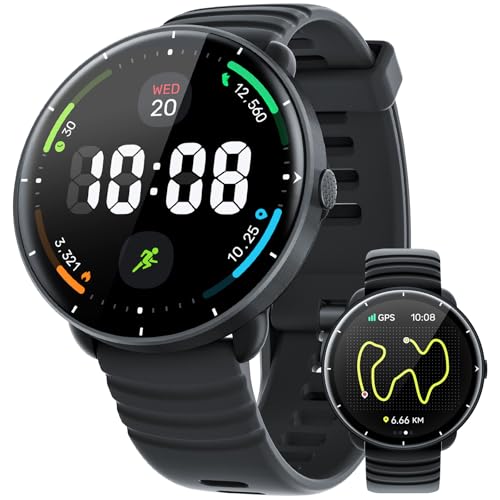
Parsonver Swimming Smart Watch (5ATM, GPS) — The actual swim watch
Parsonver’s title does something none of its five rivals attempt: it starts with the word swimming. This is a swimming smart watch, the listing says, 5ATM waterproof for pool and open water, with an AI swim analysis, built-in GPS and a compass, an AMOLED screen, more than a hundred sports modes and heart rate and sleep monitoring around the edges. Read as a swimmer reads it, the hierarchy is exactly right — venue first, analysis second, navigation third — and it makes the watch the only pick in this guide that can be recommended to a lap counter without a single documentation caveat about its purpose.
The open-water half of its claim is the bolder half. Pool swimming gives a watch a wall every twenty-five metres and a clock on the wall; open water gives it a compass bearing, a GPS track stitched from surface glimpses and a swimmer navigating by landmarks. A title that names both venues, plus the two instruments navigation needs, is aiming at the swimmer who trains in the lake on Saturday and the lanes on Tuesday. The hundred-plus sports modes and the general monitoring fill the rest of that athlete’s week. Test its lap counting against a known set in your first session, as this guide advises for any swim software, but know that you are testing a stated feature here, not hoping for an undocumented one. Pull up the Parsonver swim watch on Amazon to check its price and strap options.
- Water rating: 5ATM waterproof, stated for pool and open water in the listing
- Swim features: AI swim analysis, per the listing
- Navigation: built-in GPS and compass, per the listing
- Display: AMOLED screen, per the listing
- Activity scope: 100+ sports modes, per the listing
- Monitoring named: heart rate and sleep monitor, per the listing
Strengths
- The only title here that answers the swimmer’s actual questions in the swimmer’s own vocabulary.
- GPS and compass together equip the open-water half of its claim, not just the pool half.
- An AMOLED screen serves the sunlit-wall glance that pool training runs on.
Trade-offs
- The title states no battery span, so training-load endurance must be checked in the documentation.
- Swim analysis quality can only be proven against a counted set in your own pool.
- No rugged IP69-class rating is printed, so its second life as job-site equipment is unclaimed.
Best for: the swimmer who counts lengths, analyses sets and ventures into open water. Not suited for: a buyer whose water exposure is weather and work, and who would rather have a flashlight and a fortnight’s battery.

KOSPET PULSE 2 (5ATM/IP69) — The big-screen rugged
The PULSE 2 must be reviewed under this guide’s honesty rule, and the rule produces a compliment of a specific kind: this is a superbly specified water-resistant watch whose title never claims to understand swimming. What it claims is a 1.96-inch AMOLED — the largest screen here alongside the REDMI — in a military-grade rugged body, with GPS, 5ATM and IP69 sealing, an LED flashlight, more than one hundred seventy sports modes, heart rate and sleep monitoring for Android and iPhone, and a fifteen-day battery. As a training watch that can be worn into the pool without a thought, that is a formidable parcel.
Its poolside virtues are real even under the strict framing. The big, bright screen is the one you can read at the wall through wet goggles pushed up on your forehead; the sealing covers the swim itself; the battery span means the watch is a weekly habit rather than a nightly one. What a swimmer must not do is mistake the sports-mode count for swim analysis, because the title does not claim it, and the documentation is where that question goes. Buy the PULSE 2 as the rugged all-rounder whose water resistance happens to be swim-grade, and it will delight; buy it as a lap computer on a menu count, and the misunderstanding is the buyer’s, not the watch’s. Check the KOSPET PULSE 2 price on Amazon before the rugged comparison hardens.
- Water rating: 5 ATM and IP69 waterproof, per the listing
- Display: 1.96-inch AMOLED, per the listing
- Build: military-grade rugged smartwatch, per the listing
- Battery: 15-day battery, as claimed in the listing
- Extras: LED flashlight and GPS, per the listing
- Swim-specific features: Not stated in the listing title — verify with the maker’s documentation
Strengths
- The joint-largest screen here, and brightness is a genuine poolside feature.
- Fifteen claimed days of battery suit a training week without charger anxiety.
- A flashlight in a sealed rugged case earns its keep far beyond the pool.
Trade-offs
- No swim analysis or lap feature is stated; swimmers must verify modes in the documentation.
- A near-two-inch case is a presence on smaller wrists, in the water and out.
- The rugged brief spends weight and bulk that a pure pool watch would not carry.
Best for: the all-round athlete who swims among other training and wants one sealed watch for all of it. Not suited for: a data-led lap swimmer whose session is a spreadsheet with a warm-up.
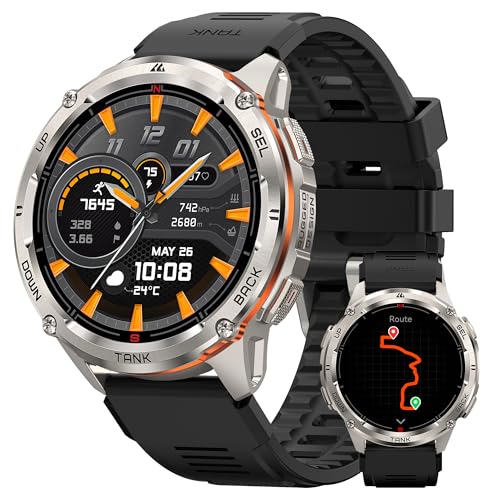
KOSPET TANK T3 Ultra 2 (5ATM/IP69K) — The full-metal tank
The TANK T3 Ultra 2 is the expedition instrument of this field: a full metal body, 5ATM and IP69K sealing, GPS, and a sensor trio — pressure, altitude and compass — that belongs to mountains and weather as much as to water. Its listing adds an extra-large battery, an AMOLED of 1.43 inches, and the same hundred-seventy-plus sports modes as its PULSE sibling. Under the honesty rule, its swimming identity is identical to the PULSE 2’s: swim-grade sealing on a watch whose title makes no swim-software claim, to be verified in documentation by any buyer who needs lap data.
Where it separates from its sibling is the instrument panel and the metal. Pressure and altitude turn the watch into a barometric companion for the hiker and the open-water swimmer who trains where weather arrives quickly; the compass joins the Parsonver as the only other navigation-aware pick here, though without that model’s swim framing. The metal body will read as reassuringly serious to the buyer who equates heft with survival, and as ballast to the swimmer who equates grams with drag — both readings are honest, and the wrist decides. As a one-watch expedition purchase that can also be worn through every swim of a training camp, it has the strongest brief in the guide. See the TANK T3 Ultra 2 on Amazon and check the current price for its metal-bodied configuration.
- Water rating: 5ATM and IP69K waterproof, per the listing
- Build: full metal body, rugged military smartwatch, per the listing
- Instruments: pressure, altitude and compass, with GPS, per the listing
- Display: 1.43-inch AMOLED, per the listing
- Battery: extra-large battery, as described in the listing
- Swim-specific features: Not stated in the listing title — verify with the maker’s documentation
Strengths
- A barometric instrument set serves open country and open water preparation alike.
- Full-metal construction suits the buyer who equates mass with durability.
- The strongest sealing combination in the guide, for water and for pressurised grime.
Trade-offs
- Metal weight is the opposite of what a competitive swimmer shops for.
- The smallest screen here is paired with the densest instrument ambition.
- Like its sibling, it states no swim software, so lap data is a documentation question.
Best for: the expedition athlete whose watch must survive the trail, the site and the swim. Not suited for: a pool racer counting grams and hundredths in equal measure.

REDMI Watch 6 (5ATM, GPS) — The endurance civilian
The REDMI Watch 6 is what the rugged field looks like after a shower and a haircut: a mainstream smartwatch with a 2.07-inch AMOLED — the largest display in this guide, and stated at two thousand nits in the listing — GPS, 5ATM sealing and a battery claim of up to twenty-four days that laps every rival here. Its monitoring list is the civilian health suite as titled: heart rate, SpO2, stress and sleep tracking, across iOS and Android. Nothing in the title performs toughness; everything in it performs competence, brightness and endurance.
For the swimmer, the framing follows the rule: a 5ATM watch that may be worn in the pool, with no swim-specific feature stated, whose swim modes are a documentation question. What the REDMI offers that swimmer in exchange is the screen and the stamina — a display genuinely readable in the sunniest lane, and a charging rhythm so relaxed that the watch can be forgotten as an object and remembered only as a log. For the fitness swimmer whose sessions are time-and-heart-rate affairs rather than lap-count liturgy, that trade may be the most sensible on this page. The mainstream finish also walks into an office without explaining itself, which no tank in this guide can claim. Look up the REDMI Watch 6 on Amazon to check its price and band range.
- Water rating: 5ATM, per the listing
- Display: 2.07-inch AMOLED stated at 2000 nits in the listing
- Battery: up to 24-day battery, as claimed in the listing
- Navigation: GPS, per the listing
- Monitoring named: HR, SpO2, stress and sleep tracker, per the listing
- Swim-specific features: Not stated in the listing title — verify with the maker’s documentation
Strengths
- The biggest, brightest-stated screen here, built for glare at the pool wall.
- A twenty-four-day claim rewrites the charging habit entirely.
- A civilian design that needs no excuse in any room of the wearer’s life.
Trade-offs
- No rugged IP rating is printed alongside the 5ATM figure.
- Swim software is unstated, so structured lap training needs documentation proof.
- The large case face may overwhelm a smaller wrist despite the slim intent.
Best for: the fitness swimmer and everyday athlete who prize screen and stamina over swim liturgy. Not suited for: an impact-rich working life that wants a metal tank instead.

KOSPET Tank T4C (5ATM/IP69K) — The communicator
The Tank T4C’s listing contains the guide’s one genuine eyebrow-raiser: between the GPS, the 5ATM and IP69K sealing, the LED flashlight, the 1.5-inch AMOLED and the hundred-seventy-plus sports modes, KOSPET prints a walkie-talkie feature. Whatever its practical range and arrangement — a documentation question, like all curiosities — its presence tells you the design’s centre of gravity: this is a watch for people who work and train in groups, outdoors, where a wrist that can talk back is worth more than a wrist that can count. Long battery life is claimed without a figure, and heart rate and sleep monitoring run around the clock as titled.
Swimming, under the rule, is again a sealing story rather than a software story: the T4C may be worn in the water on its ratings, and its swim modes must be verified before a lap swimmer relies on them. Its natural buyer trains outdoors in company — the open-water group that stays in voice contact, the trail team, the site crew — and for that buyer the mid-size screen and the full rugged sealing make a coherent, slightly eccentric package that no other pick duplicates. Eccentricity in a title is information: it marks a maker solving for a tribe. If the tribe is yours, find the Tank T4C on Amazon and check the price and the walkie-talkie arrangement in its details.
- Water rating: 5ATM and IP69K waterproof, per the listing
- Display: 1.5-inch AMOLED, per the listing
- Navigation and light: GPS and LED flashlight, per the listing
- Curiosity: walkie-talkie feature, as printed in the listing
- Monitoring named: 24/7 heart rate and sleep monitor, per the listing
- Swim-specific features: Not stated in the listing title — verify with the maker’s documentation
Strengths
- A voice feature aimed at groups gives it a social talent no rival here claims.
- The mid-size AMOLED balances readability against the larger tanks’ wrist presence.
- Full rugged sealing keeps the whole eccentric package swim-wearable.
Trade-offs
- The battery claim arrives without a number, leaving planning to the documentation.
- A walkie-talkie is only as useful as the group that shares the system.
- Swim software, once more, is a verify-first matter rather than a title promise.
Best for: group trainers, open-water pods and outdoor crews who value contact over counting. Not suited for: a solitary lap swimmer whose only companion is the pace clock.

AMAZTIM Rugged Smart Watch (5ATM/IP69K) — The concise tank
AMAZTIM’s listing is eleven ideas long and stops, and there is a kind of confidence in that brevity worth respecting: a rugged fitness watch, 5 ATM and IP69K sealing, a 1.43-inch AMOLED. No mode count, no battery boast, no instrument list — the title of a product that expects to be compared on build and price by a buyer who has read the other five reviews and developed opinions. Under this guide’s rule its swimming account is the shortest of all: sealed to swim-grade on its ratings, with every software question referred to the maker’s documentation.
That concision cuts both ways, and the review should say so plainly. A buyer cannot tell from the title whether GPS rides along, what the battery promises, or which sports the fitness brief covers, so the AMAZTIM is the documentation-first purchase of the six — the one where the listing page and the maker’s manual do the selling that the title declines to do. For the buyer whose needs are genuinely simple — a sealed, readable, rugged watch for wet work and wet training, at whatever the market’s gentlest commitment turns out to be — that may be exactly the right amount of product. Check the AMAZTIM rugged watch on Amazon for its current price and the specifications its title omits.
- Water rating: 5 ATM and IP69K, per the listing
- Display: 1.43-inch AMOLED, per the listing
- Build: rugged fitness watch, per the listing
- Navigation: Not stated in the listing title — verify with the maker’s documentation
- Battery: Not stated in the listing title — verify with the maker’s documentation
- Swim-specific features: Not stated in the listing title — verify with the maker’s documentation
Strengths
- The full rugged sealing pair arrives without a flagship’s feature theatre.
- A compact AMOLED format suits wrists the bigger tanks overwhelm.
- The title’s brevity at least never overpromises a single feature.
Trade-offs
- Nearly every practical question — GPS, battery, modes — is deferred to documentation.
- No swim, navigation or monitoring claim can be credited from the listing alone.
- Comparison shoppers must do more homework here than for any other pick.
Best for: a buyer with simple, wet, rugged needs and a willingness to read the manual first. Not suited for: anyone who wants the title itself to certify their training features.
Which Strap and Fit Details Decide Comfort in the Water?
A swimming watch is worn tighter than a desk watch, because a loose case slides down the wrist at every push-off and the optical heart-rate window — the quiet passenger in most of these designs — loses its contact with the skin it reads. The fitting rule swimmers settle on is one notch tighter than land comfort, checked by a dry run: if the watch migrates during a windmilled arm swing in the changing room, it will migrate at metre three hundred. None of the listings here dwell on strap materials, so the documentation and the listing’s photographs must carry that enquiry, with a preference for straps that chlorine cannot stiffen into a bracelet.
Buckle security outranks buckle beauty in the water. A pin that works loose mid-set costs the session’s data; a strap that works loose at the deep end can cost the watch, which is why the monthly strap inspection in this guide’s care section is written like a ritual rather than a suggestion. Swimmers who train in open water add a habit worth copying: a cheap secondary retainer or a wetsuit sleeve over the strap, so that a single failure is an inconvenience instead of a donation to the lake.
Finally, fit the watch to the wrist you swim with, not the wrist you type with. Cold water shrinks, effort swells, and a case that sat perfectly in the shop can saw at the wrist bone by the second kilometre. The larger cases in this field — the near-two-inch screens — deserve a deliberate trial on smaller wrists before the return window closes, because in swimming, unlike in most watch wearing, the instrument is in constant, repetitive motion against the body it measures.
Head to Head: Sealing Is Shared, Software Is Not
| Pick | Water rating as titled | Swim claim as titled | Screen as titled | Battery as titled |
|---|---|---|---|---|
| Parsonver | 5ATM | Pool and open water, AI swim analysis | AMOLED | Not stated |
| KOSPET PULSE 2 | 5ATM / IP69 | Not stated | 1.96-inch AMOLED | 15 days claimed |
| KOSPET TANK T3 Ultra 2 | 5ATM / IP69K | Not stated | 1.43-inch AMOLED | Extra-large, unquantified |
| REDMI Watch 6 | 5ATM | Not stated | 2.07-inch AMOLED, 2000 nits stated | Up to 24 days claimed |
| KOSPET Tank T4C | 5ATM / IP69K | Not stated | 1.5-inch AMOLED | Long life, unquantified |
| AMAZTIM | 5ATM / IP69K | Not stated | 1.43-inch AMOLED | Not stated |
The table is this guide’s argument in miniature: one column is identical, one column belongs to a single watch, and the remaining columns are where the rugged field actually competes. Buy the column that matches your training, and the shared sealing will quietly do its work underneath.
Which Swimming Watch Mistakes Cost Buyers the Most?
The expensive mistake is reading a sports-mode count as a swim brain. A menu with a swimming icon is a promise that a timer exists; it is not a promise about lap counting, stroke recognition or open-water tracking, and the returns process is full of watches whose menus were mistaken for methods. Read the title for the swim verbs, and where the verbs are absent, read the documentation before the parcel ships.
The second mistake is treating water resistance as immortal. Seals age, chlorine works, knocks accumulate, and a three-year-old watch with a 5ATM birth certificate is a watch whose current rating is a hope. Rinse, inspect, and demote veterans honestly; the pool will forgive a cautious owner and punish a nostalgic one exactly once.
The third mistake is buying the tank for the pool and the pool watch for the trail. The metal expedition models and the swim-analysis model solve different lives, and each looks faintly ridiculous in the other’s: the TANK’s heft on a racing start, the Parsonver’s swim brain on a building site. The reviews above keep the two jobs separate so the buyer can too.
The fourth mistake is forgetting the strap in a waterproof purchase. The case is sealed; the strap is the part that touches chlorine daily, perishes first and decides whether the watch is still on your wrist at the deep end. Inspect it, rinse it, replace it at the first crack — the cheapest component in this entire guide is the one whose failure loses all the others.
How Do Pool, Open-Water and Casual Swimmers Rank These Differently?
Hand the same six watches to three swimmers and you will collect three rankings, each correct. The lane swimmer, whose year is written in intervals, puts the Parsonver first by acclamation and then argues about screens, because the wall glance is the only interface that matters mid-set. The open-water swimmer sorts by instruments — compass, GPS, a case that shrugs off a pontoon’s knock — and finds the Parsonver and the TANK T3 Ultra 2 sharing the podium for opposite reasons, one for its swim brain, the other for its expedition body. The casual swimmer, in the water twice a week between other sports, sorts by battery and by whether the watch embarrasses them at work, which crowns the REDMI and its twenty-four claimed days.
The disagreements are the guide’s point. Water resistance, the one property all three swimmers share, is the one property that cannot rank the field; everything that does rank it — analysis, instruments, endurance, discretion — is a property of a life, not of a seal. A buyer who names their swimmer type honestly in the first minute will find this page’s verdicts falling into place without further argument, and a buyer who cannot name it should buy for the swimming they actually did last month, not the expedition they are planning for next year.
What Should the First Fortnight in the Water Establish?
Establish the count. Two weeks of known sets — lengths you tally on the wall clock and in your head — will calibrate any swim software a watch claims, and will just as usefully reveal that a rugged pick’s swim mode is a timer with good manners, information worth having while exchanges are still easy. Establish the rinse ritual in the same fortnight, at the same sink, until it stops feeling like maintenance and starts feeling like part of the session, the way racking a barbell is part of a lift.
Establish, finally, the watch’s place in the kit bag’s geography. A swim watch that lives in the bag gets forgotten on charge days and left behind on early mornings; one that lives on the wrist, as all six of these are designed to be lived in, is simply there when the water is. The fortnight’s real product is not data but placement — of the charger, of the habit, of the watch in the day’s order — and a buyer who spends it deliberately will still be swimming with the same device, seals honest and strap sound, when the next season’s version of this guide is published.
A last word belongs to the goggles-up moment at the end of a hard set, when a swimmer decides in one glance whether the session was what the plan promised. Everything in this guide — the sealing that permits the swim, the screen that survives the sunlight, the software that understands a length — exists to make that glance informative. Choose the watch whose glance answers your kind of session, keep its strap sound and its seals rinsed, and the instrument will repay you in the only currency swimmers actually bank: honest numbers, session after session, in water that never once got inside.
And if the glance disappoints — a count that drifted, a track that wandered — let the first response be calibration rather than condemnation: swim the known set again, check the strap’s notch, confirm the pool length the software believes in. Swim instruments, like swimmers, have off days with explainable causes, and the fortnight’s records you kept are what separate a watch that needs a setting from a watch that needs replacing.
Keep those fortnight records somewhere more durable than the app’s first screen — a training diary, a notebook in the kit bag — because the comparison that matters in month six is not against another watch but against your own earlier water, and paper remembers what software updates occasionally forget, which is a comfort on the morning the app greets you with a redesign and a cheerful insistence that your history has been improved beyond recognition, filed under headings nobody chose, in an order only the redesign understands, while the notebook in the kit bag sits exactly where you left it, open at the page where last season’s honest numbers wait in your own handwriting.
Final Recommendation
If your training is measured in lengths and splits, the decision is already made: the Parsonver is the only watch here whose listing speaks swimming fluently, and its GPS-and-compass pairing extends that fluency to open water. Everyone else should buy the rugged field for what it honestly is. The PULSE 2 pairs the big screen with the fortnight battery, the TANK T3 Ultra 2 adds metal and instruments for the expedition life, the Tank T4C talks to your training group, the REDMI Watch 6 outlasts and outshines them all in civilian dress, and the AMAZTIM keeps the whole proposition concise for the buyer who reads manuals. Take the winner into the water without fear — the sealing is real — and take its software claims only as far as its title and documentation support. A swim watch earns its name in the lengths it understands, and the rest earn theirs everywhere the water is merely trying to get in.
Frequently Asked Questions
Does 5ATM mean all six watches track swimming?
No. 5ATM is a water-resistance rating shared by all six listings; swim tracking is software. Only the Parsonver’s title claims swim features — pool and open water use with AI swim analysis — while the other five state sports modes and sealing, leaving their swim software to be verified in the makers’ documentation.
Which pick suits open-water swimming best?
The Parsonver, because its title names open water directly and pairs GPS with a compass for navigation. The TANK T3 Ultra 2 carries GPS and a compass among its instruments, but its listing frames them for the expedition life generally, without a swim claim.
Can I wear these watches in the shower or a hot tub?
The listings support swim wear at their stated ratings, and this guide reports those figures as printed. Hot water and steam are a documentation question for each maker, because heat treats seals differently from pool water; check your model’s guidance rather than assuming the rating covers the sauna.
Why do three picks carry IP69 or IP69K as well as 5ATM?
The two scales measure different abuses: 5ATM speaks to water pressure resistance for swimming, while the IP69 family speaks to dust sealing and high-pressure, high-temperature water jets. A watch carrying both is declaring itself for rugged work as well as for the pool, which matches the KOSPET and AMAZTIM designs.
How should I test a swim watch in its first session?
Swim a set you can count without thinking — a known number of lengths at a steady stroke — and compare the watch’s account with yours, including how it handled the rests. For open-water claims, swim a short, known course and inspect the track. One honest session teaches more than a month of specification reading.
What shortens a waterproof watch’s life fastest?
Unrinsed chlorine and salt, a perished strap ignored until it fails, and controls operated underwater against the maker’s guidance. The rinse-and-inspect ritual in this guide costs two minutes per swim and is the difference between a rating that stays true for seasons and one that quietly expires.
Should a beginner buy the swim-analysis watch or grow into it?
Buy the analysis if the beginner is already counting lengths, because the habit the watch serves exists and will be fed by it; buy a sealed all-rounder if the beginner is still negotiating with the water itself, because a watch that also serves the run, the ride and the working week will be worn on the days swimming loses the argument. The Parsonver will still be there when the counting starts, and the rugged picks will still be sealed when the beginner’s second season turns serious about open water.
Do these watches belong in the sea as much as in the pool?
The ratings as printed support swim wear, and the care discipline decides the rest: salt is as corrosive as chlorine and sand is an abrasive no seal enjoys, so the rinse ritual matters doubly after the beach. Open-water swimmers should also read each maker’s documentation for any stated limits on salt-water use, since a title’s 5ATM does not distinguish between the lane and the bay.
Related Guides
The wrist’s other specialities live nearby: best smartwatches with fall detection covers the alert-first designs, and best ecg smartwatches examines the heart-focused shelf with the same title discipline. For land-based training, best running smartwatches ranks the runners’ instruments.
Related guides
- Best Basic Phones Camera Buyers Can Trust: Flip Phones and Simple Handsets That Still Take a Photograph
- Best Sony Full Frame Cameras for Astrophotography: Sensitivity vs Resolution
- Best Affordable Android Tablets: Five True Android Slates and One Fire OS Specialist, Clearly Labelled
- Best 400 FPS High Speed Cameras: The Honest Truth About Burst Slow Motion


