What's inside
- Key Takeaways
- Quick Picks
- How Did We Separate the Wired Pairs From the Portables?
- Which Bose Route Fits a Walled Terrace, a Long Lawn and a Rented Balcony?
- Why Does Open Air Steal Bass, and What Can Placement Do About It?
- How Loud Is Loud Enough Once the Walls Disappear?
- What Happens When a Wired Pair Meets a Modern Streaming Amplifier?
- How Do You Wire a Garden Pair Without Regretting It?
- What Does a Full Year of Weather Actually Do to Each Design?
- How Should You Budget the Whole Installation Rather Than the Speakers Alone?
- Which Gardens Should Skip Bose Entirely and Reconsider?
- What Do People Get Wrong When They Buy Outdoor Speakers?
- Final Recommendation
- Frequently Asked Questions
- Related Guides
As an Amazon Associate I earn from qualifying purchases. This post may contain affiliate links at no extra cost to you.
gizmoverdict.com is reader-supported. When you buy through links on our site, we may earn an affiliate commission.
Where to buy: The best bose outdoor speakers split into two families that shop from different shelves, and this guide keeps them separate on purpose. Three picks are wired environmental speakers that connect to an amplifier or AV receiver you already own; the other three are portable Bluetooth models with batteries inside. Each linked pick below goes to the listing we checked, and no prices or star ratings appear anywhere in this article, because outdoor audio pricing shifts with the season and a printed number would age badly.
Bose built its outdoor reputation on a simple observation: a garden is a hostile room. There are no walls to reinforce bass, no ceiling to contain treble, and the air itself carries sound away from the chairs you actually sit in. Add rain on the cabinet, sun on the grille, and a winter of frost, and an indoor speaker left outside is a speaker being slowly retired. The wired environmental models in this guide were designed around that hostility decades ago and are still sold because the formula works — sealed, weather-resistant enclosures, drivers voiced to project into open space, and brackets that let you aim the sound at people rather than at the sky.
The portable wing answers a different brief. Not every garden has speaker cable buried in it, and not every household wants a permanent installation on a rented wall. A SoundLink that lives on a kitchen shelf all week and comes out for Saturday lunch gives you Bose voicing without a single hole drilled. What it cannot give you is the set-and-forget permanence of a wired pair: batteries need charging, Bluetooth needs a phone within range, and a portable speaker left outside permanently will age faster than one carried in each night. Choosing between the two families is the real decision in this guide; choosing within a family is mostly about garden size and how loud your evenings get.
Key Takeaways
- The 251 and 151 SE are wired speakers, full stop — each pair needs an amplifier or receiver channel, speaker cable, and a mounting surface, and neither contains a battery or a Bluetooth radio.
- The FreeSpace FS4SE comes from Bose’s professional line, so it suits larger patios and commercial-style installs where a surface-mount cabinet and tidy cable runs matter more than portability.
- SoundLink Flex, Max and Plus are the no-installation route: charge them, carry them out, and expect to bring them back indoors when the evening ends.
- Open air eats bass, so placement under an eave or against a wall does more for a wired pair’s low end than a bigger amplifier ever will.
- One wired pair covers a seating area honestly; a long garden needs a second zone or a portable speaker stationed at the far end, not one pair played painfully loud.
Quick Picks
| Pick | Badge | Why it earns its place |
|---|---|---|
| Bose 251 Environmental Speakers | Best wired pair for most gardens | The larger environmental cabinet projects furthest into open air and suits the main seating zone of a medium or large garden. |
| Bose 151 SE Environmental Speakers | Best compact wired pair | A smaller, sleeker enclosure for porches, balconies and eaves where a big cabinet would dominate the wall. |
| Bose FreeSpace FS4SE Loudspeakers | Best professional install | Surface-mount pro loudspeakers sold as a pair, built for tidy permanent installs indoors or out. |
| Bose SoundLink Flex (2nd Gen) | Best everyday portable | Second-generation Flex with waterproof, dustproof sealing and up to 12 hours of battery for ordinary garden use. |
| Bose SoundLink Max | Best portable for parties | The biggest SoundLink here, with a rope handle, IP67 sealing and up to 20 hours of playtime for long evenings. |
| Bose SoundLink Plus | Best middleweight portable | Up to 20 hours of battery and full weather sealing in a cabinet smaller and lighter than the Max. |
How Did We Separate the Wired Pairs From the Portables?
Every Bose outdoor guide that mixes these two families without flagging the difference sets a reader up for a bad delivery day: a box arrives, it opens, and inside are two speakers with bare-wire terminals and no way to play a note until an amplifier joins the order. So the first sort in this guide was architectural. Wired environmental pairs — the 251, the 151 SE and the FreeSpace FS4SE — were judged on enclosure sealing, mounting hardware, projection into open space and how gracefully they disappear into a garden’s sightlines. The SoundLinks were judged on battery endurance as titled, weather sealing as titled, carry comfort and how much garden one unit can honestly cover.
One more filter shaped the final six: every pick had to survive the “explain it to the neighbour” test. Outdoor audio is full of products whose appeal evaporates when described plainly — speakers too small for the gardens they are marketed to, portables whose battery claims assume volumes nobody uses, pro cabinets sold to households with no intention of installing them properly. Each pick below can be justified in one honest sentence about a real garden and a real listening distance, and the badge lines in the Quick Picks table are exactly those sentences. If a model’s justification needed footnotes, it did not make the six.
The second sort was honesty about listings. Bose sells some of these models in bundles and multi-packs through various sellers, and bundle listings muddy what a price or a box actually contains. This guide links only the straightforward listings named in our checked pool: pairs for the wired models, single units for the portables. Where a listing title stays silent about a feature, the spec boxes below say so rather than guessing, and the wired picks are described as what they are — long-running environmental designs, not new releases wearing a fresh coat of marketing.

Bose 251 Environmental Speakers — Best wired pair for most gardens
The 251 is the speaker Bose’s outdoor line is built around: a substantial environmental cabinet, sold as a pair in white, designed to live permanently on a wall, post or eave and to be driven by an amplifier indoors. Its enclosure is the point of the product. The cabinet is sealed against weather, the drivers sit behind protection from direct rain, and the mounting arrangement lets you angle the pair down toward a patio rather than firing level into the neighbour’s garden. In open air, that aim matters more than any specification — sound that passes over the seating is sound nobody hears properly.
Consider how the pair behaves across a real week rather than a demo afternoon. On a Tuesday it plays radio at breakfast volume for one person with coffee. On Friday it carries a playlist for eight people who keep drifting between the kitchen and the terrace. On Sunday it does nothing at all, in the rain, and is expected to work on Monday. A wired environmental pair fits that rhythm precisely because there is nothing to remember: no battery state to check before guests arrive, no Bluetooth pairing to negotiate with a visitor’s phone, no app update standing between the household and music. The amplifier’s remote or app is the whole interface, and the speakers simply convert whatever it sends into sound, in all weathers, for years.
Voicing is the other half of the appeal. Bose tuned this generation of environmental speakers to stay intelligible at the modest volumes most gardens actually use: conversation-level background music at lunch, a little more presence in the evening, and enough headroom for a party without the cabinet sounding strained. Because the pair wires back to your receiver, source switching, volume and multi-room grouping are handled by whatever system you already own — a streaming amp in the kitchen runs the garden exactly as it runs the living room, which is a calmer arrangement than a portable speaker being passed hand to hand.
- Format: wired passive environmental speakers, pair, white finish
- Amplifier: required — connects to a receiver or stereo amp with speaker cable (not included in the speaker box)
- Mounting: wall/eave brackets, aimable toward the seating area
- Power source: none onboard — no battery, no Bluetooth, no mains lead
- Listing title notes: titled as premium outdoor speakers; detailed driver specifications are not stated in the listing title — verify against Bose documentation
Strengths
- Permanent installation means the garden system is ready the moment the receiver wakes — no charging rota, no pairing, no hunting for the speaker.
- The larger cabinet of the wired range projects across a real patio instead of giving up halfway down the lawn.
- White finish and a clean enclosure profile sit quietly against pale walls and rendered exteriors.
Trade-offs
- You are buying speakers only: amplifier, cable and installation time are separate costs that a portable buyer never faces.
- The design has been in the range for many years, so you are paying for a proven formula rather than any recent feature — there is no app, no streaming, nothing smart about it.
- Fixed placement is fixed: if the seating moves to the other end of the garden, the sound does not follow without new cable.
Best for: a main patio or terrace with an existing receiver or a streaming amp planned, where the install happens once and serves for years.
Not suited for: renters who cannot drill, or anyone whose “outdoor listening” means the park, the beach and other people’s gardens.

Bose 151 SE Environmental Speakers — Best compact wired pair
The 151 SE is the smaller sibling in the environmental family, sold as a pair in black, and its whole argument is discretion. Where the 251 announces itself, the 151 SE tucks under an eave, onto a porch beam or beside a door frame and gets on with it. The enclosure is still a sealed, weather-resistant design made for permanent outdoor duty, and it still wires back to an amplifier in exactly the same way — the difference is cabinet volume, and with it, how much open air the pair can fill before physics wins.
That makes the 151 SE the honest choice for the spaces most houses actually have: a covered porch where people sit within a few metres of the speakers, a balcony, a narrow side terrace, a pool house wall. In those contained settings its smaller drivers are not a compromise at all, because the seating is close and often partly sheltered, which returns some of the bass that open lawns steal. Push it to cover a long garden from one end, though, and you will turn the volume up, the sound will thin out, and the neighbours will hear your music more clearly than your guests do.
- Format: wired passive environmental speakers, pair, black finish
- Amplifier: required — speaker cable run back to a receiver or amp channel
- Mounting: compact brackets for eaves, beams and porch walls
- Power source: none onboard — no battery or wireless input of any kind
- Listing title notes: titled as elegant outdoor speakers; output and driver figures are not stated in the listing title — verify with Bose documentation
Strengths
- The discreet cabinet is the least visually intrusive wired option in this guide, which matters on a porch you look at all year.
- Same permanent, always-ready behaviour as the 251, in a size that suits sheltered seating.
- Black finish hides grime and blends against dark timber and shadowed eaves better than white.
Trade-offs
- Coverage is the compromise: this pair serves a seating zone, not a field, and no amplifier upgrade changes that.
- Still a speakers-only purchase — the amp, cable and mounting effort are identical to its bigger sibling.
- Like the 251, it is a long-established design with no smart features; the value is in the enclosure and the voicing, not in novelty.
Best for: covered porches, balconies and compact terraces where the chairs sit close and the speakers should be heard more than seen.
Not suited for: open lawns, long gardens, or pool decks where the seating is far from the only mounting wall.

Bose FreeSpace FS4SE Loudspeakers — Best professional install
The FreeSpace FS4SE comes from a different branch of Bose — the professional division that outfits cafés, hotels and retail courtyards — and it shows in the priorities. This is a surface-mount loudspeaker sold as a pair in black, rated for indoor and outdoor use, designed to be installed once by someone who cares about straight cable runs and even coverage across a wide area. Homeowners meet this line when a garden is big enough, or a household demanding enough, that consumer environmental pairs start to feel like a compromise.
What the pro lineage buys you is install discipline. Surface-mount cabinets in this class are built for consistent dispersion, so several seating pockets across a large terrace receive similar sound instead of one loud spot under the speakers and silence at the far table. They are also built to be serviced and matched: if a courtyard needs four speakers today and six next year, a pro line lets you add identical units. The trade is that this world assumes an installer mindset — amplification, wiring topology and any distributed-audio configuration are system decisions, and the listing title does not spell out those details, so plan the system with Bose Professional’s documentation or an installer rather than improvising.
- Format: professional surface-mount loudspeakers, pair, black
- Use rating: indoor/outdoor as titled
- Amplifier: required — part of an installed system; configuration details are not stated in the listing title, verify with Bose Professional documentation
- Mounting: surface-mount, aimed for even coverage across a wide seating area
- Power source: none onboard — fully passive, no battery, no wireless
Strengths
- Pro-grade dispersion suits large terraces and multi-table spaces where a single consumer pair leaves dead zones.
- Surface-mount format keeps the install tidy and the cabinets serviceable, which permanent outdoor systems eventually need.
- Matching units can be added later in identical form, something consumer lines rarely guarantee for long.
Trade-offs
- This is the least plug-and-play pick here: it rewards a planned system and punishes guesswork about amplification.
- The utilitarian pro aesthetic is deliberate and will not charm anyone shopping for garden décor.
- For a small porch it is simply more speaker system than the space can use, and the 151 SE serves that brief better.
Best for: large terraces, courtyard gardens and households building a permanent installed system with even coverage as the goal.
Not suited for: a first outdoor setup on a modest porch, or anyone hoping to unbox, mount and play in an afternoon without system planning.
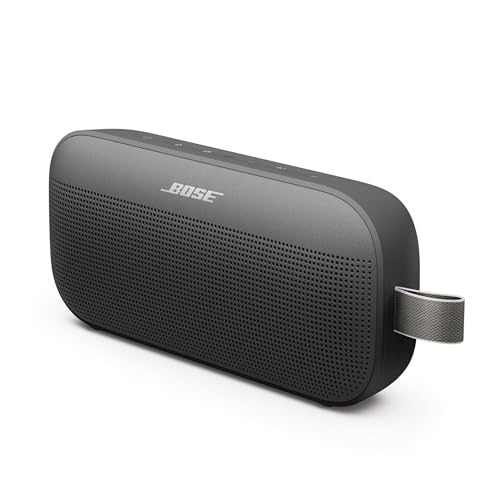
Bose SoundLink Flex (2nd Gen) — Best everyday portable
The second-generation SoundLink Flex is where the portable wing starts, and for many gardens it is also where it can stop. The listing title gives the essentials: hi-fi audio positioning, waterproof and dustproof construction, USB-C charging and up to 12 hours of battery life. In practice the Flex is the speaker that lives on a shelf by the back door, gets carried out with the drinks tray, and comes back in at bedtime — a routine its size and sealing are built around. It asks nothing of the house: no cable in the lawn, no bracket on the wall, no amplifier at all.
Its honest limit is coverage. One Flex voices a table, a lounger pair or a small patio corner beautifully, because Bose’s portable tuning keeps voices clear at the low volumes close listening uses. Set it at one end of a long lawn and ask it to serve twenty people, and it will sound like what it is — a small speaker working hard. The households that love this model tend to use it personally rather than communally: gardening with a podcast, lunch for two, a balcony in the evening. Judged on that work, the second-generation Flex is the most sensible portable in this guide.
- Format: portable Bluetooth speaker, single unit, black
- Battery: up to 12 hours of playtime as titled, USB-C charging
- Sealing: waterproof and dustproof as titled
- Amplifier: none needed — fully self-contained
- Listing title notes: hi-fi audio positioning claimed in the title; no wired input is mentioned in the listing title
Strengths
- Zero installation: it serves renters, balconies and new houses where drilling for wired speakers is not on the table.
- Full weather sealing means a rain shower during lunch is an inconvenience, not a rescue mission.
- Twelve hours covers a full day of garden use without thinking about the charger.
Trade-offs
- One unit covers one seating pocket; it is not a party system for a crowd spread across a lawn.
- Battery discipline is part of ownership — a Flex left discharged in a drawer serves nobody at the barbecue.
- It should live indoors between uses; permanent outdoor storage shortens the life of any battery speaker, however good the sealing.
Best for: everyday personal listening on a patio, balcony or small terrace, carried out and back as part of the routine.
Not suited for: hosting large garden parties from a single unit, or replacing a wired pair as a home’s only outdoor system.

Bose SoundLink Max — Best portable for parties
The SoundLink Max is Bose’s answer to the gathering that outgrows a personal speaker. The title tells the story plainly: a portable wireless party speaker with IP67 waterproofing, a rope handle for carrying, up to 20 hours of playtime, USB-C charging and a built-in 3.5mm AUX input. That AUX socket deserves more attention than it gets — it lets the Max take a wired feed from a laptop, a DJ controller or an older source that Bluetooth forgot, which is exactly the flexibility a party speaker needs when the playlist keeper’s phone dies at nine o’clock.
Scale is the real upgrade. The Max carries the output to fill a proper patio gathering from one box, with the low-end weight that open air usually strips away, and the rope handle is not a styling cue — this is a speaker you move between the terrace and the lawn as the evening migrates. Twenty hours of titled playtime means a full weekend of use between charges for most households. It remains a portable, though: one point of sound, however capable, still localises the music, and the far end of a big garden will always hear a party happening somewhere else.
- Format: portable Bluetooth party speaker, single unit, black
- Battery: up to 20 hours of playtime as titled, USB-C charging
- Sealing: IP67 waterproof as titled
- Inputs: Bluetooth plus built-in 3.5mm AUX input as titled
- Carrying: rope handle as titled
Strengths
- The only portable here that can anchor a real garden party alone, with battery life to match the ambition.
- AUX input rescues the evening when phones die, and suits laptops and controllers at organised events.
- IP67 sealing shrugs off poolside splashes and sudden showers without a scramble for cover.
Trade-offs
- Size and weight are party-class: you carry it deliberately, not absent-mindedly with the salad bowl.
- One-box sound still comes from one place; two smaller speakers placed apart can image a long terrace more evenly.
- As the flagship portable it sits at the top of the SoundLink price ladder in qualitative terms, and the Flex covers quieter lives for less commitment.
Best for: households whose garden hosts real gatherings and that want one self-contained speaker to anchor them, indoors or out.
Not suited for: background-music-only gardens, or anyone who will resent carrying a party-sized box in and out.

Bose SoundLink Plus — Best middleweight portable
The SoundLink Plus sits between the Flex and the Max, and its listing title makes the pitch: a portable Bluetooth speaker for outdoor use with up to 20 hours of battery life and waterproof, dustproof construction. That combination — Flex-like portability discipline with Max-like endurance — is precisely what a middleweight is for. It suits the household that found the Flex slightly small for its terrace but does not host often enough, or loudly enough, to justify the party flagship.
In the garden the Plus behaves like the sensible default. It is light enough to move between the kitchen counter and the patio table without ceremony, sealed well enough to stay out through a damp evening, and it runs long enough that charging becomes a weekly habit rather than a daily one. Sound-wise it fills a family seating area with the same Bose clarity the line is known for, and it gives up only the Max’s last measure of scale and the wired-input flexibility. Households choosing between the three portables should think in gatherings: solo and pairs point to the Flex, family terraces to the Plus, crowds to the Max.
- Format: portable Bluetooth speaker, single unit, black
- Battery: up to 20 hours of battery life as titled
- Sealing: waterproof and dustproof as titled
- Amplifier: none needed — fully self-contained
- Listing title notes: no wired input is mentioned in the listing title — verify with Bose documentation if an AUX feed matters to you
Strengths
- Twenty-hour endurance in a cabinet that still moves around the house without effort.
- Full weather sealing supports the leave-it-out-all-evening pattern that family terraces actually follow.
- The balanced brief: enough output for a family gathering, none of the flagship’s bulk.
Trade-offs
- It inherits the portable compromise in full — battery to manage, Bluetooth range to respect, indoor storage between uses.
- Party crowds will find its ceiling, just later than the Flex’s; the Max exists for those evenings.
- No wired input is stated in the title, so sources are wireless by default.
Best for: family terraces and mid-size patios that host dinners and small gatherings rather than full parties.
Not suited for: the largest gardens, or listeners who want a permanent installed system with zero battery management.
Which Bose Route Fits a Walled Terrace, a Long Lawn and a Rented Balcony?
| Pick | Type | Power | Honest coverage |
|---|---|---|---|
| Bose 251 Environmental | Wired pair | Amplifier required | Main seating zone of a medium or large garden |
| Bose 151 SE Environmental | Wired pair | Amplifier required | Porch, balcony or sheltered terrace |
| Bose FreeSpace FS4SE | Pro surface-mount pair | Installed system | Wide terraces needing even coverage |
| SoundLink Flex (2nd Gen) | Portable | Up to 12 hours battery | A table, a lounger pair, a small corner |
| SoundLink Max | Portable | Up to 20 hours battery | A full patio gathering |
| SoundLink Plus | Portable | Up to 20 hours battery | A family terrace or mid-size patio |
Two households illustrate the fork better than any specification. The first has a stone terrace, a receiver in the kitchen that already runs indoor speakers, and grandchildren who visit every Sunday: their answer is a wired pair mounted once under the eave, because their garden life happens in one predictable place and their amplifier shelf is already paid for. The second household rents, moves every few years, and listens mostly on a balcony and at the park: their answer is the Flex or the Plus, because a drilled bracket is a deposit deduction and their garden, for now, is wherever they are sitting. Neither household is wrong, and neither speaker would serve the other — which is the entire argument for deciding architecture before model.
Read the table by architecture first and output second. A walled terrace with a receiver indoors is wired-pair territory, and the only question is cabinet size. A rented balcony forbids the drill, which settles the argument for a SoundLink before sound quality enters it. A long lawn defeats every single-point solution in this guide: the grown-up answers are a wired second zone, a FreeSpace-style install planned for coverage, or a Max stationed where the people actually are rather than where the house happens to be.
Why Does Open Air Steal Bass, and What Can Placement Do About It?
Indoors, walls and ceilings return low frequencies to the listener; a small speaker in a small room borrows loudness from the room itself. Outdoors that loan is cancelled. Bass radiates into a half-space or worse, travels past the seating, and keeps going into the hedge. This is why outdoor speakers that measure modestly on paper can sound thin in a garden, and why the fix is placement before power. A wired pair mounted under an eave gains a boundary that reinforces low end and shelters the cabinet; a portable set on a table near a wall borrows the same effect. Corner placement reinforces further but can boom at the nearest seat, so angle the speakers toward the middle of the seating and keep them at roughly ear height for seated listeners.
Height plays a quieter role in the same story. A speaker mounted high under a roofline throws sound over a wide area and keeps it clear of furniture, but aim it level and much of that throw sails over seated heads; tilt it down toward the chairs and the same output lands where ears are. Mounted too low, the opposite problem appears — the nearest listener gets a face full of tweeter while everyone else hears the back of the cabinet’s effort. Seated ear height, plus a modest downward tilt from a higher mount, is the compromise that has served patios for decades, and it costs nothing but a few minutes with a helper calling back from the far chair.
Distance is the second thief. Sound level falls quickly as listeners move away from the source, and no garden speaker repeals that arithmetic. Two speakers placed near the people beat one powerful speaker placed far from them, every time — which is why this guide keeps returning to zones. If your garden has a dining end and a fire-pit end, they are two zones, and they deserve either two wired pairs on separate amp channels or a portable that travels with the group.
How Loud Is Loud Enough Once the Walls Disappear?
Volume outdoors behaves nothing like volume in a lounge. Indoors, a modest speaker fills a room because the room helps; outdoors, the same speaker competes with wind in the hedge, traffic beyond the fence, a fountain, and the simple fact that listeners sit further away. Doubling your distance from a speaker costs a clearly audible slice of level, so a pair that sounds generous from the mounting wall can sound apologetic from the far bench. This is why experienced installers talk about listening distance before they talk about power: a wired pair serving chairs six metres away lives an easier life than the same pair asked to reach chairs fifteen metres away, and no badge on the grille changes that relationship.
It also explains why the three wired picks in this guide are not interchangeable. The 251’s larger cabinet exists for reach — for the main lawn-facing wall of a house whose seating sits well away from it. The 151 SE trades reach for discretion because a porch compresses distances until reach stops mattering. The FS4SE approaches the problem sideways, spreading output evenly so that no single seat is blasted and none is starved. On the portable side, the same logic ranks the SoundLinks: the Max’s party brief is really a distance brief, the Flex’s personal brief is a confession that its listeners will be close, and the Plus splits the difference for the family terrace where the furthest chair is a table’s length away, not a lawn’s.
A practical test before you buy: stand where the speaker will live, play music on whatever you own now at the level you would actually choose for a garden dinner, and walk to the furthest seat. If the music is already background at that chair, the new system needs either more reach or a better position — and position is cheaper. Moving a mounting point two metres closer to the seating, or swinging a portable from the house wall to the pergola, routinely gains more than stepping up a model. Buy reach only after placement has done its work.
What Happens When a Wired Pair Meets a Modern Streaming Amplifier?
The wired picks in this guide predate streaming, and that turns out to be a strength, because the amplifier you connect them to supplies every modern feature they lack. A compact streaming amplifier on the kitchen shelf gives the 251 or 151 SE app control, voice-assistant grouping where the platform supports it, multi-room sync with indoor speakers, and a volume ceiling you can set before a party sets it for you. The speakers stay dumb, sealed and weatherproof; the intelligence lives indoors where electronics belong. When the streaming platform changes in five years, you replace one indoor box and the garden pair plays on — a replacement cycle no smart outdoor speaker can match.
Zone discipline is the part to plan. If the garden pair shares an amplifier with indoor speakers, check whether the amp can run both zones at independent volumes, because garden listening and kitchen listening rarely want the same level. A dedicated Zone 2 output, or a small second amplifier for the garden alone, removes the argument entirely. For the FreeSpace FS4SE, this planning matters more, not less: pro surface-mount systems are often wired in configurations that assume an installer’s amplifier choices, and the listing title does not describe those arrangements, so the amplifier conversation belongs before the order, with the Bose Professional documentation open on the table.
None of this applies to the SoundLinks, which carry their streaming relationship in your phone. That is their convenience and their ceiling: the phone is the source, the remote and the battery’s rival for your attention. Households that already live happily in that pattern will find the portables effortless; households that want the garden to play music while phones stay in pockets should wire the garden and let an indoor amplifier do the thinking.
How Do You Wire a Garden Pair Without Regretting It?
Start at the amplifier and work outward. Confirm the receiver or amp has a spare pair of speaker outputs or a Zone 2 you are willing to dedicate, then plan the cable route: along walls, under decking, or buried in conduit where the run crosses open ground. Use cable rated for outdoor or burial use on any run that leaves the house — indoor cable insulation degrades in sunlight and soil, and a failed run inside a finished garden is a miserable repair. Leave slack at both ends, keep runs away from mains cabling where the route allows, and label the amplifier end before the memory of which cable is left fades.
One detail separates tidy installs from future mysteries: photograph the cable route before any conduit is buried or decking screwed back down, and keep the photo with the house documents. The next person to dig that border — possibly you, in three years, planting a hedge — deserves to know where the music runs. Speaker cable carries no dangerous voltage, but a spade through a buried run still silences a zone and turns a Saturday into a fault-finding exercise.
Mount before you finalise. Hold each speaker at its intended bracket position while a helper listens from the furthest chair; a few centimetres of height and a small change of angle are audible from the cheap seats. Drill once, into sound material, with fixings suited to the wall — a sealed cabinet is no protection if the bracket tears out in a storm. Finally, set the amplifier’s volume ceiling conservatively for the first week: outdoor listening invites louder playback than the neighbours agreed to, and a system that starts polite tends to stay welcome.
What Does a Full Year of Weather Actually Do to Each Design?
A wired environmental pair experiences weather as a resident. Summer sun works on the grille and cabinet finish, autumn rain finds every seam the installer rushed, and winter freeze-thaw cycles test whether water that entered a cable entry in October can expand somewhere harmless in January. The Bose environmental designs earned their longevity reputation by treating this as the core engineering problem: sealed enclosures, protected drivers, and materials chosen for ultraviolet exposure rather than for a showroom. What they ask in return is competent installation — brackets torqued into sound material, cable entries dressed so water runs away from them rather than into them, and a downward aim that keeps the cabinet’s face from becoming a birdbath.
The portables experience weather as visitors. Their sealing — waterproof and dustproof on the Flex and Plus, IP67 on the Max — is engineered for exposure during use: the shower that interrupts lunch, the splash from the pool, the dusty afternoon on a building-site radio’s territory. What sealing cannot do is repeal battery chemistry. A lithium battery stored flat in a freezing shed ages faster than one kept charged indoors, and a speaker forgotten on a patio through a season of storms collects UV and moisture stress its designers budgeted for hours, not months. The ownership pattern that keeps a SoundLink young is boring: charge it after big weekends, store it inside, and let the wired pairs be the ones that winter outside.
The FreeSpace FS4SE splits the difference in an instructive way. As a professional surface-mount loudspeaker it is designed for the resident pattern — installed outdoors on commercial premises where nobody carries speakers in at night — and its indoor/outdoor rating as titled reflects that duty. A homeowner adopting it inherits the installer’s checklist along with the hardware: sound fixings, dressed cable, and an amplifier configuration chosen on purpose. Households willing to do that work get the most durable arrangement in this guide; households that know they will skip it should buy a SoundLink and be honest about the trade.
How Should You Budget the Whole Installation Rather Than the Speakers Alone?
The wired pairs invite a budgeting error that portable buyers never meet: the speaker price is only the visible part of the system. A household choosing the 251 or 151 SE should think in four buckets. The speakers themselves are bucket one. Bucket two is amplification — free if a receiver with a spare zone already lives indoors, a real purchase if it does not, and the single most consequential choice in the system because it supplies every source and control the speakers lack. Bucket three is cable and hardware: outdoor-rated speaker cable for the full run, fixings suited to the wall material, and conduit where the route crosses open ground. Bucket four is time — an afternoon of measuring, drilling and aiming for a simple wall mount, or an installer’s visit for a FreeSpace-style system with several cabinets.
None of those buckets is a reason to avoid the wired route; together they are simply the honest shape of it, and they buy something the portable route cannot — a system whose running costs for the next decade are close to zero, with no battery to replace and no electronics outdoors ageing in the sun. The portables invert the shape: one bucket, one purchase, everything included, and the long-term cost is battery ageing measured in years of charge cycles. Households that frame the choice this way rarely regret it, because the regret in outdoor audio almost never comes from the speaker itself. It comes from the bucket nobody counted — the amplifier discovered at unboxing, the cable run that turned into a trench, or the party speaker whose battery gave out the winter it was left in the shed.
A final budgeting note belongs to expansion. A wired system grows by zones: a second pair on a second channel when the fire pit starts hosting evenings, added without disturbing the first install. A portable household grows by units, and a second SoundLink bought later should be checked for pairing compatibility with the first before the order, since stereo and group features vary by generation. Planning the second step while buying the first is the cheapest upgrade path in either architecture.
Which Gardens Should Skip Bose Entirely and Reconsider?
Honesty about fit matters more than loyalty to a badge. A garden whose owner wants music in four separate pockets — dining terrace, pool, fire pit, greenhouse — will outgrow any single pair or single portable in this guide, and should be planning a multi-zone system from the start, whether the speakers wear this badge or another. A listener whose outdoor life is mostly festivals, beaches and borrowed gardens needs a portable first and a garden system maybe never; the Flex serves that life, but so do a dozen rivals, and the Bose premium buys voicing rather than features there. And a household that wants voice control, Wi-Fi streaming and app ecosystems at the speaker itself will find the wired pairs stubbornly silent on all three — those features live in the amplifier you choose, which is either the system’s elegance or its deal-breaker, depending on the household.
Where Bose earns its place is narrower and stronger: proven environmental cabinets for the wired route, and a portable line whose three sizes map cleanly onto personal, family and party scales without a confusing sprawl of near-identical models. If your garden matches one of those six briefs, the badge premium buys you a design that has already survived the years of weather your garden is about to deliver.
What Do People Get Wrong When They Buy Outdoor Speakers?
The classic error is buying a wired pair and discovering the amplifier requirement at unboxing — the 251, 151 SE and FS4SE are speakers, not systems, and the order is incomplete until amplification and cable join it. The second error is scale optimism: one pair, however good, asked to cover a whole garden from the house wall, played loud enough that the nearest chairs are uncomfortable and the far chairs still strain. The third is portable neglect — a SoundLink stored in a damp shed all winter, battery flat, then blamed in spring. Weather sealing protects against weather during use; it is not a storage plan. A fourth, quieter mistake is bundle confusion: multi-pack and wire-bundle listings circulate for the wired models, and buyers who do not read the box contents end up with duplicates or missing brackets. The listings linked in this guide are the plain pairs and single units, deliberately.
Final Recommendation
If your house already runs music through a receiver or streaming amp, the wired route is the grown-up purchase: the 251 for a main garden seating zone, the 151 SE where the space is sheltered and the cabinet should disappear, and the FreeSpace FS4SE when the terrace is wide enough that even coverage becomes the whole problem. If drilling is impossible or the garden is still a plan rather than a fact, buy the portable that matches your gatherings — Flex for personal listening, Plus for family terraces, Max for parties — and accept the battery as part of the deal. Either way, decide the architecture before the model, because a Bose bought for the wrong architecture is an expensive ornament. The garden does not care which badge is on the grille; it cares where the sound starts, where it is aimed, and whether anyone remembered to charge it.
Frequently Asked Questions
Do the Bose 251 and 151 SE work without an amplifier?
No. Both are passive wired speakers with no battery, no Bluetooth and no onboard amplification. Each pair connects by speaker cable to a receiver, stereo amplifier or streaming amp, and that amplifier is a separate purchase if your system does not already have a spare channel or second zone.
Can the wired environmental pairs stay outside all year?
That is what they are built for. The enclosures are sealed environmental designs intended for permanent outdoor mounting, including winter, provided the brackets are fixed into sound material and the cable entries are installed neatly. Portable SoundLinks are different: weather-sealed for use outdoors, but they should be stored indoors between uses.
What does IP67 on the SoundLink Max actually promise?
An IP67 rating as titled means the sealed unit is tested for dust ingress and for immersion in shallow water for a limited time — far beyond the splashes, rain showers and poolside accidents a garden speaker actually meets. It is a sealing standard, not an invitation to leave the speaker at the bottom of the pool, and charging ports should be dry before a cable goes in.
Is one SoundLink Max better than two smaller SoundLinks for a terrace?
For sheer output at a gathering, the Max is the stronger single box. For even coverage across a long terrace, two smaller speakers placed apart can serve listeners more evenly, because sound falls off with distance from its source. Choose output if the crowd clusters, placement if the crowd spreads.
Can I mix a wired pair and a SoundLink in the same garden?
Yes, and many households end up doing exactly that: a wired pair covers the terrace where people predictably gather, while a portable handles the movable parts of the evening — the fire pit, the lawn games, the neighbour’s side of the fence during a joint barbecue. They will not play in perfect sync as one system unless the amplifier and the portable share a platform that supports it, so treat them as two zones for two jobs rather than one chorus. Programmes differ, volumes differ, and nobody at a garden party has ever complained that the fire pit was hearing a different song from the terrace.
How long will a wired environmental pair realistically last?
Measured in years rather than seasons, provided the installation respects the basics: sound fixings, cable entries dressed against water ingress, and an amplifier that is not driven into distortion every weekend, since a clipping amplifier is harder on speakers than weather is. The designs in this guide have remained in the range for a long time precisely because the failure rate of a sealed cabinet with no electronics, no battery and no moving parts beyond its drivers is low. The grille may weather cosmetically long before the sound changes.
Should a small garden buy the 251 anyway, just to be safe?
Usually not. In a compact or sheltered space the 151 SE delivers the same permanent, always-ready behaviour in a cabinet that suits the wall better, and the 251’s extra reach goes unused where listeners sit close. Oversizing also tempts overspending on amplification to match. Buy the cabinet that fits the listening distance you measured, and put the difference toward better placement or a second zone later.
Why does this guide avoid the Bose bundle listings?
Bundle and multi-pack listings for the wired models mix speakers with wire, brackets or second pairs in ways that make box contents hard to compare, and a buyer can easily pay for duplicates or miss a needed part. Linking the plain pairs and single units keeps what-you-get unambiguous; accessories can be added deliberately afterwards.
Related Guides
Outdoor sound rarely lives alone in a garden plan. Readers weighing a full patio system against portable convenience may also want our look at affordable outdoor speakers that wire back to an indoor amp, the wider speaker landscape in the 7.1 home theater speaker systems worth building around, and a different kind of permanent install in home tower speakers for rooms that host movie nights.


