What's inside
- Where to buy
- Key Takeaways
- Quick Picks
- How did we choose these headsets for kids?
- What does a volume limiter actually do — and what can it not do?
- Wired or Bluetooth: which belongs in the school bag?
- How do the six kids’ headsets compare side by side?
- How do you fit and manage a child’s headset day to day?
- Which headset suits which age, from first stories to first homework?
- How do headsets change car journeys, flights and family travel?
- How should families handle sharing, hygiene and listening breaks?
- What mistakes do parents make when buying headsets for kids?
- How should you test a new kids’ headset in its first week?
- What should you check about controls, cases and spare parts before buying?
- What if your child’s tablet or laptop has no headphone jack?
- Final Recommendation
- Frequently Asked Questions
- Related Guides
As an Amazon Associate I earn from qualifying purchases. This post may contain affiliate links at no extra cost to you.
gizmoverdict.com is reader-supported. When you buy through links on our site, we may earn an affiliate commission.
Where to buy
Each of the six headsets below is listed on Amazon’s US store, and the links in this guide point there. Check the colour and pack size on the listing before ordering — children’s headphones are sold in a rainbow of near-identical variants, and the one your child chose from a photograph is a specific colourway, not a general concept.
Parents shopping for the best headsets for kids are really shopping for three things at once, and only one of them is sound. The first is a volume limiter that works without anyone remembering to set it. The second is a headset that survives being sat on, stuffed into a backpack beside a leaking juice box, and worn by a child who treats the cable as a skipping rope. The third — the one that decides whether the purchase gets used at all — is whether the child actually likes wearing it: the fit on a small head, the weight through a long car ride, the colour. This guide weighs all three honestly, and it starts with a promise about language: a volume limiter limits volume. It is a ceiling built into the electronics, not a guarantee about hearing, and no headset in this roundup — or anywhere — can promise that a child’s hearing is safe. What a good limiter does is remove the worst accidents from the range of things a volume button can do, and that is worth having.
The six picks divide by cable as much as by brand. Three are wired or wired-capable designs from iClever, awatrue and Belkin that never need charging and plug straight into the school-issued devices children actually use. Three are Bluetooth models from EarFun, JBL and iClever that trade the cable for freedom of movement and add features — long battery life, active noise cancelling, lights — that older children genuinely enjoy. Neither camp is better in the abstract. The right camp is the one that matches where the headset will live: a classroom, a car seat, a bedroom desk, or all three in rotation.
Key Takeaways
- A volume limiter is a ceiling, not a shield: the 85-decibel class of limit found across this guide caps how loud the headset can play, but listening habits, fit and session length still belong to the adults in charge.
- Wired headsets are the school-safe default — they never arrive with a flat battery, and they plug into Chromebooks and tablets that may refuse Bluetooth pairing altogether.
- Bluetooth picks earn their place at home and in the car, where the missing cable removes the single most common cause of children’s headphone damage.
- The JBL Junior 470NC is the only pick here with active noise cancelling and app-based parental control, making it the aeroplane and open-plan-household specialist.
- Fit decides everything for younger children: a headset that slides off a small head or clamps an older one will be abandoned regardless of its specifications.
- Buy the second pair strategy seriously — children lose and break headphones at a rate that makes one spare wired set the most rational accessory in this entire guide.
Quick Picks
| Pick | Badge | Why it earns its place |
|---|---|---|
| iClever HS19 | Best wired all-rounder | A corded over-ear headset with iClever’s SafeSound limiting and a proper microphone, built for the school-and-homework circuit. |
| EarFun K2 | Best Bluetooth value | Volume-limited wireless listening with a claimed 60 hours of playtime, so charging becomes a monthly event rather than a nightly argument. |
| JBL Junior 470NC | Best with noise cancelling | JBL Safe Sound limiting plus active noise cancelling and app parental controls — the travel and noisy-household flagship of this roundup. |
| Belkin SoundForm Mini | Best for younger children | Wireless and wired in one small, light frame with a claimed 30 hours of playtime, sized for the youngest listeners here. |
| awatrue AT2 | Best dual-limit wired pick | A foldable corded headset with two selectable volume ceilings, 85 or 94 decibels, so parents choose the cap that fits the setting. |
| iClever BTH12 | Best battery and fun factor | A claimed 85 hours of playtime, USB-C charging and LED lights children adore, with the same SafeSound limiting as its wired sibling. |
How did we choose these headsets for kids?
Every pick had to clear the limiter bar first: a built-in volume ceiling in the 85-decibel class, implemented in hardware or firmware the child cannot defeat from the headset’s own buttons. Models that merely advise parents to supervise volume were excluded, because advice is not a feature. Beyond the limiter, we required a microphone on every pick — the category keyword is headsets, and homework in this decade means video lessons, language apps and calls with grandparents, all of which need a child to be heard as well as to hear.
Durability evidence came next. We favoured headbands with genuine flex rather than rigid plastic, cables with strain relief where cables exist, and designs whose ear cushions can survive being wiped clean, because they will need to be, often. Manufacturer claims about drop resistance were treated as marketing weather — noted, not relied on. What can be relied on is construction logic: fewer hinges, thicker headbands and replaceable cables survive childhood better than delicate folding mechanisms, and the sections below say which picks make which trade.
Finally we sorted by the pairing reality of children’s actual devices. School Chromebooks and managed tablets frequently have Bluetooth disabled by policy or locked to approved accessories, a fact that strands many wireless headsets at the classroom door. So the guide deliberately keeps three wired or dual-mode options, and each Bluetooth pick’s section states plainly where it belongs: home, car and travel first, school only where the school allows it. A headset that cannot connect to the device it was bought for is not a bargain at any price, and parents deserve that warning before purchase rather than after.
What does a volume limiter actually do — and what can it not do?
A volume limiter caps the maximum output the headset can deliver, regardless of how high the source device’s volume is set. In the picks here that ceiling sits in the 85-decibel class, a level chosen by makers because it aligns with widely used guidance for prolonged listening. The mechanism varies: wired limiters shape the electrical signal in the cable path, while Bluetooth limiters are enforced in the headset’s own electronics, and JBL’s system adds an app layer that lets parents set and check the ceiling themselves. The awatrue AT2 makes the mechanism visible with its two selectable ceilings — a stricter cap for everyday listening and a higher one intended for noisier settings where a child otherwise cannot hear the lesson at all.
Now the honesty this category needs. A limiter controls the maximum; it does not control the dose. A child can listen at the cap for many hours, in a fit that leaks and invites turning up, with content whose loud passages sit at the ceiling throughout — and no specification on any box speaks to that total picture. Nor can a limiter account for a headset worn half-off one ear, or shared between siblings with different sensitivities. Treat the limiter as what engineers call a safeguard against the worst case: the accidental full-volume blast when a video starts, the toddler who finds the volume rocker. That accident prevention is genuinely valuable. The rest of hearing care — breaks, moderate levels, adults paying attention — remains a household practice, not a product feature, and this guide will not let any pick pretend otherwise.
Practically, parents should also know that limiting interacts with environment. In a quiet bedroom, a capped headset sounds generous. In a car at motorway speed or a cabin full of engine drone, the same cap can make speech hard to follow, which is why the higher second setting exists on the awatrue and why JBL’s noise cancelling matters: cancelling the background lets the child hear clearly at lower volume, attacking the problem from the other side. Choosing between a stricter cap and a noisier setting is a judgement about your child’s actual listening places, and the picks below are annotated with that judgement in mind.
Wired or Bluetooth: which belongs in the school bag?
The wired case is boring and overwhelming. A corded headset works with every device that has a headphone jack or a cheap adapter, never needs charging, never needs pairing, and cannot be locked out by a school IT policy. It wakes up the instant it is plugged in, which matters when a teacher gives a class ninety seconds to get headphones on. Its failure mode is equally predictable: the cable is the part children destroy, by wrapping it around the headset, chewing it in concentration, or yanking the plug sideways out of a tablet. The wired picks here fight back with reinforced cables and, in the awatrue’s case, a foldable frame that at least packs small when the cable survives.
The Bluetooth case is freedom, and children feel it instantly. No cable tethering them to the tablet on the sofa, no cord catching on the car seat, no plug to bend. In exchange, the household takes on a charging routine and a pairing relationship with every device the headset meets. The playtime claims on the wireless picks here — 30, 60, even 85 hours — transform that routine from nightly to occasional, which is precisely why they were selected: a Bluetooth headset that needs charging weekly gets charged; one that needs it daily gets forgotten, then abandoned, then replaced by the wired spare. Note that two of the wireless picks hedge the school question directly: the Belkin works wired as well as wireless, so a flat battery or a pairing ban demotes it to corded duty rather than to uselessness.
Our sorting rule is simple. School-first headsets: wired, or dual-mode with the cable in the bag. Home-and-travel headsets: Bluetooth, with playtime long enough to forgive a forgotten charge. Children old enough to manage their own devices can graduate to Bluetooth everywhere their school allows it — and the word “allows” should be checked with the school, not assumed, because managed Chromebooks are the single most common reason a Christmas headset fails its first January.
iClever HS19 — Best wired all-rounder
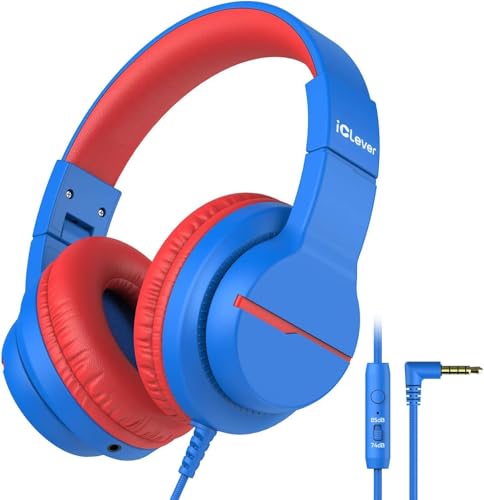
The HS19 is the headset this guide would hand to a parent who asked for one sensible purchase and no further research. It is a corded over-ear design with iClever’s SafeSound volume limiting in the signal path, a built-in microphone for lessons and calls, and the kind of padded, adjustable frame that fits the wide middle of childhood — roughly the primary-school years where headsets earn their keep daily. The over-ear cushions matter more than they look: they spread pressure around the ear instead of on it, which is what lets a child wear the HS19 through a whole film or a long drive without the earache complaints that end younger children’s listening sessions early.
Because it is wired, the HS19’s school credentials are impeccable. It plugs into Chromebooks, classroom tablets and the family laptop with zero ceremony, and it will work on the morning its owner forgot — as children reliably do — to do anything at all to prepare it. The microphone is a proper headset mic rather than a token, so teachers hear the child clearly in recorded assignments and video lessons. What it does not offer is any escape from its cable: on the sofa it tethers, in the car it tangles, and the cable remains the component most likely to end the headset’s life. Accept that trade, keep the cable untangled in a pouch, and the HS19 is the reference wired pick against which the others here are measured.
- Connection: wired 3.5mm
- Volume limiting: SafeSound limiting in the 85dB class
- Microphone: built-in, for lessons and calls
- Fit: over-ear cushions, adjustable headband
- Charging: none — always ready
Strengths
- Works with every school device that has a jack, with no pairing policy able to lock it out.
- Over-ear comfort suits long sessions better than the on-ear designs younger picks use.
- The microphone quality serves real schoolwork, not just entertainment listening.
Trade-offs
- The cable is both its school superpower and its most likely point of failure.
- No wireless mode at all, so sofa and car use keeps the child tethered to the device.
- Older children may find the styling young once secondary school begins.
Best for: primary-school children whose headset must work at school every single day. Not suited for: families who want one headset to roam the house cable-free.

EarFun K2 — Best Bluetooth value
EarFun built its reputation on giving adult earbuds more battery and better tuning than their price suggests, and the K2 applies the same formula to children. It is a volume-limited Bluetooth headset with a built-in microphone and a claimed 60 hours of playtime — a number that, even treated with the usual discount, means charging roughly when the seasons change rather than when the school week starts. For parents, that battery is the feature: the leading cause of wireless-headset failure in family life is not breakage but the flat battery discovered at the moment of need, and the K2 pushes that moment weeks apart.
The K2’s school story needs the standard Bluetooth caveat stated in its own section so nobody buys it on a misunderstanding: if your child’s school Chromebook has pairing locked down, this headset stays home. At home it is in its element — tablet on the sofa, music in the bedroom, calls with family — and EarFun’s tuning gives it a livelier sound than most children’s headsets manage, which older primary children notice and appreciate. The fit is sized for kids rather than scaled-down adults, and the controls are simple enough that a child can run them without a parent mediating every session. As the wireless value pick of the guide, it makes the fewest apologies per pound or dollar spent.
- Connection: Bluetooth wireless
- Volume limiting: built-in limited output
- Claimed playtime: up to 60 hours
- Microphone: built-in
- Fit: child-sized over-ear design
Strengths
- The long playtime claim turns charging into a rare event, which is what family logistics actually need.
- EarFun’s audio tuning gives music and stories more life than typical children’s headsets.
- Simple controls let children run their own listening without constant adult help.
Trade-offs
- Bluetooth-only design can be refused by managed school devices.
- When the battery does finally run flat, there is no wired fallback in the box to save the day.
- Younger toddlers will find it big; it is sized for school-age heads.
Best for: school-age children whose listening happens mainly at home and in the car. Not suited for: children whose school requires a headset the IT policy can veto.

JBL Junior 470NC — Best with noise cancelling
The Junior 470NC is the flagship of this roundup and the only pick with active noise cancelling, which reframes what a children’s headset can be for. JBL’s Safe Sound system caps output at the 85-decibel class, and the parental-control layer goes further than any rival here: through the app, parents can set a custom volume limit and check listening habits, turning the ceiling from a fixed factory choice into a family decision. Then the cancelling does its quiet work — on an aeroplane, in a car, in a kitchen where a sibling is practising drums, the background drops away and the child hears the story clearly without reaching for volume that is not there.
That combination makes the 470NC the travel specialist of the guide, and its price the highest here, which is the honest exchange. It is also the pick most likely to be borrowed by parents on a flight, though its sizing is genuinely for children. Battery life with cancelling active is shorter than the marathon claims of the EarFun and iClever wireless picks, as ANC always costs power, so the charging routine tightens from monthly to trip-based. For families who fly often, share open-plan space, or have a child who concentrates markedly better with the world turned down, the premium buys something no other pick offers. For a headset destined to live in a school bag and be sat on weekly, it is more money in harm’s way than the job requires.
- Connection: Bluetooth wireless
- Volume limiting: JBL Safe Sound, 85dB class, with app-based parental control and customisable limit
- Noise cancelling: active noise cancelling
- Microphone: built-in
- Fit: child-sized over-ear with cushioned band
Strengths
- Noise cancelling lets children hear clearly at lower volume in loud places — the smartest loudness strategy in the guide.
- App parental controls let families set the ceiling rather than merely accept the factory one.
- JBL’s build and tuning give it the most grown-up feel of any pick here.
Trade-offs
- The highest price in the roundup, exposed to the loss-and-breakage statistics of childhood.
- Cancelling shortens battery endurance compared with the marathon wireless picks.
- Its talents are wasted in a quiet bedroom, where a third of its technology never wakes up.
Best for: travelling families and noisy households, and children who focus better with distractions cancelled. Not suited for: school-bag duty where loss is a matter of time.
Belkin SoundForm Mini — Best for younger children
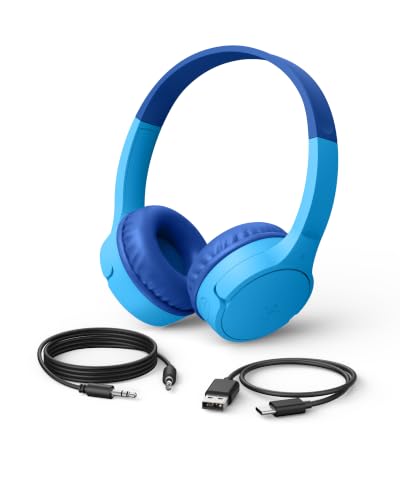
Belkin aimed the SoundForm Mini at the youngest listeners in this guide, and the design shows the thinking: a small, light frame that does not overwhelm a little head, simple controls a small child can actually operate, and a claimed 30 hours of wireless playtime that forgives a parent who forgets the charging cable on a trip. The decisive feature, though, is its double life — the Mini works wirelessly over Bluetooth and wired through its cable, so the same headset that roams the living room on Saturday plugs into the classroom tablet on Monday, and a flat battery never becomes a missed lesson.
That dual-mode honesty makes the Mini the most flexible pick here, and for younger children flexibility outranks almost everything, because their listening lives are the least predictable. The volume limiting follows the same 85-decibel class as the rest of the guide. Fit is the Mini’s home ground: where the EarFun and JBL picks suit school-age heads, the Belkin suits the child for whom those are still swimmy and loose, and a headset that stays on is a headset that gets used. Its sound is tuned for clarity of speech and story rather than excitement, which suits its audience of audiobooks, phonics apps and first films. As children grow toward the top of primary school, most will graduate to the larger picks; the Mini is the right first headset precisely because it does not try to be the last one.
- Connection: Bluetooth wireless plus wired mode
- Volume limiting: built-in, 85dB class
- Claimed playtime: up to 30 hours
- Microphone: built-in
- Fit: small, light frame for younger children
Strengths
- Dual-mode design survives both flat batteries and school Bluetooth bans without missing a lesson.
- The smallest, lightest fit here — the pick most likely to stay on a young child’s head.
- Belkin’s accessory-brand polish shows in controls a little child can genuinely manage.
Trade-offs
- Playtime is the shortest of the wireless picks, so the charging routine matters more.
- Children will outgrow its fit and its styling sooner than the larger models.
- Sound is clear rather than thrilling, which older children will notice.
Best for: the youngest listeners, and families wanting one headset for home and school alike. Not suited for: older primary children ready for a bigger, longer-lasting design.

awatrue AT2 — Best dual-limit wired pick
The AT2’s signature is a small switch with a big idea behind it: two selectable volume ceilings, at the 85 and 94 decibel settings, letting a parent match the cap to the context instead of accepting one factory judgement for every room in a child’s life. Quiet bedroom, strict cap. Noisy car, where the stricter cap would leave speech buried under road noise, the higher setting — chosen by the adult, not discovered by the child. That single feature makes the AT2 the most parent-configurable wired pick in the guide, and it costs little, folds flat for the school bag, and plugs into everything with its standard 3.5mm connection.
The rest of the design is sensibly school-shaped. The frame folds for transport, the microphone handles lessons and calls, and the wired connection means it is ready every morning without a thought about charge. Its limits are the wired limits stated throughout this guide — a cable to tangle and eventually to fail — plus one specific to its party trick: the dual ceiling only helps if the adult sets it deliberately, and a household that never thinks about the switch owns a single-limit headset with extra hardware. Buy it if the two-setting idea matches how your family actually listens, in genuinely different noise environments; buy the iClever HS19 if you want the same wired reliability with the decision already made for you.
- Connection: wired 3.5mm
- Volume limiting: two selectable ceilings, 85dB and 94dB
- Microphone: built-in HD microphone
- Design: foldable frame for school bags
- Charging: none
Strengths
- Two ceilings let parents tune the cap to the room instead of fighting it.
- Folding design packs smaller than any other wired pick here.
- Full school-device compatibility, with zero charging or pairing overhead.
Trade-offs
- The higher ceiling setting demands an adult’s judgement; it is a responsibility as much as a feature.
- Cable failure remains the statistical end of its life, as with all wired picks.
- Folding hinges are one more moving part in a product category children test destructively.
Best for: families whose child listens in both quiet rooms and noisy cars, with a parent happy to set the cap. Not suited for: households wanting set-and-forget simplicity above configurability.
iClever BTH12 — Best battery and fun factor
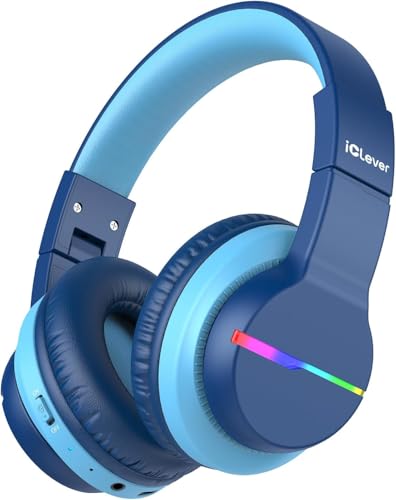
The BTH12 is the HS19’s wireless sibling with the volume turned up on everything except the sound. Its headline numbers are a claimed 85 hours of playtime — the longest in this guide by a distance — and USB-C charging, so it tops up from the same cable as everything else in a modern house. Its headline feature, as far as its actual owner is concerned, will be the LED lights in the ear cups. Adults may file lights under decoration; children file them under identity, and a headset a child is proud to wear is a headset that gets worn with its limiter doing its work, rather than swapped for an uncapped hand-me-down. Never underestimate the safety value of the pick the child actually chooses.
Under the lights, the substance is iClever’s SafeSound limiting and a fit aimed at the middle childhood years, with a microphone for calls and lessons. Eighty-five claimed hours deserves the standard discount and still leaves a battery that can be charged on a monthly rhythm and forgotten between times — for travel especially, this is the pick least likely to die mid-journey. The cautions are the wireless cautions: school pairing policies may exclude it, and when the marathon battery finally fades there is no cable in the design to fall back on. As the fun-forward home headset in a house that also owns a wired school spare, it is close to unbeatable; as a child’s only headset in a strict-IT school district, pair it with that spare from day one.
- Connection: Bluetooth wireless
- Volume limiting: SafeSound limiting in the 85dB class
- Claimed playtime: up to 85 hours
- Charging: USB-C
- Extras: LED ear-cup lights, built-in microphone
Strengths
- The longest claimed battery in the guide removes charging from family life almost entirely.
- The lights make children choose this headset voluntarily — which keeps the limiter on their ears.
- USB-C charging matches the rest of the household’s cables, no orphan charger required.
Trade-offs
- No wired fallback, so a forgotten charge or a school pairing ban benches it completely.
- The lights that delight a seven-year-old may embarrass the same child at eleven.
- Its fit suits middle childhood; the youngest listeners are better served by the Belkin.
Best for: home and travel listening for children who will wear it with pride for years of battery at a time. Not suited for: being a child’s sole headset where school devices forbid Bluetooth.
How do the six kids’ headsets compare side by side?
| Headset | Connection | Volume limiting | Claimed playtime | Defining trait |
|---|---|---|---|---|
| iClever HS19 | Wired | SafeSound, 85dB class | Always ready | Over-ear school all-rounder with a proper mic |
| EarFun K2 | Bluetooth | Built-in limiter | Up to 60 hours | Wireless value with grown-up tuning |
| JBL Junior 470NC | Bluetooth | Safe Sound plus app parental control | Trip-length, ANC in use | Only noise-cancelling pick in the guide |
| Belkin SoundForm Mini | Bluetooth + wired | Built-in, 85dB class | Up to 30 hours | Smallest fit, dual-mode flexibility |
| awatrue AT2 | Wired | Selectable 85dB / 94dB | Always ready | Parent-chosen ceiling, folding frame |
| iClever BTH12 | Bluetooth | SafeSound, 85dB class | Up to 85 hours | Marathon battery and LED lights |
The table’s most useful column is the first one, because connection decides where each headset can work at all. The two purely wired picks and the dual-mode Belkin are the only ones guaranteed a school day; the three pure Bluetooth models are home-and-travel instruments whose playtime figures then decide how much parental charging labour they demand — almost none from the BTH12, very little from the K2, and a trip-based routine from the JBL, whose battery is spent partly on cancelling the world’s noise. Limiting, by contrast, is the column where the guide refuses to rank: every pick caps output in the same class, and the differences are in who sets the cap — factory, parent by switch, or parent by app.
How do you fit and manage a child’s headset day to day?
Fitting comes before the first story or lesson. Slide the headband until both ear cups sit symmetrically — a cup riding high on one ear leaks sound, invites volume creep and aches within the half hour. For younger children, check the fit again every few months; heads grow faster than headsets wear out, and a band at its last notch is a band about to be outgrown. Teach the child the two handling rules that double a headset’s life: two hands to take it off, never one-handed by a cup, and the cable — where one exists — hangs loose or gets coiled gently, never wound tight around the frame, which is how cables die from the inside while looking fine from the outside.
Management is the unglamorous system that makes the technology work. Give the headset a home: one hook or one pouch, in one place, so “where are your headphones” has an answer. Put wireless charging on a family rhythm rather than a battery emergency — the long-playtime picks here forgive almost any rhythm, but a Sunday-night top-up habit means no headset in the house ever starts Monday empty. Keep the wired spare. Every family in this category eventually faces the lost, broken or flat headset on the morning of the school trip, and the household with a cheap wired headset in a drawer treats that morning as a shrug instead of a crisis. Finally, wipe cushions and headbands regularly; children’s headsets live against skin, hair products and the occasional mystery substance, and a thirty-second clean keeps both the headset and the child more pleasant to be near.
Which headset suits which age, from first stories to first homework?
The youngest listeners — the three-to-five years of picture-book apps, phonics games and first films — need the least technology and the most supervision of fit. For them the Belkin Mini’s small frame and dual-mode simplicity is the natural starting point, and sessions should be short, shared and mostly in rooms where an adult is present anyway. Sound quality barely registers at this age; what registers is whether the headset stays on, whether the story is intelligible, and whether the child can put it on without help, because independence with the small things is the whole developmental game. Lights and colours, which adults dismiss, are legitimate selection criteria here: the headset the child asks for by name is the headset whose limiter stays on the child’s ears.
Early primary school changes the job description. Now the headset goes to school, meets a Chromebook, records a reading assignment and joins a video call with a teacher, so the microphone graduates from accessory to requirement and the wired picks — HS19 first among them — come into their own. This is also the age of the backpack as an extreme environment: headsets are packed beside sports kit, dropped on playgrounds and lent to friends. Durability spending peaks in value here, and premium spending troughs; the mid-priced wired picks are not a compromise for this age, they are the correct engineering answer to it.
Older primary and early secondary children start to have tastes, journeys and opinions. Music matters to them, travel is longer, homework moves to their own desk, and a Bluetooth pick with real battery life — the EarFun K2 or the BTH12 — respects their growing autonomy while the limiter keeps the ceiling where parents set it. The JBL 470NC finds its moment here too, for the child who reads through family noise or flies regularly. The conversation parents should have at this stage is about the limiter itself: explain what it does, why it exists, and that it stays — because a child old enough to understand the reasoning is a child who will keep the protection voluntarily when the first unlimited headset eventually arrives.
How do headsets change car journeys, flights and family travel?
Travel is where children’s headsets pay for themselves in adult sanity, and each travel mode rewards a different pick. In the car, the problems are road noise and the cable that reaches neither the tablet nor the child’s patience; Bluetooth picks win the car, with the awatrue’s higher ceiling setting as the wired answer for families who prefer a cord — the higher cap exists precisely because a quiet-room limiter can leave a story inaudible at motorway speed, and an adult choosing that setting for a journey is using the feature as designed. Battery barely matters in the car, where journeys end; it matters enormously at the airport, where they compound.
Flights stack every problem at once: engine drone, a seatback screen that speaks only through a jack, a neighbour who did not choose your child’s film, and hours that outlast small batteries. The complete travel answer in this guide is therefore a pairing — the JBL 470NC for its cancelling and app-set ceiling, plus a wired cable or wired spare in the hand luggage for the seatback system and the flat-battery hour. Families who fly twice a year may find the EarFun or BTH12’s marathon battery the simpler single purchase, accepting the seatback gap. What no family should do is discover these constraints at thirty thousand feet with a tired child; the time to learn a headset’s travel behaviour is a Saturday afternoon at home, testing it against the tablet, the laptop and the oldest device in the house.
One travel habit is worth teaching early: the headset comes off when a person is talking to you. Cabin crew, grandparents at arrivals, the sibling in the next seat — children who learn to lift one cup or pause the story when addressed grow into travellers other people enjoy. It costs nothing, it cannot be bought, and it matters more to the journey than anything a spec sheet can promise.
How should families handle sharing, hygiene and listening breaks?
Headsets are personal equipment in a way children instinctively understand about toothbrushes and forget about ear cushions. Cushions sit against skin and hair for hours; they collect sweat, sunscreen and whatever the playground provided. A weekly wipe with a barely damp cloth, and cushions left to dry before the headset goes back in a bag, keeps them pleasant and extends their life. Sharing between siblings will happen regardless of policy — the realistic rule is clean before swapping, and never share with a child who has an ear infection, full stop; that week, the shared headset belongs to the well child and the patient listens through speakers.
Breaks are the household’s half of the hearing bargain that the limiter cannot keep for you. A simple rhythm — ears off while a snack is eaten, a chapter break between episodes, no headsets at the table — keeps total listening time in sane territory without turning volume into a daily negotiation. Parents of children who listen for homework and then again for pleasure should count both; the ears do not care which app the sound came from. None of this requires anxiety. It requires the same calm structure families apply to sweets and screens: a ceiling on the device, a rhythm in the house, and adults who model the behaviour by taking their own headphones off when a small person is talking to them.
What mistakes do parents make when buying headsets for kids?
The classic mistake is buying adult headphones in a bright colour and calling them children’s headphones. Without a limiter, a child’s tablet at full volume through efficient adult headphones can reach levels no parent would knowingly allow, and the colour of the plastic changes nothing about the electronics. The second mistake is the mirror image: buying a limited headset and then treating the limiter as a complete hearing policy, when session length, fit and the household’s own volume habits still matter and still belong to the adults.
Compatibility mistakes come next. A Bluetooth-only headset bought for a school Chromebook that forbids pairing is a return waiting to happen; check the school’s device policy before choosing the wireless camp. Sizing mistakes follow — a headset bought “to grow into” slides around for the two years it takes to grow, leaking sound and teaching the child that headphones are uncomfortable. And the final mistake is buying one headset for two siblings with different heads, different schools and simultaneous homework. In this category, two modest headsets beat one premium one shared, almost every time.
How should you test a new kids’ headset in its first week?
Unbox it with the child, because the first fitting is a small ceremony that sets how the headset will be treated. Fit the band together, show the child how the cups sit over — or on — the ears, and run the limiter test yourself: play the loudest content the household owns at full device volume and listen, at arm’s length and then briefly wearing it, to confirm the ceiling is doing its job and the sound is clean rather than distorted. A limiter that distorts badly at its cap teaches children to dislike the headset; the picks here were chosen partly because they stay listenable at theirs.
Then run the compatibility circuit before the school week does it for you. Plug or pair the headset with every device it will meet: the school Chromebook if it comes home, the family tablet, the laptop used for video calls, the car system if that is its destiny. Record a ten-second voice memo through its microphone and play it back — teachers will hear this microphone all year, and a muffled mic discovered in week one is a return; discovered in month three, it is a school year of “speak up”. Test the wireless picks’ range around the house and the wired picks’ cable length against the actual desk and sofa, because both measurements are household-specific and both are return-window information.
Finally, watch the child use it unobserved for twenty minutes. Do they adjust it constantly, wear it half-off one ear, chew the cable, complain at minute ten? Those observations are worth more than any review, including this one, because they predict the year ahead. Every pick in this guide is a good headset for somebody’s child; the first week tells you whether it is the right one for yours, while the return window is still open and the school term has not yet made the decision for you.
What should you check about controls, cases and spare parts before buying?
Children’s controls should be few, big and findable by touch. A volume control the child can reach is not a threat when the limiter works — the ceiling holds regardless — and it is a blessing in practice, because a child who can lower the volume for a quiet scene can also raise it back without summoning an adult. Check where the buttons sit: controls on a cup’s edge get pressed accidentally against car-seat headrests, and in-line cable controls dangle exactly where small hands fidget, which is fine, because fidgeting with a control that works beats fidgeting with the cable itself.
Cases and spares decide the second year. A headset that travels in a hard or padded case survives the backpack; one that travels loose among the books is on borrowed time, so if the pick you love ships without a case, buy the case with it, not after the first crack. Spare cushions and cables are the other quiet divide between brands: where replacements exist, a worn cushion is a small purchase; where they do not, it is the end of the headset. None of the six picks here is exotic in this respect, but the wired models’ cables are not user-replaceable, which is the honest cost of their price — another argument for the drawer with the spare headset in it.
What if your child’s tablet or laptop has no headphone jack?
The disappearing jack is the compatibility wrinkle this category did not need. Many current tablets and some laptops speak only through USB-C, which affects the wired picks in two ways: an adapter is required, and the adapter becomes a small, losable object in a child’s ecosystem — which is to say, an object that will be lost. If your child’s main device is jackless, buy two adapters with the headset, keep one in the school bag and one in the headset’s pouch, and treat the pair as part of the purchase price when comparing against the Bluetooth picks. Adapters also vary: the simple USB-C-to-3.5mm kind carries both sound and microphone for a headset like the HS19 or AT2, and that microphone path is exactly what a homework device needs, so confirm the adapter supports headsets rather than headphones only.
For some families the jackless device settles the wired-versus-wireless argument outright: a Bluetooth pick never meets the problem, and the Belkin’s dual-mode design lets the same headset go wireless at the jackless tablet and wired at the school Chromebook that still has its jack. Map your household’s actual ports before you shop — it takes two minutes, it is different in every house, and it prevents the most avoidable return in the category. The schools, characteristically, are the last to abandon the jack, which is one more reason the wired picks remain the school-bag default even as home devices go portless.
Final Recommendation
Match the headset to the room it will live in. For the school bag, the iClever HS19 is the dependable default, the awatrue AT2 adds a parent-set second ceiling for noisy journeys, and the Belkin SoundForm Mini covers younger children while hedging both ways with its wired mode. For home and travel, the EarFun K2 is the value wireless buy, the iClever BTH12 removes charging from your life, and the JBL Junior 470NC earns its premium wherever noise cancelling turns a flight or a busy kitchen into a place a child can actually hear a story. Whichever you choose, fit it carefully, keep a wired spare in the drawer, and remember what the limiter is: a good ceiling, honestly described — the rest of the listening habits in your house are still, rightly, yours to teach. One last piece of arithmetic for parents torn between two finalists: in this category the difference between a good year and a frustrating one is almost never sound quality, which every pick here delivers adequately for young ears. It is the Tuesday-morning details — the battery that is never flat, the plug that fits the school device, the band that still fits in March. Choose the headset whose Tuesday mornings you believe in, and the stories, lessons and long drives will take care of themselves.
Frequently Asked Questions
Does an 85dB volume limit guarantee my child’s hearing is protected?
No. A limiter caps the maximum output, which prevents accidental full-volume blasts — a real and worthwhile protection. It does not govern how long a child listens, how the headset fits, or the household’s habits. Treat it as one safeguard among several, alongside breaks and adult awareness, never as a guarantee.
Will a Bluetooth headset work with my child’s school Chromebook?
Sometimes — and the school’s IT policy decides, not the headset. Many managed Chromebooks disable Bluetooth or restrict pairing to approved devices. If the headset is mainly for school, choose a wired pick or the dual-mode Belkin, and confirm the policy before buying any wireless-only model.
At what age can a child use these headsets?
Fit matters more than birthdays. The Belkin Mini is sized for the youngest listeners in this guide; the other picks suit primary-school heads. A headset that slides off or clamps painfully will be rejected at any age, so match the frame to the child in front of you and re-check the fit as they grow.
Wired or wireless for a long flight?
Wireless, ideally the noise-cancelling JBL, because cabin noise is exactly what cancelling exists for, and no cable tangles in a seat pocket. But pack the wired spare or choose a dual-mode model: aircraft entertainment systems still speak through a headphone jack, and a Bluetooth-only headset cannot join that conversation.
How long should a children’s headset last?
Plan on school years, not decades. Cables fatigue, cushions wear, heads outgrow frames. The picks here are built to survive ordinary childhood, but the rational budget assumes replacement or hand-me-down within a few years — another reason the marathon-battery and dual-mode designs, which remove failure modes, rank so well.
My child says the limited headset is too quiet. What should I check?
Three things, in order. First, the fit: a cup leaking against the ear loses more volume than any limiter takes away, so reseat the band and check both sides sit symmetrically. Second, the room: in a genuinely noisy space, the honest answers are the awatrue’s higher setting chosen by you, the JBL’s noise cancelling, or moving the listening — not defeating the cap. Third, the content: some apps and videos are recorded quietly, and a per-app volume check often finds the culprit without touching the ceiling at all.
Can two children share one headset for homework?
They can, until both need it at the same moment — which, in homework households, is most evenings. Sharing also means one fit compromise serving two different heads, one charging routine serving two schedules, and one inevitable argument about whose turn the good headset is. Two modest headsets, one per child, each living in its owner’s bag, is the arrangement this guide recommends without hesitation, and it usually costs less than one premium headset plus the replacement bought in frustration by half-term.
Related Guides
For the grown-up listening in the same house, see our guides to the best headsets for sleeping for the parents’ side of the bed, the best headsets microphone dictation for the home office down the hall, and the best gaming wired headsets with microphone for the older players whose homework is done and dusted.


