What's inside
- Where to buy
- Key Takeaways
- Quick Picks
- How did we choose small speakers for small rooms?
- What does small actually cost you in sound?
- How do the six pairs compare?
- How do you choose an amplifier for a small passive pair?
- How do you place small speakers so they sound big?
- What do buyers most often get wrong with small passive speakers?
- What does sensitivity mean, and why does it matter more than watts?
- Can small passive speakers serve a desk and a gaming setup?
- Why do passive speakers outlive everything else in the system?
- How do small speakers behave in a real shelf, among books and boxes?
- What should a second-hand amplifier buyer check?
- Which pair suits which listener, honestly?
- How do you run in and live with a new pair?
- Final Recommendation
- Frequently Asked Questions
- Related Guides
As an Amazon Associate I earn from qualifying purchases. This post may contain affiliate links at no extra cost to you.
gizmoverdict.com is reader-supported. When you buy through links on our site, we may earn an affiliate commission.
Where to buy
The six pairs below link to the Amazon listings verified for this guide, and the first thing to know is printed here rather than buried: every pick in this guide is a passive speaker, which means none of them makes a sound alone — each pair needs an amplifier or receiver between it and your music. Budget for that amplifier if you do not already own one, and read each listing’s quantity line, because bookshelf speakers are sold in pairs so routinely that the rare single would be a trap; all six picks here are pairs, per their listings.
The best small bookshelf speakers occupy the most honest corner of hi-fi. Small here means woofers in the three-to-five-and-a-quarter-inch class, cabinets that fit an actual bookshelf or a desk’s corners, and prices of attention rather than of furniture. These are speakers for the rooms where most listening happens — studies, bedrooms, kitchen-diners, the desk where a person spends their working life — and for the second systems and surround channels of larger homes. What they give up in bass and scale, they repay in placement freedom and in the peculiar intimacy of near-field listening, where a small speaker a metre away can feel more present than a floor-stander across a hall, because at that distance the room itself almost stops interfering and the recording arrives nearly untouched.
Because they are passive, these six are also a guide to amplifiers by implication. Every judgement in the pages that follow — about partnering, about placement, about which rooms each pair can honestly serve — assumes that amplifier exists and is chosen with the same care as the speakers, because in a passive system the two purchases are really one purchase made in two boxes. A passive speaker is a long-term citizen: it has no battery to age, no firmware to abandon, no amplifier inside to fail, and it will outlive several generations of the electronics feeding it. The reviews below therefore judge each pair twice — as a speaker, and as a partner: how demanding it is of an amplifier, how forgiving it is of a modest one, and how it will behave in the small rooms and close quarters that are its natural home.
Key Takeaways
- All six picks are passive pairs: an amplifier or receiver is required for every one of them, and no pick in this guide can play a note without one.
- The Polk Audio T15 is the default recommendation for most buyers — a compact, wall-mountable pair with a 100-watt handling claim in its listing and a decade of all-purpose service behind it.
- The Sony SS-CS5M2 is the technical overachiever: a three-way, three-driver design with a 5.12-inch woofer, unusual ambition at this size and tier.
- The Micca COVO-S is the true miniature, with a 3-inch woofer for desks and surround duty — and its own listing honestly warns it is not for turntable use without the right chain.
- Small speakers plus small rooms are a partnership, not a compromise: at desk and armchair distances, these pairs give up far less than their dimensions suggest.
- Power figures in the listings are handling claims — what a speaker can accept — not promises of loudness; sensitivity and your amplifier decide how loud a pair actually plays.
Quick Picks
| Speaker pair | Badge | Why it is here |
|---|---|---|
| Polk Audio T15 | Best all-purpose pair | The compact, wall-mountable default for music, film and everything between, from a name that has furnished a generation of first systems. |
| Sony SS-CS5M2 | Best three-way design | A 3-way, 3-driver layout with hi-res positioning, for listeners who want engineering ambition in a compact cabinet. |
| Klipsch R-41M | Best lively pair | The Klipsch Reference character — presence and snap — in the smallest cabinet the line offers. |
| Micca COVO-S | Best true miniature | A 3-inch-woofer pair for desks, shelves and surround channels where space is the whole question. |
| Dayton Audio Classic B40 | Best silk-dome value | A 4-inch woofer and a 1-inch silk dome tweeter in a wood-finished pair aimed at hi-fi on a budget. |
| Edifier P12 Passive | Best wall-mount pair | A built-in wall-mount bracket and a wood finish, from a powered-speaker maker applying its tuning to a passive pair. |
How did we choose small speakers for small rooms?
We defined small by the woofer and the cabinet’s footprint on a real shelf, then judged within that definition rather than apologising for it. A small speaker reviewed as a failed large speaker teaches its reader nothing; a small speaker reviewed as a precision instrument for close quarters — which is what the best of these are — teaches exactly the things its buyer needs to know: where it will sit, what it will be fed, and how near its listener should be. The criteria were the ones small-room life actually tests: clarity at low volume, because desks and bedrooms are near-field and often quiet; behaviour close to walls, because shelves push speakers against boundaries that exaggerate bass; and amplifier manners, because small speakers are usually bought alongside small amplifiers, and a pair that demands a powerhouse has misunderstood its own market.
We also read the listings for honesty, and rewarded it where we found it. A maker who prints an impedance a beginner can plan around, or who writes plainly that a speaker is not for turntable use without the right chain — as Micca does — is a maker whose other claims deserve more trust. Power-handling figures were recorded as the listings state them and then set aside, because in this class the difference between a good and a great purchase is almost never wattage; it is voicing, placement and the amplifier partnership.
Finally, we considered each pair’s second job. Small bookshelf speakers lead double lives — today’s desk pair becomes tomorrow’s surround pair, or the bedroom system when the main rig upgrades, or the first hi-fi a child of the house inherits when they leave for a room of their own. Wall-mounting options, finish quality and sheer durability all feed that longevity, and the reviews note which pairs are built for a decade of reassignments and which are happiest staying exactly where they first land, in the room they were chosen for, serving one listener faithfully for years.
What does small actually cost you in sound?
Physics sends one bill, and it arrives in the bass. A small woofer in a small cabinet cannot move the air that deep notes require, so every pick here rolls off the bottom octave and asks the listener to accept foundation-by-implication: the ear, given the harmonics, reconstructs the fundamental surprisingly well, which is why a good small speaker can sound complete on most music while a measurement says the lowest notes are absent. What small speakers do not cost you is clarity, imaging or intimacy — at a metre or two, a compact pair focuses sound into a stereo image of a precision that big speakers in big rooms envy.
The practical consequence is a listening contract, and it is worth reading the contract’s fine print before money moves: the midrange — where voices, guitars, pianos and the emotional centre of nearly every recording live — is fully present in every pair in this guide, while the extremes at either end are suggested rather than stated, the bass by implication and the highest air by restraint. Small pairs reward the music of voices, strings, acoustic instruments and everything mixed with its energy in the midrange — which is most music ever recorded. They tax the music of pipe organs, film explosions and electronic bass, which wants a subwoofer’s help or a larger speaker’s cabinet. Owners who understand the contract are delighted for decades; owners who discover it are disappointed for a week and then either add a subwoofer or start saving for floor-standers. This guide is written so that you sign the contract with your eyes open.

Polk Audio T15 — Best all-purpose pair
The T15 is the pair this guide would hand to a buyer who asked for one recommendation and no homework. Polk’s listing describes a compact pair of home-theatre bookshelf speakers with a 100-watt handling claim, hi-res surround positioning with deep bass response in the maker’s phrase, Dolby and DTS surround compatibility and wall-mountable cabinets. Translated from listing language: this is a general-purpose compact speaker from a company that has sold them by the container-load, designed to be a first pair, a surround pair or a bedroom pair without changing its nature. An amplifier or receiver is required — the T15 is passive, like everything here.
Its virtues are the unglamorous ones that decide decades. The sound is balanced toward friendliness: clear enough for dialogue, warm enough for long music sessions, and forgiving of the modest amplifiers and receivers it will mostly meet. In home-theatre duty — the role its listing leads with — it voices the front or surround channels of a small-room system without calling attention to itself, which is precisely what cinema sound asks of a speaker. Wall-mountability extends its placement options to the rooms where shelf space is the scarcest resource in the house.
Set against its five rivals, the T15 is the median made product: not the smallest, not the most ambitious, not the liveliest, and not the cheapest trick — but the pair with the fewest scenarios in which it is the wrong answer. Buyers building a first system around a receiver, parents furnishing a teenager’s room, or owners adding surrounds to a soundbar-free setup will all find it waiting patiently at the sensible centre of the category. That is a less exciting sentence than any rival’s headline, and a more useful one.
- Amplifier: required — passive pair
- Power handling: 100-watt claim in the listing
- Format: compact bookshelf pair, wall-mountable
- Positioning: home theatre and surround use per the listing
- Finish: black, per the listing
Strengths
- Balanced, forgiving voicing suits music and film equally.
- Wall-mount option rescues rooms with no shelf to spare.
- Easy amplifier manners make it a safe first-system partner.
Trade-offs
- Compact cabinet observes the class’s usual bass limits.
- All-purpose tuning lacks the Klipsch pair’s sparkle and drama.
- Needs an amplifier or receiver before it makes any sound at all.
Best for: first systems, small-room home theatre and anyone who wants one pair that does everything decently — with an amplifier or receiver to drive it. Not suited for: listeners chasing maximum excitement per note, or anyone expecting a speaker that plays without an amplifier.

Sony SS-CS5M2 — Best three-way design
Sony’s SS-CS5M2 is the engineering statement of this guide. Its listing specifies a three-way, three-driver design — a 5.12-inch woofer with dedicated drivers above it — in a compact pair from the CS home-theatre series, with hi-res audio positioning and high-precision tweeters. Three-way designs are rare at this size because they cost more to build and more to tune: an extra crossover, an extra driver, and the obligation to blend three voices into one. Sony, with the CS series’ long history behind it, is one of the few makers that attempts it here, and the attempt is the pick’s reason to exist. Passive, of course: bring an amplifier or receiver.
The point of three drivers in a small box is division of labour. The woofer, relieved of the midrange’s upper reaches, stays composed on busy material; the midrange driver gives voices and instruments their own specialist; and the tweeter handles only the air at the top. In practice, listeners hear it as separation — a choir that remains a choir rather than becoming a chord, dialogue that stays intelligible when a film’s score swells. At 5.12 inches, its woofer is also the largest in this guide, which buys the pair a shade more low-end authority than its rivals can claim, within the class’s honest limits.
The CS5M2 suits the listener who reads spec sheets for pleasure and hears differences for confirmation — the buyer building a small, serious stereo or the front stage of a compact home theatre, powered by a receiver they chose with equal care. It asks a little more of placement than the Polk: give it air from the wall and a clean line to the listening seat, and it repays the courtesy. As the most ambitious design here, it is also the natural answer for buyers who want the small format without the small ambitions.
- Amplifier: required — passive pair
- Design: 3-way, 3-driver, per the listing
- Woofer: 5.12-inch, per the listing
- Positioning: hi-res audio, CS home theatre series per the listing
- Tweeters: high-precision design per the listing
Strengths
- Three-way separation keeps complex music and film scores untangled.
- Largest woofer in this guide, for a shade more low-end body.
- Serious engineering from a series with a long, proven history.
Trade-offs
- Rewards careful placement more than plug-anywhere rivals.
- Largest cabinet here, which matters on genuinely small shelves.
- Silent until an amplifier or receiver joins the system, as with all six.
Best for: detail-minded listeners building a compact stereo or home-theatre front stage around a decent receiver. Not suited for: the tightest desks, or buyers who want sound without owning an amplifier.

Klipsch R-41M — Best lively pair
The R-41M is the smallest doorway into the Klipsch Reference world, and it brings the family’s defining trait with it: efficiency married to a horn-loaded tweeter, which together produce the most forward, alive presentation in this guide. The listing itself is terse — Reference bookshelf speakers, a pair, in black — so this review leans on what the Reference design means in practice. A horn lets a small speaker play louder on fewer watts than its rivals, which makes the R-41M the kindest partner here for genuinely small amplifiers, and its voicing puts performers in the room with you rather than behind a curtain. It is passive: that small amplifier is still required.
Character this pronounced divides listeners, and the review should not pretend otherwise. Rock, live recordings, brass, acoustic guitar played with attack — the R-41M presents them with a grin. Quiet, mellow material late at night reveals the same forwardness as insistence, and listeners who prize relaxation over excitement may find the Polk or the Dayton a better temperament match. In small rooms the Klipsch trick has a practical side, though: clarity at low volume, because an efficient speaker articulates detail before the amplifier has woken up properly, which is exactly when desk and bedroom listening happens.
As surround or second-system speakers, the R-41Ms bring a home theatre a sparkle that keeps effects placed and dialogue crisp. As a main pair, they suit the listener who has heard polite speakers and found them wanting. Every guide needs a pick with a personality strong enough to argue about; this is ours, and the argument is the recommendation — audition its character in your head honestly, and you will know whether it is yours.
- Amplifier: required — passive pair
- Design: Klipsch Reference bookshelf pair
- Finish: black, per the listing
- Character: horn-loaded efficiency and presence, the family signature
- Partnering: kind to small amplifiers thanks to high efficiency
Strengths
- Most lively, present sound in this guide, especially at low volume.
- High efficiency makes modest amplifiers sound generous.
- Crisp dialogue and effects suit film as well as music.
Trade-offs
- Forward character can tire listeners who prefer a mellow balance.
- Bass observes the small-cabinet limits despite the energy up top.
- Requires an amplifier or receiver — it has no power of its own.
Best for: listeners who want their music awake and their films crisp, driving it with a small amplifier that benefits from the speaker’s efficiency. Not suited for: late-night mellow listeners, or anyone shopping for a self-powered speaker.

Micca COVO-S — Best true miniature
The COVO-S is what small means when a maker means it. Micca’s listing specifies a compact two-way passive pair with a 3-inch wool-fibre woofer and a 0.75-inch PEI tweeter, wall-mountable, amplifier required — and then does something this guide wishes every listing did: it states a limitation in plain words, warning that the speakers are not for turntable use, meaning they need the proper amplifier chain rather than a bare deck. That honesty is the COVO-S in miniature: a small speaker that knows exactly what it is.
What it is, is a specialist in proximity. A 3-inch woofer cannot fill a room and does not audition for the job; at a desk, flanking a monitor, or as surround channels handling a film’s ambience, the COVO-S pair produces a focused, intimate sound that larger speakers blur at such close range. Wool-fibre cones are an old, respectable material choice with a naturally damped character, and the little Miccas sound composed rather than strained when kept inside their brief. Break the brief — volume, distance, bass-led music — and the speaker’s smallness becomes the whole story, which is a user error rather than a product flaw.
Buy the COVO-S for the places the other five cannot go: the shelf with fifteen centimetres of depth, the desk already crowded with monitors, the surround positions in a room where full-size rears would dominate the walls. Its amplifier demand is modest, its footprint is a rounding error, and its price tier — in spirit, the gentlest here — makes it the natural second pair in a house that already owns one bigger system. Small, honest and precisely aimed: the COVO-S earns its place by refusing to be anything else.
- Amplifier: required — passive pair, per the listing
- Woofer: 3-inch wool-fibre, per the listing
- Tweeter: 0.75-inch PEI dome, per the listing
- Mounting: wall-mountable, per the listing
- Listing note: not for turntable use without the correct chain
Strengths
- Genuinely tiny footprint fits shelves and desks nothing else here can.
- Near-field focus suits monitors, desks and surround channels.
- Listing honesty about its limits sets a standard for the category.
Trade-offs
- 3-inch woofer sets the firmest bass and volume ceiling in this guide.
- Room-filling is beyond its brief by design.
- Needs an amplifier like every pick here, despite its miniature scale.
Best for: crowded desks, shallow shelves and surround duty, driven by any modest amplifier. Not suited for: main speakers in a living room, turntable setups without a proper chain, or bass-led listening.

Dayton Audio Classic B40 — Best silk-dome value
Dayton Audio built its name selling drivers and honest value to people who know what a crossover is, and the Classic B40 carries that DNA into a finished pair. The listing specifies a passive two-way design with a 4-inch woofer, a 1-inch silk dome tweeter, a 6-ohm impedance, a 60-watt maximum handling figure and a wood finish, aimed at music, television, PC and home theatre alike. The silk dome is the detail to underline: silk tweeters are the traditional choice for a smooth, unforced top end, and in a small speaker destined for near-field listening, that smoothness is a daily kindness. An amplifier is required, and the 6-ohm rating is worth a glance at your amplifier’s label — most drive 6 ohms happily, but the check takes ten seconds.
The B40’s character follows its tweeter: composed, easy and a little warm, the pair in this guide most likely to disappear during a long listening session and be remembered fondly afterwards. Silk does not sparkle like metal or project like a horn; it integrates, and for the mixed diet of a desk — music in the morning, a film at night, a game between — integration is the virtue that survives contact with reality. The wood finish lifts it visually above the black-box default, which matters in the living spaces where small speakers actually live.
Dayton’s value proposition is engineering without theatre: sensible drivers, honest figures, no lifestyle tax. The B40 will not out-shout the Klipsch or out-engineer the Sony, but as a pair for a first amplifier-based system — or as the music-first alternative to the Polk’s cinema-first balance — it makes a case that gets stronger the longer you listen. Buyers who fatigue easily at bright speakers should put it at the top of their shortlist and let the silk do its quiet work.
- Amplifier: required — passive pair
- Woofer: 4-inch, per the listing
- Tweeter: 1-inch silk dome, per the listing
- Impedance: 6 ohm, per the listing — check your amplifier’s rating
- Power: 60W max handling figure in the listing
- Finish: wood, per the listing
Strengths
- Silk dome tweeter gives the smoothest top end in this guide.
- Wood finish suits living spaces better than black-box styling.
- Honest, engineering-led value from a driver specialist.
Trade-offs
- 6-ohm load deserves a label check on very small amplifiers.
- Smoothness trades away the Klipsch pair’s excitement.
- Passive like all six — no amplifier, no music.
Best for: long-session listeners and first hi-fi systems that prize smoothness, paired with an amplifier comfortable at six ohms. Not suited for: listeners who want maximum sparkle, or anyone without an amplifier in the plan.
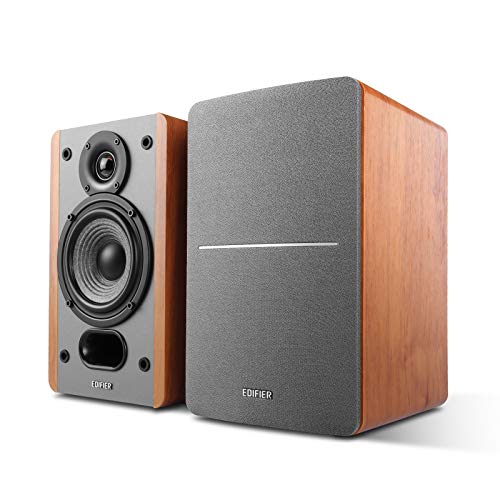
Edifier P12 Passive — Best wall-mount pair
Edifier appears in this site’s powered guides as a maker of complete systems; the P12 is the interesting exception, a passive pair from a powered specialist. Its listing is admirably blunt: two-way passive bookshelf speakers with a built-in wall-mount bracket, in a wood colour, as a pair — and the words needs amplifier or receiver to operate printed in the title itself. A maker that puts the requirement in the product name has told you everything about its attitude, and the P12’s design follows through: this is a pair engineered to be mounted, heard and left alone for years.
The built-in bracket is the feature that organises the product. Most small speakers can be wall-mounted with added hardware and optimism; the P12 arrives with the bracket integrated, which suits the rooms where mounting is the plan from the start — kitchens, dining rooms, hallways, surround positions and the shelf-less studies of the world. Mounting also solves the small speaker’s oldest placement problem, because a wall position frees the desk entirely and puts the tweeters at a height shelves rarely offer. The boundary effect of a wall adds bass weight, which a small cabinet gratefully accepts.
Edifier’s tuning experience shows in a balanced, unfussy presentation that flatters mixed use — radio in a kitchen, music in a dining room, a film’s rear channels in a lounge. The wood finish warms rooms that black boxes chill. As the closing pick of this guide, the P12 makes the passive case in its purest form: no battery, no firmware, no amplifier inside to age — just a well-tuned pair, a bracket, and whatever amplifier the next thirty years of your life happens to own.
- Amplifier: required — the listing itself says a receiver or amplifier is needed to operate
- Design: 2-way passive pair, per the listing
- Mounting: built-in wall-mount bracket, per the listing
- Finish: wood colour, per the listing
- Maker: Edifier’s passive counterpart to its powered lines
Strengths
- Integrated bracket makes wall mounting a plan rather than a project.
- Wall placement frees desks and lends small cabinets useful bass support.
- Balanced Edifier tuning suits kitchens, dining rooms and surrounds.
Trade-offs
- Wall-first design is wasted on buyers with perfect shelves.
- Wood finish is a single look; black-box rooms may not welcome it.
- An amplifier or receiver is mandatory — the title itself insists.
Best for: wall-mounted music in kitchens, dining rooms and shelf-less studies, with any amplifier or receiver driving. Not suited for: buyers who want a powered speaker, or a black finish to match existing kit.
How do the six pairs compare?
| Pair | Woofer (listing) | Design note | Needs |
|---|---|---|---|
| Polk Audio T15 | Compact class | Wall-mountable all-rounder | Amplifier or receiver |
| Sony SS-CS5M2 | 5.12-inch | 3-way, 3-driver | Amplifier or receiver |
| Klipsch R-41M | Compact class | Reference efficiency and presence | Amplifier or receiver |
| Micca COVO-S | 3-inch | True miniature, wall-mountable | Amplifier |
| Dayton Audio B40 | 4-inch | Silk dome tweeter, 6 ohm | Amplifier |
| Edifier P12 | Compact class | Built-in wall bracket | Amplifier or receiver |
The needs column is deliberately monotonous. Repetition is the point: in a market where powered and passive speakers share shelves and search results, the single most expensive misunderstanding in this category is a passive pair arriving at a home with nothing to drive it. Every row of this table needs an amplifier, and the total cost of any row is the pair plus that amplifier — or nothing extra at all, if a receiver already lives in the room, which is the situation these speakers are truly designed for.
Read the woofer column as a room-size dial. The 3-inch Micca serves the desk’s immediate field; the 4-inch Dayton and the compact-class pairs serve rooms at conversational distance; the Sony’s 5.12-inch driver reaches a little further into a living room. None reaches the bottom octave, and the table makes no row pretend otherwise. Buyers who know they will add a subwoofer later should confirm their amplifier or receiver has a subwoofer output — that socket, not any speaker figure, is the growth path in a passive system.
How do you choose an amplifier for a small passive pair?
Start with the label, not the brochure. Your amplifier should be rated for the impedance your speakers present — the Dayton’s 6 ohms is the only figure among the six that asks for a conscious check, and most amplifiers handle it without comment. Power needs are smaller than folklore suggests: small rooms at near-field distances use a few watts, and the Klipsch’s efficiency uses fewer still. A modest amplifier played within its comfort will outperform a powerful one mismatched or abused, every evening of the year.
Features matter more than watts at this level. A subwoofer output buys the future. Tone controls, unfashionable as they are, genuinely help small speakers near walls, where a touch of bass trim restores balance. And the input list decides whether the system serves the room: a turntable owner needs a phono input or a deck with its own stage — remembering Micca’s blunt printed warning that its speakers should not be fed by a turntable outside a proper chain — while a television household needs an optical or HDMI input on the amplifier, since the speakers themselves accept nothing but speaker cable. Readers cross-shopping the powered route, where the amplifier is built in, will find it compared in our guide to best powered bookshelf speakers for vinyl.
How do you place small speakers so they sound big?
Ear height is the first law: tweeters level with your ears at the listening seat, by shelf, stand or bracket. The second law is symmetry — equal distances to your seat, equal distances to the side walls where the room allows — because stereo imaging is geometry before it is electronics. Toe-in, angling the speakers toward the seat, sharpens focus; start with the cabinets aimed at a point just behind your head and adjust by ear over a week’s listening rather than a minute’s.
Walls are the third consideration, and small rooms make it unavoidable. A speaker close to a wall gains bass from the boundary — welcome for the Micca, occasionally too much for the Sony — so experiment in small steps: ten centimetres of air can be the difference between bloom and boom. Keep speakers off the same surface as a turntable, where vibration feeds back, and off wobbling furniture generally. None of this costs money, and in small systems placement routinely buys more sound than the next tier of speaker would.
What do buyers most often get wrong with small passive speakers?
Expecting them to be powered heads the list, and this guide has repeated the amplifier requirement in every section, every spec box and every verdict in the hope of retiring that surprise forever. The second error is judging a small pair in a big room at a shop, or by a specification written for a different class: a COVO-S asked to fill a hall has been set an exam it never entered. The third is amplifier neglect — pairing a thoughtful speaker with a humming, clipping bargain amplifier and blaming the speaker for the result. In a passive system the amplifier is half the sound; budget it as such.
A quieter error is ignoring the second life. Small pairs get moved — to the bedroom, to a child’s room, to surround duty — and the pairs that survive those moves are the ones with finishes that forgive and cabinets that endure. Buy the pair whose build you trust for a decade, because in this category the decade is the normal unit of ownership.
What does sensitivity mean, and why does it matter more than watts?
Sensitivity is the specification that tells you how loud a speaker plays for a given amount of power, and in small systems it quietly outranks every wattage figure in this guide. Two pairs fed by the same small amplifier can differ audibly in volume purely through efficiency — the Klipsch design philosophy is built on exactly this advantage — and the practical consequence lands on your amplifier budget: an efficient pair lets a modest amplifier live comfortably within its clean range, while an inefficient pair asks that same amplifier to work near its ragged edge for the same evening’s listening.
Listings in this class do not always print sensitivity, which is itself information: where the figure is absent, judge by design and by the partnership the maker implies. A pair marketed for small amplifiers and receivers, like most of these six, is engineered to be an easy load in practice. The buyer’s working rule is simple — if your amplifier is small, favour the pairs whose character is described as efficient or easy-going; if your amplifier is generous, the whole guide is open and sensitivity can retire to a footnote. Either way, watts on a speaker’s box remain a ceiling for safety, never a target to aim at.
Can small passive speakers serve a desk and a gaming setup?
They serve desks better than almost any powered alternative, for a reason that surprises people: the amplifier becomes the desk’s volume knob, input switch and headphone station in one box, while the speakers stay pure and permanent. A COVO-S pair flanking a monitor, fed by a compact amplifier, gives a working desk a stereo image of genuine precision — near-field listening is where small speakers are not a compromise but the correct engineering — and the same chain handles a game’s audio with the immediacy that built-in monitor speakers cannot approach.
Gaming adds one demand worth naming: dialogue and directional cues live in the midrange and treble, where every pair here is competent, while explosions live where none of them can go. Players who feel the missing foundation add a subwoofer through the amplifier’s output and complete the illusion. For the mixed desk — work calls, music, film, games — the Dayton’s smoothness and the Micca’s footprint are the two shapes the role most often takes, with the Polk as the all-round substitute when one pair must also serve a television across the room.
Why do passive speakers outlive everything else in the system?
Because there is so little in them to die. A passive bookshelf speaker is drivers, a crossover of a few robust components, and a cabinet — no battery chemistry counting its cycles, no wireless standard expiring, no amplifier cooking itself in an unventilated box, no app whose server will one day go dark. The pairs in this guide can reasonably expect to be re-homed three or four times across twenty years, driven by amplifiers that have not been designed yet, playing formats that have not been named. That longevity is the passive format’s deepest argument, and it reframes the amplifier requirement from a cost into an investment pattern: the electronics may change with the decades, the speakers simply continue.
It also changes how a careful buyer should spend. In a powered system, money divides between speaker and built-in amplifier whether you like it or not. In a passive system, you choose the division — and the durable half, the speakers, is where patience pays, because a well-bought pair amortises itself across every source and amplifier that follows. Buy the pair for the decade, the amplifier for the present, and the system can grow old without growing obsolete.
How do small speakers behave in a real shelf, among books and boxes?
The product photographs lie politely: they show small speakers in open air on empty shelves, while real shelves are crowded neighbourhoods of books, boxes and ornaments, each one reflecting or absorbing sound. A speaker pushed back among books loses its treble’s freedom and gains a boomy boundary on every side — the shelf becomes a megaphone pointed at its weakest frequencies. The cures are free and unglamorous: bring the cabinet’s front edge flush with or slightly proud of the shelf’s edge, so the sound leaves into the room rather than into the furniture; keep a hand’s width of air at the sides where you can; and angle the pair toward the seat rather than firing them straight down the room’s axis.
Books themselves are not the enemy — a full bookcase is one of the better acoustic surfaces a room can have, scattering reflections that a bare wall would slap back — provided the speakers sit in front of the books rather than inside a gap among them. Rear-ported cabinets, where a design vents backward, ask for the most air and suffer most in a tight shelf; if your shelf is shallow and fixed, favour the pairs whose placement tolerance this guide describes as forgiving, and mount the P12 on the wall instead, which is the problem it was built to solve. The shelf you have is part of the system; shop and place for it, not for the photograph.
What should a second-hand amplifier buyer check?
Because passive speakers invite second-hand amplifiers — the natural, economical pairing — a short inspection ritual is worth printing. Power the amplifier up and listen for hum and crackle with no music playing, turning every control slowly; scratchy knobs are usually cleanable, but a loud hum suggests ageing power-supply components. Check that both channels play at equal strength, that the speaker terminals grip firmly, and that the unit runs warm rather than hot after ten minutes. Ask what it has been driving: an amplifier that spent a decade with easy speakers in a small room has lived a gentler life than one that powered a hall.
Match the features to the room while you inspect: a phono input if a turntable is in the plan, a subwoofer output if film is, enough line inputs for the sources you actually own. The second-hand market is full of superb receivers from the home-theatre boom years, built to standards their original prices would embarrass today, and any of them will wake these six pairs handsomely. That ecosystem — great used amplification meeting durable passive speakers — is the budget hi-fi route that never appears in advertisements, and it is one of this category’s best-kept open secrets.
Which pair suits which listener, honestly?
Strip the guide to its temperaments and the six resolve into people. The all-rounder, who listens to everything and hosts film nights in a small lounge, is the Polk’s owner; the pair asks nothing and returns competence everywhere. The analyst, who hears a choir as individual voices and reads a crossover design with pleasure, belongs to the Sony. The enthusiast, who wants the performance to lean forward and grab the room, is Klipsch’s natural citizen, and will forgive the R-41M its insistence because insistence is what they came for.
The space-poor — the desk worker, the dorm room, the shelf measured in centimetres — belong to Micca, whose COVO-S turns scarcity from a compromise into a specification. The long-session listener, who plays music for six hours while working and wants no edge anywhere in it, is Dayton’s silk-dome audience. And the planner, whose room has no shelf but a perfect wall, is the P12’s owner, the one buyer in this guide whose placement problem arrived pre-solved. None of these listeners is a lesser audiophile than another; they are simply honest about different rooms, and the guide’s whole labour has been to let each of them recognise themselves quickly.
How do you run in and live with a new pair?
New speakers are often said to need running in, and the truth is modest: driver suspensions loosen slightly over the first hours, and listeners’ ears adjust over the first weeks, with the second effect larger than the first. Give a new pair a fortnight of normal listening before judging it, and spend that fortnight on placement rather than on test tones — small movements, a few centimetres at a time, with a familiar record as the measuring instrument. The pair that sounded merely good on delivery day frequently sounds right by the month’s end, not because the speaker transformed, but because its owner finished the installation.
Living with them afterwards asks almost nothing. Dust the cabinets with a dry cloth, keep grilles clear, and never vacuum a tweeter. Check speaker cable connections once a year — terminals loosen almost imperceptibly, and a faint crackle on one side is usually a wire asking to be reseated rather than a driver dying. Keep small speakers out of sustained direct sun, which fades finishes and ages surrounds, and they will repay the indifference with the format’s famous longevity: the pair you place carefully this year is, in all likelihood, the pair your household will still be arguing happily about a decade from now.
Final Recommendation
Choose by temperament and room, and let the amplifier you own — or honestly plan to buy — confirm the choice. The Polk T15 is the pair for most people: balanced, mountable and content in any role a small room invents. The Sony SS-CS5M2 rewards the detail hunter, the Klipsch R-41M electrifies the listener who finds politeness dull, the Micca COVO-S fits where nothing else fits, the Dayton B40 soothes the long-session ear, and the Edifier P12 was born for the wall. Whichever pair you bring home, give it a decent amplifier, an honest placement and a chair placed with intent — and a small speaker will show you, evening after evening, how large a small room can sound.
Frequently Asked Questions
Can I connect these speakers directly to my television or phone?
No — and this is the question the whole guide exists to answer before a purchase rather than after one. Passive speakers accept only an amplified signal through speaker cable. Your television, phone or computer produces a line-level or headphone signal, which must pass through an amplifier or receiver first. The chain is source, amplifier, speakers, in that order, always. If you want speakers that connect directly to a source with no amplifier between, you want the powered category — the companion vinyl guide linked in this article covers that route in depth.
How powerful an amplifier do these speakers need?
Far less than their handling figures might suggest. Handling numbers — the Polk’s 100 watts, the Dayton’s 60-watt maximum — describe what a speaker can accept without damage, not what it requires to sing. In a small room at sensible distances, a modest amplifier delivers everything these pairs can use, and the efficient Klipsch needs least of all. What matters more is that the amplifier is rated for your speakers’ impedance and stays clean at the volumes you use; distortion from an over-driven small amplifier damages speakers more readily than power from a comfortable large one.
Can small bookshelf speakers work for home theatre?
They are, in many homes, the home theatre. The Polk T15’s listing positions it for exactly that duty, the Sony comes from a home-theatre series, and the Micca and P12 make natural surround pairs where space is tight. A small-room system built from these pairs plus a centre channel and, ideally, a subwoofer for the film bass no small speaker can reach, will outperform a soundbar at the things cinemas care about: dialogue clarity, placement of effects and the sense of a room full of event. The receiver that drives them is the system’s brain, which is why its quality matters as much as any speaker’s.
Should I add a subwoofer to a small pair?
If your listening includes film, electronic music or anything whose soul lives below the midrange, a subwoofer is the single most transformative addition a small system can receive — it supplies the foundation the cabinets physically cannot, and relieves the small woofers of attempting it, which cleans up everything above as well. Your amplifier or receiver needs a subwoofer output to feed one. Music listeners in the acoustic and vocal traditions may never miss it; the honest test is your own record shelf, read carefully.
Why does one pair cost so much more than another at the same size?
Drivers, crossovers and cabinets — in that order of audibility. A three-way design like the Sony’s carries an extra driver and a more complex crossover to blend; a horn-loaded Klipsch carries precision moulding and an efficient motor; a silk dome costs more than a basic dome. Cabinet bracing and finish add their share. None of this guarantees a given listener’s preference, which is why this guide describes character rather than crowning by price: the most expensive pair here is the right answer for one temperament and the wrong one for another.
Do small speakers need speaker cable of a particular kind?
Ordinary copper speaker cable of a sensible thickness for the run is all any pair here asks for. Short desk runs are forgiving; longer runs across a room benefit from a step up in thickness, because thin cable over distance wastes a little of the amplifier’s authority and can soften the bass. What does not matter, at this level, is exotic construction or heroic pricing — the audible differences in a small system live in placement, amplifier health and the speakers themselves, in that order. Spend the cable money on records, films or a better chair, and connect the system with clean, firmly seated bare wire or simple plugs.
Are these speakers suitable for a child’s or teenager’s room?
They are a classic choice for exactly that room, with the amplifier question answered by the household: a simple integrated amplifier or a hand-me-down receiver completes a system that teaches a young listener how real stereo works, at a scale a bedroom welcomes. The Micca and Polk pairs suit the tightest rooms, and passive speakers have a parenting virtue nobody markets — no battery to swallow the evening in charging, no account, no notifications, just music when the amplifier wakes. Choose the finish that survives the room’s idea of decoration, and expect the pair to follow its owner to a first flat years later.
Can I use a single pair for both a turntable and a computer?
Yes, provided the amplifier between them offers the inputs — the speakers themselves are agnostic, since they only ever see the amplifier’s output. A typical small system routes the turntable through the amplifier’s phono input (or the deck’s own stage into a line input), the computer through another input or a digital connection, and switches between them at the amplifier. Remember Micca’s printed caution in this context: its speakers are not a turntable-direct product, meaning a bare turntable cannot drive or feed them directly — with a proper amplifier chain, any of these pairs can serve a vinyl-and-computer desk faithfully.
Related Guides
The powered alternative — speakers with the amplifier built in and a phono stage in several models — is covered in our guide to best powered bookshelf speakers for vinyl, and the same rooms often want sound outdoors as well, which is where best outdoor rock bluetooth speakers takes over.


