What's inside
- Where to buy
- Key Takeaways
- Quick Picks
- How did we choose powered speakers for record players?
- What does a phono preamp actually do?
- How do the six pairs compare for a turntable owner?
- How do you set up a powered vinyl system properly?
- What mistakes send new vinyl listeners wrong?
- How do you choose between the two Klipsch models?
- What about cartridges, and does MM versus MC matter here?
- How big a room can a powered bookshelf pair honestly fill?
- How should you audition these speakers with your own records?
- What does the rest of the vinyl chain ask of these speakers?
- When is an external phono stage still worth adding?
- How do powered speakers change the second-hand turntable hunt?
- Final Recommendation
- Frequently Asked Questions
- Related Guides
As an Amazon Associate I earn from qualifying purchases. This post may contain affiliate links at no extra cost to you.
gizmoverdict.com is reader-supported. When you buy through links on our site, we may earn an affiliate commission.
Where to buy
Each speaker below links to the Amazon listing verified for this guide. Powered speakers are sold as pairs, as single units and occasionally as bundles with cables or stands, so read the listing’s quantity line with care — and if you are matching a speaker to a turntable, read the input list twice, because the entire buying decision in this category hides in the inputs. The reviews state plainly which picks carry a phono stage and which do not; a listing that contradicts its review on that point is a different revision, and its inputs govern.
The best powered bookshelf speakers for vinyl exist to delete a box. The traditional vinyl chain — turntable, phono stage, amplifier, passive speakers — sounds wonderful and fills a shelf with hardware. A powered pair folds the amplifier into the speakers, so the chain becomes turntable, speakers, music. But folded inside that simplicity is the one technical fact that decides whether a new vinyl listener hears their records gloriously or barely at all: a turntable’s raw output is far too quiet and far too bass-shy to feed an ordinary input, and something in the chain must correct it. That something is a phono preamp, and whether it lives in your turntable, in your speakers, or nowhere is the question this entire guide is organised around.
Here is the short version, which the rest of the article will unpack slowly and from several directions, because this single fact is responsible for more returned speakers and more disappointed first evenings than every other specification in the category combined — and because, once understood, it never troubles a listener again. Three of the six picks — the two Klipsch models and the Orroplus — carry a built-in phono stage per their listings, so any turntable can plug straight in. The other three — both Edifiers and the Saiyin — are line-level speakers: superb with a turntable that has its own built-in preamp switched on, and nearly silent with one that does not, unless an external phono stage joins the chain. Neither family is better. They simply expect different turntables, and matching them correctly is the whole game.
Key Takeaways
- Phono versus line is the decision in this category: a record player’s raw signal needs a phono preamp somewhere, and the six picks split evenly on whether they provide one.
- The Klipsch R-40PM and R-51PM and the Orroplus carry built-in phono stages per their listings, so any turntable — vintage or modern — connects directly.
- The Edifier R1280T, Edifier R1700BTs and Saiyin are line-level only; pair them with a turntable whose built-in preamp is switched to line, or add an external phono stage.
- The Edifier R1280T remains the classic starter pair: 42 watts RMS per its listing, no Bluetooth, no phono stage, and a decade of owners who began exactly there.
- A subwoofer line out, offered by the R1700BTs and the Saiyin per their listings, is the upgrade path for buyers who later want the bottom octave vinyl hides in big rooms.
- Power figures here are RMS or per-channel listing figures, a more honest dialect than party-speaker peak claims — but they still describe the listing, not a measurement.
Quick Picks
| Speaker pair | Badge | Why it is here |
|---|---|---|
| Edifier R1280T | Best classic starter | The long-running entry point to powered vinyl listening, for turntables that bring their own phono stage. |
| Klipsch R-40PM | Best phono-equipped all-rounder | A built-in phono stage, horn-loaded clarity and a modern input set in the smaller Klipsch cabinet. |
| Klipsch R-51PM | Best bigger Klipsch | The larger PM model with the same plug-any-turntable convenience and more cabinet to work with. |
| Edifier R1700BTs | Best line-level upgrade | 66 watts RMS per the listing, Bluetooth and a subwoofer line out for systems that plan to grow. |
| Orroplus Powered Speakers with Phono Preamp | Best vintage-styled phono pair | A built-in phono preamp and DSP in a vintage-styled cabinet with a 3.5-inch woofer per side. |
| Saiyin Powered Bluetooth Bookshelf Speakers | Best input-rich line-level pair | Bluetooth, optical, aux and RCA inputs plus a sub out, for desks where the turntable shares duty with a TV and a computer. |
How did we choose powered speakers for record players?
We started with the phono map, because a guide that ranks these six without it would be ranking blind. Every pick was classified by its listing: phono stage built in, or line-level only. Then, within each family, we weighed the things that decide daily vinyl life — how the speaker handles the quiet detail of an acoustic pressing, whether its controls sit where a listener actually reaches, whether a subwoofer can join later, and whether the non-vinyl sources in a real room (a phone, a television, a computer) can share the speakers without a cable swap.
Sound character mattered in a specifically vinyl way. Records reward speakers that are forgiving in the treble and honest in the midrange, because surface noise lives in the treble and music lives in the midrange. A speaker voiced for maximum sparkle will present every crackle as a headline; a speaker voiced warm will let the music stand in front of the medium. Neither voicing is a defect — collectors of pristine audiophile pressings and collectors of charity-shop originals are, acoustically, shopping for opposite virtues, and this guide tries to say plainly which pick leans which way so that each kind of collector lands on the right side of the line. The reviews describe each pick’s leaning in those terms, using the design facts the listings provide — horn loading on the Klipsch models, near-field monitor positioning on the Edifiers, DSP on the Orroplus — rather than invented measurements.
Finally, we checked the growth story. A first vinyl system is rarely the last: a subwoofer, a better turntable, a streamer, a second room that wants the old pair when the main system climbs. Picks that offer a subwoofer output or a generous input count leave those doors open, and the reviews say which doors each pick leaves open and which it closes. The cheapest system is the one bought once, and in this category that usually means buying the inputs you will need in three years, today, rather than the inputs that merely suffice for this winter.
What does a phono preamp actually do?
Two jobs, both essential. First, amplification: the signal leaving a phono cartridge is measured in millivolts, roughly a hundred times weaker than the line-level signal a CD player or phone produces, so without a phono stage the music arrives at a normal input as a whisper. Second, equalisation: records are cut with the bass deliberately reduced and the treble boosted, to keep the grooves physically manageable, and the phono stage applies the exact mirror curve — the RIAA curve — to restore the balance. Skip it, and music sounds thin, tinny and wrong in a way no tone control can repair, because the tone control is being asked to rebuild a balance that was never delivered to it — like trying to season a meal whose ingredients were halved before cooking.
The stage can live in three places: inside the turntable (many modern decks offer a phono/line switch), inside the speakers (the Klipsch PM models and the Orroplus here), or in a small external box between the two. All three arrangements can sound excellent. The one arrangement that cannot is its absence — and the second failure is duplication: two phono stages in one chain over-amplify and double-equalise, producing a loud, boomy mess. So the working rule is exactly one phono stage per chain, and the buyer’s job is simply to know where theirs lives. Every review below states its pick’s arrangement in the first paragraph, so you can plan the chain before a single cable is bought, and the comparison table further down gathers all six arrangements onto one line each for the moment of decision.

Edifier R1280T — Best classic starter
The R1280T is where a generation of vinyl listeners started, and its specification explains both its fame and its one condition. The listing describes a 2.0 active near-field pair, 42 watts RMS, finished in brown wood effect. There is no phono stage and no Bluetooth. What there is: a simple, honest powered speaker that expects a line-level signal — which means your turntable must provide its own preamp, switched to line, or an external phono stage must sit between deck and speakers. Meet that condition and the R1280T rewards you with the sound that made its reputation.
That sound is warm, close and forgiving — near-field voicing designed for listeners a metre or two away, which is where most turntable setups in real rooms actually sit. Acoustic records, jazz trios and vocal pressings come across with a body that flatters vinyl’s strengths, and the treble is civilised enough that surface noise stays in its proper place as background texture rather than headline act. The front-panel controls on the master speaker put volume and tone where a hand falls naturally, and the absence of an app or a remote worth losing is, for many owners, a feature disguised as an omission.
Its limits are the honest kind. Forty-two watts RMS fills a bedroom, a study or a living-room corner; it will not fill a hall, and it was never asked to. There is no subwoofer output, so the upgrade path runs through replacement rather than addition. And the phono condition is absolute: connect a raw turntable output and you will hear almost nothing, which has generated a decade of confused one-line reviews from buyers who skipped this paragraph’s lesson. Paired with the right deck, the R1280T remains the benchmark starter pair against which every other pick here is measured.
- Phono stage: none — line-level inputs only
- Power: 42 watts RMS, per the listing
- Type: 2.0 active near-field monitors, per the listing
- Finish: brown
- Subwoofer out: not offered
- Turntable requirement: built-in preamp in the deck, or an external phono stage
Strengths
- Warm near-field voicing flatters records and forgives surface noise.
- Simple controls and no app layer keep daily use friction-free.
- A long production life means proven, well-understood behaviour.
Trade-offs
- No phono stage, so a bare turntable output will not work directly.
- No Bluetooth for the phone listening that shares most rooms.
- No subwoofer output, so bass growth means new speakers later.
Best for: beginners with a modern turntable that has a built-in preamp, listening at desk or armchair distance. Not suited for: owners of vintage decks without a preamp, unless an external phono stage joins the budget.

Klipsch R-40PM — Best phono-equipped all-rounder
The R-40PM answers the phono question by removing it. Per its listing and the PM line’s design, a phono stage is built in, so the chain collapses to its simplest possible form: any turntable, a cable, these speakers, music. Vintage deck with no preamp? Plug in. Modern deck? Switch it to phono output and plug in. That universality is the R-40PM’s headline, and for buyers who inherited a turntable or hunt second-hand ones, it is worth more than any single sound trait, because it makes every deck a compatible deck.
The sound is unmistakably Klipsch. The listing names the 90-degree by 90-degree Tractrix horn and the Linear Travel Suspension tweeter design — horn loading is the company’s century-old signature, and its character is presence: instruments step forward, dynamics arrive with a snap that soft-dome speakers smooth over, and quiet passages hold their detail because the horn is efficient at low levels too. On vinyl, that character flatters live recordings and anything with horns, strings and attack; on a crackly old pressing, it will also present the crackle honestly, which some listeners love as atmosphere and others should audition before committing.
As the smaller of the two PM models here, the R-40PM fits the shelves and desks where most vinyl systems live, while keeping the family’s full convenience. It is the pick we would hand to the buyer who says the words plug and play and means them as a requirement rather than a hope. Combined with the phono stage, the modern input set hinted by its PM positioning makes it a room’s audio hub, not merely a turntable accessory — the television, the phone and the deck can all live here.
- Phono stage: built in, per the listing — any turntable connects directly
- Tweeter: 90-degree x 90-degree Tractrix horn with LTS design, per the listing
- Type: powered bookshelf pair
- Finish: black, per the listing
- Role: smaller of the two Klipsch PM picks in this guide
- Turntable requirement: none beyond a cable
Strengths
- Built-in phono stage makes every turntable compatible out of the box.
- Horn-loaded presence suits live and dynamic recordings beautifully.
- Compact cabinet fits the shelves real vinyl systems occupy.
Trade-offs
- Forward voicing presents surface noise on worn pressings honestly.
- Smaller cabinet limits deep bass without a subwoofer partner.
- Sits in a higher tier than the Edifier starter pair.
Best for: owners of any turntable — especially vintage decks — who want direct connection and lively sound. Not suited for: listeners who prefer a soft, laid-back presentation that hides a record’s wear.

Klipsch R-51PM — Best bigger Klipsch
The R-51PM is the R-40PM’s larger sibling, and the review can be honest about the relationship: same philosophy, more cabinet. The listing describes a powered Bluetooth speaker pair in black, and the PM designation carries the family’s built-in phono stage, so the plug-any-turntable convenience applies in full. What the bigger box buys is the thing bigger boxes always buy — easier bass, more headroom, and a sound that fills a living room rather than perfuming a desk.
That scale changes the vinyl experience in a specific way. Records of scale — orchestral pressings, live rock recordings, the big-chorus albums of the seventies — ask a speaker to move air in proportion to the event, and a compact cabinet answers with effort where the R-51PM answers with ease. At the modest volumes of evening listening the difference narrows, but the larger Klipsch never sounds like it is counting its reserves, and listeners who host — records as a room’s entertainment, not a desk’s — will feel that ease as the evening’s background confidence.
Bluetooth, named in its listing, covers the phone’s share of the room, and the phono input covers the deck; between them, most households’ listening is fully housed. Why choose it over the R-40PM? Room size and listening distance, answered honestly: beyond roughly three metres of listening distance, or in a room that opens into another, the bigger cabinet earns its shelf space. Within a cosy study, the smaller sibling gives up little. Klipsch buyers are choosing a size here, not a philosophy, and both sizes share the guide’s most convenient phono story.
- Phono stage: built in, per the PM line’s listing position — direct turntable connection
- Connectivity: Bluetooth named in the listing
- Type: powered bookshelf pair, larger cabinet
- Finish: black, per the listing
- Role: the full-room Klipsch option in this guide
- Turntable requirement: none beyond a cable
Strengths
- Same any-turntable convenience as its sibling, with more cabinet.
- Headroom suits living rooms and listening at real distance.
- Bluetooth covers the phone without disturbing the vinyl chain.
Trade-offs
- Larger footprint needs a shelf or stand that can hold it.
- Klipsch presence is a character some listeners find assertive.
- Overkill for a small desk setup, where its sibling suffices.
Best for: living-room vinyl systems and inherited turntables that need a phono stage and room-filling ease. Not suited for: tight desks or listeners who want the gentlest possible treble.
Edifier R1700BTs — Best line-level upgrade
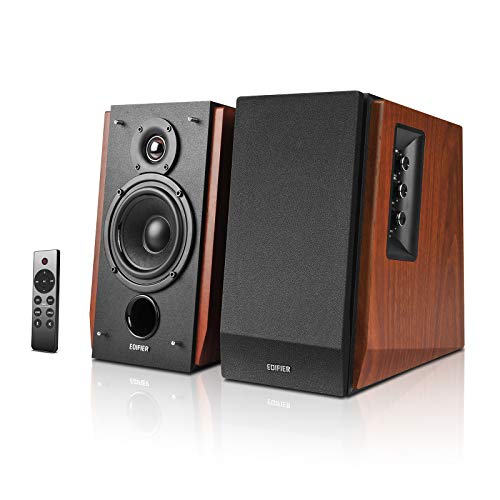
The R1700BTs is the R1280T’s more ambitious relative, and its listing tells the growth story in numbers and sockets: 66 watts RMS, Bluetooth in the name, and a subwoofer line out. The phono condition, however, is unchanged — this is a line-level pair, so the turntable must bring its own preamp or an external stage must join the chain. Buyers stepping up from the R1280T already own that arrangement, which is precisely the audience this speaker serves: the second-system buyer, upgrading deliberately.
The subwoofer line out is the feature with the longest consequences. Vinyl’s deepest bass is modest by modern standards, but a large room swallows what there is, and a subwoofer restores the foundation that makes orchestral and electronic pressings feel complete. A speaker without a sub out makes that upgrade a replacement; the R1700BTs makes it an addition, whenever the budget and the room agree. Until then, 66 watts RMS and a larger cabinet than its sibling give it a fuller voice at distance — this is the Edifier for the living-room end of the desk-to-room spectrum.
Bluetooth covers streaming duties, and the angled front baffles of the R1700 design aim the sound up toward seated ears from low shelves, a small ergonomic kindness that near-field listeners notice daily. Its character stays in the family — warm, composed, forgiving of older pressings — with more authority underneath. For the line-level household planning to grow, this is the natural summit of the Edifier route in this guide, and its only real demand is that the phono homework be done before it arrives.
- Phono stage: none — line-level inputs only
- Power: 66 watts RMS, per the listing
- Subwoofer: line out provided, per the listing
- Connectivity: Bluetooth named in the listing
- Type: active near-field bookshelf pair
- Turntable requirement: the deck supplies the preamp, or a separate stage is added
Strengths
- Subwoofer output turns a future upgrade into an addition, not a replacement.
- More power and cabinet than the starter Edifier, for real rooms.
- Bluetooth folds streaming into the same pair that plays records.
Trade-offs
- Still no phono stage — the line-level condition applies in full.
- Angled, larger cabinets need more shelf depth than the R1280T.
- Its headroom is wasted in tiny rooms at whisper volumes.
Best for: line-level households upgrading from a starter pair, with a subwoofer in their future plans. Not suited for: buyers whose turntable has no preamp and no plans to add one.

Orroplus Powered Speakers with Phono Preamp — Best vintage-styled phono pair
Orroplus builds its pitch directly into its name: powered speakers with a phono preamp. The listing specifies a built-in phono preamp and DSP, 30 watts per channel, a 3.5-inch woofer per side, and AUX, RCA and Bluetooth inputs, all in a vintage-styled cabinet. For the vinyl beginner, that combination reads like the brief itself answered: connect any turntable directly, connect the phone by Bluetooth when the records rest, and let the DSP keep the small woofers behaving beyond their size.
The 3.5-inch woofer is the honest limit to keep in view. Small drivers in small cabinets produce a sound scaled for desks, bedrooms and kitchen counters — clear, present and light in the bass. DSP can extend the impression of low end and protect the drivers from overreach, and modern processing does it surprisingly gracefully, but it cannot repeal cone area. Judge the Orroplus as a near-field companion and it is well judged; ask it to fill a hall and the judgement is yours, not the speaker’s. The vintage styling, meanwhile, is a genuine part of the product: a vinyl corner is a designed place in most homes, and a speaker that looks like it belongs beside a turntable earns its shelf differently from a studio-styled box.
As a route into vinyl, the Orroplus may be the lowest-friction pick in this guide: no preamp homework, no external boxes, a forgiving size and a look that invites the hobby rather than intimidating it. Its ceiling is lower than the Klipsch pair’s — in output, in cabinet, in long-term system ambition — but a first system that gets played daily beats an ambitious one that intimidates its owner, and this pair is engineered, styled and priced in spirit for exactly that daily play.
- Phono stage: built in, per the listing — direct turntable connection
- Power: 30W per channel in the listing
- Woofer: 3.5-inch, per the listing
- Inputs: AUX, RCA and Bluetooth per the listing
- Processing: built-in DSP, per the listing
- Style: vintage-styled cabinet
Strengths
- Built-in phono preamp removes the category’s main beginner trap.
- Vintage looks belong beside a turntable in a designed corner.
- Bluetooth and aux inputs cover the phone and everything else.
Trade-offs
- Small woofers cap bass and volume at near-field scale.
- DSP assistance is not a substitute for cabinet size in big rooms.
- Less upgrade headroom than the sub-out-equipped rivals.
Best for: vinyl beginners and vintage-deck owners building a handsome desk or bedroom corner. Not suited for: large rooms, bass-led music at volume, or long-term system builders.

Saiyin Powered Bluetooth Bookshelf Speakers — Best input-rich line-level pair
Saiyin’s pair competes on connectivity breadth. The listing enumerates Bluetooth, optical, auxiliary and RCA inputs, a subwoofer output, 40 watts per channel and a 4-inch woofer, aimed at turntable, television, record player and computer alike. Read that list as a room strategy: this is the pair for the desk or media corner where one set of speakers must serve every source in the room, switching between a record at breakfast and a film at night without a cable ever moving. The phono condition is the line-level one — no built-in phono stage is claimed — so the turntable brings its preamp or an external stage joins.
The optical input is the quietly decisive item. Televisions and media boxes speak optical, and a bookshelf pair that accepts it becomes the room’s sound system in full, which changes the value calculation: the Saiyin is not a turntable accessory with extras, it is a hub that also plays records. The sub out repeats the R1700BTs’ growth argument at a different tier — when the room wants more foundation, a subwoofer plugs in and the pair stays. Forty watts per channel, as claimed in the listing, is ample for the desk-and-TV distances this speaker is designed around.
Character, judged by design, is the modern neutral: a 4-inch woofer pair tuned for clarity across mixed content rather than for vinyl warmth alone. Records sound clean and present; dialogue sounds intelligible; games sound immediate. The specialist might miss the Edifiers’ forgiving warmth on rough pressings or the Klipsch drama on live ones, but the generalist — which is most rooms — gets a single pair that never has to apologise to any source. In a guide organised by a turntable question, the Saiyin is the answer for households whose turntable is one citizen among several.
- Phono stage: none claimed — line-level inputs only
- Power: 40W per channel in the listing
- Woofer: 4-inch, per the listing
- Inputs: Bluetooth, optical, auxiliary and RCA per the listing
- Subwoofer: sub out provided, per the listing
- Turntable requirement: line output from the deck, or a standalone phono box upstream
Strengths
- Optical input makes it a genuine TV and media hub, not a single-source pair.
- Subwoofer output keeps the growth path open.
- Input breadth ends cable swapping in multi-source rooms.
Trade-offs
- No phono stage, so bare turntable outputs need help as elsewhere.
- Neutral tuning is less flattering to worn records than warmer rivals.
- Brand and long-term support are less established than Edifier or Klipsch.
Best for: desks and media corners where turntable, TV and computer must share one capable pair. Not suited for: purists building a vinyl-only chain, or vintage decks without a preamp plan.
How do the six pairs compare for a turntable owner?
| Pair | Phono stage | Power (listing) | Sub out |
|---|---|---|---|
| Edifier R1280T | No — line-level | 42W RMS | No |
| Klipsch R-40PM | Yes, built in | See listing | See listing |
| Klipsch R-51PM | Yes, built in | See listing | See listing |
| Edifier R1700BTs | No — line-level | 66W RMS | Yes |
| Orroplus | Yes, built in | 30W per channel | See listing |
| Saiyin | No — line-level | 40W per channel | Yes |
The phono column is the table’s reason to exist, and it divides the six into two households of three. If your turntable has a built-in preamp with a line setting — most modern decks do — both households are open to you, and the choice becomes about sound, size and growth. If your turntable lacks a preamp, the left household is closed unless an external stage is added, and the right household — Klipsch, Klipsch, Orroplus — is where your shortlist lives, at least until an external stage reopens the door. Notice that the division is not a quality ranking: the line-level Edifiers are excellent speakers that simply expect the preamp to live elsewhere.
The power column needs its dialect lesson. Edifier quotes RMS, the conservative continuous measure; the Orroplus and Saiyin quote per-channel figures; all are listing figures rather than our measurements, and none maps directly onto loudness in your room, which depends on sensitivity and distance as much as wattage. Treat the numbers as class markers — desktop, room, larger room — and let the reviews’ placement advice carry the real decision.
How do you set up a powered vinyl system properly?
Begin with the switch hunt. If your turntable has a phono/line selector, find it — it hides on the back panel, underneath, or occasionally inside the platter area — and set it to match your speakers: line for the Edifiers and the Saiyin, phono for the Klipsch pair and the Orroplus, whose own stages then do the work. Exactly one stage in the chain, always. Connect with the turntable’s ground wire attached where the phono-equipped speaker or stage provides a terminal; an unattached ground announces itself as a hum that rises with the volume, and it is the most common — and most curable — sound in new vinyl systems.
Placement is the second half of setup, and bookshelf speakers reward the same care as the deck. Tweeters at ear height from your listening seat is the goal, achieved with stands, shelves or simple angled pads; the R1700BTs’ angled baffles forgive low shelves, but nothing forgives a speaker buried behind books. Keep the pair away from the turntable’s own surface where you can — a speaker sharing a shelf with a deck can feed vibration back into the cartridge at volume, heard as a low bloom on loud passages. A metre of separation, or isolation pads under the speakers, cures what distance cannot. Finally, give records the near field they love: these are speakers designed for a listener a few metres away, and a chair placed with intent is the cheapest upgrade in the entire system. Listeners whose vinyl corner shares a room with a screen should also see our guide to best small bookshelf speakers, where the passive alternatives for amplifier owners are compared.
What mistakes send new vinyl listeners wrong?
The silent system is the famous one: a turntable’s phono output feeding a line input, producing music so quiet that buyers conclude the speakers are broken. The boomy system is its mirror — a deck set to line feeding a speaker’s phono input, double-equalised into a loud, swollen mess that buyers conclude is just how vinyl sounds. Both are one switch away from correct, and both are why this guide repeats the one-stage rule until it becomes reflex. When a new system sounds wrong in either direction, check the chain’s stages before blaming any component.
Hum is the second teacher. A missing ground connection, a cable run alongside mains leads, or a deck and speakers on different circuits can all sing along with the music. Cure them in order: ground wire first, cable routing second, and patience throughout — hum hunting is elimination, not inspiration. The third mistake is placement by furniture rather than by ear: speakers at unequal heights, one in a corner and one in free space, will image like a funhouse mirror no matter their pedigree. Symmetry is free. Take it.
How do you choose between the two Klipsch models?
Since the R-40PM and R-51PM share a philosophy, a phono stage and a family voice, the choice between them is refreshingly physical. Measure your listening distance. Inside roughly three metres — a desk, a reading chair, a bedroom corner — the smaller cabinet gives up almost nothing, because near-field listening rewards clarity over output and both horns deliver the family’s presence at close range. Beyond that distance, or in rooms that open into kitchens and hallways, the larger cabinet’s ease begins to tell: bass that does not thin with distance, and headroom that keeps big pressings composed when the volume rises to fill the space.
Shelf reality votes too. The R-51PM needs a shelf or stand that accepts its greater depth without hanging the rear ports against a wall, and a room whose proportions suit a larger visual presence. The R-40PM disappears into ordinary furniture. Neither choice is a compromise — Klipsch built the pair as sizes of one idea — so buy the size your room asks for and spend the difference, if there is one in your budget’s mind, on records. That advice generalises across this whole guide, in fact: speakers in a well-matched chain differ by degree, while records differ by everything.
What about cartridges, and does MM versus MC matter here?
Almost every turntable a reader of this guide owns uses a moving-magnet cartridge, and every phono stage in this guide — built into the Klipsch pair, the Orroplus, or the decks feeding the line-level picks — is designed for that world. Moving-coil cartridges, the low-output exotica of high-end vinyl, need more gain and different loading than these stages provide, and they belong to systems built around external stages chosen for them. If your deck is a classic with its original cartridge, it is moving-magnet in all likelihood, and the plug-and-play promises above hold. The lesson is simply to know which world your cartridge lives in before assuming a stage suits it — a thirty-second check of the cartridge’s name against its type, done once, forever.
There is a gentler corollary for beginners: because the phono stages here are fixed and competent, they free the new listener from an entire category of setup anxiety. No gain switches to mis-set, no loading plugs to lose. The chain forgives, the music plays, and the upgrade itch — when it comes, as it does — can be spent on the turntable and the records, where this guide’s speakers will still be waiting, entirely adequate to the improved source.
How big a room can a powered bookshelf pair honestly fill?
Bookshelf speakers fill rooms by proximity more than by power. In a small room — a study, a bedroom, a snug — every pick in this guide is sufficient at any sane volume, and the differences between them narrow to character. In a medium living room, the larger cabinets and the sub-out picks pull ahead, because distance taxes bass first and the subwoofer path is the honest cure. In a genuinely large or open-plan space, a bookshelf pair of any kind becomes the near end of the solution: place the listening chair inside the speakers’ comfortable radius and the system works beautifully within it, while the far kitchen hears a pleasant murmur rather than a performance.
That radius thinking is the mature way to buy. A vinyl system is a place — two speakers and a chair in conversation — more than it is a room-filling appliance. Set up the place properly, with the speakers at ear height and the chair a few metres away, and even the smallest pick here, the Orroplus, delivers the full emotional content of a record. Ask the same speaker to entertain a dinner party across fifteen metres and it will sound thin, not because it failed, but because the question changed. Buy for the place you will actually sit, and let parties borrow the system at whatever volume it offers.
How should you audition these speakers with your own records?
Bring three records you know by heart and one you suspect is badly recorded. The beloved three tell you whether the speaker serves your music: listen for the voice you have heard a hundred times, and whether it arrives with its character intact. The bad record is the honesty test — a forgiving speaker, like the Edifiers, will let you enjoy it anyway; a revealing one, like the Klipsch pair, will show you exactly why it sounds bad, which is information some listeners treasure and others experience as rudeness. Neither response is wrong, but knowing yours before the return window closes is the entire point of the exercise.
Audition at your real distance and your real volume, in the evening quiet if that is when you listen. Play the quietest passage you own and notice whether detail survives at low level — horn efficiency and near-field tuning both shine there — then play the loudest chorus and notice whether the sound stays composed or begins to shout. Swap the phono arrangement if your chain allows both routes, and trust the one that sounds balanced rather than the one that sounds impressive. Impressive is a first-week quality; balanced is a tenth-year one.
What does the rest of the vinyl chain ask of these speakers?
Very little, and that is the format’s gift. A turntable asks for a stable, level surface far more than it asks anything of the speakers, and a cartridge asks for its tracking force set once with care. The speakers ask only for what this guide has covered: the right input, a sane placement, and a chair. Everything else in the vinyl ritual — cleaning records, replacing a stylus on schedule, storing sleeves upright — belongs to the records themselves, and the speakers will report your diligence faithfully: a clean, well-kept pressing through even the humblest pick here will move a listener more than a dirty masterpiece through the finest.
Budget accordingly. The temptation in any new system is to spend on the visible electronics, but vinyl’s economics point the other way: the speakers in this guide are all, within their sizes, more capable than the average record collection they will play. Money beyond the right pick is usually better spent on the deck’s cartridge, on a record cleaning routine, and above all on records — the one component of the system that is also the entire point of it. Buy the pair that matches your chain and your room, then stop shopping and start listening; the hobby begins where the comparison ends.
When is an external phono stage still worth adding?
Owners of the line-level picks sometimes ask whether a dedicated external stage would beat the one inside their turntable, and the honest answer is: eventually, perhaps, and later than you think. A turntable’s built-in stage is engineered for its own cartridge and is rarely the weakest link in a starter system; the cartridge, the pressing and the placement all queue ahead of it. An external stage earns its money when the rest of the chain has matured — a better cartridge fitted, a collection of demanding pressings, ears that have learned what their system does. At that point the stage becomes a tuning instrument as much as a necessity, and the line-level speakers in this guide accept it without complaint, because a line input does not care what produced the line signal.
For owners of the phono-equipped picks, the question inverts: the built-in stage can be bypassed by feeding the speakers a line signal from an external stage or a preamp-equipped deck, should an upgrade path ever lead there. Nothing is wasted either way. That flexibility — every pick here can live in a chain whose phono stage moves house as the system grows — is the quiet structural virtue of the whole category, and it is why a first purchase made on the one-stage rule does not become a dead end when the hobby deepens.
How do powered speakers change the second-hand turntable hunt?
They widen it enormously, and this may be the phono-equipped picks’ most practical gift. The second-hand market is full of excellent turntables from the decades when no deck carried a preamp, because none needed one — amplifiers had phono inputs as a matter of course. A buyer limited to line-level speakers must either restrict the hunt to modern decks or budget an external stage for every vintage candidate. A buyer with a Klipsch PM pair or the Orroplus can shop the whole history of turntables on sound and condition alone, knowing the speakers will accept whatever follows them home. In a hobby where the deck is often inherited, found or rescued, that universality has a value no specification captures.
The same logic protects the opposite journey. A modern deck bought today for a line-level pair may be replaced in five years by a vintage flagship; if the speakers are the Edifiers, an external stage joins at that point, and if they are the Klipsch pair, nothing joins at all. Either way the speakers survive the deck change, which is the pattern to aim for in every component of a vinyl system: buy the pieces that do not care what their partners are, and the system can evolve one honest upgrade at a time.
Final Recommendation
Decide where your phono stage lives, and this guide resolves itself. Owners of turntables without a preamp should choose between the Klipsch R-40PM for compact rooms, the R-51PM for larger ones, and the Orroplus for a vintage-styled beginner’s corner — each connects directly and forgives every deck. Owners of modern decks with a line output should start at the Edifier R1280T for a first system, climb to the R1700BTs when a subwoofer enters the plan, or take the Saiyin when a television and a computer must share the pair. Every route ends in the same place: a record spinning, two speakers singing, and not a single unnecessary box in between.
Frequently Asked Questions
My turntable has a phono/line switch. Which setting do I use?
The setting that puts exactly one phono stage in your chain. With the Klipsch PM models or the Orroplus, set the turntable to phono, because the speakers provide the stage. With the Edifiers or the Saiyin, set it to line, because the turntable must provide the stage the speakers lack. If you add an external phono stage later, the turntable goes back to phono and the external box takes the job. One stage, one job, no exceptions — nearly every bad first impression of vinyl traces back to breaking this rule in one direction or the other.
Can I use these speakers with a turntable that has a USB output?
Yes, and USB decks make the phono question easier, because a turntable with USB almost always includes a built-in preamp and a line-level analogue output alongside it. Use the analogue line output into any pick in this guide, including the line-level Edifiers and Saiyin. The USB port itself is for digitising records to a computer, which is a separate hobby; for listening, the analogue chain is the path, and it is already amplified correctly by the deck.
How long should a powered vinyl pair last?
Longer than the upgrade itch, if the room is kind. The amplifiers in powered speakers live a hotter life than those in a separate box, so ventilation matters — do not seal a powered pair into a closed cabinet — but a well-placed pair should serve through several turntables and many hundreds of records. The parts that age are the parts that move and the parts that store: drivers loosen gracefully over years, and any capacitors in the amplifier age on a decade’s scale rather than a season’s. Buy the pair whose sound you like, place it with air around it, and expect the relationship to be measured in record collections rather than product cycles.
Do I need speaker stands for bookshelf speakers?
Need is strong, but height is not negotiable — only the method is. Tweeters belong near ear level at your seat, and stands are simply the most flexible way to put them there. A sturdy shelf at the right height serves as well, and angled pads can rescue a low surface by tilting the sound upward. What does not serve is the top of a wobbling bookcase or the same surface the turntable sits on, where vibration feeds back into the cartridge. Judge stands as an acoustic purchase, not furniture, and their cost makes sense.
Why does my vinyl sound thinner than streaming through the same speakers?
First, check the phono rule: a missing stage leaves records quiet and thin in exactly this way, and it is the cause nine times in ten. If the chain is correct, the remaining difference is character. Vinyl’s mastering, especially on older pressings, often carries less deep bass and a gentler top than a modern stream, and honest speakers report that faithfully. A subwoofer through the R1700BTs or Saiyin’s sub out addresses the foundation; the rest is the medium’s nature, which most listeners come to prefer precisely because it asks the ear to lean in.
Can powered speakers stay plugged in all the time?
They are designed to, and most owners leave them in standby permanently, waking them when the deck spins. Standby draw on modern powered pairs is small, though a listener counting every watt can use the master speaker’s switch. The practical caution is hum: a powered speaker left on with its input open can amplify a ground loop’s whisper into audibility, which is an argument for tidy cabling rather than for switching off. Keep the chain grounded and routed cleanly, and an always-ready system stays silent until the needle drops.
What cables do I actually need?
Fewer than the accessories industry hopes. A phono run from turntable to speaker or stage should be the deck’s own interconnect where one is captive, or a short, well-shielded RCA lead where it is not — phono signals are tiny and pick up interference gratefully, so short and shielded beats long and exotic every time. The ground wire, where the deck provides one, is not optional decoration; attach it. Line-level runs between a deck with a built-in stage and the speakers are far more forgiving, and ordinary quality RCA leads serve perfectly. Spend on records before cables, in this category above all, and let any cable that hums be replaced for its shielding rather than its mythology.
Can I wall-mount or place these speakers on their sides?
On their sides, mostly yes for casual listening, with the caveat that stereo imaging is designed around upright tweeters aligned vertically with their woofers; a sideways pair trades a little focus for the shelf fit, and many listeners in real rooms accept the trade happily. Wall mounting is a question for the individual model’s rear panel and your wall, and none of the picks here is primarily designed as a wall speaker — the passive guide linked in this article covers a pair built with a wall bracket, if that is the installation you truly need. For the powered six, stands and shelves remain the intended homes.
Is Bluetooth good enough for vinyl listening?
Bluetooth does not carry the vinyl signal in any setup in this guide — the turntable connects by cable, always, because that is where its quality lives. Bluetooth’s role here is the second source: the phone, for the hours when the records rest. Judged in that role it is entirely good enough, and its presence on the R1700BTs, R-51PM, Orroplus and Saiyin is a convenience for the room rather than a compromise for the deck. Purists lose nothing; the needle never knows Bluetooth exists.
Related Guides
Buyers who already own an amplifier and want the passive route through the same shelves will find it in our guide to best small bookshelf speakers, and those whose listening leans portable can step sideways into best outdoor wireless bluetooth speakers for the garden end of the collection.


