What's inside
- Key Takeaways
- Quick Picks
- How Did We Rank a Class That Time Has Closed?
- Why Do Birders Still Choose a Mirror and a Prism?
- What Should You Check Before Buying Any Body in This Guide?
- How Do These Six Survivors Compare for the Working Birder?
- Which Long Lenses Give These Bodies Their Reach?
- How Do You Shoot Birds Through a Prism in Practice?
- How Does the Used Lens Market Actually Work for Each Mount?
- How Does a DSLR Kit Behave Across a Birding Year?
- DSLR or Mirrorless for Birds: What Is the Honest Ledger?
- What Goes Wrong When People Buy a DSLR for Birds Today?
- Two Canons, Two Nikons, Two Pentaxes: How Do You Choose Within Each Pair?
- How Do You Set Up a Feeding Station or Hide for DSLR Bird Portraits?
- Does the Sound of a Mirror Matter to the Birds?
- How Do You Inspect a Used or Remaining-Stock DSLR Before Money Changes Hands?
- What Does Good Birding Technique Look Like on Decade-Old Hardware?
- Final Recommendation
- Frequently Asked Questions
- Related Guides
As an Amazon Associate I earn from qualifying purchases. This post may contain affiliate links at no extra cost to you.
gizmoverdict.com is reader-supported. When you buy through links on our site, we may earn an affiliate commission.
Where to buy: Each body below links to its verified listing, and several of these cameras now reach buyers through marketplace sellers and remaining retail stock rather than fresh factory runs, so read the listing’s seller and condition notes carefully before ordering. Every pick is a body-only listing; the long lens that makes birding possible is, as ever, a separate decision.
Let us say the quiet part in the first paragraph, because honesty is the entire point of this guide: the best birding DSLR cameras belong to a class that has ended. No manufacturer is developing new DSLRs, the great birding bodies of the mirrorless era have taken the flagship budgets, and several listings below are the tail end of production or carefully kept remaining stock. And yet a DSLR remains, for a particular kind of birder, a completely rational purchase — sometimes the smartest one on the page — because the lenses are cheap and plentiful, the batteries last for days, and the optical viewfinder shows the bird itself rather than a screen’s opinion of the bird.
That is the audience this guide serves: the birder who already owns EF or F-mount telephotos and refuses to sell them at a loss, the beginner who wants a real birding apprenticeship at used-market prices, and the traditionalist who simply prefers a pentaprism and a mirror’s honest clack. What follows is not nostalgia. Each body here earned its reputation on real marshes and real migration mornings, and the differences between them — autofocus spread, burst depth, sealing, sensor size — still decide real photographs.
The economics deserve emphasis because they invert the mirrorless story. In the DSLR world the celebrated bodies are finished products with finished prices, and the legendary telephotos — the 100-400mm zooms, the 150-600mm third-party workhorses, the fast primes of the professional era — circulate second-hand in enormous numbers. A complete, serious birding kit built around the D500 or 90D below can cost what a single modern mirrorless telephoto costs alone. For a hobby where fieldcraft matters more than electronics, that arithmetic is not a compromise. It is a strategy.
Key Takeaways
- The DSLR class is closed: no new models are coming, so buy for the lenses and the value, not for a future upgrade path within DSLRs.
- Used and remaining-stock telephoto lenses are the real prize; every mount here has a deep, affordable long-glass market.
- The Nikon D500 remains, years on, the autofocus and burst benchmark of the entire DSLR birding era.
- Pentax never left: the K-3 Mark III is the most modern DSLR in this guide and the toughest in bad weather.
- The Canon EOS 7D Mark II is a 2014 veteran — buy it as the used-market bargain it is, with eyes open about its age.
- Optical viewfinders and multi-day battery life are genuine working advantages, not sentimental ones.
Quick Picks
| Pick | Badge | Why it made the list |
|---|---|---|
| Canon EOS 90D (body) | Best overall | The highest-resolution birding DSLR here, with modern live-view focus, 4K video and Canon’s friendly handling. |
| Nikon D500 (body) | Best AF and burst | A flagship autofocus system in a crop body, ten frames a second and a buffer that behaves like it means it. |
| Pentax K-3 Mark III (black) | Best weather sealing | The newest design in this guide: 12fps, a superb 1.05x viewfinder and weather resistance built for filthy mornings. |
| Nikon D7500 (body) | Best value | Most of the D500’s sensor goodness and Nikon’s metering in a lighter, friendlier body for long walks. |
| Pentax K-1 Mark II Silver LE (body) | Full-frame Pentax option | A limited silver edition full-frame body with grip included, for perched birds, hides and deliberate work. |
| Canon EOS 7D Mark II (body) | Veteran budget body (2014) | The professional workhorse of its decade, now the cheapest honest apprenticeship in serious bird photography. |
How Did We Rank a Class That Time Has Closed?
Our criteria ignored launch dates and judged the bodies as tools available to buy today. Autofocus coverage and intelligence came first, because birding through a viewfinder lives or dies on whether focus points reach the corner where the bird actually sits. Burst rate and buffer followed, then the viewfinder itself — its magnification, its brightness, the honesty of seeing the subject directly. Sealing and build were scored for the weather birding actually happens in, and lens-market depth was treated as a specification in its own right: a body is only as good as the affordable long glass behind it.
Two judgements need explaining. The 90D takes the overall crown not because it out-shoots the D500 — in pure action terms it does not — but because it is the most complete birding DSLR a newcomer can buy today: resolution for cropping, a modern touchscreen live view that focuses like a mirrorless camera when the bird is perched and still, and video the Nikon cannot match. The K-1 Mark II sits in this list for a different reason: it is the full-frame option for hide and feeder photography where the bird comes to you, and its limited-edition silver finish with battery grip makes it the collector-birder’s pick as much as a working one.
Why Do Birders Still Choose a Mirror and a Prism?
Start with the viewfinder. An optical finder shows the bird with zero lag, zero blackout drama and no exposure simulation lying to you about a backlit sky; experienced flight photographers track through it with an ease that even the best electronic finders only approach. Add battery life measured in days of birding rather than hours, bodies that wake instantly and stay awake, and controls designed to be found by gloved fingers without a menu in sight. Then add the deepest advantage of all: thirty years of telephoto lenses, from humble zooms to legendary primes, circulating at prices set by a market that has moved on.
There is also the matter of how these cameras age in the hand. A DSLR’s controls are physical and positional: the mode dial clicks, the joystick nudges, the depth-of-field preview is a lever your finger learns. After a season, operation becomes spinal rather than visual, and the camera disappears from the transaction between eye and bird. Touchscreen mirrorless bodies reach a similar fluency by a different road, but the DSLR road is shorter for photographers who shoot in gloves, in rain, or with eyes that no longer love small bright screens at arm’s length. Accessibility is a specification too, and this class scores on it in ways its makers never advertised.
The honest debits are equally real. No DSLR here offers the bird-eye detection that modern mirrorless bodies use to find a warbler’s eye in foliage; you place the focus point, as birders always did, and skill carries more of the load. Live view on most of these bodies is slow for action, video is a secondary skill except on the 90D, and every gram of the mirror mechanism is weight you carry. A DSLR in 2026 is a deliberate choice, not a default — which is exactly why the people who make it tend to know precisely what they are doing.
What Should You Check Before Buying Any Body in This Guide?
Shutter count is the DSLR equivalent of mileage. These are mechanical cameras with rated shutter lives, and a used or remaining-stock body should be checked against its rating the way you would check a car’s odometer; sellers of remaining retail stock will state condition plainly, and marketplace listings deserve a careful read of what exactly is in the box. Ask about the battery’s health, the sensor’s cleanliness, and whether the charger and strap are original, because small omissions are how a bargain quietly stops being one.
Then check the lens you intend to marry it to, before the body ships. Confirm the mount, confirm autofocus compatibility with any teleconverter you plan to use, and — for the Canon bodies — remember that EF and EF-S lenses are the native fit while RF lenses cannot be adapted backwards onto a DSLR at all. Nikon F-mount shooters should check whether their chosen telephoto has its own focus motor, since the D7500 and D500 both drive modern AF-S and AF-P glass happily but older screw-drive lenses are a different conversation. Pentax owners have the simplest story: decades of K-mount glass, all of it stabilised by the body itself.

Canon EOS 90D (body) — Best overall
The 90D was Canon’s last and finest APS-C DSLR, and it shows in the one number birders care about most: 32.5 megapixels on a crop sensor, the densest pixel pitch in this guide, which translates directly into pixels on the bird. A warbler that fills half the frame can be cropped hard and still print; a distant raptor becomes identifiable rather than impressionistic. Through the viewfinder it fires ten frames per second with a competent 45-point autofocus system whose centre points stay sensitive in poor light, and its DIGIC 8 processor keeps the whole operation feeling modern rather than memorial.
Flip to live view and the 90D becomes a different, sneakily excellent camera: Dual Pixel autofocus covers the frame, touches focus where you tap, and turns perched-bird work at feeders and hides into the easiest shooting in this entire guide. The vari-angle touchscreen that enables it also makes low hide work and awkward angles painless, and the 4K video is genuinely usable for behaviour clips. The debits are the class debits — no bird-eye detection, a viewfinder autofocus spread narrower than the D500’s, and a single card slot — but as a complete, current, warrantied-feeling route into serious birding on Canon’s vast EF lens market, nothing else here argues as persuasively.
- Sensor: 32.5MP APS-C CMOS with DIGIC 8
- Video: 4K, uncropped in its main mode
- Autofocus: 45-point viewfinder system; Dual Pixel AF in live view
- Screen: 3.0-inch vari-angle touch LCD
- Connectivity: built-in Wi-Fi and Bluetooth
- Listing format: body only from the Canon storefront listing
Strengths
- Cropping power that rescues distant birds no other DSLR here can match.
- Live-view focusing that turns feeder and hide sessions into near-mirrorless ease.
- Access to the largest used telephoto market in photography.
Trade-offs
- Viewfinder autofocus coverage is narrower than the Nikon’s wide spread.
- A single card slot, where the D500 offers two.
- Ten frames per second comes with a buffer that asks for short, edited bursts.
Best for: newcomers and Canon lens owners who want the most complete modern birding DSLR. Not suited for: flight specialists who need the widest autofocus spread and the deepest action buffer above all.

Nikon D500 (body) — Best AF and burst
Ask a room of veteran bird photographers to name the greatest crop-sensor DSLR ever made and the D500 ends the discussion. Nikon took the autofocus system of its flagship D5 — 153 points spread across the frame, with the cross-type density and the tracking brain to use them — and put it in an APS-C body whose crop factor turns a 200-500mm zoom into a serious birding instrument. Ten frames per second, a buffer that swallows long RAW sequences when fed fast cards, and a viewfinder experience that still feels like professional equipment rather than a consumer compromise: this is the action birding benchmark of the mirror era, full stop.
Its 20.9-megapixel sensor is the deliberate trade. You get less cropping room than the 90D offers, and in exchange the pixels are larger, the high-ISO files cleaner, and the whole pipeline faster. Birders who fill the frame through fieldcraft rather than software will never miss the extra resolution; birders who rely on the crop will feel it weekly. Build quality is tank-grade, sealing is serious, the illuminated buttons are a dawn blessing nobody else in this guide copied, and dual card slots protect the morning’s work. If flight is your religion, this is your church, and its second-hand congregation of F-mount telephotos is the deepest value pool in birding.
- Sensor: 20.9MP DX-format CMOS
- Autofocus: 153-point system shared with the flagship line
- Burst: 10fps with a deep buffer on fast media
- Cards: dual slots, XQD/CFexpress-class plus SD
- Build: magnesium body, extensive sealing, illuminated controls
- Listing format: body only
Strengths
- Autofocus spread and tracking that remain the DSLR class standard.
- Buffer discipline that rewards decisive flight sequences.
- Low-light files that stay cleaner than its resolution rivals.
Trade-offs
- Twenty megapixels punish the crop-happy shooter.
- Video is an afterthought beside the Canon’s offering.
- Fast cards for the primary slot add a real, if one-off, cost.
Best for: flight photographers and action birders who fill the frame in the field. Not suited for: beginners who want live-view ease and video, or heavy croppers working distant perched birds.

Pentax K-3 Mark III (black) — Best weather sealing
The K-3 Mark III is the wonderful anomaly of this guide: a DSLR designed and launched as if the mirrorless takeover were a rumour, by the one company that never stopped believing. The result is the most modern optical-viewfinder camera here — a 1.05x magnification prism with essentially full frame coverage that makes the bird big and bright in the finder, 12 frames per second, a 25.7-megapixel sensor with in-body stabilisation that steadies every K-mount lens ever made, and weather sealing specified to a degree that invites genuinely foul conditions. Pentax birders shoot in rain that sends other brands under the hide roof.
Autofocus is the honest caveat. The 101-point SAFOX system improved subject tracking markedly over earlier Pentax bodies and handles birds against sky and water well, but against tangled branches the Canon and Nikon brains still read the scene a step faster. What you get instead is a system philosophy: superb primes and zooms going back decades, all stabilised, all affordable, in a body built like field equipment rather than electronics. For the birder whose patch is a windswept headland and whose calendar is migration season in all weathers, this is not the eccentric choice. It is the correct one.
- Sensor: 25.7MP APS-C with 5-axis in-body shake reduction
- Burst: 12fps
- Viewfinder: 1.05x optical, 100% coverage
- Build: weather-resistant magnesium alloy body
- Screen: touch LCD
- Listing format: black body only
Strengths
- The finest optical viewfinder experience in this entire guide.
- Sealing and build that treat bad weather as a working condition.
- Every legacy K-mount telephoto gains stabilisation from the body.
Trade-offs
- Tracking through clutter trails the Nikon and Canon systems.
- The long-lens market is smaller than Canon’s or Nikon’s, if still deep.
- Fewer third-party birding zooms are made in K-mount today.
Best for: all-weather birders and Pentax loyalists who value the finder and the fortress build. Not suited for: shooters who want the biggest possible choice of new third-party telephoto zooms.
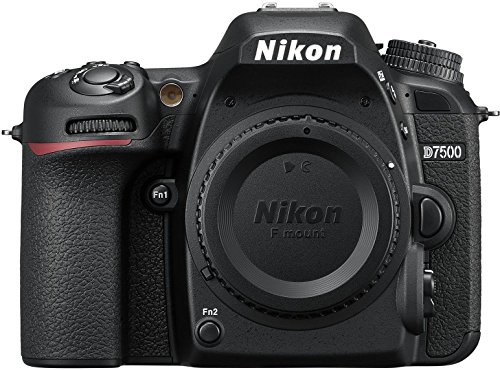
Nikon D7500 (body) — Best value
The D7500 is the thinking birder’s shortcut through the Nikon range: the same excellent 20.9-megapixel sensor family as the D500, Nikon’s superb 180,000-pixel metering brain reading the scene, and a tilting touchscreen, all in a body that weighs noticeably less on the walk out and costs noticeably less at the till. Its 51-point autofocus system is a generation behind the flagship spread in the D500, and the difference shows mainly at the frame’s edges and in the most chaotic flight work; for the great majority of birding — perched birds, waterbirds on approach lines, raptors circling a thermal — the D7500 focuses with an authority that embarrasses cameras costing far more.
Eight frames per second with a respectable buffer covers burst work honestly, the high-ISO behaviour inherited from that sensor family is a gift at woodland edges, and the lighter build pairs beautifully with the 200-500mm class zooms for handheld days. The compromises are documented and acceptable: one card slot, no battery-grip option for those who want one, and a buffer that fills during the longest RAW sequences. As the value door into serious Nikon birding — with the entire F-mount lens library on the other side of it — the D7500 has been the recommendation for years, and the end of DSLR production has only made its remaining stock more interesting.
- Sensor: 20.9MP DX-format CMOS
- Burst: 8fps
- Metering: 180k-pixel RGB sensor scene recognition
- Screen: tilting touch LCD
- Build: lighter monocoque construction, single card slot
- Listing format: body only
Strengths
- Flagship-family image quality at the friendliest Nikon price here.
- Weight that keeps handheld telephoto days enjoyable.
- Metering that reads backlit birds against water with unusual sense.
Trade-offs
- Autofocus spread is a clear step behind the D500’s coverage.
- Single card slot and no grip option limit professional redundancy.
- Buffer depth asks for burst discipline on long flight sequences.
Best for: value-minded Nikon birders and walkers who count grams. Not suited for: professionals needing dual slots and the widest tracking spread for paid action work.

Pentax K-1 Mark II Silver LE (body) — Full-frame Pentax option
Full frame and birding are usually opposing ideas — the crop bodies exist precisely because reach is scarce — but there is a kind of bird photography where the bird comes to you: the hide, the feeding station, the garden blind, the patient sit beside a known perch. For that photographer the K-1 Mark II in this limited silver edition is a genuinely desirable tool. Its 36-megapixel full-frame sensor resolves feather detail with a richness crop sensors admire from a distance, high-ISO files stay immaculate in hide gloom, in-body stabilisation steadies the big Pentax telephotos, and the included BG-6 battery grip extends both handling and endurance for long seated sessions.
The silver limited finish is not mere vanity; limited Pentax editions hold their following, and the camera underneath is the same serious instrument as the standard black version. Burst speed is modest and autofocus spread is full-frame-DSLR modest, so flight work belongs to the D500 and K-3 Mark III in this guide. Judged on its own brief — deliberate, close, quality-obsessed bird portraiture on the deepest-value full-frame lens market there is — the K-1 Mark II Silver LE is the connoisseur’s pick, and the only camera here that will also be admired as an object on the shelf between outings.
- Sensor: 36.4MP full-frame CMOS
- Stabilisation: 5-axis in-body shake reduction
- Edition: Limited Silver, BG-6 battery grip included
- Build: weather-resistant full-frame body
- Mode note: APS-C crop mode available for extra reach framing
- Listing format: body with grip
Strengths
- Full-frame feather detail and hide-light cleanliness.
- Grip included, extending seated-session comfort and battery life.
- A limited edition with a genuine enthusiast following behind it.
Trade-offs
- Burst rate and focus spread are not built for flight sequences.
- Full frame gives back the reach the crop bodies multiply.
- Weight with grip suits the hide far better than the long hike.
Best for: hide and feeder photographers, and Pentax collectors who shoot. Not suited for: flight chasers and reach-hungry birders working distant subjects on foot.

Canon EOS 7D Mark II (body) — Veteran budget body (2014)
Every word about this camera must begin with its birth year: 2014. The 7D Mark II is a veteran, and this guide frames it exactly that way — not as a modern camera in disguise, but as the most instructive bargain in bird photography. In its day it was the professional’s crop body: 65 cross-type autofocus points spread wide across the frame, ten frames per second, a magnesium body sealed like a flagship, dual card slots and ergonomics that taught a generation of sports and wildlife shooters their craft. All of that hardware still works exactly as it did, and the used market prices it like the elder statesman it is.
Its 20-megapixel sensor shows its age in dynamic range and high-ISO noise beside the 90D, there is no touchscreen finesse and no 4K anything, and any example you buy deserves the shutter-count and condition checks this guide described earlier. What you are purchasing is apprenticeship and autofocus: a focus system that still teaches flight technique properly, wrapped in a body tough enough to survive the learning. Pair it with a used 400mm prime or a third-party 150-600mm and you own a birding education for the price of a modern kit lens. Photographers who learned on this camera are, disproportionately, the ones whose work you stop scrolling for.
- Sensor: 20.2MP APS-C CMOS (2014 generation)
- Autofocus: 65-point, all cross-type
- Burst: 10fps
- Cards: dual slots, CF plus SD
- Build: magnesium alloy, flagship-grade sealing for its era
- Listing format: body only; expect marketplace and remaining-stock sellers
Strengths
- Professional autofocus spread at the lowest entry price here.
- Build quality that shrugs off a decade of field use.
- The ideal teaching camera: it rewards technique instead of replacing it.
Trade-offs
- Sensor age shows in shadows and at high sensitivities.
- Condition varies by seller; shutter count checks are essential.
- No modern live-view or video conveniences to lean on.
Best for: budget apprentices and second-body traditionalists who know what they are buying. Not suited for: anyone expecting current-generation image quality or a factory-fresh experience.
How Do These Six Survivors Compare for the Working Birder?
| Body | Sensor | Burst | Autofocus character | Defining virtue |
|---|---|---|---|---|
| Canon EOS 90D | 32.5MP APS-C | 10fps | 45-point finder; Dual Pixel live view | Cropping power plus modern ease |
| Nikon D500 | 20.9MP APS-C | 10fps | 153-point flagship spread | Action authority |
| Pentax K-3 Mark III | 25.7MP APS-C | 12fps | 101-point SAFOX system | Finder quality and weatherproofing |
| Nikon D7500 | 20.9MP APS-C | 8fps | 51-point system, superb metering | Value with real reach |
| Pentax K-1 Mark II Silver LE | 36.4MP full frame | Modest | Full-frame spread, deliberate pace | Hide portraiture and detail |
| Canon EOS 7D Mark II | 20.2MP APS-C | 10fps | 65 cross-type points | The veteran apprenticeship |
The table’s lesson is that this class ended with its specialisations intact. There is no bad birding camera here; there are six different answers to six different mornings, priced by a market that has stopped asking a premium for any of them. Choose by the photography, not the production year.
Which Long Lenses Give These Bodies Their Reach?
Canon birders live in the deepest glass market in the world: the EF 100-400mm II is the connoisseur’s walk-around, the third-party 150-600mm zooms are the people’s choice, and the great white primes circulate used at prices that once seemed impossible. Nikon F-mount answers with the beloved 200-500mm, a lens whose steady second-hand supply is half the D500’s value argument, plus the same third-party 150-600mm family in F fit. Pentax shooters choose between the 150-450mm zoom, the compact 300mm prime beloved of walkers, and a back-catalogue of film-era telephotos that the in-body stabilisation makes useful again.
Teleconverters behave predictably in this world: a 1.4x on a fast zoom keeps autofocus on all these bodies’ centre points and costs a stop; a 2x is a bright-day, perched-bird tool and should be bought with that expectation. And one warning that applies to every mount: check autofocus compatibility between your specific lens, converter and body in the maker’s charts before spending, because the DSLR era’s long product runs produced combinations that focus beautifully and combinations that merely fit.
How Do You Shoot Birds Through a Prism in Practice?
The DSLR flight technique is a craft with settled rules. Use the widest autofocus area your subject’s background allows, keep the shutter at or beyond 1/2000 for anything smaller than a heron, and let aperture sit where the lens is sharp rather than where pride suggests. Pre-focus on the perch or the flight line’s midpoint so the system starts its search near the answer, and track with the lens supported — a monopod’s pivot is the flight photographer’s metronome. Shoot the burst as the bird crosses your front, not as it recedes, and stop the moment the sequence peaks; DSLR buffers forgive much, but editors forgive nothing.
For perched birds the discipline reverses: slow down, use the centre group of points or, on the 90D, the live-view touch focus, and wait for the head turn that makes the portrait. Give the bird time to forget the camera entirely — a feeding bird that has accepted your presence will offer poses no amount of chasing can buy, and the DSLR’s patience-friendly battery means the camera can wait exactly as long as you can. The optical finder teaches patience because it never flatters you with a simulated preview; what you see is the bird, the light and nothing else, and the photograph is made by the waiting as much as by the shutter.
How Does the Used Lens Market Actually Work for Each Mount?
Canon EF is the deepest pool. Three decades of professional and enthusiast buying mean the celebrated birding lenses exist in every condition grade and every city, and prices are set by genuine competition among sellers. The buyer’s discipline is simple: check the glass for fungus and haze with a torch shone through the elements, work the zoom and focus rings through their full travel, and confirm the image stabilisation engages with its characteristic soft clunk and settles the finder image. A lens that passes those tests at thirty years old will very likely pass them at forty.
Nikon’s F-mount pool is nearly as deep, with one extra question to ask: does this lens carry its own focus motor? The D500 and D7500 both focus modern AF-S and AF-P lenses fully, and both can drive many older designs, but the combinations matter enough that Nikon’s own compatibility charts deserve ten minutes before any purchase. Pentax’s K-mount pool is smaller and friendlier — prices are set by a compact community that tends to describe condition honestly — and it hides a unique treasure: manual-focus telephotos of superb optical quality that the in-body stabilisation and focus-confirmation systems make genuinely usable for perched birds.
Across all three mounts, the smart money buys the lens first and the body second, because the lens is the scarcer, longer-lived asset. Bodies in this guide are finished products at finished prices; the lens you choose will still be the heart of the kit if you change bodies within the system, and it holds the larger share of the kit’s resale value if you ever leave. Birding folklore says you date the body and marry the lens, and the DSLR market’s maturity has made that proverb into straightforward financial advice.
How Does a DSLR Kit Behave Across a Birding Year?
Spring migration is the DSLR’s showcase season: warblers moving fast through fresh leaves, waders on passage, light returning. The D500 and 90D earn their keep in the chaos, and battery endurance stops being an abstraction when a dawn session stretches to five hours without a recharge — a DSLR simply keeps going, where a mirrorless bag needs its rotation of charged cells. Summer slows the pace; breeding birds demand distance and discretion, and the hide-based photographers with the K-1 Mark II and long primes do their finest, quietest work of the year.
Autumn brings the second migration and the year’s most forgiving light, the season when the 7D Mark II apprentices traditionally discover that their keeper rate has quietly doubled since spring — the camera did not change, and that is the point of the apprenticeship. Winter is the sealing test: sea-watching in driven rain, wildfowl in sleet, short days at high sensitivities. The K-3 Mark III was quite literally designed by people who shoot this season, and the Pentax advantage stops sounding like marketing somewhere along a February seawall. A DSLR kit asks for one seasonal ritual in return: a end-of-winter clean, contacts wiped, firmware checked, desiccant in the bag during the damp months, so the mirror mechanism that defines the class stays as crisp in year five as in year one.
DSLR or Mirrorless for Birds: What Is the Honest Ledger?
The mirrorless column is formidable and this guide will not pretend otherwise: bird-eye autofocus that finds the subject for you, silent shutters that never disturb a bird, pre-capture buffering that rescues launches, and viewfinders that preview exposure. If money is no object and the newest capability is the point, the argument ended years ago and the wildlife guide elsewhere on this site ranks those bodies. The DSLR column wins on different ground entirely: total system cost, battery endurance, optical-finder honesty, control layouts built for gloves, and a used lens market of unmatched depth.
The deciding question is therefore not which technology is better in the abstract, but which constraint binds you. If your constraint is budget — and for most birders it is — the DSLR system buys more birding per unit of money than anything else in photography today, full stop. If your constraint is the last few percent of flight keepers at professional level, mirrorless owns that territory. Most birders live between those poles, and the healthiest sign in the hobby right now is how many of them run both: a DSLR kit that cost little and teaches much, beside a mirrorless body for the assignments that demand it, sharing the same tripod, the same hides and the same photographer.
What Goes Wrong When People Buy a DSLR for Birds Today?
The commonest failure is buying the badge instead of the system: a famous body arrives, and only then does the owner discover the telephoto budget was spent on the camera. In this class the lens is the purchase and the body is nearly an accessory to it, so price the pair together or do not price at all. The second failure is ignoring condition on veteran bodies — the 7D Mark II especially rewards a shutter-count check and punishes its absence. The third is expecting mirrorless subject-detection from a mirror: these cameras focus where you point them, superbly, and the pointing is your job.
There is also the mistake of the wrong first lens: a fast, short prime bought for its reputation, when birding needed the unglamorous zoom that actually reaches. In this class the 150-600mm and 200-500mm class zooms are the correct first telephotos for almost everyone — flexible for learning distances, long enough for real birds, and cheap enough used that the body-plus-lens budget survives contact with them. The exotic primes are second lenses, bought by photographers who already know exactly which distance their patch demands.
A fourth mistake is subtler: selling excellent DSLR glass in a panic because the class has ended. Lenses do not read press releases. A sharp 150-600mm on a D500 will photograph next spring’s migration exactly as well as it photographed the last one, and the photographers who kept their nerve own the best-value birding kits of the decade.
Two Canons, Two Nikons, Two Pentaxes: How Do You Choose Within Each Pair?
Canon asks you to choose between the present and the past of the same idea. The 90D is the 7D concept grown up: more resolution, kinder live view, modern connectivity, a gentler learning curve. The 7D Mark II is the same idea in its professional prime, with the wider focus spread and the tougher body, priced by its age. If the budget stretches to one body and the photography is general birding, the 90D is the answer; if the budget must also swallow a serious lens this season, the 7D Mark II plus glass is the combination that produces photographs sooner, and photographs are the point.
Nikon’s pair divides by ambition rather than era. The D7500 covers the whole of ordinary birding superbly and asks little; the D500 covers the extraordinary days — the flight chaos, the once-a-year rarity in bad light — and asks for fast cards and full commitment. Birders who know their patch is mostly perched and passing birds should save the difference toward the 200-500mm; birders whose patch is a migration bottleneck, where the sky fills and the light fails, should buy the D500 and never think about the decision again.
Pentax divides by format and philosophy. The K-3 Mark III is the action instrument, crop-sensored and quick, with the great finder; the K-1 Mark II is the portrait instrument, full-framed and deliberate, with the grip and the limited-edition silver finish. They share lenses, batteries of accessories and a design language, and a surprising number of Pentax birders eventually own both, using the crop body as the walk-around and the full-frame as the hide camera. Of the three pairs, it is the one where “both” is a respectable answer rather than an extravagance.
How Do You Set Up a Feeding Station or Hide for DSLR Bird Portraits?
The hide is where the full-frame K-1 Mark II and the live-view 90D justify their places in a birding guide, and the setup is a craft of its own. Position the hide so the morning light falls over your shoulder onto the perch, place that perch — a weathered branch, not a sawn dowel — at the distance your lens loves most, and let the background fall far enough behind it to melt into colour. Feed consistently for a week before the first session; birds are creatures of timetable, and a station that is stocked at dawn becomes a studio with regular models by the second week.
Inside the hide, the DSLR virtues compound. Battery life measured in days means the camera stays ready through a six-hour sit without a power bank in sight. The optical finder lets you watch the perch for hours without the eye fatigue of a bright screen in a dark box. On the 90D, flip to live view on the vari-angle screen and compose low, silent-feeling portraits without contorting; on the Pentax bodies, let the in-body stabilisation hold a slow shutter steady as the light fades and the last birds come in. Work the session like a portraitist: wait for the turn of the head, the catchlight, the moment the bird is a subject rather than a specimen, and take three frames where the mirrorless shooter takes thirty. The restraint shows in the results.
Does the Sound of a Mirror Matter to the Birds?
Sometimes, and honest guidance should say when. At a feeder ten metres away, a DSLR’s shutter is a soft mechanical event that habituated birds ignore within a session; garden regulars learn the sound the way they learn the hide’s silhouette, as part of the furniture. At a nest or with a nervous species at close range, the calculus changes, and the ethical answer is distance first and equipment second: a longer lens from farther away beats a quiet camera too close, every time, on every system. Several bodies here offer quieter drive modes that soften the mirror’s return at the cost of speed, and they are worth learning before the session that needs them rather than during it.
It is also worth puncturing a myth in the other direction. Birds react to movement, shape and pattern far more than to sound; the photographer who shifts position, raises the lens suddenly or wears a bright sleeve will flush a bird that would have sat through a hundred shutter clicks. Camouflage the movement before you worry about the noise, keep the lens still and pointed near the subject so its final lift is small, and let the mirror make its honest sound. Fieldcraft silences more birds’ alarms than any silent shutter ever fitted.
How Do You Inspect a Used or Remaining-Stock DSLR Before Money Changes Hands?
Work through the camera the way a technician would, in the same order every time. First the exterior: grip rubber lifting at the corners tells a story about hard years, bright marks on the prism housing tell one about drops, and neither is fatal if priced honestly. Work every dial through its detents, press every button, and open both card doors and the battery door to check the seals and contacts inside. Mount a lens — ideally the one you intend to buy — and listen to the shutter at its fastest and slowest speeds; a healthy focal-plane shutter sounds even and decisive, while hesitation or a ragged note at slow speeds is a service bill introducing itself.
Then photograph methodically. Shoot a plain wall or clear sky at a small aperture to expose sensor dust and any dead-pixel clusters, shoot a detailed subject at your highest sensitivity to see the noise character you will live with, and shoot a burst to confirm the buffer and mirror mechanism run without complaint. Find the shutter-count readout — many bodies record it in image file data readable by free utilities — and set it against the model’s rated life: a D500 at a third of its rating is a young camera, while the same count on a body rated lower is a negotiation. Finally, confirm the small print of the sale: charger, battery, strap, caps, and a returns window long enough for a morning’s real birding to serve as the true inspection. Sellers of remaining retail stock will meet this list without blinking, and a private seller who welcomes it is telling you something good about the camera.
What Does Good Birding Technique Look Like on Decade-Old Hardware?
It looks, mostly, like the technique that built bird photography’s classic era, because these cameras were designed around it. The focus point is placed, not delegated: you learn to move the selected point or group with the joystick or pad while your eye stays at the finder, until the bird and the active points meet by reflex. Back-button focus separates the act of focusing from the act of firing, so a perched bird can be focused once and then photographed through a dozen head turns without the system re-hunting at every press — a technique DSLR birders refined to an art and one every body in this guide supports.
Exposure is likewise manual in spirit even when automatic in setting. The optical finder does not preview your exposure, so you learn to read light itself: the compensation a white egret needs against dark water, the stop you add for a raven against bright sky, the moment a cloud changes everything by two thirds. Photographers raised on these bodies develop an exposure intuition that transfers to every camera they will ever own, which is a large part of why the 7D Mark II apprenticeship keeps being recommended by people who now shoot flagship mirrorless bodies. The old hardware teaches the permanent skills; that is its final specification, and no successor model has superseded it.
Final Recommendation
Buy the Canon EOS 90D if you want one DSLR that does the whole of birding well today — the resolution, the live view and the lens market make it the complete answer. Buy the D500 if flight is your first love and frames are filled in the field, the K-3 Mark III if your birding happens in weather, the D7500 if Nikon’s system calls and the budget argues, the silver K-1 Mark II if your birds come to a hide and detail is your pleasure, and the 7D Mark II if you want the finest apprenticeship ever discounted. The mirror is finished as an industry, but on a cold marsh at first light, with a heron lifting through mist in front of a prism, finished and done-for are not at all the same thing.
Frequently Asked Questions
Are DSLRs a dead end for a beginner birder?
They are a closed system, not a dead one, and the distinction matters every time a beginner weighs a first serious purchase against a tight and honestly limited budget. Your lenses will not migrate to a mirrorless body without adapters and compromises, but the kit you build will work superbly for years at prices mirrorless cannot touch. Many beginners learn on DSLR value and upgrade later with skills fully formed.
Why is the D500 still so respected when it is a decade old?
Because its autofocus system came from a flagship, its buffer behaves professionally, and birding rewards those two things above novelty. Age has lowered its price far faster than it has lowered its capability.
Should I worry that the 90D listing I saw elsewhere said renewed?
Listings vary by seller and stock, which is why this guide assigns the Canon storefront listing for the 90D. Whatever listing you buy from, read its stated condition carefully and confirm what is included; condition honesty matters more with end-of-production cameras than with current ones.
Can these cameras use mirrorless lenses with an adapter?
No. Mirrorless lenses are designed for a shorter distance to the sensor and cannot be adapted backwards onto DSLRs. DSLR lenses, by contrast, often adapt forward onto mirrorless bodies — one more reason the glass in this ecosystem holds its value.
Is the 7D Mark II too old to be reliable?
It is a professional body built for hard use, and well-kept examples work beautifully. Reliability questions are really condition questions: check shutter count against its rated life, test the cards and dials, and buy from sellers who describe condition precisely.
Which of these is best for a complete beginner?
The 90D, for its forgiving live view, touchscreen and resolution that tolerates imperfect framing. The D7500 is the close alternative for Nikon-leaning beginners, and the 7D Mark II suits the beginner who specifically wants to be taught by demanding equipment.
Do these DSLRs hold their value if I upgrade later?
Better than most electronics, because their prices have already taken the depreciation the class’s end imposed. A carefully bought D500 or 90D, kept in good condition, typically resells near its purchase price within the enthusiast market, and the lenses hold value better still. Buy condition, keep boxes and receipts, and the apprenticeship can cost surprisingly little in the end.
What memory cards should I buy for the D500 and 90D?
Feed them at the speed their buffers deserve. The D500’s primary slot takes fast XQD or CFexpress Type B media, and pairing it with a slow card wastes the buffer you bought the camera for; the 90D takes SD cards and rewards the fastest UHS-II cards in sustained bursts. In both cases, two medium cards rotated daily beat one enormous card that holds a whole trip hostage to a single failure.
How long will manufacturers keep servicing these bodies?
Service windows vary by maker and model, and they close gradually rather than overnight; the highest-volume bodies like the D500 and 7D Mark II also enjoy a deep ecosystem of independent repairers and donor parts. Before buying any end-of-line body, a quick check of the maker’s current service list for that model is a sensible five minutes, and independent specialists will keep mechanical DSLRs working for many years beyond official windows.
Is a DSLR a sensible second body beside a mirrorless camera?
It is one of the best-value second bodies in all of photography today: an optical-finder alternative for long, patient hide sits, a battery-sipping backup that shares your tripod plates and field habits, and — in the same mount family via adapters in some systems — a home for lenses you already own. Many working birders run exactly this pairing during migration season.
Which of these handles a 150-600mm zoom best handheld?
The K-3 Mark III and 90D, thanks to in-body stabilisation working with the lens’s own system, with the D500 close behind on technique and grip depth. On any of them, a monopod transforms handheld telephoto work from endurance into craft, and it costs less than any other upgrade discussed in this guide.
Related Guides
Keep exploring the long-lens craft with our guide to adapting classic telephoto lenses on modern bodies, compare the new world in mirrorless cameras for bird photography, ranked honestly for flight work, and round out the kit with the best monopods and gimbal heads for long lenses.
Related guides
- Best Balancing Stabilizers for Mirrorless Cameras: Payload, Balancing and Native Vertical Shooting
- Best 1080p IP Cameras: PoE Domes, Turrets, Bullets and a PTZ That Earn Their Cable
- Best Basic Phones Camera Buyers Can Trust: Flip Phones and Simple Handsets That Still Take a Photograph
- Best Sony Full Frame Cameras for Astrophotography: Sensitivity vs Resolution


