What's inside
- Where to buy
- Key Takeaways
- Quick Picks
- How did we choose these business backpacks for 15.6-inch laptops?
- How do the six business backpacks compare side by side?
- What makes a backpack a business backpack, really?
- How much should a business backpack hold beyond the laptop?
- How do you keep a business backpack looking professional for years?
- What about the 16-inch laptops entering business fleets?
- What mistakes do buyers of business backpacks keep making?
- How do you pack a business backpack for a one-night trip?
- Which pick suits which profession?
- How does hybrid work change what a business backpack must do?
- What should you check in the shop before buying a business backpack?
- Should your employer buy the backpack, or should you?
- How do business backpacks handle the journey’s last mile?
- What does a business backpack say in a meeting — and does it matter?
- How do you transition from a student backpack to a business one?
- What is the one accessory that improves every business backpack?
- Final Recommendation
- Frequently Asked Questions
- Related Guides
As an Amazon Associate I earn from qualifying purchases. This post may contain affiliate links at no extra cost to you.
gizmoverdict.com is reader-supported. When you buy through links on our site, we may earn an affiliate commission.
Where to buy
The best business backpacks 15.6 laptop owners can buy all answer the same brief, and it is a stricter brief than it looks. The bag must fit the world’s most common business laptop size exactly — 15.6 inches, the dimension of the standard corporate machine — present correctly in a client meeting, organise the artefacts of a working day without turning into a hiking pack, and survive the commute that happens twice a day in all weathers. The six verified picks below all speak directly to that brief in their listings, with stated fits at 15.6 inches or in the 15-to-16-inch business window, and profiles drawn for offices rather than trails.
Notice what this category is not. It is not the biggest-bag contest — several fine 17-inch travel packs were excluded because a business backpack that swallows a 15.6-inch laptop in a cavern sized for giants serves neither the machine nor the silhouette. It is not the outdoor category in a darker colour, either: zips, organisation and finish here are judged by whether they belong in a boardroom at nine and a train carriage at six. And it is not a fashion pageant. Every pick below earns its place on working merits first, with appearance treated as what it is in professional life — a real requirement, but the second one, after the bag actually working.
The six divide by temperament. There is the value professional, the premium traveller, the classic commuter, the tech-forward organiser, the right-sized minimalist and the padding-first traditionalist — six recognisable office lives, each with a bag in this guide drawn for it. Read the reviews with your own calendar in mind, because the best business backpack is the one whose compromises are scheduled where your week can afford them.
Key Takeaways
- Every pick states a fit at 15.6 inches or within the 15–16 inch business window — no caverns, no squeezing.
- The tomtoc X-Pac Techpack is the premium business-travel statement; the MATEIN 15.6 is the value benchmark for the same laptop.
- Two Targus designs bookend the traditional commuter: the Groove for simple organisation, the Classic for padding-first carry.
- The SwissGear Tech Elite adds a USB port and a shoe compartment — features for the business traveller who lives out of the bag.
- The tomtoc 24L suits the disciplined daily load; if you regularly carry two days of kit, step up to the 28L X-Pac.
Quick Picks
| Pick | Badge | Why it is here |
|---|---|---|
| tomtoc X-Pac Techpack 28L | Best premium business travel | A 28L X-Pac professional pack for 15.6-inch laptops, built for business travel and the daily commute alike. |
| MATEIN Travel Laptop Backpack 15.6 | Best value professional | The slim, sturdy grey standard for 15.6-inch machines, doubling as a flight personal item. |
| SwissGear Travel Tech Elite | Best feature-rich traveller | ScanSmart layout, USB port and a shoe compartment for laptops up to 16 inches. |
| Targus Groove 16 | Best simple commuter | A water-resistant 16-inch business backpack with an uncomplicated, durable brief. |
| tomtoc 24L Laptop Backpack | Best right-sized daily | 24L fitted for laptops up to 16 inches — the disciplined load’s favourite volume. |
| Targus Classic 15-16 Padded | Best padding-first classic | A padded commuter bag for the 15–16 inch class from the category’s most experienced maker. |
How did we choose these business backpacks for 15.6-inch laptops?
The filter was the keyword itself, applied literally: a pick had to state a laptop fit of 15.6 inches, or a range squarely containing it — the 15-to-16-inch window that business machines actually occupy, including the 16-inch models many professionals now carry as the class evolves. Bags whose stated fit jumped straight to 17 inches were set aside for this guide, however good, because a business backpack’s first duty is to hold the standard machine snugly and present a silhouette proportioned to a working day, not a camping weekend.
Within that filter we weighted the professional evidence in each listing: business or commute intent in the maker’s own description, water resistance for the commute’s weather, organisational features a working day uses — and, for the travelling picks, the checkpoint and carry details that business trips reward. Capacities are quoted only where stated: 28L for the X-Pac, 24L for its tomtoc sibling. Where a maker does not publish a figure, the review describes the bag’s class in words and invents nothing.
One more consideration shaped the final six: the bag had to be buyable as a considered purchase rather than a lottery. Every pick here comes from a maker with a real catalogue presence in this category and a listing that states its essential facts — fit, and where relevant capacity and features — in plain language. In a market flooded with anonymous bags whose listings promise everything and specify nothing, that plainness is itself a professional quality, and it is the same quality the bags are being bought to project.
Finally, we spread the six across the price-and-temperament range a real office contains, because a guide that recommends six versions of the same bag has answered nobody. The new graduate and the travelling partner are both professionals with a 15.6-inch laptop; they simply need different bags, and this guide is written so each of them can find theirs without translating from the other’s life.

tomtoc X-Pac Techpack 28L — Best premium business travel
The Techpack is what the business backpack becomes when a maker decides the category deserves technical respect. Its listing describes a 15.6-inch professional laptop backpack in X-Pac — a laminate fabric family borrowed from performance sailcloth and technical luggage, chosen for weather resistance and structure — at 28 litres, designed for business travel and the daily commute, and described by its maker as a heavy-duty compact city backpack. Every phrase in that sentence is doing work: professional in intent, technical in material, sized at the generous end of daily carry, and compact in the sense of disciplined rather than small.
Twenty-eight litres is the considered traveller’s volume. It takes the 15.6-inch laptop — the listing also notes fit for 15- and 16-inch MacBook class machines — plus the overnight layer a one-night business trip actually needs, without crossing into the 40-litre territory where a bag stops being welcome in a meeting room. The X-Pac shell gives the design its crisp, architectural face: this is a backpack that reads as equipment for someone whose judgement is trusted, which in business travel is not vanity but signalling, and the heavy-duty brief promises the structure will hold that face after a year of overhead bins.
The costs are position and specificity. This is the premium pick of the six, and its technical aesthetic, while professional, speaks a modern dialect — firms with a more traditional dress culture may find the Targus pair below more fluent. It is also sized for the traveller’s day, so the pure commuter carrying a laptop and a sandwich is buying capacity that will spend its life half empty. For the professional whose week genuinely alternates between the office and the airport, though, the Techpack is the guide’s most complete answer: one bag, both lives, no costume change.
- Stated laptop fit: 15.6 inches (also 15″/16″ MacBook class per listing)
- Stated capacity: 28L
- Material in listing: X-Pac, water-resistant, heavy-duty
- Intended use: business travel and daily commute (per listing)
Strengths
- Technical X-Pac shell with a crisp, professional structure
- 28L hits the overnight business trip exactly
- One bag credibly serves office days and travel days
Trade-offs
- Premium position among these six picks
- Modern technical styling may not suit traditional firms
- More capacity than a pure commuter needs
Best for: professionals splitting the week between office and business travel. Not suited for: minimal commuters or traditional-dress workplaces.

MATEIN Travel Laptop Backpack 15.6 — Best value professional
If the Techpack is the business backpack as statement, the MATEIN is the business backpack as consensus. A slim, sturdy 15.6-inch daypack in grey, water-resistant, described by its maker for business, college and travel, and sized to serve as a personal item on flights — it has become the default first professional bag for a generation of graduates and commuters, and using one for a week explains the phenomenon. Everything a standard working day requires is present, arranged sensibly, in a silhouette that has never once embarrassed its owner in a meeting.
The professional virtues are quiet ones. Grey goes with every suit and no suit. Slim reads as organised. The personal-item dimension means the bag stays at its owner’s feet on flights rather than in the overhead lottery, which travelling juniors — sent on the early flight, back the same night — come to value more than any feature with a trademark. And the value position matters in this category more than reviewers admit: a first business bag is bought alongside a first work wardrobe and a deposit on a flat, and a bag that respects that arithmetic while doing the whole job is not a compromise. It is a correct decision.
Its ceiling is equally clear. The organisation serves the standard day rather than the expedition; the finish is businesslike rather than luxurious; and the 15.6-inch fit, exact for the standard machine, excludes the 16-inch models now entering fleets — those owners should look at the Tech Elite or the tomtoc 24L in this guide. None of that dents the recommendation for its intended reader, who is most readers: if your laptop is 15.6 inches and your week is office, campus and the occasional flight, this remains the bag to beat at its position.
- Stated laptop fit: 15.6 inches
- Profile: slim, sturdy business daypack (per listing)
- Shell: water-resistant; colour in listing: grey
- Flight role: personal-item size (per listing)
Strengths
- The complete standard brief at a value position
- Slim grey profile is presentable in every office
- Personal-item sizing keeps it with you on flights
Trade-offs
- Organisation is standard-day, not expedition depth
- 15.6-inch fit excludes 16-inch machines
- Finish is practical rather than premium
Best for: graduates, commuters and value-minded professionals with 15.6-inch laptops. Not suited for: 16-inch owners or buyers wanting a premium statement.

SwissGear Travel Tech Elite — Best feature-rich traveller
The Tech Elite is the SwissGear entry in this guide, and its listing reads like a frequent traveller’s diary of small frustrations, each answered. A ScanSmart TSA-friendly layout for the checkpoint. A USB port for charging on the move. A shoe compartment — the feature non-travellers smile at and road warriors recognise instantly, because the professional who flies in the morning and presents in the afternoon needs somewhere for the shoes that are not the presentation shoes. Organiser pockets throughout, and a stated fit for laptops up to 16 inches, covering the 15.6 standard with headroom for the newer class.
Judge it as the road kit of the six. The consultant doing three cities a week, the trainer touring offices, the sales professional whose car boot is a wardrobe — these lives accumulate exactly the needs the Tech Elite itemises. The shoe compartment alone separates the gym-and-work or travel-and-present day from the two-bag problem, and the ScanSmart routine compresses the airport into a smaller tax on the week. SwissGear’s travel heritage shows in the accumulation: no single feature is revolutionary, and the total is a bag that has clearly been designed by people who fly for a living.
The debits are focus and flavour. A feature-rich bag is a heavier, busier object than the minimalist picks here, and the owner who never travels will carry the shoe compartment’s volume and the port’s hardware as pure overhead. The styling is travel-professional rather than boardroom-tailored — correct in an airport lounge, slightly technical in a wood-panelled office. Buy it for the road and it is the most capable tool in this guide; buy it for a desk commute and its talents will spend the year unemployed.
- Stated laptop fit: up to 16 inches
- Layout: ScanSmart TSA-friendly (per listing)
- Features in listing: USB port, shoe compartment, organiser pockets
- Colour in listing: black
Strengths
- Shoe compartment solves the travel-and-present day
- USB port and ScanSmart layout serve constant travellers
- 16-inch fit covers 15.6 with room for newer machines
Trade-offs
- Features are overhead for non-travelling commuters
- Travel-technical styling over boardroom polish
- Busier organisation than minimalist rivals
Best for: consultants and travelling professionals with 15.6- or 16-inch laptops. Not suited for: desk-based commuters who rarely fly.
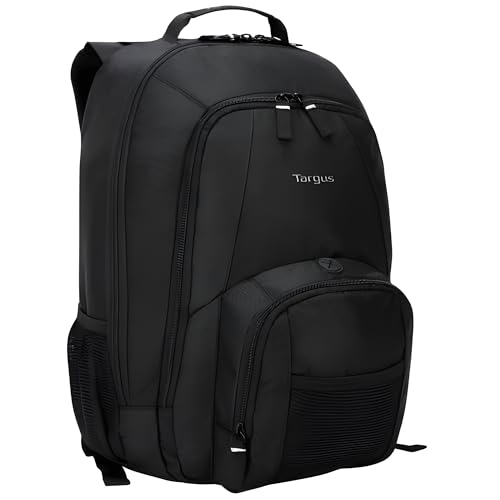
Targus Groove 16 — Best simple commuter
The Groove is the elder statesman of this guide — a Targus business backpack for laptops up to 16 inches, water-resistant, in black, carrying a model reference (CVR600) that has been in catalogues long enough to qualify as furniture. Its longevity is the review. Business bags live or die on whether working people reorder them, recommend them to the new starter, and find them still working when the laptop inside has been replaced twice. The Groove’s design brief is the commute stripped to essentials: the machine, the day’s papers and tech, weather shrugged off, nothing to learn and nothing to break.
Simplicity is an underrated professional feature. A bag with an uncomplicated layout is a bag you can pack in the dark of a winter morning, empty with one hand on a train, and lend to a colleague without a briefing. For the commuter whose route is fixed and whose load is stable — laptop, charger, notebook, lunch, layer — the Groove’s lack of systems is the system. Targus, which effectively invented the laptop bag as a category, has always understood this reader, and the Groove is that understanding in its most distilled form.
What it does not attempt is equally plain. There is no checkpoint theatre, no charging port, no travel wardrobe ambitions; the professional who flies weekly should take the Tech Elite or the Techpack. The design language is conservative to the point of invisibility, which boardrooms forgive and design studios may not. But as the guide’s simple, durable, fairly-priced answer to the standard commute, the Groove has outlasted trendier bags by the decade, and there is no reason to expect the next decade to argue.
- Stated laptop fit: most laptops up to 16 inches
- Shell: water-resistant (per listing)
- Intended use in listing: business commuters and travel
- Model reference in listing: CVR600
Strengths
- Proven, uncomplicated layout for a stable daily load
- Water-resistant durability from the category’s originator
- 16-inch fit covers the 15.6 standard comfortably
Trade-offs
- No travel systems — checkpoint, charging or wardrobe features
- Conservative styling will not excite design-led buyers
- Organisation depth is modest
Best for: commuters with a fixed route and a stable daily load. Not suited for: frequent flyers or feature hunters.

tomtoc 24L Laptop Backpack — Best right-sized daily
Twenty-four litres is the volume of a working day with nothing left over, and the tomtoc 24L is this guide’s argument that “nothing left over” is a professional virtue. Listed as fitting laptops up to 16 inches — the 16-inch MacBook Pro class is named — and intended for work, commute, business, college and weekend trips, it holds the standard day in a bag whose proportions stay meeting-room appropriate from every angle. No sag, no spill, no silhouette suggesting you are also moving house.
The right-sizing cuts deeper than looks. A bag matched to its load carries better, because nothing inside is travelling; it organises better, because every item’s place is a decision the volume enforces kindly; and it ages better in an office wardrobe, because it never competes with the suit. tomtoc’s background in protective electronics carry shows in the laptop-first brief — this is a daypack drawn around the machine and the working day, rather than a general bag that admits a laptop. For the 15.6-inch standard and the 16-inch newer class alike, the stated fit removes the squeeze-or-swim dilemma that haunts this category.
Its boundary is the boundary of its litre count. The overnight layer, the gym kit, the second pair of shoes — each addition starts an auction the 24L cannot settle, and professionals whose days routinely include them should step up to the Techpack’s 28L or the Tech Elite’s travel systems. The listing also keeps its counsel on fine organisational detail, so buyers who want every pocket enumerated should compare in person. For the disciplined daily load, though, this is the guide’s most proportionate answer, and proportion is the quality business bags are actually judged by at 9 a.m.
- Stated laptop fit: up to 16 inches, including 16-inch MacBook Pro class
- Stated capacity: 24L
- Intended use in listing: work, commute, business, college, weekend trips
- Brand focus: laptop-first everyday carry
Strengths
- Right-sized volume keeps the silhouette boardroom-clean
- Stated fit spans the 15.6 standard and the 16-inch class
- Laptop-first design from a protective-carry specialist
Trade-offs
- 24L cannot absorb gym kit or overnight layers routinely
- Fine organisational detail is not enumerated in the listing
- Less travel machinery than the Tech Elite
Best for: professionals with a disciplined daily load and a 15.6- or 16-inch laptop. Not suited for: travellers who pack the bag for two days at a time.

Targus Classic 15-16 Padded — Best padding-first classic
The second Targus in this guide shares the Groove’s heritage and adds a headline: padding. The Classic is a padded laptop backpack for the 15-to-16-inch class, aimed at business commuters, students and travellers — which makes it, in business terms, the risk manager’s choice. Corporate laptops are assets, often the most expensive object an employee carries, and a bag whose stated design priority is cushioning the machine answers the concern that fleet managers and careful owners share: the commute’s knocks are not hypothetical, and the compartment is where they are settled.
The stated 15–16 window is the other half of its professional logic. It is tailored to the business fleet as it actually exists — the 15.6 standard in the majority, the 16-inch machines arriving with each refresh — and a compartment tailored to a window holds its residents more securely than one rated for everything. In a meeting the Classic reads as pure business: no outdoor language, no technical theatre, just a black commuter bag from the maker whose name is practically generic for the category. Some professionals consider that anonymity a flaw. Their IT departments consider it a feature, and both are right about different things.
Against the Groove, the choice is emphasis: the Classic spends its design budget on the compartment, the Groove on distilled simplicity, and the price of the Classic’s priority is a bag that does the standard day superbly without reaching for travel systems or feature lists. Against the premium Techpack, it trades material theatre for traditional manners. In a guide organised by temperament, the Classic is the traditionalist — and traditionalists, in business, are a constituency with excellent reasons.
- Stated laptop fit: most laptops up to 16 inches (15–16 class)
- Design headline: padded (per listing)
- Audience in listing: business commuters, college, travel
- Model reference in listing: TBB943GL
Strengths
- Padding-first design protects the company’s most carried asset
- 15–16 window matches the real business fleet
- Pure business presentation, zero outdoor language
Trade-offs
- No travel systems or charging features
- Traditional styling will not satisfy design-led buyers
- Less capacity ambition than the 28L Techpack
Best for: professionals and fleets prioritising laptop protection in a classic profile. Not suited for: frequent flyers wanting travel features in the same bag.
How do the six business backpacks compare side by side?
| Backpack | Stated laptop fit | Stated size | Professional temperament |
|---|---|---|---|
| tomtoc X-Pac Techpack | 15.6″ | 28L | Premium traveller |
| MATEIN 15.6 | 15.6″ | Not stated | Value all-rounder |
| SwissGear Tech Elite | Up to 16″ | Not stated | Feature-rich road kit |
| Targus Groove | Up to 16″ | Not stated | Simple commuter |
| tomtoc 24L | Up to 16″ | 24L | Right-sized minimalist |
| Targus Classic | 15–16″ | Not stated | Padding-first traditionalist |
The table’s last column is the one to shop by. All six hold the business laptop class; what differs is the professional life each was drawn for, and the mismatch costs of choosing against your own temperament — features you carry but never use, capacity you pay for in silhouette, simplicity you outgrow by March — exceed any difference in the spec columns.
What makes a backpack a business backpack, really?
Strip the marketing away and three tests remain. The first is the meeting test: set the bag down in a client meeting and ask whether it argues for your competence or apologises for your hobbies. Business bags pass by being proportioned, finished and quiet — no dangling straps, no expedition hardware, no silhouette that suggests the owner is leaving for a trailhead at noon. Every pick in this guide passes it, though they pass in different dialects: the Techpack in modern technical, the Targus pair in traditional, the tomtoc 24L in minimal.
The second test is the platform test: the bag at 8 a.m. in rain, on a crowded train, in the crush at the ticket gates. Business bags answer with water-resistant shells — stated in most listings here — slim profiles that do not harvest fellow passengers, and zips that work one-handed with gloves half off. The third test is the five-year test, invisible in any shop: whether the bag’s organisation matches the stable artefacts of a working life so well that packing becomes unconscious, and whether its construction survives the ten thousand openings that five years of twice-daily use implies. The Groove’s catalogue longevity and the Classic’s heritage are this guide’s evidence that some designs pass it; the newer technical picks argue their case in materials and structure, and time will mark their papers.
A business backpack, then, is not a colour or a logo. It is a bag that passes the meeting, the platform and the years — and the reader who shops by those tests, rather than by feature-count, will find the six above sort themselves with surprising speed.
How much should a business backpack hold beyond the laptop?
Inventory a real working day before answering. The standard professional load, weighed honestly, runs: the laptop and its charger, a notebook or tablet, documents or a folder, a water bottle, lunch or the intention of it, a layer for the office air-conditioning, and the small technology of modern work — mouse, cables, earbuds, a phone charger. That inventory fills a bag in the low-to-mid twenties of litres, which is why this guide’s stated capacities sit at 24L and 28L and why the unstated commuters are in the same neighbourhood. A business bag much smaller forces daily triage; much larger invites the accumulation that turns a professional silhouette into a expedition.
Travel redraws the inventory rather than merely enlarging it. The overnight business trip adds a shirt, a wash bag and perhaps the Tech Elite’s famous second pair of shoes — a load the 28L Techpack was sized for precisely. The week-long trip breaks the backpack format’s business manners entirely, and the professional answer is a suitcase with the backpack riding on it, not a 45-litre bag straining to be both. Knowing where your calendar sits on that spectrum — daily, overnight, weekly — is the single most predictive question in this category, and it is why the guide’s picks are arranged by temperament rather than ranked on one ladder.
How do you keep a business backpack looking professional for years?
Appearance is maintenance, and maintenance is mostly refusal. Refuse to overfill: a business bag’s silhouette is its suit, and a stuffed bag wears the strained, bulging look of a jacket buttoned over a sweater. Refuse the floor where you can — office floors are kind, train floors are not, and the bag that lives on the desk-side hook or the spare chair keeps its finish years longer. Refuse to let the small damages ride: a fraying strap edge, a zip that has begun to hesitate, a scuffed base — each is cheap to address early and fatal to the professional impression late, because a bag reads as cared-for or neglected in a single glance, and the glance happens in the meeting, not the shop.
Cleaning is simpler than owners fear. Most shells in this guide are synthetic and water-resistant; a damp cloth, mild soap for the commute’s accumulated grime, and air drying away from radiators will restore the working face of any of them. Empty the bag fully first — the archaeology of old receipts and dead pens that every business bag accumulates is itself part of the neglect impression when it spills at a client’s table. Ten minutes quarterly is the whole programme, and it is the difference between a bag that looks bought-last-year for five years and one that looks bought-five-years-ago by spring.
What about the 16-inch laptops entering business fleets?
The keyword says 15.6, and 15.6 remains the standard — but any honest business guide in this decade must address the 16-inch machines arriving with each fleet refresh, because a bag bought today will meet them. Four of this guide’s six picks state fits up to 16 inches — the Tech Elite, the Groove, the tomtoc 24L and the Classic’s 15–16 window — and the Techpack’s listing adds the 16-inch MacBook class to its 15.6 headline. Only the MATEIN draws the line exactly at 15.6, which is correct for its brief and its price, and which buyers with a 16-inch refresh on the horizon should weigh as a genuine, stated limitation rather than a detail.
The reverse error exists too: buying a cavernous 17-inch travel bag “for the future” and spending the present with a 15.6 machine sliding in an oversized compartment and a silhouette too large for the meeting room. The business window in this guide — 15.6 contained, 16 accommodated — is the considered answer: it serves the fleet as it is, welcomes the fleet as it is becoming, and declines to dress today’s professional for a laptop that exists only in a rumour.
What mistakes do buyers of business backpacks keep making?
The commonest is buying the bag for the job they wish they had. The aspiring traveller buys the feature-rich road kit and commutes with its unemployed systems for years; the aspiring minimalist buys the 24L and conducts a daily auction between the gym kit and the laptop. Buy for the calendar you actually keep — it is printed, it is knowable, and it is the only brief that matters. The second mistake is the opposite vanity: buying the cheapest bag that fits, for a laptop that costs twenty times the difference, and discovering that in business luggage the saving is usually taken out of the zips and straps that the commute uses hardest.
Third, buyers ignore the charger’s vote. Business laptops travel with business chargers, and a bag whose organisation has no honest place for the brick will bulge at the exact point where the silhouette should be cleanest. Fourth, they shop the photograph instead of the meeting: a bag that looks superb empty on a studio background may slump, swing and shed straps in a crowded carriage, and only a loaded trial — even a loaded walk around the shop — reveals it. Fifth, they treat the purchase as permanent in a role that is not: the bag for the graduate job and the bag for the partner-track job are different instruments, and planning to trade up as the career does is not extravagance but accuracy.
How do you pack a business backpack for a one-night trip?
Pack the office day first and the trip second, in that order, because the day is certain and the evening is elastic. Laptop, charger and documents take their usual places — a trip is no excuse for a new geography inside a familiar bag. The overnight layer then fills the main compartment in a strict priority: the next day’s shirt, rolled, in a shirt folder or a clean packing cube; the wash bag, sealed, low and forward; underwear and socks in the corners where they double as padding. Shoes, if the itinerary truly demands a second pair, are the auction’s most expensive item — which is why the Tech Elite’s dedicated compartment exists, and why every other pick’s owner should ask whether the trip’s shoes can simply be the ones being worn.
At the destination, work from the bag rather than unpacking into the hotel’s drawers; a one-night stay repacked in haste is how chargers begin their new lives in other cities. In the morning, the audit takes thirty seconds: charger, wash bag, yesterday’s shirt accounted for, laptop in its compartment, bag closed and professional again. The one-night trip is the business backpack’s finest hour — suitcase quality of life at carry-on speed — and the picks in this guide were, several of them, drawn for exactly it.
Which pick suits which profession?
The consultant is the easiest portrait: airports weekly, clients daily, a laptop that is effectively her office, and a professional image that must survive both. She splits by taste between the Techpack’s technical polish and the Tech Elite’s travelling systems, and either will serve her better than any commuter bag in this guide, because her compromises are scheduled in terminals rather than at desks. The account manager in a regional role — car, client sites, the occasional overnight — belongs to the same pair, with the Tech Elite’s shoe compartment quietly solving his two-appointments-one-day problem.
The desk professional with the fixed commute is the guide’s centre of gravity, and her three-way choice is a matter of conscience rather than capability: the Classic for protection, the Groove for simplicity, the MATEIN for value, each an honourable answer to the same biography. The new graduate should take the MATEIN without a flicker of embarrassment and spend the difference on the wardrobe; the senior professional whose bag enters rooms where impressions are audited may reasonably take the Techpack and call the premium a professional expense. And the hybrid worker, whose office is a kitchen table three days a week and a headquarters for two, belongs to the tomtoc 24L — a bag sized for the days she travels light between two desks, which is the defining commute of her generation.
How does hybrid work change what a business backpack must do?
Hybrid work quietly rewrote this category’s brief. The pre-hybrid commuter carried a stable load between two fixed points; the hybrid worker carries a mobile office between a home desk, a headquarters, coworking spaces and client sites, and the load changes with the destination — the full kit for the headquarters day, the light kit for the coworking afternoon, the presentable kit for the client. Bags that serve this life need organisation that scales without restructuring, which is why the guide’s middle picks — the 24L’s discipline, the Techpack’s 28L headroom — map so neatly onto hybrid calendars.
The home end of the hybrid day matters too. A business backpack now spends its evenings in hallways and home offices rather than office lockers, and its off-duty appearance — structured enough to stand, finished enough not to shame a room — has become part of the product. The technical and minimal designs here wear that domestic duty well; the expedition-styled bags of other categories do not, which is one more reason this guide’s filter favoured business-first designs over general packs in business colours.
What should you check in the shop before buying a business backpack?
Bring the laptop, or its exact measurements, and perform the three tests this guide has used throughout. The meeting test: set the loaded bag down, step back, and look at it as a client would — silhouette, finish, the discipline of its straps. The platform test: walk with it loaded, stairs included, and feel whether the load rides composed or negotiates. The five-year test you must simulate: open and close every zip twenty times, work the laptop in and out of its compartment one-handed, and ask whether the organisation matches the artefacts you actually carry — not the ones the display model is stuffed with.
And check the commute you actually take, in the shop’s mirror of your imagination: the bag on a wet platform, the bag under a café table at a working lunch, the bag in the boot of a client’s car. Business bags are bought in shops and judged everywhere else, and the ten seconds spent picturing the everywhere-else is the cheapest research in this entire guide — cheaper even than reading it, which is saying something.
Check the charger separately. Business laptops’ power supplies vary enormously, and the bag that swallows a slim ultrabook’s adapter may bulge around a workstation’s brick. If your machine’s charger is a serious object, it deserves a veto in the shop rather than a daily grievance at the office. Finally, check the bag against your travel reality if you fly: personal-item hopes, overhead realities and your airline’s published dimensions are all knowable in advance, and the professional habit of knowing them is the same habit this entire category exists to serve.
Should your employer buy the backpack, or should you?
It is a more practical question than it sounds, because the answer changes what “best” means. When the bag is a personal purchase, temperament rules — the guide’s whole structure assumes a reader spending their own money on their own week. When an employer or IT department issues bags across a fleet, the criteria rotate toward uniformity, durability and protection: one model, every desk, spares in a cupboard, and a compartment that treats the company’s laptops as the assets they are. That is the natural habitat of the Targus Classic in this guide — a padded, traditional, fleet-shaped answer — and of the Groove for organisations whose loads are lighter and budgets tighter.
Professionals given a budget rather than a bag occupy the happy middle: the allowance legitimises the premium picks, and the Techpack’s case strengthens considerably when the alternative is expensing nothing and carrying the issued bag forever. Whichever side of the arrangement you sit on, one principle survives: the person who carries the bag daily should have a voice in choosing it, because a business backpack is worn more hours than any item of clothing its owner owns, and imposed luggage fits its wearer exactly as well as imposed shoes would.
How do business backpacks handle the journey’s last mile?
Every business trip ends with a walk the itinerary forgets: the station to the office, the hotel to the client, the car park to the entrance, in weather that did not consult the schedule. This last mile is where business bags are truly separated — not by their feature lists but by how a loaded example carries at walking pace, in rain, when its owner is also holding a coffee, a phone and a mild grievance against the morning. Water-resistant shells, stated across most of this guide’s listings, exist for this mile. Slim profiles exist for its crowds. Composed loads exist for its kerbs and stairs.
It is also where the trolley-sleeve and personal-item details of the travelling picks repay their design: the bag that rides the suitcase through the terminal and then converts, without ceremony, into a respectable object for the client’s reception area has understood the journey as a whole. Judge the six here by that whole journey — desk, platform, terminal, last mile, meeting — and the guide’s temperaments resolve into a single question: where does your working life put its miles? Answer honestly, and the bag chooses itself.
What does a business backpack say in a meeting — and does it matter?
It says something, whether or not anyone at the table would admit to hearing it. A composed, well-kept bag in a professional register tells the room that its owner prepares, maintains and finishes things — the same virtues the meeting was called to assess. A battered expedition pack or a bulging novelty tells a different story, also unfair, also instant. Professionals in client-facing roles do not get to opt out of this semiotics; they only get to choose which message to send, and the six designs in this guide were filtered to send the reliable one in six different accents.
The mature view is proportion. The bag is a paragraph in your professional presentation, not the headline — the work is the headline — and money spent past the point of “composed and appropriate” buys diminishing returns that the Techpack’s fans and the MATEIN’s fans can argue about happily from their opposite ends of this guide. What is not proportionate is neglect: the professional who would never attend a meeting in a stained shirt attending it with a stained, fraying bag has mispriced the signal, and the quarterly ten minutes of care described earlier in this guide is the entire correction.
How do you transition from a student backpack to a business one?
The reader this question serves is real and numerous: the graduate whose university bag — capacious, logo’d, softened by three years of libraries — is about to walk into its first office. The transition is less about buying luxury than about changing grammar. Student bags are organised around volume and survival; business bags around proportion and presentation. The MATEIN in this guide exists precisely at the crossing point, priced for a first salary and styled for a first meeting, and it is the recommendation this guide gives that reader without hesitation: buy the correct grammar now, and let the premium dialects wait for the promotions that will pay for them.
What transfers from the student years is the discipline, not the bag. The habit of a fixed place for every artefact, of packing the night before an early start, of keeping the laptop’s compartment sacred — these were professional skills in embryo, and the new bag simply gives them a better instrument. What does not transfer is the tolerance for chaos: the business bag that arrives at a client site shedding receipts and last week’s gym sock has failed at the one job its student predecessor was never asked to do. The upgrade, in the end, is not really about the bag at all — it is about deciding that how you arrive is part of the work, and then buying the modest equipment that makes arriving well the default.
What is the one accessory that improves every business backpack?
A small tech pouch, and it is not close. The modern professional’s small chaos — two cables, a charger, a mouse, earbuds, a dongle whose purpose is remembered only in meetings — defeats even good built-in organisation, because it changes shape daily. A pouch gives the chaos a single address inside any of this guide’s six bags, moves between them in one gesture on the day you change bags, and keeps the charger brick’s corners in a padded neighbourhood of their own instead of against the laptop’s compartment wall. It costs little, weighs less, and converts the inside of a business backpack from a drawer into a system. Buy the bag first, by all means — but buy the pouch in the same week, and the bag you chose will feel a class more organised than the one you tried in the shop.
Final Recommendation
Let your calendar choose. If it mixes office and airport in roughly equal weeks, the tomtoc X-Pac Techpack is the most complete professional instrument here — technical, structured and sized for the overnight life. If it is road-heavy with presentations at the end of the journeys, the SwissGear Tech Elite’s travel systems earn their keep. If it is the classic commute, choose by conscience: the Targus Classic if the laptop’s protection leads your thinking, the Groove if simplicity does, the MATEIN if the budget must be respected without surrendering the brief, and the tomtoc 24L if your load is disciplined and your taste runs to proportion. Every one of the six will walk into a meeting without apologising — pick the one whose compromises fall where your week is strong, and it will still be representing you well when the laptop inside it has been refreshed twice.
Frequently Asked Questions
Will a 15.6-inch business backpack fit a 16-inch laptop?
Only if its stated fit says so. In this guide, the Tech Elite, Groove and tomtoc 24L state fits up to 16 inches and the Targus Classic states a 15–16 window, while the MATEIN is a 15.6-inch design and should be believed. A 16-inch machine forced into a true 15.6 compartment strains zips and presses corners — measure your laptop and honour the stated range.
Is 24L or 28L better for a business backpack?
It depends on the overnight question. A pure commuting load — laptop, charger, documents, lunch, a layer — sits comfortably in 24L, and the smaller bag keeps a cleaner silhouette. Add a regular overnight shirt-and-washbag layer and 28L becomes the honest size. Buy for the week you repeat most often, not the trip you take twice a year.
What does a USB port on a backpack actually do?
It is a pass-through: your own power bank sits inside the bag, connected to the port, and you plug your phone into the outside. The bag provides the routing, not the power. On the SwissGear Tech Elite, whose listing names the feature, it serves travellers who charge while walking through terminals — convenient, provided you remember the power bank is yours to supply and to charge.
What colour should a business backpack be?
Black is the default for a reason — it matches every professional wardrobe, hides the commute’s grime longest, and reads correctly in the widest range of rooms — and several picks in this guide are listed in black. Grey, the MATEIN’s colour, is the thoughtful alternative: equally professional, slightly less funereal, and better at disguising the light dust of dry commutes. Beyond those two, colour becomes a statement, and statements in business dress are best made deliberately by people who know their audience. A first business backpack should be black or grey; a second can afford a personality.
Can a business backpack double as a personal item on flights?
The MATEIN 15.6 is listed with personal-item sizing, which is one of its quiet strengths: it stays at your feet rather than in the overhead bins. Other picks here are carry-on scale and will generally travel as your cabin bag rather than your personal item, with exact treatment varying by airline — check your carrier’s dimensions if the distinction decides your purchase.
Should a business backpack have a trolley sleeve?
If your professional life includes airports, yes — the sleeve that slides the bag onto a rolling suitcase’s handle converts the terminal from a carry into a tow, and it is the feature travelling professionals in this category consistently rank above its modest appearance. Among this guide’s picks, the travel-oriented designs are the ones to interrogate for it when you compare in person, since listings do not always headline it. If your life is a fixed commute, the sleeve is harmless dead fabric; if your life is departures, it separates the professional who walks in ready from the one who walks in recovering — and clients grade that difference silently, every time.
Is a backpack acceptable in formal business settings?
In most contemporary offices and client settings, yes — the backpack completed its migration from student wear to professional standard over the past decade, driven by laptop sizes, commute realities and the ergonomics of two-strap carry. The conditions are the ones this guide applies throughout: a business-styled design rather than an outdoor one, kept clean and unstuffed, and carried in one hand or set down promptly in the most formal rooms rather than worn through them. A small minority of traditional environments still read any backpack as casual; professionals who live in those rooms already know it, and for them the traditional Targus designs in this guide sit closest to the line those rooms draw.
How long should a business backpack last?
A well-made one, used daily, should serve three to five years before its zips, straps or laptop padding ask for retirement — roughly the life of the laptop fleet it carries. Longevity designs like the Targus pair have catalogue histories suggesting exactly that span. Retire the bag when the laptop compartment’s protection thins or a main zip begins to fail, not when fashion turns; in business, a seasoned bag in good order reads as reliability, not age.
Related Guides
Completing the professional setup? See Best Accessories for Laptops: Docks, Stands, Sleeves and Cooling Pads for the desk kit, and Best Acer Laptops: Aspire, Swift and Chromebook Picks for Work, Study and Travel if the 15.6-inch machine itself is due for replacement.


