What's inside
- Key Takeaways
- Quick Picks
- How Did We Choose These Picks?
- What Actually Makes a Component System Different?
- Which Component System Fits Your Car and Your Ambition?
- What Does the Crossover Actually Do All Day?
- Which System Matches Which Builder? A Decision Walk-Through
- How Much Amplifier Does a Component System Want?
- Do the Rear Doors Deserve Components Too?
- How Does a Component System Settle Over the First Months?
- What Supporting Work Makes Components Worth Their Price?
- How Should You Audition a Component Set Before Committing?
- How Do the Six Entries Compare?
- Where Should the Tweeters Actually Go?
- How Do You Install a Component Set Well?
- What Mistakes Do Component Buyers Make?
- Final Recommendation
- Frequently Asked Questions
- Related Guides
As an Amazon Associate I earn from qualifying purchases. This post may contain affiliate links at no extra cost to you.
gizmoverdict.com is reader-supported. When you buy through links on our site, we may earn an affiliate commission.
Where to buy: The picks below mostly link to verified component listings in this site’s product pool — four of the six. One pick is an Alpine bundle — a component set packaged with a coaxial set — and it is labelled a bundle every time it appears. One pick is a coaxial, included openly as a labelled contrast. The final pick is prose-only, covering the European component class that the pool does not list.
The best 6 1/2 component speakers exist to solve the one problem a coaxial cannot: geography. In a coaxial, the tweeter sits in the middle of the woofer, low in the door, broadcasting the most directional frequencies in music toward the occupants’ legs. A component system unbundles the drivers. The woofer stays in the door where the opening is; the tweeter goes where ears can use it — the sail panel at the window’s front corner, the A-pillar, the dash corner — and an external crossover divides the signal between them with more care than a capacitor soldered to a basket ever could. The reward is imaging: voices and instruments arranged on a stage across the dashboard, instead of pooled in the footwells.
That reward is bought with effort, and this guide will not pretend otherwise. A component install means mounting tweeters, placing crossovers, and routing wire that a coaxial never asks for. It means decisions — where exactly the tweeter lives changes the sound — and it means an afternoon measured in hours rather than minutes. The listeners who should pay that price are the ones who hear the difference in a coaxial’s staging and cannot unhear it. For them, the six entries below map the territory: two Kickers from two different series, Pioneer’s flagship A-Series component set, Alpine’s two-set bundle, one honest coaxial standing in for contrast, and the prose-only European class that component devotees eventually audition.
One discipline governs the whole bench, because this category suffers a specific fraud — committed innocently, by search results and shelf labels rather than by villains. Kicker’s line contains a code trap: the KS component system in this guide is the KSS6504, while a near-identical code, KSC6504, belongs to a coaxial. One letter carries the entire architecture. This guide uses the pool-verified codes throughout and flags the trap wherever the Kicker names appear, because a component guide that lets a reader order a coaxial by miscopied code has failed at its only job.
Key Takeaways
- Four linked picks are true component systems: Kicker KSS6504, Kicker CSS65, Pioneer TS-A653CH, and Alpine’s S2-S65C inside its bundle.
- The Alpine pick is a BUNDLE — the S2-S65C component set plus an S2-S65 coaxial set in one listing — labelled as such everywhere.
- The Kicker CSC65 is included as a labelled coaxial alternative, for buyers who decide the component effort is not for them.
- Code discipline matters: KSS6504 is the component; the similar KSC6504 code is a coaxial and is not this guide’s pick.
- Tweeter placement is the system’s decisive variable — sail panel or A-pillar mounting is where the imaging comes from.
- The sixth pick is prose-only: the Focal/Morel European component class, which the verified pool does not list.
Quick Picks
| Pick | Badge | Why it earns its place |
|---|---|---|
| Kicker KSS6504 | The KS flagship — component system | Kicker’s KS-series component set with 1-inch tweeters: the maker’s most serious 6.5-inch staging in one box. |
| Kicker CSS65 | The accessible component — component system | The CS-series component set with .75-inch tweeters: the imaging upgrade at the range’s friendlier altitude. |
| Pioneer TS-A653CH | The A-Series MAX flagship — component system | Pioneer’s top A-Series component thinking, a 370W Max system built for listeners who drive components properly. |
| Alpine S2-S65C + S2-S65 Bundle | The two-set BUNDLE — component set + coaxial set | One listing, two sets: the S2-S65C components for the front, the S2-S65 coaxials for the rear — a whole-car kit. |
| Kicker CSC65 | The coaxial alternative — COAXIAL, labelled contrast | Not a component: the CS coaxial pair, here so readers can weigh the simpler architecture honestly. |
| The Focal / Morel component class | The European reference class — prose-only | Hand-finished component sets from the French and Israeli specialists; covered without a link, as the pool lists none. |
How Did We Choose These Picks?
Architecture was verified before brand. Each linked pick was confirmed through this site’s product pool as what its label claims: the KSS6504 and CSS65 as component systems with separate tweeters and crossovers, the Pioneer TS-A653CH as Pioneer’s component flagship in the A-Series MAX line, and the Alpine listing as exactly what it is — a bundle whose component half is the S2-S65C, with no standalone listing for that set in the pool. That last fact shaped the pick’s presentation: the bundle is recommended as a bundle, for the whole-car job it actually performs, never as though the component set were available alone.
The coaxial contrast pick was chosen deliberately rather than apologetically. Component guides that pretend coaxials do not exist leave readers unable to price the upgrade they are contemplating. The CSC65 — the CS-series coaxial — stands in the bench as the honest alternative from the same family as one of the component picks, so the comparison a reader actually faces, CSS65 components against CSC65 coaxials, appears here with both sides labelled. Its heading, table row and spec box all call it coaxial, because a contrast pick that blurs its own architecture would be a trap, not a service.
The prose-only slot went to the class component enthusiasts eventually cross-shop regardless of what any pool lists: the European specialists, Focal of France and Morel of Israel chief among them, whose component sets are built around hand-finished drivers and crossovers voiced as a system. No listing in the verified pool covers them, so no link is offered and no model is invented — the class is described, its character explained, and the reader sent to audition it with open eyes and a known budget. A guide’s honesty is measured by what it refuses to link as much as by what it recommends.
What Actually Makes a Component System Different?
Three separations, each with a consequence. The tweeter separates from the woofer, and the consequence is placement: high frequencies are directional, they beam rather than spread, and a tweeter at ankle height spends its beam on carpet and shin. Raised to the sail panel or pillar, the same tweeter addresses the listeners directly, and the soundstage rises with it — the single largest perceived difference between the architectures, larger than any driver-material upgrade within either camp. The crossover separates from the speaker, moving out of the basket into its own housing, and the consequence is quality: external crossovers use better components, divide the spectrum more precisely, and in some sets allow the tweeter’s level to be adjusted to the car’s cabin and the listener’s taste. The install separates from the simple, and the consequence is time — which the next sections treat as a cost to plan, not a surprise to discover.
There is a subtler consequence worth naming: components reveal systems. A coaxial forgives a noisy amplifier and a careless install by keeping everything in one forgiving location. A component set, with its tweeter exposed at ear level and its crossover voicing on display, reports the whole chain honestly — the head unit’s character, the amplifier’s noise floor, the door’s rattles at newfound resolution. Owners who relish that honesty are this category’s natural citizens. Owners who want the car to simply sound better by Saturday lunch are equally natural citizens of the coaxial bench, and this guide’s contrast pick exists to honour them rather than convert them.
One more distinction separates the architectures in daily life, and it is rarely printed: serviceability. A coaxial that fails is one unit out, one unit in. A component system localises its failures — a tweeter can be replaced without disturbing the woofer, a crossover fault diagnosed by swapping channels — and rewards the owner who kept the install documented and the crossovers reachable. Over a decade of ownership, that maintainability is worth real money, and it belongs in the honest ledger alongside the imaging: components cost more to install, ask more of the installer, and then spend years being easier to live with than their reputation suggests.
Which Component System Fits Your Car and Your Ambition?
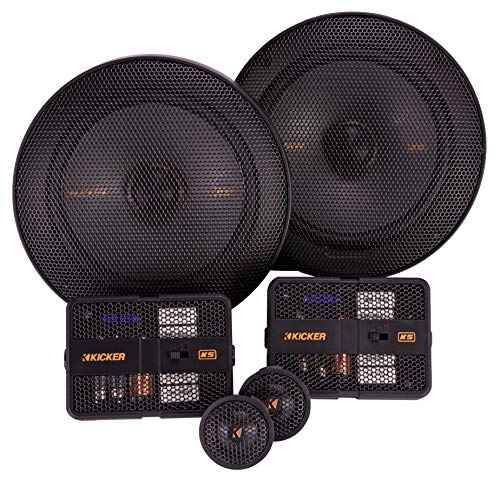
Kicker KSS6504 — The KS flagship component
Code first, because with this pick the code is the product: KSS6504, with the second S doing the architectural work. This is Kicker’s KS-series component system — a 6.5-inch woofer pair, separate 1-inch tweeters, and the crossovers to divide labour between them. The KS line is where Kicker stops building replacements and starts building systems, and the KSS6504 carries that intent in its tweeter size alone: a full inch of dome, where the CS component below it uses a smaller unit, buys a lower, more comfortable handover from the woofer and a tweeter that never sounds like it is working at its limit. In a component set, that handover region is where the sound is made or muddled, and the flagship spends its money exactly there.
The system suits the listener who has already decided — the coaxial chapter is closed, the tweeters are going up high, and the question is only whose engineering to trust with the stage. Kicker’s answer is characteristically confident: present, dynamic, engineered to make its imaging obvious rather than subtle, which is a genuine virtue for a first component system because the owner hears, immediately, what the extra money and effort purchased. Subtlety can be chased later, in the prose-only class at this bench’s end. The KSS6504 is the component system’s case made loudly enough for a sceptic in the passenger seat to hear it.
- Format: 6.5-inch component system, 4-ohm, pair
- Drivers: 6.5-inch woofers with separate 1-inch tweeters
- Crossover: external, supplied in the set
- Code warning: KSS6504 is the component — KSC6504 is a different, coaxial product
Strengths
- Full-size tweeters give the smoothest driver handover on this bench.
- Imaging gains are obvious from the first drive.
- KS-series build aimed at amplified systems.
Trade-offs
- Demands the full component install — tweeters, crossovers, wire.
- Confident voicing will not suit neutrality seekers.
- Its code is one letter from a coaxial’s — verify before ordering.
Best for: decided component buyers who want the staging gain made obvious. Not suited for: anyone hoping to avoid mounting tweeters.

Kicker CSS65 — The accessible component
The CSS65 is the component idea at its most approachable: the CS series’ component system, with .75-inch tweeters and the range’s characteristic balance between polish and price. Everything the flagship does, this set does in a slightly smaller hand — the stage still rises to the dashboard, the crossover still divides the work properly, the installation still asks the full set of questions. What the buyer saves is money; what the buyer keeps is the architecture, which is where most of the benefit lives. For a first component system, that is the correct trade, and the CSS65 is the bench’s natural starting point for owners graduating from the CS coaxial world.
That graduation path is this pick’s quiet elegance. The CSC65 coaxial — this guide’s labelled contrast pick — and the CSS65 component share a series, a voicing philosophy and a showroom. An owner can begin with the coaxial, hear its ceiling, and step to the CSS65 knowing the family’s accent already. Or an owner can skip the step, as this guide generally advises once the imaging itch is felt, and start here. Either way, the CS component set is the hinge of the whole bench: the least expensive honest answer to the question this keyword asks, from the maker whose range frames the question most clearly.
- Format: 6.5-inch component system, 4-ohm, pair
- Drivers: 6.5-inch woofers with separate .75-inch tweeters
- Crossover: external, supplied in the set
- Series: Kicker CS — the step-up line’s component expression
Strengths
- The full component architecture at the bench’s friendliest altitude.
- Natural graduation from the CS coaxial in the same family.
- Balanced voicing that suits long listening.
Trade-offs
- Smaller tweeters hand over higher than the flagship’s.
- Still requires complete component installation work.
- Amplifier-free systems hear less of its ceiling.
Best for: first component systems and CS-family graduates. Not suited for: buyers who want flagship tweeter scale at this step.

Pioneer TS-A653CH — The A-Series MAX flagship
Pioneer’s A-Series is one of car audio’s longest-running arguments, and the TS-A653CH is its current component flagship in this size — an A-Series MAX system rated at 370W Max, built for owners who intend to drive their components with real amplification and want a set engineered for that life. Where the Kickers speak in a confident American accent, the Pioneer’s manner is breadth: a system designed to cover the spectrum generously, with the composure of a line that has been refined across generations of A-Series sets and knows exactly which compromises its buyers will not accept.
The flagship designation carries a practical implication worth stating. Sets at this altitude assume the rest of the system is serious — an amplifier with clean power, doors treated against rattle, a source worth reproducing. Installed behind a wheezing factory radio, the TS-A653CH will work, and will even improve matters, but it will be a thoroughbred pulling a cart. Installed as intended, it is the bench’s pick for the builder: the owner constructing a system in stages, who wants the front stage settled at a level the later stages can grow toward rather than outgrow. Pioneer has sold that owner speakers for decades, and this set knows its customer by name.
- Format: 6.5-inch 2-way component system
- Rating: 370W Max, per the verified listing title
- Series: Pioneer A-Series MAX — the line’s flagship tier
- Assumes: amplification and treated doors to show its ceiling
Strengths
- Flagship engineering from a deeply experienced line.
- Built for amplified systems and high clean output.
- Broad, generous presentation across the spectrum.
Trade-offs
- Underachieves on weak factory power by design intent.
- Asks for a system built around it, not dropped into one.
- Full component install, as with every true pick here.
Best for: builders assembling amplified systems in stages. Not suited for: a quick factory-radio refresh.

Alpine S2-S65C + S2-S65 Bundle — The two-set BUNDLE
Read the badge twice: this listing is a bundle. It contains the Alpine S2-S65C component set and the S2-S65 coaxial set — two complete sets, two architectures, one purchase — because the S2-S65C component set has no standalone listing in the verified pool. The guide includes the bundle because the job it performs is one real owners constantly face: a whole car to re-speaker, components wanted in front where the listeners sit, coaxials entirely sufficient in the rear where fill is the duty. The bundle answers that job in a single order, from a single family, with a single voicing philosophy across all four positions.
Judged as that job, it is shrewd. The S2 generation of Alpine’s S-Series brings the maker’s composed, engineered manner to both halves; the front stage gets genuine component imaging, the rear gets honest coaxial fill, and nobody pays the mismatch tax of mixing families across the cabin. Judged as anything else — a way to buy the S2-S65C alone, a component set with a spare — it miscasts itself, and the guide’s labelling exists to prevent that miscasting. Buy it for the whole-car refresh, install the components in front and the coaxials behind, and the bundle is the most efficient purchase on this bench. Want components only, front doors only? The Kickers and the Pioneer above are your picks, and this one should be admired and passed.
- Format: BUNDLE — one listing containing two complete sets
- Contents: S2-S65C 6.5-inch component set + S2-S65 6.5-inch coaxial set
- Intended job: components in front, coaxials in rear, one order
- Pool note: the S2-S65C has no standalone listing — bundle only
Strengths
- Whole-car coverage from one family in one purchase.
- Component imaging where it matters, coaxial value where it suffices.
- Alpine S2 voicing consistent across the cabin.
Trade-offs
- It is a bundle — you are buying the rear set whether planned or not.
- Front-only shoppers pay for speakers they may not install.
- The component set cannot be bought alone from this listing.
Best for: whole-car refreshes with components in front. Not suited for: front-door-only component upgrades.

Kicker CSC65 — The coaxial alternative, labelled as such
This pick is not a component system, and its presence here is an argument, not an error. The CSC65 is Kicker’s CS-series coaxial pair — the same family as the CSS65 component set above it, with the tweeter in the woofer’s centre and no separate mounting, no external crossover, no placement decisions. It stands in this guide so that the component question can be priced honestly: this is what you give up, and this is what you keep, when the simpler architecture wins. What you keep is considerable — CS-series polish, an install measured in minutes per door, and a voicing that shares its component sibling’s accent. What you give up is the raised stage: the CSC65’s music happens lower, wider and less precisely placed.
The buyer for whom this pick is correct is not a failed component buyer. They are the owner whose car fights back — no sane tweeter location, a lease that forbids drilling, a schedule that allows one hour rather than one day — or the listener who auditioned both architectures and honestly preferred the coaxial’s undemanding spread. Car audio’s oldest snobbery holds that components are the serious choice; this guide holds that the serious choice is the one matched to the car and the listener. The CSC65 is matched, for many, and it is labelled coaxial in every line of this guide so that choosing it is a decision, never a misunderstanding.
- Format: 6.5-inch COAXIAL pair, 4-ohm — not a component system
- Series: Kicker CS — sibling of the CSS65 component set
- Install: single-opening, no tweeter mounting, no crossover placement
- Role in this guide: the labelled contrast pick
Strengths
- CS polish with a fraction of the installation effort.
- No drilling, no tweeter placement dilemmas.
- Shares the component sibling’s family voicing.
Trade-offs
- Soundstage stays low — the coaxial architecture’s fixed limit.
- No external crossover refinement.
- Component-curious owners will still feel the itch.
Best for: constrained cars, leases and listeners who prefer simplicity. Not suited for: anyone whose goal is dashboard-level imaging.
The Focal / Morel Component Class — Prose-only
Beyond the verified pool sits the class that component enthusiasts discuss in a different tone of voice: the European and Israeli specialists, Focal and Morel foremost, whose 6.5-inch component sets are built less like car accessories and more like small high-fidelity instruments. Their hallmarks are consistent across their ranges — drivers finished and matched with unusual care, crossovers treated as voicing instruments rather than electrical necessities, and a house sound in each case that owners describe the way wine drinkers describe regions. Focal’s sets tend toward the vivid and the detailed; Morel’s toward a warmth and ease that long-distance drivers prize. Both ask component money at a level above this bench’s linked picks, and both assume amplification and installation of matching seriousness.
This guide covers the class without a link because the verified pool contains no listing for it, and the discipline of this site is that an unlinked pick is described, never disguised. The class earns its prose for a practical reason: it is the reference against which the linked picks should be priced. A buyer who auditions a Focal or Morel set and returns to the KSS6504 or the Pioneer content has learned something real about value. A buyer who falls for the European class has at least fallen knowingly, with the install and amplification budget counted. Either outcome is a success for honest shopping — which is the only success this guide is selling.
- Format: 6.5-inch component sets — prose-only, no pool listing
- Class character: hand-finished drivers, voicing-led crossovers
- Assumes: serious amplification and installation
- Role in this guide: the reference class for pricing the linked picks
Strengths
- Craftsmanship and voicing at the class’s reference level.
- Each maker’s house sound is distinctive and deliberate.
- Rewards the finest installs with genuine resolution.
Trade-offs
- No verified listing in this site’s pool — no link offered.
- Costs sit above the linked bench, before amplification.
- Demands installation quality equal to its own.
Best for: devotees auditioning the reference class in person. Not suited for: buyers who need a verified link and a settled budget today.
What Does the Crossover Actually Do All Day?
It is worth slowing down for the crossover, because in a component system this unglamorous box is half the product. Its job is traffic direction at the frequency border: low and mid frequencies to the woofer, high frequencies to the tweeter, with the handover engineered so neither driver is asked to reproduce what it handles badly. A woofer asked to play treble beams and breaks up; a tweeter asked to play midrange distorts and, eventually, dies. The cheap in-line capacitor of a coaxial performs a minimal version of this duty. The component’s external crossover performs it properly, with a steeper, better-controlled slope and components chosen for the specific drivers it serves — which is why two systems with similar drivers can sound like different species, and why the crossover’s quality is a legitimate reason one set costs more than another.
Many crossovers in this class add a refinement owners should actually use: tweeter level adjustment, typically a choice of settings that trims the tweeter’s output relative to the woofer’s. It exists because tweeter placement varies — a sail-panel tweeter close to the ear needs less level than a dash-corner unit firing across glass — and because cabins vary in reflectivity. The correct setting is the one that makes a familiar voice sound present without sounding sharpened, judged from the driver’s seat with the engine off and then confirmed at road volume. Owners who never open the crossover box after installation have left the system’s final voicing to a factory default chosen for a car that is not theirs.
Bi-wiring and bi-amplification terminals appear on some crossovers in the wider class, allowing separate amplifier channels for woofer and tweeter. For most owners they are a future option rather than a present need, and this guide’s advice is to run the system conventionally first, tune it thoroughly, and let a year of listening decide whether the extra amplification is a genuine ambition or a spec-sheet itch. Component systems reward patience in stages; the stage most owners skip — patient tuning of what they already own — is the one with the highest return.
Which System Matches Which Builder? A Decision Walk-Through
Consider the builders in the order they usually arrive. The graduate arrives from coaxials, ears educated, budget real but bounded, install confidence growing. Their set is the CSS65: the architecture in full, the family’s familiar accent, the price of admission at its fairest. The graduate who skips a rung — who knows the car will be kept and amplified — should look directly at the KSS6504 instead, because buying the flagship once is cheaper than buying the ladder twice, and its larger tweeters forgive more placement imperfection than any other set here.
The system builder arrives with a plan measured in seasons: amplifier already owned or already chosen, doors to be treated, a subwoofer pencilled for later. The TS-A653CH was designed for this person’s front stage — a flagship that assumes the plan exists and rewards each completed stage. The whole-car refresher arrives with four tired speakers and one free weekend; the Alpine bundle is their pick, and its two-set honesty is the reason it sits in a component guide at all — the front of that car will image like a component car, which is where the driver lives. The constrained owner arrives with the lease, the pillar airbag, the firm no-drilling rule; the CSC65 is their correct answer, and this guide’s respect for it is genuine. And the devotee arrives last, having heard things at a specialist dealer that rearranged their priorities; the prose-only class is their direction, and the linked bench is their value reference on the way.
Notice that the walk-through never once needed a wattage figure. Component selection turns on architecture, tweeter scale, amplification plans and installation constraints — in that order — and the bench was arranged so that each of those questions eliminates different picks. Answer them in order and the bench narrows itself to one name, which is how a guide knows its bench was built correctly.
How Much Amplifier Does a Component System Want?
Less than folklore says, and cleaner than folklore settles for. A component set’s crossovers and separate drivers do not inherently demand enormous power; they demand power that stays clean at the volumes the owner actually uses, because the raised tweeter reports distortion with a fidelity the old coaxial never could. In practice, the factory head unit will run every linked pick here acceptably at moderate volume, a modest aftermarket amplifier will run them beautifully, and the difference between those two states is the difference between hearing the architecture and hearing its potential. The Pioneer flagship wears its preference openly; the Kickers are more forgiving; the Alpine bundle’s front set sits between.
Gains deserve a paragraph of their own, because more component tweeters die from mis-set gains than from any defect. An amplifier’s gain control is not a volume knob; it matches the amplifier to the source’s output, and setting it by ear means raising it only until the loudest passages stay clean, then stopping. Owners who treat distortion as a sign to buy a bigger amplifier have the diagnosis backwards — distortion is the system reporting that something upstream is already beyond its clean range. Set gains conservatively, let the component set’s efficiency do the work, and the tweeters at ear level will repay the discipline every drive.
Do the Rear Doors Deserve Components Too?
Usually not, and the Alpine bundle’s existence is the market admitting it. Rear speakers in most cars serve passengers and ambience; their tweeters, however placed, address the front occupants’ seat-backs more than their ears. Spending component money behind you buys architecture whose benefit is delivered to an audience of headrests. The exceptions are real but narrow: vehicles where rear passengers are the point — chauffeured cars, family haulers whose second row does the long-distance listening — and show systems built to surround deliberately. For the ordinary owner’s ordinary car, the correct rear answer is a good coaxial, ideally from the front set’s family, which is precisely the division of labour the bundle formalises.
There is a staging argument too. A front stage images because its tweeters are placed as a pair, at matched height, addressing the front seats. Rear components add a second pair of high tweeters behind the listener, which can smear the front stage’s precision as easily as enrich it — the rear tweeters’ output arrives late and from the wrong direction, and the brain’s staging arithmetic notices. Owners chasing the purest front image often run rear coaxials at modest level or even fade them down for solo driving. The bundle’s design quietly encodes that wisdom: components where imaging lives, coaxials where fill is wanted, one family’s voicing across both.
How Does a Component System Settle Over the First Months?
Expect a tuning arc rather than a finished state. In the first week, placement decisions dominate: tweeter angles adjusted, crossover levels tried at each setting, the stage coaxed to sit centred for the driver without abandoning the passenger. In the first month, the owner’s ears finish their own recalibration — the raised stage stops sounding novel and starts sounding correct, and recordings reveal details whose absence in the old system had simply never registered. This is the period in which component buyers typically become component advocates, and it is worth warning them that passengers with coaxial cars will not understand the enthusiasm until they have lived a week in the passenger seat.
Later comes the honest audit. A component system exposes the chain, and by the third month its owner has a list: the head unit’s noise on quiet passages, the door that still buzzes on one bass line, the recording collection’s uneven quality now plainly audible. Each item on that list is a future project, and the system’s gift is that it makes the projects legible — you cannot fix what the old coaxial politely hid. Owners who enjoy that legibility were always this category’s audience. The guide’s final word on settling is therefore a temperament test disguised as advice: if the audit list excites you, you bought correctly; if it wearies you, the coaxial contrast pick was your road, and it remains a good one.
What Supporting Work Makes Components Worth Their Price?
A component set installed into an untreated door is a violin played in a stairwell: the instrument is not the limiting factor. The supporting work is unglamorous and decisive. Sound-deadening material on the door’s outer skin and around the woofer’s mounting surface stills the panel resonances that blur the midrange the crossover worked to deliver. A proper mounting baffle or gasket seals the woofer’s front wave from its back wave. The door’s moisture barrier, disturbed by every install, must be preserved or replaced, because the crossover and woofer now represent more money sitting in the rain’s path than any coaxial ever did. None of this appears on the component set’s box, and all of it belongs in the component budget — owners who count it from the start end with systems; owners who discover it later end with explanations.
Wiring deserves the same seriousness. Component installs route more wire through more hostile territory — door jambs that flex, pillars that hide airbags, sills that collect grit. Factory wiring can carry a modest system honourably, but connections are the weak points: every joint should be crimped, soldered or properly connectorised, insulated against the door’s damp, and loomed away from moving glass and regulators. The system’s resolution will report a bad joint as faithfully as a bad recording, months later, intermittently, on rough roads. The installer who spends the extra half hour on joints is buying future silence, and in a component car, silence between the notes is a measurable part of what was purchased.
Finally, budget the second visit. Every experienced installer returns to a component install after a fortnight — levels re-checked with educated ears, tweeter angles nudged, one rattle hunted to its clip. Building that visit into the plan converts the install from an event into a process, and the process is where component systems separate themselves from the coaxials they replaced. The hardware in this guide is capable of that separation; the supporting work is what permits it.
How Should You Audition a Component Set Before Committing?
Dealer demo boards lie politely: they mount every set at ear height in a quiet room, which flatters components exactly where cars challenge them. A useful audition therefore asks different questions than a home-audio one. Listen first for the handover — a voice or a violin crossing from woofer to tweeter should not change address or accent midway, and the sets in this guide were chosen partly because their designers treat that border as sacred. Listen second for tweeter manners at the volume you actually drive at; a dome that is thrilling in a demo and tiring at motorway level will be tiring every day of its life, and the crossover’s level adjustment can only trim so much character.
Listen third for the set’s behaviour on bad material, because cars play bad material constantly — compressed streams, talk radio, a passenger’s phone over an auxiliary cable. Systems voiced for resolution alone can make daily listening feel like an audit. The bench’s balance — Kicker’s confidence, Pioneer’s breadth, Alpine’s composure in the bundle’s front half — represents three different treaties with imperfect sources, and the right treaty is a matter of honest self-knowledge about your own library. Bring your worst recording to the audition. The set that forgives it while honouring your best recording is the set that will still please you in year three.
And audition the install, not just the set. Ask who will mount the tweeters and where; ask how the crossovers will be reached for adjustment after the trim returns; ask what the second visit costs. A component set is a small system, and systems are bought from people as much as from catalogues. The guide’s linked picks are all installable by a careful owner in a weekend — but the owner should decide that with the car’s tweeter locations physically inspected, not assumed from a forum photograph of a different trim level.
How Do the Six Entries Compare?
| Pick | Architecture | Tweeter | Sold as | Choose it when |
|---|---|---|---|---|
| Kicker KSS6504 | Component | 1-inch, separate | Component set | You want the staging gain made obvious |
| Kicker CSS65 | Component | .75-inch, separate | Component set | It is your first component system |
| Pioneer TS-A653CH | Component | Separate, A-Series MAX | Component set | You are building an amplified system |
| Alpine bundle | Component + coaxial | Separate (front set) | BUNDLE of two sets | The whole car needs re-speakering |
| Kicker CSC65 | COAXIAL | Centre-mounted | Coaxial pair | Simplicity outranks staging |
| Focal / Morel class | Component | Separate | Prose-only | You are auditioning the reference class |
The table compresses the guide’s argument into one screen: architecture first, brand second. Four rows are components, one row is a bundle containing components, one row is honestly not — and the reader who understands which row matches their car has done the real work of this keyword, whatever badge the box eventually wears.
Read the tweeter column as the table’s conscience. Separate tweeters are the entire point of four rows, a shared benefit of the bundle’s front half, and conspicuously absent — by honest declaration — from the coaxial row. A comparison table in this category that does not make that column impossible to miss has failed its reader before the first price is ever compared.
Where Should the Tweeters Actually Go?
Placement is the component system’s whole thesis, so it deserves specifics. The sail panel — the small triangle at the front lower corner of the side window — is the classic first choice: it sits near ear height, points the tweeter across the cabin, and in many cars the panel is a cheap, replaceable trim piece, which matters to owners who drill reluctantly. The A-pillar aims higher and often images best of all, but it can require more fabrication and, in cars with pillar airbags, it demands professional respect — never mount into a panel whose deployment path you have not understood. Dash corners reflecting off the windscreen are the third route, trading a little precision for an install that touches nothing structural.
Whichever site is chosen, symmetry is law: tweeters at matched heights and matched angles, or the stage leans permanently toward the better-placed side. Many component tweeters arrive with both flush and angled surface mounts in the box, and the angled mount is frequently the difference between a stage on the dashboard and a stage hovering at the windscreen’s base. Experiment before committing — strong temporary tape and a week of driving will teach more about your cabin than any diagram, because cabins differ in glass angle, dash material and seat position in ways no universal guide can fully predict. The crossover’s tweeter-level adjustment, where fitted, is the final trim: set it after placement, with familiar music, from the driver’s seat.
How Do You Install a Component Set Well?
Sequence is everything. Run the new wiring and place the crossovers before any driver is mounted — crossovers belong somewhere dry, accessible and vibration-free, commonly inside the door’s protected inner skin or behind the kick panels, never loose in the door’s wet outer cavity where rain runoff does its work. Mount the woofers with the same gasket discipline any door speaker deserves. Mount the tweeters last and temporarily, audition, adjust angles, and only then make the mounting permanent. The order feels backwards to first-timers and is in fact the only order that lets each decision inform the next.
Two warnings from experience deserve emphasis. Keep crossover and tweeter wiring away from the window mechanism’s travel, and test the glass through its full range before panels return — a wire pinched by a regulator becomes an intermittent fault that will haunt the car for years. And photograph everything before the trim goes back: crossover settings, wire routes, tweeter angles. A component system invites later tuning, and the owner who documented the install can tune it; the owner who did not will be removing door cards to answer questions a photograph would have settled.
Time budgeting is the third warning, and it is the one first-timers resist hardest. A careful first component install — both doors, tweeters trialled in two positions, crossovers placed accessibly, panels refitted without a single broken clip — is a full day for most owners, and it should be scheduled as one. The half-day version exists, and its products are audible for years: tweeters where they fit rather than where they image, crossovers wherever they landed, levels never revisited. The sets in this guide deserve the full day, and the owner deserves the result the full day buys. Split the job across a weekend without shame: Saturday for the driver’s side and the learning it teaches, Sunday for the passenger side at twice the speed and none of the doubt.
Tools, briefly, because component installs ask for two the coaxial job does not: a step bit or hole saw matched to the tweeter cups if flush mounting is chosen, and the patience to trial-mount with tape before any hole exists. Add the usual panel tools, a multimeter for polarity certainty, and lengths of wire in two colours so that future hands — including your own, in three years — can read the install at a glance. Good wiring is a letter to the future; write it legibly.
What Mistakes Do Component Buyers Make?
The code mistake leads the list in this category specifically: ordering the KSC6504 coaxial while believing it is the KSS6504 component, because the names differ by one letter and search results interleave them freely. Verify the exact code against this guide before money moves. The second mistake is tweeter timidity — buying components and then mounting the tweeters low beside the woofers because the high positions felt daunting, thereby purchasing the architecture and declining its benefit. The third is crossover neglect: settings left wherever the factory put them, levels never adjusted, the system’s final voicing left to chance.
The fourth mistake is amplification mismatch in both directions — flagship components strangling on a tired factory radio, or modest components fed distortion from an overdriven amplifier whose owner mistook clipping for power. The fifth is its cousin: judging the system in the first hour, before tweeter angles and crossover levels have been tuned, and reviewing the architecture for the installer’s unfinished work. Components are a system, and systems are judged at the end of their setup, not the beginning.
The sixth mistake is buying for the demo board — choosing the set that dazzled at ear height in a quiet showroom without asking how its tweeter behaves at motorway volume in a reflective cabin, or how its crossover can be reached once the door trim is back on. The seventh is neglecting the rear of the car entirely while overspending in front: a front stage of reference quality above rear speakers that buzz will still present as a flawed system to every passenger, which is why the bundle’s whole-car logic keeps earning its place in this guide. Component buying rewards the owner who plans the cabin as a whole and the install as a process — the hardware, on this bench at least, is the easy part.
Final Recommendation
Buy the Kicker KSS6504 if the decision is made and the stage is the prize — its full-size tweeters make the component case unmistakably. Start with the CSS65 if it is your first system or your first step out of the CS coaxial world. Builders with amplification planned should settle the front stage with Pioneer’s TS-A653CH, and whole-car refreshers should take the Alpine bundle for exactly the two-set job it is. Choose the CSC65 only with eyes open — it is a fine coaxial and no component at all — and audition the Focal and Morel class when the budget and the devotion both run deep. The component question is never which box, but where the tweeters will live; answer that, and the KSS6504 will make your dashboard sound like a place music happens.
Frequently Asked Questions
What is the real difference between the KSS6504 and KSC6504?
Architecture. The KSS6504 in this guide is Kicker’s KS component system with separate tweeters. The similarly coded KSC6504 is a coaxial. One letter, two different products — verify the code on any listing before ordering.
Why is the Alpine pick called a bundle everywhere?
Because it is one: the listing contains the S2-S65C component set and the S2-S65 coaxial set together, and the component set has no standalone listing in the verified pool. The guide labels it a bundle in every heading and table so nobody buys it expecting a single set.
Can I install components without drilling?
Often, yes — surface and angled tweeter mounts exist for sail panels and dash corners, and many cars offer factory tweeter locations. What you cannot skip is placing the tweeters high; mounting them low surrenders the architecture’s point.
Do component speakers need an amplifier?
They work on factory power, but the architecture’s resolution rewards clean amplification — the Pioneer flagship most explicitly. Plan an amplifier as the system’s second stage if it is not already present.
Is the CSC65 a mistake in this guide?
No — it is the labelled coaxial alternative, included so the simpler architecture can be weighed honestly against its own series’ component set. It is called coaxial in its heading, its table row and its spec box.
Why is there no link for the Focal and Morel pick?
The verified pool contains no listing for that class, and this site does not invent links. The class is described as a reference for auditioning and price comparison, and readers should buy it only where they can hear it first.
Are component speakers wasted in a noisy car?
No, though the noise sets the ceiling. At road volume the raised tweeter’s clarity is precisely what survives wind and tyre roar — consonants and detail that ankle-level coaxials surrender first. Quiet cruising is where the full staging blooms, but the architecture earns its keep in both conditions, provided the doors were treated during the install.
Can I mount the tweeters where the factory put tweeters?
Usually, and it is often the wisest choice: factory sail or pillar locations were placed by people who measured the cabin, they need no new holes, and they keep the car looking stock. Check the factory location’s size against your set’s tweeter cups before assuming a drop-in fit.
What if only one side of my car has a factory tweeter location?
Then match the other side to it, or choose a symmetric new location for both. A component stage built on unmatched tweeter positions leans permanently, and no crossover setting can straighten geometry. Symmetry first, then level, then angle — in that order, every time.
Related Guides
Compare against our guide to 6.5-inch car speakers for the coaxial bench, read how to place tweeters for a dashboard soundstage, or plan the next stage with our amplifier matching guide for component systems.


