What's inside
- Key Takeaways
- Quick Picks
- How Did We Choose These Picks Without Pretending They Are 3 Inches?
- Why Do True 3-Inch Monitors Barely Exist?
- What Can a Small Monitor Honestly Tell You About a Mix?
- How Should You Choose the Best 3-Inch Monitor Speakers When 3 Inches Is a Mirage?
- Where Should Small Monitors Sit on a Desk?
- Do Small Monitors Need a Subwoofer Later?
- What Should Podcasters and Video Editors Take From This Guide?
- How Long Do Small Studio Monitors Last?
- How Do Small Monitors Behave at Night-Time Volumes?
- What About Bluetooth and Convenience Inputs on a Monitor?
- Can One Small Monitor Work, or Must It Be a Pair?
- Comparison Table
- What Does This Ladder Mean for Your Budget?
- What Mistakes Do Small-Monitor Shoppers Keep Making?
- Final Recommendation
- Frequently Asked Questions
- Related Guides
As an Amazon Associate I earn from qualifying purchases. This post may contain affiliate links at no extra cost to you.
gizmoverdict.com is reader-supported. When you buy through links on our site, we may earn an affiliate commission.
Where to buy: Of the picks below, three link to listings verified in this site’s product pool, and each is labelled with its true woofer size wherever it appears — 3.5 inch, 4 inch and 5 inch respectively. The one genuinely 3-inch monitor class in this guide is discussed without a link, because the pool holds no verified listing for it.
Anyone searching for the best 3-inch monitor speakers should hear this guide’s central finding before anything is sold to them: if you expect a shelf of true 3-inch studio monitors to compare, that shelf barely exists. In the current market, a genuine 3-inch nearfield monitor is essentially a single famous idea — the ultra-compact class led by IK Multimedia’s iLoud Micro, discussed below as a prose-only pick because this site’s verified pool holds no listing for it. Everything else honest in this neighbourhood starts at 3.5 inches and climbs. Any guide that lines up six supposedly 3-inch monitors is measuring with its imagination.
Why is the true 3-inch monitor so rare? Because monitor buyers, unlike television buyers, punish fantasy. A studio monitor’s job is to report a mix truthfully, and truth at the bottom of the spectrum needs cone area and cabinet volume that a 3-inch design cannot conjure. Manufacturers know that a 3-inch monitor would be judged against 5-inch rivals in the same review and found silent in the bass, so the serious brands either build the one ultra-compact design as a specialist travel tool, or start their honest ranges at 3.5 inches and let physics breathe. The result is a category where the search term describes a wish, and the products describe a negotiation.
So this guide negotiates openly. The linked picks are the three genuine stepping stones above the wish: a 3.5-inch pair that keeps the footprint tiny, a 4-inch pair that buys back some low-end honesty, and a 5-inch monitor sold singly that represents the size where nearfield monitoring fully grows up. Around them, the prose-only picks cover the true 3-inch class itself, the second-hand route to it, and the satellite-plus-subwoofer alternative that some small desks honestly need. Every size in this article is the size on the product’s own listing — read the labels as carefully as the conclusions.
Key Takeaways
- A true 3-inch studio monitor is nearly a one-product class — the iLoud Micro idea — and it is prose-only here because the verified pool holds no listing for it.
- No linked pick in this guide is 3 inches: the PreSonus Eris 3.5 is 3.5 inch, the Edifier MR4 is 4 inch, and the JBL 305P MkII is 5 inch and sold as a single speaker.
- Small monitors trade bass for footprint by physics, not by brand failure; judge them on midrange honesty and nearfield clarity.
- Desk placement matters as much as driver size at this scale — distance to your ears and to the wall behind changes the sound daily.
- Pairs versus singles changes your basket: the Eris and MR4 listings are pairs, while the JBL is one speaker, so stereo means two.
- If your desk truly cannot host anything above 3 inches, the prose-only ultra-compact route is the honest answer, not a relabelled 3.5-inch pair.
Quick Picks
| Pick | Badge | Why it earns its place |
|---|---|---|
| PreSonus Eris 3.5 | Smallest honest rung — a 3.5-inch pair, not 3 inch | The closest truthful step above the 3-inch wish: a genuine nearfield pair that still fits the desks that inspired the search. |
| Edifier MR4 | The 4-inch step — a size up from the search, honestly labelled | For desks that can stretch one size further, the MR4 buys back low-end information the 3.5-inch rung cannot reach. |
| JBL 305P MkII | The grown-up reference — 5 inch, sold as a single speaker | The rung where nearfield monitoring stops compromising, included so the ladder shows where it leads — priced and sold per speaker. |
| IK Multimedia iLoud Micro class | The true 3-inch class (prose-only) | The genuine article the search describes: a real 3-inch monitor class, discussed without a link because the pool holds none. |
| Second-hand true-3-inch monitors | The pre-owned route to the real size (prose-only) | Because the true-3-inch class is so small, the second-hand market is a legitimate second shelf for it. |
| Satellite-plus-subwoofer desktop route | The split-the-problem alternative (prose-only) | Some desks cannot fit monitor cabinets at ear level at all; splitting bass into a floor subwoofer changes the geometry honestly. |
How Did We Choose These Picks Without Pretending They Are 3 Inches?
The selection rule for this guide was labelling before loyalty. A pick could only enter with a link if the verified pool held its listing, and it could only be described with the size that listing states. That rule produced a ladder instead of a fake peer group: 3.5 inch, 4 inch, 5 inch, each rung named truthfully, each rung answering a different desk. The true 3-inch class was then handled the way this site handles every product it cannot link — as prose, with its strengths and its scarcity described rather than disguised.
Within the ladder, the choosing lens was the nearfield job itself. A small monitor earns its place by midrange truth, by imaging at arm’s length, by connections a small desk actually has, and by behaving at the low volumes small rooms impose. Cabinet bulk was counted as a cost, because the reader who typed 3 inch into a search box was telling us their desk is small; a pick that ignores that confession fails the brief even if it measures beautifully. The three linked monitors each respect the confession to a different degree, and the prose picks cover the readers for whom even the smallest rung is too large.

PreSonus Eris 3.5 — Smallest honest rung — a 3.5-inch pair, not 3 inch
Let the label lead: the PreSonus Eris 3.5 is a 3.5-inch monitor, sold as a powered pair, and this guide will not call it anything smaller. That half-inch of honesty is precisely why it headlines the linked picks. For the reader whose search began at 3 inches, the Eris asks the smallest possible concession — a cabinet a touch larger than the dream — and in exchange delivers what the dream could not: a real nearfield pair from a company whose entire business is studio monitoring, with the low end extending far enough to judge a vocal against a piano without guessing.
At a small desk, the Eris pair’s virtues are the daily ones. They image tightly at arm’s length, so a mix’s centre stays where you put it. They stay composed at the modest volumes bedrooms and shared flats impose, which is where small monitors are actually used and where cheap speakers usually fall apart into boxiness. And they present the midrange — the band where voices, guitars and most mixing mistakes live — with a plainspoken quality that flatters nothing. Producers learning their craft on an Eris pair learn transferable lessons, because the speakers are not inventing a house sound to unlearn later.
The limits are the size’s limits, shared with everything in this guide and merely softened here. Kick drums arrive as information rather than impact, and anyone mixing bass-heavy music will eventually want a subwoofer or a larger pair. But as the first rung above the 3-inch wish, the Eris 3.5 is the market’s own answer to the search: this, it says, is how small an honest monitor pair can be while still being a monitor pair.
A quieter virtue deserves a line: the Eris pair behaves at whisper volumes, holding its balance together when the household is asleep and the session is not. Small monitors are often judged at showroom levels their owners will never use, while their real working lives happen at the bottom of the volume knob. A pair that stays truthful down there respects both your mixes and your neighbours, and that respect compounds nightly.
- True size: 3.5 inch woofer — labelled 3.5 everywhere in this guide
- Format: powered nearfield pair, per the listing
- Power figure in listing title: 50W for the pair’s system
- Role: smallest-desks mixing, editing and honest listening
Strengths
- The smallest footprint among the linked picks that still behaves like a studio pair
- Plainspoken midrange teaches mixing lessons that transfer to other systems
- A pair in the box — stereo without a second purchase
Trade-offs
- It is 3.5 inch, not the 3 inch of the search — the concession is real
- Bass-heavy genres will outgrow it or demand a subwoofer
- Very small rooms can still overwhelm it if placed carelessly
Placement repays ten minutes of fuss with this pair. Raise them so the tweeters aim near ear height, keep them a hand’s breadth or more from the wall behind, and form the classic triangle with your listening chair. Small monitors forgive many things, but firing at your chest from a low desk, hard against a wall, is not among them — and the Eris pair is good enough to make correct placement audible.
Best for: small-desk producers and editors who accept a half-inch of growth in exchange for a genuine monitor pair. Not suited for: anyone whose space limit is a hard 3 inches, or bass-first listeners expecting club weight.
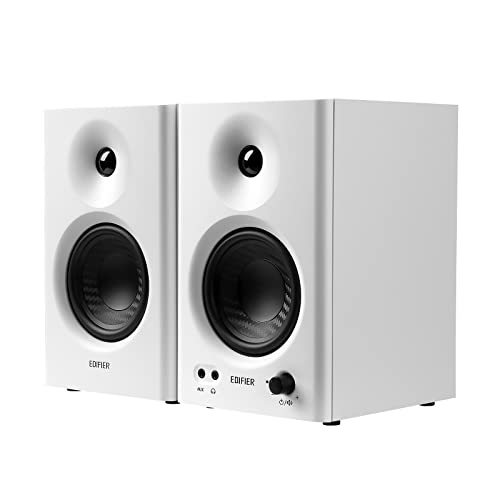
Edifier MR4 — The 4-inch step — a size up from the search, honestly labelled
The Edifier MR4 is a 4-inch active nearfield monitor, and the extra half-inch over the Eris is not a rounding error — it is a different compromise. Cone area grows faster than diameter suggests, and cabinet volume grows with it, so the MR4 reaches audibly further into the low midrange and upper bass where bass guitars, kick-drum bodies and male voices keep their weight. A reader who came hunting 3 inches and leaves with the MR4 has not been upsold; they have been shown the rung where small monitors stop apologising for the bottom of a mix and start reporting it, in miniature but in earnest.
Edifier’s angle on this rung is accessibility of a particular kind: a studio monitor that behaves like a friendly desk product. The MR4 suits the hybrid worker whose desk is an office by day and a studio by night, because it accepts the sources both lives produce and presents them without the fussy temperament studio gear sometimes performs. Its voicing aims at balance rather than excitement, which is the correct ambition for anything calling itself a monitor, and at nearfield distances that balance reads as calm competence.
Size discipline still applies, and this section is where the guide insists on it: the MR4 is bigger than the search that found it. Measure your desk’s depth, account for the space behind the cabinets that rearward air movement appreciates, and be honest about whether the 4-inch rung fits your furniture as comfortably as it fits your mixes. If it does, this is the rung where most small-desk listeners should stop climbing — the point where the remaining compromises are about physics’ outer edges rather than about audibly missing music.
Think of the MR4 as the rung where a desk stops being a compromise and starts being a position. Owners stepping up from laptop speakers or multimedia sets describe the same recalibration: music they thought they knew reveals its scaffolding, and their own recordings reveal their habits. That is the monitor experience arriving at a friendly size and temperament, and for many home producers it is the first time the word reference feels earned rather than marketed.
- True size: 4 inch woofer — stated as 4 inch at every appearance here
- Format: active nearfield monitor speakers, per the listing
- Class: powered studio pair in the Edifier monitor line
- Role: small desks that can host one size up
Strengths
- Low-end information the 3.5-inch rung only hints at becomes judgeable
- Desk-friendly manners suit work-and-music hybrid setups
- Balanced voicing serves mixing and long listening equally
Trade-offs
- A full size above the 3-inch search — desk depth must be verified
- Still no true deep bass; electronic producers will want more eventually
- Its calm balance excites nobody looking for a hyped desktop sound
The MR4 rewards owners who treat volume as a mixing tool. At the low-to-moderate levels of a home desk, its balance holds together and the low end stays in proportion; pushed toward party levels in a small room, any 4-inch monitor starts negotiating with physics. Work at the volumes the size was designed for and it behaves like a professional instrument that happens to be small.
Best for: hybrid desk workers and home producers whose furniture can accept the 4-inch rung. Not suited for: hard 3-inch space limits, or listeners who want their desk speakers to double as party speakers.

JBL 305P MkII — The grown-up reference — 5 inch, sold as a single speaker
Two labels must lead this pick, and both come straight from its listing: the JBL 305P MkII is a 5-inch powered studio monitor, and it is sold as one speaker. Stereo requires two. This guide includes it not as a 3-inch contender — it is nothing of the kind — but as the ladder’s honest top rung, the size class where the nearfield monitor becomes a mature instrument with real low-end reach, wide dispersion control and a reputation earned in thousands of project studios. Readers deciding how far to climb deserve to see the destination described accurately.
What the climb buys is authority. A 5-inch woofer in a properly shaped cabinet reports the bass region as fact rather than implication, and JBL’s waveguide approach keeps the sweet spot generous enough for a working producer who moves, reaches for a keyboard and leans toward a screen. Mixes made on this class of monitor translate — to cars, to earbuds, to living-room systems — with the reliability that made the line a default recommendation. If your desk and room can host the size, the argument for stopping lower is footprint and nothing else.
And footprint is a real argument, which is why this pick sits third rather than first. A pair of 5-inch monitors dominates a small desk visually and acoustically; in a tiny room their low-end ability can excite the walls into commentary. The 305P MkII is the right answer for the reader whose 3-inch search was really about budget or timidity, and the wrong answer for the reader whose search was about centimetres. Only the reader knows which search they typed.
There is a community dividend at this rung that smaller sizes cannot match. Because the 305P MkII is so widely owned, its behaviour is common knowledge: producers trade placement notes, room impressions and mix translations for this exact monitor, which means a new owner inherits a library of other people’s lessons. Obscurity has its charms, but a reference that thousands of peers also use is a communication tool as much as a speaker.
- True size: 5 inch woofer — never rounded down anywhere in this article
- Format: powered two-way studio monitor, per the listing
- Sold as: a single speaker — buy two for stereo
- Role: project-studio reference for desks that can host it
Strengths
- Bass reported as fact, not implication — mixes translate reliably
- Generous sweet spot suits real working postures at a desk
- A mature, widely understood reference character
Trade-offs
- Two full sizes above the search term — a different furniture decision
- Sold singly, so the stereo pair is two purchases
- Small rooms can boom under its low-end ability
If you climb to this rung, budget for the unglamorous companions: isolation pads or stands that decouple the cabinets from the desk, and cables for two powered speakers rather than one passive pair. A reference monitor vibrating a hollow desk is reviewing the desk as much as the mix, and the decoupling fix is cheap compared with the speakers it protects.
Best for: serious home producers with the desk and room to host the full-size rung. Not suited for: genuinely tiny desks, strict minimalists, or anyone who only wanted a small footprint.
IK Multimedia iLoud Micro class — The true 3-inch class (prose-only)
Meet the only resident of the category this article is named after. The iLoud Micro class — IK Multimedia’s ultra-compact monitor design — is what a true 3-inch studio monitor actually looks like when a serious company builds one: a pair of very small powered speakers engineered as a system, with digital processing used aggressively to stretch what tiny drivers in tiny cabinets can honestly do. It exists as a specialist instrument, aimed at producers who travel, who work in hotel rooms and borrowed corners, and who need a reference that fits in luggage. It is discussed here without a purchase link because the verified pool holds no listing for it.
Understanding this class recalibrates the whole search. Its designers never pretended a 3-inch woofer reaches deep; instead they optimised for the things a travelling producer actually loses first — imaging, midrange truth, consistency between unfamiliar rooms — and used processing to keep the low end tidy rather than large. Judged as a hi-fi toy it seems expensive for its size. Judged as a portable reference that lets a professional work anywhere, it has few rivals at any size, which is why it remains nearly alone: the niche is real but narrow, and one excellent inhabitant fills it.
Buying into the class means hunting outside this guide’s links — through the maker’s own channels and reputable audio retailers — with the usual diligence about region, warranty and what exactly is in the box. Verify that a listing describes the genuine monitor pair and not a namesake accessory, and be wary of prices that suggest the seller is confused about what they hold. Scarcity classes attract sloppy listings the way small harbours attract weather.
The class also teaches a lesson the whole category keeps relearning: constraints concentrate design. Denied size, its engineers spent their budget on consistency — the quality a travelling producer cannot improvise in an unfamiliar room. Owners who buy it for a tiny desk at home are borrowing that discipline, and many find the little pair’s steadiness in odd spaces is worth more than a larger speaker’s occasional brilliance in one perfect position.
- True size: 3 inch — the genuine size of this guide’s title
- Format: ultra-compact powered monitor pair class
- Status in this guide: prose-only, no verified pool listing
- Role: travel production and the smallest possible desks
Strengths
- The real 3-inch article — no relabelling required
- Engineered as a portable reference for working away from home
- Processing keeps its small output tidy and consistent
Trade-offs
- No verified link here, so sourcing diligence is entirely yours
- Deep bass is beyond its physics, however clever the processing
- Its specialist pricing buys portability, not power
If this class is your answer, treat placement as part of the product. Ultra-compact monitors are often used in untreated, unfamiliar rooms, and their consistency depends on the small disciplines: same distance from your ears, away from corners, tweeters near ear level. The class rewards the ritual precisely because it was designed for people who work wherever the ritual can be performed.
Best for: travelling producers and anyone with a genuinely hard 3-inch ceiling. Not suited for: bass-critical mixing, or shoppers who want a link-verified easy purchase.
Second-hand true-3-inch monitors — The pre-owned route to the real size (prose-only)
Niche products create peculiar second-hand markets, and the true-3-inch monitor is a fine example. Its owners are professionals who upgrade deliberately, so used examples tend to be complete, cared for and sold with honest descriptions — a healthier pool than the churn of mass-market gadgets. For a buyer set on the genuine size, watching the used market for the iLoud Micro class and its rare peers can succeed where waiting for new stock fails. This guide offers the route as prose because a used listing, by nature, cannot sit in a verified pool.
The diligence list is short and specific. Powered monitors hide their failures in amplifiers rather than drivers, so ask for a demonstration or a video of both speakers playing at moderate volume, listening for hum, crackle and one side sitting quieter. Confirm the power supply is the correct original type, since compact monitors often use external bricks that sellers substitute carelessly. Check the cabinets’ corners for drop damage, because a small speaker that has fallen off a desk has lived a harder life than its age suggests.
Priced fairly, a used true-3-inch pair is the most honest artefact in this entire guide: the exact size, doing the exact job, at a discount for having been loved before. Priced greedily — and scarcity invites greed — it becomes a trophy. Walk away from trophies. The ladder of linked picks above remains on sale every day, in honest sizes, for buyers whose patience runs out before the right used listing appears.
One advantage of this route rarely gets mentioned: you can audition the exact unit you will own. New purchases are leaps of faith softened by returns policies, but a used pair demonstrated in the seller’s room, playing your own familiar tracks, removes the guesswork entirely. In a class defined by scarcity, that certainty is a genuine feature, and it is only available to buyers willing to do the route’s homework.
- True size: 3 inch, when the genuine class is found
- Format: pre-owned powered monitor pairs
- Status in this guide: prose-only route, no pool listing possible
- Role: patient hunters of the exact size
Strengths
- Access to the genuine size when new channels are dry
- Professional first owners tend to sell complete, honest kits
- A fair used price undercuts every new alternative in the class
Trade-offs
- Amplifier faults hide until the speakers play — testing is essential
- Warranty is whatever the seller’s conscience provides
- Scarcity pricing can turn a tool into a trophy
Set your alert and your ceiling before you start watching the market, and write both down. Used-niche hunting rewards the prepared: the right listing at a fair figure goes to whoever responds in an hour, and dithering over whether the price is fair is how the prepared lose to the merely quick. Decide in the calm, act in the moment.
Best for: patient buyers committed to the exact 3-inch size with a set budget ceiling. Not suited for: anyone on a deadline, or buyers uncomfortable testing powered electronics.
Satellite-plus-subwoofer desktop route — The split-the-problem alternative (prose-only)
Step back from the size argument and a different architecture appears. If the desk’s problem is specifically cabinet volume at ear level, a satellite-plus-subwoofer arrangement relocates the volume to the floor, where desks have room to spare. Small satellites handle the midrange and treble from the desktop while a compact subwoofer, crossed over carefully, supplies the foundation no 3-inch cabinet could. This route is not a studio monitor in the strict sense, and this guide will not call it one — but for video editing, casual production and honest listening at a cramped desk, it solves the geometry problem without lying about sizes.
The craft lies in the crossover. Set it too high and the subwoofer starts announcing its location, dragging voices toward the floor; set it thoughtfully and the system coheres, the satellites freed from bass duty just as a filtered dash speaker is freed in a car. Subwoofer placement under a desk interacts with walls and floor, so expect an afternoon of small movements — a hand’s width here, a rotation there — each one audible. Owners who enjoy that afternoon get a system whose footprint at ear level beats everything else in this guide.
Choose this route with clear eyes about its ceiling. Without a monitor’s designed nearfield behaviour and flat intent, mixes made here need checking on other systems before they travel. For the reader whose work is video, streaming, writing with music and the occasional production sketch, that ceiling sits comfortably above their needs. For the reader mixing records for release, the ladder of true monitors above remains the professional answer, and this route is the waiting room, not the destination.
There is a household diplomacy to this architecture as well. A desk that must look like a desk — for video calls, for guests, for the simple dignity of an uncluttered room — keeps its clean lines with satellites, while the subwoofer hides where furniture already hides things. Not every studio decision is acoustic, and a system that survives the household’s aesthetic vote gets used daily, which is the first requirement of any tool.
- Architecture: small desktop satellites plus a floor subwoofer
- Monitor status: not a true studio monitor — labelled as an alternative
- Status in this guide: prose-only route, no pool listing
- Role: desks with no ear-level cabinet room at all
Strengths
- Smallest possible footprint where your ears actually are
- Bass exists, supplied from the floor instead of faked by small cones
- Satellites freed from bass duty play cleaner at desk volumes
Trade-offs
- Not a reference monitor — mixes need checking elsewhere
- Crossover and sub placement demand a patient afternoon
- More boxes and cables than any single pair in this guide
Keep the satellites’ job description narrow when you shop this route: clear midrange, civilised treble, no attempt at bass of their own. A satellite that tries to be a full speaker duplicates the subwoofer’s work and muddies the handover between them. Systems thinking beats component pride — each box doing one job well is the entire philosophy of the split design.
Best for: cramped desks doing video, casual production and everyday listening. Not suited for: release-critical mixing, or anyone who wants one pair of boxes and no setup ritual.
Why Do True 3-Inch Monitors Barely Exist?
The economics are as unforgiving as the physics. Developing a monitor costs roughly the same whether its woofer spans 3 inches or 5, but the 5-inch result can be sold to every project studio on earth while the 3-inch result serves travellers and the truly space-starved. Research budgets follow the larger market, tooling follows the budgets, and the small size is left to the one maker who saw a defensible niche in portability itself. Scarcity here is not a conspiracy or a gap waiting for a hero; it is a rational industry declining to build what few would buy.
There is also a standards problem. A monitor is judged by what it reveals, and reviewers compare across sizes without mercy. A 3-inch entrant from a mainstream brand would be measured against its own 5-inch sibling, found wanting in the bass, and remembered as the weak one — reputational damage no marketing department volunteers for. The ultra-compact class survives precisely because it refuses that comparison, defining itself by travel rather than by the studio shelf. Categories live or die by the comparison they invite, and 3 inches invites a fatal one.
What Can a Small Monitor Honestly Tell You About a Mix?
More than sceptics expect, provided the mix’s questions are the ones small monitors can hear. Balance between voice and accompaniment, the intelligibility of lyrics, the presence of guitars and keyboards, the shape of reverb tails in the midrange — these live in the bands small monitors reproduce faithfully, and they are the decisions listeners actually judge. A mix whose vocal sits correctly on a 3.5-inch pair will sit correctly almost anywhere, because the midrange is where playback systems agree with each other most.
What small monitors cannot adjudicate is the bottom octave’s diplomacy: how a kick and a bassline share space, whether a sub-bass note will overwhelm a car system, where rumble hides under a quiet recording. The professional habit is to check those questions on a second system — headphones with known low-end behaviour, a larger pair elsewhere, a car test — rather than demand one small box answer everything. Knowing which questions your monitor cannot hear is not a weakness in your studio; it is the definition of engineering judgement.
How Should You Choose the Best 3-Inch Monitor Speakers When 3 Inches Is a Mirage?
Reframe the search as a ladder and ask which rung your room can host. Measure the desk first: depth available, distance from your ears to the wall, the space a cabinet’s rear needs to breathe. Then be honest about the work. Spoken-word editing and acoustic production live happily on the 3.5-inch rung; beat-making that must judge its own low end wants the 4-inch rung at minimum and the 5-inch rung ideally; travel work belongs to the true-3-inch class wherever you can source it. The keyword brought you here, but your furniture and your material should cast the deciding votes.
Resist the two failure modes this category invites. The first is buying a relabelled fantasy — any product whose listing whispers 3-inch performance from a cabinet that plainly is not, or whose size cannot be verified from the maker’s own description. The second is buying the largest rung out of abstract ambition and then fighting your room for years, when the honest smaller pair would have integrated quietly and taught you more. In small-monitor shopping, fit is a specification, and it outranks diameter.
Where Should Small Monitors Sit on a Desk?
The geometry is simple to state and fiddly to achieve: tweeters at ear height, speakers and head forming a triangle, cabinets pulled away from the wall behind them and decoupled from the desk’s surface. At 3.5 inches the triangle shrinks to arm’s length, which is why small monitors feel so intimate — you are inside their designed listening distance in a way large monitors never permit at a desk. Foam pads or small stands solve the height and decoupling together, and they are the highest-value accessories in this entire category.
Walls deserve a paragraph of their own because small rooms put walls everywhere. A monitor close behind a wall gains bass from the boundary whether it wants it or not, and at these sizes the gain lands in the low midrange as boxiness rather than in the deep bass as power. Pulling the cabinets even a short distance forward, and resisting the corner placement that triples the effect, cleans the sound more than any equaliser preset. Your ears will hear the difference in one A-B shuffle of a familiar track.
Treat the first placement as a draft rather than a verdict. Live with it for a week of real work, then move one variable — a few centimetres of distance from the wall, a small change of toe-in — and live with that. Small monitors respond to these adjustments audibly and immediately, which makes them wonderful teachers: the room’s acoustics stop being theory and become a set of sounds you can produce on demand. Few purchases in a home studio repay curiosity as reliably as a pair of speakers on movable pads.
Do Small Monitors Need a Subwoofer Later?
Many owners add one eventually, and the addition is a graduation rather than an admission of failure. A small subwoofer, crossed over where the monitors naturally fade, extends the system downward while the monitors keep doing the midrange work they were chosen for. The discipline is restraint: the sub should be discovered by its absence when muted, not by its presence when playing. Set up that way, a 3.5-inch pair plus a modest sub becomes a genuinely full-range nearfield system whose desktop footprint remains smaller than the 5-inch rung’s.
Timing matters. Live with the monitors alone for some months first, learning their character on your material, so the subwoofer is tuned to extend a known sound rather than to rescue an unknown one. Owners who add the sub on day one often tune the pair into a combined fantasy neither component intended. Sequence is a quiet form of expertise in small studios: monitors, placement, familiarity, then extension — each stage earning the next.
What Should Podcasters and Video Editors Take From This Guide?
Your work is voice work, and voice lives exactly where small monitors are strongest. A 3.5-inch pair at a tidy desk will judge vocal balance, sibilance and room echo in a recording more usefully than a large pair across a room, because you are listening in the nearfield the format assumes. The true-3-inch class serves the travelling version of the same job. For spoken content, the ladder’s lower rungs are not compromises at all; they are the correctly sized tool, and the money saved against the 5-inch rung buys the microphone upgrade your audience will actually hear.
One caution travels with that good news: small monitors reveal a recording’s room more than its bass, so editors sometimes chase echo problems that belong to the recording space rather than the mix. Learn to recognise the difference — a voice that sounds boxy on every system is the room; a voice boxy only on yours is your placement. The first needs treatment at the source, the second needs your cabinets moved a few centimetres, and confusing the two wastes weekends.
How Long Do Small Studio Monitors Last?
Powered monitors are electronics wearing speaker costumes, and their lifespan is set by the amplifier stages and power supplies as much as by the drivers. Quality small monitors routinely serve a decade or more at a desk, helped by the gentle volumes nearfield work imposes. Heat is the long enemy: cabinets wedged into sunlit corners or stacked against warm equipment age faster than their specifications suggest, so a little air around a small monitor is a longevity policy as much as an acoustic one.
There is a second-hand corollary that connects to the prose pick above: because good small monitors age slowly and their owners upgrade for size rather than failure, the used market in this category is unusually rational. A five-year-old pair from the ladder’s rungs, tested for hum and channel balance, is often a smarter purchase than a new budget pair built to a price. Longevity is a feature you can buy second-hand at a discount, which is a rare sentence in consumer electronics.
How Do Small Monitors Behave at Night-Time Volumes?
Human hearing cheats at low volume: bass and treble recede in perception while the midrange holds, which is why quiet music sounds thin even on perfect equipment. Small monitors live most of their lives in that perceptual regime, and the good ones are voiced with the humility to stay balanced inside it. When you audition any rung of this guide’s ladder, do a meaningful part of the listening at the level of a late-evening session, because that is the level your neighbours, your household and your working hours will actually impose.
This is also why loudness comparisons between sizes mislead. A 5-inch monitor’s authority at high volume is real but irrelevant to a bedroom producer at midnight, while a 3.5-inch pair’s composure at low volume is the entire product. Match the monitor to the volume your life permits, and the ladder’s smaller rungs stop looking like compromises and start looking like instruments tuned to your actual conditions — which is the only tuning that matters.
What About Bluetooth and Convenience Inputs on a Monitor?
Small desks accumulate sources: a laptop, a phone, a tablet, perhaps a synthesiser or a television. Convenience inputs tempt buyers toward multimedia speakers wearing monitor clothing, and the distinction matters less than purists claim and more than marketers admit. A true monitor’s defining feature is intent — a voicing that aims to report rather than to flatter — and that intent can coexist with friendly connections. What should worry you is the reverse costume: a speaker whose every design choice flatters, wearing a studio badge for credibility.
Judge by behaviour on your own material. Play a recording you know is flawed and see whether the speaker shows you the flaw or papers over it; play a great one and check the speaker gets out of its way. Convenience features that survive that test are welcome passengers. The ladder in this guide was chosen on the reporting side of the line, at every rung, because a monitor that flatters is a mirror that lies — pleasant, and professionally useless.
Can One Small Monitor Work, or Must It Be a Pair?
A single small monitor has honourable employment: dialogue editing, voiceover checking, a reference for spoken content where the centre image is the whole story. Podcasters working alone often discover that one well-placed monitor answers their questions more directly than a careless pair, and the single-speaker listing format of the ladder’s top rung quietly serves them. Music production, though, is a stereo art, and imaging decisions — where the guitar sits, how wide the chorus opens — cannot be made in mono without borrowing trouble.
The pragmatic sequence for tight budgets is to buy the pair in the size you can place properly rather than one unit of a grander size, because placement and pairing are structural while diameter is incremental. A correctly arranged 3.5-inch pair teaches stereo craft from the first session; a lone 5-inch monitor teaches mono craft and a saving habit. Both are lessons, but only one of them is the craft most readers came to learn.
Comparison Table
The ladder and its alternatives, side by side, with every size stated as the product’s own listing states it — the comparison this category usually refuses to print.
| Pick | True woofer size | Sold as | Honest role | Status |
|---|---|---|---|---|
| PreSonus Eris 3.5 | 3.5 inch | Pair | Smallest true monitor pair | Linked, verified pool |
| Edifier MR4 | 4 inch | Pair | Low-end step up for small desks | Linked, verified pool |
| JBL 305P MkII | 5 inch | Single speaker | Full nearfield reference | Linked, verified pool |
| iLoud Micro class | 3 inch | Pair | Travel reference, genuine size | Prose-only |
| Second-hand 3-inch route | 3 inch | Pair, pre-owned | Patient route to the real size | Prose-only |
| Satellite + sub route | Satellites vary | System | Geometry workaround, not a monitor | Prose-only |
What Does This Ladder Mean for Your Budget?
Read the ladder as a set of honest trades rather than a ranking of worth. Money climbing from the 3.5-inch rung to the 5-inch buys bass information and authority; money spent sideways on the true-3-inch class buys portability and exact fit; money spent on the satellite route buys geometry. None of those purchases is the others’ failure. The wasteful purchase in this category is the one made against a mislabelled size, because it spends real money on a fiction and then spends more correcting it.
There is also a resale asymmetry worth knowing. The ladder’s standard rungs hold their value in a deep, rational used market, while the scarce true-3-inch class can swing between bargain and trophy pricing depending on who is selling that month. Buyers who may move house, change desks or graduate to a bigger room should weigh that liquidity quietly alongside the sound, because small-monitor ownership is often a chapter rather than a lifetime, and chapters end better when the equipment sells easily.
Notice, too, what the ladder does to upgrade anxiety. In categories with a single obvious flagship, every purchase feels like a down payment on regret. Here, each rung is a complete answer to a stated constraint — desk, room, travel, ambition — so a buyer can finish shopping when the constraint is met rather than when the catalogue runs out. That is a healthier relationship with equipment, and small-monitor buyers, whose constraints are unusually concrete, are unusually well placed to enjoy it.
What Mistakes Do Small-Monitor Shoppers Keep Making?
The signature mistake is believing a label the product never printed — assuming a guide’s headline size describes every product beneath it, then feeling deceived by a speaker that stated its true dimensions all along. This guide’s labelling discipline exists to make that mistake impossible here. The second mistake is its mirror: dismissing the ladder’s smaller rungs as toys because their woofers sound small in print, when at nearfield distances their midrange truth exceeds what a large speaker across a treated room offers a beginner.
Third comes placement neglect — reference monitors aimed at a chest, jammed against a wall, vibrating a hollow desk — followed by blaming the speakers for the room’s commentary. Fourth is buying the 5-inch rung singly and forgetting stereo needs two, an arithmetic surprise this guide flags in the pick itself. Fifth is judging small monitors with bass-heavy audition tracks at high volume, a test designed to make the category fail. Judge them at your working distance, at your working volume, on your own material, and the ladder sorts itself with surprising speed.
Final Recommendation
Let the size on the listing, not the size in the search, make your decision. If your desk can stretch half an inch beyond the dream, the PreSonus Eris 3.5 — a 3.5-inch pair, labelled so everywhere here — is the smallest honest monitor pair and the natural home for most readers. If it can stretch a full inch, the Edifier MR4’s 4-inch rung buys back the low-end information that makes mixing feel less like guesswork. If the search was never really about centimetres, the JBL 305P MkII waits at 5 inches, sold singly, as the reference the ladder climbs toward. And if 3 inches is a hard physical law in your room, the iLoud Micro class is the genuine article — hunt it through the maker’s channels or the patient second-hand route, and let no relabelled substitute talk you out of the size you measured. A monitor’s first duty is to tell the truth, and a guide about monitors should be held to the same standard: every size in this article is the size on the box, and the box was right all along, patiently waiting for the shopper to read it instead of the headline that brought them here.
Frequently Asked Questions
Is there really only one true 3-inch monitor class?
Essentially, yes, in the current market. The iLoud Micro class is the standing example of a genuine 3-inch studio monitor, which is why it appears here as a prose-only pick — the verified pool holds no listing for it, and this guide does not invent links.
Is the PreSonus Eris 3.5 close enough to count as 3 inch?
It is close in footprint and spirit, but it is a 3.5-inch monitor and this guide labels it that way everywhere. Whether half an inch matters is a question for your desk’s measurements, not for creative rounding.
Why is the JBL 305P MkII in a small-monitor guide at all?
As the ladder’s honest top rung. It is a 5-inch monitor sold as a single speaker, included so readers can see where climbing leads and what it costs in space — not as a disguised small option.
Can I mix music on 3.5-inch monitors?
Yes, within the size’s honest limits: midrange decisions, balances and vocal work are reliable, while deep-bass decisions should be checked on headphones or another system. Many successful home producers work exactly that way.
Should I add a subwoofer to a small monitor pair?
Eventually, many owners do, crossed over with restraint so it extends rather than overwhelms. Live with the pair alone first and learn its character, so the subwoofer extends a known sound.
Are the Edifier MR4 speakers a pair or a single?
The listing describes the MR4 as active near-field monitor speakers in the plural product sense; confirm the exact box contents on the listing before ordering, as packaging can vary by seller. The JBL, by contrast, is explicitly a single-speaker listing.
Related Guides
Round out the small-desk studio with these companion reads: Desk placement for nearfield monitors Adding a compact subwoofer to small monitors Headphones for checking bass in a small studio


