What's inside
- Key Takeaways
- Quick Picks
- How Did We Shortlist Drivers for This Guide?
- Which Amplifier Archetypes Flatter Which Driver?
- How Does the Cabinet Change What a Driver Delivers?
- What Happens in Two-Driver Cabinets?
- How Does a Swapped Driver Behave in the Studio?
- Why Does Impedance Matching Matter More Than Tone?
- How Do You Actually Swap 10-Inch Guitar Speakers?
- What Should You Listen for During the Break-In Period?
- Which Voice Suits Which Music?
- Why Does Sensitivity Matter More Than Wattage for Loudness?
- When Is a Swap the Wrong Answer?
- Comparison Table
- Is a 10-Inch Driver a Compromise Compared With a 12?
- What Should You Know About Buying Drivers Second-Hand?
- What Mistakes Ruin Otherwise Good Speaker Swaps?
- How Should You Store the Driver You Removed?
- Final Recommendation
- Frequently Asked Questions
- Related Guides
As an Amazon Associate I earn from qualifying purchases. This post may contain affiliate links at no extra cost to you.
gizmoverdict.com is reader-supported. When you buy through links on our site, we may earn an affiliate commission.
Where to buy: The five linked drivers below were checked against this site’s verified product pool, and the sixth pick is a prose-only class recommendation with no link and no invented listing. No prices and no star ratings are printed anywhere in this guide.
Say it before anything else, because the listings will not say it loudly: every pick in this guide to the best 10-inch guitar speakers is a bare replacement driver — a cone, a magnet and a frame, sold on its own. There is no cabinet here, no amplifier, no grille cloth, nothing to plug a guitar into. These are the speakers you bolt into an existing combo amplifier or extension cabinet whose original driver has blown, sagged with age, or simply never sounded like the amp in your head. If you arrived hoping for a small practice amp, this category is a workshop, not a showroom, and the honest tools for the job are a screwdriver, a soldering iron or crimp connectors, and twenty patient minutes.
Why swap at all? Because in a guitar amplifier the speaker is not a neutral messenger — it is the final and most characterful stage of the instrument. The same amplifier through a bright, efficient ceramic driver and through a soft, early-breaking vintage-voiced one becomes two recognisably different amps. A 10-inch driver swap is also the cheapest serious tone change available: one component, reversible in an afternoon, no modifications to the circuit. Players rescue tired practice combos this way, tame an amp that is too harsh, or coax more clean headroom from a small valve amp before rehearsals.
One safety subject runs through the whole guide and outranks tone: impedance. A driver’s ohm rating must match what your amplifier expects, and the picks below are deliberately mixed — one is a 16-ohm driver, the rest are 8-ohm — because both standards are common in 10-inch combos. Fitting an 8-ohm driver where an amp demands 16, or the reverse, changes the load the output stage works into; on valve amps a serious mismatch stresses the output transformer, and on any amp it shifts volume and response. Check your old driver’s label or your amp’s manual before ordering, not after the parcel arrives.
Key Takeaways
- Every pick is a bare 10-inch replacement driver for an existing combo or cabinet — no amp, no enclosure, nothing to plug into until you install it.
- Match impedance before chasing tone: the Celestion Ten 30 here is the 16-ohm version, while the G10 Vintage, Jensen C10R and MOD10-50 are 8-ohm drivers.
- Power handling figures quoted in this guide are manufacturer-rated and must comfortably exceed your amplifier’s output, especially in open-back combos run loud.
- Voice is the real buying decision — Celestion drivers lean British and mid-forward, the Jensens lean American and open, and the Eminence sits between with high efficiency.
- A speaker swap is reversible and needs only basic tools, which makes it the lowest-risk tone experiment in the guitar world.
Quick Picks
| Pick | Badge | Why it earns its place |
|---|---|---|
| Celestion Ten 30 (16 Ohm) | The 16-ohm upgrade path | Celestion’s affordable British-voiced driver in its 16-ohm form, for the many small combos wired for that load. |
| Celestion G10 Vintage (8 Ohm) | Vintage 30 character, shrunk | The 10-inch member of Celestion’s Vintage family, bringing that famous upper-mid push to small 8-ohm combos. |
| Eminence Legend 1058 | Loud, balanced American workhorse | A high-efficiency Legend-series driver that gives small amps clean volume and an even, unhyped response. |
| Jensen C10R | The vintage American voice | A reissue of the ceramic drivers behind classic small American combos — bright, articulate and quick to colour when pushed. |
| Jensen MOD10-50 | Budget-friendly all-rounder | Jensen’s MOD series entry: a warm, forgiving 10 with manufacturer-rated handling that suits everyday amp rescues. |
| Alnico-Magnet Vintage-Style Driver | Prose-only: the soft-touch class | The alnico class of 10-inch drivers, chosen for compression and sweetness at volume — discussed without a link because no pool listing covers it. |
Notice what the table cannot tell you: which of these your amplifier needs. That answer sits on the label of the driver you are removing, and it is the first thing to check.
How Did We Shortlist Drivers for This Guide?
The pool for this guide was built from listings verified through the site’s own product checks, and every linked pick is a genuine standalone 10-inch guitar driver — not a loaded cabinet, not a bass speaker wearing a guitar keyword, not a hi-fi woofer. That filtering sounds obvious until you browse the category, where car audio and PA drivers crowd the same search terms. What survived is a spread across the three voices a 10-inch swap can offer: the British Celestion school, the American Jensen school in two flavours, and Eminence’s efficient middle path, plus one prose-only class for the alnico sound no verified listing currently covers.
Impedance coverage was treated as a selection criterion, not a footnote. Small combos exist in both 8-ohm and 16-ohm forms, and a guide that listed only one would send half its readers away empty or — worse — mismatched. The Ten 30 represents the 16-ohm need explicitly, with its rating in its name throughout this guide, and each pick section restates its driver’s impedance in the spec list so nobody has to hunt for the number that protects their amplifier.
Power figures, where mentioned, are manufacturer-rated values and are used the way engineers use them: as a ceiling to stay comfortably under, matched against the amplifier’s output, not as a promise of loudness. Loudness lives in sensitivity, which is why the efficient Eminence earns attention out of proportion to its modest fame.
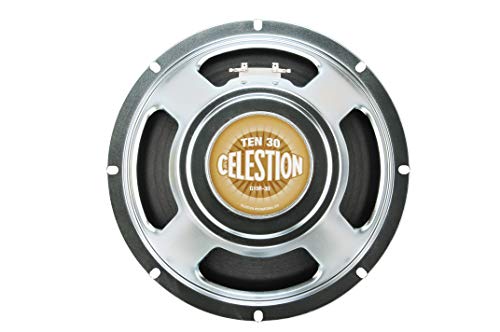
Celestion Ten 30 (16 Ohm) — The 16-ohm upgrade path
The Ten 30 is Celestion’s entry point into its own legend — the driver the company fits, and sells for upgrades, where a small amplifier needs the Celestion midrange signature without the price of the firm’s premium lines. In its 16-ohm form, the version listed in the pool, it answers a specific and common problem: a great many compact combos, particularly British-designed ones and many modern modelling-era valve combos, present a 16-ohm load, and their owners watch 8-ohm bargains pass by with nothing to buy. This driver exists for them, and this guide lists it first so the impedance conversation starts with a solution rather than a warning.
Tonally the Ten 30 speaks with the family accent. The midrange is forward and articulate, single notes carry a vocal quality that flatters lead lines, and chords stay separated when gain rises because the cone breaks up in an orderly, musical way rather than dissolving into fizz. The low end is appropriately modest — a 10-inch ceramic driver in a small open-back box will not thump, and pretending otherwise would be dishonest — but what bass there is stays tight, which recording engineers and bandmates both appreciate. Clean tones have a chime at the top that suits arpeggios and funk rhythm work.
As an installation it is undemanding: standard 10-inch mounting, a manufacturer-rated power handling figure in the thirty-watt class that suits the small combos it is aimed at, and a weight that will not unbalance a portable amp. Pair it with a low-wattage valve combo that currently sounds thin or harsh and the transformation is the textbook speaker-swap story — the amp you were considering selling becomes the amp you keep, for the price of an evening’s tinkering and a component you can remove again if your taste changes.
- Format: Bare 10-inch replacement driver — no cabinet, no amplifier
- Impedance: 16 ohms — check your amp expects this load before ordering
- Magnet / family: Ceramic magnet, Celestion’s entry British-voiced line
- Power handling: Manufacturer-rated in the 30-watt class
- Voice: Forward midrange, tight low end, orderly breakup
- Typical home: Small 16-ohm combos and extension cabinets
Strengths
- Direct answer for 16-ohm combos that most upgrade guides ignore
- Genuine Celestion midrange character at the accessible end of the range
- Breaks up musically instead of turning harsh when a small amp is pushed
Trade-offs
- Low end is tight rather than deep — physics, in a 10-inch open-back fitting
- The 16-ohm rating is a hard constraint: it is wrong for an 8-ohm amplifier
- Clean headroom is limited by its modest manufacturer-rated handling in louder valve combos
Best for: owners of 16-ohm small combos whose stock driver sounds thin, harsh or tired.
Not suited for: anyone whose amplifier is labelled 8 ohms — the G10 Vintage below is your Celestion instead.

Celestion G10 Vintage (8 Ohm) — Vintage 30 character, shrunk
The G10 Vintage exists because guitarists fell in love with a 12-inch speaker and then bought 10-inch amplifiers. Celestion’s Vintage 30 defined a generation of rock and metal tone from big cabinets — aggressive upper mids, tight lows, a presence that cuts through any mix — and the G10 Vintage is the company’s translation of that recipe into a 10-inch frame for 8-ohm combos. The translation is faithful in intent: this is the most assertive driver in this guide, the one that makes a polite practice amp clear its throat.
That assertiveness divides opinion, and this guide will not pretend otherwise. In a band mix the G10 Vintage is a gift — rhythm parts sit exactly where the engineer wants them, solos step forward without a volume pedal, and high-gain tones stay articulate because the driver refuses to flatter sloppy low end. Played alone in a quiet room at low volume, the same upper-mid emphasis can feel forward to ears that prefer warmth, particularly with bright single-coil guitars. Context is everything: it is a driver designed by its voicing to be heard among other instruments.
Its manufacturer-rated power handling sits comfortably above the Ten 30’s, in the sixty-watt class, which widens its amplifier compatibility to the many mid-powered 8-ohm combos whose owners drive them hard. Efficiency is healthy too, so a modest amp gains noticeable working volume. Fit it to a combo that vanishes in rehearsals and the problem usually ends — not because the amp grew, but because the driver spends its output in the frequencies where human hearing and band mixes actually live.
- Format: Bare 10-inch replacement driver — installation required
- Impedance: 8 ohms
- Magnet / family: Ceramic magnet, Celestion Vintage family
- Power handling: Manufacturer-rated in the 60-watt class
- Voice: Assertive upper midrange, tight bass, mix-cutting presence
- Typical home: 8-ohm combos that need to be heard in a band
Strengths
- Translates the famous Vintage-family push into a 10-inch fitting
- Manufacturer-rated handling covers mid-powered combos run with conviction
- High-gain and dense-mix clarity is the best in this guide
Trade-offs
- Upper-mid emphasis can sound forward for quiet solo practice
- Not the choice for players chasing soft, smoky vintage cleans
- Its focus flatters tight playing and exposes loose low-end technique
Best for: gigging and rehearsing players whose 8-ohm combo keeps disappearing in the mix.
Not suited for: bedroom players wanting a gentle, warm clean tone at whisper volume.
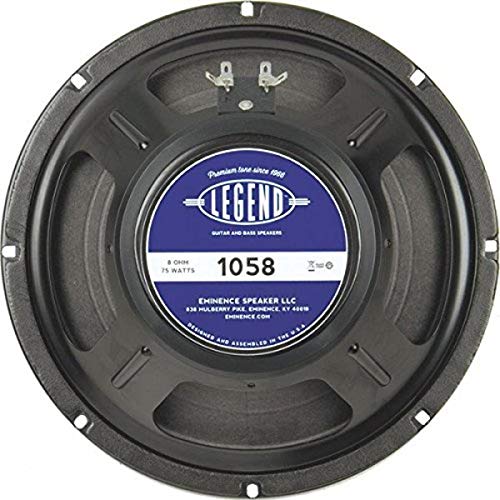
Eminence Legend 1058 — Loud, balanced American workhorse
Eminence built the Legend series on a plain promise — honest American-made drivers, voiced for working amplifiers, priced for working musicians — and the Legend 1058 is the 10-inch embodiment. Where the Celestions editorialize and the Jensens evoke an era, the 1058 aims for balance: a response that presents the amplifier rather than impersonating a genre. That neutrality makes it the diagnostician’s driver, the one technicians fit when an amp should be judged on its own merits, and the one players choose when their pedals, not their speaker, are supposed to supply the personality.
Its headline trait is efficiency. The 1058 is a sensitive driver, converting modest amplifier watts into serious acoustic output, and the effect on a small combo is startling the first time: clean headroom stretches, the volume knob’s useful range widens, and a 15-watt amp that used to shout at rehearsal speaks comfortably instead. Manufacturer-rated power handling is generous for the class — in the seventy-five-watt neighbourhood — so the same driver also survives in stronger combos without complaint, a breadth neither Jensen here can match.
There is a trade hidden in the balance, and fairness requires naming it: the 1058 will not give you the Celestion snarl or the Jensen sparkle for free. Its breakup, when it comes, is polite. Players whose entire sound is a small amp being tortured may find it almost too well-behaved, while players running modelers, pedal platforms or channel-switching amps will call that same behaviour honesty. Know which guitarist you are and the 1058 either becomes the obvious pick or the respectable also-ran.
- Format: Bare 10-inch replacement driver — Eminence Legend series
- Impedance: 8-ohm standard form
- Magnet / family: Ceramic magnet, American-voiced Legend line
- Power handling: Manufacturer-rated around the 75-watt class
- Voice: Balanced and even, with high sensitivity for real volume from small amps
- Typical home: Pedal-platform combos, rehearsal amps, technicians’ benches
Strengths
- High efficiency stretches the clean headroom of small amplifiers
- Even response suits pedals and modelers that supply their own character
- Generous manufacturer-rated handling fits a wide span of combo power
Trade-offs
- Polite breakup underwhelms players who want the speaker itself to snarl
- Less vintage colour than either Jensen for period-correct restorations
- Its neutrality can expose a mediocre amplifier rather than rescue it
Best for: players who need volume and honesty from a modest 8-ohm combo, and pedal-platform users.
Not suited for: tone purists whose sound is a small amp’s speaker breaking up on its own.

Jensen C10R — The vintage American voice
The C10R is a reissue of the drivers that defined the sound of small American combos in the 1960s — the ceramic 10s behind countless recording and club amplifiers whose clean tones still serve as reference points. Jensen’s reissue programme rebuilt those designs for modern production, and the C10R carries the family traits faithfully: a bright, open top end, a lean and articulate low end, and a response to being pushed that moves quickly from sparkle into a ragged, characterful edge. If your mental benchmark for clean guitar is a vintage American recording, this driver is the shortest route there from a modern combo.
That character comes with the original’s limits, preserved as faithfully as its charms. Manufacturer-rated handling is modest — in the twenty-five-watt class — because the amps it voices were modest, and the C10R is happiest reproducing their world: low-to-medium wattage, cleans with hair on them, edge-of-breakup rhythm work. Feed it a high-powered combo at full tilt and you are asking a vintage-voiced cone to do a modern job, which ends in flub and, eventually, in a recone. Matched to the right amplifier, though, its dynamics are delightful — pick attack speaks, volume-knob cleans bloom, and the whole amp feels older in the best way.
Restorers should note the C10R’s other role: it is the period-plausible replacement when an original driver in a vintage-style combo has failed and the owner wants the amp to sound like itself rather than like a modern reinterpretation. In reissue combos built to vintage recipes it is equally at home, completing the circuit the designer intended.
- Format: Bare 10-inch replacement driver — Jensen Vintage reissue series
- Impedance: 8 ohms
- Magnet / family: Ceramic magnet, vintage American voicing
- Power handling: Manufacturer-rated in the 25-watt class — match to low/medium-watt amps
- Voice: Bright open top, lean lows, quick characterful breakup
- Typical home: Vintage-style American combos and restorations
Strengths
- The reference vintage American clean tone, faithfully reissued
- Responsive dynamics reward volume-knob playing and pick attack
- Period-plausible choice for restoring vintage-style combos
Trade-offs
- Modest manufacturer-rated handling excludes powerful amplifiers
- Lean low end disappoints players wanting modern fullness
- Breakup arrives early — a feature for some, a ceiling for others
Best for: vintage-tone players and restorers with low-to-medium wattage 8-ohm American-style combos.
Not suited for: owners of high-powered combos, or anyone needing tight modern low end.

Jensen MOD10-50 — Budget-friendly all-rounder
Jensen’s MOD series — the name shortens “modern” — was created for the unglamorous majority of speaker swaps: the practice combo with a torn cone, the inherited amp with a driver that rattles, the rehearsal-room workhorse that needs to make noise again by Friday. The MOD10-50 is that series’ 10-inch answer, an 8-ohm ceramic driver with manufacturer-rated handling in the fifty-watt class, voiced warmer and more forgiving than its vintage-series siblings. It does not pretend to be a 1964 original, and its honesty about that is the point.
The voicing brief seems to have been friendliness. The top end is present but rounded, which flatters bright solid-state combos and early modelling amps whose stock drivers could sound like tearing paper. The midrange is warm rather than pushed, chords stay pleasant at practice volumes, and distortion — whether from the amp or a pedal — lands softly instead of spiking. In a teaching studio, a school music room or a shared rehearsal space, that forgiving quality is worth more than boutique character, because the driver must get along with every guitar and every level of technique plugged into it.
As a rescue component it is close to ideal: widely compatible impedance, handling that covers the small-to-mid combo fleet, and a price position — described qualitatively, as this guide prints no prices — at the accessible end of the market. Players sometimes apologise for choosing the sensible driver; they should not. An amplifier that works warmly every day beats a silent icon, and the MOD10-50 exists to return amps to service.
- Format: Bare 10-inch replacement driver — Jensen MOD series
- Impedance: 8 ohms
- Magnet / family: Ceramic magnet, modern-voiced Jensen line
- Power handling: Manufacturer-rated in the 50-watt class
- Voice: Warm and forgiving, rounded top end, soft landing for distortion
- Typical home: Practice combos, teaching amps, rehearsal-room rescues
Strengths
- Forgiving voicing tames harsh budget and early modelling combos
- Manufacturer-rated handling spans most small and mid-sized combos
- The practical rescue pick when an amp simply needs to work again
Trade-offs
- Rounded top end lacks the C10R’s vintage sparkle and air
- Warmth can turn vague in an already dark-sounding amplifier
- Little collector or restoration appeal — it is a tool, not an heirloom
Best for: teachers, rehearsal spaces and anyone reviving a tired 8-ohm practice combo.
Not suited for: restorers chasing period correctness, or players wanting cutting presence.
Alnico-Magnet Vintage-Style 10-Inch Driver — Prose-only: the soft-touch class
One voice is missing from the linked picks, and rather than invent a listing this guide describes it as a class: the alnico-magnet 10-inch driver, the construction used by the earliest guitar amplifiers and still made in vintage-style lines — the Eminence Legend 1028K type of design is the reference point. Alnico’s reputation rests on behaviour, not nostalgia: as the driver works harder, the magnet’s response softens transients in a way players describe as compression, rounding pick attack and sweetening the top end precisely when a ceramic driver would be getting stern. At the edge of breakup an alnico 10 seems to lean into the note with you.
The class suits low-wattage amplifiers played at their natural working volume — the small club and studio world where an amp lives between halfway and three-quarters on its dial. Touch-sensitive players, roots and blues guitarists, and anyone recording a small amp close-miked will recognise the appeal immediately. The same softness is a genuine liability elsewhere: high-gain players lose definition, loud clean players lose headroom, and the class typically carries the highest prices in the 10-inch world, again stated qualitatively. Alnico drivers are also frequently offered in several impedances, which returns the buyer to this guide’s standing rule — confirm the exact rating of the exact unit before it goes anywhere near your amplifier.
Because no listing for this class passed the site’s verification pool for this guide, it appears as prose only: no link, no marker with an ASIN, no borrowed specifications. If your heart is set on the alnico feel, shop the class by its rules — vintage-style product lines from the established driver makers, impedance matched to your amp, handling matched with headroom to spare — and treat any listing that cannot state its magnet type and rating plainly as a listing to skip.
- Format: Bare 10-inch replacement driver — described as a class, no linked listing
- Impedance: Varies by model — verify the exact unit before buying
- Magnet / family: Alnico magnet, vintage-style construction
- Power handling: Typically modest and model-specific — confirm manufacturer-rated figures per unit
- Voice: Compressive, sweet top end, softening attack at working volume
- Typical home: Low-wattage vintage-style combos for club and studio work
Strengths
- Musical compression at volume that ceramic drivers do not imitate
- Sweetened top end flatters single-coils and edge-of-breakup tones
- The period-correct feel for the earliest amplifier designs
Trade-offs
- Definition suffers under high gain and loud clean demands
- Usually the most expensive route into a 10-inch swap
- Specifications vary widely by model, so research cannot be shortcut
Best for: touch-sensitive roots, blues and studio players with low-wattage amps played at working volume.
Not suited for: high-gain players, loud-clean players, and anyone who wants a link-verified pick from this guide.
Which Amplifier Archetypes Flatter Which Driver?
Abstract voicing descriptions become decisions when they meet real amplifiers, so consider the archetypes one by one. The small British-voiced valve combo — bright, gainy, often 16-ohm — is the Ten 30’s home ground: the driver’s forward mids reinforce what the circuit already believes, and its orderly breakup extends the amp’s own distortion character rather than fighting it. The same amp on an 8-ohm tap, where one exists, takes the G10 Vintage as a louder, more aggressive alternative for the player who gigs it.
The mid-powered American-style combo with a pedalboard in front belongs to the Legend 1058. Its even response passes the pedalboard’s carefully built tones to the room without repainting them, and its efficiency covers the rehearsal volume those rigs demand. The vintage-style American combo — the low-powered tweed and black-panel recipes — is the C10R’s birthright, and fitting anything more modern-voiced squanders the circuit’s intent. The MOD10-50 inherits everything else: the solid-state practice amp, the school combo, the spare amplifier that must simply work with every guitar in the building.
The alnico class pairs with the smallest archetype of all — the five-to-fifteen-watt single-ended or push-pull combo played where its power section genuinely works. In that narrow, glorious window the magnet’s compression becomes part of the instrument. Outside it, in a hundred-watt head’s extension cabinet, the same driver is an expensive way to sound tired. Archetype honesty saves money in both directions.
How Does the Cabinet Change What a Driver Delivers?
A driver does not sound like itself; it sounds like itself in a box. Most 10-inch combos are open-backed, which lets sound escape rearward, fills small rooms with ambience, and relieves the cone of deep-bass duty — one reason 10-inch combos feel airy and why their low end stays modest whatever driver you fit. The same driver in a closed-back extension cabinet gains low-end weight and projection, loses the room-filling spill, and aims its output at the audience like a torch instead of a lantern. Neither is better; they are different instruments built from one component.
Cabinet volume matters at this size more than folklore admits. A driver designed for the generous air of a combo can sound strangled in a miniature sealed box, while a small cabinet can tighten a loose-voiced driver usefully. When a swap disappoints, the box is a legitimate suspect alongside the driver — and the cheapest experiment is often moving the same combo away from the wall, since an open back too close to a surface chokes exactly the ambience the design promises.
What Happens in Two-Driver Cabinets?
Some 10-inch rigs run drivers in pairs — 2×10 cabinets and combos — and pairing introduces arithmetic and diplomacy. The arithmetic is impedance: two drivers wired in parallel halve the total, in series they double it, so a pair of 8-ohm drivers presents 4 or 16 ohms and the amplifier must be matched to the result, not to the individual labels. The diplomacy is voicing: matched pairs behave predictably, while mixed pairs — a Celestion beside a Jensen, say — blend characters in ways many players love, the forward driver supplying cut and the open driver supplying air.
Efficiency decides whether a mixed pair is a blend or a solo act. A sensitive driver beside a quiet one simply shouts it down, and the expensive second cone becomes decoration. When mixing, keep sensitivities within a small margin, keep impedances identical between the two drivers, and wire polarity with double care, because a pair fighting out of phase produces the thinnest sound in guitar amplification — a fault owners regularly misdiagnose as a bad driver.
How Does a Swapped Driver Behave in the Studio?
Recording exposes what rehearsal forgives. A close microphone hears a 10-inch cone in zones — brighter at the centre, warmer at the edge — and a driver swap moves those zones’ characters, which is why engineers keep favourite small combos the way photographers keep lenses. The C10R’s sparkle records beautifully for clean rhythm parts that must sit under a vocal without masking it. The G10 Vintage’s push survives dense mixes where a softer driver’s part would be EQ’d into audibility at the cost of its nature. The Legend 1058, predictably, is the session all-rounder: what the microphone hears is what the amp was doing.
Small drivers carry a studio advantage worth naming: they reach their musical working zone at volumes a control room can tolerate, and their modest low end leaves the bass guitar’s territory uninvaded, so mixes assemble themselves. More records than listeners suspect were made by a 10-inch combo working hard in a quiet room — and every one of those sessions was, in effect, an argument for choosing the driver by voice rather than by size.
Why Does Impedance Matching Matter More Than Tone?
An amplifier’s output stage is designed into a specified load, printed on the amp’s rear panel or in its manual and matched by the original driver’s label. Swap in a driver of half the expected impedance and the output stage works harder than designed — on a valve amp the output transformer absorbs the stress, and a serious mismatch sustained at volume can damage it; fit double the expected impedance and the amp delivers less power, sounds thinner, and on some valve designs faces its own risks from the opposite direction. Solid-state amps are more forgiving in one direction and abruptly unforgiving in the other, shutting down or failing when the load drops too low. None of this is subtle or theoretical: impedance is the one specification in this guide that can break equipment.
Series and parallel wiring complicate multi-driver cabinets — two 8-ohm drivers wire to 4 or 16 ohms depending on method — but the single-driver combos this guide mostly serves are simple: read the old label, buy the same number. Where an amp offers switchable impedance or multiple speaker outputs, follow the manual for the tap you will actually use. And when a seller’s listing cannot state a driver’s impedance plainly, that listing has failed the only test that cannot be negotiated.
Tool preparation is five minutes well spent: a screwdriver or nut driver matching your amp’s fixings, a phone for the wiring photographs, masking tape and a pen to label leads if both look identical, and a soft surface to rest drivers on cone-up. Work on a table, not on the floor — dropped screws find carpet instantly and amplifiers are heavier than memory suggests when you are kneeling.
How Do You Actually Swap 10-Inch Guitar Speakers?
The job is within any careful owner’s reach. Power the amp down and unplug it — valve amps store charge, so keep hands to the speaker hardware and away from the chassis internals. Photograph the existing wiring before touching it: which terminal the marked lead feeds, how the driver sits, which way the gasket faces. Remove the old driver’s mounting screws evenly, support its weight as the last screw leaves, and note the terminal type — soldered leads or push-on connectors — so the new driver can be connected the same way. Seat the replacement without forcing it, tighten in a cross pattern a little at a time so the frame is not warped, and reconnect with polarity preserved.
First power-up is a listening test, not a celebration. Start at low volume with a clean tone, confirm sound is centred and free of buzz, then raise volume gradually while listening for rattles that betray a loose screw or a lead touching the cone. Play for twenty minutes before declaring victory — some faults appear only as components warm. Keep the old driver if it still works; tastes change, amps get sold, and a reversible experiment is only reversible while the original parts survive.
What Should You Listen for During the Break-In Period?
A new driver’s suspension is stiff, and its first hours are its worst. Straight from the box many 10-inch drivers sound tight, slightly boxy and reluctant in the low end; after ten to twenty hours of real playing the surround and spider loosen, bass fills in and the top end relaxes. Judging a swap in the first evening is the commonest evaluation error in this hobby — players have condemned excellent drivers at hour one that they would have praised at hour fifteen. Play normally, vary the material, and let band rehearsal do in two sessions what noodling does in a month.
Break-in also recalibrates the player. Your picking hand adapts to a new driver’s dynamics unconsciously, and amplifier settings that suited the old speaker — particularly treble and gain — deserve revisiting once the new one settles. Revisit the amp’s EQ with fresh ears after the break-in window before concluding anything about the pairing, because half of what owners attribute to a driver lives in settings carried over from its predecessor.
Players in a hurry sometimes accelerate break-in with low-volume programme material left playing for an afternoon, and within reason it works — the suspension only counts hours of movement, not hours of inspiration. Keep the level modest, keep the material varied, and never leave an unattended valve amplifier running in an empty house; patience at rehearsal remains the safer accelerant, and it has the side effect of making you better at playing through the new driver while it settles.
Which Voice Suits Which Music?
Match the driver to the repertoire, not to fashion. British-voiced Celestions serve rock rhythm work, indie jangle with an edge, and any setting where the guitar must occupy a defined midrange seat among other instruments. The G10 Vintage in particular is a band driver, happiest with drums present. Vintage American Jensen voicing serves the musics those original combos were built for — blues, country, soul, early rock and roll — where clean and edge-of-breakup tones carry the evening and sparkle matters more than thump. The MOD series suits the mixed reality of teaching and rehearsal rooms, where one amp meets every genre in a day and forgiveness outranks identity.
The Eminence Legend 1058 is the chameleon: jazz players value its even response, pedal-platform players its honesty, and loud rehearsal bands its efficiency. The alnico class belongs to the traditionalists of touch — players whose dynamics are the effect. None of these assignments is a law; a country player through a G10 Vintage will still sound like themselves, because hands outrank hardware. But a driver whose voicing leans toward your music asks less of your EQ, your pedals and your patience.
Why Does Sensitivity Matter More Than Wattage for Loudness?
New swappers fixate on wattage because it is the number sellers print largest, but a driver’s handling figure only states what it can survive — sensitivity states what it does with the power it receives. Sensitivity describes the sound level a driver produces from a standard input at a standard distance, and the differences are not cosmetic: a driver a few decibels more sensitive plays as loudly on fifteen watts as a quieter driver manages on fifty. That is the entire mechanism behind the Legend 1058’s reputation for waking small amplifiers up, and behind the disappointment when a high-handling but insensitive driver leaves a small combo sounding smaller than before.
The practical reading is two-step. First match handling to the amplifier with headroom, as a safety ceiling. Then compare sensitivity to predict the volume change the swap will actually deliver, remembering that your amplifier’s character also shifts with how hard it must work — an amp cruising at half volume because its new driver is efficient keeps clean headroom the same amp, straining into an insensitive driver, spends entirely. Loudness is a system property, and the driver is where the system’s efficiency is decided.
When Is a Swap the Wrong Answer?
Honesty requires the negative cases. A driver cannot repair tired valves, dried capacitors or a failing output transformer, and an amplifier that hums, fades or smells hot needs a technician before it needs a cone. A swap is also the wrong spend when the real limitation is the room — a boxy rehearsal space makes every driver sound boxy — or when the amplifier itself is simply not the circuit the player wants, in which case a new voice on the wrong amp postpones an inevitable purchase while consuming its budget. Finally, collectors should pause: in a genuinely vintage amplifier, the original driver is part of the instrument’s value, and the reversible swap is only reversible if the original is stored safely, labelled, and kept with the amp forever.
The diagnostic that separates the cases is substitution. Borrow any known-good cabinet, connect the amplifier to it with impedance matched, and listen. If the amp blooms through a different speaker, your driver was the limitation and this guide is your shopping list. If the faults travel with the amplifier, close this page and find a technician — the most valuable sentence in any buying guide is the one that tells you not to buy.
Comparison Table
| Driver | Impedance | Magnet | Voice | Handling (manufacturer-rated) |
|---|---|---|---|---|
| Celestion Ten 30 | 16 ohms | Ceramic | British, forward mids | 30-watt class |
| Celestion G10 Vintage | 8 ohms | Ceramic | British, assertive upper mids | 60-watt class |
| Eminence Legend 1058 | 8 ohms | Ceramic | American, balanced, efficient | 75-watt class |
| Jensen C10R | 8 ohms | Ceramic | Vintage American, bright | 25-watt class |
| Jensen MOD10-50 | 8 ohms | Ceramic | Modern, warm, forgiving | 50-watt class |
| Alnico vintage-style (prose-only) | Varies | Alnico | Compressive, sweet | Model-specific |
Two columns decide safety — impedance and handling — and one column decides happiness. Check them in that order and the table has done its work.
Is a 10-Inch Driver a Compromise Compared With a 12?
Only in the frequencies physics reserves for larger cones. A 10-inch driver moves less air, so the deepest low end is leaner — which guitar, an instrument whose fundamental range sits well above the sub-bass, rarely misses. What the smaller cone returns is speed and focus: transients arrive crisply, chords articulate at gain levels where a loose 12 can smear, and the whole amplifier becomes more portable, which is a musical property on the third trip up rehearsal-room stairs. The 10-inch format’s long recording pedigree is not an apology; engineers choose it for definition the way drummers choose a smaller kick drum for punch.
Where the compromise is real is stage volume in loud, un-miked bands: a single 10 works harder to fill a big room, and a driver at its limits colours everything. In that setting the answer is rarely a different 10 — it is a second cabinet, a microphone into the PA, or accepting that the gigging rig and the beloved small combo are different tools. Most players, most nights, play rooms where the 10 is not the limiting factor, and its focus is pure profit.
What Should You Know About Buying Drivers Second-Hand?
The used market in drivers is deep, because swaps generate spares, and it rewards a short inspection ritual. Examine the cone for tears, creases and repaired patches; flex it gently and evenly with fingertips spread, listening for the gritty scrape of a rubbing voice coil, which condemns the driver regardless of price. Check the surround for rot or cracking, the terminals for damage, and ask what amplifier the driver lived in — a low-rated vintage-voiced unit pulled from a high-powered combo has had a hard life whatever its face looks like. Verify impedance with a meter at the meeting if the label is missing, using the reading pattern the FAQ below describes.
Price expectations should stay qualitative but firm: a used driver with an unknown history is worth meaningfully less than the same model new with a warranty, because the failure modes that matter are invisible in photographs. The picks in this guide are linked new for exactly that reason — the verified listings remove the inspection gamble — while the second-hand route suits experienced buyers who enjoy the ritual and can absorb an occasional dud as tuition.
What Mistakes Ruin Otherwise Good Speaker Swaps?
Ordering by diameter alone leads the list: a driver can be a perfect 10-inch circle with the wrong impedance, the wrong mounting depth for a shallow combo, or terminals that foul the chassis. Measuring the old driver and reading its label takes four minutes and prevents all three. Second comes the handling mismatch — a charming low-rated vintage driver installed in a powerful combo because the tone description seduced its owner — followed by polarity errors that leave a multi-driver cabinet thin and hollow, and screws driven home unevenly until the frame warps and the voice coil rubs.
Expectation errors complete the set: judging before break-in, expecting a driver to fix faults that live in the amplifier, and expecting a 10-inch cone to produce the low end of a 12. A speaker swap changes an amp’s voice profoundly and its physics not at all. Buyers who accept that boundary are almost always delighted; buyers who shop for miracles blame innocent drivers.
How Should You Store the Driver You Removed?
A removed driver is an asset — the means to reverse the swap, the original equipment a future buyer of a vintage amp will ask about, and a spare that can rescue another combo. Store it cone-up in its replacement’s box if that survives, or in any rigid box with the cone protected from pressure and the terminals from bending. Keep it indoors, dry and away from radiators; garages kill surrounds with damp and temperature swings. A paper label noting the amplifier it came from, its impedance and the date of removal turns a dusty box into a documented part, and takes ninety seconds while the details are fresh.
If the removed driver was faulty, decide its fate honestly: reconing by a specialist can be worthwhile for genuinely vintage units whose value lives in originality, while a tired modern driver is usually worth more as a trade-in, a test-bench speaker, or a recycling trip than as a shelf ornament awaiting a repair that costs more than its replacement.
Label the leads before the swap if your amp uses two identical push-on connectors — a wrap of tape marked with a pen prevents the silent polarity error that owners chase for weeks, blaming cones for a wiring fault committed in the first five minutes.
Final Recommendation
Start with the label on your old driver. If it reads 16 ohms, the Celestion Ten 30 is your pick and the decision is already made. At 8 ohms the choice becomes musical: the G10 Vintage for band presence, the Legend 1058 for volume and honesty, the C10R for vintage American sparkle in a low-powered amp, and the MOD10-50 for the warm, forgiving rescue of a working practice combo. The alnico class waits, unlinked and unhurried, for the touch player who knows exactly why they want it. Whichever driver you bolt in, give it twenty hours before you judge it — a speaker, like a new bandmate, should be assessed after the rehearsals, not at the audition.
And when the last screw is tightened and the first chord blooms through a cone that finally sounds like the amp in your head, you will understand why guitarists keep a spare driver on the shelf: it is the one upgrade that lets an old amplifier introduce itself all over again.
Frequently Asked Questions
Will any of these picks work as a standalone speaker for listening to music?
No — and the question identifies the category error this guide opened with. These are instrument drivers, voiced for guitar and built to be installed in an amplifier or cabinet. They have no enclosure, no amplifier and no inputs of their own, and their voicing would flatter nothing in a record collection.
My amp’s label is worn away. How do I learn its impedance?
Check the manual or the maker’s published specification for the model, and if the old driver survives, measure it: a multimeter across the terminals reads a little below nominal impedance — roughly six to seven ohms on an 8-ohm driver, twelve to thirteen on a 16-ohm one. When in doubt, ask a technician rather than guessing with a valve amp’s transformer at stake.
Is a higher manufacturer-rated wattage always safer?
Safer against damage, yes, provided impedance matches — a driver rated well above the amp’s output will not be hurt by it. But very high-rated drivers in tiny amps can sound stiff at low volume, because the cone barely moves. Aim for comfortable headroom, not the largest number on the shelf.
Can I fit a 10-inch driver where an 8-inch one lived?
Not as a swap. The baffle cutout, mounting depth and cabinet volume are all built around the original size, and enlarging a baffle is carpentry that changes the cabinet permanently. This guide’s picks assume a cabinet already built for a 10-inch driver.
Why is the alnico pick not linked like the others?
Because no listing for that class passed this site’s verification pool, and the guide links only what it has verified. The class is described honestly in prose so the comparison stays complete; if you buy one elsewhere, apply the same checks — stated impedance, stated magnet type, manufacturer-rated handling.
Does a heavier magnet mean a better driver?
No — magnet material and size serve the design’s goals rather than ranking it. Ceramic magnets deliver strong output economically, which is why four of the linked picks use them; alnico offers its particular dynamic behaviour at higher cost; neither is a grade. Judge a driver by voice, sensitivity and suitability for your amplifier, and let the magnet be whatever the designer needed to achieve them.
Can one driver serve both guitar and bass practice?
A guitar driver will reproduce a bass guitar audibly at low volume, but it is not built for the excursion deep bass demands, and enthusiastic low notes can damage it. Bass practice deserves a bass-voiced driver or a small bass combo; the guitar picks in this guide should stay in guitar service.
How long does a replacement driver last?
Decades, in ordinary service. Guitar drivers fail from abuse — overpowering, physical damage, moisture in storage — far more often than from age. The vintage drivers these reissues imitate are still working after half a century, which is the durability standard the class is held to.
Related Guides
Continue with best 12-inch guitar speakers and how to match speaker impedance to your amp and best small valve combos worth upgrading when the coordinators connect this guide to the wider guitar cluster. See also 5.1 wireles soundbars.


