Our Top Picks


What's inside
- Why a first mechanical watch so often comes from this brand
- The product map: four families that cover most wrists
- Movements: the in-house story in practical terms
- Size and wear: why lug-to-lug decides more than diameter
- Water resistance: reading the numbers as daily permissions
- Crystals, dials, and the light a watch lives in
- Straps and bracelets: the upgrade path almost every owner takes
- Buying the right version: codes, markets, and warranty
- A decision checklist for the four most common buyers
- Check prices on Amazon
- Living with the watch after the first month
As an Amazon Associate I earn from qualifying purchases. This post may contain affiliate links at no extra cost to you.
Some watch brands ask you to pay a premium for a famous name, a celebrity campaign, or a movement bought in from an outside supplier. Orient built its reputation in almost the opposite way. Founded in Tokyo in 1950, the company grew by designing and building its own mechanical movements, fitting them into honest, well-finished watches, and selling those watches at prices that left room in a household budget for everything else in life. Today Orient sits inside the Seiko Epson group, yet it keeps its own design language, its own factories for movements, and its own loyal following among people who care more about what ticks inside a case than about a logo seen across a room.
That in-house movement story is the single most important fact to understand before you choose one. In entry-level mechanical watchmaking, many brands assemble watches around movements supplied by large third-party makers. Those movements can be perfectly good, but the brand itself is closer to a designer and assembler than to a watchmaker in the full sense. Orient, by contrast, develops its own calibers, produces them in volume, and has refined the same basic architecture over decades. When you buy a Bambino, a Mako, or a Kamasu, the engine inside was drawn, built, and regulated under the same roof as the watch that carries it. For a first mechanical watch, that coherence matters. It explains the value, it explains the parts support, and it explains why collectors who own far more expensive pieces still keep an Orient in the box.
Disclosure for this guide: if you follow the links on this page and complete an order, the retailer may pay a small commission that helps fund this site, at no extra cost to you.
Why a first mechanical watch so often comes from this brand
A mechanical watch is a small machine that asks something of its owner. It needs winding, it drifts by seconds each day rather than holding perfect atomic time, and it rewards attention with a kind of quiet satisfaction that a screen cannot copy. People entering the hobby usually want three things at once: a movement with a genuine story, a design that will not look dated in five years, and a total cost of ownership that stays sensible when the first service eventually comes due. Orient answers all three requests without drama. Its catalog is deep enough to contain dress watches, divers, moonphase models, and open-heart designs, yet narrow enough that a newcomer can learn the whole range in an evening.
There is also a matter of proportion. Many entry mechanical watches from fashion-led brands are oversized, thick, and styled for a season. Orient tends toward classic dimensions, restrained dials, and case shapes drawn from the middle decades of the twentieth century, when a watch had to fit under a shirt cuff and read at a glance. That restraint ages well. A Bambino bought for a first job interview still looks correct at a wedding ten years later, and a Mako bought for summer holidays still looks correct on a boat, at a barbecue, or under a winter coat sleeve, provided the strap suits the setting.
Collectors take a different path to the same brand. Once a collection already holds Swiss divers and Japanese chronographs, the appeal shifts toward variety for its own sake: a sun-and-moon complication that few rivals offer at this level, a semi-skeleton dial that shows the balance wheel working, a green Kamasu that changes colour as light moves across it. Orient gives experienced owners a low-risk way to explore a complication or a colour before committing serious money elsewhere, and quite often the exploration piece stays in regular rotation because it wears so easily.
None of this means every model suits every wrist or every need. The catalog contains several generations of movements, two broad families of sizing, mineral and sapphire crystals, and water ratings that range from splash resistance to proper dive duty. Choosing well means matching those details to your wrist, your routine, and your taste. The sections that follow break the decision into parts, starting with a map of the product lines, then moving through movements, fit, water resistance, crystals, straps, and the practical checks that separate a careful purchase from a hopeful one.
One comparison deserves space at the start, because many readers arrive here while deciding between a mechanical watch and a connected watch. A reader weighing a traditional automatic against the options gathered under best mens smartwatches is really choosing between two daily rituals, one built on charging, notifications, and software updates, the other built on winding, setting, and a machine that can run for years without a screen ever lighting up. Neither ritual is superior for everyone. This guide assumes you are curious about the mechanical ritual, and it will help you choose the Orient that fits it best.
The product map: four families that cover most wrists
Orient organises its range in ways that can confuse a first-time shopper, because naming differs between the Japanese domestic market and international markets, and because older model names linger in listings long after a replacement arrives. A simpler mental map works better. Think of four families. First, the Bambino line of dress watches. Second, the diver family built around the Mako, Ray, and Kamasu names. Third, the Sun and Moon line, which adds a day-night indicator and, on many versions, a moonphase-style display. Fourth, the open-heart and semi-skeleton models, which cut windows into the dial so the movement itself becomes part of the design. Around those four sit broader Classic and Contemporary groupings that collect simpler three-hand watches, small-seconds models, and modern everyday pieces.
Once that map is in mind, the catalog stops feeling like a crowd and starts feeling like a set of answers to different questions. Do you need a watch for formal shirts and quiet rooms? Start with Bambino. Do you need a watch that can swim, time a dive or a pasta pot, and shrug off knocks? Start with the divers. Do you want a complication that sparks conversation? Start with Sun and Moon. Do you want to see the machine work? Start with the open-heart models. The rest of this guide keeps returning to those four questions, because most good purchases begin with the right family and only then narrow to a dial colour or a strap.
Bambino: the dress watch most people picture first
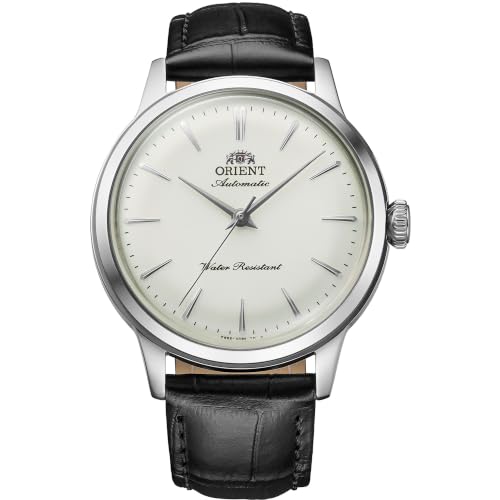
The Bambino is the line that turns casual browsers into owners. Its signature is a domed crystal that rises gently above the case and bends light at the edge of the dial, paired with a domed or softly curved dial beneath it. The two curves together give the watch a warmth that flat modern dress watches rarely achieve. Dauphine hands, applied indices, and a clean minutes track complete a design that owes a clear debt to mid-century dress pieces without copying any single one of them.
Most Bambino versions sit around 40.5mm in diameter, a size that sounds large for a dress watch on paper yet wears smaller than the number suggests. The case sides curve inward, the lugs are short, and the domed crystal draws the eye toward the dial centre rather than the outer edge. On a medium wrist the result reads as elegant rather than bulky, especially on the stock leather strap. Smaller versions exist in some markets and generations, and readers with slim wrists should seek them out, because a dress watch that overhangs the wrist loses the very neatness it was bought for.
Across generations the Bambino has offered cream, white, black, blue, and green dials, Roman numerals on some versions, baton indices on others, and a small-seconds variant that moves the seconds display into a subdial for a more vintage character. A date window appears on many versions, usually at three o’clock. None of these choices changes the underlying character. Every Bambino is a quiet watch. It does not shout across a room, it does not carry a rotating bezel or a screw-down crown, and its water resistance belongs to the splash category rather than the swimming category. Buy it for desks, dinners, ceremonies, and evenings, and it will do that work beautifully for decades.
Two practical notes belong here. First, the stock leather strap on many Bambino versions is serviceable rather than luxurious, with a stiff feel when new that softens over weeks of wear. Many owners treat a strap upgrade as part of the purchase plan, and the section on straps later in this guide explains how to choose one. Second, the domed mineral crystal catches reflections in bright light. That is part of its charm, but readers who want maximum legibility under office lighting may prefer a flatter dial design from the Contemporary grouping instead.
Mako, Ray, and Kamasu: one diver idea at three levels
Orient’s divers share a clear recipe: a steel case, a unidirectional rotating bezel for timing immersion or any other interval, strong luminous material on hands and indices, a screw-down crown, and a water rating suited to real swimming and recreational diving. Within that recipe, the three names mark steps in finish and equipment rather than wholly different watches. Understanding the steps saves money for some buyers and prevents disappointment for others.
The Mako line is the long-running entry point, known for a day-date display that sets it apart from most divers at any level. A pusher above the crown on older generations adjusted the day, a quirk owners remember fondly, while newer generations moved to more conventional crown setting. The Ray line began as a close sibling with a different dial layout, most visibly round indices where the Mako used other shapes, and the two lines have gradually converged in specification over the years. In current catalogs the names often describe dial and market variations on a shared platform, so comparing the exact generation in front of you matters more than comparing the names in the abstract.
The Kamasu sits at the top of the three. Its defining upgrade is a sapphire crystal where its siblings use mineral glass, and its dial finishing, bezel action, and overall sense of solidity step up to match. For a buyer who plans to wear one diver daily for years, in water, at work, and on trips, that crystal alone can justify choosing the Kamasu, because sapphire resists the scratches that mineral glass collects from door frames, seatbelt buckles, and grit. The Kamasu also tends to offer the richest dial colours in the family, including deep red and green sunray finishes that shift tone as the wrist turns.
All three lines centre on cases around 41 to 42mm, with thickness that reflects their 200-metre rating and bezel construction. They wear like tool watches because they are tool watches, yet the polished case sides and restrained dial text keep them presentable with a collared shirt when the strap or bracelet suits the occasion. Readers choosing between them should decide first whether sapphire matters, then whether the day-date display matters, then pick a colour. That order of decisions leads to a happier purchase than starting with colour and working backwards.
Solar and quartz relatives appear in the wider diver family in some markets, and Orient has also released smaller diver-styled models with slimmer cases for wearers who love the look but not the bulk. Those pieces have their place, yet the mechanical heart of the family remains the automatic trio described here, and the movement section below covers the calibers they share.
Sun and Moon: a complication with real charm
The Sun and Moon line answers a different desire. Instead of sport or formality, it offers theatre: an aperture on the dial that carries a disc showing a sun during the day and a moon and stars at night, turning the simple passage of hours into a small daily performance. Some versions pair that display with a moonphase indication, a day subdial, or a 24-hour register, and the layouts vary enough between generations that reading the exact dial in front of you is essential.
These are larger, more ornate watches than the Bambino, often around 42 to 43mm, with layered dials, Roman numerals on many versions, and enough visual detail to reward a long look. They suit owners who enjoy a watch as an object of interest in itself, not merely as a time display. A Sun and Moon on the wrist starts conversations in a way that a plain three-hand watch does not, and for gift buying that quality can be exactly the point.
The trade-offs are equally clear. A busy dial reads more slowly at a glance. The cases run thicker and wider than the dress line, so slim wrists should try before committing where possible. Water resistance stays in the everyday category rather than the swim category on most versions. None of that diminishes the line. It simply places it correctly: a character piece, chosen for delight, worn when the day allows a watch to be noticed.
Open heart and semi-skeleton: the movement as decoration
Mechanical watchmaking has a long tradition of showing its work, and Orient’s open-heart models bring that tradition to an accessible level. A cut-out in the dial, often near nine o’clock, reveals the balance wheel beating and the escapement stepping, while semi-skeleton versions open larger areas so bridges and wheels join the display. The effect is hypnotic for the mechanically curious. You are not merely told the watch is a machine; you can watch the machine breathe.
Design discipline decides whether these dials succeed. The strongest versions keep the rest of the dial calm, with simple indices and a clear minutes track, so the aperture feels like a window rather than a hole torn in a busy surface. Weaker layouts crowd the opening with text and decoration. When comparing versions, look for legibility first, then finishing around the edge of the cut-out, then the colour match between the exposed movement parts and the dial around them.
Open-heart models appear in both the Classic and Contemporary groupings and span dress-leaning and sport-leaning cases. Their movements belong to the same in-house families as the rest of the range, with the added display work done on the dial side. Owners should know that an open dial does not change servicing needs or accuracy expectations. It changes only what you see, and for many owners what they see is the entire reason for choosing mechanical over electronic timekeeping in the first place.
Classic and Contemporary: the two shelves everything sits on
Above the named lines, Orient sorts much of its catalog into Classic and Contemporary collections. Classic gathers the traditional shapes: round cases, domed crystals, Roman or baton indices, leather straps, and dial colours drawn from cream, white, black, and deep blue. Contemporary gathers the modern everyday pieces: flatter crystals, brushed cases, simpler dials, more bracelets, and a slightly sportier stance that pairs naturally with casual clothing.
Treat those labels as shelving rather than as quality grades. A Contemporary three-hand watch with a clean dial and a steel bracelet can be the most versatile single watch in this entire guide for someone who wants one Orient for work, weekends, and travel within its water rating. A Classic small-seconds model can be the most distinctive. The label tells you the styling direction; the specification sheet still decides whether the watch fits your life, and the next sections show how to read that sheet with confidence.
Movements: the in-house story in practical terms
Orient movements carry caliber numbers that begin with letters such as F6 and F7 in current generations, and older references include the long-serving 469 family that powered generations of Mako and Ray divers. You do not need to memorise a catalog of calibers to buy well. You need to understand five things: where the movement comes from, how fast it beats, how long it runs, how you set it, and how much daily drift the maker states. Each of those points affects daily life with the watch in a concrete way.
Start with origin. An in-house caliber means Orient designed the architecture, makes the components, and assembles the finished movement in its own production system. That vertical control is rare at accessible prices and it brings practical benefits beyond bragging rights. Parts availability stretches across long production runs. Service knowledge is widely shared among independent watchmakers because the same basic movements appear in millions of watches. Design choices stay consistent from one generation to the next, so an owner moving from a first Bambino to a later Kamasu meets familiar behaviour rather than a wholly new machine.
Beat rate, reserve, and what they feel like day to day
Most current Orient automatic calibers beat at 21,600 vibrations per hour. In plain terms, the balance completes three full cycles each second, and the seconds hand advances in six small steps per second rather than sweeping in a perfectly smooth line. That beat rate has served the brand for decades because it balances durability, service life, and accuracy in a way that suits watches worn daily and serviced at sensible intervals. A higher beat can smooth the sweep and can help a movement resist positional drift, yet it also asks more of lubrication and components over years of running.
Power reserve on the common calibers sits around forty hours. Wind the watch fully, take it off on a Friday evening, and it should still be running on Sunday morning, though it may stop before Sunday lunch. In practice that reserve suits a daily-wear rhythm perfectly and a two-watch rotation comfortably, while owners rotating four or five watches will often find an Orient stopped when its turn comes. Setting a stopped automatic takes under a minute once the habit forms: a gentle shake or a few crown turns to start it, set the date away from the late-night changeover zone, set the time, and wear it so wrist motion tops up the reserve through the day.
Stated accuracy for these calibers is typically expressed as a daily range in the region of minus fifteen to plus twenty-five seconds, varying by caliber and by the market sheet that describes it. Real-world results often land tighter than the stated range, because makers publish conservative figures that account for temperature, position, and state of wind. A new owner should expect a mechanical watch to gain or lose a little each day, check it against a phone once a week, and judge it over that week rather than over a single anxious morning. A watch that gains a steady forty seconds a week is behaving normally and predictably, and steady behaviour is what good regulation looks like at this level.
Hacking and hand-winding: the generational divide that matters
Two convenience features separate newer Orient calibers from older ones, and they are worth checking on any specific listing because old and new stock can sit side by side. The first is hand-winding: the ability to wind the mainspring by turning the crown, rather than relying only on wrist motion or shaking. The second is hacking: the seconds hand stops when the crown is pulled out for setting, which lets an owner set the time precisely to the minute and second.
The long-serving older calibers in early Mako and Ray generations offered neither feature, which is why veteran owners describe the famous shake-to-start ritual and a setting routine that works around a moving seconds hand. Current F6 and F7 family calibers, including the F672 and F692 variants found in recent divers and the F67 and F69 family movements used across dress and open-heart models, provide both hand-winding and hacking in most versions. That difference alone can justify choosing a current generation over a discounted older one, especially for a first-time owner who will set the watch often while learning the hobby.
Date and day setting deserves its own warning. On day-date calibers, avoid quick-setting the calendar when the watch hands show a time near midnight, because the changeover mechanism is engaged during those hours and forcing the corrector can strain it. A safe habit is to move the hands to roughly six o’clock before using the quickset, then set the date to the day before today, then advance the hands past midnight until the calendar flips to today, and finally set the correct time. That routine sounds fussy for one evening and then becomes automatic for years.
Magnetic fields, drops, and water ageing affect every mechanical caliber regardless of brand. Keep the watch away from strong magnets in bag clasps and tablet covers if you notice sudden large rate changes, have gaskets checked when water use is frequent, and plan on a movement service roughly every five to seven years of regular wear, or sooner if the watch stops holding its reserve or its rate wanders. Orient’s volume production keeps that service within the reach of independent watchmakers, which is one more quiet advantage of choosing a mainstream in-house movement over an obscure one.
Size and wear: why lug-to-lug decides more than diameter
Watch sizing conversations usually start and end with case diameter, and that habit misleads more buyers than any other. Diameter tells you the width of the case across its widest point, yet the dimension that decides whether a watch sits within the top surface of your wrist is lug-to-lug length: the full span from the tip of one lug to the tip of the opposite lug, where the strap or bracelet turns down toward your arm. When lug-to-lug exceeds the flat width of your wrist, the lugs overhang, the watch looks borrowed, and the strap leaves the case at an awkward angle no matter how you adjust it.
Orient’s range spans roughly 36mm to 43mm in diameter, which covers nearly every wrist and taste when lug-to-lug is read alongside. The smaller Classic and ladies’ and unisex-adjacent models near 36 to 38mm carry lug-to-lug spans in the low-to-mid forties in millimetres and sit neatly on slim wrists. The Bambino near 40.5mm pairs its diameter with a compact lug span for a dress case, which is why it wears smaller than its number. The divers near 41 to 42mm add bezel width and longer lugs, landing in a lug-to-lug zone that suits medium and larger wrists best, while the larger Sun and Moon cases near 42 to 43mm ask for a confident wrist or a deliberate taste for presence.
Matching the case to your wrist, honestly
Measure your wrist with a soft tape where the watch will sit, just behind the wrist bone, and be honest about the number. Wrists under roughly 16cm generally find their sweet spot in the 36 to 39mm zone, or in a Bambino worn deliberately as a slightly generous dress piece. Wrists from about 16 to 18cm can carry almost the whole catalog, including the divers, provided lug-to-lug stays within the flat of the wrist. Wrists above 18cm can enjoy the larger Sun and Moon cases and the divers at full presence, while very slim dress models may start to look delicate rather than elegant.
Wrist shape matters as well as wrist size. A flat-topped wrist carries longer lugs gracefully, because the case sits on a broad surface. A round wrist of the same circumference gives the case less flat ground, so the same watch can rock or overhang sooner. Strap material changes the equation too: a bracelet with solid end links effectively extends the rigid span of the case, while a soft leather or fabric strap turns down sharply at the lugs and lets a larger case settle onto a smaller wrist. When a diver feels borderline on its bracelet, the same watch on a rubber or fabric strap often feels a full size smaller.
Thickness completes the fit picture. Dress models in the Bambino family generally stay near or under 12mm, and that slimness is functional: the watch slides under a cuff, rests flat on a desk, and never announces itself against a door frame. Divers run thicker, commonly in the 12 to 13mm region and beyond once the domed or raised bezel is counted, because their cases must house gaskets, a substantial crown system, and a bezel mechanism rated for real immersion. Neither figure is better in isolation. A dress watch should be judged on how it disappears until you look at it; a diver should be judged on how securely it stays put and how clearly it reads.
Weight follows size and material. A steel diver on a full steel bracelet is a noticeable object for the first week of wear and a forgotten one by the third week, as most owners adapt quickly. A dress watch on leather stays light all day. Sensitive wearers, and anyone whose work involves constant typing or instrument handling, should think about which sensation their routine tolerates better, because a watch that comes off at a desk every afternoon is a watch that was matched to a wrist but not to a life.
Readers who split their days between a desk, a gym bag, and weekend travel sometimes frame the choice differently, setting a versatile automatic beside the shortlist collected under best all around smartwatches and asking which single device covers the most hours. A diver on a bracelet comes closest among Orient’s lines to that all-hours role, since it handles water, knocks, and a collared shirt with equal calm, while a Bambino covers the formal hours better and a Sun and Moon covers the celebratory hours best. Naming the hours you actually live is the surest sizing tool of all, more reliable than any diameter chart.
Water resistance: reading the numbers as daily permissions
Water ratings cause more confusion, and more avoidable damage, than any other specification on a watch dial. The number printed as metres or bar is a laboratory pressure figure measured on a new watch under controlled conditions, not a promise that you may take that exact watch to that exact depth in moving, warm, soapy real-world water. Makers and retailers translate the figures into use categories, and those categories, rather than the raw numbers, should guide your behaviour.
A 30-metre rating, common on Bambino and many Sun and Moon and open-heart models, means splash resistance. Rain, hand washing with care, and an accidental spray at a sink are within its design. Bathing, showering, and swimming are not, and pressing pushers or turning a non-locking crown while the watch is wet invites moisture past seals that were never built for immersion. Treat a 30-metre Orient as a dry-land watch that forgives accidents, and it will serve for decades without a fogged dial.
A 50-metre rating widens the permission to include showering and shallow swimming for many models, following the guidance that comes with the specific watch, though hot water and steam remain poor companions for gaskets of any rating. Owners who swim regularly should still prefer a screw-down crown design, because a crown that locks into the case removes the most common entry path for water during active use. A rating describes the case system as a whole, crown included, and the crown design tells you how seriously that system takes immersion.
The divers’ 200-metre rating is a different class of promise. Cases in the Mako, Ray, and Kamasu lines are built and individually aligned to a dive-watch pattern: screw-down crown, screw case back, substantial gaskets, and a bezel that turns in one direction only so that an accidental knock can only shorten a timed interval, never lengthen it. That system supports swimming, snorkelling, and recreational scuba within the limits of the maker’s guidance, provided the crown is fully screwed home before the watch meets water and the gaskets are inspected on a sensible cycle. Divers also carry the practical benefit of indifference: rain, sweat, washing-up, and beach days simply stop being decisions.
Whatever the rating, a few habits protect every watch. Rinse a diver in fresh water after salt water or a chlorinated pool and dry it with a soft cloth. Never operate the crown or any pusher while the watch is submerged or wet unless the design explicitly allows it. Treat any fogging under the crystal as an emergency that deserves a watchmaker promptly, not as a cosmetic flaw to watch and wait on. And remember that gaskets age whether a watch swims or not, so a pressure check belongs in the service conversation for any Orient that will keep meeting water after several years of ownership.
Activity shapes this choice as much as depth does. A reader comparing a mechanical diver with the sport-focused options under best activity smartwatches should note what each tool counts and what each one survives: the connected device counts laps, heartbeats, and routes, while the Orient diver survives the swim itself with no battery anxiety, no software account, and a bezel that times an interval with gloves on. Many active owners end up using both on different days, which is a perfectly coherent answer rather than a failure to decide.
Crystals, dials, and the light a watch lives in
Two crystal materials divide the range. Mineral glass, used across most Bambino, Mako, and Ray models, is hard, clear, and economical to replace if the worst happens. It resists everyday knocks well, though it can pick up fine scratches from harder materials and, if struck sharply, it tends to crack rather than chip. Sapphire, reserved mainly for the Kamasu and selected higher models, sits near the top of the hardness scale. Only materials such as diamond and a few industrial abrasives mark it easily, so a sapphire crystal can look new after years that would leave mineral glass carrying a visible history of desks, doors, and seatbelts.
Hardness is not the whole story. Sapphire reflects more light than mineral glass, and without effective coatings it can look slightly milky at oblique angles under bright lamps. Mineral glass, especially in the Bambino’s domed form, gives a softer, warmer view of the dial and bends reflections into curves that many owners find beautiful. The choice is therefore partly practical and partly aesthetic. A daily diver that will meet grit and hardware benefits most from sapphire. A dress watch worn in gentler settings loses little with mineral glass and gains that vintage dome in exchange.
Dial finishing rewards close looking across the whole catalog. Sunray dials, common on Kamasu colours and many Contemporary models, carry fine brushing radiating from the centre, so the colour brightens and darkens as the wrist moves between shade and sun. Guilloche-style textures on dress models cut or stamp a repeating pattern that catches light in smaller, quieter flashes and gives a plain dial depth without adding text or complication. Lacquered dials in cream or black go the other way, offering a still surface where the hands and indices carry all the visual work.
Lume, the luminous material on hands and indices, separates the families by purpose. Divers receive generous lume plots designed to charge under daylight or a lamp and then read clearly in dark water, in a cinema, or in a tent at midnight. Dress models receive little or none, because glowing indices would break the formal calm of a Bambino dial and because nobody needs to read a dress watch in the dark badly enough to justify the trade. Open-heart and Sun and Moon models sit between those poles, with lume following the sportiness of the specific case. If night legibility matters to you, choose a diver and stop apologising for it; if it does not, the cleaner dress dials will please you more every single day.
Hands and indices deserve a final look before choosing. Applied indices, raised above the dial surface and polished on their facets, catch light independently of the dial and give Orient’s better dress and diver models a sense of depth that printed markers cannot match. Dauphine hands split their surface into two angled facets, one bright and one dark at almost any angle, which is why they remain the dress line’s signature. Diver hands trade that elegance for width and lume area. When a listing photo looks flat, it is often the photography rather than the watch; these are dials built to perform in moving light, and a still image under one lamp shows only a fraction of their behaviour.
Straps and bracelets: the upgrade path almost every owner takes
Ask long-term owners where the value engineering shows, and many will point to the strap rather than the watch. Orient concentrates its budget on the case, dial, and movement, then fits straps and bracelets that are adequate rather than memorable. The stock leather on dress models can feel stiff and plasticky when new. The stock bracelets on divers are functional, with pressed clasps on many versions where enthusiasts dream of milled ones. None of this is a defect at the price level involved; it is a decision about where money matters most, and it hands the owner an easy, enjoyable upgrade path.
Leather is where most Bambino and Sun and Moon owners begin. A quality strap in a matching width transforms the watch more than any other change, softening the wrist feel and sharpening the whole appearance. Choose a taper that suits the case, a lining that tolerates sweat if the watch will work through summer, and a tone that serves the dial: deep brown with cream, black with black, and a cautious hand with blue, where a near match usually looks calmer than an exact one. Keep the original strap stored rather than discarded, since a complete set matters if the watch is ever sold or given onward.
Steel bracelets define the diver experience. A bracelet balances the weight of a 200-metre case, survives water without complaint, and gives the watch its tool character. When judging a stock bracelet, look at the end links where metal meets case, the clasp’s security and micro-adjustment range, and whether links are held by pins or screws. A slightly ordinary bracelet can still wear superbly once sized correctly, with a link count that centres the clasp under the wrist and leaves a finger’s width of ease for warm days when wrists swell.
Lug width decides how large the replacement world is. Orient commonly uses 21mm and 22mm spacings across its diver and dress families, with some models at other widths, so measuring the gap between the lugs on the exact model matters before ordering anything. A 22mm width opens the widest aftermarket selection in rubber, fabric, leather, and steel. A 21mm width narrows the shelf slightly yet still offers plenty of choice from makers who cut odd sizes. Keep a spring-bar tool, work over a tray, and tape the lugs while learning, because a slipped tool marks polished steel in a heartbeat and those marks are the ones owners remember.
Rubber and fabric straps change a diver’s personality completely. A rubber strap makes the Kamasu or Mako a true swim-first watch that rinses clean and never worries about water ageing. A woven fabric strap lightens the whole package for hot climates and small wrists, dries quickly, and lends a field-watch calm to a polished diver case. Many owners end up with a small rotation of straps for one watch, which is the cheapest way in the entire hobby to feel as though the collection grew. The watch stays the same; the character changes with the season, the trip, or the shirt.
Buying the right version: codes, markets, and warranty
Orient sells overlapping models through Japanese domestic channels and international channels, and the same basic watch can appear under different reference codes in each system. International references commonly begin with RA-, while domestic and older references use other prefixes, including F- style codes on some generations. The letters that follow encode the family, dial, and strap variation. A careful buyer reads the full reference rather than trusting a headline name, because two listings that both say Kamasu or Bambino can differ in crystal, movement generation, or calendar language on the day wheel.
Domestic-market versions carry their own appeal. Some dial colours and limited runs appear only in Japan, and the finishing on certain domestic lines earns strong praise from collectors. The practical questions are mundane rather than romantic: which warranty card, if any, will a seller honour in your country, which language appears on a day wheel, and how easily can the watch be returned if the specific example disappoints? International versions bought through authorised channels answer those questions cleanly, with local warranty support and paperwork that a future buyer will trust. Neither route is automatically wiser. The right route is the one whose aftercare you understand before paying, not after a problem appears.
Grey-market listings, sold outside authorised distribution, often look tempting beside official listings for the same reference. The watch itself may be genuine and identical. What changes is the safety net: warranty service may depend on the seller rather than the maker’s local network, paperwork may be stamped by an unfamiliar shop or left blank, and return windows can be short. For a robust, widely serviced movement family like Orient’s, many experienced buyers accept that trade knowingly. A first-time buyer, especially one buying a gift, usually benefits from the boring certainty of an authorised seller and a warranty that starts on the day of the gift rather than the day of some earlier warehouse transfer.
Whatever the channel, inspect the specific example on arrival with a short routine. Check that the hands align sensibly, that the date changes near midnight rather than in the afternoon, and that the crown winds, sets, and, on divers, screws down smoothly through several full turns without a gritty or cross-threaded feel. On divers, look closely at the chapter ring inside the dial edge and confirm its markers line up with the dial indices and the bezel’s triangle at twelve; slight misalignment on chapter rings is a known cosmetic talking point on affordable divers from many makers, and it is far easier to exchange an example in the first week than to learn to ignore a flaw your eye visits daily. On a Bambino, check the domed crystal for distortion that warps the indices at the edge beyond the gentle bending the design intends.
Keep the box, papers, spare links, and original strap together in one place. A complete set supports warranty conversations, simplifies any future service intake, and preserves the watch’s value if tastes change. Register or record the reference and serial details in your own notes at home, with the date and seller name, so that a service years later begins from facts rather than from memory.
A decision checklist for the four most common buyers
The dress watch for work and formal days
- Start with the Bambino family, then choose Roman or baton indices by the formality of your wardrobe.
- Keep thickness near or under 12mm so the case clears a cuff without a fight.
- Plan a leather strap upgrade as part of ownership, and confirm the lug width before ordering one.
- Accept the splash-level water rating consciously, and give swimming days to another watch.
- Pick cream or white for maximum formality, black for evening weight, and blue or green for a quieter kind of personality.
The diver for daily wear and water
- Choose the Kamasu if sapphire and the richest dial colours matter; choose Mako or Ray for the day-date layout and the classic entry point.
- Confirm the lug-to-lug span against the flat of your wrist before falling for a dial colour.
- Check chapter ring and bezel alignment on the delivered example, inside the return window.
- Size the bracelet with a little ease, and keep every removed link with the box.
- Add a rubber or fabric strap if the watch will swim often or travel to hot climates.
The first mechanical watch
- Prefer a current movement generation with hand-winding and hacking, since frequent setting is part of learning the hobby.
- Let the family’s water rating match your real routine rather than an imagined one.
- Judge accuracy over a full week of wear, not over a single morning.
- Learn the calendar routine that keeps quickset changes away from the midnight zone.
- Leave room in the plan for a strap change and, years later, a first service.
The gift that should land well
- Buy through a channel with a clear return window and a warranty that starts at gifting.
- Choose Sun and Moon for a recipient who loves objects with a story, and Bambino for one who dresses formally.
- Favour versatile dial colours over bold ones unless the recipient’s taste is well known.
- Include the complete set, and consider a second strap as part of the present.
- Set the time and date before wrapping, so the first morning with the watch starts correctly.
Runners and other early risers sometimes ask whether a mechanical watch belongs in a training life at all, and a glance across the field gathered under best running smartwatches shows what a dedicated training device records that no automatic can. The honest division of labour is simple: let the training device own the workout, and let the Orient own the rest of the day, from the shower after a long run, where a diver’s rating earns its keep, to the evening where a Bambino under a cuff says the training is done and the day has changed key.
Whichever family you choose, the underlying bargain stays the same. Orient offers its own movements, classic proportions, and specifications that hold up under close reading, in exchange for a little of your attention each week: a wind, a setting, an occasional wipe of the crystal. Owners who enjoy that exchange tend to keep these watches for a very long time, often longer than pieces that cost far more and asked far less of them.
Check prices on Amazon
Live listings for the shortlist in this guide are pulled from Amazon below, so prices and availability are always current at the moment you look.


Living with the watch after the first month
The first month with a mechanical watch teaches habits; the years after that teach judgement. You learn how your own example behaves on your own wrist, which is information no specification sheet can give you. One Orient may gain a few seconds on active days and rest flat at night, while the same caliber in another case may prefer to rest crown-up beside the bed. Keeping a loose weekly note of the drift turns that behaviour into a pattern you can use, setting the watch a touch slow at the start of a week so that it crosses the correct minute right when accuracy matters most to you.
Care routines settle down just as quietly. A soft cloth after wear keeps case backs and bracelets free of the salt and dust that dull polished steel. Leather straps rest a day between wears when the weather runs hot, and they live away from radiators and direct sun when stored. A diver gets its fresh-water rinse after the sea, its crown checked by fingertip before every swim, and its bezel turned a few clicks now and then so the mechanism never sits in one position for a whole season. None of this work fills an afternoon. Spread across a year, it fills a few minutes, and it keeps a small machine honest for a decade or more.
May the Orient you choose be the one whose dial you still glance at twice, once for the time and once for the pleasure of it, long after the novelty of owning it has faded.


