Our Top Picks
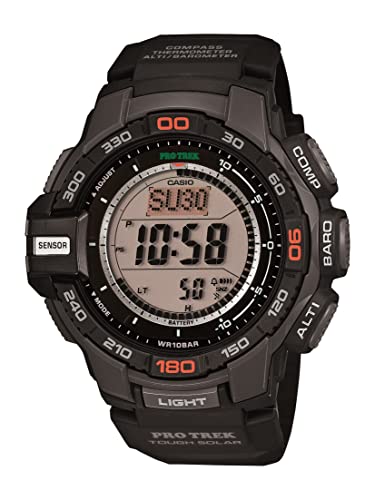


What's inside
- What Pro Trek means and where the range came from
- The Triple Sensor idea in plain language
- Altimeter range, resolution and reference setting
- Barometer readings and pressure trend alarms
- Digital compass, bearing memory and declination
- Thermometer behaviour and its honest limits
- Tough Solar charging and power saving behaviour
- Multi Band 6 radio timekeeping and where it works
- Duplex LCD layouts and reading the display outdoors
- PRW and PRT families, resin and titanium construction
- Water resistance at one hundred metres in real use
- Sunrise and sunset data, world time and alarms
- How Pro Trek differs from a smartwatch
- Sizing, fit and wearing a large instrument well
- Service intervals, solar cells and rechargeable cells
- Common buying mistakes and how to avoid them
- A practical buying checklist
- Questions owners ask most often
- Check prices on Amazon
- Verdict guidance for different kinds of owners
As an Amazon Associate I earn from qualifying purchases. This post may contain affiliate links at no extra cost to you.
A Casio Pro Trek is not bought for decoration. It is bought because a hiker wants altitude on the wrist without a phone, because a climber wants a pressure trend before cloud builds over a ridge, because a field worker wants a compass bearing that works when a battery hungry screen would already be dark, and because all of that needs to keep running for months rather than days. That narrow, stubborn purpose explains the whole range. Every design choice, from the large sensor housing on the side of the case to the duplex liquid crystal display, serves outdoor measurement first and fashion second.
This guide is built from published specifications and manufacturer documentation rather than from invented field stories. Model sheets, instruction manuals and Casio technical pages give the hard facts that matter here: sensor generation, measurement ranges, measurement intervals, water resistance ratings, charging behaviour, radio reception regions, case dimensions and band materials. Those documents do not tell you which watch feels right on your wrist, yet they do tell you, with unusual precision, what each model can measure, how often it measures it, and where its limits sit. Reading them closely is the most reliable way to choose.
Pro Trek sits apart from the wider outdoor watch market in one important respect. It refuses to become a general purpose computer. There is no app store, no message reply screen, no music storage and no colour map that needs a nightly charge. In place of that breadth you get a focused instrument: an altimeter, a barometer, a digital compass and a thermometer gathered under the Triple Sensor name, a solar charging system called Tough Solar, and on many models a radio controlled timekeeping system called Multi Band 6. The trade is deliberate, and for the right owner it is the correct one.
Readers comparing different kinds of wrist technology will find useful contrast in neighbouring guides. Runners and gym users who want connected training tools may prefer to start with best adventure fit smartwatches, while readers who simply want a Pro Trek that will still be running at the end of a long expedition should stay here and work through sensors, power and construction in order. The sections that follow treat each system on its own terms before bringing them together in a buying checklist, because a Pro Trek bought on headline features alone often disappoints once the details of logging intervals or reception regions become clear.
What Pro Trek means and where the range came from
The Pro Trek name, written as PRO TREK on the watches themselves, has been used by Casio for outdoor instruments since the mid nineteen nineties. Early models were large, resin cased and unapologetically technical, with a sensor bulge that made them instantly recognisable. The formula has barely changed in spirit. A modern Pro Trek still puts measurement buttons where gloved fingers can find them, still protects its display with a raised bezel, and still treats the strap as a replaceable working part rather than a jewellery element. Continuity matters because accessories, service knowledge and owner experience carry across generations.
Two naming families dominate current and recent catalogues. Models beginning with PRW tend to be the fuller featured line, often combining Triple Sensor hardware with Tough Solar and Multi Band 6 radio reception. Models beginning with PRT, and the related PRG line sold in some regions, often keep the sensor suite and solar charging while leaving out radio reception or using simpler display layouts. The letters alone do not guarantee a feature set, though. Always read the individual model sheet, because Casio has reused family letters across many years and the specification of a watch from one generation can differ sharply from a similarly named watch from another.
Size is part of the identity too. Pro Trek cases are wide, commonly in the low to mid fifty millimetre range across the case on larger references, with substantial thickness to house the sensor, the solar panel and the protective structure. That bulk is not carelessness. The sensor needs an opening to the outside air, the buttons need travel and sealing, and the display needs room for two layers of information. Owners with smaller wrists should still try the resin band models first, because the flexible strap and low weight often make a large diameter wear more comfortably than the numbers suggest.
The Triple Sensor idea in plain language
Triple Sensor is Casio language for three measurement systems sharing one watch: a pressure sensor that serves both the altimeter and the barometer, a magnetic sensor for the digital compass, and a temperature sensor for the thermometer. The count of three refers to sensor types, not to the number of functions, which is why the same hardware produces four familiar outdoor readings. Altitude comes from pressure interpreted against a reference, barometric pressure is reported directly, direction comes from magnetism, and temperature comes from a dedicated thermal element inside the case.
Understanding that shared pressure sensor is the key to understanding both the strengths and the quirks of the whole watch. When weather pressure falls while you stay in one place, the altimeter reading will drift even though you have not moved, because the watch cannot know whether pressure changed due to height or due to weather. Conversely, climbing steadily through stable weather gives clean altitude traces. Experienced owners therefore treat altitude as a relative tool: set a known reference at a trailhead, a hut or a surveyed summit, then trust changes from that point far more than any absolute figure read cold at the start of a day.
Sensor generation matters more than almost any other buying decision in this range. Casio groups its hardware under version labels, and the widely used third generation Triple Sensor, often written as Ver. 3, brought smaller hardware, lower power draw and faster, finer measurement compared with earlier generations. In practical terms that generation is associated with altitude measurement in one metre steps on many models and compass readings taken continuously for a longer window. Older generations remain perfectly usable, yet they may measure in coarser steps, sample less often, and draw more from the cell while doing so.
None of these sensors should be confused with satellite positioning. A Pro Trek of the classic type described here does not know where it is on the earth. It knows air pressure, magnetic direction, temperature and time, and from those it derives altitude and weather clues. That limitation is also a freedom: there is no satellite fix to wait for, no position tracking to manage, and no location record stored anywhere. For walkers who navigate with map and compass skills they already own, the watch supports judgement rather than replacing it, which is precisely how many long term owners prefer to work.
Altimeter range, resolution and reference setting
On many current Triple Sensor models the altimeter displays a range from minus seven hundred metres to ten thousand metres, a span chosen to cover deep valleys, high passes and serious alpine summits without clipping. Display resolution on third generation hardware is commonly one metre, sometimes shown as five feet in imperial units. Fine resolution can mislead new owners into expecting one metre accuracy, and the two ideas must be kept separate. Resolution is the smallest step the display can show. Accuracy depends on how well the pressure reference matches real conditions at that moment.
Setting a reference altitude is a simple habit with an outsized effect. At a known point, open the altimeter mode, hold the adjust control as the manual directs, and enter the height from a map, a signboard or a hut register. From there the watch tracks change faithfully while weather stays settled. Mountain guides and hut wardens have used this routine for decades with barometric instruments of every kind. Repeat the setting whenever you reach another known height, especially after a weather front passes, and treat any reading taken days after the last setting as an estimate to be checked rather than a fact to be defended.
Measurement intervals shape how useful the altimeter feels in motion. In active measurement, readings update frequently, on some models every second for an initial period and then at longer intervals to save power, while background logging follows its own schedule. Manuals describe patterns in which frequent sampling runs for the first minutes, then settles to a slower rhythm. That design reflects real walking: you glance often at the start of a climb and during a descent, then check occasionally once a steady rhythm forms. Before buying for a specific sport, read the interval table for the exact module rather than relying on a general impression.
Altitude logging deserves separate attention because it is the feature record keepers actually use. Many Pro Trek models store sets of records containing altitude, date and time, and some store temperature alongside. Logs may be gathered manually with a button press at a summit or a camp, or automatically at set intervals during a trek, with high, low and cumulative ascent and descent totals kept on dedicated recall screens. Storage is finite, and when memory fills the oldest records are overwritten on many modules, so owners who value a complete record should copy figures into a notebook or a phone at the end of each trip.
Barometer readings and pressure trend alarms
The barometer reports atmospheric pressure, commonly across a range from two hundred and sixty to one thousand one hundred hectopascals, displayed in one hectopascal steps. On its own a single pressure figure tells you little. The value lies in change over time, and Pro Trek watches help in two ways: a pressure trend graph that plots recent readings on the display, and on many models a barometric pressure trend indicator that flags a sudden change. Watching the graph at breakfast and again at camp turns an abstract number into a usable weather habit.
Trend information is gathered at regular intervals even while you use other modes. Many modules take a reading every two hours and build the graph from that sequence, which is why a watch left on a bedside table still produces a meaningful trace. A steady fall across several readings, especially a fall that gathers pace, often arrives ahead of deteriorating weather in temperate mountain regions. A steady rise usually accompanies settling conditions. These are tendencies drawn from long meteorological practice, not promises, and local geography can bend them, yet as one input among several they are genuinely valuable.
Some models add a barometric pressure change alarm, sometimes described as a sudden pressure change indicator, that signals when a measured shift between readings passes a set threshold. The alert appears as an arrow and an audible tone on supporting modules, drawing attention to a rapid fall that might otherwise sit unnoticed in the graph until your next scheduled check. Owners who travel in regions of fast moving maritime weather value this feature disproportionately to its simplicity. It asks nothing of you between readings, consumes little power, and interrupts only when the pattern it watches for actually occurs.
Two cautions keep barometer use honest. First, altitude change contaminates the trend: descending a thousand metres will swamp any weather signal, so judge the graph over periods spent near one height, such as overnight at camp. Second, pressure sensors live behind a case opening that must stay clear. Mud, ice and a tightly sealed sleeve can all distort the air reaching the sensor. Rinse the case gently after dirty days, let it dry fully, and avoid pressing buttons underwater or in heavy grit, because the same openings that let the sensor breathe are the paths you must protect.
Digital compass, bearing memory and declination
The digital compass measures magnetic direction and presents it as a bearing in degrees together with a direction indication on the dial. Third generation hardware on many models takes readings continuously for up to sixty seconds once started, updating as you turn, which makes following a bearing across broken ground far smoother than the short bursts offered by earlier generations. North points, direction letters and degree figures appear together on the duplex display, so you can confirm both a number for your map work and a plain direction for quick orientation without changing screens.
Bearing memory is the compass feature that earns its keep most often. It lets you lock a chosen direction into memory so that the display continues to show how your current heading relates to the stored bearing. Set it at a trail junction toward the line you intend to hold, then walk, checking at intervals that you remain aligned. In mist, in forest and across featureless plateaus this simple stored reference reduces the constant stop, measure and compare cycle that tires walkers and invites error. The manual for each module gives the exact button sequence, and learning it at home beats learning it in fog.
Declination correction separates careful navigators from casual users. Magnetic north and true north differ by an angle that depends on where you stand, and that angle changes slowly over years. Many Pro Trek modules let you enter a declination value, east or west, so the compass reports true bearings that match your map directly. Charts and map margins state the local value. Entering it takes a minute, yet skipping it can put you several degrees out, which across a long leg becomes a serious distance. Check the setting when you travel to a new region, because a correction entered for one country can mislead in another.
Calibration keeps the magnetic sensor honest. The manual describes a figure movement, turning the watch through a full pattern so the sensor can map its own surroundings, and some modules offer two direction or three direction calibration routines. Calibrate away from vehicles, steel structures, power lines and the magnets in phone cases and bag clasps. Recalibrate after long journeys, after exposure to strong magnetic fields, and whenever readings disagree with a known street direction or a baseplate compass. A compass that has been calibrated in a quiet place and checked against a map feature is a tool; one that has not is a guess with a display.
Thermometer behaviour and its honest limits
The thermometer typically measures from minus ten degrees Celsius to sixty degrees Celsius in steps of a tenth of a degree. That precision on paper collides with a physical reality: the sensor sits inside a case worn against a warm wrist, so while worn it reports a blend of air and body influence. Casio manuals state this plainly and advise removing the watch and leaving it for twenty to thirty minutes away from direct sun when a true air reading matters. Owners who accept that routine get sensible figures; owners who glance at a worn watch and quote the number as air temperature mislead themselves.
Used with that discipline, temperature data still earns its place. Overnight readings taken from a watch left on a tent groundsheet help judge frost risk for water filters and boots. Readings at a summit, taken while the watch rests on a pack during lunch, inform layer choices for the descent. The trend across a day matters more than any single value, and pairing temperature with pressure change gives a fuller picture of an arriving front than either reading alone. Some modules also allow a manual temperature correction if you own a reference thermometer and want the two to agree.
Tough Solar charging and power saving behaviour
Tough Solar is Casio name for a solar charging system built around a panel set into the dial and a rechargeable cell inside the case. Light, daylight or artificial, is converted to electricity and stored, so the watch runs from its cell while topping that cell up whenever light is available. Casio publishes operating time estimates for many modules that run to months on a full charge without further light, commonly around six months of normal use and far longer, in some cases approaching two years, when the power saving function is allowed to work in darkness.
Power saving is the quiet partner of the solar panel. After a period in darkness, typically in the late evening hours described in each manual, the display blanks and internal functions reduce to essentials while timekeeping continues. Bring the watch into light or press a button and it wakes, showing the correct time because the underlying clock never stopped. Owners who store a Pro Trek in a drawer for a season often find it blank yet alive, needing only a period on a windowsill to return to full display. That behaviour is the practical meaning of months of runtime: the watch manages scarcity on its own.
Charge management becomes a simple routine once understood. A battery level indicator, on many models shown as high, medium and low states with charge warnings at the lowest levels, tells you where you stand. Regular wear under ordinary light keeps most watches at high for years. Problems arise from long storage in darkness, from sleeves that cover the dial through winter, or from keeping the watch in a kit bag between trips. The remedy is light and time: a bright windowsill out of excessive heat, checked over days rather than minutes, restores a depleted cell far more kindly than any hurried method.
Light quality matters and Casio publishes charging time tables that make the differences plain. Bright outdoor daylight charges fastest by a wide margin, an overcast sky takes longer, and indoor lighting takes longest of all, with times stretching to many hours for a full recovery from low states. Those tables reward a habit: leave the watch where daylight reaches it when it is off your wrist. A shelf near a window beats a closed drawer in every season, and a watch treated that way rarely approaches the low warnings that restrict sensor and light functions on depleted modules.
Multi Band 6 radio timekeeping and where it works
Multi Band 6 is the radio controlled timekeeping system fitted to many PRW models. The watch listens for long wave and short wave time signals broadcast by atomic clock stations and corrects itself, typically during the night when reception is cleanest. The six in the name refers to reception across six transmitter regions: two in Japan, one in China, one in the United States, one in the United Kingdom and one in Germany. Between them they cover much of Japan, China, North America and Europe, which is why the feature feels almost magical at home and strangely absent on some travels.
Geography decides everything. The North American signal from Colorado reaches widely across the continental United States and into parts of Canada and Mexico, with night time range far exceeding daytime range. The German signal from near Frankfurt serves much of central and western Europe, while the United Kingdom signal from Cumbria covers the British Isles and nearby coasts. Japanese transmitters serve the Japanese islands from two sites, and the Chinese transmitter serves a broad area around its site in Henan province. Outside those footprints, in much of the southern hemisphere, in Oceania, in South Asia and across Africa, a Multi Band 6 watch simply receives nothing and runs as an ordinary quartz watch.
That fallback deserves emphasis because travellers sometimes misread silence as failure. Quartz accuracy in these modules is typically stated within about fifteen seconds per month without reception, a figure entirely adequate for outdoor life. The watch attempts reception on schedule, notes success or failure, and lets you check the last successful reception time on a dedicated screen. Manual reception can be triggered when you arrive in a new region: place the watch near a window overnight, with the twelve o clock side toward the likely transmitter direction as manuals advise, keep it away from metal and electronics, and let the process run without moving the watch.
Reception also carries calendar benefits. When a signal is received, time and date are set together, and many modules handle daylight saving transitions through the signal data or through city settings you configure. Choosing the correct home city is therefore more than a display preference; it governs which transmitter the watch seeks and how it interprets saving time rules. Owners who move between regions should learn the city setting routine before departure. A watch left set to a home city on another continent will keep excellent time from its quartz base, yet it will listen for a transmitter that is not there.
Duplex LCD layouts and reading the display outdoors
Many Pro Trek models use a duplex liquid crystal display, meaning two display layers work together. One layer can show large time digits while the other carries sensor graphics, direction marks or a trend graph, allowing the watch to present time and measurement data in a single glance rather than forcing a choice between them. On compass screens the arrangement is especially effective: direction indicators occupy the upper area while degrees and time remain legible below. When comparing models, display layout deserves as much attention as sensor specification, because it decides how much information you absorb with cold hands and fading light.
Legibility outdoors follows from contrast, digit size and viewing angle rather than from brightness in the connected watch sense. These displays emit no light of their own during the day; they reflect ambient light, which is why they stay readable in hard sun where a glowing screen washes out. At night a backlight, on many models an LED or electroluminescent panel with afterglow and selectable duration, lifts the display for a few seconds per press. Some references add an auto light that triggers with a turn of the wrist, a convenience that manuals warn can drain the cell if it fires constantly under a moving sleeve.
Negative displays, with pale digits on a dark ground, divide opinion and deserve a clear warning. They look striking in photographs and in shop lighting, yet in flat outdoor light many readers find positive displays, dark digits on a pale ground, easier to read at speed. Neither is objectively superior for every eye. If your use is serious navigation in poor weather, favour the layout you can read fastest in dim conditions, and if possible view both styles outside a shop before deciding. This single choice affects every glance you will ever take at the watch.
Button layout supports the display. Pro Trek models place direct sensor access on large side buttons, often with textured surfaces, so altimeter, compass and barometer modes open with one press rather than through menus. That directness is a considered safety feature: a bearing taken quickly at a path junction keeps a group moving, while a buried menu invites delay and error. Learn the layout by touch at home. In rain, in gloves and in darkness, the watch you operate by feel is the watch that gets used, and the watch that gets used is the one that justifies its weight.
PRW and PRT families, resin and titanium construction
Construction splits the range into honest work tools and lighter, more refined instruments that share the same measurement heart. Resin case and resin band models are the traditional Pro Trek form: light for their size, forgiving of knocks, and inexpensive to re strap when a band eventually cracks or tears after years of sun and sweat. The resin bezel takes the scratches that outdoor life delivers and can often be replaced as a part, returning a battered watch to tidy order without touching the module inside. For walkers, riders and field crews, this is usually the sensible default.
Titanium line models move the same sensor package into metal construction, with titanium cases and bracelets on the flagship references and a price and weight character entirely their own. Titanium resists corrosion from sweat and sea air, feels warm against skin compared with steel, and keeps a large watch lighter than a steel equivalent would be. Bracelets use pin and collar or screw adjustments depending on reference, and they need a different care routine from resin: rinse salt away, keep link pivots clean, and have sizing done with proper tools so pins seat fully. A loose link discovered on a ridge is a lesson learned late.
Case architecture protects the module in ways worth understanding. A raised bezel shields the glass, side guards shield the sensor and buttons, and the case back, whether screwed or fixed with screws at the corners depending on model, seals the cell compartment. Mineral glass is standard across much of the range, chosen for toughness and sensible replacement cost, while a small number of premium references use sapphire crystal for greater scratch resistance. Glass choice rarely decides a purchase alone, yet owners who work among rock and metal should weigh it, because a scarred crystal cannot be polished back the way a bezel can be swapped.
Water resistance at one hundred metres in real use
Most Pro Trek models carry a one hundred metre water resistance rating, expressed as 10 BAR on many dials and case backs. In Casio guidance that rating suits everyday water exposure, swimming and snorkelling in calm conditions, and it comfortably covers rain, river crossings, washing and the general wetness of outdoor life. It is not a diving specification. Dynamic pressure from striking water at speed, hot showers that age gaskets, and pressing buttons while submerged all sit outside the comfortable margin, and manuals advise against operating buttons underwater as a general rule.
Gaskets, not case material, decide how long that rating lasts. The seals around the case back, crown area and buttons harden and compress with age, heat and chemical exposure from sunscreens and insect repellents. Service guidance treats gasket renewal as periodic maintenance, commonly at the time of cell replacement or every few years for a watch that swims often. A watch that has been opened by anyone must be resealed and pressure checked by a competent service centre before its rating can be trusted again. That single discipline prevents most of the water failures that owners later blame on the original rating.
Sunrise and sunset data, world time and alarms
Sunrise and sunset data appear on many Pro Trek models and prove more useful in camp life than their modest billing suggests. After you set a date and a location, from a preset city or, on some modules, from latitude and longitude you enter, the watch reports the times for that day. Planners use them to time a pre dawn start, to judge whether a descent can finish in light, and to schedule photography at high camps. Accuracy depends on the location you set, so a watch still carrying a home city will report home times with complete confidence and complete irrelevance to your valley.
World time supports the same travel rhythm. A second city display lets you keep home time visible while local time runs the alarms and logs, and swapping the two takes a button sequence worth learning before a trip rather than during a jet lagged arrival. Radio models add order to this, because reception corrects the home city you designate. Owners who cross the Pacific or move between field sites and home bases build a small routine: set the city, attempt reception near a window that night, confirm the reception indicator in the morning, then trust alarms and logs for the rest of the stay.
Five daily alarms and an hourly signal are common across the range, with a snooze function on at least one alarm on many modules. In outdoor use the alarm set is a planning tool: a start alarm, a turn around alarm for summit days, a medication reminder that does not depend on a phone, and a camp routine marker. Because the watch runs for months, these alarms remain trustworthy on long trips in a way that phone alarms, hostage to a nightly charge, do not. Label your intentions when you set them, because at four in the morning every alarm sounds the same.
How Pro Trek differs from a smartwatch
The clearest way to choose between a Pro Trek and a smartwatch is to list what each asks of you. A smartwatch asks for a nightly or near nightly charge, a phone nearby, an account, periodic updates and a tolerance for notifications competing for your attention. In return it offers maps, messages, payments, music, training analysis and a bright colour screen. A Pro Trek asks for light, an occasional reference setting and a calibration routine now and then. In return it offers measurement, time and alarms for months at a stretch, readable in hard sun, operable with gloves, and silent unless you ask it something.
Readers weighing connected training features against that simplicity may want to compare the categories side by side in best activity smartwatches, and those focused on general everyday connected use can look at best mens smartwatches before deciding which philosophy fits their week. Neither answer is wrong. A city runner who values route maps and heart rate trends will be frustrated by a Pro Trek, and a mountaineer who values a compass that works on day forty will be equally frustrated by a watch that needs a cable on day three. Honesty about your own pattern settles the question faster than any feature table.
Longevity tilts the comparison further. A Pro Trek has no software platform to be retired, no battery chemistry cycled hard every day, and no screen technology that dates quickly. Watches from earlier generations remain in daily use because their functions were complete at manufacture and their parts, straps, bezels and cells, remain serviceable. That completeness is a different kind of value: you are buying a finished instrument rather than a subscription to a developing platform. For owners who keep gear for a decade, that finished quality is often the deciding argument.
There are, of course, genuine gaps. No heart rate, no satellite track, no fall detection, no message alerts and no contactless payment appear on the classic models covered here, and no accessory can add them later. If your safety plan depends on satellite communication, carry a dedicated device built for it rather than expecting a wrist instrument to improvise the role. If your training plan depends on physiological data, choose the tool built for training. Pro Trek rewards owners who want environmental measurement done well and who prefer to leave communication and physiology to separate, purpose built equipment.
Sizing, fit and wearing a large instrument well
Fit decides daily satisfaction more than any sensor figure. Start with lug to lug length rather than case width, because overhang beyond the wrist edges causes the rocking and catching that make a big watch feel clumsy. Resin band models curve down at the lugs and hug smaller wrists better than flat bracelet models of the same diameter. Wear the strap snug enough that the case does not slide when you shake your hand, yet loose enough to admit a fingertip beneath the band, because wrists swell with heat and altitude across a long day.
Button discipline follows from fit. If your wrist shape places the sensor buttons where the back of your hand presses them during scrambling or ski pole use, expect accidental mode changes until you adjust position or choose a model with different button placement. Some owners rotate the watch to the inner wrist for climbing, gaining protection for the glass and easier display access, at the cost of more knocks to the case edge. Experiment during ordinary days before a serious trip. Fit problems discovered at home are adjustments; fit problems discovered on a summit ridge are enduring discomforts.
Service intervals, solar cells and rechargeable cells
A Tough Solar watch has two components whose ageing owners should understand separately. The solar panel itself, set into the dial, has no routine replacement interval and ordinarily lasts the life of the watch when the crystal stays intact and the module stays dry. The rechargeable cell behind it does age. Casio does not promise a fixed lifespan in consumer documents, yet service experience across the industry shows these cells commonly serve many years before capacity fades, with symptoms appearing as shorter reserve after charging, more frequent low warnings, and functions restricting themselves sooner than they once did.
When those symptoms appear, the correct response is a cell replacement by a service centre or a watchmaker familiar with solar modules, followed by gasket renewal and a water resistance check. The cell in a solar watch is not the disposable cell of an ordinary quartz watch, and fitting the wrong type can damage the charging circuit. Manuals warn against user replacement for good reason: the case back seals, the internal contacts and the cell specification all matter. Budget for this service once in a long ownership rather than expecting the watch to run untouched forever, and it will repay you with another long stretch of use.
Routine service intervals for the rest of the watch follow the water exposure in its life. A Pro Trek that swims and travels in salt air benefits from gasket inspection every two to three years, while a dry land walking watch can run longer between checks, guided by any sign of seal damage, a case opening for any reason, or a change in button feel. Strap and bezel renewal is owner level work on resin models with the correct spring bar tool and patience. Keep spare spring bars in a repair kit on long trips; they weigh nothing and a lost bar ends a watch usefulness faster than any electronic fault.
Common buying mistakes and how to avoid them
The first common mistake is buying a radio model for a region the radio cannot serve, then judging the watch harshly for silence. Check the transmitter footprint against your home and your regular travel before paying for Multi Band 6. The second mistake is the mirror image: dismissing a non radio model that would serve perfectly well on quartz accuracy alone. Fifteen seconds a month is smaller than the error most people tolerate from every other clock they own, and in regions without coverage the two watches perform identically in timekeeping.
The third mistake is reading resolution as accuracy, expecting one metre altitude steps to mean one metre truth. Barometric altimetry has been understood for a century: reference setting and weather awareness decide quality. The fourth mistake is ignoring display style until the box is open. Negative displays, small secondary digits and crowded duplex layouts suit some eyes and defeat others, and no return policy fully compensates for a watch you cannot read at a glance. The fifth mistake is choosing a bracelet model for a life of grit and glove use, then resenting the care it asks. Match construction to routine, not to the photograph that caught your eye.
A sixth mistake, quieter than the rest, is never learning the manual. Pro Trek modules pack many functions behind few buttons, and the difference between an owner who delights in the watch and one who abandons it is usually a single evening spent working through calibration, reference setting, declination entry, log recall and alarm setting at the kitchen table. The manuals are free, thorough and written for the exact module in your watch. That evening also teaches the button sequences by touch, which is when the instrument starts to feel like yours rather than like borrowed equipment.
A practical buying checklist
Begin the checklist with sensors. Confirm the Triple Sensor generation for the exact reference, the altitude resolution it offers, the compass measurement window and whether trek logging stores the fields you care about. Continue with power: confirm Tough Solar, read the stated operating time for that module, and check that the level indicator and power saving behaviour match the manual description. Then settle radio honestly: if you live inside a transmitter footprint and travel mainly within one, a Multi Band 6 model earns its place; if you live outside every footprint, put the money toward construction or glass instead.
Move next to the physical watch. Record case width, lug to lug length, thickness and weight from the specification sheet, and compare them with a watch you already wear comfortably. Decide resin or titanium by routine rather than by status, decide positive or negative display by reading speed, and confirm strap replacement availability for the reference. Check the water resistance figure on the case back description, confirm sunrise and sunset data if camp planning matters to you, and confirm the alarm count if the watch will run your mornings on expedition days.
Finish with ownership costs and habits. Ask a service centre about gasket checks and rechargeable cell replacement for the module before you need either. Download the manual for the exact module number and read the charging time table, the calibration pages and the reception map. Plan where the watch will live when off your wrist so that light reaches it. None of these steps is glamorous, and together they are the difference between a purchase that settles into your kit for a decade and one that circulates through drawers and resale listings within a year.
Readers whose main interest is overnight recovery data rather than mountain weather will find a different category more suitable in best smartwatches with sleep tracking, because a Pro Trek deliberately offers no sleep analysis at all. That absence is worth stating inside a checklist: buy this watch for pressure, direction, temperature and time, and let other devices handle the jobs it never claimed. A checklist that names what a product refuses to do protects you from the most expensive kind of disappointment, the kind built on an assumption nobody actually promised.
Questions owners ask most often
How accurate is the altimeter on a long climb?
With a fresh reference setting at the trailhead and settled weather, changes in altitude track closely enough for navigation decisions, rest planning and summit confirmation, often within a small margin over a day of climbing. As weather moves, error grows gradually rather than suddenly, which is why experienced users reset the reference at every known point the route offers. Treat the figure as a well informed estimate that improves with your habits, and pair it with map contours whenever a decision, such as which col you are standing on, carries real consequences.
Can the compass replace a baseplate compass?
For direction finding, bearing following and orientation checks, the digital compass performs the core job well, especially with bearing memory set and declination entered. A baseplate compass still wins for plotting on a map, for taking bearings from map features with a straight edge, and as a backup that needs no power at all. Most careful navigators carry both and let each do what it does best. The watch gives instant direction while moving; the baseplate gives map craft while stopped. Together they cost little weight and cover each other weaknesses.
How long does the solar charge really last?
Published operating times for many modules describe months of use from a full charge without further light, with far longer survival when power saving is allowed to blank the display in darkness. Real life is kinder than those figures for most owners, because ordinary wear exposes the dial to light daily and repays what alarms, sensors and backlight spend. The honest summary is that charging stops being a routine and becomes an occasional check of the level indicator, usually after storage, after a winter of long sleeves, or before a long trip when certainty matters.
What happens when travelling outside radio coverage?
The watch keeps time from its quartz movement at the accuracy stated in the manual, attempts reception on schedule without success, and otherwise behaves exactly as it does at home. Alarms, sensors, logs and solar charging are unaffected. On returning to a covered region, one successful night near a window restores corrected time. Travellers who move often learn to check the reception indicator after the first night in a new place and then forget the subject, which is the level of attention the system was designed to require.
Is one hundred metre resistance enough for swimming?
For ordinary swimming, surface snorkelling and every kind of rain and river work, the rating on most Pro Trek models is sufficient according to manufacturer guidance, provided the seals are in good order and buttons are not operated underwater. It is not a licence for diving, hot tubs or high speed water impact. If swimming is a weekly habit, treat gasket inspection as part of ownership, rinse after salt and chlorine, and have the watch pressure checked after any case opening. Ratings describe a maintained watch, not a neglected one.
Check prices on Amazon
Live listings for the shortlist in this guide are pulled from Amazon below, so prices and availability are always current at the moment you look.


Verdict guidance for different kinds of owners
For the mountain walker who navigates with map skills and wants weather awareness at camp, the resin band Triple Sensor models with Tough Solar represent the heart of the range: light, repairable, readable and indifferent to charging cables. Add Multi Band 6 if your home sits inside a transmitter footprint, and value the duplex display and bearing memory above cosmetic variations. This is the configuration that built the Pro Trek reputation, and it remains the easiest to recommend without qualification to the widest group of outdoor readers.
For the traveller who moves between regions and values a watch that always shows the right time on arrival mornings, a PRW family model with radio reception, world time and sunrise data earns its bulk. For the owner who wants one instrument for field days and town evenings alike, a titanium line model carries the same measurement heart in a form that sits comfortably with a jacket, at the cost of more careful strap and link maintenance. For the minimalist who camps light and counts grams, the simpler resin references without radio hardware remove a system you may never use and spend nothing on it.
Whichever direction you choose, choose it from the specification sheet and the manual rather than from a headline. Confirm the module, confirm the sensor generation, confirm the reception map, confirm the dimensions against your wrist, and confirm the service path for cell and gaskets. A Pro Trek chosen that way becomes unremarkable in the best sense: it sits on your wrist for years, answers when asked, warns when pressure falls, points when cloud closes in, and asks only for light in return.
Disclosure: this guide was prepared from published specifications and manufacturer documentation for the models discussed, and the links in it are affiliate links, which means this site may earn a commission when a reader follows a link and completes a qualifying purchase, at no added cost to the reader. That commission helps fund the work of reading manuals and specification sheets in full, and it does not change which features this guide recommends checking or which limits it reports.
Choose the Pro Trek that matches the weather you actually walk into, and it will still be answering on the last morning of the trip when every other screen you carried has long gone dark.


