Our Top Picks


What's inside
- Our picks at a glance
- How we researched these sets
- What makes notched log building work
- Lincoln Logs 100th Anniversary Tin — the commemorative set
- Lincoln Logs On The Trail Building Set — 59 pieces for a first build
- LINCOLN LOGS Collector’s Edition Village Set — 327 real wood pieces
- Lincoln Logs Fun On The Farm — 102 parts with a story built in
- LINCOLN LOGS Sawmill Express Train — 101 parts and a buildable track
- Lincoln Logs Beechwood Retreat — the Amazon Exclusive cabin
- Lincoln Logs Adventure Pod Cabin — a compact cabin with big ideas
- SainSmart Jr. 665 PCS Wooden Log Cabin Set — the compatible third-party alternative
- Comparing the sets by piece count and theme
- How to choose the right set
- Frequently asked questions
- Check prices on Amazon
- Our verdict
As an Amazon Associate I earn from qualifying purchases. This post may contain affiliate links at no extra cost to you.
Some toys survive because they are fashionable for a single season. Lincoln Logs have survived for more than a century because the basic idea is so simple that a young child can grasp it in minutes and so open-ended that the same child can still find a new building to attempt months later. The pieces are short lengths of real wood, notched near each end so that they stack at right angles and hold a wall together without glue, batteries, screens, or instructions that have to be followed in only one correct order. A cabin rises corner by corner. A roof goes on. The whole structure comes down, and a different one takes its place on the rug before lunch.
That simplicity is also what makes choosing a set harder than it first looks. The boxes can appear similar at a glance, yet the experience inside them is not the same at all. One set in this guide contains 59 pieces and suits a first, small build. Another contains 327 real wood pieces and is meant to become a village rather than a single cabin. Between those extremes sit a farm, a sawmill with a buildable train track, a trail-themed starter, and two newer cabin sets sold under names that suggest a quieter, more focused kind of building session. Getting the size and the theme right matters more than getting the largest box, because a set that overwhelms a young builder will spend its life in a cupboard, while a set that is too small for an ambitious one will be outgrown in a single afternoon.
This guide compares eight sets side by side. Seven of them are genuine Lincoln Logs sets made with real wood logs. The eighth is different, and we want to be plain about that from the start: the SainSmart Jr. set is not a Lincoln Logs product. It is a third-party wooden log cabin set described by its maker as compatible with Lincoln Logs, and we have included it only as a clearly labelled compatible alternative for families who want a very large piece count in a classical style. Everywhere in this guide, we keep that distinction visible, because a parent shopping for the original brand deserves to know exactly which box carries that name and which one does not.
Our research for this roundup was deliberately narrow. We checked each product against its own title and description, compared piece counts and themes only where the maker states them, and treated everything else as general knowledge about how notched wooden logs work as a category. Where a title gives a number, we use that number. Where a title gives an age guide, we repeat that guide. Where a title is silent, we do not invent a figure to fill the gap, and you will notice that two of the newer cabin sets are discussed in terms of theme and format rather than a piece count we cannot confirm from the information provided. That restraint is intentional. A buying guide is only useful if the differences it describes are real.
Our picks at a glance
- Lincoln Logs 100th Anniversary Tin — the commemorative choice, presented in a tin, for families who value the heritage of the brand as much as the building itself.
- Lincoln Logs On The Trail Building Set — 59 pieces of real wood, listed for ages 3 and up, and the gentlest starting point in this list.
- LINCOLN LOGS Collector’s Edition Village Set — 327 real wood pieces, listed for ages 3 and up, and by far the largest genuine Lincoln Logs set here.
- Lincoln Logs Fun On The Farm — 102 parts of real wood, listed for ages 3 and up, built around a farm theme.
- LINCOLN LOGS Sawmill Express Train — 101 parts of real wood, listed for ages 3 and up, with a buildable train track and a sawmill setting.
- Lincoln Logs Beechwood Retreat — an Amazon Exclusive cabin set for buyers who prefer a focused retreat theme.
- Lincoln Logs Adventure Pod Cabin — a compact cabin concept with an adventurous name, suited to imaginative small builds.
- SainSmart Jr. 665 PCS Wooden Log Cabin Set — a third-party compatible set, not Lincoln Logs, with 665 pieces and a STEM construction framing.
How we researched these sets
We started by separating the genuine article from the alternatives. Lincoln Logs is a specific brand with a long history, and the seven sets that carry its name in this guide all describe real wood logs in their titles. That matters because the feel of the material is a large part of the appeal: wood has weight, it makes a satisfying sound when pieces are gathered up, and it ages in a way that plastic imitations do not quite reproduce. When a set is made by another company, as the SainSmart Jr. set is, we say so in its heading, in its description, and again in the comparison sections, so that no reader can skim this page and come away with the wrong impression.
Next, we lined the sets up by the two facts a buyer can actually rely on before opening a box: how many pieces or parts the maker states, and what world those pieces are meant to build. Piece count is a rough but honest guide to scale. A set under 60 pieces supports one modest structure at a time. A set around 100 parts supports a fuller scene with more walls, more height, or a themed extra such as a track. A set above 300 pieces supports several structures at once, which changes the play completely, because children can build a street or a village and then act out stories that move between buildings. Theme, meanwhile, decides what kind of stories get told. Neither measure is a quality score on its own, and we have not treated either as one.
Finally, we considered who would actually be building. Four of the sets in this guide state ages 3 and up in their titles, which tells you the pieces are sized and the builds pitched for preschool hands and patience. Younger builders need logs that are easy to grip, corners that forgive a slightly crooked placement, and a finished result that arrives quickly enough to feel like an achievement. Older children need headroom: more pieces, taller walls, and the freedom to ignore the pictured build and invent their own. Several sets here can grow with a child, especially when two sets are combined later, but the starting experience still differs, and our research notes below flag the best fit for each one rather than pretending every box suits every age equally well.
If you are shopping for young children more broadly, you may also be comparing other kinds of gifts entirely, from connected watches covered in our guide to best 4g kids smartwatches to drawing tools and audio gear. Building toys ask something different of a child than those products do. They reward patience and spatial thinking, they work just as well with a sibling as alone, and they need no charging, no account, and no signal. That contrast is worth holding in mind when you decide what kind of present this occasion calls for.
What makes notched log building work
The engineering inside a Lincoln Logs set is hidden in plain sight. Each log carries notches, and when two logs cross at a corner, the notches interlock so that the weight of the wall above helps to hold the wall below in place. A child does not need to understand that principle to use it. Small hands learn it by feel within the first few layers: place, cross, place, cross, and the corners begin to square themselves. That forgiving geometry is why the toy works for preschoolers while still satisfying older builders, who quickly discover that the same notches allow longer spans, internal divisions, and structures the box never pictured.
Real wood adds its own lessons. No two wooden pieces are perfectly identical in grain or tone, and a finished cabin has the slightly irregular, handmade look of an actual log building rather than the uniform finish of a moulded plastic kit. For many families that is the entire point. The sets in this guide that state real wood in their titles are leaning on a tradition that goes back to the earliest days of the brand, and the Collector’s Edition Village Set says so openly by calling itself a retro building toy. Wood also tends to be forgiving of rough treatment. A log dropped on a hard floor is far more likely to survive the incident than a thin plastic panel, though no wooden toy should be treated as indestructible, and pieces should be checked from time to time for damage before being handed to a very young child.
Lincoln Logs 100th Anniversary Tin — the commemorative set
A one hundredth anniversary is not something many toys get to celebrate, and this set is built around that milestone. The Lincoln Logs 100th Anniversary Tin presents the classic real wood building idea in a commemorative tin, which gives it a double life: it is a working building set for a child, and it is also the version most likely to be kept, displayed, and handed on. For grandparents who played with wooden logs themselves and want to give the same toy to a grandchild, that presentation is often the deciding factor, and there is nothing shallow about choosing it. The container a toy lives in shapes how often it comes out and how well its pieces survive the years between builders.
As a building experience, expect the familiar rhythm of the brand rather than a themed scene. This is the set for cabins in the classic mould: four walls rising by notches, openings left where a door or window feels right, and a roof to finish the job. Without a farm or a railway dictating the story, the child supplies the narrative, which suits imaginative builders who prefer to decide for themselves whether the finished structure is a house, a fort, a shop, or a hideout for a favourite toy figure. Adults joining in will find the same freedom appealing. There is no pictured scene you are supposed to reproduce exactly, so there is no sense of doing it wrong.
Lincoln Logs On The Trail Building Set — 59 pieces for a first build
Every category needs an honest starting point, and in this guide that role belongs to On The Trail. The title states the essentials plainly: 59 pieces, real wood logs, and an age guide of 3 and up. That combination describes a set sized for a preschooler’s attention span and hand strength. Fifty-nine pieces are enough to build a recognisable structure with real corners and a roof, to take it apart, and to build it again differently, all inside a single sitting that ends in success rather than frustration. For a first Lincoln Logs set, that arc matters more than raw quantity.
The trail theme gives the small scale a sense of place. A trail suggests the outdoors, a cabin in the woods, a stopping point on a journey, and children are good at spinning a whole afternoon out of a suggestion that light. Because the set is compact, it also works well as a travel or grandparent’s-house set, the kind that lives in one home so that a visiting child has a familiar project waiting. It is equally sensible as a trial purchase. Families unsure whether their child will take to construction play can start here, learn the answer at the smallest commitment in the genuine Lincoln Logs range in this guide, and add a larger set later if the logs are a hit, since sets in the same system can be combined for bigger builds as a child’s ambition grows.
There are limits, and we will state them plainly. Fifty-nine pieces will not support a village, a tall tower, or two children building separate structures side by side without negotiation. An older child who already builds confidently may finish what this box offers quickly and start asking for more logs, which is a good problem but still a real one for the person paying. For siblings close in age who will build together daily, consider starting one step up with one of the sets around 100 parts. For a single young builder taking a first step into construction toys, though, On The Trail is the most proportionate choice in this entire list, and its modest size is a feature rather than a compromise.
LINCOLN LOGS Collector’s Edition Village Set — 327 real wood pieces
If On The Trail is the first step, the Collector’s Edition Village Set is the destination at the other end of the range. With 327 real wood pieces, an age guide of 3 and up, and an openly retro character stated in its title, this is the set for a child, a family, or a classroom that wants to build not a cabin but a place. The arithmetic changes the play entirely. At this count, several buildings can stand at once, walls can be taller, and a builder can divide a structure into rooms or raise a whole row of fronts along an imaginary street. Stories gain geography. A character can leave one building, cross the rug, and arrive at another, and that simple possibility keeps older children engaged long after a single-cabin set would have been set aside.
The trade-offs are the obvious ones. A 327-piece set needs storage, it needs a tidy-up routine that children are actually taught, and it needs floor space on the day it all comes out. It is also more set than a very young child needs, and handing the whole box to a three-year-old on day one can bury the pleasure under sheer quantity; many families will do better by offering a portion of the pieces first and releasing the rest as confidence grows. None of that dents the conclusion. For maximum genuine Lincoln Logs building in a single purchase, nothing else in this guide comes close, and the village concept gives that quantity a purpose beyond mere size.
Lincoln Logs Fun On The Farm — 102 parts with a story built in
Fun On The Farm takes the classic log system and points it at one of the most reliable subjects in early childhood: animals, barns, and the daily theatre of farm life. The set contains 102 parts of real wood logs and is listed for ages 3 and up, which places it in the comfortable middle of this guide. That count is roughly the point where a build stops being a single simple cabin and becomes a small scene, with enough material for the main structure and something extra beside it. For many families, that middle ground is the sweet spot between a starter set a child outgrows and a giant set that dominates the toy cupboard.
The farm theme does real work here. A child who might build an abstract cabin once and wander off will often return again and again to a building that has a job: sheltering animals, storing the harvest, giving the farmer somewhere to live. The theme hands the child a story before the first log is placed, and it pairs naturally with toy animals and vehicles a family may already own, extending the set’s life without buying anything further. It also gives adults an easy way into joint play, because everyone knows what happens on a farm, and a grown-up can be handed a wall to build or an animal to house without needing to learn any rules.
Parents comparing options for this age group often juggle several gift ideas at once, and it can help to think about what each one asks of the child. A screen-based present such as the devices in our guide to best kids smartwatches for texting and calling is about communication and independence. A farm building set is about construction and pretend play. They are not rivals so much as different kinds of development in a box, and the farm set has the advantage of working at full strength the moment it is opened, with nothing to set up and nothing to charge.
LINCOLN LOGS Sawmill Express Train — 101 parts and a buildable track
The Sawmill Express Train is the most kinetic idea in this guide. Its title promises 101 parts, real wood logs, an age guide of 3 and up, and a buildable train track, and that last element changes the character of the play. Most log sets produce a place. This one produces a place with a route through it: a sawmill, the logs it processes, and a train to carry them. The story almost tells itself. Trees become timber, timber goes on the train, and the train makes the journey again and again, with the child directing every departure.
That sense of purpose suits a particular kind of builder. Some children construct for the pleasure of the finished object; others construct because they want a setting for movement and action. For the second kind, a static cabin can feel like a story that stops just as it starts, while a track gives the afternoon a rhythm of building, running, adjusting, and running again. Rebuilding the track layout becomes part of the game rather than a chore between games. The sawmill setting also introduces a gentle, concrete idea about where building materials come from, which parents and teachers can draw out in conversation if they wish, or simply leave as background colour.
With 101 parts, the set sits alongside Fun On The Farm in scale, and the choice between them should be made on theme alone. Farm children will prefer the farm; train children will not forgive you for ignoring the railway. One practical consideration follows from the track itself: layouts take floor space, and a route laid across a busy family room will be stepped on, driven over by siblings, and rebuilt often. Treat that as part of the fun and choose a corner where a layout can survive the day. Storage matters here too, since track and logs together reward a family that keeps the set together in one place rather than scattered across toy boxes.
Lincoln Logs Beechwood Retreat — the Amazon Exclusive cabin
The Beechwood Retreat arrives with two distinguishing facts in its name: it is a retreat, and it is an Amazon Exclusive. The second point is a straightforward matter of where the set is sold, and buyers who like the convenience of that route will find it here. The first point is the more interesting one. A retreat suggests a smaller, calmer kind of building: one cabin, tucked away, built carefully and then inhabited in the imagination for a while. Where the Village Set spreads outward, the Beechwood Retreat concentrates inward, and there are children, and adults, who strongly prefer that focus.
We should be transparent about the limits of what the product title tells us. Unlike several sets in this guide, the Beechwood Retreat’s title does not state a piece count or an age guide, so we will not attach numbers to it that we cannot support. What can be said fairly is that it is a genuine Lincoln Logs set, that its name places it in the cabin tradition at the heart of the brand, and that a retreat theme suits one-to-one building time: a parent and child after dinner, a grandparent and a visitor on a quiet afternoon, or a single child who likes to build a place and then play inside its story for a long while rather than racing to the next structure.
Lincoln Logs Adventure Pod Cabin — a compact cabin with big ideas
The Adventure Pod Cabin has the most playful name in this guide, and names shape play more than adults usually admit. A cabin is a cabin, but a pod suggests a base camp, a hideaway, a small headquarters from which expeditions are launched across the garden or the living room. For a child whose imagination runs to exploring, dens, and secret bases, that framing can turn a modest build into the centre of a whole invented world. Like the Beechwood Retreat, this is a genuine Lincoln Logs set in the cabin tradition, and like the retreat, its title does not state a piece count or an age guide, so we describe it by its concept rather than by numbers we do not have.
Concept-driven sets live or die by the child receiving them. A builder who loves dens will understand the adventure pod instantly, because children build pods out of sofa cushions already; giving them a wooden version with real notched logs simply upgrades a game they invented themselves. The finished cabin becomes a prop in larger adventures, housing figures, guarding treasures, and serving as the place every story returns to at nightfall. That kind of play is remarkably durable. Long after the construction itself takes only minutes, the building continues to work as scenery, and scenery is what pretend play consumes most.
It is worth adding a word about how these smaller themed cabins fit alongside the other technology gifts many families consider for children. Drawing tools such as those in our guide to best graphic tablets for kids develop one kind of creativity, on a screen, with undo buttons and endless colours. A log cabin develops another kind, in three dimensions, with gravity as the strictest critic. Neither replaces the other, and a child lucky enough to have access to both learns, without anyone lecturing about it, that making things takes different forms in different materials.
SainSmart Jr. 665 PCS Wooden Log Cabin Set — the compatible third-party alternative
This section needs to begin with the clearest sentence in the guide: the SainSmart Jr. set is not a Lincoln Logs set. It is made by SainSmart Jr., a different company, and it is included here because its title describes it as a wooden log cabin building set compatible with Lincoln Logs, which makes it relevant to a family comparing options in this category. Nothing about its inclusion should be read as the two brands being the same, and a buyer who specifically wants the original brand should choose one of the seven sets above this section.
With that established, the set’s own claims are substantial. The title states 665 pieces, which is the largest count in this guide by a wide margin, and describes the set as a classical STEM construction kit aimed at toddlers. A count of that size changes what is possible: multiple houses, large structures, and building sessions where running out of pieces is rarely the reason a project stops. For a classroom, a large family, or a child who builds on a grand scale and leaves creations standing for days, sheer quantity has genuine value, and this is the option that provides it. The STEM framing reflects how construction play is often described for educational settings, where building with interlocking pieces is used to develop spatial reasoning, planning, and patience.
Compatibility is the point that needs the most care. The maker describes the set as compatible with Lincoln Logs, which is why families consider mixing the two, but compatible is a claim about fitting and playing alongside, not a promise that every piece will be identical in finish, tone, or feel to the genuine article. Wooden pieces from different makers can vary in appearance even when their notches align. A household that prizes a uniform look across a collection may prefer to stay within one brand, while a household that prizes volume and is relaxed about matching will mind less. Either instinct is reasonable; the important thing is to choose with the distinction understood rather than discovered after the box is opened.
Our honest summary is this. As a third-party compatible alternative offering a very large piece count in a classical wooden style, the SainSmart Jr. set has a real case to make, particularly for group settings and ambitious builders. As a Lincoln Logs set, it makes no case at all, because it is not one, and we have written this entire section to keep that line bright. Shoppers who came to this guide for the original brand should treat the seven sets above as the shortlist, and treat this one as an optional extra to consider only with eyes open.
Comparing the sets by piece count and theme
Laid side by side, the stated counts tell a clean story. On The Trail offers 59 pieces for a first, focused build. Fun On The Farm offers 102 parts and the Sawmill Express offers 101 parts, two mid-sized sets separated by theme rather than scale. The Collector’s Edition Village Set offers 327 real wood pieces for multi-building play. The SainSmart Jr. compatible set offers 665 pieces as a third-party alternative. The Anniversary Tin, the Beechwood Retreat, and the Adventure Pod Cabin are presented by theme and format rather than by a count stated in their titles, and we have kept them that way rather than guessing.
One more comparison deserves attention, because it is the one most likely to be blurred elsewhere: brand. Seven of these sets are Lincoln Logs, made to the brand’s own pattern, with real wood stated in the titles of the range. One is a compatible set from another maker. There is no shame in either category, but they are different categories, and a household collecting the genuine article over several birthdays will want consistency, while a household equipping a playroom for volume may weigh things differently. Decide which kind of buyer you are before comparing counts, because a piece count only means something once you know whose pieces they are.
How to choose the right set
Match the count to the builder
For a first set for a preschooler, the smaller stated counts are a virtue. A 59-piece set can be tipped out, understood, built with, and tidied away by the child with light help, and that complete cycle is what builds the habit. Around 100 parts, expect an adult or older sibling to be a welcome building partner at first, and expect the finished scene to stay up longer. At village scale and above, plan for the set to become a fixture: a tray or mat to build on, a container that lives within reach, and an understanding that some creations are not dismantled the same day. None of these is better in the abstract. Each is better for a particular household rhythm.
Care, safety, and sensible supervision
Four sets in this guide state an age guide of 3 and up, and that guide should be respected for younger children in the household even when the set was bought for an older sibling. Keep pieces away from babies and toddlers below the stated guidance, check wooden pieces periodically and set aside any that become damaged, and wipe logs clean with a dry or slightly damp cloth rather than soaking them, since wood and prolonged water are poor companions. Building on a table or a clear patch of floor keeps pieces out of walkways and mouths alike. None of this is onerous; it is the ordinary care that keeps a wooden toy in service for years, and it is part of why sets like these are so often passed down rather than thrown away.
Families weighing up several kinds of children’s presents at once sometimes ask how a building set compares with audio gear for focus and calm, such as the options in our guide to best headsets for kids. The honest answer is that they solve different problems. Headphones shape the sound around a child; logs shape the child’s own activity. A household that values screen-free, open-ended play will find the sets in this guide squarely on its side, and a child who receives one gains a toy that works during a power cut, on a holiday, and in any room of the house without a single cable.
Frequently asked questions
Are all the sets in this guide made of real wood?
The genuine Lincoln Logs sets here describe real wood logs in their titles, and that is one of the defining features of the brand. The SainSmart Jr. set is a wooden set from another maker. In both cases we have relied on the makers’ own descriptions rather than adding claims of our own, and we would encourage buyers to read the product listing for the specific set they choose, since descriptions are the authoritative source for any single box.
Which set is best for a three-year-old?
Four sets state ages 3 and up in their titles: On The Trail, the Collector’s Edition Village Set, Fun On The Farm, and the Sawmill Express Train. Among them, On The Trail, with 59 pieces, is sized most gently for a first builder, while the farm and the sawmill add a theme a three-year-old can narrate. The village set carries the same age guidance but a far larger count, so many families will introduce its pieces gradually. Always supervise young builders and follow the guidance on the box you buy.
Can different sets be combined?
Sets built on the same notched log system are made to work together, and combining a starter set with a larger one later is a well-established way to grow a collection without replacing what a child already loves. The SainSmart Jr. set is described by its maker as compatible with Lincoln Logs, which is a separate claim by a separate company, and mixing brands may produce small differences in look and feel even where pieces fit. If a perfectly uniform collection matters to you, stay within the genuine range.
Which set should a grandparent choose as a keepsake gift?
The 100th Anniversary Tin is the natural answer, because its commemorative presentation is designed for exactly that purpose, and the Collector’s Edition Village Set is the alternative for a grandparent who wants to build alongside the child on a grand scale. Both lean into the heritage of a toy many grandparents played with themselves, and that shared history is often the real gift being given.
Check prices on Amazon
Live listings for the shortlist in this guide are pulled from Amazon below, so prices and availability are always current at the moment you look.

Lincoln Logs 100th Anniversary Tin

Lincoln Logs-On The Trail Building Set-59 Pieces-Real Wood Logs – Ages 3+

Lincoln Logs – Fun On The Farm – 102 Parts – Real Wood Logs – Ages 3+
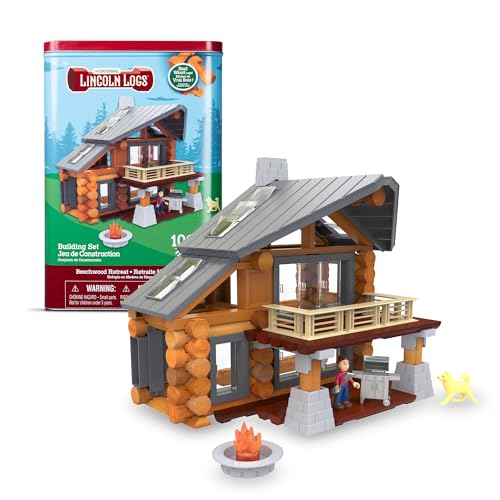
Lincoln Logs Beechwood Retreat – Amazon Exclusive
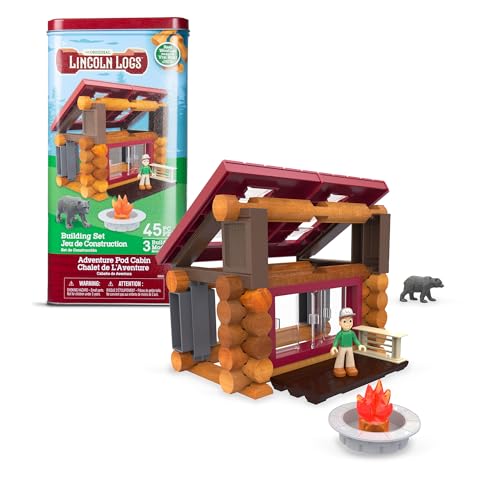
Lincoln Logs Adventure Pod Cabin

Our verdict
For a first purchase, On The Trail is the proportionate, low-risk introduction to genuine Lincoln Logs. For a themed gift, choose between Fun On The Farm and the Sawmill Express Train by asking one question: animals or trains? For the fullest genuine experience, the Collector’s Edition Village Set stands alone, with 327 real wood pieces and room for a whole settlement of stories. For a keepsake, the 100th Anniversary Tin is the one that will still be on a shelf, and still in use, years from now. The Beechwood Retreat and the Adventure Pod Cabin serve buyers who want a distinct cabin personality, one calm and one adventurous, while the SainSmart Jr. set remains what we have called it throughout: a large, clearly labelled, third-party compatible alternative, worth considering on its own terms and never to be confused with the original brand. Choose by the child, the story, and the space you have, in that order, and any set on this list will earn its place in the house.
A note on how this guide is supported: some of the links on this page are affiliate links, which means that if you choose to buy through one of them, we may receive a small commission from the retailer at no additional cost to you. That support helps us keep researching and writing guides like this one. It does not influence which sets we include, how we describe them, or the distinctions we draw between brands, and we have written this disclosure in our own words for this page alone.


