Our Top Picks
What's inside
- Who a 46mm watch actually suits
- How the five picks were chosen
- The five 46mm picks at a glance
- Tissot Seastar 2000 Pro, Swiss Powermatic 80, 46mm, Gray Dial
- Invicta Pro Diver Stainless Steel Quartz Watch, 46mm, Black/Two Tone, Bracelet
- Fossil 46mm GMT in stainless steel: one line, two colour variants
- Apple Watch Series 12 GPS 46mm, Black Aluminum Case, Black Sport Band
- Automatic, quartz, GMT, and smart: the differences that matter at 46mm
- Fit checks to do before you order a 46mm watch
- Frequently asked questions
- Our verdict
- Check prices on Amazon
- Affiliate disclosure
As an Amazon Associate I earn from qualifying purchases. This post may contain affiliate links at no extra cost to you.
A 46mm watch makes a clear statement before anyone reads the dial. It is not simply a larger version of a standard men’s watch. At this size, the case occupies more of the wrist, the dial has more room to breathe, and details that might feel crowded on a smaller watch become easier to read at a glance. For men with larger wrists, broader forearms, or a preference for a bold, sport-led look, that extra presence is exactly the point. For men with slimmer wrists, the same case can dominate the arm and change how a shirt cuff, a jacket sleeve, and even a desk job feel across a full day.
This guide is built around five specific watches, and every one of them states 46mm in its own product title. That matters. Case size is the organising idea here, so our research started by checking that the size in the title matched the size in the search, rather than rounding up a smaller watch or mixing in a case or a strap sold for a 46mm model. The five picks cover three very different approaches to the same case diameter: a Swiss automatic watch from Tissot, a quartz dive-style watch from Invicta, two colour variants of a Fossil GMT line in stainless steel, and a GPS smartwatch from Apple in a 46mm case. Same headline size, four distinct ownership experiences once you count the two Fossil colours as one line in two finishes.
That spread is useful because 46mm alone tells you almost nothing about how a watch will live on your wrist. An automatic watch asks you to keep it wound through wear or winding. A quartz watch asks far less of you day to day and tends to suit a grab-and-go routine. A GMT watch adds a second time zone to the dial, which changes both the look and the daily usefulness for travellers and for anyone who works across regions. A smartwatch replaces the traditional dial with a screen and adds health, fitness, and sleep tracking, heart rate information, and safety features, according to its title, along with the charging habit that every smartwatch owner knows. Choosing well at 46mm is therefore less about finding the biggest case and more about matching movement, dial layout, and strap or bracelet style to your wrist and your routine.
If you already know you want a screen and connected features, you may also want to compare the broader field in best mens smartwatches alongside the single Apple model covered here. If your interest is specifically in Apple as a platform, best apple smartwatches gives that family its own context. This article stays narrower on purpose: traditional and smart watches that share one case size, judged on fit, clarity, and everyday practicality.
Who a 46mm watch actually suits
Case diameter is measured across the case, and 46mm sits at the large end of the mainstream men’s range. On a larger wrist, that proportion often looks balanced rather than oversized. The case fills the flat top of the wrist, the lugs sit within the width of the arm instead of hanging past it, and the dial reads as intentional. On a medium wrist, a 46mm watch can still work, especially in sport and dive styles where a bigger case is part of the design language, but it will read as a deliberate style choice rather than a neutral one. On a slim wrist, overhang is the main risk: when the lugs extend beyond the edges of the wrist, the watch looks borrowed, shifts more as you move, and catches on cuffs and door frames more often.
A simple check helps before you buy any watch in this size. Measure around your wrist where you normally wear a watch, then look at the flat section across the top. A watch wears best when its lug-to-lug span, the distance from the tip of one lug to the tip of the other, sits inside that flat section. Diameter alone does not give you that span, which is why two 46mm watches can wear quite differently. A dive-style case with short, curved lugs can feel more contained than the number suggests, while a flatter case with long lugs can feel larger than the number suggests. Strap and bracelet shape matter too, because the first link or the way a band curves down from the case changes how the whole piece settles.
How the five picks were chosen
Our research for this guide followed a narrow rule: the product title itself had to state 46mm. That excluded a long list of otherwise fine watches in nearby sizes, and it also excluded accessories. A case or a band made for a 46mm watch is not a 46mm watch, so those results were set aside even when they appeared under the same search terms. What remained, after checking titles and images through the product research available for this site, was a compact group that genuinely represents the size.
Within that group, we checked for variety of movement and purpose rather than five versions of the same idea. The Tissot represents the Swiss automatic route, named in its title as a Seastar 2000 Pro with a Powermatic 80 movement and a gray dial. The Invicta represents the quartz dive route, a Pro Diver in stainless steel on a bracelet, in black and two tone. The Fossil line represents the GMT route, in stainless steel, shown here in two colour variants that we treat honestly as variants of one line rather than as two unrelated discoveries. The Apple Watch represents the smart route, a Series 12 GPS model in a 46mm case with a sport band. Together they let a reader compare philosophies at a fixed size, which is the most useful comparison a size-based guide can offer.
The five 46mm picks at a glance
- Tissot Seastar 2000 Pro, Swiss Powermatic 80, 46mm, Gray Dial — the automatic choice, for buyers who want a Swiss name, a self-winding movement philosophy, and a restrained gray dial in a large sport case.
- Invicta Pro Diver Stainless Steel Quartz Watch, 46mm, Black/Two Tone, Bracelet — the quartz dive-style choice, for buyers who want a steel bracelet, a black and two-tone look, and a watch that asks little routine attention.
- Fossil 46mm GMT Stainless Steel, Silver/Blue, model FS5991 — the blue colour variant of the Fossil GMT line, described in its title as dive-inspired and three-hand, for travellers who like a blue dial family look.
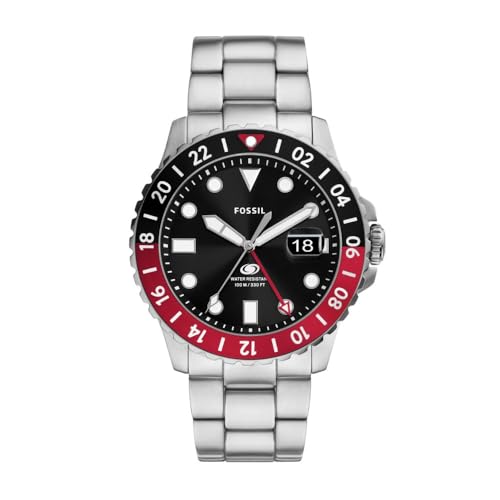
- Fossil 46mm Silver/Black/Red GMT Quartz Stainless Steel — the second colour variant of the same Fossil GMT line, in silver with black and red accents, with a quartz movement stated in its title.
- Apple Watch Series 12 GPS 46mm, Black Aluminum Case, Black Sport Band — the smart choice, for buyers who want health, fitness, and sleep tracking, heart rate, and safety features on the wrist in the same 46mm footprint.
Read the Fossil entries together. They share a line, a size, a material, and a GMT purpose. What separates them is colourway and the wording of their titles, and we flag the differences that the titles actually support rather than dressing the pair up as rivals. If you like the Fossil idea, your real decision is which colour treatment suits your wardrobe, not which of the two is a different watch.
Tissot Seastar 2000 Pro, Swiss Powermatic 80, 46mm, Gray Dial
The Tissot is the traditional watchmaker’s answer in this group, and its title carries the key facts in a compact line: Seastar 2000 Pro, Swiss, Powermatic 80, 46mm, and a gray dial. Start with the name Seastar. Within Tissot’s own naming, that family language points toward the water, toward a sport watch identity rather than a dress watch identity. At 46mm, that identity has room to express itself. A large sport case gives the dial presence, gives the markings space, and gives the whole watch the confident, tool-like stance that buyers shopping this size usually want.
The movement wording matters just as much. Powermatic 80 is the movement name stated in the title, and it places this watch in the automatic camp: a mechanical watch that winds itself from the motion of your wrist as you wear it, with manual winding as part of normal ownership. The number in the movement name is part of that product name as printed in the title, and we present it as a name rather than as a promise about your individual routine. What automatic ownership means in practice is a relationship with the watch. Wear it regularly and it keeps running as part of your day. Leave it unworn for an extended stretch and a mechanical watch will run down and stop, after which setting the time and date again becomes part of picking it up. Many enthusiasts enjoy exactly that ritual. Buyers who want a watch that is simply correct whenever they grab it often lean quartz instead, and there is no wrong answer, only a preference worth recognising before you spend.
Swiss, in the title, signals origin and watchmaking tradition. Switzerland’s watch industry built its reputation on mechanical movements, finishing standards, and long model lineages, and a Swiss automatic at a large diameter is aimed at a buyer who values that heritage as part of the object, not just the time on the dial. If you are cross-shopping this Tissot against the quartz models in this guide, that is the honest divide: heritage and mechanical character on one side, set-and-forget convenience on the other.
The gray dial is a quietly smart choice at this size. A 46mm dial is a large canvas, and high-contrast colour schemes can shout across it. Gray tends to soften the visual volume while keeping a sport watch feel, pairing easily with steel, with dark clothing, and with the kind of smart-casual wardrobe most large watches live in. It also separates the Tissot from the black-forward looks of the Invicta and the black-accented Fossil variant in this group, which helps if you are building a small rotation rather than buying a single watch.
Who should choose the Tissot
Choose the Tissot if you want the most traditional watchmaking experience available at 46mm in this selection: a Swiss automatic sport watch with a measured colour scheme. It suits a larger wrist that can carry a big sport case with proportion, and an owner who wears a watch most days, because regular wear is what an automatic movement is designed around. It also suits a buyer who expects to keep a watch for a long time and values the idea that a mechanical movement is a machine in miniature, serviced and maintained rather than replaced.
Skip it if your pattern is to wear a watch twice a month and expect it to be right the moment you pick it up, or if a second time zone or connected health features are the real reason you are shopping. Those needs point to the Fossil GMT pair or the Apple Watch in this same guide, at the same case size, without giving up the large-wrist fit you came for.
Invicta Pro Diver Stainless Steel Quartz Watch, 46mm, Black/Two Tone, Bracelet
The Invicta Pro Diver approaches 46mm from the opposite direction to the Tissot: quartz convenience in a classic dive-watch silhouette. Its title states the essentials plainly. Pro Diver is the line name. The case and bracelet story is stainless steel. The movement is quartz. The size is 46mm. The colour treatment is black with two tone, and it comes on a bracelet. Each of those facts shapes a different part of ownership, so it is worth walking through them in turn.
Quartz first. A quartz watch regulates timekeeping with a quartz crystal and runs on a battery, and the category is known for two practical virtues: it tends to keep time with very little drift in everyday terms, and it asks almost nothing of the owner between battery changes. For a large watch bought mainly for its look and presence, that low-effort character is a genuine feature. You can leave it in a drawer during a week of smartwatch wear or travel with another watch, pick it up, and expect it to be ready. In a guide where the automatic option rewards daily wear, the Invicta is the counterpoint that rewards occasional wear just as happily.
The Pro Diver name and styling place it in the dive-watch tradition: a sport watch designed around water-associated use and the bold, legible look that tradition produced. Dive styling at 46mm is a natural pairing, because the genre has always favoured larger, clearer dials and substantial cases. The black and two-tone treatment leans into that. Black gives the dial and bezel side of the design its depth, while two-tone metalwork adds a dressier glint that a plain steel finish does not. That combination makes the Invicta the most jewellery-forward of the traditional watches in this group, the one most likely to be chosen partly as an accessory with a suit or a evening shirt, even though its roots are sporting.
The stainless steel bracelet completes that picture. A bracelet changes how a 46mm watch wears compared with a band. It distributes the presence around the whole wrist, it matches the case material for a single continuous look, and it can be sized by links for a precise fit, which matters more as case size grows because a loose large watch slides and turns.
Who should choose the Invicta
Choose the Invicta if you want the dive-watch look at full 46mm presence, on a steel bracelet, with quartz ease and a black and two-tone finish that dresses up more than most sport watches. It suits larger wrists, suits a rotation where it may sit unworn for days, and suits buyers who like a substantial bracelet watch as a visible part of an outfit.
Skip it if you want mechanical watchmaking, a second time zone, or data on your wrist. Also think carefully if you dislike bracelet sizing: a bracelet usually needs link adjustment for a proper fit, done by a jeweller, a watch counter, or with a link tool at home, whereas a band with holes forgives more. That small practical step is part of bracelet ownership at any size, and at 46mm a good fit is what keeps a big watch comfortable instead of cumbersome.
Fossil 46mm GMT in stainless steel: one line, two colour variants
The two Fossil entries in this guide need an honest introduction. They are not two separate product lines competing with each other. They are two colour variants of a Fossil men’s 46mm GMT watch in stainless steel, and treating them that way makes your decision simpler and more accurate. One variant is listed as the Fossil Men’s 46mm Blue GMT Stainless Steel watch, in silver and blue, described as a GMT dive-inspired three-hand watch, with the model reference FS5991 in its title. The other is listed as the Fossil Men’s 46mm Silver/Black/Red GMT Quartz Stainless Steel watch, which states quartz in its title and presents the same GMT idea in a silver case treatment with black and red accents. Shared ground: Fossil, men’s, 46mm, GMT, stainless steel. Difference: colourway, and the specific descriptive words each listing title uses.
What is a GMT watch, and why does it earn a place in a size guide? GMT refers to a watch that can show a second time zone in addition to your local time, traditionally through an extra hand and a scale that tracks another zone across the day. For travellers, that means home time stays visible while local time changes. For remote workers and anyone with family, colleagues, or clients in another region, it means a glance replaces mental arithmetic. At 46mm, a GMT dial has the space it needs: extra markings and an additional hand ask for dial room, and a larger case gives that room without squeezing the main time display. If you have ever found a smaller GMT dial busy, the format at this size is the format at its most readable.
Fossil as a brand sits in the fashion-watch tradition, where design language, colour, and seasonal styling carry as much weight as movement pedigree. That positioning explains the pair strategy: one line, multiple colour stories, so a buyer can match a wardrobe. Dive-inspired, in the blue variant’s title, means the styling borrows the look of dive watches without the title claiming a dedicated dive instrument.
Variant one: silver and blue, model FS5991
The blue variant pairs a silver-tone stainless steel presentation with blue as its signature colour, and blue is the classic sport-watch dial colour for good reason. It reads as nautical, it pairs with navy, gray, white, and denim without effort, and at 46mm it gives the GMT layout a calm background against which an extra hand and zone markings can stand out. The title calls it a three-hand watch and dive-inspired, language that frames it as a clean, sport-led GMT rather than a complication-heavy instrument. If your wardrobe leans blue and gray, this is the variant that will look deliberate most often, and a watch that looks deliberate gets worn, which is the real test of any purchase in this category.
Variant two: silver with black and red
The second variant keeps the stainless steel GMT foundation and changes the mood. Silver with black and red accents is a higher-contrast, more motorsport-adjacent palette. Black brings the seriousness, red brings the signal colour, the small hits of emphasis that draw the eye to the GMT elements and give a large dial its energy. The title for this variant states quartz explicitly, so a buyer who prefers quartz convenience can take that fact directly from the listing title for this colourway. If your wardrobe leans black, if you like a watch with a more technical and assertive face, or if you want the GMT function to be visually obvious rather than quietly integrated, this is the colourway built for you.
Choosing between the Fossil variants
Because these are variants, choose on colour, on the words in the title that matter to you, and on current listing details for the exact colourway you prefer. Do not choose expecting a different size, a different material story, or a different core function between them: the titles support none of that. Think of your existing watches too. If you already own a black-dial steel watch, the blue variant adds range. If your collection is blue-heavy, black and red adds contrast. Readers comparing GMT ownership with connected features sometimes keep a traditional GMT for travel and a smartwatch for training, and our research notes that pattern often in reader questions about best running smartwatches, where the training side of that pairing gets its own dedicated look.
Choose the Fossil GMT line if a second time zone is a weekly, not yearly, need, and if you want that function in a large stainless steel case with a fashion-led choice of colours. Skip the line if you never track another zone: a GMT hand you never use is dial furniture, and the simpler Tissot or Invicta layouts in this guide may please you more every time you glance down.
Apple Watch Series 12 GPS 46mm, Black Aluminum Case, Black Sport Band
The Apple Watch changes the conversation entirely while keeping the same headline number. Its title describes a Series 12 GPS smartwatch at 46mm, with a black aluminum case, a black sport band in size M/L, and a feature set summarised as health, fitness, and sleep tracking, heart rate, and safety. That is a different object from the other four picks in almost every way except the footprint on your wrist, and comparing it fairly means judging it by smartwatch rules, not by mechanical or quartz rules.
Start with fit, because 46mm means something different here. On a smartwatch, case size is also screen size in practical terms: a larger case carries a larger display, which makes notifications, workout screens, and glanceable complications easier to read and easier to tap. For larger wrists, the 46mm case also restores proportion. A small smartwatch can look like a pebble on a big arm, while the 46mm case sits with the same visual balance that a 46mm traditional watch gives a larger wrist. The black sport band in M/L, as stated in the title, is the sizing clue in the listing itself: band size matters as much as case size on a device worn for sleep tracking and workouts, because a sensor watch needs consistent, comfortable contact with the wrist to do its job well. If you plan to wear any smartwatch overnight for sleep tracking, band comfort stops being a detail and becomes the feature.
The feature words in the title deserve a careful, literal reading. Health, fitness, and sleep tracking describe the broad tracking role. Heart rate names a specific kind of measurement the watch is built around. Safety names a category of protective features. GPS, in the model name, tells you this variant carries satellite positioning as part of its identity, which is the capability runners, walkers, and cyclists use to record routes and distance with the watch. We checked the title wording closely in our research, and we deliberately do not extend it into claims about specific sensors, specific alerts, or specific performance figures that the title does not state. If a particular health or safety capability is essential to you, confirm it on the current listing and in Apple’s own documentation for this exact series and model before relying on it.
Daily life with a smartwatch differs from daily life with the other picks in one unavoidable way: charging. A traditional quartz watch runs for a long stretch on its battery, and an automatic runs on motion. A smartwatch is a small computer and joins your charging routine alongside your phone. Owners who love the category accept that trade without hesitation because the screen earns its keep: messages without reaching for a phone, workouts recorded in detail, sleep patterns visible over weeks, and a watch face that changes with context. At 46mm the screen is at its most useful, which makes this the strongest case for the smart route in the size.
The black aluminum case with a black sport band is the understated configuration in the title: dark case, dark band, a single continuous look that works with gym clothing and with a black or gray everyday wardrobe. Aluminum as a case material is associated in the category with a lighter feel than steel, which matters during runs and sleep, and the sport band name signals a band designed for activity and sweat rather than for ceremony. For readers whose main interest is the sleep side of that feature set, best smartwatches with sleep tracking explores that single capability in more depth across the category.
Who should choose the Apple Watch
Choose the Apple Watch Series 12 GPS 46mm if you want your 46mm of wrist space to work as a tracker and a connected screen, not only as a clock: fitness and sleep tracking, heart rate information, and safety features in a black, sport-ready configuration. It suits larger wrists that make the big case look proportionate, and it suits an owner comfortable with regular charging as the price of a screen. Skip it if you want a watch that disappears from your attention for weeks at a time, if you prefer the permanence of a traditional dial, or if your phone ecosystem does not centre on the platform this watch is designed to pair with, a compatibility point worth confirming on the listing before any smartwatch purchase.
Automatic, quartz, GMT, and smart: the differences that matter at 46mm
Movement type is the deepest dividing line in this guide, deeper than brand or colour, because it decides what owning the watch feels like after the first week. Automatic and quartz are both ways of powering a traditional watch. GMT is a function layered onto a traditional watch. Smart is a different product category sharing a wrist. Keeping those layers separate prevents the most common buying mistake in this size: comparing a feature from one category against a virtue from another and concluding that one watch wins overall, when in truth each wins its own game.
Automatic ownership
An automatic watch, represented here by the Tissot with its Powermatic 80 movement name, is a mechanical watch that winds through wrist motion. Its appeal is craft, continuity, and independence from batteries. Its demands are regular wear and periodic servicing over a long life, the normal economics of mechanical objects. At 46mm, an automatic sport watch also carries a certain weight of presence, in character as much as in mass: it is the choice of a buyer who wants the watch itself, as an object, to be the point.
Quartz ownership
A quartz watch, represented here by the Invicta Pro Diver and stated in the title of the black and red Fossil variant, is powered by a battery and regulated by a quartz crystal. Its appeal is accuracy in everyday terms, thin running costs in attention, and readiness after rest. Its demands are minimal: a battery change when the time comes, carried out by a jeweller, a watch counter, or a service point. For many buyers at 46mm, where the purchase is driven by size and style, quartz is the pragmatic engine under a bold case. There is no loss of legitimacy in that choice. The dive look, the GMT function, the bracelet, and the colour story are all fully present in quartz form, and the watch on the wrist does not announce its movement type to anyone looking at it.
What GMT adds, and what it does not
GMT is not a movement type. It is a complication, a function that tracks an additional time zone. It can sit on different movement types, which is why the Fossil pair can present the same GMT idea with quartz stated in one title. What GMT adds is information at a glance for people whose lives span zones. What it does not add is connectivity: a traditional GMT watch does not update itself when you land, does not know about seasonal clock changes in the other zone unless you account for them, and does not replace a phone for scheduling.
What smart adds, and what it costs
A smartwatch adds a screen, sensors as described by its listing, apps, and a direct line to your phone’s notifications. In the Apple pick here, the title promises the tracking and safety categories that define the modern smartwatch for most buyers. What smart costs is charging discipline, a shorter product lifecycle than a traditional watch in practical terms, because software and platforms evolve, and a different aesthetic: a screen that lights up rather than a dial that catches light. At the same 46mm, those are not small differences. They are the whole decision. Frame it as a question about your wrist’s job: telling time with character points traditional, tracking your body and day points smart.
Fit checks to do before you order a 46mm watch
- Measure your wrist honestly. Use a soft tape or a strip of paper marked and measured flat, at the exact spot where you wear a watch, not higher on the forearm where the arm is thicker.
- Think in lug-to-lug, not only diameter. Diameter is the headline, but the span across the lugs decides overhang. If a listing or a brand page gives that span for your chosen model, compare it with the flat top of your wrist.
- Account for the bracelet or band. A steel bracelet on the Invicta or the Fossil line may need link adjustment. A sport band on the Apple Watch comes in a stated size, M/L in the title here, so check that the band size in the listing matches your wrist, not only the case size.
- Picture your cuffs. Try to recall your tightest shirt or jacket cuff. A 46mm case needs room. If your wardrobe is full of slim cuffs, expect this size to sit outside them or to be reserved for open-cuff days.
- Consider your activity. A large case is easier to knock. If your work is physical, a sport-led model and a realistic attitude to scratches will serve you better than a precious attitude toward any watch in this size.
- Read the exact title again. Colour, band size, model reference, and movement words all live in the title. The FS5991 reference on the blue Fossil, the M/L band note on the Apple Watch, and the quartz wording on the Invicta and on the black and red Fossil are the kinds of details that prevent a wrong-variant order.
Frequently asked questions
Is 46mm too big for an average wrist?
It depends on the shape of the wrist as much as its circumference. On a broad, flat wrist, 46mm can look proportionate and deliberate. On a narrow or very rounded wrist, the same case may overhang at the lugs and feel top-heavy. Use the lug-to-lug check described above, look at photos of the exact model on wrists where sellers or makers provide them, and be honest about whether you want a bold look. Bold is a valid goal. Accidental is what to avoid.
Are the two Fossil watches in this guide different models?
They are best understood as two colour variants of one Fossil 46mm GMT stainless steel line. The blue variant’s title adds the model reference FS5991 and describes a dive-inspired three-hand GMT in silver and blue. The other variant’s title presents silver with black and red and states GMT quartz. Buy between them on colourway and on the exact current listing for that colourway, not on an expectation of a different size or material.
Which of these five needs the least day-to-day attention?
Among the traditional watches, the quartz models ask the least: the Invicta Pro Diver states quartz in its title, and the black and red Fossil variant states quartz in its title as well. The automatic Tissot rewards regular wear. The Apple Watch asks the most routine attention of the group because every smartwatch needs regular charging, in exchange for its tracking and connected features.
Why does this guide not list detailed specifications for each watch?
Because our research rule for this guide was to state only what the product titles themselves support, plus general category background. Titles confirm size, line, material where stated, movement where stated, colour, and headline features. Anything beyond that belongs to the current listing and the maker’s documentation for the exact model, which is where you should confirm any figure that will decide your purchase.
Our verdict
There is no single best 46mm watch in this group, because the five picks split into honest categories. The Tissot Seastar 2000 Pro is the pick for the traditionalist: Swiss, automatic in philosophy through its Powermatic 80 movement name, and calmly finished with a gray dial. The Invicta Pro Diver is the pick for presence with ease: quartz, stainless steel, black and two tone on a bracelet, in a dive-led silhouette. The Fossil GMT line, in blue FS5991 form or in silver with black and red, is the pick for the traveller who wants a second time zone and a colour choice, understood correctly as one line in two variants. The Apple Watch Series 12 GPS 46mm is the pick for the tracker: a black aluminum case and black sport band carrying health, fitness, and sleep tracking, heart rate, and safety features in the title’s own words.
Start your decision with your wrist, continue with your routine, and finish with colour. Measure first, be honest about wear patterns, then let colour and finish do the final sorting. On a wrist that suits it, with a routine that matches it, a 46mm watch is not too much watch. It is exactly the watch its owner went looking for.
Check prices on Amazon
Live listings for the shortlist in this guide are pulled from Amazon below, so prices and availability are always current at the moment you look.

Tissot Seastar 2000 Pro, Swiss Powermatic 80, 46mm, Gray Dial, Men's Watch

Invicta Pro Diver Stainless Steel Men's Quartz Watch – 46mm, Black/Two Tone, Bracelet

Fossil Men's 46mm Blue GMT Stainless Steel, Silver/Blue GMT Dive-Inspired Three-Hand Watch, FS5991
Fossil Men's 46mm Silver/Black/Red GMT Quartz Stainless Steel Watch

Affiliate disclosure
This article is an affiliate buying guide for gizmoverdict.com. If you buy a product through links that lead from this page to a retailer, we may earn a commission from that retailer at no additional cost to you. That commission helps fund the research behind guides like this one, including the title-by-title checking of case size, movement wording, and colour variants described above. Our research for this guide relied on product titles and general category knowledge, and we state only details those titles support. Product listings, availability, and terms can change after publication, so confirm the exact model, colourway, band size, and current listing details with the retailer before you order. As an Amazon Associate, this site earns from qualifying purchases.


