Our Top Picks
 Casio Collection Retro A159WGEA-1EF Digital Watch for Men36.8 x 33.2 x 8.2 mm0.1 poundsCheck on Amazon
 Casio Men's AE-1200WHD-1AV World Time Digital Watch withOne Size0 x 0 x 0 inches0.1 poundsCheck on Amazon


What's inside
- Why a design from 1989 still earns its place on a wrist
- The core models, and how they actually differ
- Reading a spec sheet in the right order
- Functions compared, model by model
- Fit, straps, and the small hardware that decides comfort
- Telling a genuine watch from a counterfeit
- Where the connected alternatives fit, and where they do not
- Care, battery swaps, and keeping resin alive
- Who each model suits
- Disclosure and how this guide was assembled
- Check prices on Amazon
- Closing thoughts
As an Amazon Associate I earn from qualifying purchases. This post may contain affiliate links at no extra cost to you.
Why a design from 1989 still earns its place on a wrist
Most consumer electronics age in dog years. A phone from five years ago feels slow, a laptop from ten years ago feels heavy, and a smartwatch from three years ago may already have lost software support. The Casio F-91W ignores that entire cycle. Introduced in 1989 and still in production today, it tells the time, runs an alarm, times laps to a hundredth of a second, and does all of that on a single coin cell rated to last seven years. It weighs about 21 grams with its resin strap fitted. There is no account to create, no companion app to pair, no firmware update waiting when you pick it up in the morning, and no screen that dims itself to save a battery you charged last night.
That stubborn simplicity is the real reason the retro Casio format endures, and it helps to be precise about what the format actually is. These are watches built around mature digital modules, the small electronic movements Casio has refined over decades, housed in resin or resin-and-metal-look shells with acrylic or mineral crystals. The displays use segmented liquid crystal digits rather than pixel grids, which is why they stay readable in hard sunlight and sip power instead of drinking it. A segmented display does not redraw a whole screen thirty times a second. It holds a static pattern of dark segments against a pale background, and holding that pattern costs almost nothing in electrical terms.
Compare that with the smartwatch proposition and the trade becomes clear. A smartwatch offers notifications, health sensors, contactless payment, and a bright colour display, and in exchange it asks for a charge every day or two, a phone nearby, and a tolerance for planned obsolescence when the maker moves on. A retro Casio offers none of those connected features and asks for almost nothing. For many wearers that is not a compromise at all. It is the point. The watch does a small set of jobs, does them the same way every single day, and stays out of the way the rest of the time.
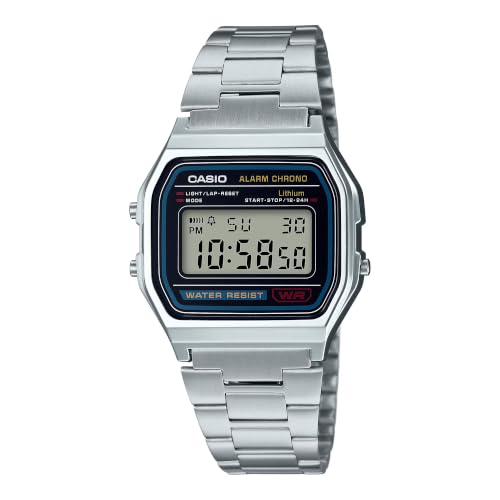
There is also an honesty to the format that is worth naming. The F-91W does not pretend to be a luxury object. Its housing is moulded resin, its crystal is acrylic, its strap is a simple ribbed band with a plastic buckle, and its backlight is a single small LED that lights one corner of the display more than the rest. Nothing about it is hidden or dressed up beyond recognition. When Casio wanted a dressier version of the same idea, it did not redesign the concept; it produced the A158W with a chrome-look finish and a stainless bracelet, and the A168W with an electroluminescent backlight, keeping the same underlying approach of a small module in a compact shell.
Price, discussed only in words because figures shift between sellers and seasons, is part of the story but not the whole of it. These watches sit at the modest end of the market, and that modesty changes how people relate to them. A watch you are not afraid to scratch gets worn in the garden, in the workshop, on a building site, and on a night bus. A watch with a seven or ten year battery gets worn by people who would never tolerate a nightly charging ritual. Low cost here is not a synonym for disposable. Plenty of F-91Ws run for a decade or more on their original strap, and the module inside tends to outlast the resin around it.
This guide works through the core models in the current retro line, explains how to read their published specifications in a sensible order, compares their functions model by model, and covers fit, straps, buying checks, and care. Everything here rests on published documentation: manufacturer specification pages, module manuals, and long-running watch publications that have documented these models for years. Where a figure comes from a spec sheet, it is presented as a published figure, because rated battery life and laboratory water resistance are claims with conditions attached, and later sections unpack those conditions in detail.
The core models, and how they actually differ
Start with the F-91W, because almost every other model in this guide is best understood as a variation on it. The published specification lists module 593, a resin housing measuring roughly 38.2 by 35.2 millimetres with a thickness a little under 9 millimetres, and a total weight near 21 grams. It runs on a CR2016 lithium coin cell with a rated battery life of seven years, a rating that assumes a modest daily allowance of alarm and backlight use. Functions are deliberately spare: time in 12 or 24 hour format, a daily alarm, an hourly time signal, a 1/100 second stopwatch, an auto calendar, and a small LED backlight in the corner of the display. Lug width is 18 millimetres, which matters later when straps enter the discussion.
The A168W, sold in some markets as the A168WA, keeps the same general footprint and the same basic function set, then changes the materials and the light. The housing wears a chrome-look finish, the strap becomes a stainless steel bracelet with a sliding adjustable clasp, and the backlight becomes an electroluminescent panel that glows across the whole display rather than pooling in one corner. That EL panel is the single biggest everyday difference between the two watches. Reading an F-91W at night means tilting it toward its one lit corner; reading an A168 means the whole dial face glows a soft blue-green. The A168 also feels different on the wrist: cooler, slightly heavier, and more like conventional jewellery, which is exactly why some wearers choose it as their only watch.
The A158W sits close to the A168 in spirit. It presents a dressier chrome-look housing and a stainless bracelet, with a cleaner dial treatment that reads as slightly more formal, and it uses an LED backlight rather than the EL panel of the A168. Shoppers comparing the two on a spec sheet sometimes miss that backlight distinction because the housings look so alike in photographs. If night legibility matters to you, the A168 has the stronger claim. If you prefer the A158 dial layout and rarely check the time in the dark, the difference may never bother you. Both share the slim profile that lets them slide under a shirt cuff without argument.
At the smaller end of the line sits the LA670W, a compact model long marketed toward women and toward anyone with a slim wrist who finds even the F-91W visually broad. Its housing is noticeably smaller, its digits are correspondingly smaller, and its function set leans on a countdown timer alongside the usual alarm and stopwatch, a combination that made it popular with people who time tasks in short bursts. The trade is legibility at a distance. Small digits are elegant up close and harder to read at arm’s length, and no backlight specification can fully compensate for digit height. On a small wrist, though, proportion beats digit size, and the LA670W looks intentional where a larger watch looks borrowed.
The CA-53W is the calculator watch distilled to its essentials. Its resin housing carries a keypad of small rubberised keys across the lower face, offering an 8-digit calculator with basic arithmetic, alongside time, alarm, stopwatch, and a dual time display. The keys are small enough that adult fingertips tend to press them with a fingernail or the edge of a finger, and Casio’s published material has never pretended otherwise. What the CA-53W offers is a very specific kind of independence: figures can be checked, split, and totalled on the wrist, in places where pulling out a phone is awkward or impolite. It remains a favourite among engineers, market traders, and anyone whose school days included an earlier generation of the same idea.
Data bank models take that memory idea further. The DBC-150 and the DB-360 store names and telephone numbers in a small on-wrist database, with the DBC-150 offering the larger memory of the two in its published specification, presented through a dot-matrix area of the display that can show characters rather than only digits. Before phones held every contact, this was a genuinely useful feature, and it still has a niche: a short list of key numbers, available on a device with no network connection and a battery measured in years. The DB-360 pairs its data bank with a 10-year battery rating in published material, which suits a watch bought to be a quiet backup rather than a daily companion.
Then there is the AE-1200WH, known almost universally by its nickname, the Royale, earned because its world map display and four-window layout recall a famous film spy watch that it resembles in spirit without copying. This is the most function-dense watch in this guide. Published specifications list world time across 31 time zones and 48 cities, five daily alarms, a 1/100 second stopwatch, a countdown timer, an LED backlight with afterglow, and a battery rated for ten years on a CR2025 cell. A small world map graphic highlights the zone currently displayed, and a separate home time window stays visible while you browse other zones. The housing is larger than the F-91W by a clear margin, roughly 45 millimetres across in published figures, and it wears that size proudly rather than apologetically.
The W-218H answers a different complaint: that the classic format is too small and too fragile-looking for larger wrists and rougher work. It scales the design up, pairs the bigger housing with a 50 metre water resistance rating, keeps an LED backlight, and runs a module with alarm, stopwatch, and hourly signal. On a big wrist the W-218H looks proportionate where an F-91W can look lost, and the larger digits help anyone who reads the time at a glance while moving. The B640W goes the other direction in character rather than size: a metal-look resin housing, a bracelet-style band in matching finish, and an LED backlight, pitched at wearers who want the retro digital look with a more polished surface than the basic resin models offer.
Finally, the MQ-24 breaks the digital pattern entirely. It is an analogue quartz watch with a resin housing around 27.8 millimetres in published listings, simple baton markers, and a three-hand display driven by a quartz module with a battery life rated in years rather than months. It belongs in this guide because it shares the same design philosophy: minimum mechanism, minimum fuss, maximum legibility for the format. There are no alarms and no backlight. There is just a dial, a crown, and a strap. For wearers who love the retro Casio ethos but never warmed to digital digits, the MQ-24 is the quiet answer, and its tiny dimensions make it one of the least obtrusive watches in the entire catalogue.
Reading a spec sheet in the right order
Specification pages list whatever the maker wants to emphasise first, which is rarely the order that helps a buyer. A more useful order starts with size, moves to weight, then water resistance, battery, backlight, and glass, because that sequence runs from the things you cannot change to the things you can live around. A watch that is too wide for your wrist will annoy you every day. A watch with a dim backlight will annoy you only at night. Work through the sheet in that order and the right model usually identifies itself before you reach the function list.
Case dimensions come first, and they need translating. The headline width figure, such as the F-91W at roughly 38.2 by 35.2 millimetres, describes the housing across and down its face, not the distance that decides how it sits between the bones of your wrist. That deciding measurement is lug to lug, the span from the tip of one set of lugs to the tip of the opposite set, because lugs that overhang your wrist make a watch look and feel larger than its width suggests. Compact Casio housings keep lug to lug short, which is why an F-91W suits slim wrists despite a width figure that sounds middling. The AE-1200WH, by contrast, pairs its greater width with a longer lug span and a thicker profile, and it reads as a large watch in every dimension at once.
Thickness deserves the same attention. Most models in this guide sit between roughly 8 and 14 millimetres thick, and the difference between the slim end and the chunky end decides whether the watch slips under a cuff or catches on it. The F-91W and A168 family live at the slim end. The AE-1200WH and W-218H live at the other. Neither is better in the abstract. A thick watch shrugs off knocks against door frames with more resin between the world and the module, while a thin watch disappears under clothing and on the wrist during sleep, which matters to people who wear a watch in bed for its alarm.
Weight follows naturally. The F-91W at about 21 grams is light enough that many wearers report forgetting it is there, and that published figure includes the strap. Resin models with bracelets and metal-look finishes weigh more, and stainless bracelet models such as the A168 weigh more again, though still far less than a typical steel dive watch. Weight distribution matters as much as the number. A bracelet balances a housing across the wrist, while a resin strap leaves most of the modest mass on top. Runners and typists tend to prefer the lightest option. People who like to feel a watch present tend to prefer the bracelet models. Neither preference needs defending; the spec sheet simply lets you predict which camp a model falls into.
Water resistance is where spec sheets mislead the most people, because the numbers sound like depths and behave like categories. A watch marked simply WR, as the F-91W is, is splash resistant in Casio’s published guidance. It survives hand washing, rain, and the odd splash from a tap. It is not rated for showering, and it is certainly not rated for swimming, whatever its survival in anecdotes. A 50 metre rating, as on the W-218H, covers showering and shallow swimming in published guidance for this class of watch. A 100 metre rating, found on the AE-1200WH in its published specification, covers swimming and snorkelling in surface water. None of the watches in this guide is a dive watch, and none should be taken scuba diving, because dynamic pressure from moving your arm through water exceeds the static pressure the rating describes.
Two practical rules sit underneath those categories. First, do not press buttons underwater on any of these models, because a button press can momentarily break a seal that holds fine while left alone. Second, treat water resistance as a property that ages. Gaskets dry, shrink, and take compression set over years, and a battery change done carelessly can end a rating that survived a decade of showers. A ten year old watch with a 50 metre marking is a watch that once met that standard on the day it was sealed. Warm soapy water, steam rooms, and hot tubs are hard on gaskets at any age, and published guidance for the category consistently advises against hot water exposure even where cold water at the same depth would be fine.
Battery specifications repay a careful read because the headline years rest on stated assumptions. The F-91W rating of seven years on its CR2016 assumes limited daily use of the alarm and light, as module documentation describes. The ten year ratings attached to models such as the AE-1200WH on a CR2025, and to the DB-360 in its published material, rest on similar assumptions with a larger cell. Real life varies around those figures in both directions. A watch whose alarm rings daily and whose light fires every night will land short of the rating. A watch worn as a simple timekeeper can run past it. Cell codes matter when replacement day arrives: CR2016, CR2025, and CR2032 share a diameter family but differ in thickness, and fitting the wrong thickness can strain the retaining clip or leave the cell loose under the contact spring.
Backlight types divide into three families in this line, and the spec sheet names them plainly once you know the vocabulary. The micro LED in the F-91W lights one corner of the display; it is frugal, durable, and uneven. The electroluminescent panel in the A168 lights the whole display evenly for a few seconds per press, at a higher power cost per use and with a panel that can fade over very long service. The LED backlight in models such as the AE-1200WH and B640W lights the display from one or two positions with an afterglow that holds briefly after the press, landing between the other two in evenness. None of these will light a room, and none is meant to. They exist so a time check at 3 a.m. does not require a phone, and judged on that job the EL panel remains the most pleasant of the three.
Glass, listed as crystal material in fuller spec sheets, closes the first pass. Acrylic, fitted to the most basic models, is light and shatter resistant, and it scratches readily against masonry, metal edges, and grit. Its saving grace is that shallow scratches can be polished out with suitable compounds, a repair owners of acrylic-crystal watches have performed for generations. Mineral glass, used on dressier pieces in the wider catalogue, resists scratches better and chips or cracks where acrylic would flex. In daily terms, an acrylic crystal will gather a patina of fine marks that most owners stop noticing, while a mineral crystal stays clear longer and fails more suddenly when it fails. Choose based on your environment: workshops and climbing walls favour acrylic, offices and kitchens favour either.
Functions compared, model by model
Function lists look interchangeable until you line them up side by side, at which point the personality of each module emerges. Alarms are the clearest example. The F-91W offers one daily alarm. The A168 and A158 offer one daily alarm. The AE-1200WH offers five. That single difference decides real purchases: a person who needs a wake-up call, a medication reminder, a school-run warning, and an evening prompt cannot be served by a one-alarm module, and no amount of affection for the classic design changes that arithmetic. The DB-360 and DBC-150 add a different kind of reminder through their data functions, storing the number you need rather than the time you need it.
Snooze and hourly signal are smaller features with outsized daily effects. Snooze appears on some modules in the wider line and not on the core classics covered here, so heavy sleepers should check the specific module manual rather than assume. The hourly signal, present on the F-91W and most of its siblings, beeps twice on the hour every hour. Some wearers use it as a gentle metronome for the working day, a prompt to stand, drink water, or check a simmering pan. Others disable it within the first day. Its presence costs nothing when off, and its absence on a module that lacks it cannot be worked around, which is why it earns a line in any careful comparison.
Stopwatch specification is more uniform. A 1/100 second stopwatch with split and lap capability is standard across the F-91W, A168, AE-1200WH, W-218H, and CA-53W in their published documentation, typically measuring up to just under 24 hours before rolling over. For timing a run, a swim set, a board-game turn, or a laboratory step, that resolution is far beyond need. Where modules differ is in how the stopwatch shares the display with the time of day. Larger displays, such as the one on the AE-1200WH, keep more information visible at once. Compact displays cycle through modes, and a mode you must cycle to is a mode you will use less often.
The countdown timer is the most unevenly distributed function in this guide, and the most commonly assumed. The F-91W has no countdown timer at all. Read that sentence again if the F-91W is your leading candidate and you cook, brew, develop film, or work in timed intervals, because no setting unlocks one. The LA670W includes a countdown timer, one reason it punches above its size for task timing. The AE-1200WH includes a countdown timer as part of its fuller module. The CA-53W focuses its extra capability on calculation rather than countdown. This single line on the spec sheet, present or absent, is responsible for more returns and exchanges in this category than any question of colour or strap, and it takes ten seconds to check in the module manual before buying.
Dual time and world time sound like synonyms and are not. Dual time, as on the CA-53W, shows one additional zone alongside your home time: useful for a partner abroad, a head office in another country, or a second home. World time, as on the AE-1200WH, lets you scroll through dozens of city codes across 31 zones and promote any of them to the main display, with the map graphic confirming the region at a glance. A traveller crossing several zones in a week wants world time. A person with one fixed second zone wants dual time and will never miss the other 30 zones. Published city lists also age: zone rules change when governments adjust daylight saving policy, and a pre-programmed watch follows the rules it shipped with until its auto calendar horizon ends.
That horizon deserves its own note. Auto calendars on these modules are pre-programmed to handle month lengths and leap years without correction until a stated year, commonly 2099 in current published documentation for the modules covered here. Until that horizon, you set the date once and the watch manages short months and February 29th on its own. Day of week follows automatically. The limitation only bites at the horizon itself, which for practical purposes means the calendar will outlast the strap, the gasket, and very possibly the wearer’s interest in wearing the same watch for seven decades. It is a good example of a specification that sounds like a caveat and behaves like a lifetime feature.
Data bank functions close the comparison. The DBC-150 stores the largest contact set of the models here, with its published specification describing memory for names and numbers presented through its telememo mode, while the DB-360 offers a smaller bank alongside its long battery rating. Entry is done character by character with the side buttons, a process nobody would describe as swift, and retrieval is quick once the data is in. Judged as a contacts system against a modern phone, it is hopeless. Judged as a sealed, offline list of the handful of numbers that matter most, readable when a phone is flat, lost, or forbidden, it remains oddly compelling, and it explains why these models keep a loyal following in secure workplaces where phones stay in lockers.
Fit, straps, and the small hardware that decides comfort
A watch can win every specification argument and still lose on the wrist, because comfort is decided by holes, clasps, and spring bars rather than by modules. Resin straps on the F-91W, W-218H, CA-53W, and AE-1200WH follow a familiar pattern: a ribbed band with a row of punched holes and a simple buckle, sized to cover a wide span of wrist circumferences. Published strap dimensions for the classics suit wrists roughly from the small end of adult sizing up to a generous maximum before the last usable hole. Where your wrist falls in that span matters. A strap worn on its final hole leaves no tail to tuck and no room on a hot day when wrists swell slightly. A strap worn near its tightest holes leaves a long tail that catches on sleeves and desk edges.
The stainless bracelet on the A168W and A158W solves fit differently. Its sliding clasp travels along the bracelet and locks where you set it, giving near-continuous adjustment instead of fixed holes, with no links to remove and no jeweller’s tools required. You loosen the clasp lever, slide it to the point that fits, and close it down. That mechanism is one of the quiet triumphs of the line: genuinely tool-free sizing on a watch at this level of the market. The bracelet also drapes differently from resin, distributing weight around the wrist and letting air move under the links, which warm-climate wearers appreciate. Against that, a bracelet rattles faintly, catches wrist hair for some wearers, and shows desk-diving scuffs on its clasp that a resin strap would hide.
Replacement straps begin with one number: lug width. The F-91W takes an 18 millimetre strap in published dimensions, the AE-1200WH uses a wider fitting in keeping with its larger housing, and the compact LA670W uses a narrower one. Measure between the lugs, not across the old strap, because straps taper and housings flare. Spring bars, the small sprung pins that hold strap to housing, deserve respect during any swap. Resin lugs can be gouged by careless tool work, and a spring bar launched across a room has a near-supernatural ability to vanish. Work over a tray, in good light, and keep the original bars if they are sound; pattern replacements vary in shoulder design, and a bar that sits shallow in a resin lug is a dropped watch waiting for its moment.
NATO-style pass-through straps tempt many owners of these watches, and the fit is more complicated than forums sometimes admit. The classic resin housings were not designed with a gap for a thick fabric pass-through, so adapters are sold that clip into the lug area and present a wider bar for the fabric. With adapters fitted, an F-91W on a fabric strap gains height and a different character, and the combination is genuinely popular. Without adapters, forcing fabric behind the standard bars strains the bars and the lugs, and the strap can lever a bar out under load. If you want that look, budget the adapters into the plan and accept the added stack height as part of the aesthetic rather than a surprise.
Telling a genuine watch from a counterfeit
Success at the modest end of the market brings a particular problem: the F-91W is widely reported to be among the most copied watches in the world, precisely because its tooling is simple and its volumes are enormous. A buyer therefore needs checks that work from observation and published facts, described here in words rather than figures. The first check is print quality. On a genuine watch the dial printing, including the brand name in its familiar typeface, is crisp at the edges under magnification, aligned with the display window, and consistent in weight across letters. Counterfeit dials often show fuzzy edges, slightly uneven letter spacing, or a brand wordmark that sits a fraction off centre, small faults that become obvious once you compare against photographs on the manufacturer’s own product pages.
The module printing carries the second check. Genuine housings carry the module number, 593 in the case of the classic F-91W, marked on the case back alongside the model name and housing material notes, stamped or printed cleanly. The stainless case back on the classics is held by four small screws, and its engraving has a depth and evenness that cheap copies struggle to match. Some genuine modules also include a factory test display: holding the right-side button arrangement described in enthusiast documentation summons a full-segment display check on many units, and copies frequently fail to reproduce that behaviour or reproduce it with visibly wrong segments. Treat any single check as suggestive rather than decisive; counterfeiters improve, and genuine production varies across factories and years.
Backlight colour and behaviour form the third check, and it is a good one because it is hard to fake cheaply. The F-91W’s genuine LED glows a particular greenish tone from its corner position, dim and uneven by design. Copies often glow a different colour, light the display too evenly, or use a harsh white LED that no genuine F-91W ever shipped with. On the A168 the EL panel should glow evenly across the whole display in its characteristic blue-green. A168 copies with a corner LED pretending to be a panel reveal themselves the first time the light button is pressed in the dark, which is an argument for testing the light before money changes hands wherever the seller allows it.
Weight and feel supply a fourth check. A genuine F-91W weighs about 21 grams, a figure a kitchen scale confirms in seconds. Copies built with cheaper filler materials and thinner straps often land noticeably off that mark in one direction or the other. Buttons on a genuine unit press with a defined, slightly springy resistance and the case edges are cleanly moulded without flashing or sharp seams. None of this requires expertise. It requires handling the watch slowly, which is exactly what rushed marketplace purchases discourage, and exactly why channel choice matters as much as inspection skill.
On channels, the guidance is general but firm. Buy from the maker’s own store, from established watch retailers, or from large sellers with a returns process you have read before ordering. Be wary of listings that use official photographs while shipping from an unrelated storefront with no returns address, and of bundles padded with irrelevant extras to justify a listing that undercuts every authorised seller you can find. Price floor logic, expressed without figures, is simple: a genuine watch passes through manufacturing, distribution, and retail margins, so a listing priced far below every legitimate channel is not a bargain discovery, it is a description of a different product. Keep the warranty card, stamped or completed by the seller where the market uses them, and keep the instruction booklet with its module number, because both support any later warranty conversation and both are documents counterfeit sellers frequently omit or reproduce badly.
One more consideration keeps this section honest. A copy of an inexpensive watch harms the buyer in practical ways beyond principle: the module may keep poor time, the water resistance may be fictional, the strap material may irritate skin, and the battery may be a fraction of the rated cell. The checks above take minutes. For a watch you may wear daily for a decade, minutes are a fair price for certainty, and the same checks transfer, with model-specific details swapped, to the A168, the CA-53W, and every other widely sold model in this guide.
Where the connected alternatives fit, and where they do not
No buying guide for a wrist device in this decade is complete without placing the connected options honestly, because some readers arriving here are really deciding between a retro digital and a smartwatch rather than between two Casios. If your wrist device must charge your transit fare, answer calls, and log heart data, the retro line simply does not compete, and a modern smartwatch is the correct purchase. Readers weighing full smartwatches for a phone ecosystem built around Android will find a dedicated comparison in our companion coverage.
best affordable android smartwatches
Charging is the hidden tax of the connected route, and it deserves a sentence of its own. A smartwatch that needs a proprietary puck or pad every night or two creates a small recurring errand, and travel multiplies it. Anyone who has packed the wrong cable understands why a watch with a seven year battery feels like a holiday. Our guide to charging accessories for the most common smartwatch platform covers the pads, stands, and travel pucks that soften that errand for those who stay connected.
For men comparing the broader smartwatch field on size, strap options, and battery claims, there is a separate roundup that treats those devices on their own terms rather than as foils for a digital classic. It is worth reading before concluding that the retro route is right for you, because the honest answer depends on which features you will actually use weekly rather than admire in a feature list.
Runners sit in their own category again. Satellite positioning, pace alerts, and structured workout logging are jobs the retro Casio stopwatch cannot do, and serious training plans lean on them. Our running-focused smartwatch coverage compares those training tools directly. A retro digital still earns a place in many runners’ kit bags as a backup timer and a travel watch, but it should be bought as that, not as a substitute for a training instrument.
What the retro line offers in return is focus. It is telling that so many smartwatch owners keep an F-91W or an AE-1200WH in a drawer for festivals, site work, swimming trips, and flights. The two categories overlap on the wrist and almost nowhere else, and recognising that saves money in both directions: no smartwatch bought for features that go unused, and no retro digital blamed for lacking radios it never claimed to carry.
Care, battery swaps, and keeping resin alive
These watches ask for little care, but the little they ask for matters, because most retro Casios die from neglect of the housing and strap rather than from module failure. Cleaning comes first. A resin watch that is worn daily collects sweat, sunscreen, and soap film in the ribs of the strap and around the buttons. Warm water, a soft brush, and a drop of mild soap handle nearly all of it, followed by a thorough dry with a soft cloth, paying attention to the gap between strap and lugs where moisture lingers. Bracelet models such as the A168 benefit from the same wash with extra attention between the links, where grit works like abrasive paste if it is left to grind. Avoid solvents, avoid ultrasonic baths for resin housings, and avoid leaving any of these watches to bake dry on a radiator.
Battery replacement is the one service event in the life of these watches, and it rewards patience. The classic housings open from the back: four small screws on the F-91W family, removed with a precision screwdriver that fits the heads exactly, because a chewed screw head on a watch this small becomes a long afternoon. Inside, the cell sits under a retaining arrangement that varies by module, and the module documentation for each model describes the release method and the reset step that some modules need after a cell change, often a brief contact between marked points. Work on a clean tray, keep screws in order, and photograph the open back before touching anything if it is your first attempt. A phone photograph taken before disassembly has saved more watch repairs than any specialised tool.
The gasket is the part most often ruined by an otherwise successful battery swap. That thin rubber ring seals the case back against water, and it should be lifted out gently, inspected for nicks and flat spots, kept clean, and seated back in its groove without twists or trapped grit. A gasket that is pinched, stretched, or seated dry and crooked will leak at the first splash. Many owners treat a battery change as the moment a splash rating quietly expires, and plan accordingly: after a home battery swap, a prudent wearer retires the watch from shower duty unless the seal was renewed and seated with real care. Watchmakers renew gaskets as a matter of routine during service, which is the strongest argument for paying a professional the modest labour charge instead of treating the job as a rite of passage.
Cell choice matters at the same moment. Fit the exact code the module specifies, CR2016 in the F-91W, CR2025 in the AE-1200WH, and the code printed inside the case back or listed in the manual for every other model. Cells of the wrong thickness sit loose or strain the contact, and bargain cells of unknown origin can leak late in life, corroding contacts that a quality cell would have left clean for a decade. Buy the replacement cell from a reputable source, check its date code where one is printed, and recycle the old cell through a battery collection point rather than a household bin.
Resin straps age on their own schedule. Ultraviolet light, heat, and the flexing at the buckle hole combine to harden and eventually crack the material, typically after years rather than months, and typically starting at the hole you use most. Warning signs are easy to read: the strap holds a curve when removed, fine white stress lines appear at the holes, and the surface turns glossy where it was matte. A strap in that condition should be replaced before it fails away from home, because a strap that lets go drops the watch head-first onto whatever is below. Spares for the common models are plentiful and inexpensive in the general sense, and fitting one is a spring bar job of a few minutes with the tray-and-light method described earlier.
Who each model suits
Minimalists should start and probably finish with the F-91W. It is the lightest watch in this guide, the slimmest of the digitals here alongside its bracelet siblings, and the one with the fewest decisions attached. One alarm, one stopwatch, one small light, and a calendar that minds itself until 2099. If your ideal object is the one you never think about, module 593 in a black resin housing is the purest expression of that ideal in the current catalogue, and its 18 millimetre lug width keeps strap options open if the standard band ever needs replacing.
Small wrists have two natural homes in this line. The LA670W was proportioned for them, with its compact housing and smaller digits, and it adds the countdown timer that the F-91W lacks, which suits cooks, carers, and anyone whose day runs in timed intervals. The MQ-24 serves the same wrists in analogue form, its roughly 27.8 millimetre housing sitting where a fashion watch would sit, with none of the bulk that makes small wrists look swamped. Between those two, the choice is digits or hands, timer or simplicity, and either watch will look deliberate rather than downsized.
Travellers should look first at the AE-1200WH. World time across 31 zones, five alarms for awkward departure times, a 100 metre water rating for hotel pools and sea swims, an LED light with afterglow for dark cabins, and a ten year battery rating add up to the most complete travel specification in this guide. Its size is the only real cost, and on an average or larger wrist that cost is minor. The DB-360 makes a quieter travel case as a second watch: a data bank holding key numbers, a long battery rating, and a value low enough in general terms that it can live in a wash bag without a second thought.
Children and first-watch buyers are well served by the W-218H and the F-91W. Both are light, legible, and tolerant of the knocks that school and sport deliver, and the W-218H adds a 50 metre rating that survives swimming lessons and showers without debate. The larger digits of the W-218H help younger readers and anyone learning to read digital time quickly, while its bigger housing suits older children who find the classic format babyish. For a first watch that teaches alarms, punctuality, and stopwatch timing for sports day, either model does the job without a screen-time argument attached.
Uniform and work wear split by environment. Healthcare and food work favour wipe-clean resin and a seconds-capable display for timed observations, which points to the F-91W and W-218H. Office and formal uniforms favour the A158W and A168W, whose chrome-look housings and stainless bracelets sit naturally with a shirt and jacket, and whose slim profiles clear a cuff without snagging. The A168 gets the nod where shifts run into darkness, thanks to its full-display EL glow. Site and workshop wear favours acrylic crystals that polish rather than shatter, light housings that do not swing on the wrist, and straps that rinse clean, which brings the choice back, as so many routes in this guide do, to the resin classics.
Calculator and data specialists know who they are. If your work still involves quick figures away from a desk, the CA-53W with its 8-digit keypad is the only watch in this guide that answers, and its dual time display covers the colleague in another zone while you work. If your need is a pocket-free list of numbers in a phone-free workplace, the DBC-150 and DB-360 remain almost alone in the modern market, carrying a feature the rest of the industry abandoned and a small, loyal group of users never did.
Disclosure and how this guide was assembled
The recommendations in this guide rest entirely on published documentation: manufacturer specification pages, module manuals, and reputable watch publications that have covered these models over many years. No product was handled, worn, opened, or measured by the writer for this piece, and no conclusion here depends on direct contact with any watch. Figures for dimensions, weight, battery codes, and water ratings are the published figures for each model, presented with the conditions and limits that the documentation attaches to them. Where sellers or marketplaces are mentioned, they are discussed in general terms only, and readers should confirm the exact specification of any individual listing before buying, because model suffixes and regional variants can differ in detail.
Check prices on Amazon
Live listings for the shortlist in this guide are pulled from Amazon below, so prices and availability are always current at the moment you look.


Closing thoughts
Choosing among these watches is refreshingly unlike choosing among most modern gadgets. There is no storage tier to agonise over, no colour premium, no previous generation discounted to confuse the comparison. There is a short list of honest questions instead. Do you need a countdown timer, and does your chosen module actually have one. Do you need more than one alarm. Will the watch meet water beyond rain, and does its rating truly cover that. Does the housing fit your wrist and your cuff, and does the backlight suit the hours you keep. Answer those from the spec sheet, in the order this guide used, and the right model tends to be obvious, whether it turns out to be the featherweight classic, the glowing bracelet watch, the calculator, the data bank, or the world-time Royale.
It is worth ending on the trait that unites the whole line, because it is the trait modern product design most often trades away. These watches were specified once, specified well, and then left alone. The module in a new F-91W is not following a yearly refresh cycle, the A168 does not need a successor with a slightly larger display, and the MQ-24 will not be disrupted by its own maker next spring. Buying one is therefore a small act of opting out of the upgrade treadmill, in favour of an object whose maker finished designing it decades ago and saw no reason to apologise for that. Somewhere in a drawer, a classroom, or a night-shift locker, the next ten years of someone’s punctuality are already ticking away on a single coin cell, indifferent to fashion and entirely content to be forgotten until the exact moment it is needed.


