What's inside
- Key Takeaways
- Quick Picks
- How did we assemble this shortlist for a household DSLR?
- What do the T6i’s stills and video actually ask of a card?
- What should Rebel T6i shooters check in each card review?
- How do the six cards compare side by side?
- How should a Rebel household handle, format and offload its cards?
- How does a Rebel’s year actually unfold across its cards?
- Which T6i features change what the card must endure?
- How should a sceptical reader decode a card listing?
- What mistakes do Rebel T6i owners make when buying SD cards?
- When should a Rebel’s card be retired, and what replaces it?
- Final Recommendation
- Frequently Asked Questions
- Related Guides
As an Amazon Associate I earn from qualifying purchases. This post may contain affiliate links at no extra cost to you.
gizmoverdict.com is reader-supported. When you buy through links on our site, we may earn an affiliate commission.
Where to buy: Each of the six cards below is linked from the Quick Picks table and again from its detailed review, so you can check price on Amazon once you have settled on a capacity. Two of the picks are SanDisk Extreme PRO listings at the same 64GB size with different titles, so compare the full listing title, not just the product name, before ordering either one.
The best sd cards for rebel t6i are governed by one specification that simplifies everything: the T6i’s single slot is a UHS-I slot. Canon’s mid-range Rebel records its 24-megapixel stills and its 1080p video through that bus and no faster one, so a UHS-II card would physically fit, would work, and would run at UHS-I pace for every frame — a premium spent on contacts the camera cannot read. The honest contest, and the one this guide runs, is among UHS-I cards: their stated read speeds, their printed speed classes, and capacities chosen for the way a Rebel actually gets used, at family events, school games, holidays and the occasional burst of video.
The T6i’s workload has a particular shape worth naming. Its stills files are larger than those of the older Rebels it replaced, its continuous shooting is brisk enough to fill a buffer at a birthday-party cake moment, and its video, while capped at 1080p, is the feature many owners reach for most after stills. A card for this camera therefore needs a guaranteed write floor that respects video, enough read pace to make a full card painless to offload, and a size that matches a household camera’s rhythm — many short outings, a few very long ones. The six picks below are all 64GB or 128GB, because that is where this camera’s life is lived.
Every speed figure in this guide comes from a listing title. Where a title prints a read speed or a class, the review uses it; where a title prints nothing, the spec box records the silence and points to the manufacturer’s documentation. That discipline matters doubly in this shortlist, because two picks share a famous product name while only one of them states its speed, and treating them as identical would mislead exactly the readers this guide exists to help.
Key Takeaways
- The Rebel T6i slot is UHS-I, so all six picks are UHS-I cards; UHS-II hardware would idle at UHS-I speed in this body.
- The two PNY Elite-X cards state the fullest credentials in their titles: C10, U3 and V30, with 4K UHD labelling the T6i cannot use but can bank as margin.
- One SanDisk Extreme PRO 64GB listing states a 200MB/s read figure; the other states no speed at all — they are separate listings and are reviewed separately.
- The GIGASTONE 64GB states a read speed of up to 160MB/s and a 4K Camera Extreme label, without printing a video class in its title.
- Kingston’s Canvas Go Plus 64GB arrives with the barest title of the six, so its review rests on capacity, format and brand line alone.
- For a household camera, a pair of 64GB cards generally serves better than one 128GB card, spreading risk across birthdays and holidays.
- Whatever you choose, rehearse the card before an important event: format it in the camera, fire a test burst, record an unbroken clip, and offload the results to prove the whole chain works.
Quick Picks
| Pick | Badge | Why it earns its place |
|---|---|---|
| SANDISK 64GB Extreme PRO SDXC UHS-I Memory Card | Name-brand anchor | Extreme PRO branding at 64GB, with a title that states no speed figure whatsoever. |
| SANDISK 64GB Extreme PRO SD Memory Card, Up to 200MB/s Read Speeds, UHS-I | Stated-speed sibling | The same family name with a 200MB/s read figure printed in the title for all to see. |
| PNY 64GB Elite-X C10 U3 V30 SDXC Flash Memory Card, UHS-I, 4K UHD | Fully classed 64GB | U3 and V30 printed in the title, the strongest guarantees available at this size in the set. |
| PNY 128GB Elite-X C10 U3 V30 SDXC Flash Memory Card, UHS-I, 4K UHD | Fully classed 128GB | The same complete class set doubled in capacity for video-heavy Rebel owners. |
| GIGASTONE 64GB SD Card, 4K Camera Extreme, Speed Up to 160MB/s | Recovery-backed 64GB | A stated 160MB/s read ceiling plus a data recovery offer declared in the listing title. |
| Kingston Canvas Go Plus 64GB SD Card | Bare-title contender | Kingston’s Go Plus line at 64GB, its title offering no speed or class evidence at all. |
How did we assemble this shortlist for a household DSLR?
The first pass removed every UHS-II card from consideration, for the slot reason already explained, and every card below 64GB, because a 24-megapixel camera that also shoots video makes small cards feel smaller than their labels. What remained was judged on title evidence: stated read speed first, then printed UHS and video classes, then capacity fit. Cards with silent titles were not excluded — brand line and format still count — but their reviews carry the silence openly rather than borrowing figures from siblings or from memory.
The second pass considered the Rebel’s audience honestly. This is a camera that lives in family bags, gets handed to relatives, shoots the school play from row nine and the dog at the park on the same weekend. Its card needs to be forgiving: tolerant of being nearly full, of being swapped between the camera and a laptop reader by different hands, of sitting in a drawer between outings. Forgiveness is partly about the card and partly about routine, so the guide sections after the reviews cover handling, formatting and offloading in the plain terms a household actually needs.
The final pass was about honesty in pairing. Two listings here wear the Extreme PRO name at the same capacity, and a lazy guide would merge them into one entry with the better figure attached. They are kept apart, reviewed apart, and priced apart, because a reader following a link deserves the listing the review describes. The same discipline separates the two PNY capacities and keeps the GIGASTONE’s recovery offer described as a service, not as speed. What a title says is what a review may claim; everything else is labelled as homework.
What do the T6i’s stills and video actually ask of a card?
Stills first. A 24-megapixel raw file is a meaningful chunk of data, and the T6i can produce them in bursts of several frames per second when a goal is scored or a candle is blown out. The camera’s buffer absorbs the opening of each burst, then hands the backlog to the card. A card with a stated U3 floor — a guaranteed 30MB/s sustained write minimum — clears that backlog at a predictable pace, so the camera feels ready again quickly. A card with no stated floor clears it at an unknown pace, which may be perfectly adequate and may vary as the card fills. The difference is certainty, and certainty is what the PNY pair sells in this shortlist.
Video asks a different question. The T6i records 1080p, and a long take — the whole school concert, not the highlight — is a sustained, unpausing write. That is the exact workload the V30 class certifies, and the exact workload where an unspecified card is a gamble taken on the one recording that cannot be restaged. The T6i’s movie bitrates are not extreme, so the gamble often pays off; this guide simply refuses to pretend a gamble is a guarantee. Readers whose Rebel is primarily a video camera for family milestones should treat a printed V30 as close to compulsory.
Then there is the journey off the card. The T6i offers Wi-Fi transfer to a phone, which is charming for a handful of JPEGs and miserable for a 64GB card of raw files. A reader and a cable remain the serious route, and there the stated read figures rule: 200MB/s on one SanDisk listing, up to 160MB/s on the GIGASTONE, silence from the rest. Offload pace decides whether the evening backup ritual feels like a chore or a moment, and rituals that feel like moments are the ones that survive busy households.
What should Rebel T6i shooters check in each card review?

SANDISK 64GB Extreme PRO SDXC UHS-I Memory Card — Name-brand anchor
This listing is a study in how much weight a product name can be asked to carry. Extreme PRO is SanDisk’s camera-facing flagship line for UHS-I media, and the 64GB capacity is the natural size for a Rebel, yet the title states no read speed, no write speed and no speed class of any kind. A reader buying on the name is buying the line’s reputation, which is considerable, and a set of expectations formed by other Extreme PRO listings — including the very next pick in this guide, whose title does print a figure. Those expectations may be entirely justified by the card in the packet; they are simply not evidence this review is entitled to use.
Judged on what is verifiable — brand line, capacity, SDXC format, UHS-I interface — this remains a sensible main card for a T6i. Sixty-four gigabytes holds a great many 24-megapixel raw files and a respectable stack of video, and the Extreme PRO line exists precisely for camera duty rather than for dashcams or doorbells. The reservation is procedural: before trusting it with an unrepeatable event, a careful owner will open SanDisk’s documentation for this exact listing, confirm the classes, and run the card through a rehearsal shoot. That homework separates this pick from its stated-speed sibling, and the review scores it accordingly.
There is one more consideration, which is resale of trust within a household. A Rebel gets borrowed — by a teenager for a project, by a partner for a trip — and the card inside travels with it. A card whose credentials are printed on its face, or at least in its title, reassures the next user without a documentation hunt. This SanDisk asks its borrowers to trust the name. Many will, happily, and the card will very likely reward them; the guide simply records that trust, rather than specification, is the currency here.
A practical rehearsal settles the question for a particular household faster than any document. Load the card, shoot a burst of raw files at a pet in the garden, record three unbroken minutes of video, offload the results, and watch how the camera and the card behave together. If the buffer clears without drama and the video plays cleanly end to end, the card has demonstrated the only performance that matters in your hands, whatever its title withheld. If anything stumbles, the rehearsal cost nothing and the event it protected is priceless.
- Capacity: 64GB
- Interface: UHS-I, SDXC format
- Read speed: Not stated in the listing title — verify with SanDisk documentation
- Write speed: Not stated in the listing title — verify with SanDisk documentation
- Video speed class: Not stated in the listing title — verify with SanDisk documentation
Strengths
- Flagship Extreme PRO line positioning aimed squarely at camera work.
- 64GB is the natural working size for a 24-megapixel household DSLR.
- SanDisk’s mainstream availability makes replacement and matching spares easy.
Trade-offs
- No performance figure of any kind appears in the listing title.
- Its own sibling listing states a 200MB/s read figure, making this silence conspicuous.
- Video assurance must be established from documentation before an important recording.
Best for: a T6i owner seeking a flagship-line 64GB card and content to confirm its figures in SanDisk documentation. Not suited for: a parent filming an unrepeatable school concert who needs the video class confirmed before the evening arrives.

SANDISK 64GB Extreme PRO SD Memory Card, Up to 200MB/s Read Speeds, UHS-I — Stated-speed sibling
Here is the same family name with the missing sentence restored: up to 200MB/s read speeds, printed in the title. That figure describes offloading, not shooting — inside the T6i, the UHS-I bus and the camera’s own write pace rule the day — but offloading is half the life of a card in a busy household, and 200MB/s is the strongest read claim among the six picks. A full 64GB card of raw files and video, drained through a capable reader at anything near that pace, turns the evening backup from a background chore into a short, finishable task.
The title still leaves the write side unstated: no UHS class, no video class accompanies the read figure. For stills, the Extreme PRO lineage and the T6i’s moderate buffer make that a small risk. For long video takes, it leaves the same documentary homework as its sibling, and this review will not pretend the read number answers a write question. What the listing does prove is that SanDisk was willing to publish a headline figure for this variant, which makes it the easier of the two SanDisk picks to recommend to a reader who wants evidence in hand before paying.
Choosing between the two SanDisk listings is therefore a small lesson in buying discipline. If this stated-speed listing is available at a comparable price to its silent sibling, it is the rational purchase: same capacity, same line, one extra verified claim. If the silent listing is meaningfully cheaper, the saving buys the same plastic with less paperwork, and a stills-led household may take that bargain with open eyes. Either way, match the ASIN and the full title at the listing, because the two are easy to confuse in a search result and the difference lives entirely in the wording.
It is worth adding that a stated read ceiling is measured through a fast reader on a test bench, and a household’s elderly laptop reader will collect only part of it. Even so, the ranking survives the discount: through the same reader, this card will offload ahead of the unstated listings, and on the evening after a holiday, when the card holds a fortnight of family life, that head start is the difference between a backup finished before bed and one postponed into the danger zone of good intentions.
- Capacity: 64GB
- Interface: UHS-I
- Read speed: up to 200MB/s, as stated in the listing title
- Write speed: Not stated in the listing title — verify with SanDisk documentation
- Video speed class: Not stated in the listing title — verify with SanDisk documentation
Strengths
- Strongest stated read figure of the six picks, easing full-card offloads.
- Extreme PRO line and 64GB size fit the Rebel’s working pattern neatly.
- A published headline figure makes the listing easier to justify than its silent sibling.
Trade-offs
- Read speed says nothing about the sustained write floor video depends on.
- No speed class is printed, so burst clearing rests on line reputation.
- Near-identical sibling listing creates a real risk of ordering the wrong variant.
Best for: a Rebel owner seeking fast evening offloads from a 64GB card, with stills as the main workload. Not suited for: a videographer whose long takes require a printed V30 guarantee rather than a read headline.
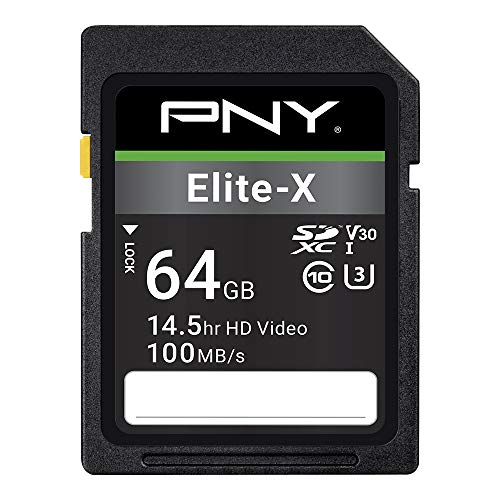
PNY 64GB Elite-X C10 U3 V30 SDXC Flash Memory Card, UHS-I, 4K UHD — Fully classed 64GB
PNY’s title does the complete job: Class 10, U3, V30, UHS-I, 4K UHD, 64GB. Every credential a T6i owner needs is printed where it can be read before purchase, and the pairing of U3 with V30 certifies the sustained write floor — 30MB/s minimum — that governs both buffer clearing after a burst and survival through a long video take. The 4K UHD label overshoots the Rebel, which records 1080p, but overshoot in a guaranteed floor is margin, not waste: a card certified to sustain 4K-class writes will not be troubled by anything this camera can produce.
What the title does not print is a read speed, so the offload chapter of this card’s life is undocumented in the listing. In practice the trade is favourable for most Rebel owners, because the moments that cannot be repeated happen during recording, not during copying. A card that guarantees the recording and leaves the copying pace unstated protects the irreplaceable and leaves the merely inconvenient unmeasured. Readers who offload huge cards nightly may weigh that differently, and the SanDisk stated-speed pick exists for them; readers who film milestones should start here.
At 64GB, this is also the natural first card for a new T6i owner building a kit from nothing. It is large enough for a holiday’s mixed stills and video, classed well enough that no shooting mode in the camera can embarrass it, and priced in the tier where buying a second one as a rotation partner is an easy decision. Pairs matter for a single-slot camera, and a matched pair of fully classed 64GB cards is the quiet backbone of many a family archive.
New Rebel owners sometimes ask whether a card this well classed is wasted on a camera that predates 4K. The answer is that certification is not about the camera’s ceiling but about the floor beneath its ordinary work. A V30 guarantee means the card’s worst sustained moment still clears the T6i’s demands, and worst moments — a hot afternoon, a nearly full card, the longest take of the year — are exactly when a family camera earns its keep. Headroom you never notice is the kind that saves the footage you cannot reshoot.
- Capacity: 64GB
- Interface: UHS-I, SDXC format
- Speed classes: C10, U3 and V30, as stated in the listing title
- Video labelling: 4K UHD, as stated in the listing title
- Read speed: Not stated in the listing title — verify with PNY documentation
Strengths
- Complete class set printed in the title, led by the U3 and V30 guarantees.
- Certified floor covers every mode the T6i offers, stills and video alike.
- 64GB size pairs naturally into an affordable two-card rotation.
Trade-offs
- Read speed is unstated, so offload pace cannot be judged from the listing.
- 4K headroom is margin the Rebel cannot spend, however reassuring it feels.
- Households shooting video daily may outgrow 64GB faster than expected.
Best for: a T6i owner requiring a printed V30 guarantee for family video at a manageable 64GB size. Not suited for: a high-volume shooter whose nightly offload speed matters more than recording guarantees.
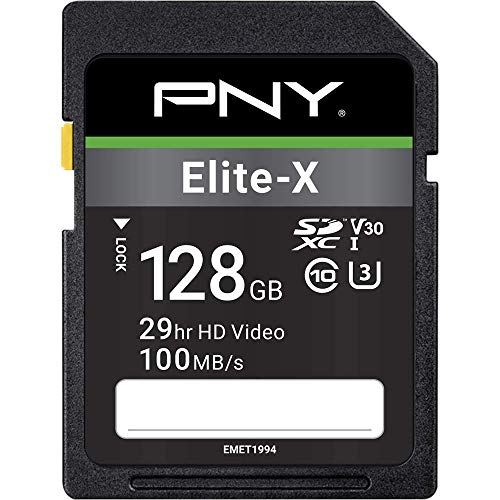
PNY 128GB Elite-X C10 U3 V30 SDXC Flash Memory Card, UHS-I, 4K UHD — Fully classed 128GB
Everything said about its 64GB sibling’s credentials applies here unchanged, because PNY prints the identical class set — C10, U3, V30, 4K UHD — on the larger card. The difference is purely arithmetic, and arithmetic changes behaviour. A 128GB card in a Rebel swallows a two-week holiday of raw stills and video without a swap, which is a genuine comfort on trips where the laptop stayed home. It also holds twice as much unrepeatable material when something goes wrong, which is the standing argument for offloading discipline that this guide will keep making until it sticks.
The natural owner of this card is the Rebel videographer. Video consumes capacity at a rate stills never approach, and a household filming matches, recitals and road trips in long takes will feel 64GB as a series of interruptions. With the V30 floor certified in the title, the larger PNY removes the interruption without introducing a specification gamble: the same guarantee, twice the room. Stills-led owners, by contrast, gain little from the doubling and carry more concentration risk for it, so the smaller sibling remains the better default for them.
One handling note belongs to large cards generally. The fuller a card becomes, the slower any card’s writes tend to feel, and a 128GB card invites its owner to live in the nearly-full zone for weeks at a time. The remedy is the same rhythm recommended throughout this guide: offload when you return, verify the copies, format in the camera, and let the big card start each outing empty. A large card treated like a small one — emptied often, never trusted as the only copy — delivers its comfort without its hazard.
Travel sharpens the case for this card. A family that leaves the laptop behind and shoots for two weeks needs capacity that simply removes storage from the list of things to think about, and 128GB in a Rebel does exactly that for all but the most prolific video diaries. The discipline travels too: a portable drive or a phone-based backup at the hotel, even an incomplete one covering the best material, means the big card is a convenience rather than a single point of failure wearing a holiday’s worth of memories.
- Capacity: 128GB
- Interface: UHS-I, SDXC format
- Speed classes: C10, U3 and V30, as stated in the listing title
- Video labelling: 4K UHD, as stated in the listing title
- Read speed: Not stated in the listing title — verify with PNY documentation
Strengths
- Full U3 and V30 certification at a video-friendly 128GB capacity.
- Removes mid-event card swaps for long family recordings.
- Identical printed credentials to its 64GB sibling simplify kit building.
Trade-offs
- Doubles the amount of work a single card failure can take.
- Read speed remains unstated, leaving offload pace undocumented.
- Stills-led owners pay for capacity their pattern rarely uses.
Best for: a Rebel videographer requiring certified V30 performance across long, swap-free recording days. Not suited for: a cautious stills shooter whose protection strategy is spreading work across smaller cards.

GIGASTONE 64GB SD Card, 4K Camera Extreme, Speed Up to 160MB/s — Recovery-backed 64GB
GIGASTONE’s title leads with two different kinds of reassurance. The first is a number: speed up to 160MB/s, which in context reads as a read ceiling for offloading, sitting between the unstated figures elsewhere and the SanDisk’s 200MB/s claim. The second is a service: the listing family advertises data recovery support, and the title’s “4K Camera Extreme” labelling positions the card for camera video work. What the title does not print is a video speed class, so the sustained write floor behind that 4K label is a documentation question, and this review treats the label as positioning rather than as certification.
That distinction shapes the recommendation. As an offload-friendly 64GB card for stills and ordinary clips, the GIGASTONE is easy to like: a published read ceiling, a sensible capacity, and a recovery offer that acknowledges the worst day in a card’s life. As the sole card for an unrepeatable recording, it asks for one verification step first — confirm the class in GIGASTONE’s documentation — after which it can be trusted like any other verified card. The recovery offer itself deserves a clear-eyed word: recovery services rescue data from many failures, not all, and they are a seatbelt, not a licence to skip backups.
There is a household angle here too. Family cameras hold the least replaceable footage in most homes, and they are often managed by the least technical member of it. A card whose maker advertises recovery support in the title speaks directly to that anxiety, and for some owners that promise will outweigh a missing class mark. This guide’s ordering simply insists the promise be understood for what it is: help after an accident, priced into the card, sitting alongside a read figure that is genuinely stated and a write floor that is not.
The read figure deserves its due in a household context. One hundred and sixty megabytes per second, collected through a decent reader, empties a full card of party footage while the kettle boils, and that speed of ritual matters because rituals survive on convenience. A parent who can copy, verify and put the card back in the camera inside five minutes will do it after every outing; stretch the same chore to half an hour and it quietly becomes a monthly event, with a month of family life riding on one card in between. Judged as an engine of good habits, this GIGASTONE has a real claim on a household’s money.
- Capacity: 64GB
- Format: SDXC, UHS-I class card for camera use
- Read speed: up to 160MB/s, as stated in the listing title
- Video speed class: Not stated in the listing title — verify with GIGASTONE documentation
- Data recovery offer: declared in the listing title
Strengths
- Stated 160MB/s read ceiling promises brisk offloads through a good reader.
- Data recovery support is advertised openly in the listing.
- 64GB capacity fits the Rebel’s everyday rhythm without excess concentration.
Trade-offs
- The 4K Camera Extreme label is not a substitute for a printed V30 class.
- Sustained write floor requires confirmation in manufacturer documentation.
- Recovery is a remedy after failure, never a replacement for backups.
Best for: a family T6i owner seeking a stated read speed and a recovery offer behind a 64GB card. Not suited for: a milestone videographer who wants the video class certified in the title itself.

Kingston Canvas Go Plus 64GB SD Card — Bare-title contender
The shortest title in this guide belongs to Kingston: a line name, a capacity, the words SD Card, and nothing else. No speed, no class, no video claim. The Canvas Go Plus line is Kingston’s performance-leaning range for cameras and drones, and in other capacities and formats it wears impressive figures — but a review may only spend the evidence in front of it, and in front of us is a 64GB SD card from a major memory maker with an entirely silent specification sheet. Everything else is a trip to Kingston’s documentation.
Positioned honestly, this is the shortlist’s research project. A reader comfortable doing that research may find a card whose documented figures rival the fully classed PNY pair, at which point the Kingston becomes a shrewd buy. A reader who wants the decision finished at the listing page has two PNYs and a stated-speed SanDisk ahead of it in the queue. Neither response is wrong; they are different appetites for homework. What would be wrong is assuming the figures from a different Canvas Go Plus variant — a microSD sibling, a larger size — and this review declines to import them.
The capacity, at least, needs no research: 64GB suits the Rebel’s mixed stills and video diet, and Kingston’s distribution means a matching spare is easy to source later. If the documentation check comes back with strong classes, a pair of these makes a coherent kit. Until that check is done, the card sits in this guide as a name with potential, recommended with an asterisk that the spec box prints in full.
There is a fair counter-argument in the Kingston’s favour, which is that listing titles across this whole category are marketing documents, and the PNYs’ completeness is the exception rather than the rule. Kingston publishes full specifications for its ranges on its own site, and a buyer treating the listing as a shop window and the maker’s site as the contract will find the Canvas Go Plus range documented like any other serious line. On that reading, this pick is not under-specified; it is simply specified elsewhere, and the review’s insistence on the distinction is a matter of evidence hygiene rather than suspicion about the card itself.
- Capacity: 64GB
- Format: SD card for camera use
- Read speed: Not stated in the listing title — verify with Kingston documentation
- Write speed: Not stated in the listing title — verify with Kingston documentation
- Video speed class: Not stated in the listing title — verify with Kingston documentation
Strengths
- Performance-leaning Canvas Go Plus line from a major memory maker.
- 64GB capacity matches the T6i’s everyday needs without excess.
- Kingston’s wide availability simplifies buying a matching spare later.
Trade-offs
- The title states no performance evidence of any kind.
- Figures from other Canvas Go Plus variants must not be assumed for this card.
- Fully classed rivals in this guide finish the decision at the listing page.
Best for: a methodical T6i owner seeking a 64GB card and willing to verify its figures in Kingston documentation first. Not suited for: a last-minute purchase before a family event, where certified classes are needed immediately.
How do the six cards compare side by side?
| Card | Capacity | Read speed in title | Classes in title |
|---|---|---|---|
| SanDisk Extreme PRO (silent listing) | 64GB | Not stated | None stated |
| SanDisk Extreme PRO (stated listing) | 64GB | Up to 200MB/s | None stated |
| PNY Elite-X 64GB | 64GB | Not stated | C10, U3, V30 |
| PNY Elite-X 128GB | 128GB | Not stated | C10, U3, V30 |
| GIGASTONE 64GB | 64GB | Up to 160MB/s | None stated |
| Kingston Canvas Go Plus 64GB | 64GB | Not stated | None stated |
Read the table as two different kinds of confidence. The PNY pair offers confidence about recording: certified floors, printed plainly. The stated-speed SanDisk and the GIGASTONE offer confidence about copying: published ceilings for the journey to the computer. The remaining two listings offer the confidence of a brand name, which is real but thinner. A Rebel owner’s own pattern — filming milestones or filling cards with stills, offloading nightly or monthly — decides which confidence is worth paying for, and the reviews above are written to make that decision a short one.
How should a Rebel household handle, format and offload its cards?
Format every card in the T6i itself, and repeat that format each time the card comes back from the computer. The camera prepares the file structure it expects, and a household card that may be handled by several people needs that single, simple rule more than it needs any cleverness: if it is going in the camera, it gets formatted in the camera, after its contents are safely copied. Deleting files one by one on a computer leaves the card in a state the camera tolerates but does not love, and over a school year of such treatment the patchwork shows up as sluggish behaviour nobody can explain.
Offloading deserves a household routine rather than a hero. Copy the whole card, not selected frames, to one folder named by date and event; open a few files at random to prove the copy is real; keep the card untouched until a second copy exists somewhere else, whether that is a cloud folder or an external drive. Only then does the card go back into the camera for its format. The routine takes minutes, and it converts the family’s least replaceable possessions — first steps, first goals, grandparents at birthdays — from a single point of failure into a small, resilient system.
Physical care is the unglamorous third leg. Cards live in a hard case in the camera bag, not loose in a coat pocket or a car’s cup holder. The write-protect tab on the side of a full-size SD card can guard a finished card against accidental erasure during handling, a small feature households underuse. And when a card produces its first unexplained error, believe it: retire the card from camera duty that day, because a Rebel’s card is cheap and a reshoot of a seventh birthday is impossible at any price.
How does a Rebel’s year actually unfold across its cards?
A household camera’s calendar is uneven, and the card feels every swing. Term-time weeks produce a trickle: a few dozen frames at a match, a birthday, a walk. Then December or a holiday arrives and the same camera produces more in ten days than in the previous two months, much of it video, much of it unrepeatable, all of it shot by tired people in poor light who will not check a storage gauge. A card strategy built for the trickle fails in the flood. This is the practical argument for the 128GB PNY as the holiday card and a 64GB classed card as the everyday card: the kit flexes with the calendar instead of pretending the calendar is flat.
The flood has a second property: it is when cards get swapped by the least experienced hands. A relative fills a card at a wedding and reaches for whatever spare is in the bag, which may be an elderly card of unknown class that has lived in a drawer since another camera’s era. The defence is curatorial. Keep only cards you would trust with a wedding in the bag’s card case, and exile the antiques to a labelled envelope at home for unimportant transfers. A small, honest kit beats a large, mysterious one every time the pressure rises.
There is also the matter of the camera changing hands across years. Rebels get handed down — to a child starting photography, to a school club, to a relative whose phone died before a trip. The card inside goes with it, often still holding the previous owner’s unoffloaded month. A household offloading and formatting as a ritual never faces that small embarrassment or the larger risk behind it, and the incoming owner inherits a camera with a known, tested, empty card. Stewardship of a humble SD card turns out to be stewardship of the family’s whole photographic memory, which is why this guide spends so many words on so small an object.
Which T6i features change what the card must endure?
The vari-angle touchscreen is the first. A Rebel is often used at arm’s length, overhead at a parade or low to the ground for a toddler, with the photographer composing on the screen and firing bursts by touch. Touch shooting produces bursts almost by accident, and accidental bursts are still full-size raw files arriving at the card in a rush. Owners who shoot this way more than they expect — most do, once the screen’s convenience sinks in — should weight the certified-floor cards more heavily than a viewfinder traditionalist needs to.
Creative modes form the second pressure. The T6i encourages experimentation: HDR modes, multi-exposure tricks, scene modes that fire supporting frames, and raw plus JPEG recording for safety. Each experiment multiplies the write stream behind a single shutter press, and a card’s guaranteed floor is what keeps the camera feeling responsive while the experiments stack up. None of this demands exotic media; it simply means the difference between a V30-certified card and an unspecified one is felt in the camera’s manners, in whether it pauses, hesitates and makes its owner wait at the exact moment the next moment arrives.
The third feature is the one owners forget: the camera as playback device. Family photographs get reviewed on the rear screen, passed hand to hand at gatherings, zoomed into, shown again. That is read work, gentle and easily handled, but it is also when a failing card often announces itself, with a frame that will not display or a review that freezes. Treat playback oddities as the early warnings they are. A card that stumbles while showing pictures is telling you, politely and in advance, what it will eventually do while taking them.
How should a sceptical reader decode a card listing?
Begin with the floor, not the ceiling. The classes — U3, V30 — are promises about the slowest sustained write the card guarantees, and guarantees are what recording depends on. A title that prints them, as both PNY titles do, has given you the single most decision-worthy fact on the page. A title that prints only a read ceiling, as the stated-speed SanDisk and the GIGASTONE do, has told you about copying, which matters, but second. A title that prints neither has told you a brand and a capacity, and the honest response is documentation, not faith.
Then interrogate the adjectives. Words like Extreme, Elite and Professional are line names, not measurements; they locate a card within a maker’s range without stating a single number. “4K” labelling certifies an intention, and when it travels with a V30 class it means something concrete; travelling alone, as on the GIGASTONE, it is positioning. Even the humble capacity figure deserves a glance, because families of cards share names across sizes whose performance can differ, and the figure that matters is the one attached to the exact capacity in your hand.
Finally, price the homework honestly. A silent-title card is not a bad card; it is a card plus a task. If the task gets done — five minutes in the maker’s documentation, figures confirmed for the exact model — the card can be bought with the same confidence as a fully printed rival. If the task will not get done, and in a busy household before a big event it often will not, then the fully classed listings have already earned their premium by finishing the decision at the page. This guide’s ordering follows that logic from first pick to last.
What mistakes do Rebel T6i owners make when buying SD cards?
The first is paying for UHS-II, seduced by a second row of contacts and flagship language, when the T6i’s slot cannot use them and the premium could have bought a second UHS-I card instead — the spare being worth more than the speed. The second is merging the two Extreme PRO listings in the mind, assuming the 200MB/s figure belongs to whichever listing is cheaper that day. It does not; figures belong to the exact listing that prints them, which is why this guide reviews the siblings separately.
The third mistake is treating read speed as shooting speed, then feeling cheated when a card with a heroic read figure clears bursts no faster than a modest one. Read figures describe the reader’s desk, not the camera’s buffer. The fourth is the opposite complacency: assuming that because the T6i records only 1080p, any card will do for video, and discovering during a long, unrepeatable take that an uncertified floor was a hope rather than a promise. The fifth is household-scale: one card, never offloaded, holding a year of family life, until the day it does not.
When should a Rebel’s card be retired, and what replaces it?
Cards rarely die dramatically in household service; they fade. The signs arrive as small mysteries: a file that will not copy, a thumbnail missing in playback, a format that needs a second attempt, a video that ends a breath early. Any single sign, repeated, is the card asking to be relieved of irreplaceable duty. Households should honour that request immediately, because the economics are absurdly one-sided — the replacement costs less than the petrol to drive to the event the old card is about to ruin. Mark the faded card, demote it to moving documents between computers, and never let it drift back into the camera bag unlabelled.
Replacement is also the moment to re-read the kit as a whole. If the retired card was the household’s only fully classed card, its successor must be classed too, or the kit’s video insurance quietly lapses. If the family’s shooting has tilted toward video over the years, the replacement is the natural moment to step from 64GB to the 128GB PNY pattern. And if two cards in the case are the same age from the same purchase, retire them in the same season even if only one has complained, because cards bought together tend to fade together, and a kit is only as trustworthy as its weakest member on the day everything else goes wrong.
Final Recommendation
Start with the PNY Elite-X pair. The 64GB version is the default recommendation for most Rebel households — certified U3 and V30 floors, a sensible capacity, an easy second card when the kit grows — and the 128GB version serves the family’s videographer with the same guarantees and twice the room. Choose the stated-speed SanDisk when offload pace is your friction, the GIGASTONE when its recovery offer speaks to your anxiety, and either silent-title card only with the documentation check done. A Rebel’s photographs are a family’s archive in the making, and the right card is the one whose promises were printed before you paid, then defended by a routine after you did.
One last word on timing: buy the card before the event, not on the way to it. A card deserves a rehearsal — an in-camera format, a test burst, a short unbroken video, a full offload — before anything unrepeatable is entrusted to it, and a rehearsal needs an ordinary evening rather than a wedding morning. Every pick in this guide will likely serve a Rebel household for years; the ones that serve best will be the ones that were chosen early, checked calmly, and then folded into the small rituals of formatting, copying and verifying that turn a piece of plastic into a trustworthy family archive.
Frequently Asked Questions
Will a UHS-II card make the Rebel T6i faster?
No. The card will work, because UHS-II media is backwards compatible, but the T6i’s slot reads only the first row of contacts, so the card runs at UHS-I speed for stills, bursts and video alike. The money a UHS-II card costs beyond a good UHS-I card buys performance that only a UHS-II camera can unlock, which is why all six picks here are UHS-I.
Which card here is safest for recording a whole school concert?
Either PNY Elite-X, because both print a V30 class in their titles, certifying the sustained write floor a long, unpausing take depends on. The 128GB version adds swap-free capacity for an evening of recording. Other picks may well record the concert successfully, but their titles do not certify the floor, and an unrepeatable event deserves certification rather than optimism.
Are the two SanDisk Extreme PRO 64GB listings the same card?
They are separate listings with different titles, and one states a read speed of up to 200MB/s while the other states no speed at all. This guide reviews them separately and attaches each figure only to the listing that prints it. When ordering, match the full title and the ASIN from the review, because the product names alone will not tell you which listing you are buying.
Is 64GB enough for a Rebel T6i?
For stills-led use, comfortably: 64GB holds thousands of 24-megapixel raw files or a far larger count of JPEGs, covering most family outings without a swap. Video changes the arithmetic, since long takes consume capacity continuously; households filming whole events regularly will feel the ceiling and should look at the 128GB PNY. Either way, capacity should be emptied by offloading often, not treated as an archive.
Why does this guide keep pointing to manufacturer documentation?
Because several listing titles state no speed or class figures, and inventing them would mislead you. The spec boxes mark each absent figure as not stated in the listing title and name the maker whose documentation holds the real number for that exact model and capacity. Five minutes with that documentation converts a brand-name purchase into a specification purchase.
Should a new T6i owner buy one large card or two smaller ones first?
Two smaller ones, provided both are properly classed. A pair of 64GB cards lets a household split a holiday across two pieces of media, keep a formatted spare ready in the bag, and retire one card without leaving the camera empty. One large card wins only when card swaps themselves are the problem, as they can be during long video events, and even then the pair remains the safer foundation to build on later.
Can the T6i’s Wi-Fi replace a card reader for offloading?
For a few favourite JPEGs sent to a phone, yes, and it is genuinely pleasant. For a full card of raw files and video, no: wireless transfer of tens of gigabytes is slow enough that the backup routine collapses, and a routine that collapses is how family archives end up living on one card. Use Wi-Fi for sharing and a reader for archiving.
Related Guides
Households building out the rest of a Rebel kit may also value our guides to entry-level DSLR accessories that matter, memory card classes explained for video and family photo backup routines that stick.
Related guides
- Best 3rd Party MacBook Chargers: 96W-Class Alternatives, the 100W Cable Rule, and the Apple Benchmark
- Best Graphics Cards with HDMI Out for TV Only: Six Picks for a PC Whose Only Screen Is a Television
- Best Powerline Range Extenders: Wi-Fi Kits That Travel Through Your Wiring
- Best Built PC: Six Prebuilt Gaming PCs Judged on Parts, Power and Upgrades