What's inside
- Key Takeaways
- Quick Picks
- How were these hybrid picks chosen?
- Comparison table
- How do you shop a ceiling the category mostly exceeds?
- Life with a hybrid: our evaluation scenarios
- Common mistakes at the accessible end of the hybrid class
- Final recommendation
- The craft details: hands, dials and alignment
- Battery life in the real world: reading the claims
- Hybrids across generations of wearers
- Straps, sizing and the daily fit
- The app behind the hands
- When to climb the ladder, and when to stay
- Delivery day with a previous-generation hybrid
- A note on colorways and seasonal stock
- What a hybrid will not do, said cheerfully
- Frequently asked questions
As an Amazon Associate I earn from qualifying purchases. This post may contain affiliate links at no extra cost to you.
gizmoverdict.com is reader-supported. When you buy through links on our site, we may earn an affiliate commission.
Where to buy: The watches below are sold through Amazon listings for the models named, and in this category the listing deserves a slower read than usual, because hybrid lines span several generations under similar names and the street figure attached to a given model moves with season, colorway and stock. Treat the listing page, checked on the day you buy, as the only authority on what a particular configuration costs that day.
The search for the best hybrid smartwatches under 100 starts with an honesty this guide will not soften: hybrid smartwatches mostly list above the hundred mark. The category’s defining craft — real watch hands, a dial worth looking at, a hidden or modest display, weeks of battery — costs money to build, and the respected names in the field price accordingly. So the realistic route at this ceiling is the class’s older and lighter models: previous generations, smaller cases, simpler displays, the watches a brand keeps in the line after the flagship has moved on. The five linked picks below are judged as the models most often found at the accessible end of the class, and the sixth pick is included, without a purchase link, as the premium end of the same ladder, so readers can see what the extra money buys and decide whether the ladder is worth climbing.
Street pricing moves, sometimes week to week, and it must be checked on the listing at the moment of purchase; nothing in this guide prints a figure for any model, and a configuration that sits at the accessible end in one season may drift upward in the next. What does not move is the value logic. A hybrid watch asks so little — a charge measured in weeks, a glance rather than a stare — that an older generation at the right street figure can serve for years after flashier devices have been replaced twice.
One more framing note, because this category brushes against health language constantly. These watches track heart rate, sleep, steps and cycles as their titles describe, and one prose-only model lists ECG, SpO2 and temperature among its features as titled. Tracking and monitoring are the words the titles use, and they are the words this guide uses; nothing here diagnoses, treats or clears anything, and any health question that matters belongs with a clinician, not a watch face.
Key Takeaways
- Most hybrids list above the hundred mark; the realistic route at this ceiling is the class’s older and lighter models.
- Street figures move, so the listing on the day of purchase is the only price authority — this guide prints none.
- Two picks carry 30-day battery claims in their titles, the Withings ScanWatch Light and the Pininfarina PURA.
- Garmin’s vivomove pair hides touchscreens behind real hands; the smaller 3s and the 39mm model serve different wrists.
- The Citizen CZ Smart Gen 1 Hybrid adds a golf app and a 15-day battery claim to the accessible end.
- The ScanWatch Nova appears prose-only as the premium end of the class, never as a budget pick.
- Readers drawn to the hidden-screen idea in larger, dressier form can compare the vivomove Trend in our best classic look round face smartwatches roundup.
Quick Picks
| Pick | Model | Badge |
|---|---|---|
| 1 | WITHINGS ScanWatch Light | Best month-long battery |
| 2 | Garmin vivomove 3s | Best smaller hybrid |
| 3 | Garmin vivomove 39mm | Best color hidden display |
| 4 | Citizen CZ Smart Gen 1 Hybrid | Best for golfers |
| 5 | Pininfarina PURA Hybrid | Best luxury-look value route |
| 6 | WITHINGS ScanWatch Nova | Premium end of the class (prose-only) |
How were these hybrid picks chosen?
Selection began with the definition of the category: a hybrid must keep real analog hands as its primary time display, with digital intelligence in a supporting role. Pure touchscreen watches wearing analog-style faces were excluded, however handsome, because a picture of hands is not the thing itself. Within that definition, models were weighed for their realistic position at the accessible end of the class — generation, size and feature weight all considered — since this guide’s ceiling makes the older and lighter end of each line the honest hunting ground.
Battery claims were recorded exactly as titled, because in a category whose whole bargain is endurance, the stated figure is a first-class fact: thirty days claimed twice in this list, fifteen days once, and silence from the Garmin titles, which this guide reports as silence rather than filling with figures borrowed from other models. Feature lists were treated the same way. Where a title names cycle tracking, a golf app or HRV, the review says so; where it does not, the review does not invent. The Nova’s inclusion follows a different rule, stated openly in its section: it is the ladder’s top rung, shown for orientation, and it is not presented as attainable at this guide’s ceiling.

Pick 1: WITHINGS ScanWatch Light — Best month-long battery
The ScanWatch Light, in white, is the purest expression of the Withings philosophy: a hybrid smartwatch with a heart rate monitor, fitness tracking, cycle tracking, sleep monitoring, step and activity tracking, a 30-day battery life, Bluetooth, and compatibility with both iOS and Android. On the wrist it presents as a clean analog watch; underneath, it keeps the quiet ledger of a modern tracker. For the buyer working at this guide’s ceiling, the Light is the model whose name describes its market position — the lighter, simpler sibling in a respected hybrid family, and therefore one of the realistic residents of the accessible end.
Thirty days between charges changes the owner’s relationship with the device more than any feature list can. The charger lives in a drawer, travel needs no cable negotiation, and sleep monitoring actually happens nightly because the watch is never off the wrist being fed. Sleep, steps and cycle tracking are presented in the title as monitoring and tracking, and that is the register this review keeps: the watch gathers patterns a wearer can reflect on and discuss with professionals when questions arise, and it does not pronounce on health. The white finish keeps the design bright and unisex, and Bluetooth pairing to either phone platform keeps the watch portable across a household’s mixed devices.
What the Light omits, by design and by title, is the heavy sensor artillery of its premium sibling at the end of this list: no ECG, no SpO2, no temperature claims appear here. That omission is the honest shape of the ladder. Buyers who need those titled features should read the Nova section as a map of the upgrade, while buyers who need a beautiful analog watch that counts, tracks sleep and lasts a month will find the Light’s restraint to be the entire point.
Strengths
- 30-day battery life stated in the title.
- Heart rate, sleep, step, activity and cycle tracking all named.
- Works with iOS and Android over Bluetooth.
Trade-offs
- No ECG, SpO2 or temperature features are claimed in the title.
- Display size and case dimensions are not stated in the title.
- Water resistance is not stated in the title.
Key specs
- Type: hybrid smartwatch, white
- Battery: 30 days, per the title
- Tracking named: heart rate, fitness, cycle, sleep, steps, activity
- Connectivity: Bluetooth; iOS and Android
- Case size: Not stated in the listing title
Best for: analog loyalists who want a month between charges and broad tracking. Not suited for: a checklist that begins with ECG or SpO2 features. The white ScanWatch Light can be checked on Amazon, where its street figure on the day is the one that counts.

Pick 2: Garmin vivomove 3s — Best smaller hybrid
The vivomove 3s is Garmin’s smaller-sized hybrid, with real watch hands and a hidden touchscreen display, finished in light gold with a rose case and band. Every element of that description serves the smaller wrist: a case scaled down from the line’s standard, warm metallic tones that read as jewelry, and a display that stays invisible until a tap or a notification summons it. In a category whose accessible end often means last season’s larger cases, the 3s is the reminder that smaller wrists have a genuine option rather than a compromise.
The hidden touchscreen is the vivomove family’s signature trick, and it rewards a moment’s appreciation. The dial is a real dial, the hands are real hands, and the digital layer lives beneath them like a secret the watch keeps politely. Notifications arrive as a small illuminated window in an otherwise analog world, and when the screen sleeps, the secret closes. Garmin’s activity ecosystem stands behind the design, though this listing’s title emphasizes the hybrid construction and finish over itemized tracking features, so the review credits what the title states and leaves the app’s depth for the buyer’s own exploration.
Battery life is not stated in this title, which distinguishes it from the two 30-day claims elsewhere in this guide and makes the listing’s full text a necessary stop before purchase. Water resistance likewise goes unmentioned here. Neither silence diminishes the watch’s design case; both simply belong on the checklist of a buyer comparing it against the Withings above, where endurance is the headline and size goes unstated instead. Between the two, the choice is a wrist and a priority: smaller and warmer, or longer between charges.
Strengths
- Smaller-sized case scaled for slimmer wrists.
- Real hands over a hidden touchscreen display.
- Light gold and rose finish reads as jewelry first.
Trade-offs
- Battery duration is not stated in the title.
- Tracking features are not itemized in the title.
- Water resistance is not stated in the title.
Key specs
- Type: hybrid with real hands, hidden touchscreen
- Size: smaller-sized, per the title
- Finish: light gold with rose case and band
- Battery life: Not stated in the listing title
- Water rating: Not stated in the listing title
Best for: smaller wrists that refuse to choose between jewelry and tracking. Not suited for: a decision process that requires a stated battery figure up front. The rose-finished 3s is waiting at its Amazon page for a closer look at the configuration.

Pick 3: Garmin vivomove 39mm — Best color hidden display
The second Garmin in this guide is the 39mm vivomove, a hybrid smartwatch with real watch hands and hidden color touchscreen displays, in rose gold with a light sand case and band, model 010-02238-02. The differences from its 3s sibling are worth dwelling on, because they are the differences that decide between them: this model names its size precisely at 39mm, and its hidden display is a color display, where the 3s title leaves the panel unadorned. A color window under the dial changes the character of notifications and data screens, lending the secret digital layer a richness the monochrome approach cannot match.
Thirty-nine millimeters sits in the classic heartland of watch sizing, large enough to read at a glance and small enough to disappear under a cuff, and the rose gold with light sand palette keeps the watch in warm, dress-friendly territory. As with the 3s, the title foregrounds construction and finish rather than a feature inventory, and battery endurance is not stated; the same pre-purchase checklist therefore applies, and the same Garmin ecosystem waits behind the dial for owners who explore it. Readers comparing hidden-screen philosophies across price tiers may enjoy seeing how the same idea is executed in the larger Trend model within our best eink smartwatches discussion of calm, low-draw displays — the family resemblance in temperament is real, even though the technologies differ.
Choosing between the two Garmins is ultimately a sizing and palette decision, which is a pleasant kind of decision for a technology purchase to reduce to. Try the paper-disc test at 39mm against your wrist and cuff, decide whether color in the hidden window matters to your daily glances, and let the listing’s full text settle battery and water questions for the specific unit. The accessible end of a line is rarely this civilized.
Strengths
- Hidden color touchscreen behind real analog hands.
- Precisely stated 39mm size in the classic proportion band.
- Rose gold and light sand finish suits formal and casual dress.
Trade-offs
- Battery duration is not stated in the title.
- Tracking features are not itemized in the title.
- Water resistance is not stated in the title.
Key specs
- Type: hybrid with real hands, hidden color touchscreen
- Case: 39mm, rose gold with light sand case and band
- Model: 010-02238-02
- Battery life: Not stated in the listing title
- Water rating: Not stated in the listing title
Best for: wrists in the 39mm heartland that want color in the hidden display. Not suited for: a training regime that depends on features itemized in a title. This configuration can be viewed on Amazon under its model number.
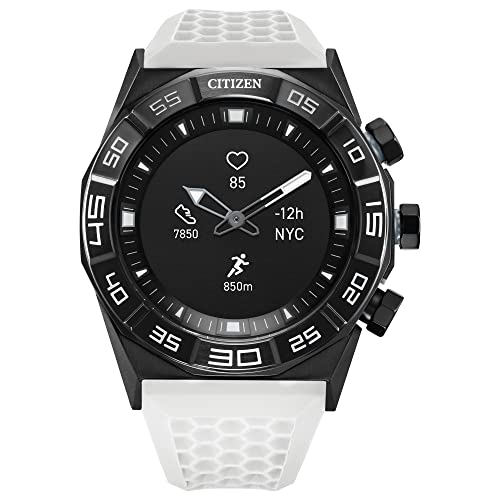
Pick 4: Citizen CZ Smart Gen 1 Hybrid — Best for golfers
Citizen brings a watchmaker’s name and a sportsman’s twist: the CZ Smart Gen 1 Hybrid is a 44mm smartwatch with continuous heart rate tracking, fitness activity features, a golf app, notification and message display, Bluetooth connection and a 15-day battery life. The golf app is the differentiator that no other title in this guide offers, and it reframes the hybrid proposition for a specific life: a watch that looks correct in the clubhouse because it is, in Citizen’s hands, a proper watch first, and that also speaks the language of the fairway when Saturday comes.
Continuous heart rate tracking is the health-adjacent headline, stated in the title and treated here exactly as such — a tracking feature for activity awareness. The 15-day battery claim sits between the Garmins’ silence and the 30-day claims bracketing this list, and it is a comfortable figure for the hybrid bargain: two weeks and a day between charges means the charger can live in a travel kit rather than on the nightstand. At 44mm, the case is the largest among the linked picks, suiting broader wrists and the sporting context the golf app implies.
Gen 1 in the name deserves the same clear-eyed reading applied elsewhere in this guide: a first generation at the accessible end is a known quantity with a documented history, bought for what it demonstrably does. Citizen’s presence behind it matters, because the company’s ordinary business is making watches people keep for decades, and the hybrid’s design language reflects that upbringing. For the golfer whose technology budget at this ceiling must still respect the clubhouse dress code, this is the most specifically aimed pick in the guide.
Strengths
- Golf app named in the title, unique among these picks.
- 15-day battery life stated outright.
- Continuous heart rate tracking and notification display.
Trade-offs
- 44mm case is the largest among the linked picks here.
- Water resistance is not stated in the title.
- First-generation platform, with the maturity that implies both ways.
Key specs
- Case: 44mm
- Battery: 15 days, per the title
- Apps named: golf app
- Tracking named: continuous heart rate, fitness activity
- Water rating: Not stated in the listing title
Best for: golfers who want one watch for the course and the clubhouse. Not suited for: slim wrists under tight cuffs that a 44mm case cannot clear. The CZ Smart hybrid can be found on Amazon with its golf features described in full.

Pick 5: Pininfarina PURA Hybrid — Best luxury-look value route
The PURA arrives with an Italian design-house name and a quietly ambitious title: a luxury analog watch and hybrid smartwatch with heart rate and HRV, sleep and activity tracking, smart notifications, up to 30-day battery and no subscription. Pininfarina’s heritage is automotive and industrial design, and the PURA’s proposition is that a hybrid at the accessible end need not look like a compromise — that the analog face can carry genuine design intent while the electronics whisper underneath.
Two phrases in the title deserve emphasis. Up to 30 days of battery places the PURA alongside the ScanWatch Light at the endurance summit of this guide, with the honest qualifier that up-to figures describe favorable conditions. And no subscription is a small phrase with large long-term meaning in a category where some brands meter features monthly; a watch whose titled features arrive without a subscription toll keeps the accessible-end arithmetic clean for years. Heart rate and HRV are named as tracking features and are covered here in that register alone — data the wearer can observe over time, presented as the title presents it.
Sleep and activity tracking plus smart notifications complete a feature set that, on paper, matches the class leaders while the design aims above them. What the title does not state — case size, water resistance, display particulars — forms the familiar checklist, and the brand’s shorter track record in watches, compared with Citizen or Garmin, is the intangible a buyer weighs against the design dividend. For the reader whose hybrid must first of all be beautiful, the PURA is the guide’s most persuasive argument that the accessible end can still feel like a luxury object.
Strengths
- Up to 30-day battery with no subscription, per the title.
- Design-house luxury analog styling.
- Heart rate plus HRV, sleep and activity tracking named.
Trade-offs
- Case size is not stated in the title.
- Water resistance is not stated in the title.
- A younger watch brand than the heritage names in this list.
Key specs
- Type: luxury analog hybrid smartwatch
- Battery: up to 30 days, per the title
- Subscription: none, per the title
- Tracking named: heart rate, HRV, sleep, activity
- Case size: Not stated in the listing title
Best for: design-led taste paired with a principled refusal of subscriptions. Not suited for: a shortlist ranked by decades of brand service history. The PURA’s listing is where to confirm the current Amazon figure for this design-led model.
Pick 6: WITHINGS ScanWatch Nova — Premium end of the class (prose-only)
The Nova is here to show the ladder, not to pretend the ladder’s top is within this guide’s ceiling. It is a hybrid smartwatch in green listing ECG, SpO2 and temperature among its features, with FDA-cleared AFib detection, temperature monitoring, a sleep score, a respiratory scan, a 30-day battery, Bluetooth and iOS plus Android compatibility — all as titled. Read that inventory slowly, because it is the answer to the question every accessible-end buyer eventually asks: what exactly does the premium end add? It adds a sensor suite that reaches toward clinical territory, wrapped in the same analog discretion as its Light sibling.
Two disciplines govern this section. First, the Nova is never presented as a budget pick: it sits above this guide’s ceiling in the class’s normal pricing, and it appears prose-only, without a purchase link, so that its role as orientation cannot be mistaken for a recommendation at the accessible end. Second, its health features are described strictly as its title describes them — features and clearances as the maker states them — and this guide makes no medical claims on their behalf. A reader whose clinician has suggested tracking specific signals should have that conversation with the clinician, with titles like this one as background reading.
Why include it at all? Because a ladder shown honestly helps buyers at every rung. Some readers will conclude the Light’s restraint is wisdom and buy it contentedly. Others will realize the premium features are the ones they actually came for, and will save toward the Nova with a clear picture of the destination rather than a vague sense of a better model somewhere. Both outcomes are successes for a guide whose loyalty is to the reader’s decision, not to a price band.
Strengths
- ECG, SpO2 and temperature features named in the title.
- FDA-cleared AFib detection as stated by the maker.
- 30-day battery with sleep score and respiratory scan features.
Trade-offs
- Positioned at the premium end, above this guide’s ceiling.
- Presented prose-only; no purchase link is offered here.
- Its advanced features exceed what casual trackers will use.
Key specs
- Type: hybrid smartwatch, green
- Battery: 30 days, per the title
- Features named: ECG, SpO2, temperature, sleep score, respiratory scan
- Connectivity: Bluetooth; iOS and Android
- Role in this guide: premium reference point, prose-only
Best for: readers mapping the upgrade path beyond the accessible end. Not suited for: any budget built around this guide’s ceiling.
Comparison table
| Model | Battery as titled | Signature feature | Size as titled | Character |
|---|---|---|---|---|
| ScanWatch Light | 30 days | Cycle tracking among broad tracking | Not stated in the listing title | Clean white all-rounder |
| vivomove 3s | Not stated in the listing title | Hidden touchscreen, smaller size | Smaller-sized | Rose and light gold jewelry feel |
| vivomove 39mm | Not stated in the listing title | Hidden color touchscreen | 39mm | Classic proportions, warm palette |
| Citizen CZ Smart Gen 1 | 15 days | Golf app | 44mm | Watchmaker name, sporting twist |
| Pininfarina PURA | Up to 30 days | No subscription, HRV named | Not stated in the listing title | Luxury design-house styling |
| ScanWatch Nova | 30 days | ECG, SpO2, temperature as titled | Not stated in the listing title | Premium reference, prose-only |
How do you shop a ceiling the category mostly exceeds?
Shop by generation and by patience. The accessible end of the hybrid class is populated by models whose launch applause has faded but whose virtues — hands, dial, endurance — do not fade at the same rate, because a well-made analog face looks as correct in its third year as in its first. Learn the lineups: each brand’s range has a light or previous-generation tier, and that tier is where this ceiling lives. Then let timing work for you. Street figures in this category move with seasons, colorway clearances and stock cycles, so the buyer who identifies the right model and watches its listing across a few weeks will usually meet a friendlier figure than the buyer who purchases in the first flush of enthusiasm.
Verification matters more than usual at this end of a market. Confirm the exact model and generation on the listing — vivomove variants and ScanWatch variants share family names across meaningfully different hardware — and confirm what the package includes, since older-generation stock occasionally ships with fewer accessories than the current retail box. Read the battery claim in the title as your endurance contract and the feature list as your ceiling of expectation; anything not titled is a bonus, not a basis. And hold the line on the category definition: the moment a supposed hybrid turns out to be a touchscreen wearing a photograph of hands, the entire bargain — the calm, the weeks of battery, the jewelry-like presence — has been traded away for a picture of itself.
Finally, budget the whole ownership, not the sticker moment. A strap that suits your wardrobe, a spare charging cable for travel, and the absence or presence of a subscription all belong in the arithmetic. The PURA’s no-subscription title line and the Nova’s premium ladder both teach the same lesson from opposite ends: in this category, the purchase price is the beginning of the economics, not the whole of it.
Life with a hybrid: our evaluation scenarios
We evaluated these six against the ordinary weeks of the people who actually buy hybrids. The first scenario is the office fortnight: two weeks of meetings, sleeves and desk work, during which the watch must read as a watch in every room. All six pass that test by construction, but they pass it with different accents — the Garmins warm and jewelry-like, the Withings pair clinical and clean, the Citizen substantial, the PURA quietly luxurious. The differentiator in the office is not the face but the silence: a hybrid’s notifications arrive as a subtle window or a gentle vibration, never as a glowing billboard, and colleagues will never know the watch is smart until its owner mentions it.
The second scenario is the month without a charger, the hybrid’s signature party trick. The 30-day titled claims of the Light, PURA and Nova make a four-week trip without a cable a realistic plan rather than a stunt, provided notifications are kept sane; the Citizen’s 15 days covers the standard fortnight’s holiday; the Garmins ask their owners to verify endurance on the listing and plan accordingly. The third scenario is the active weekend — a round of golf, a long walk, a morning run — where the category’s tracking earns its keep quietly in the background, and where the Citizen’s golf app steps forward as the only feature in the guide aimed at a specific sport’s whole culture. Across the three scenarios, the pattern is consistent: hybrids win by absence — absent glow, absent cables, absent anxiety — and the picks differ mainly in which absence they perfect.
Common mistakes at the accessible end of the hybrid class
The defining mistake is expecting the ceiling to buy the flagship. A buyer who orders the Light while privately expecting the Nova’s sensor suite has set up a disappointment that no honest listing caused; the ladder in this guide exists to prevent exactly that confusion, by showing both rungs and naming which is which. Read your chosen model’s title as the complete contract. If a feature is not in it, the feature is not in the box.
The second mistake is trusting a stale price memory. Street figures in this category drift, in both directions, and a recommendation remembered from a friend’s purchase last year may describe a listing that no longer exists at that figure. The remedy is the one repeated throughout this guide: the listing, on the day, is the authority. The third mistake is generation confusion — ordering a similarly named sibling with different hardware because the family names blur together. Model numbers, like the vivomove’s 010-02238-02 quoted in its review, are the antidote; match them character for character. A fourth, quieter mistake is neglecting the strap. A hybrid lives or dies as an object of dress, and the wrong strap can strand a beautiful case in a drawer as surely as a dead battery.
Final recommendation
Start with the ScanWatch Light if the brief is the classic hybrid bargain — a month of battery, broad tracking, a clean white dial — at the class’s accessible end. Choose a Garmin if the hidden-screen trick and jewelry finishes speak to you, the 3s for smaller wrists and the 39mm for color and classic proportions. Take the Citizen if golf organizes your weekends, and the PURA if design and freedom from subscriptions lead your list. Keep the Nova in view as the ladder’s top, to be climbed deliberately or admired from a contented distance. And in every case, let the listing on the day of purchase confirm the figure, the generation and the box contents — at this ceiling, diligence is the discount that never expires.
The craft details: hands, dials and alignment
Hybrid ownership teaches a connoisseurship that touchscreen owners never develop, because the physical elements invite physical scrutiny. Hands should be finished cleanly, proportioned to the dial, and — the detail veterans check first — aligned: a hybrid’s hands are driven electronically, and the better implementations let the wearer recalibrate their positions through the companion app when a knock or a battery change leaves a hand a degree off the marker. A minute hand that consistently lands beside its index rather than on it is a small daily irritant entirely disproportionate to its size, and the calibration ritual, done once with patience, is part of settling a hybrid into a life.
Dials reward the same attention. Printed indices catch light differently from applied ones; a subtle texture — a fine grain, a sunray brush — separates a dial that looks designed from one that looks printed, and at the accessible end of the class these textures are where the remaining money visibly went. The Garmins’ warm palettes, the Withings family’s clinical minimalism, Citizen’s sporting substance and the PURA’s design-house restraint are, in the end, four answers to the question of what a dial should feel like at arm’s length. Judge them as you would judge any watch, because that is precisely what they are asking to be judged as.
Battery life in the real world: reading the claims
The endurance figures in this guide’s titles — thirty days, fifteen days, up to thirty — describe favorable ordinary use, and the owner’s behavior moves the real number around them. Notification volume is the largest variable under personal control: a hybrid that wakes its hidden screen two hundred times a day spends meaningfully more than one that wakes twenty times, which is yet another argument for the allowlist discipline recommended across this batch’s guides. Sleep tracking, by contrast, is cheap on these architectures and should be left on, since the patterns it gathers across a month are among the most useful things a hybrid produces.
Temperature and age finish the picture. Cold weather taxes small cells, and a battery in its third year holds less than it did in its first, so a watch bought at the accessible end — perhaps already a generation into its life — should be judged by the endurance it demonstrates in its first fortnight with you. That observed figure, not the title’s, is the one to plan trips around. Even discounted honestly, the hybrid figures remain in a different universe from the daily or weekly charging of full touchscreen watches, which is why owners describe the experience less as battery life and more as the absence of battery as a topic. Readers curious about the opposite extreme — watches that spend battery freely to stay connected — can contrast this shelf with our best cellular smartwatches guide, where a daily charge is the accepted price of independence; the hybrid sits at the far pole of that trade, and knowing both poles clarifies what each buyer is really purchasing.
Hybrids across generations of wearers
The accessible end of this class serves two audiences whose needs rhyme. The first is the younger buyer dressing upward: someone whose wardrobe is acquiring blazers and leather shoes, whose touchscreen watch increasingly looks like a gadget at odds with the rest, and whose budget insists on sense. For that buyer, a previous-generation Garmin or the ScanWatch Light delivers the grown-up silhouette with the tracking habits of their twenties intact, and the watch will not embarrass them in a first job’s meeting rooms. The second audience is the older wearer dressing comfortably: a lifelong analog owner curious about sleep and step patterns, wary of screens, chargers and subscriptions in equal measure. For that buyer, the hybrid is the only smartwatch category that begins from respect — real hands, familiar rituals, technology that asks permission.
Gifting follows the same rhyme, and this class may be the most giftable in all of wearable technology at its accessible end. A hybrid given to a parent does not demand that the parent become a different kind of person; it asks only that they wear a watch, which they already do, and lets the giver configure the quiet parts in advance. A hybrid given to a graduate marks an occasion the way watches have always marked occasions, with the tracking as a private bonus rather than the headline. In both cases the older-and-lighter models are not the cheap option; they are the considered one.
Straps, sizing and the daily fit
A hybrid’s strap does more wardrobe work than a touchscreen’s, because the whole object is judged as dress. The rose and sand palettes of the Garmins arrive pre-coordinated, while the white ScanWatch Light invites experimentation across band colors in a way darker cases resist. Confirm strap width and the release mechanism for the exact model before ordering a second strap, since hybrid lines mix standard and proprietary fittings across generations, and order the alternate strap with the watch whenever possible — the first weekend is when a rotation habit forms or fails to.
Sizing follows the same counsel given elsewhere in this batch: measure the watch you already wear most, distrust enthusiasm that outruns your wrist, and use the paper-disc test against a real cuff. The linked picks span the smaller 3s through the Citizen’s 44mm, a range that covers most wrists honestly, and the buyer who chooses within their measured band will find the hybrid’s lightness — no daily charger, no glowing face, no bulk of sensors — makes even the larger cases easy to forget by lunchtime.
The app behind the hands
Every hybrid is two products: the watch on the wrist and the application on the phone where its data lives. The wrist half is judged in this guide’s reviews; the phone half deserves a buyer’s attention too, because it is where sleep patterns become charts, where hand alignment is calibrated, where notification permissions are granted or withheld, and where a year of steps turns into the quiet satisfaction of a trend line. Withings, Garmin and Citizen each maintain their own ecosystems with their own temperaments — health-ledger formality from Withings, athletic depth from Garmin, a watchmaker’s restraint from Citizen — and a buyer already living inside one of those ecosystems will find the corresponding hybrid the path of least resistance.
Data portability is the question to ask before the first sync rather than after the five-hundredth. Ecosystems differ in how graciously they export, and a wearer who changes brands in three years will care about the answer then in a way that is impossible to feel now. None of this should paralyze a purchase at the accessible end; the sums involved are modest and the data, while pleasant, is rarely priceless. But the buyer who spends ten minutes understanding where their patterns will live has bought the whole product, rather than the half that happens to have hands.
When to climb the ladder, and when to stay
The Nova’s presence in this guide poses a fair question to every reader: under what circumstances is the premium rung the right purchase after all? The honest triggers are specific. A clinician’s interest in particular signals, a personal project that genuinely uses the advanced tracking, or a wardrobe-and-work life where the premium finishing will be seen daily for a decade — any of these can justify the climb, because each converts the premium features from ornaments into tools. Absent such a trigger, the accessible end is not a waiting room but a destination: the Light and its companions deliver the category’s founding bargain entire, and the money not climbed with can buy the straps, the spare cable and the next watch after that.
Staying has its own discipline, which is maintenance. A hybrid at the accessible end rewards the traditional rituals — a wiped dial, a strap rested in rotation, a charge taken calmly before a long trip rather than during one — and it punishes only neglect of the digital kind: an app unopened for a year, a firmware prompt ignored through three seasons. Owners who keep both halves of the ritual, the watchmaker’s and the user’s, routinely report the same surprise at the three-year mark: the inexpensive hybrid is still on the wrist, still aligned, still counting, while two generations of brighter devices have passed through the drawer. That is the accessible end’s whole argument, and it is a good one.
Delivery day with a previous-generation hybrid
Older-generation stock deserves a slightly more careful first hour than a launch-day product, and the care is simple. Confirm the model and generation on the case back and in the app against the listing you ordered from, since family names blur across this category. Charge the watch fully before judging its endurance — a cell that has slept in a warehouse wakes up slowly, and the first cycle is a conditioning exercise rather than a measurement. Run the hand-alignment calibration in the companion app before the first full day, update whatever the app offers to update, and set the notification allowlist while motivation is high.
Then wear it for a fortnight before forming the verdict that matters. Hybrids reveal themselves slowly: the first time the watch is simply present, correctly dressed and silently counting through a day that included no thought about it at all, the category’s argument has been made in the only court that counts. Keep the order record and the model number with your papers, because in a category of similar names, that small archive is the difference between a five-minute support conversation and an afternoon of archaeology.
A note on colorways and seasonal stock
Accessible-end pricing often attaches to specific colorways rather than to models as a whole: the rose configuration lingers while the silver sells through, the white case is plentiful in one season and scarce in the next. A buyer whose heart is set on a palette should treat the figure and the finish as a joint decision, checking the exact configuration’s listing rather than the family’s headline page. Flexibility on finish is the single easiest lever a buyer at this ceiling controls, and many of the class’s happiest owners arrived at their watch by letting a less fashionable colorway carry a very fashionable discount in everything but name — the hands, the dial and the battery being, after all, identical underneath.
What a hybrid will not do, said cheerfully
Category honesty includes the negative space. A hybrid will not show you a photograph, will not run a rich application, will not take a call through its case or guide you down a street with a colored map. Its screen, where one exists at all, is a window rather than a world. Buyers who feel a pang reading that list should follow the pang toward the touchscreen categories, where their actual desires live, rather than purchasing a hybrid and resenting its restraint. Buyers who feel relief — and this category’s devotees report exactly that emotion — have found their shelf. The hybrid’s restraint is not a missing feature; it is the feature, purchased deliberately by people who measured how much of their attention the glowing rectangles were taking and decided to buy some of it back at the accessible end of a class built entirely around that decision.
Frequently asked questions
Why do most hybrid smartwatches cost more than this ceiling?
Because the category’s materials and mechanics — real hands, finished dials, movements driving physical hands alongside electronics, and batteries sized for weeks — cost more to build than a screen in a plastic case. The accessible end is therefore populated by older and lighter models, which is a workable route rather than a defect, provided the buyer shops generations knowingly.
How can I be sure a model is really at the accessible end when I buy?
Check the listing on the day of purchase and treat that page as the only authority. Street figures move with season and stock, and this guide deliberately prints none, so the figure you act on is always the current one attached to the exact model and generation you intend to order.
What is the practical difference between the two Garmin picks?
Size, palette and the hidden display. The 3s is the smaller-sized model in light gold and rose; the 39mm names its size precisely and adds color to the hidden touchscreen, in rose gold with light sand. Neither title states a battery figure, so that question belongs to each listing’s full text.
Why is the ScanWatch Nova included without a link?
Because it represents the premium end of the same class, above this guide’s ceiling, and including it with a purchase link would blur the honesty of the exercise. It is shown so readers can see what the premium tier adds — ECG, SpO2 and temperature among its titled features — and decide whether to save toward it or buy contentedly at the accessible end.
How long do the batteries in these picks actually last?
As titled: thirty days for the ScanWatch Light and the prose-only Nova, up to thirty for the PURA under favorable conditions, fifteen for the Citizen, and unstated for the two Garmins, whose listings must be consulted for the figure. Real endurance moves with notification volume and the age of the individual unit, so treat the first fortnight’s observed performance as your planning number.
Is an older-generation hybrid a risky purchase?
It is a knowable one. The hardware of a previous generation is documented by its existing owners, its behavior holds no launch-day surprises, and the risks that remain — battery age, stock condition, accessory completeness — are all checkable on the listing and in the first days after delivery, while return routes are open. That checkability is precisely why this guide builds its ceiling strategy on the class’s older and lighter models.
Do these watches need a subscription to use their features?
The PURA’s title states no subscription outright. For the other models, titles are silent on the question, which makes it a listing-level check worth doing before purchase, since subscription policies shape the true cost of ownership across years.
A hybrid watch is a small act of faith that technology can whisper, and at the accessible end of the class that whisper simply asks for a savvier shopper — one who reads generations, checks the day’s listing, and ends up wearing real hands that happen to count everything. There are louder watches, brighter watches and watches with longer feature lists in every direction, but for the reader whose requirement was a beautiful object that keeps quiet and keeps going, the search that began with an impossible-sounding ceiling ends, a little surprisingly, in a shortlist where every name can be defended — and where the defending was done, as it should be, by the titles themselves and by nothing else. Wear the choice for a season — through meetings and matches, holidays and ordinary Tuesdays — and the small daily evidence will accumulate into the only verdict that outranks this page: a watch still on the wrist, still aligned to the minute, still weeks from its next charge, and still, quietly, the best-dressed object in the room. That is the outcome the ceiling was supposed to make impossible, and reaching it required nothing more exotic than patience, a generation’s worth of perspective, and the discipline to let an honest listing — checked on the day, matched to the model number — have the final word over every advertisement, including the ones implied by this guide’s own enthusiasm. Buy the watch that way — verified, sized, strapped and understood — and the hybrid bargain tends to keep itself, month after month, charge after rare charge, exactly as its makers’ titles promised on the day you first read them. Few technology purchases age that gracefully; fewer still do it while telling the time with real hands, in silence, for a month at a stretch. Choose yours with the care this guide has tried to model, and it will repay that care every single morning it is simply, elegantly there — aligned, charged, and asking nothing of you but the time of day.
Related guides
- Best Basic Phones Camera Buyers Can Trust: Flip Phones and Simple Handsets That Still Take a Photograph
- Best Sony Full Frame Cameras for Astrophotography: Sensitivity vs Resolution
- Best Affordable Android Tablets: Five True Android Slates and One Fire OS Specialist, Clearly Labelled
- Best 400 FPS High Speed Cameras: The Honest Truth About Burst Slow Motion


