What's inside
- Key Takeaways
- Quick Picks
- How were these cellular picks chosen?
- Comparison table
- eSIM flagship or SIM-slot standalone: which architecture is yours?
- Phone-free in practice: our evaluation scenarios
- Common mistakes when buying a cellular watch
- Final recommendation
- Activation day: setting up a cellular watch without tears
- Signal, battery and the physics of a wrist radio
- The safety case: children, parents and the reachable wrist
- Cameras on the wrist: honest uses and real limits
- Traveling with a connected wrist
- When a Bluetooth watch is honestly enough
- Two numbers, one life: managing the second line
- Longevity: how cellular watches age
- eSIM and nano-SIM, explained without jargon
- Accessories that earn their place
- The first week: habits that make or break the category
- Frequently asked questions
As an Amazon Associate I earn from qualifying purchases. This post may contain affiliate links at no extra cost to you.
gizmoverdict.com is reader-supported. When you buy through links on our site, we may earn an affiliate commission.
Where to buy: Cellular watches are sold through Amazon in the configurations named below, but the watch is only half the purchase — the other half is a carrier relationship, and that half is arranged with your mobile provider, never through the listing. Buy the hardware here, then activate its line with your carrier under whatever terms your own account offers; this guide quotes no plan prices and promises no plan availability, because those belong to contracts we cannot see.
The best cellular smartwatches answer a craving that sounds simple until you try to shop for it: leave the phone at home and stay reachable anyway. A run without a brick bouncing in a waistband. A school pickup where the call still finds you. A worksite where the phone stays in the truck but the wrist stays connected. Two very different machine families deliver that freedom, and this guide keeps them clearly separated. The first family is the carrier flagship: watches from Samsung and Google that share your existing phone number through an eSIM arrangement with your provider. The second is the standalone Android watch-phone: full Android devices from AIEK, Rogbid and LOKMAT with physical nano-SIM slots, their own cameras, and in effect a small phone relocated to the wrist.
One pick requires an upfront disclosure. The Google Pixel route is represented here by the first-generation Pixel Watch in its GPS plus cellular LTE configuration, and the current listing for it is a renewed unit. It is therefore covered as a prose-only pick: no purchase link, no image marker with a product code, and the renewed status stated wherever it is discussed. Readers who want a brand-new Pixel with LTE should treat that section as a map of the route rather than a product to order today.
Health features appear across these titles — heart rate tracking, sleep coaching and monitoring among them — and are described throughout exactly as titled: tracking and coaching information for everyday awareness and training. No watch in this guide is a medical device, and nothing here should be read as diagnosis or treatment.
Key Takeaways
- Two architectures deliver phone-free calling: carrier eSIM flagships that share your number, and standalone Android watches with nano-SIM slots.
- The Galaxy Watch9 40mm LTE and Galaxy Watch 7 40mm LTE are the flagship route, both US versions with stated warranty terms.
- AIEK, Rogbid and LOKMAT build full Android watch-phones with dual cameras and storage measured like small phones.
- The first-generation Pixel Watch LTE is covered prose-only because its current listing is a renewed unit.
- Carrier plans and their costs are your contract with your provider; no plan or price is promised anywhere in this guide.
- For the opposite philosophy — a watch that hides its connectivity behind analog hands — see our best hybrid smartwatches under 100 roundup.
Quick Picks
| Pick | Model | Badge |
|---|---|---|
| 1 | Samsung Galaxy Watch9 40mm LTE | Best flagship cellular |
| 2 | Samsung Galaxy Watch 7 40mm LTE | Best established LTE alternative |
| 3 | AIEK 4G LTE Cellular Smart Watch | Best big-screen standalone |
| 4 | Rogbid 4G LTE Smart Watch | Best camera-led watch-phone |
| 5 | LOKMAT 4G SIM Card Smart Watch | Best rotating-camera design |
| 6 | Google Pixel Watch 1st Gen LTE | Best renewed Pixel route (prose-only) |
How were these cellular picks chosen?
The entry ticket was genuine cellular independence, stated in the title: an LTE designation on the flagships, a 4G LTE or SIM-card claim on the standalone models. Bluetooth-only watches that merely relay a nearby phone’s calls were excluded, however excellent, because they answer a different question. Within the gate, picks were ordered by the completeness of the phone-free proposition — flagship polish and carrier integration first, then the standalone family’s hardware ambition, with the renewed Pixel closing the list as a clearly labeled route rather than a stocked product.
Evidence discipline mattered as much as inclusion. Storage, screen size, camera counts and battery capacity are quoted only where titles state them, which is why the Samsung reviews discuss coaching features while the standalone reviews discuss gigabytes: each title testifies about its own priorities. Warranty statements, where printed, are reported as printed. Carrier compatibility, by contrast, is deliberately not adjudicated here, because bands and eSIM policies shift by provider and year; the guide’s consistent advice is to confirm your carrier’s support for the exact model before ordering, a five-minute check that prevents the one truly disappointing outcome in this category, a beautiful watch that cannot join your network.

Pick 1: Samsung Galaxy Watch9 40mm LTE — Best flagship cellular
The Galaxy Watch9 in graphite, at 40mm with LTE, is the current flagship expression of the carrier route: an AI assistant on the wrist, fitness tracking, sleep coaching and running coaching with heart rate tracking, sold as a US version with a 2-year warranty stated in the title. The 40mm case keeps the watch wearable across wrist sizes, which matters more for a cellular model than for any other kind, because a watch bought to be worn everywhere must first be comfortable everywhere — on the run at dawn, at the desk by nine, at the school gate by three.
The coaching pair, sleep and running, describes Samsung’s guidance philosophy in miniature. Data is gathered quietly, then returned as advice a person can act on: tonight’s sleep framed against tomorrow’s training, a run structured rather than merely recorded. The AI assistant shortens the distance between intention and action on a device with no keyboard worth the name, and on an LTE watch that assistance works at phone-free distance, which is the entire point of the configuration. Heart rate tracking is presented here exactly as the title presents it, as tracking; the guide attaches no medical meaning to it.
Two practical notes belong in this review. First, the stated 2-year warranty is unusually explicit for this category and materially de-risks a flagship purchase. Second, LTE service itself is a carrier matter: the watch carries the radio, your provider carries the line, and confirming that your plan supports this model is a step to complete before the box arrives, not after. Battery endurance is not quantified in the title, and cellular use is famously the heaviest spender of any watch’s charge, so daily charging should be assumed as the rhythm of flagship LTE life.
Strengths
- LTE in a compact 40mm graphite case.
- Sleep coaching and running coaching with heart rate tracking, per the title.
- 2-year warranty stated on the US version.
Trade-offs
- Battery duration is not stated in the title; LTE use is power-hungry by nature.
- Carrier activation and plan terms sit outside the purchase entirely.
- Storage and display specifics are not stated in the title.
Key specs
- Case: 40mm, graphite
- Connectivity: LTE, per the title
- Features: AI assistant, fitness tracker, sleep and running coaching
- Warranty: 2 years, per the title
- Battery life: Not stated in the listing title
Best for: phone-free runs and errands inside an existing Samsung-friendly carrier setup. Not suited for: a wrist that goes three days between charges as a matter of routine. Flagship shoppers can check price on Amazon for the graphite 40mm LTE configuration.

Pick 2: Samsung Galaxy Watch 7 40mm LTE — Best established LTE alternative
The Galaxy Watch 7 in its 40mm LTE configuration, finished in green and sold as a US version with a 1-year manufacturer warranty, is the previous flagship generation carrying the same essential promise: an AI smartwatch with an energy score, wellness tips, heart rate tracking, a sleep monitor and fitness tracking, untethered by LTE. A generation behind the headline model is often the shrewdest seat in the house — the platform is mature, the quirks are documented by a year of owners, and the street price typically reflects its seniority, though this guide quotes no prices and simply notes the generational logic.
Energy score and wellness tips are the features to understand. The score condenses sleep and activity into a morning readiness figure, and the tips translate figures into suggestions, which is software behaving like a considerate coach rather than a dashboard. For the cellular buyer, the deeper point is continuity: the watch keeps this coaching relationship alive on the wrist even when the phone is in another building, so a lunchtime walk or an evening run still feeds the same record. Sleep monitoring, likewise, is described as the title describes it — monitoring for awareness and habit-building, not a clinical instrument.
The warranty difference between the two Samsung picks deserves a plain sentence: this configuration states one year of manufacturer coverage where the Watch9 above states two. Neither figure changes the watch’s abilities, but on a device category where batteries and radios work hard, the coverage term is a legitimate axis of comparison, and it is one of the few this category’s titles state in black and white. Case size matches its sibling at 40mm, and the green finish offers the less formal personality of the pair.
Strengths
- Full LTE independence in the same wearable 40mm size.
- Energy score plus wellness tips for guided daily decisions.
- Established generation with a documented track record.
Trade-offs
- Warranty stated at 1 year, half the term of the Watch9 configuration.
- Battery endurance is not quantified in the title.
- A generation behind the current flagship’s refinements.
Key specs
- Case: 40mm, green
- Connectivity: LTE, per the title
- Features: energy score, wellness tips, heart rate tracking, sleep monitor
- Warranty: 1-year manufacturer, per the title
- Battery life: Not stated in the listing title
Best for: a mature platform paired with guided wellness features. Not suited for: a purchase contract that treats a 2-year warranty term as non-negotiable. The green 40mm model sits at its Amazon listing for a closer examination.
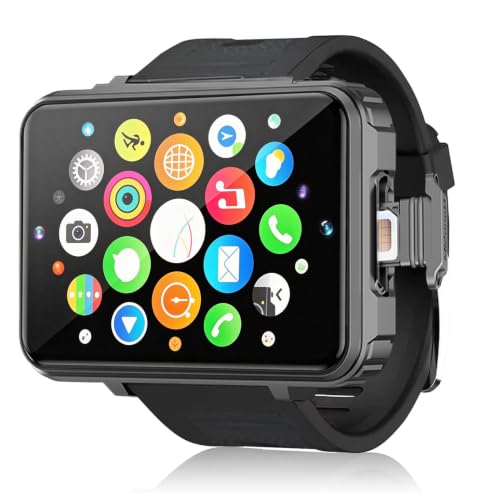
Pick 3: AIEK 4G LTE Cellular Smart Watch — Best big-screen standalone
Crossing to the second family changes the conversation from coaching to hardware. The AIEK is a 4G LTE cellular smartwatch for men and women running Android, with 4GB of memory and 64GB of storage, a 2.4-inch HD touchscreen, a nano-SIM slot for standalone calling, dual cameras, heart rate and step counting, GPS and Wi-Fi. A 2.4-inch screen is enormous by watch standards — closer to a small phone worn on the wrist — and that scale is the design’s argument: maps you can actually read, a dialer you can actually tap, messages you can answer without squinting.
Standalone architecture carries consequences a buyer should embrace knowingly. The watch takes its own nano-SIM and therefore its own number and line, arranged with a carrier on the buyer’s own account; it does not borrow a flagship phone’s identity the way the eSIM flagships do. For some owners that independence is the point — a worksite number, a travel line, a first connected device for a family member — while for others a second number is friction. The dual cameras serve video calls and quick photographs at wrist level, and GPS plus Wi-Fi round out a positioning and connectivity kit that owes nothing to a paired handset.
Heart rate and step counting are named in the title and are treated here as the activity features they are. Battery capacity is not stated in the title, and with a screen this large driving a full Android system, endurance expectations should be set in days-at-most terms and verified on the listing. The AIEK is best understood as a phone that happens to be worn, judged by phone criteria — screen, storage, cameras — rather than by the minimalism of the flagship school.
Strengths
- 2.4-inch HD touchscreen, the largest in this guide.
- Nano-SIM standalone calling with 4GB plus 64GB memory configuration.
- Dual cameras, GPS and Wi-Fi all named in the title.
Trade-offs
- A screen this size wears like equipment, not jewelry.
- Requires its own SIM line rather than sharing a phone number.
- Battery capacity is not stated in the title.
Key specs
- Display: 2.4-inch HD touchscreen
- Memory: 4GB RAM, 64GB storage, per the title
- SIM: nano-SIM, standalone calling
- Cameras: dual, per the title
- Battery capacity: Not stated in the listing title
Best for: worksites and travel where a wrist-borne standalone phone earns its bulk. Not suited for: formal cuffs or wrists that find a 2.4-inch face unmanageable. The AIEK’s full specification can be reviewed on Amazon before ordering.

Pick 4: Rogbid 4G LTE Smart Watch — Best camera-led watch-phone
The Rogbid pushes the watch-phone idea toward its logical extreme: a 4G LTE smartwatch phone for men with call and text-back ability, dual cameras specified at 13MP and 5MP, an all-ceramic body, SIM card support across all networks according to the title, heart rate and sleep monitoring, in graphite black with 4GB of RAM and 128GB of storage. Camera resolutions printed in a watch title remain a novelty, and they signal the intended user plainly — someone who wants the wrist to document, video-call and message as a primary device, not as a phone’s apprentice.
All-ceramic construction is the other headline. Ceramic wears with a cool, dense, premium feel and resists scratches gracefully, at the cost of weight and a brittleness under sharp impacts that metal forgives more easily. Storage at 128GB is phone-class, supporting the camera ambition with room for photographs and media, and the title’s claim of support across all networks should still be verified against your own carrier’s bands before purchase, as this guide advises for every standalone model. Text-back ability matters more than it may appear: a watch that can answer, not merely receive, completes the communication loop that justifies carrying a line on the wrist.
Heart rate and sleep monitoring are named as monitoring features and are covered here in exactly those terms. Battery capacity is not stated in the title, and a ceramic body with two cameras and a full Android system will live on a charging rhythm closer to a phone’s than to a fitness band’s; buyers should plan accordingly and confirm the figure on the listing. Judged as a watch-phone flagship from the standalone school, the Rogbid is the most ambitious object in this guide.
Strengths
- Dual cameras specified at 13MP plus 5MP in the title.
- All-ceramic body with 128GB of storage.
- Call and text-back with SIM support, per the title.
Trade-offs
- Ceramic adds weight and dislikes sharp impacts.
- Battery capacity is not stated in the title.
- Network support claims still need carrier-by-carrier verification.
Key specs
- Body: all ceramic, graphite black
- Cameras: 13MP plus 5MP dual, per the title
- Memory: 4GB RAM, 128GB storage
- Monitoring named: heart rate, sleep
- Battery capacity: Not stated in the listing title
Best for: owners who want the wrist to serve as their camera-carrying primary phone. Not suited for: rough trade work where a ceramic case meets concrete weekly. The graphite black Rogbid can be inspected at Amazon in the configuration described.

Pick 5: LOKMAT 4G SIM Card Smart Watch — Best rotating-camera design
The LOKMAT distinguishes itself with a mechanical flourish: a rotating camera, set into a 4G SIM-card Android smartwatch with a 2.16-inch AMOLED large screen, 3GB of RAM and 32GB of storage, Wi-Fi, GPS, an 1150mAh battery and a fitness activity tracker brief, finished in gold. A rotating camera solves the wrist camera’s oldest problem — a fixed lens points where the case points — by letting one good camera serve both the selfie and the world-facing photograph, and it gives the watch a gadget charisma the slab designs cannot match.
Uniquely among the standalone picks, the LOKMAT title states its battery capacity: 1150mAh, a substantial cell by watch standards and a necessary one, since a 2.16-inch AMOLED and a 4G radio are both honest spenders. Stating the figure invites the informed comparison this guide encourages, and buyers should still translate capacity into days cautiously, because usage patterns swing endurance widely on full Android watches. The gold finish and large face make the same extroverted statement as its standalone siblings: this is a device content to be noticed, closer in spirit to the statement pieces in our best digital smartwatches for men coverage than to the discreet flagships at the top of this page.
Storage at 32GB and memory at 3GB sit a tier below the Rogbid’s specification, which positions the LOKMAT as the mid-point of the standalone family: the rotating camera and stated battery are its arguments, rather than maximal gigabytes. Fitness activity tracking is named generally in the title and treated generally here. As with every SIM model in this guide, the line itself is the buyer’s own arrangement with a carrier, and band compatibility deserves a pre-purchase confirmation.
Strengths
- Rotating camera serves both selfie and world-facing shots.
- Battery capacity stated outright at 1150mAh.
- 2.16-inch AMOLED screen with Wi-Fi and GPS.
Trade-offs
- 3GB plus 32GB memory configuration trails the Rogbid’s.
- Gold, large-face styling will not pass as a discreet dress watch.
- Carrier band compatibility still requires confirmation.
Key specs
- Display: 2.16-inch AMOLED
- Battery: 1150mAh, per the title
- Memory: 3GB RAM, 32GB storage
- Camera: rotating, per the title
- Finish: gold
Best for: video-callers who like the rotating-camera solution and a stated battery figure. Not suited for: storage habits that already fill 32GB on a phone. The gold LOKMAT is available to examine on Amazon with its full listing details.
Pick 6: Google Pixel Watch 1st Gen LTE — Best renewed Pixel route (prose-only)
This pick is presented without a purchase link, deliberately. The first-generation Google Pixel Watch in its GPS plus cellular LTE configuration — a 41mm black watch, listed without a band as an OEM unit — is currently sold as a renewed product, and it is covered here so that readers loyal to Google’s design and software can see the route honestly rather than stumble onto the renewed status at checkout. The renewed status is not a footnote to this pick; it is the pick’s defining condition, and everything below should be read through it.
The watch itself explains why the route remains attractive. The original Pixel Watch introduced Google’s domed, pebble-like design language at 41mm, paired it with the company’s software sensibility, and in this configuration added cellular LTE, the feature that frees it from a phone’s vicinity. For a reader embedded in Google’s services, that combination — the dome, the software, the standalone radio — retains a coherence that newer listings in this batch could not supply in brand-new condition, which is precisely why the renewed unit earns a prose-only place instead of an omission.
Renewed buying has its own discipline, and it applies in full. A renewed watch should be evaluated on the seller’s stated condition, its return terms and whatever renewed-program warranty the listing describes, because those terms — not a manufacturer’s new-product warranty — are the actual safety net. Battery expectations should be set for a device of its generation, and the absence of a band in this OEM listing means a strap purchase belongs in the budget from the start. Readers comfortable with those terms gain a distinctive watch at the renewed end of the market; readers who are not should take the flagship Samsung route above and leave this section as a signpost.
Strengths
- The original domed Pixel design with genuine LTE independence.
- 41mm case in black, the most discreet flagship footprint here.
- A route into Google’s watch software for committed Pixel owners.
Trade-offs
- Sold renewed; condition and coverage follow the renewed listing’s terms.
- Listed without a band, so a strap is an additional purchase.
- First-generation hardware in a fast-moving category.
Key specs
- Case: 41mm, black
- Connectivity: GPS plus cellular LTE, per the title
- Condition: renewed, as listed
- Band: not included, per the title
- Warranty: governed by the renewed listing’s terms, not stated here
Best for: Google loyalists who accept renewed condition knowingly for the original design. Not suited for: a gift purchase where a brand-new, band-included presentation is expected.
Comparison table
| Model | Architecture | Screen or case | Storage as titled | Defining trait |
|---|---|---|---|---|
| Galaxy Watch9 LTE | Carrier eSIM flagship | 40mm, graphite | Not stated in the listing title | 2-year warranty, sleep and running coaching |
| Galaxy Watch 7 LTE | Carrier eSIM flagship | 40mm, green | Not stated in the listing title | Energy score and wellness tips |
| AIEK 4G LTE | Standalone nano-SIM Android | 2.4-inch HD touchscreen | 4GB plus 64GB | Dual cameras, biggest screen here |
| Rogbid 4G LTE | Standalone SIM Android | All-ceramic body | 4GB plus 128GB | 13MP plus 5MP cameras |
| LOKMAT 4G | Standalone SIM Android | 2.16-inch AMOLED | 3GB plus 32GB | Rotating camera, 1150mAh battery |
| Pixel Watch 1st Gen LTE | Carrier flagship, renewed | 41mm, black, no band | Not stated in the listing title | Prose-only renewed route |
eSIM flagship or SIM-slot standalone: which architecture is yours?
The decision tree starts with a question about identity. Should the watch be you — your existing number, your contacts, your carrier relationship extended to the wrist? That is the flagship proposition, and its elegance is administrative: one number rings phone and watch alike, and the watch is a citizen of an ecosystem you already inhabit. Choose this route if the phone stays in your life and the watch’s job is to cover the hours when the phone is elsewhere — runs, swims, school runs, the gym floor.
Should the watch instead be its own device, with its own line, its own storage and its own cameras, owing nothing to a handset? That is the standalone proposition, and its elegance is independence: a worksite can issue it, a traveler can feed it a local SIM, a family can give a connected wrist to someone not ready for a full phone. Choose this route if the watch replaces a phone for stretches of life rather than complementing one, and accept the phone-like consequences — phone-like size, phone-like charging habits, phone-like app management.
Whichever architecture calls, run the carrier check before the purchase. For flagships, confirm your provider supports the exact model’s eSIM on your account type. For standalone watches, confirm band compatibility with your chosen carrier’s network, because a title’s general network claim cannot see your local spectrum. And hold the plan question at arm’s length from the hardware decision: lines, terms and costs are your contract with your provider, arranged after the watch is chosen, and no listing in this guide can or should promise them.
Phone-free in practice: our evaluation scenarios
We assessed these six against the moments that justify a cellular watch’s existence. The first is the dawn run: phone on the kitchen counter, watch on the wrist, a route through quiet streets where the only communication that matters is the emergency call that never happens and the message that can wait until the cool-down — except the one morning it cannot, which is the morning the LTE radio earns its entire premium. Flagships serve this scenario with the least friction, because the number that rings is simply yours.
The second scenario is the worksite. A phone in a truck cab is safe and useless; a standalone watch on a wrist is present for the call from the gate, the photograph of a delivered pallet, the message confirming a changed plan. Here the big screens and cameras of the AIEK, Rogbid and LOKMAT stop looking like excess and start looking like tools, and their bulk is priced correctly against a day of physical work. The third scenario is the family handoff: a grandparent whose phone lives in a handbag, a teenager not yet entrusted with a flagship handset. A connected wrist in those lives is not a gadget but a safety line, and the renewed Pixel, for all its caveats, enters that conversation as the gentle, design-led option for the Google household.
Across all three scenarios, battery honesty kept surfacing as the deciding discipline. Cellular radios spend charge in proportion to distance from towers and hunger for signal, so a watch that coasts through a connected day at home may work noticeably harder at a rural site. Owners who thrive with these devices build the nightly charge into the same ritual as keys and wallet, and judge their watch by whether it ever once left them unreachable — the only metric the category ultimately answers to.
Common mistakes when buying a cellular watch
The classic error is buying the hardware and discovering the network afterward: an eSIM model a carrier will not provision on the buyer’s plan, or a standalone watch whose bands ignore the local network entirely. Both disappointments are prevented by the same five-minute confirmation, made before ordering, with the exact model name in hand. A second error is assuming a standalone watch shares a phone number. It does not; it carries its own SIM and its own line, and friends will need the watch’s number unless the owner arranges forwarding — a small administrative fact that surprises more buyers than any specification.
A third mistake is underestimating size. A 2.4-inch touchscreen is a wonderful tool and a substantial object, and wrists that have only worn 40mm flagships should calibrate expectations before choosing the biggest standalone screens. The mirror mistake is buying a renewed flagship — the Pixel route here — with new-product expectations about bands, batteries and warranty; renewed purchases succeed when their terms are read as the actual product being bought. Finally, buyers forget that cellular freedom includes the freedom to be interrupted everywhere, and the owners who love these watches most are invariably the ones who configured a strict notification allowlist on the first evening.
Final recommendation
For the mainstream phone-free life, the Galaxy Watch9 40mm LTE is the complete current answer, with the Watch 7 LTE as its mature, slightly shorter-warrantied alternative. For a wrist that must work as a phone in its own right, the standalone trio divides by ambition: the AIEK for screen, the Rogbid for cameras and ceramic, the LOKMAT for its rotating lens and stated battery. The renewed first-generation Pixel closes the list as a design-led route for Google loyalists who accept renewed terms with open eyes. Choose the architecture first, verify the carrier second, and the hardware third — in this category, that order is the whole secret.
Activation day: setting up a cellular watch without tears
The smoothest cellular watch purchases share a ritual. Before the box arrives, spend ten minutes with your carrier’s support pages or app, confirming that your account can host the exact model — for a flagship, that its eSIM can be provisioned alongside your phone; for a standalone, that its bands match the network and that a nano-SIM, if needed, is ordered or in hand. When the watch lands, charge it fully first, because activation, pairing and updates are unkind to a half-full battery, and complete the software updates before judging anything about speed or endurance.
Then configure in a deliberate order. Contacts first, pruned to the people who should reach the wrist. Notification allowlist second, built by exclusion — everything off, essentials restored — rather than by inclusion. Display and radio settings third, with brightness and always-on choices made for the battery you actually have rather than the one the brochure implied. Runners in particular should test the full phone-free loop once around the block before trusting it on a long route; the riders among our readers who pair a watch with the machines in our best cycling smartwatches guide will recognize the same wisdom, since a connection verified at home is worth ten assumed on the road.
Signal, battery and the physics of a wrist radio
A watch radio works under handicaps no phone faces: a tiny antenna, a small battery, and a body — yours — absorbing signal on one side. In strong coverage none of this matters; at the fringe, everything does. A cellular watch at a rural property or inside a steel building will hunt for signal with an enthusiasm that spends battery visibly, and owners in fringe locations learn to read that behavior as information rather than defect. The practical mitigations are humble: keep the watch charged nightly without exception, prefer Wi-Fi calling environments where the architecture supports them, and treat a fringe day as a reason to carry margin rather than as a surprise.
Standalone watches add their own variable, since a full Android system multitasks like the phone it is. Background applications, camera use and a large bright screen each draw from the same account as the radio, and the LOKMAT’s stated 1150mAh capacity is best read as headroom for that combined appetite rather than as a promise of any particular day count. Across both families, the owners who report satisfaction share a trait: they chose the watch for the connected hours that matter to them, and they let the charger handle the rest without resentment.
The safety case: children, parents and the reachable wrist
A growing share of cellular watches are bought not for their owners’ convenience but for someone else’s peace of mind. A child walking to school with a connected wrist can call and be called without carrying a full smartphone into the classroom economy. An older parent whose phone lives forgotten in another room becomes reachable in the garden, at the shops, in the ordinary geography of an independent life. In both directions of the family, the watch succeeds because it is worn — the one device that is reliably on the person is the one strapped to them.
Choosing for a family member adds criteria the spec sheet underplays. Setup should be completable by the giver in one sitting, contacts should be locked to a short list, and the charging ritual must fit the wearer’s habits rather than the giver’s hopes; a watch that spends its life in a drawer beside a flat battery protects nobody. The renewed Pixel route, with its gentle design and Google familiarity, suits a parent already comfortable in that ecosystem, while the standalone family, with their big screens and simple dialers, often suit first-time wearers who benefit from large targets and obvious controls. Judge the human fit first and the radio second, and the safety case usually resolves itself.
Cameras on the wrist: honest uses and real limits
Three of the six picks carry cameras, and the feature deserves a sober assessment rather than either hype or dismissal. A wrist camera will not replace a phone camera for photography you care about: the sensor is small, the angle is dictated by your forearm, and composing on a two-inch screen is an exercise in cheerful approximation. What it does superbly is presence. A video call from a worksite, a grandchild’s face at wrist height, a quick photograph of a serial plate, a meter reading, a delivered parcel’s position — these are communications, not artworks, and for communications the wrist camera’s immediacy beats the phone camera’s quality every time.
The three implementations here express different priorities. The AIEK’s dual cameras are part of a generalist big-screen package. The Rogbid prints resolutions — 13MP and 5MP — and wraps them in ceramic, aiming at the owner who will actually use the camera daily and wants the object to feel premium while doing it. The LOKMAT rotates its lens, the cleverest mechanical answer, trading a second sensor for one that can face either way. Buyers choosing among them should ask which camera behavior matches their real habits, because the megapixel figure, as phone buyers learned long ago, is the least predictive number in the whole arrangement.
Traveling with a connected wrist
Travel rearranges the cellular calculation in ways worth planning for. The flagship owner roaming abroad inherits whatever their carrier arrangement provides, which is a reason to read the roaming terms before departure rather than at the border. The standalone owner gains a distinctive trick: a local SIM at the destination turns the watch into a local device with a local number, useful for deliveries, drivers and reservations in a strange city, while the home phone stays safely in a hotel drawer. Few travelers buy a watch for that trick alone, but many report it among the pleasures discovered afterward.
Airports and flights add smaller considerations. A watch that is also a phone attracts the same airplane-mode discipline as any radio, and the big-screen standalones reward a downloaded film or playlist in a way the flagships’ tighter storage may not. Time zones, at least, every watch here handles with grace. The traveler who thinks through the line, the bands and the charging cable before departure will find a cellular watch the least anxious piece of technology in the bag, precisely because it asks so little luggage space to give so much reachability back.
When a Bluetooth watch is honestly enough
A trustworthy guide should mark its own category’s border. If your phone is effectively always within a room’s distance — desk workers with phones on chargers, home-based parents, anyone whose handset travels in a dedicated pocket from waking to sleeping — then a Bluetooth watch delivers nearly the same lived experience at lower cost and with kinder battery life, and the cellular premium buys insurance against a separation that rarely occurs. The honest self-test is a week’s memory: count the hours your phone was genuinely out of reach while a call or message mattered. If the count is near zero, buy the simpler watch and spend the difference elsewhere.
If the count is not zero — if it includes every run, every swim, every school run, every hour on a ladder or a tractor — then the cellular premium is not a luxury but the price of the category’s entire reason to exist, and the six picks above divide that price by architecture and ambition. Categories earn their keep by matching real separations, and no separation was ever closed by a specification the buyer’s life did not need.
Two numbers, one life: managing the second line
Standalone owners acquire something flagship owners never think about: a second public number, with all its small social consequences. Friends and services must learn which number lives on the wrist, and the cleanest arrangement is a declared purpose — the watch number for family and the worksite, the phone number for everything else, or the reverse — written into contact notes so nobody has to guess during an urgent moment. Call forwarding, where a carrier offers it, can blur the boundary usefully, ringing the wrist when the phone goes unanswered, and the five minutes spent arranging it pays out across the watch’s whole life.
There is also a quiet privacy dividend to a second line that many owners come to value. A number given to delivery drivers, marketplace buyers and temporary contacts can live on the wrist and be retired without disturbing the primary number’s decades of history. Managed deliberately, the standalone watch becomes not just a second device but a filter for the owner’s attention, and several long-term owners describe that filtering, unexpectedly, as the feature they would surrender last.
Longevity: how cellular watches age
Cellular watches age along two curves at once. The battery curve is the steeper one: a small cell cycled daily, and worked hard by a radio, will hold noticeably less after a few years, and owners should expect the endurance of year three to be a discount on the endurance of month one. The network curve is slower but more final, since carriers retire generations of technology on their own schedules; a 4G LTE device bought today is aligned with the networks that will dominate the coming years, yet the prudent buyer treats network longevity as a horizon to check at purchase rather than a promise any guide can underwrite.
The stated warranty terms in this guide — two years on the Watch9 configuration, one year on the Watch 7 — should be read against those curves: they cover the period when manufacturing faults declare themselves, while the aging curves beyond them belong to the owner. The renewed Pixel compresses the whole question, since its aging began before its next owner; its listing’s terms are the honest measure of the risk, and its price position in the renewed market is the compensation. Buy with the curves in view, and none of them will ambush you.
eSIM and nano-SIM, explained without jargon
An eSIM is a SIM card that exists as a rewritable chip soldered inside the device rather than as a removable sliver of plastic. Your carrier programs it remotely with your line’s identity, which is why flagship watches can share a phone’s number and why activation happens through an app or a QR code rather than a tray and a pin. The advantages are elegance and sealing; the dependency is that the carrier must support the arrangement for that specific watch, which returns us to the pre-purchase confirmation this guide keeps recommending.
A nano-SIM is the smallest physical SIM format, and the standalone watches here carry trays for it. The physical card makes the watch’s line portable and legible — move the card, move the number — and it makes local SIMs abroad a trivial swap. Its costs are a tray opening in the case and a number that belongs to the watch rather than to you. Neither technology is better in the abstract; each encodes the philosophy of its family, integration on one side and independence on the other, and the buyer who understands that sentence understands the category.
Accessories that earn their place
A cellular watch’s accessory list is short but consequential. A second charging cable, kept where the watch actually spends its days — the office drawer, the gym bag, the truck cab — prevents the specific failure this category cannot afford, the unreachable afternoon. A protective case or bumper earns its keep on the standalone models, whose large screens present large targets, and on the ceramic Rogbid it is close to mandatory for anyone working around hard surfaces. A spare strap matters for the renewed Pixel especially, since its listing includes no band at all; budget for one in a material suited to the wearer’s life, and confirm the lug fitting for the 41mm case before ordering.
Beyond those, restraint is a virtue. The category’s promise is lightness — one device, worn, connected — and an owner buried in accessories has quietly rebuilt the phone-shaped burden the watch was bought to escape. Buy the cable, the protection and the strap, and let the wrist travel light.
The first week: habits that make or break the category
New cellular watch owners tend to spend their first week in one of two failure modes: leaving every notification on, until the wrist becomes a second, louder phone and gets abandoned; or switching so much off that the watch becomes a bracelet with a clock. The middle path is built in the first evenings. Decide which three categories of communication may interrupt you anywhere — typically calls from starred contacts, messages from family, and one work channel if the watch serves a job — and let everything else wait for the phone. Then deliberately rehearse the phone-free scenarios the watch was bought for: a short run, a supermarket trip, an hour in the garden, phone left inside each time, until the mild anxiety of separation is replaced by the category’s actual sensation, which is lightness.
By the second week the charging rhythm should be as unconsidered as tooth-brushing, the carrier arrangement invisible, and the watch’s number — if it has its own — distributed to the small circle that needs it. Owners who reach that steady state rarely go back, because the value was never the radio itself; it was the recovery of all the moments that used to require carrying a phone like a permission slip.
Frequently asked questions
Does a cellular watch need its own plan?
It needs a carrier line of some form, arranged with your provider under your own account’s terms. Flagship eSIM models typically extend an existing phone relationship, while standalone SIM watches take a line of their own. This guide quotes no plan prices and guarantees no plan availability, because both are set by contracts between you and your carrier.
Can a standalone Android watch replace a phone entirely?
For calls, messages, photographs and connected apps within its storage and screen limits, the AIEK, Rogbid and LOKMAT are built to do exactly that. The compromises are physical — screen size for typing, battery rhythm, camera handling — rather than conceptual, and whether they are acceptable depends on how phone-heavy your day truly is.
What does renewed mean for the Pixel Watch pick?
It means the unit is sold in renewed condition rather than new, under the listing’s stated terms for condition, returns and any renewed-program coverage, and in this case without a band included. It is covered prose-only, with no purchase link, so that the status is impossible to miss.
Will LTE drain the battery quickly?
Cellular use is the heaviest common load on a smartwatch battery, and weak-signal environments make radios work harder still. None of the flagship titles here states an endurance figure, so plan on a daily charging rhythm for LTE flagships and verify standalone capacities on their listings.
How do I know whether my carrier supports a specific model?
Ask the carrier directly, with the full model name and configuration in hand, and treat the answer as part of the purchase. Support pages and account apps answer most flagship questions immediately; standalone watches may require confirming network bands against the carrier’s published list. Five minutes spent there prevents the category’s only truly frustrating outcome, a watch that cannot join the network it was bought for.
Can I give a cellular watch to a child or a parent?
Yes, and the standalone models are often chosen for exactly that, since a big-screen watch with its own SIM can be set up by the giver, loaded with a short contact list, and worn without any handset in the picture. Judge the fit by the wearer’s habits — charging routine, screen size, comfort with the interface — and arrange the carrier line yourself so the gift arrives working rather than as a project.
Do these watches make emergency calls?
A connected cellular watch can place calls like the phone-class device it is, subject to its carrier line being active and in coverage. Treat that as a communication capability of the hardware and the line together, and confirm any specific emergency features with the maker and your provider rather than assuming them from a category label.
The phone on the counter, the watch on the wrist, the door closing behind you — when a cellular watch is chosen well, that small morning ritual stops feeling like a risk and starts feeling like the lightest version of your connected life. The calls still arrive, the people who matter still reach you, and the glass rectangle that used to anchor every pocket and every plan finally gets to stay home, face down and silent, while your day unfolds at the unhurried pace of a wrist that handles everything essential by itself. That is the whole promise of the category, kept one ordinary, phone-free day at a time, for as many years as the ritual holds. Choose carefully at the start — architecture, carrier, size — and the years tend to take care of themselves.
Related guides
- Best Affordable Android Tablets: Five True Android Slates and One Fire OS Specialist, Clearly Labelled
- Best 400 FPS High Speed Cameras: The Honest Truth About Burst Slow Motion
- Best Kids Smartwatches for Texting and Calling: Six Watch-Phones Under Parent Control
- Best Fast Charge Qi Wireless Chargers: Qi2 at 15W and Qi2.2 at 25W


