What's inside
- Key Takeaways
- Quick Picks
- How Was This Pool Built Around Evidence Instead of Adjectives?
- How Do the Six Sealed Chargers Compare?
- What Does an IP Rating Actually Certify — and What Does It Not?
- How Is an Onboard Charger Installed So the Sealing Survives?
- What Does Maintainer Duty Actually Involve Across a Storage Season?
- How Do Dust and Water Attack a Charger Differently?
- What Changes When the Batteries Belong to Working Machines?
- Which Mistakes Rot Sealed-Charger Installations?
- How Should a Sealed Charger Be Inspected Each Season?
- Final Recommendation
- Frequently Asked Questions
- Related Guides
As an Amazon Associate I earn from qualifying purchases. This post may contain affiliate links at no extra cost to you.
gizmoverdict.com is reader-supported. When you buy through links on our site, we may earn an affiliate commission.
Where to buy: The six chargers below all come from this site’s verified pool. One discipline governs the whole guide: an ingress rating is credited only where a listing title prints the code. Exactly one title here does — the Victron’s IP67 — and the other five are described at the level their own titles support, no higher.
The hunt for the best waterproof and dust proof battry chargers — the keyword’s spelling preserved in the slug, the products’ spelling corrected everywhere else — begins at the waterline. A battery charger that lives on a boat, in a tractor shed or beside a pressure washer works in an atmosphere of spray, condensation, road salt and chaff, and its enclosure is not packaging; it is the difference between a decade of service and a corroded board by the second season. Sealed, onboard chargers exist for exactly this world: bolted down beside the batteries they serve, connected permanently, indifferent to the weather that moves through their compartment.
The pool divides into three families. Four NOCO units from the GEN range cover the bank-count staircase — one bank at 5A, one bank at 10A in the PRO line, two banks at 10A, three banks at 15A — all sold as onboard marine charger-maintainers. The Victron Blue Smart IP67 brings the pool’s only printed ingress code and a smart-charger brief at 7A. The Battery Tender 800 closes the set as the sealed traditionalist: an encapsulated unit whose weather argument is its construction rather than a code, from the brand that popularised the battery maintainer itself.
What “waterproof” may honestly mean in this guide needs one paragraph of care. An IP code is a tested claim with a defined meaning — the Victron’s IP67 certifies dust-tightness and temporary immersion resistance under the standard’s conditions — and it appears in exactly one title. The NOCO titles claim marine onboard duty without printing a code; the Battery Tender’s listing presents encapsulation. Those are three different kinds of evidence, and the picks below keep them separate, because a reader mounting a charger in a wet bilge deserves to know which promise is a certification, which is a positioning, and which is a construction method.
Key Takeaways
- Only the Victron Blue Smart title prints an ingress code — IP67 — so it is the only pick credited with a certified dust and water rating in this guide.
- The four NOCO GEN picks form a bank staircase: 1-bank 5A, 1-bank 10A PRO, 2-bank 10A and 3-bank 15A, all titled as onboard marine charger-maintainers.
- Onboard means permanently mounted and wired beside the batteries — the charger becomes part of the boat or machine rather than a visitor to it.
- The Battery Tender 800’s stated weather defence is encapsulation: the electronics are sealed in a filled housing, a construction claim rather than an IP code.
- Total amps in a multi-bank title describe the whole unit; how the current divides between banks is a documentation question, answered per model.
- Maintainer duty — holding batteries at full health through storage seasons — is half the job description in every title here.
Quick Picks
| Pick | Badge | Why it earns the slot |
|---|---|---|
| NOCO GEN5X2 12V 10A 2-Bank OnBoard Marine Battery Charger & Maintainer | Best twin-bank balance | Two banks and 10A in total for the classic twin-battery boat, mounted once and forgotten. |
| NOCO GEN5X1 12V 5A 1-Bank OnBoard Marine Battery Charger & Maintainer | Best single-battery simplicity | One bank, 5A, permanently installed — the small boat and single-machine answer. |
| NOCO GENPRO10X1 12V 10A 1-Bank OnBoard Marine Battery Charger & Maintainer | Best single-bank strength | The PRO line puts the full stated 10A behind one bank for faster recovery of a big single battery. |
| NOCO GEN5X3 12V 15A 3-Bank OnBoard Marine Battery Charger & Maintainer | Best multi-bank coverage | Three banks and 15A total for starting plus house arrangements and twin-engine setups. |
| Victron Energy Blue Smart IP67 Smart Marine Battery Charger 12V 7A | Only stated IP rating | IP67 printed in the title, a smart-charger brief and 7A for a single bank that lives wet. |
| Battery Tender 800 SuperSmart Battery Charger | Best sealed traditionalist | An encapsulated maintainer from the brand that defined the category, for one battery kept ready indefinitely. |
How Was This Pool Built Around Evidence Instead of Adjectives?
The first filter was the sealed, onboard form itself. Portable workshop chargers with open vents and carry handles were excluded however capable, because the keyword’s promise — waterproof, dust proof — describes a charger that lives in the weather rather than visiting it. What survived are units designed to be mounted permanently in wet, dirty compartments: four NOCO GEN onboard units, the Victron IP67 marine charger, and the encapsulated Battery Tender. Each defends its electronics by enclosure, which is the only defence that works while nobody is watching.
The second filter sorted evidence into its three honest grades. Grade one is a printed code: IP67 in the Victron title, a claim with a test standard behind it. Grade two is stated positioning: the NOCO titles’ “OnBoard Marine” designation, which commits the maker to the environment without publishing a code in the title. Grade three is construction: the Battery Tender’s encapsulation, a method whose weather resistance is real but expressed as design rather than certification. The guide never promotes a pick from one grade to another, and the spec boxes show the grades plainly so readers can weigh them with open eyes.
Third, the pool was arranged as a coverage map of real battery arrangements. Single battery: two answers at 5A and 7A, plus the PRO’s 10A and the Tender’s maintainer-first approach. Twin battery: the GEN5X2. Three banks — twin engines plus a house bank, or starting, house and trolling arrangements: the GEN5X3. A reader should be able to count the batteries in the bilge or the shed, find that number in the pool, and land on the pick whose title already speaks to it.
The final filter was maintainer duty. Every title here pairs charging with maintaining, because the sealed onboard charger’s defining use is not rescuing dead batteries but preventing their death — holding a stored boat’s banks at health across a winter, keeping the tractor’s battery honest between seasons. A unit that charged brilliantly but maintained carelessly would fail the category’s actual job, and the pool was read with that job in view.
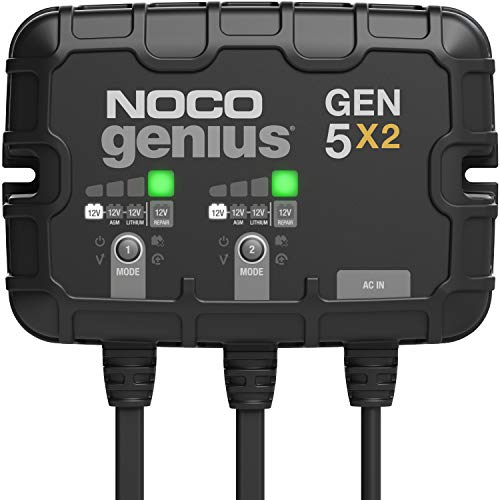
NOCO GEN5X2 12V 10A 2-Bank OnBoard Marine Battery Charger & Maintainer — Best twin-bank balance
The twin-battery boat is the classic onboard charging problem: a starting battery that must never be found wanting, and a house or trolling battery that does the day’s work and returns depleted. The GEN5X2’s title answers it in the category’s plainest language — 12V, 10A, 2-bank, onboard, marine, charger and maintainer. Mounted once in the battery compartment and wired to both banks, it ends the ritual of the portable charger, the extension cord across the dock and the clips that corrode in the bilge air. Shore power goes in; both batteries are tended; the arrangement disappears into the boat’s furniture.
The 10A figure is the unit’s total as titled, and the honest reading stops there. How that current divides between the two banks — evenly, or by each bank’s need as the charger judges it — is behaviour the listing title does not describe, and NOCO’s documentation for the model is where the division is stated. The practical consequence is modest either way: a maintainer-class total of 10A across two banks is sized for overnight recovery and indefinite upkeep, not for resurrecting a flattened bank between the morning coffee and the tide. Owners whose routine includes deep daily discharge of a large trolling bank should run the per-bank arithmetic from the documentation before choosing this rung of the staircase.
The marine onboard designation is the pick’s weather evidence, and this guide grades it as positioning rather than certification: NOCO sells the GEN line for permanent installation in boat battery compartments, an environment of spray and condensation, but the title prints no IP code, so none is claimed here. What can be said is that the form factor is the argument — a sealed, mountable unit with no vents inviting the bilge atmosphere inside is built on the correct theory of survival in wet places, whatever code a fuller specification may carry.
Choose the GEN5X2 when the battery count is exactly two and the boat’s rhythm is weekend use with shore power between. It is the pool’s centre of gravity: enough banks for the commonest serious arrangement, enough current for overnight manners, and the set-and-forget character that is the entire point of bolting a charger to a boat in the first place.
- Banks: 2, stated in the title
- Stated output: 10A total at 12V, as titled — per-bank division per NOCO documentation
- Role as titled: onboard marine charger and maintainer
- IP rating: Not stated in the listing title — verify with NOCO documentation
- Mounting: onboard, permanent installation, per the title
- Battery chemistries: not enumerated in the title — confirm in NOCO documentation
Strengths
- The classic twin-bank arrangement answered in a single mounted unit.
- Charger and maintainer in one title — recovery and upkeep under one housing.
- Permanent wiring ends the portable-charger ritual and its corroding clips.
Trade-offs
- 10A is the whole unit’s figure; deep daily trolling discharge may outpace it.
- No IP code in the title, so the weather claim rests on marine positioning.
- Permanent installation is a commitment — this charger moves boats rarely.
Best for: a twin-battery boat on a weekend rhythm with shore power between outings, where both banks must simply always be ready.
Not suited for: a single-battery setup paying for a second bank it will never wire, or a heavy daily-discharge routine needing faster recovery.
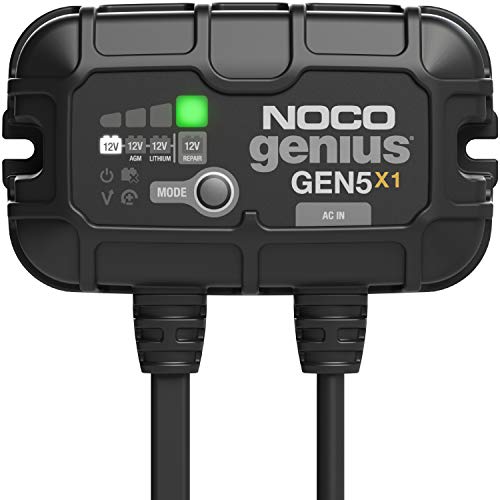
NOCO GEN5X1 12V 5A 1-Bank OnBoard Marine Battery Charger & Maintainer — Best single-battery simplicity
Not every boat carries a battery farm. The small centre-console, the single-battery runabout, the tractor, the standby generator, the mower that must start in April — these live on one 12V battery, and their charging need is singular: keep that one battery ready, forever, without being thought about. The GEN5X1 is that brief in hardware: one bank, a stated 5A, onboard and marine in its title, charger and maintainer in its job description. It is the smallest promise in the NOCO staircase and, for a single-battery life, the correctly sized one.
Five amps invites the same honesty as the other figures here. Against a single starting battery that returns from an outing slightly depleted, 5A restores it across an evening and then settles into maintenance — the pattern this class of charger exists for. Against a large, deeply discharged house battery it would be a slow companion, which is why the pool contains the PRO pick below; the GEN5X1’s virtue is not speed but fit. A maintainer’s current should be judged against the battery’s size and the time available, and for the single modest battery with all night to recover, 5A is not a compromise — it is the specification.
The onboard form matters even at this scale. A single-battery boat served by a portable charger is a boat whose battery readiness depends on somebody remembering, clipping and unclipping, in a compartment that punishes forgotten connections. The mounted GEN5X1 removes memory from the system: shore cord in, battery tended, season after season. The same logic serves the generator and the tractor in the shed, where “marine” in the title reads less as a limitation than as a weather grade — a unit positioned for boat compartments will not be troubled by a barn.
Its weather evidence is graded like its siblings’: marine onboard positioning, no printed IP code in the title, and a spec box that says so. Buyers for whom a certified code is the deciding document have the Victron pick; where the deciding document is the battery count — one — and the desire never to think about it again, the charger has been found.
- Banks: 1, stated in the title
- Stated output: 5A at 12V, as titled
- Role as titled: onboard marine charger and maintainer
- IP rating: Not stated in the listing title — verify with NOCO documentation
- Mounting: onboard, permanent installation, per the title
- Best matched battery: a single modest starting or utility battery
Strengths
- Correctly sized for the single-battery boat, tractor or generator.
- Permanent mounting removes memory and clips from the readiness equation.
- Maintainer duty is in the title — storage seasons are its home ground.
Trade-offs
- 5A is a measured pace; a big depleted bank will keep it busy for many hours.
- One bank only — a second battery added later means a second solution.
- The title prints no IP code, so certification shoppers must look to the Victron.
Best for: a single 12V battery that must simply always be ready — small boat, tractor, generator or mower on a mounted, forgettable routine.
Not suited for: multi-bank arrangements, or a large house battery cycled deeply every day.

NOCO GENPRO10X1 12V 10A 1-Bank OnBoard Marine Battery Charger & Maintainer — Best single-bank strength
The GENPRO10X1 takes the single-bank brief and doubles its stated muscle: 10A behind one bank, where the GEN5X1 offers 5A. That difference is a decision about time. A single large battery — the big house bank on a single-battery boat, the heavy diesel starting battery, the trolling battery that works a full day — returns from deep use with a real energy debt, and 10A repays it in roughly the shape of an evening rather than a day. The PRO designation in the title marks this as the line’s stronger single-battery instrument, aimed at owners whose one battery is big enough, and worked hard enough, to justify it.
The comparison with the GEN5X2 is the instructive one, because the two units share a stated 10A and differ entirely in intent. The 5X2 spreads its figure across two banks for coverage; the PRO concentrates its figure on one bank for recovery speed. Neither is the better charger in the abstract — the bilge decides. Two modest batteries want the spread; one hard-worked battery wants the concentration, and a guide that ranked one above the other without asking about the batteries would be selling a league table instead of advice.
Maintainer duty remains in the title, and it matters more at this size, not less. A large battery is an expensive asset, and the months it spends in storage are when neglect does its quiet damage — self-discharge, sulphation, the spring morning when the diesel turns over twice and gives up. A mounted charger-maintainer standing watch over the off-season is insurance priced in watts, and the PRO’s stronger charge rate means the watchman can also handle the recovery work when the season turns, one unit across the whole calendar.
The weather grading follows the family pattern: onboard marine positioning in the title, no IP code printed there, and the sealed mounted form as the practical argument. The PRO buyer is typically outfitting a working boat or a serious single-battery installation where the compartment is wet by profession; the documentation lookup for the exact ingress specification belongs on that buyer’s checklist alongside the per-bank questions the multi-bank picks raise.
- Banks: 1, stated in the title
- Stated output: 10A at 12V — the full figure behind a single bank
- Line: GENPRO, the maker’s stronger single-bank tier, per the title
- Role as titled: onboard marine charger and maintainer
- IP rating: Not stated in the listing title — verify with NOCO documentation
- Mounting: onboard, permanent installation, per the title
Strengths
- The full stated 10A concentrated on one bank for real recovery speed.
- Covers both halves of the calendar — working-season recovery and storage-season care.
- Single-bank simplicity of wiring with a working boat’s appetite.
Trade-offs
- A second battery has nowhere to go; twin-bank boats need the 5X2 or 5X3.
- Strength is wasted on a small battery that a 5A unit would tend as well.
- No IP code in the title — the ingress specification is a documentation retrieval.
Best for: one large, hard-worked 12V battery — big house bank or heavy starting duty — that must recover overnight and winter safely.
Not suited for: twin or triple battery arrangements, or a small battery whose needs the gentler GEN5X1 already meets.
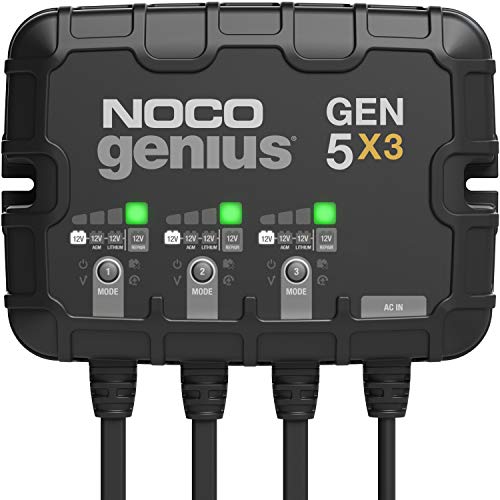
NOCO GEN5X3 12V 15A 3-Bank OnBoard Marine Battery Charger & Maintainer — Best multi-bank coverage
Three banks is where boat electrical systems stop being simple, and the GEN5X3’s title meets the complexity head-on: 12V, 15A, 3-bank, onboard marine, charger and maintainer. The arrangements it serves are the serious ones — twin engines with a house bank, a starting battery flanked by a two-battery trolling set, the fishing boat whose electronics, livewell and propulsion all draw on separate reservoirs. Before onboard multi-bank chargers, such boats were tended by a rotation of portable units and good intentions; the 5X3 replaces the rotation with wiring.
Fifteen amps across three banks returns the discussion to division, and the discipline from the 5X2 pick applies with more force: the title states the total, the documentation states the distribution, and the owner’s arithmetic should start from the documented per-bank behaviour rather than from dividing by three and hoping. Maintainer-class totals are sized for the pattern these boats actually live — days at the dock or on the trailer between outings, during which a modest current per bank restores and then holds everything at readiness. A tournament schedule that flattens all three banks daily is a different duty, and it should be specified from documents, not from a title’s total.
The installation commitment scales with the banks. Three banks means three fused runs, three sets of connections in the compartment’s atmosphere, and a mounting position that keeps the unit’s indicators visible for the weekly glance. It is an afternoon of careful work that buys years of absence of work, and it deserves the same corrosion discipline as every other bilge wiring job: sealed connections, drip loops, and terminals protected against the salt air that the charger’s own sealed housing is designed to shrug off.
As with its siblings, the title offers marine onboard positioning without a printed IP code, and the spec box records that plainly. In a three-bank installation the practical weather question is usually less about the charger’s housing — sealed and mounted by design — than about everything connected to it, which is why this pick’s section spends its words on wiring. The charger is the most protected object in the compartment; the installation succeeds when the rest of the system rises toward its standard.
- Banks: 3, stated in the title — the widest coverage in this pool
- Stated output: 15A total at 12V, as titled — distribution per NOCO documentation
- Role as titled: onboard marine charger and maintainer
- IP rating: Not stated in the listing title — verify with NOCO documentation
- Mounting: onboard, permanent installation, per the title
- Typical arrangements: twin engines plus house bank, or starting plus trolling set
Strengths
- Three banks tended by one mounted unit — the complex bilge made boring.
- The pool’s largest stated total, matched to the largest common arrangements.
- Maintainer duty across all three banks protects a serious battery investment.
Trade-offs
- Per-bank distribution is a documentation question; the title’s total is not a per-bank promise.
- Installation effort triples with the banks — wiring quality decides the outcome.
- Oversized for any boat carrying fewer than three batteries.
Best for: a three-bank boat — twin engines plus house, or starting plus a trolling pair — that winters and weekends under one shore cord.
Not suited for: single or twin battery setups, or daily deep-discharge tournament duty planned without the documented per-bank figures.

Victron Energy Blue Smart IP67 Smart Marine Battery Charger 12V 7A — Only stated IP rating
One title in this pool prints the two letters and two digits the whole keyword is about: IP67. The code has a defined meaning under its test standard — the 6 certifies the enclosure as dust-tight, the 7 certifies resistance to temporary immersion in water under specified conditions — and its presence in the Victron’s title converts the guide’s weather conversation from positioning into certification. For a charger destined for the wettest assignments, an open boat’s exposed compartment, a wash-down environment, a machine that lives outdoors in the rain’s direct employ, that printed code is the document the purchase can rest on.
The rest of the title earns its keep too: Blue Smart names Victron’s smart charger line, marine states the arena, and 12V 7A sizes the unit between the NOCO 5A and 10A single-bank picks. Seven amps against a single boat battery is a working pace — overnight recovery for a sensibly sized bank, with the smart charger’s staged behaviour managing the finishing and holding phases that decide battery lifespan. Victron’s broader reputation, built on documented engineering across its marine and off-grid ranges, stands behind the title; but note that this guide credits the pick with what the title prints, and the title prints plenty.
The smart designation deserves a balanced sentence. Smart charging, in the sense this line uses it, means the charger adapts its stages to the battery’s state and history rather than running a fixed timer — behaviour that matters most for batteries in irregular service, discharged unevenly and stored unpredictably, which is to say most boat batteries. The connectivity and configuration depth that the Blue Smart family is known for lives in the maker’s documentation rather than the title, and buyers for whom app-level oversight is the point should confirm the specifics there; buyers for whom the point is a certified-sealed charger that thinks about the battery can proceed on the title alone.
Against the NOCO staircase, the Victron is the specialist: one bank only, a mid-range rate, and the pool’s sole certified ingress claim. The buyer whose compartment is merely damp and whose banks number three will take the GEN5X3 and never miss the code. The buyer whose charger will be hosed down, rained on and dusted by a working yard — and who wants the promise in writing — has exactly one pick in this pool, and this is it.
- IP rating: IP67, stated in the listing title — dust-tight, temporary-immersion resistant under the standard’s conditions
- Stated output: 7A at 12V, as titled
- Banks: single-bank marine charger, per the title’s framing
- Line: Blue Smart, Victron’s smart charger family, per the title
- Role as titled: smart marine battery charger
- Connectivity specifics: not enumerated in the title — confirm in Victron Energy documentation
Strengths
- The only certified ingress rating in the pool, printed where buyers can rely on it.
- Smart staged charging suits batteries in irregular, real-world service.
- A 7A pace sized honestly for a single boat battery’s overnight recovery.
Trade-offs
- One bank only — multi-bank boats must look to the NOCO staircase.
- IP67 covers temporary immersion under test conditions, not permanent submersion or pressure washing at close range.
- Smart features beyond the title’s word are documentation territory.
Best for: a single-bank installation in a genuinely wet or dusty post, where the ingress promise must be a printed certification rather than a positioning.
Not suited for: multi-bank boats, or treating IP67 as a licence for deliberate submersion.

Battery Tender 800 SuperSmart Battery Charger — Best sealed traditionalist
The Battery Tender name carries a particular weight in this category: the brand effectively taught the market what a battery maintainer is, and the 800 is its sealed, weather-minded expression. The listing presents the unit as an encapsulated charger — its electronics sealed within a filled housing — and constantly monitoring in the SuperSmart manner the title describes: watching the battery, charging when charge is needed, and holding when holding is right. Encapsulation is the oldest weatherproofing argument in electronics, and it remains a persuasive one: there is no interior atmosphere to manage when there is effectively no interior air at all.
Precision about the claim matters, and this guide keeps the Tender in its honest grade. Encapsulation is a construction, not a code: the title prints no IP rating, and none is credited. What the construction delivers in practice is a small charger unusually indifferent to the shed, the garage floor and the damp corner — the environments of its natural constituency, which is not boats at all but the stored machinery of ordinary life: the motorcycle through winter, the classic car between Sundays, the mower, the quad, the battery that must simply be alive in April.
The 800 in the name is a model designation rather than a figure this guide will decode into amps; the title’s truncated listing text emphasises the monitoring behaviour over output numbers, and the spec box follows that lead. Maintainer-class output is the correct expectation — this is an instrument of preservation, sized to hold a battery at health indefinitely and to recover a stored battery gently across days, not to rescue a flattened one by lunchtime. Judged as a rescuer it would disappoint; judged as a keeper, it is the pick with the longest pedigree in the pool.
Its constituency should also note what the Tender is not: not an onboard multi-bank system, not a marine installation piece, not a smart-ecosystem component. It is a single battery’s quiet companion, plugged in and forgotten in the honourable sense — the sense in which the battery it keeps is the one that starts, first turn, on the season’s first morning, while the neighbours are pricing replacements.
- Construction: encapsulated — electronics sealed in a filled housing, per the listing’s presentation
- Behaviour as titled: SuperSmart constant monitoring, charging and holding as the battery requires
- IP rating: Not stated in the listing title — verify with Battery Tender documentation
- Stated output: the title emphasises monitoring over figures — confirm the rate in Battery Tender documentation
- Banks: single battery, per the model’s maintainer format
- Natural ground: stored vehicles and seasonal machinery
Strengths
- Encapsulated construction shrugs off the damp shed and the garage floor.
- The maintainer pedigree is the category’s original — preservation is the brand’s founding idea.
- Set-and-forget monitoring suits batteries that wait months between uses.
Trade-offs
- No printed IP code; the weather claim is construction, not certification.
- Maintainer pace, not rescue pace — a flat battery is a long project here.
- A single-battery companion, not an onboard system for a wired bilge.
Best for: one stored battery — motorcycle, classic car, mower, quad — that must wake up ready after months of being ignored.
Not suited for: multi-bank marine installations, or a deeply discharged battery needed back by tomorrow.
How Do the Six Sealed Chargers Compare?
| Pick | Banks | Stated output | Weather evidence in title | Defining trait |
|---|---|---|---|---|
| NOCO GEN5X2 | 2 | 10A total | Onboard marine positioning | Twin-bank balance |
| NOCO GEN5X1 | 1 | 5A | Onboard marine positioning | Single-battery simplicity |
| NOCO GENPRO10X1 | 1 | 10A | Onboard marine positioning | Single-bank recovery strength |
| NOCO GEN5X3 | 3 | 15A total | Onboard marine positioning | Widest bank coverage |
| Victron Blue Smart IP67 | 1 | 7A | IP67 printed in the title | Certified ingress claim |
| Battery Tender 800 | 1 | Not stated in title | Encapsulated construction | The original maintainer |
The table’s weather column is the guide in miniature: one certification, four positionings, one construction. All six are credible in wet and dusty service — the category’s entry ticket — but they ask to be believed on different evidence, and the right pick is the one whose evidence matches the severity of the post it will serve.
What Does an IP Rating Actually Certify — and What Does It Not?
The IP code is a pair of tested promises. The first digit grades solid-particle protection on a scale that tops out at 6, dust-tight: no ingress of dust in the test’s terms. The second grades liquid protection, and 7 — the Victron’s figure — certifies temporary immersion under the standard’s stated depth and duration without harmful ingress. Both digits describe the enclosure as tested, in laboratory conditions, when new. That precision is the code’s strength and its boundary: it is a real claim, and it is a bounded one.
The boundaries deserve the same print size as the claim. IP67 does not certify resistance to high-pressure jets — that is a different digit’s territory — nor to permanent submersion, nor to the chemical hospitality of fuel, solvents and battery acid, nor to a decade of ultraviolet and gasket ageing. A charger with an honest IP67 remains a device to mount thoughtfully: out of standing bilge water, connectors dressed with drip loops, cable glands respected. The code certifies the housing; the installation decides the system, and systems fail at their joints far more often than at their housings.
For the picks without a printed code, the absence should be read accurately: not as proof of fragility, but as an absence of certification in the title. Marine onboard positioning from a maker like NOCO reflects design intent for wet compartments, and encapsulation reflects a construction with a long field record. Where an insurer, a surveyor or the owner’s own caution requires the code, there is one pick; a merely damp shed has six to choose from, by banks and amps rather than by anxiety.
How Is an Onboard Charger Installed So the Sealing Survives?
Mount the unit where its housing’s protection is an advantage rather than a test: high in the compartment rather than low, vertical where the maker prefers it, with its indicators visible and its cables leaving downward in drip loops that shed water away from the entries. The lowest point of a bilge is a sump, and equipment mounted in a sump is equipment being auditioned for a failure the spec sheet never promised to survive — IP67 included, since immersion in the code’s terms is temporary and clean, and bilge water is neither.
Wire with marine discipline. Each bank’s run gets its own fuse near the battery, tinned conductors where the environment is salt, sealed or adhesive-lined connections, and terminals coated against the atmosphere the whole system breathes. The charger’s sealed housing will outlast careless wiring by years, and a system is graded by its weakest joint — usually a corroded ring terminal in the dark behind the bank, discovered on the season’s first morning. The installation afternoon is where the next five years are decided.
Commission by verification. With everything wired, confirm each bank is actually being tended — indicators per bank where provided, a meter where not — and confirm the maintainer behaviour over a week of storage rather than an hour of optimism. Then write the installation’s facts on a card in the compartment: bank sizes, fuse ratings, the charger’s model, the date. The next owner, or the same owner four winters later, will be grateful in direct proportion to the card’s honesty.
What Does Maintainer Duty Actually Involve Across a Storage Season?
A stored battery is not a static object; it is a slow chemical argument with itself. Self-discharge bleeds charge monthly, faster in heat. A lead-acid battery left sitting at partial charge grows sulphate crystals on its plates, and sulphation left standing becomes permanent capacity loss — the mechanism behind most “it was fine in October” failures in April. Maintainer duty is the counter-argument: the charger watches the battery’s voltage, replaces what self-discharge takes, and holds the battery at full health without the overcharging that a dumb continuous current would inflict. Every title in this pool names that duty, because it is the duty that decides whether batteries live four seasons or seven.
The seasonal rhythm differs by chemistry and climate, and the charger’s documentation — not its title — carries the profiles that matter: which battery types the unit supports, how it treats each, whether temperature compensation is fitted. A buyer storing lithium or AGM banks alongside flooded ones should confirm the per-bank or per-unit chemistry settings before the first winter, since a maintainer’s kindness is chemistry-specific. The pool’s titles do not enumerate chemistries, and this guide’s spec boxes leave that line to the documentation lookups they name.
The human half of maintainer duty is a glance. Monthly, in the storage season: indicators showing the expected state, cables undisturbed, no heat, no smell, no swollen case on any battery in the arrangement. Ten seconds per bank, four times a winter, is the entire labour cost of the system these chargers automate — and it catches the one failure automation cannot, the battery that is dying despite perfect care and should be replaced in the calm of the off-season rather than discovered at the launch ramp.
How Do Dust and Water Attack a Charger Differently?
The keyword pairs the two invaders because a working compartment admits both, but they attack by different physics and the defences differ in emphasis. Water is an event: spray, condensation, the hose, the storm. It seeks entries by gravity and pressure, corrodes what it reaches, and conducts where it should not. The answers are sealing, elevation and drainage — the housing’s integrity, the mounting height, the drip loop. A charger can pass every water test in the catalogue and still be undone by being mounted where water pools, which is why the installation section of this guide reads like plumbing advice wearing electrical clothes.
Dust is not an event but a climate. Chaff in a harvest shed, sawdust in a workshop, road grit in an equipment bay — fine particles migrate through any vent a design offers, settle on boards, absorb ambient moisture and become a conductive, corrosive paste in slow motion. The defence is the absence of openings: a sealed housing gives dust no interior to colonise, which is the deep reason the onboard form — ventless, fanless, closed — dominates this category. Where a fan-cooled workshop charger trades sealing for airflow, these units trade airflow for sealing, and in a dusty climate the trade is not close.
The two attacks also conspire. Dust holds water against surfaces long after the spray has passed, and compartments that are merely dusty in summer become damp-dusty in the condensation of autumn nights. Equipment specified for one invader alone — splash-proof but vented, or dust-sealed but mounted in the sump — fails the conspiracy. The six picks here were chosen as sealed systems precisely because the conspiracy is the normal condition of the places they serve, from bilges to barns.
What Changes When the Batteries Belong to Working Machines?
Boats dominate this category’s imagery, but the same sealed chargers earn their living on tractors, standby generators, pumps, lifts and site equipment — machines whose batteries share the boat battery’s essential biography: hard intermittent work, long idle seasons, and an environment of weather and grit. The differences are of rhythm rather than kind. A generator’s battery must be ready on the worst night of the year with no rehearsal; a tractor’s battery must survive a winter in an unheated shed and then start a diesel at dawn; a pump’s battery works in a wet pit that makes a bilge look hospitable.
For those duties the maintainer half of every title here is the whole purchase. The machine’s own alternator handles charging during work; the sealed charger handles the other ninety percent of the calendar, holding the battery against self-discharge and sulphation in a compartment nobody visits. The GEN5X1’s modest 5A and the Battery Tender’s preservation-first design fit this world exactly, because the current required to keep a battery is a fraction of the current required to rescue one, and the rescue scenario is the one the maintainer exists to prevent.
Working machines add one more consideration the boat world understates: vibration and impact. Equipment bays shake, get pressure-washed by the enthusiastic, and share space with tools thrown in haste. A mounted charger’s fixings deserve the same over-engineering as its wiring — backing plates where panels are thin, fasteners that cannot walk loose, a position out of the cargo’s swing. The sealed housing is tough by design; the installation should be tough by intention, so the system’s weakest point is never the bolt that was asked to hold in a storm of vibration.
Which Mistakes Rot Sealed-Charger Installations?
The first is mounting by convenience instead of by water. A charger screwed low because the holes were easy, in the compartment’s wettest corner, lives a harder life than its sealing was promised for, and its owner blames the housing for the installer’s geography. The second is its wiring twin: unsealed connections and unfused runs that corrode quietly until the charger is tending a circuit that no longer reaches the battery.
The third mistake is arithmetic by headline — reading a multi-bank total as a per-bank promise and specifying a tournament-grade discharge routine against a maintainer-grade figure. The titles state totals; the documentation states distributions; the mistake is skipping the second document. Fourth comes the pressure washer, aimed with enthusiasm at a compartment whose charger carries an immersion code — jets are a different test than immersion, and seals that shrug off the second can be driven open by the first.
The fifth mistake is forgetting that dust is also weather. The keyword pairs dust with water for a reason: chaff, sawdust and road grit infiltrate vents, coat boards and hold moisture against electronics. Sealed onboard units answer dust by having no vents to infiltrate, which is precisely their design — but their connectors, indicators and cable entries still live in the dust’s world, and the monthly glance from the maintainer section should include a wipe and a look, especially in agricultural and workshop service.
How Should a Sealed Charger Be Inspected Each Season?
Sealed equipment invites a dangerous compliment — fit and forget — and the honest version is fit and glance. Once a season, the installation deserves five unhurried minutes. Begin at the housing: cracks from an impact nobody reported, a cable gland loosened by vibration, a mounting screw walking out of a thin panel. The sealed promise lives in these details, and a housing compromised by a hairline crack is a housing whose code, positioning and construction have all been quietly renegotiated by physics.
Move to the connections next, because they age faster than the charger does. Terminals grow the pale crust of corrosion in salt air and the dull film of it everywhere else; fuses sit in holders that loosen; cable insulation chafes where it crosses an edge it has rubbed for three seasons. A wire brush, a reseated fuse, a sleeve over the chafe point — the inspection’s repairs are measured in minutes, and each one removes a failure that was scheduled for the season’s most inconvenient morning.
Finish with the batteries themselves, since the charger can only report what it sees through its connections. Cases checked for swelling, terminals for tightness, electrolyte where the design allows checking, and the system’s behaviour observed through one full charge rather than assumed from a single green light. Record the date and anything found on the compartment card the installation section prescribed. A sealed charger inspected this way is not being distrusted; it is being kept in the condition its sealing promised, which is the only state in which promises about the fifth winter mean anything.
Final Recommendation
Count the batteries, then grade the weather. One battery: the GEN5X1 for modest duty, the GENPRO10X1 for a big bank worked hard, the Victron where the post is wet enough to demand the printed IP67, and the Battery Tender 800 where the job is pure preservation of a stored machine’s battery. Two batteries: the GEN5X2, the pool’s centre of gravity. Three: the GEN5X3, with its installation taken seriously. Across all six, the maintainer half of every title is the half that will quietly repay the purchase, season after season, in batteries that simply keep starting.
Let the last word belong to the evidence habit this guide has practised from its first paragraph. A sealed charger is bought on promises about an environment the buyer cannot test in the shop — so the promises should be read at their exact strength: a code where a code is printed, a positioning where a positioning is offered, a construction where a construction is described. Matched honestly to the compartment it will serve, any of these six will still be standing guard over its batteries on the fifth winter, which is the only review that finally counts.
Frequently Asked Questions
Which of these chargers is actually rated waterproof?
By printed certification, one: the Victron Blue Smart carries IP67 in its title, certifying dust-tight construction and temporary-immersion resistance under the standard’s conditions. The four NOCO units are titled as onboard marine chargers — positioning for wet compartments without a code in the title — and the Battery Tender 800’s defence is its encapsulated construction. All six are built for hostile environments; they document that fitness in three different ways.
What does the second digit of IP67 protect against in practice?
Temporary immersion in water under the standard’s specified conditions, without harmful ingress. In practice that covers spray, splashes, rain, wash-down runoff and brief accidental dunking with room to spare. It does not cover permanent submersion, high-pressure jet washing at close range, or immersion in fuel and solvents — and the installation should still keep the unit out of standing bilge water as a matter of craft.
Does a 2-bank 10A charger give each battery 10A?
The title states 10A for the GEN5X2 as a unit; how that current is distributed between its two banks is behaviour described in NOCO’s documentation, not in the listing title. The same discipline applies to the GEN5X3’s 15A across three banks. For overnight recovery and maintenance the totals are well matched to their arrangements, but per-bank figures should come from the maker’s documents when a routine is planned around them.
Can these chargers stay connected all winter?
That is precisely their design brief — every title here pairs charger with maintainer, meaning the unit is built to remain connected, monitor the battery and hold it at health through storage. The owner’s part is the monthly glance: indicators as expected, connections undisturbed, no heat or swelling at the battery. A charger that must be disconnected to be safe is not a maintainer, and none of these six asks to be treated as one. The shore cord or shed circuit that feeds it should still be sound and protected in its own right, since the charger can only be as trustworthy as the supply it stands watch on — a detail worth one check when the system is installed and one glance each season thereafter.
Is an onboard charger better than a portable one for a boat?
For a boat with shore power access, the onboard form wins on the system’s weakest variable: human memory. A mounted, permanently wired charger tends the batteries every time the shore cord connects, with sealed construction suited to the compartment and no clips to corrode or forget. A portable charger retains the advantage of serving several boats and batteries in different places. The choice is between a system and a tool, and boats with fixed battery arrangements generally deserve the system.
What should be verified before buying any pick here?
Three things, in order: the battery count and sizes against the pick’s banks and stated total; the chemistry support for the actual banks, from the maker’s documentation, since no title here enumerates chemistries; and the ingress evidence at the strength the installation requires — the Victron’s printed IP67 where certification matters, the NOCO documentation where marine positioning needs a figure behind it.
Related Guides
Readers outfitting the rest of a marine or storage electrical system may also find our guide to marine batteries and bank sizing useful, alongside the roundup of battery maintainers for stored vehicles and the guide to shore power inlets and onboard wiring that the NOCO installations above depend on. Read together, they cover the sealed charger from every side: the batteries it tends, the seasons it guards them through, and the wiring that decides whether its protection ever gets the chance to matter.
Related guides
- Best Affordable Android Tablets: Five True Android Slates and One Fire OS Specialist, Clearly Labelled
- Best 3rd Party MacBook Chargers: 96W-Class Alternatives, the 100W Cable Rule, and the Apple Benchmark
- Best 400 FPS High Speed Cameras: The Honest Truth About Burst Slow Motion
- Best Kids Smartwatches for Texting and Calling: Six Watch-Phones Under Parent Control


