What's inside
- Key Takeaways
- Quick Picks
- How did we choose these solar chargers?
- How do the six compare at a glance?
- Why does a solar charger let a phone lose charge in the first place?
- Is a buffered power bank always better than a direct panel?
- How should you angle and place a folding panel through the day?
- What does a week off-grid actually look like on solar power?
- Should you buy one big panel or a panel plus a bank?
- How do you read a solar listing like an engineer?
- What size of panel does a phone actually need?
- Can solar charging damage a phone battery?
- What happens to solar charging in winter?
- How do you clean and store folding panels?
- Panel or roof — where should the solar live at a campsite?
- What is the honest cost per stored watt?
- Do solar chargers work through a window or in a car?
- How do you share one panel between two travellers?
- How do you set up a no-drain solar charging routine?
- What mistakes make solar charging disappoint?
- Final Recommendation
- Frequently Asked Questions
- Related Guides
As an Amazon Associate I earn from qualifying purchases. This post may contain affiliate links at no extra cost to you.
gizmoverdict.com is reader-supported. When you buy through links on our site, we may earn an affiliate commission.
Where to buy: The six products below split into two families that behave very differently in weak light: folding panels that feed a phone directly, and one power bank that stores sunshine in its own cell first. Links point to the exact listings checked for this guide, and the one panel built for power stations is labelled as such wherever it appears.
Anyone hunting for the best solar chargers that don t drain battery has usually lived through the same small betrayal: the phone sits in full sun, the charging icon lights up, and an hour later the battery percentage is lower than when the walk started. The panel was producing something, just never quite enough, and the phone spent the difference powering its screen, its radios and the repeated handshake every time a cloud crossed. Solar charging fails quietly like that far more often than it fails completely, which is why this guide treats output stability, not headline wattage, as the thing being bought.
The mechanism matters more than the brand. A bare folding panel has no battery of its own, so its output rises and falls with the sky in real time. When output dips below what the phone needs to sustain a charge session, many phones drop the session, renegotiate, and sometimes wake the display to announce the change — each restart costs energy the panel then has to repay. A charger with a built-in battery breaks that cycle: the panel trickles into the cell whenever light exists, and the phone later draws from the cell at a steady rate. Neither design is wrong, but they solve different problems, and confusing them is how money gets wasted.
So the six picks below are organised around that divide. Three folding panels feed phones and tablets directly and earn their place on efficiency and port behaviour. One very small panel is honest about being a maintainer for little power banks rather than a phone charger. One solar power bank carries its own 10,000mAh cell and sidesteps the drain problem by design. And one large bifacial panel is included deliberately as the power-station option, because plenty of readers asking this question actually camp beside a portable power station and should not be sold a phone panel for that job.
Key Takeaways
- A panel with no battery of its own sags whenever cloud crosses the sun, and a phone that keeps restarting its charge session can finish the day emptier than it started.
- The BLAVOR entry is the only pick here with a built-in cell, so it is the only one that fully decouples collecting sunlight from charging the phone.
- BigBlue publishes a 25.4 percent panel efficiency figure in both of its listings, unusually specific for this category and worth more than a vague wattage claim.
- The Jackery SolarSaga 100W Air feeds power stations, not phones directly — buying it as a handset charger misunderstands what it is.
- Goal Zero’s Nomad 5 is a maintainer for small power banks; its own listing frames it around flip-style banks, and this guide keeps that framing.
- Parking a phone in direct sun to charge it cooks the phone’s battery; shade the handset, expose only the panel.
Quick Picks
| Pick | Badge | Why it is here |
|---|---|---|
| BigBlue 28W Solar Panel Charger | Best direct panel for most walkers | A folding 28W panel with a built-in ammeter, so you can see what the sky is actually giving you instead of guessing. |
| BigBlue 35W Solar Charger | Strongest phone-ready panel | The bigger BigBlue adds a 25W USB-C output and an IP68 rating, the most weather-sealed direct panel in this line-up. |
| FlexSolar 40W Foldable Panel | Most flexible outputs | A 40W folder that adds a DC output beside USB-C and USB-A, handy when a small power station joins the trip. |
| Goal Zero Nomad 5 | Pocket maintainer | A tiny 5W panel with a kickstand, sold honestly as a partner for small flip-style power banks. |
| BLAVOR Solar Power Bank 10000mAh | The buffered answer | The only pick with its own 10,000mAh cell, so the phone charges from stored energy at a steady 20W instead of chasing the weather. |
| Jackery SolarSaga 100W Air | For power stations | A 100W bifacial panel built to feed Jackery-style power stations — included so station owners are not sold a phone panel by mistake. |
How did we choose these solar chargers?
Every candidate had to answer one question convincingly: what happens to the phone’s charge level across a real afternoon, including the cloudy twenty minutes in the middle? Listings that quoted a wattage and nothing else were passed over in favour of products whose titles disclose something checkable — a measured panel efficiency, a named port with a stated output, a battery capacity, a waterproof rating. Those disclosed facts are what the specification lists in this guide repeat, and anything a title leaves out is marked as not stated rather than guessed.
We also insisted on separating the two product families instead of blending them into one ranking. A 100-watt station panel and a pocket power bank cannot be scored on the same axis, and pretending otherwise produces the classic roundup where the biggest panel wins every category. Here each pick is judged inside its own job: direct panels on efficiency and port sense, the buffered bank on capacity and patience, the station panel on what it feeds. The result is six products that rarely compete with each other, which is exactly how a campsite kit actually gets assembled.

BigBlue 28W Solar Panel Charger — Best direct panel for most walkers
The detail that earns this BigBlue its place is not the 28W rating — plenty of folding panels claim similar numbers — it is the digital ammeter built into the junction box. That little readout changes how you use a solar panel. Instead of laying the fabric flat and hoping, you prop it, watch the current climb or fall, and adjust the angle until the number peaks. On a rest stop that takes thirty seconds and can be the difference between a phone that gains charge over lunch and one that quietly loses it, which is the entire subject of this guide.
BigBlue states a 25.4 percent conversion efficiency in the listing, a figure at the strong end for portable panels, and provides both USB-A and USB-C outputs so a phone and a headlamp battery can share the panel. It folds down with carabiners included for clipping to a pack, letting it harvest while you walk rather than only at camp. Remember what it is, though: there is no battery inside, so when a ridge cloud parks overhead the output falls with the light, and the wise move is charging a small power bank from it during the day and charging the phone from that bank at night.
Ownership details reward attention here. The ammeter also teaches you your local sky: after a week of stops you learn what your latitude and season actually deliver at ten in the morning versus two in the afternoon, and trip planning quietly reorganises itself around that knowledge. Keep the panel’s fabric dry before folding, brush grit from the cells with a sleeve rather than a handful of sand, and the BigBlue should hold its performance for years of weekends. Among direct panels it is the one that makes its owner smarter, which is a rarer feature than any port.
- Output rating in title: 28W folding panel
- Panel efficiency stated in title: 25.4 percent
- Ports named in title: USB-A and USB-C
- Metering: digital ammeter built into the unit
- Weather note in title: waterproof folding panels; exact IP rating not stated in the listing title — verify with the maker’s documentation
- Carry: carabiners included for pack attachment
Strengths
- The ammeter turns panel placement from superstition into a thirty-second adjustment
- Efficiency figure is printed in the listing rather than left to marketing fog
- Two port types cover a phone plus a small accessory at once
Trade-offs
- No internal battery, so output still breathes with the clouds
- Folding fabric panels dislike being folded wet and stored that way
- Charging two devices splits a modest harvest even thinner
Best for: a backpacker who charges a power bank by day and a phone from that bank after dark
Not suited for: a phone left plugged straight in through an overcast afternoon with nobody watching the meter

BigBlue 35W Solar Charger — Strongest phone-ready panel
Where the 28W model teaches you to read the sky, this 35W version simply brings more sky with it. The listing pairs the same 25.4 percent efficiency claim with a USB-C output rated at 25W, which matters because modern phones negotiate their fastest wired rates over USB-C; a stronger ceiling means that during the good middle hours of the day the phone spends more time genuinely charging and less time hovering at the break-even point where drain begins. For the don’t-drain question, that headroom is the argument.
The IP68 waterproof rating in the title is the other headline, and it separates this panel from fair-weather rivals. A panel that can be left out through a passing shower keeps collecting during exactly the broken-cloud conditions that make direct charging unreliable. It remains a bare panel with no storage, so the same discipline applies — feed a bank, not just the phone — but as a pure collector for a basecamp or a kayak deck it is the most capable phone-oriented panel here, and the lightest way to buy margin against a grey afternoon.
Consider who should pay the step-up over the 28W: anyone whose charging window is short. A ferry crossing, a lunch stop on a exposed ridge, the two good hours before a storm front — in compressed windows the extra area and the stronger USB-C output convert directly into stored percentage, while across a lazy full day at a sunny camp the smaller panel eventually catches up. The IP68 rating also suits the panel to permanent-ish duty on a boat deck or camper roof between trips, places where a fair-weather panel would be brought in and forgotten.
- Output rating in title: 35W panel
- USB-C output stated in title: 25W PD, alongside USB-A
- Panel efficiency stated in title: 25.4 percent
- Water resistance stated in title: IP68
- Internal battery: none — this is a direct panel
- Phone fast-charge wattage for a specific handset: Not stated in the listing title — verify with the maker’s documentation
Strengths
- Highest stated USB-C output of the direct panels gathered here
- IP68 sealing shrugs off the showers that stall lesser panels
- Same published efficiency figure as its smaller sibling
Trade-offs
- Still no buffer battery, so a black afternoon still means no harvest
- Bigger folded footprint than the 28W when pack space is tight
- Peak USB-C output needs strong, direct, well-angled sun
Best for: a basecamp or paddling kit where one panel feeds the group’s power bank in all weathers
Not suited for: a minimalist overnight where every folded inch of pack volume is already spoken for

FlexSolar 40W Foldable Panel — Most flexible outputs
FlexSolar’s 40W panel is the diplomat of this group: USB-C and USB-A for phones and tablets, and a DC output for the small power stations and battery boxes that increasingly travel with campers. That third socket changes trip planning. On a driving holiday the panel can top up the station while parked, then drop back to handset duty in the evening, and nobody has to carry two collectors to cover both jobs. The listing describes it plainly as a waterproof portable charger for phones, power banks and tablets, and the DC port stretches that list one step further.
Forty watts of panel also buys forgiveness. A panel this size, angled roughly right and ignored for an hour, usually harvests more than a smaller panel fussed over perfectly, simply because area collects photons that fussing cannot. The trade is bulk: this is a car-camping and canoe-trip panel, not something that disappears into a daypack. Used within that role it is a sensible way to keep a buffer bank full, which remains the reliable route to a phone that never slides backwards.
The DC output deserves one more examination, because it decides this panel’s ceiling. Small power stations vary in the solar input they accept, and the listing does not promise a specific station pairing, so the maker’s documentation and your station’s input specification should be compared before a trip depends on the combination. Where they match, the FlexSolar becomes the single collector for the whole camp — handsets, the buffer bank and the station all drinking from one folded square of cells — and that consolidation is worth more than a few watts either way.
- Output rating in title: 40W foldable panel
- Ports named in title: USB-C, USB-A and DC
- Weather note in title: waterproof; exact IP rating not stated in the listing title — verify with the maker’s documentation
- Panel efficiency percentage: Not stated in the listing title — verify with the maker’s documentation
- Internal battery: none — pair it with a bank or station
- Designed loads in title: phones, power banks and tablets
Strengths
- DC output lets one panel serve a small station as well as handsets
- Generous area forgives sloppy angles and intermittent attention
- Covers phone, tablet and bank duty without adapters for the USB side
Trade-offs
- Folded size rules it out of small daypacks
- No storage of its own, so night charging still needs a bank
- DC cable compatibility with a given station: Not stated in the listing title — verify with the maker’s documentation
Best for: a car camper running one panel for handsets by evening and a compact station by day
Not suited for: an ultralight hiker counting every litre of pack space twice

Goal Zero Nomad 5 — Pocket maintainer
The Nomad 5 invites misunderstanding, so let its own listing set the terms: Goal Zero describes it as ideal for charging flip power banks, and that is precisely the job it does well. Five watts will not rescue a modern smartphone from empty during a lunch stop, and pretending otherwise sets buyers up for the exact drain disappointment this guide exists to prevent. What five watts does beautifully is keep a small power bank topped up across a long day — the bank sips whatever the panel offers, stores it without complaint, and later hands the phone a proper charge.
The built-in kickstand is more than furniture. At this size, angle is everything; a flat panel on a rock at the wrong hour collects a fraction of what the same panel tilted at the sun collects, and the stand makes the right position the easy position. Treat the Nomad 5 as a maintainer in a system — panel by day, little bank by night — and it is a durable, honest piece of kit. Treat it as a phone charger and it will teach you the lesson this article opened with.
There is a psychological role for a maintainer this small: it removes the anxiety of the long, phoneless stretch. On a multi-day trek where the handset is a map and an emergency beacon rather than an entertainment system, a flip bank kept breathing by the Nomad means the beacon never quite dies, and that assurance is what the modest wattage is really selling. Pair it with disciplined phone habits — offline maps downloaded, screen brightness governed — and the little panel’s trickle becomes a strategy instead of a compromise.
- Output rating in title: 5W panel
- Stand: built-in adjustable kickstand
- Stated partner devices in title: flip power banks
- Ports and exact output current: Not stated in the listing title — verify with the maker’s documentation
- Internal battery: none
- Water resistance rating: Not stated in the listing title — verify with the maker’s documentation
Strengths
- Kickstand makes correct sun angle the default, not a chore
- Honest positioning as a bank maintainer rather than a phone saviour
- Small enough to live permanently in a travel pouch
Trade-offs
- Far too little output to charge a modern phone directly with confidence
- Value only appears when paired with a small bank you also carry
- Slow even at its intended job — this is a top-up, not a refill
Best for: a traveller keeping a flip-style power bank breathing across a long festival weekend
Not suited for: a dead phone at noon that needs to be a working phone by one o’clock
BLAVOR Solar Power Bank 10000mAh — The buffered answer
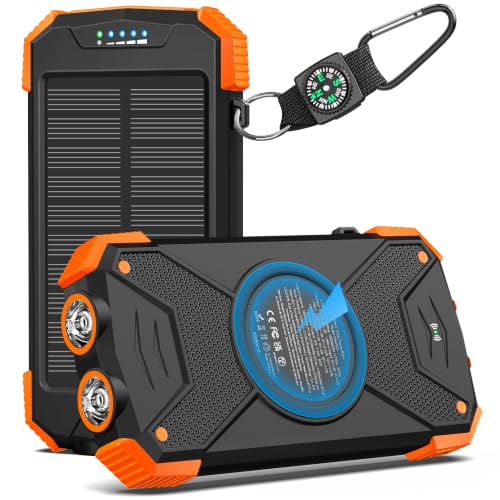
This is the product the keyword is secretly asking for. Because the BLAVOR carries a 10,000mAh battery, the solar panel on its face has one undemanding job — trickle energy into that cell whenever light falls on it — and the phone has an entirely separate, civilised job: drawing from the cell over USB-C at a stated 20W, exactly as it would from any ordinary power bank indoors. Clouds stop mattering to the phone. The charge session never renegotiates, the screen never wakes to complain, and the percentage climbs in the boring, reliable way phone charging is supposed to behave.
The listing adds the outdoor trimmings this category expects: IPX5 water resistance, a pair of flashlights, and wireless charging on its surface for phones that support it, though wired USB-C remains the efficient route. Be clear-eyed about the solar side: a panel that fits on a power bank is small, so solar refills the cell slowly across days of exposure, not hours. Think of sunlight here as range extension for a proper battery, charge the cell from a wall before departure, and the BLAVOR becomes the lowest-effort answer in this entire guide.
Two ownership notes complete this pick. First, the wireless charging surface is best treated as an emergency convenience: it wastes a meaningful share of a small solar harvest as heat, so the cable remains the serious route and the pad the kind one for a friend’s dying phone. Second, the flashlights make the BLAVOR the unit that migrates — from pack to bedside drawer during storm season and back again — and gear that migrates gets maintained, because it is seen. A power bank you encounter weekly is a power bank that stays charged.
- Battery capacity in title: 10,000mAh built in
- Wired output stated in title: 20W USB-C
- Wireless charging: stated in title for cell phones
- Water resistance stated in title: IPX5
- Lighting: two flashlights built in
- Solar panel wattage on the unit: Not stated in the listing title — verify with the maker’s documentation
Strengths
- Buffer battery ends the drain problem by design rather than by technique
- Works as an ordinary 20W power bank when the sun does nothing at all
- Flashlights and IPX5 sealing suit emergency-kit duty
Trade-offs
- Solar input is a slow top-up across days, not a same-day refill
- Heavier than a bare panel of similar phone-charging usefulness
- Wireless charging wastes energy a small solar harvest cannot spare
Best for: a glovebox, storm kit or festival bag where the phone must charge steadily regardless of sky
Not suited for: a hiker expecting the little face panel to refill the whole battery between breakfast and lunch
Jackery SolarSaga 100W Air — For power stations
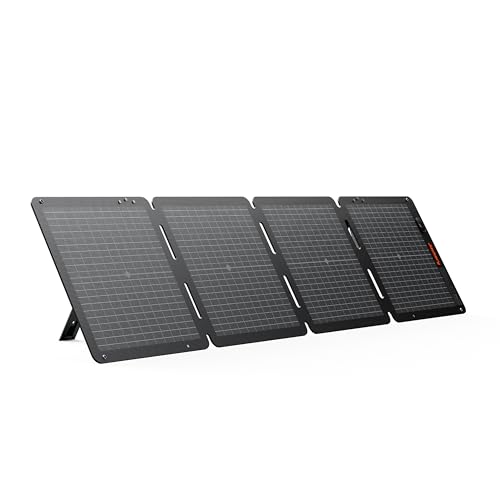
Read the listing’s own words first: this is a foldable charger for power stations, RVs and off-grid life. The SolarSaga 100W Air does not pretend to be a phone accessory, and this guide includes it because a large share of people asking about solar charging without drain are really asking beside a portable power station at a campsite. In that world the drain problem vanishes for a different reason — the station’s big battery buffers everything, the panel feeds the station, and phones charge from the station’s regulated outputs at full speed in any weather the station’s capacity can cover.
The panel itself is bifacial with a stated 23 percent conversion efficiency and IP65 water resistance, so it gathers some light from its rear face on bright ground and shrugs off campsite weather. What it will not do is plug sensibly into a handset as a primary plan; it belongs in the station ecosystem, with the station’s own input cable and charge controller between panel and phone. Buy it as infrastructure for a camp kitchen or an RV roof routine and it makes complete sense. Buy it as a phone charger and you have purchased the most expensive misunderstanding in this article.
Station owners should also think in seasons. A bifacial panel earns noticeably more on bright, reflective ground — pale gravel, light decking, snow — than on dark forest floor, so its real output follows your campsites around the calendar. The foldable format keeps it a travelling panel rather than a roof installation, and at 100W it pairs naturally with the mid-size stations that run a camp kitchen’s lights and a family’s devices together. Bought in that system context, its price buys infrastructure; bought alone, it buys a question.
- Output rating in title: 100W panel
- Panel type in title: bifacial
- Efficiency stated in title: 23 percent conversion
- Water resistance stated in title: IP65
- Stated loads in title: power stations, RVs, camping, off-grid use
- Direct phone output ports: Not stated in the listing title — verify with the maker’s documentation
Strengths
- Feeds a station battery that completely isolates phones from passing cloud
- Bifacial cells harvest reflected light from pale ground and decks
- IP65 sealing matches real campsite weather
Trade-offs
- Useless as a standalone handset charger without a station between
- Largest and heaviest thing in this guide by a wide margin
- Station input compatibility must be checked model by model
Best for: a campsite already running a portable power station for lights, laptops and phones together
Not suited for: a phone-only packing list with no power station anywhere in the plan
How do the six compare at a glance?
The table below keeps the two families separate in spirit: read the middle column as the mechanism, because the mechanism — direct or buffered — predicts your afternoon better than the wattage does.
| Pick | Mechanism | Ports or output | Standout fact from the title |
|---|---|---|---|
| BigBlue 28W Solar Panel Charger | 28W direct panel | USB-A and USB-C | Ammeter shows live output |
| BigBlue 35W Solar Charger | 35W direct panel | USB-C up to 25W stated | IP68 in title |
| FlexSolar 40W Foldable Panel | 40W direct panel | USB-C, USB-A and DC | No battery inside |
| Goal Zero Nomad 5 | 5W maintainer panel | USB via partner bank | Kickstand built in |
| BLAVOR Solar Power Bank 10000mAh | 10,000mAh buffered bank | 20W USB-C stated | Solar tops up its own cell |
| Jackery SolarSaga 100W Air | 100W station panel | Feeds power stations | Bifacial, IP65 in title |
Why does a solar charger let a phone lose charge in the first place?
A phone is not a passive bucket. While it charges it is also running a screen, radios, background sync and thermal management, and all of that draws from the same trickle the panel provides. When a panel delivers less than the phone consumes, the battery makes up the difference — which means the percentage falls even though the charging icon is lit. Add broken cloud and the session restarts repeatedly, each restart waking the screen and burning a little more. The charger has not malfunctioned; it has simply been outspent.
Heat makes the arithmetic worse. A phone lying in direct sun beside its panel warms up, and warm phones throttle charging and age their batteries faster. Experienced solar users develop a small ritual: panel in the sun, phone in the shade of the pack, cable running between them. That one habit removes the thermal penalty and the screen-glare temptation to keep checking the percentage, and it costs nothing.
Is a buffered power bank always better than a direct panel?
For a single phone and a worried owner, usually yes: the buffer converts an unreliable harvest into a reliable charge, and reliability is the whole point of the question behind this keyword. But buffers add weight, cost and one more battery to maintain, and on a long trail a good panel charging a bank you already carry achieves the same separation with gear that multitasks. The honest split is this — if you own no power bank, buy the buffered solar bank and be done; if you already carry a bank, a quality panel feeding it gives you more total capacity for similar money.
There is also a failure-mode difference worth knowing. A direct panel fails visibly and immediately: no sun, no charge, no surprise. A buffered bank can fail silently across a week if its small solar face never quite replaces what evenings withdraw, and then it is simply a flat battery with a decorative panel. Check the cell’s charge indicators every couple of days on long trips, whichever family you choose.
How should you angle and place a folding panel through the day?
Perpendicular is the target: the panel face should look directly at the sun, which in practice means re-aiming every hour or two rather than once at breakfast. The ammeter on the smaller BigBlue turns this into a quick game, but even without a meter the rule of thumb holds — if the panel’s own shadow falls straight behind it, you are close. Morning and evening sun arrives at a low angle, so a panel propped nearly upright on a pack often beats one lying flat at those hours, while midday rewards the flatter lay.
Ground matters too. Pale rock, sand and boat decks bounce light onto bifacial and even ordinary panels, while dark grass swallows it. Keep the panel out of your own shadow when you sit beside it, keep cables out of footpaths, and never leave a panel face-down in grit — scratched coatings quietly tax every future charge. None of this requires talent; it requires the thirty seconds of attention that separates a harvest from a gesture.
What does a week off-grid actually look like on solar power?
Picture a five-day walking trip with the 28W BigBlue and an ordinary power bank. Day one begins with everything full from home, and the panel’s job is merely to replace what the evening’s maps and messages spend — an easy day it wins by noon. Day two brings a cloudy morning; the bank dips, the panel spends the bright afternoon recovering the loss, and the walker learns to charge opportunistically whenever the sun appears rather than on a schedule. By day three the rhythm is set: panel out at every stop, phone rationed to aeroplane mode between waypoints, and the percentage anxiety of day one replaced by a fuel gauge mentality.
Day four is the test — rain until mid-afternoon. The system survives it because the previous days banked margin and because the phone’s appetite was governed before the weather turned. Day five dawns clear and the panel restores the bank for the walk out. Notice what never happened: the phone was never plugged straight into the panel in anger, and no single day was asked to be heroic. Off-grid solar works as a budgeting system across days, and the gear in this guide is sized for that system rather than for a single miraculous afternoon.
Should you buy one big panel or a panel plus a bank?
For the same money, the panel-plus-bank combination beats the bigger bare panel for almost every phone owner, because it converts weather into stored certainty. A large panel alone still leaves the phone negotiating with clouds in real time, and its extra area only helps while the sun cooperates. The combination’s bank, by contrast, is a full day of phone life that exists regardless of the sky, with the panel refilling it whenever fortune allows. The exception is the power-station owner, for whom the station is the bank and the big panel is correctly the purchase — the SolarSaga’s presence in this guide marks exactly that boundary.
There is also a redundancy argument. Two components can fail independently without ending the trip’s power: a panel damaged on day two still leaves a full bank, and a bank forgotten at home still leaves a panel that can feed a phone in strong sun. Single-device solutions fail singly and completely. Trips long enough to worry about solar charging are usually long enough to value that insurance, and the weight difference between the two strategies is smaller than the reliability difference.
How do you read a solar listing like an engineer?
Three numbers matter and the rest is weather. First, the panel’s rated wattage, understood as a clear-sky ceiling at perfect angle. Second, any stated conversion efficiency — the BigBlue listings’ 25.4 percent and the Jackery’s 23 percent are the honest kind of specific, suggesting the maker measured something. Third, the stated output at the port, like the 35W BigBlue’s 25W USB-C figure, because the port is where panel ambition becomes phone reality. A listing strong on all three is a listing written by people who expect to be checked.
Then read the silences. A panel that names no port output may still be fine, but the burden of proof has moved to the maker’s documentation, and a bank that names no solar input rate is telling you the solar side is a gesture. This guide has marked those silences wherever they occur, not to shame the products — several are excellent within their roles — but because a buyer comparing six listings deserves to know which facts arrived printed and which must be fetched.
What size of panel does a phone actually need?
Work backwards from the phone, not forwards from the marketing. A modern handset battery holds roughly fifteen watt-hours, and a realistic charging session wastes a share of incoming energy as heat. A panel rated near thirty watts, in strong sun at a good angle, commonly delivers somewhere near half to two-thirds of its label to the cable — enough to refill a phone across a long midday stop, or to keep a power bank gaining steadily through an afternoon. Drop to ten watts and the same refill stretches across most of a day of good weather, which is why the smallest panels in this guide are framed as maintainers rather than chargers.
Cloud, season and latitude all tax that arithmetic further. Winter sun at a northern latitude arrives weaker and lower, and a panel that felt generous in July can feel decorative in November. Buyers planning shoulder-season trips should size up one step from the summer recommendation, or accept the buffered bank’s slower but steadier temperament. The wattage printed on fabric is a clear-sky ceiling, and planning around ceilings is how the drain problem starts.
Can solar charging damage a phone battery?
The charging circuitry in a modern phone protects the cell from over-voltage and stops at full, so a panel cannot force energy in the way anxious forum posts sometimes imagine. The genuine risks are heat and interruption. Heat first: a handset baking in sun while charging ages its battery measurably faster, which is why the shade-the-phone ritual appears throughout this guide. Interruption second: hundreds of connect-disconnect cycles from a flickering panel are not known to harm the cell, but they waste energy and can leave you with less charge than a patient, buffered approach would have banked.
One more practical protection costs nothing. If a phone feels hot to the touch, unplug it and let it cool before resuming; batteries forgive a pause far more readily than a bake. And if a panel or bank ever swells, smells sweet or chemical, or becomes too hot to hold comfortably, retire it — that advice applies to every lithium product in this article, solar or not.
What happens to solar charging in winter?
Winter attacks solar charging from three directions at once: the sun sits lower, so a panel must tilt more steeply to meet it; the days shorten, shrinking the harvesting window; and cold phones charge less willingly, their batteries protecting themselves against the chill. A setup that cruised through August can feel broken in December without anything being wrong. The correct responses are geometric and behavioural — steeper angles, dawn deployment to catch the whole short day, and a phone kept warm in an inside pocket until the moment it charges.
Seasoned winter campers also shrink the load rather than only growing the supply. Paper maps return, the phone becomes a camera and an emergency beacon rather than a companion, and the panel’s modest harvest suddenly covers the budget with room to spare. Solar advice that ignores season is summer advice wearing a coat, and cold-weather buyers should size their panel one step up from every recommendation written in June — including several in this guide’s sunnier paragraphs.
There is one winter gift: cold, clear air and reflective snow can produce startlingly bright days where a well-angled panel performs near its best. The bifacial Jackery profits most from that reflected bounty, and even small panels surprise their owners on a crisp February noon. Winter solar is not hopeless; it is a fair-weather friend with occasional brilliant days, and the buffered bank exists to smooth that temperament.
How do you clean and store folding panels?
Cells under fabric live a dusty life, and a film of trail grit taxes every charge by a few percent that nobody notices and everybody pays. Clean the faces with a soft, damp cloth — never an abrasive, never a dry handful of sand used as one — and let the panel dry fully before folding, because a panel stored damp mildews its backing and corrodes its junction box across a single winter. The thirty seconds of care after a trip is the cheapest performance upgrade in this entire category.
Storage wants the same boring virtues as the batteries: cool, dry, folded along the intended seams rather than rolled or crushed under heavier gear. Hinges and cables are the mortal parts, so store the panel where nothing presses on the junction box and the cable is not bent at its root for six months. A panel treated that way keeps its rated manners for years; a panel treated as a doormat becomes one, electrically as well as literally.
Panel or roof — where should the solar live at a campsite?
The instinct to fix a panel to the vehicle roof and forget it is understandable and usually wrong for phone-scale camping. Roofs point where the vehicle points, shade arrives from trees the driver chose for the tent rather than the panel, and a fixed panel cannot chase the evening sun down the field. A portable panel on a cable, moved three times a day, routinely out-harvests a roof panel of the same rating — mobility is a specification, paid for in thirty-second errands.
The exception is the station ecosystem: a SolarSaga feeding a power station that lives in the vehicle, where the roof or the windscreen slope is the system’s permanent home and the station’s battery forgives the imperfect angles. Match the mounting philosophy to the architecture — portable panels for portable banks, fixed panels for fixed stations — and the geometry arguments in this guide resolve themselves into common sense.
What is the honest cost per stored watt?
Shoppers occasionally divide price by panel wattage and crown a winner, but the arithmetic misleads in this category because the watt is a ceiling measured in sunshine nobody owns. A fairer unit is the reliably stored watt-hour across an ordinary day: the buffered bank scores absurdly well because its small harvest is never wasted on a flickering phone session, while a large bare panel’s impressive noon peak may arrive when every device is already full. Value lives in the match between harvest timing and appetite timing.
That is also why the cheapest panel in a listing is rarely the cheapest power. A panel too small to finish any job teaches its owner to buy the second panel, and the pair costs more than the right one would have. Buy the mechanism that fits the trip, at the size the trip’s arithmetic demands, once — the oldest economy in outdoor gear, and the one this guide has been quietly recommending since its first paragraph.
Do solar chargers work through a window or in a car?
Glass is a tax collector: a panel behind a windscreen or a double-glazed window loses a meaningful share of its harvest to reflection and filtering before the light ever reaches the cells, and a car interior adds heat that the phone — if it is charging inside — would rather not meet. Panels belong outside the glass whenever possible, with the cable run through a cracked window or a door seal, and the phone kept in shade on the cool side.
The dashboard variant deserves its own warning. A phone charging on a sunny dashboard is being slow-cooked, and its battery will file the complaint as reduced capacity months later. If the car is the campsite, put the panel on the roof or the bonnet, the bank in the footwell’s shade, and the phone wherever it stays coolest; the harvest improves and the hardware survives.
Tents teach the same lesson with fabric instead of glass: a panel inside a sunlit tent works in a greenhouse of its own making. Outside, on the guy-line side, angled at the sky, is where every panel in this guide was designed to live, and the thirty seconds spent placing it there outperforms an hour of indoor optimism.
How do you share one panel between two travellers?
Sharing a panel is a scheduling problem wearing a hardware costume. The civilised solution is the shared buffer bank: the panel feeds the bank all day without favouritism, and the bank serves each phone in turn at full, steady speed in the evening. Direct-sharing — swapping the phone on the panel hourly — produces two half-charged phones and one argument, because the panel’s best hours cannot be in two places and neither traveller trusts the other’s timekeeping.
Agree the evening order before the first day: whose phone charges first, what percentage counts as served, and which device — a camera, a torch — outranks both phones when the harvest was poor. Small treaties made at home survive the trail; improvisations made beside a fading bank tend to become folklore of the wrong kind.
If the trip is long and the party is two, the second panel is not extravagance but peace: a modest panel each, or one panel and one buffered bank divided by person. Solar gear is cheap compared with the goodwill it protects, a calculation every experienced pair of travellers has made exactly once, the hard way.
How do you set up a no-drain solar charging routine?
Start the trip with everything full from a wall socket: phone, power bank, and the buffered solar bank if you carry one. Solar gear performs best as a maintainer of full batteries, not as a rescue service for empty ones, and beginning at one hundred percent converts every sunny hour into margin instead of debt. Lay the panel out at the first stop of the day, connect it to the power bank rather than the phone, and angle it at the sun before you do anything else at camp — panels forgotten until the light turns golden harvest a fraction of what they could have.
Through the day, re-aim the panel whenever you pass it, shade the bank and phone under the pack, and resist checking the phone screen, which is itself a small act of consumption. In the evening, move the phone onto the bank and let it charge steadily in the tent while the panel rests. If the forecast threatens a grey day, ration accordingly: aeroplane mode overnight, messages in batches, and the panel deployed at dawn to catch whatever thin light exists. Followed for a week, this routine is the difference between solar as a hobby and solar as a power supply.
What mistakes make solar charging disappoint?
The classic error is plugging the phone straight into a small panel and walking away for three hours of mixed weather, then concluding that solar charging is a scam. The scam was the expectation. Small direct panels feed banks; banks feed phones. The second error is chasing the largest wattage number while ignoring ports — a panel whose only output is a low-powered USB-A socket will feed a modern phone so slowly that ordinary use outruns it, whatever the fabric claims. Check the stated USB-C output where a title provides one, and treat silence on that point as information too.
Buyers also forget the cable. A long, thin, bargain cable drops voltage on exactly the marginal supply where voltage can least be spared, and a frayed connector produces the connect-disconnect flicker this guide keeps warning about. Carry one short, sound cable for solar duty. Finally, do not store a folding panel folded wet, do not leave a power bank charging on a hot dashboard, and do not judge any solar purchase by its first hour at noon in June — judge it by a whole ordinary day, the unit your trips come in.
Final Recommendation
For most readers the BLAVOR buffered bank is the shortest path to the outcome in the keyword: a phone that gains charge, every time, without weather theatre. Walkers who already carry a power bank should take the BigBlue 28W and its ammeter, or the 35W version where rain and group duty justify it, while the FlexSolar suits car campers who also feed a small station and the Nomad 5 maintains a flip bank with honest modesty. The Jackery belongs to station owners and should be bought as the infrastructure it is.
Whichever route you take, buy the mechanism before the wattage and the habit before the hardware: buffer the phone from the sky, shade the handset, aim the panel, and let stored sunshine do the steady work — do that, and the percentage on your screen will only ever move in the direction you packed for.
Frequently Asked Questions
Will a solar charger work on a cloudy day?
Output falls sharply under cloud — often to a small fraction of the clear-sky figure — but rarely to zero in daylight. That trickle is exactly why buffered designs shine in poor weather: a bank accepts a trickle patiently, while a phone connected directly may spend more than the trickle on staying awake. On truly dark days, treat solar as a bonus and ration the battery you charged from the wall.
How long does the BLAVOR take to refill from sunlight alone?
Its listing does not state a solar refill time, and honest arithmetic suggests days of good exposure for a full cell, because a panel that fits on a power bank is necessarily small. Plan on wall-charging it before trips and letting sunlight extend its range. Anyone promising a same-day solar refill from a pocket-sized panel is describing a different, larger product.
Can I charge a tablet from the folding panels here?
Yes, within patience limits. The BigBlue listings name tablets among their intended loads and the FlexSolar title says the same, but a tablet battery is roughly double a phone’s, so expect long midday sessions or overnight stays on a buffered bank. The USB-C outputs stated in the BigBlue 35W and FlexSolar titles are the ones to use.
Is the Jackery SolarSaga 100W Air usable with a phone at all?
Only through a power station, which is the product’s stated purpose. The panel feeds the station’s input, the station’s battery buffers the energy, and the phone charges from the station. Connecting station panels directly to handsets is not the design, and this guide does not present it as a phone charger for that reason.
Why does my phone show charging but still lose percentage?
Because the phone is spending more than the panel is supplying: screen, radios and a hot battery all draw current while the panel contributes a weak or flickering supply. Move the phone to shade, stop waking it, and interpose a power bank between panel and phone. If the loss continues on a strong wired supply indoors, suspect the cable before suspecting the phone.
Do folding panels wear out?
The cells themselves degrade very slowly, but hinges, fabric, cables and junction boxes live hard lives outdoors. Panels stored folded while damp, or flexed sharply at the seams, fail at those mechanical points first. Dry before storing, fold along the intended seams, and a panel should serve for many seasons of trips.
Related Guides
Charging questions travel in packs. For the bedside half of the charging story, see Best wireless chargers through thick case dual coils. When the outage is at home rather than on a trail, read Best chargers for cell phones when you have no power. And for bigger screens that drink batteries faster, compare Best portable battery chargers for iPad Pro.
Related guides
- Best Graphic Tablets for Kids: Computer-Connected Drawing Pads, Honestly Explained
- Best 3D Art Tablets
- Best 3rd Party MacBook Chargers: 96W-Class Alternatives, the 100W Cable Rule, and the Apple Benchmark
- Best Balancing Stabilizers for Mirrorless Cameras: Payload, Balancing and Native Vertical Shooting


