What's inside
- Where to buy
- Key Takeaways
- Quick Picks
- How did we sort this guide’s two very different families?
- Why do people bury their speakers in the garden at all?
- How do the six rocks compare at a glance?
- How do you wire a passive rock speaker system properly?
- Where should solar rocks sit to charge and play well?
- What goes wrong most often with rock speaker purchases?
- How do you match an amplifier to garden rocks without cooking either?
- Can a garden have real stereo, and does it want it?
- What does a year of owning rock speakers actually look like?
- How convincing is the camouflage, really?
- What should each zone of a garden sound like?
- Should you mix solar and wired rocks in one garden?
- Final Recommendation
- Frequently Asked Questions
- Related Guides
As an Amazon Associate I earn from qualifying purchases. This post may contain affiliate links at no extra cost to you.
gizmoverdict.com is reader-supported. When you buy through links on our site, we may earn an affiliate commission.
Where to buy
The six listings linked in this guide are the Amazon pages we verified while preparing it, and with garden speakers the exact listing matters more than usual: rock speakers are sold singly, in pairs and in solar sets that look identical in a thumbnail, so confirm the quantity in the listing title before you pay. A rock that arrives alone when you planned a stereo pair is an annoying parcel to return, and a pair that arrives when the budget assumed one is worse.
The best outdoor rock bluetooth speakers solve a problem no ordinary portable speaker even attempts: they make sound a permanent, nearly invisible part of a garden. The speaker hides in a flower bed or beside a pond, moulded and coloured to pass as stone, and the music seems to come from the landscaping itself. But this category hides a fork in the road that catches buyers every season. Some rocks are self-contained — solar panel, battery and Bluetooth receiver inside the stone — while others are passive loudspeakers in disguise, containing no amplifier or battery at all, and expecting speaker cable and a separate amplifier indoors. Both kinds are legitimate. Buying the wrong kind for your garden is the expensive mistake this guide exists to prevent.
So the reviews below are organised around that divide. Each pick is labelled clearly as self-powered or passive, each spec box states what else you will need to make it play, and the buying-guide sections walk through wiring, solar placement and amplifier matching in plain terms. Read the framing before the rankings: in this category, the best speaker is not the one with the biggest driver, it is the one whose power story matches your garden’s reality.
Key Takeaways
- Rock speakers split into two families that share only a costume: solar Bluetooth rocks that play by themselves, and passive rocks that are inert until an amplifier and cable reach them.
- The GGII solar rock is the most complete self-powered option here, with automatic pairing, a built-in light and a multi-speaker sync system the listing says can link up to one hundred units.
- Buyers with an existing amplifier, or plans for serious garden sound, should study the OSD Audio RS670 pair — a passive stereo set with a 6.5-inch driver per stone and hi-fi ambitions.
- The Alpine solar set is the gentlest way in: two small rocks, no wiring anywhere, placed in the sun and forgotten about.
- IP44, the rating on the GGII, means splash resistance only; it is not permission to submerge a rock in a pond or leave it in a flooded bed.
- The OSD RS850 is sold as a single speaker — useful for filling one corner or adding to an existing run, but it will not give you stereo by itself.
Quick Picks
| Rock speaker | Badge | Why it is here |
|---|---|---|
| GGII Solar Rock Speaker | Best self-powered rock | Solar charging, a light for after dark, automatic pairing and multi-unit sync for whole-garden coverage without a metre of cable. |
| OSD Audio RS670 passive pair | Best wired pair | A proper stereo pair of 6.5-inch passive rocks for amplifier owners who want garden sound with hi-fi intent. |
| Theater Solutions 2R8S pair | Best big-driver value pair | Two 8-inch sandstone rocks that give wired systems a larger driver at an easy-going tier of the market. |
| OSD Audio RS850 single | Best single addition | One 8-inch high-fidelity rock for extending a wired system into a new corner of the garden. |
| Herdio wired rock pair | Best all-weather wired pair | A resin-bodied wired pair with an IPX7 listing claim, aimed at exposed spots like pool surrounds and open patios. |
| Alpine Solar Bluetooth Rock Speaker set | Best set-and-forget pair | Two modest solar rocks, nine inches tall, that ask for nothing but sunlight and a Bluetooth source. |
How did we sort this guide’s two very different families?
We began by refusing to rank a solar rock against a passive rock on the same scale, because they answer different questions. The solar buyer’s question is: how little infrastructure can I get away with? The passive buyer’s question is: how good can permanent garden sound be? Mixing those questions produces the nonsense comparisons that fill this category’s listings, where a solar rock is criticised for lacking bass it never promised and a passive rock is praised for a Bluetooth feature it does not contain.
Within the self-powered family, we weighed solar practicality — panel placement, battery behaviour through cloudy weeks — alongside the pairing system, since a lone rock covers a patio but a garden usually wants several. Within the passive family, the criteria were driver size, weather construction, impedance sanity and whether the listing is honest about what is in the box, because the amplifier and cable you must add are part of the true purchase. Across both families we checked the camouflage itself: a rock speaker that looks like plastic garden ornament fails its founding purpose, so finish and colour options were treated as functional, not cosmetic.
One more discipline ran through the selection: quantity honesty. Listings in this category blur singles, pairs and sets deliberately, so every pick below states plainly how many speakers the money buys, taken from the verified listing title. Where a figure like wattage appears, it is the maker’s claim, and for passive speakers it describes power handling — what the speaker can accept from an amplifier — which is a completely different thing from how loud it will play.
Why do people bury their speakers in the garden at all?
Partly vanity, and there is no shame in it: a well-kept garden is a designed view, and a black plastic box on a stand interrupts it. Gardens are composed the way rooms are composed, and a visible gadget dates the composition the moment technology moves on, while a stone simply stays a stone. Partly theft and weather: a speaker that looks like a stone is a speaker nobody bothers to steal, and one built to live outdoors does not need carrying in every night. And partly acoustics — several rocks spread through planting give even, low-level coverage that lets a whole garden hold music at conversation level, instead of one loud source near the house shouting over distance. That distributed gentleness is the real luxury this category sells, and it shapes the advice throughout: more rocks, played quietly, beat fewer rocks played hard.

GGII Solar Rock Speaker — Best self-powered rock
GGII’s rock is the most ambitious self-contained unit in this guide. The listing describes a solar-powered stone with a built-in light, automatic pairing, and a multi-sync system said to link up to one hundred speakers — a figure worth reading as system headroom rather than a shopping target, but it tells you the intended scale: paths, terraces and pool decks covered by a family of rocks that find each other and play as one. For a buyer who wants the invisible-garden effect without running a single cable, this is the fullest expression of the idea on this page.
The solar bargain needs understanding before it needs praising. A rock charges where it sits, which means its panel wants real sun: a stone tucked under dense shrubs in permanent shade will slowly lose its charge no matter how efficient the panel is, and its owner will blame the battery for a placement decision. Set the GGII where it catches a few hours of direct light — the edge of a bed, beside a path, near a pond’s sunny bank — and the arrangement becomes genuinely forgetful: charge by day, play by evening, light glowing after dark. The light is not a gimmick, incidentally; on a path edge it does the work of a garden lantern while the speaker does its own.
Its IP44 rating is the specification to hold in both hands. The four-four code means protection against solid objects and against water splashing from any direction — rain is fine, sprinklers are fine, a hosed-down patio is fine. It does not mean immersion, jets of water, or a winter sitting in a flooded flower bed. Place it on a slight rise or a gravel pad rather than in the dip where puddles gather, and IP44 is entirely sufficient for garden life. Judged as a system — solar, sync, light, splash-proofing — the GGII is the pick we would build a wire-free garden around.
- Family: self-powered solar Bluetooth rock
- Power: solar panel charging, per the listing
- Water rating: IP44 — splash resistance, not immersion
- System: automatic pairing, multi-sync up to 100 speakers per listing
- Extras: built-in light for evening use
- Also needed: nothing — a Bluetooth source only
Strengths
- Multi-speaker sync scales from one patio rock to whole-garden coverage.
- Solar charging removes cables, sockets and battery errands entirely.
- Built-in light makes path-edge placement doubly useful after dark.
Trade-offs
- Needs genuine sunlight at its spot; shade-starved rocks fade.
- IP44 forbids pond edges that flood and any dunking.
- Sound output is sized for ambience, not for party volume.
Best for: wire-free gardens, paths and pool decks where several rocks playing quietly together is the dream. Not suited for: shaded beds, sunken spots that puddle, or anyone wanting one rock to host a dance party.

OSD Audio RS670 passive pair — Best wired pair
OSD Audio is a name from the installed-audio world, and the RS670 shows it: this is a passive stereo pair, two slate-finished rocks, each with a 6.5-inch driver, weather-resistant construction and a 150-watt power-handling claim in the listing. There is no battery, no Bluetooth and no amplifier inside the stone. What you are buying is the loudspeaker half of a system — the half that faces the weather — while the amplifier half stays warm and dry indoors, connected by buried or tucked-away speaker cable.
Why accept that complexity? Because the wired route removes every ceiling the solar rocks live under. Power comes from the mains, so volume and bass are limited by your amplifier rather than by a small internal battery. There is no charging behaviour to manage, no pairing to drop, and the rocks play for exactly as long as the amplifier is on — all day, every day, at whatever level the occasion wants. For a garden that hosts long summer evenings, that permanence is the difference between a novelty and an installation.
Planning is the price. You will need an amplifier or receiver with a spare pair of outputs, outdoor-rated speaker cable, and a route for that cable that does not cross the mower’s path. The 150-watt figure is a handling ceiling, not a requirement — a modest amplifier drives these rocks happily at garden levels, and matching is discussed in the guide section below. The slate finish suits modern gardens and stone patios particularly well. Buy the RS670 pair when the garden is a long-term project and sound quality is a stated goal, not an afterthought.
- Family: passive wired rock speakers — amplifier required
- Quantity: stereo pair
- Driver: 6.5-inch, per the listing
- Power handling: 150W claim in the listing
- Finish: slate, weather-resistant construction
- Also needed: amplifier or receiver plus outdoor speaker cable
Strengths
- Mains-powered system headroom outclasses any battery rock for long sessions.
- True stereo pair from the box, voiced for fidelity rather than mere presence.
- Nothing to charge, pair or update — the rocks simply wait to be played.
Trade-offs
- Amplifier and cable are extra purchases and an installation job.
- No Bluetooth at the rock; the source connects at the amplifier.
- Moving house or rearranging the garden means re-running cable.
Best for: amplifier owners and garden renovators building permanent, quality sound into a planting scheme. Not suited for: renters, impatient buyers, or anyone whose plan starts with the words no wires.

Theater Solutions 2R8S pair — Best big-driver value pair
Theater Solutions takes the wired formula and scales the driver up: the 2R8S set puts an 8-inch driver in each of two sandstone rocks. In outdoor audio, driver diameter is destiny at the low end — a larger cone moves more air with less effort, and gardens, which offer no walls to help, expose small drivers cruelly. An 8-inch rock will not thump like a subwoofer, but it fills out voices and acoustic instruments with a body that 5-inch garden speakers cannot counterfeit, and it does so while asking less of the amplifier at a given volume.
The sandstone finish is the other half of the proposition. Against gravel, pale paving, dry planting and Mediterranean-style gardens, sandstone disappears in a way grey slate cannot; against dark soil and lush green, it stands out more. Camouflage is local, and this pair is the pick for the pale garden. As with the OSD pair, these are passive speakers: an amplifier and cable are required, and the listing’s job is the weatherproof loudspeaker end of that system. Theater Solutions has sold this format for years, and the design’s simplicity — a big driver, a tough moulded enclosure, no electronics in the weather — is precisely why it endures.
Set expectations by role and the 2R8S pair satisfies: background and mid-level listening across a patio or pool surround, with enough driver to keep music full at the far chairs. It is not a precision instrument for critical listening, and its size means each rock needs a genuinely rock-plausible spot — an 8-inch stone looks wrong perched in a small border. Give them room, feed them from a decent amplifier, and they deliver the category’s core pleasure: a garden that sounds inhabited, from stones that say nothing.
- Family: passive wired rock speakers — amplifier required
- Quantity: two-speaker set
- Driver: 8-inch per rock, per the listing
- Finish: sandstone
- Intended spots: deck, pool, spa, yard and garden per the listing
- Also needed: amplifier or receiver plus outdoor speaker cable
Strengths
- Largest drivers among this guide’s pairs, for fuller low-end body outdoors.
- Sandstone finish vanishes into pale gravel and paving schemes.
- Simple passive design leaves no electronics exposed to the weather.
Trade-offs
- Big rocks demand big, believable placements in the planting.
- Amplifier and cabling are on you, as with every passive pick here.
- Sandstone reads as a feature, not camouflage, in dark-soil gardens.
Best for: pale, sunny gardens and pool surrounds where a wired pair should sound full without working hard. Not suited for: compact borders, dark woodland planting, or wire-free plans.
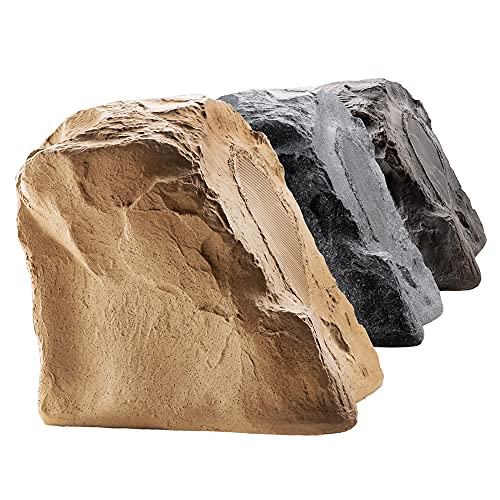
OSD Audio RS850 single — Best single addition
Read the quantity first, because it defines this pick: the RS850 is one speaker. A single 8-inch OSD rock in sandstone brown, built to the same weather-resistant philosophy as its paired sibling above. Singles exist for good reasons. Gardens grow by corners — a new seating area, a vegetable patch with a bench, a hot-tub deck — and a wired system that reaches three corners often wants a fourth voice. The RS850 is how you add it without buying a pair you do not need or mismatching the rocks you already own.
The 8-inch driver in a single enclosure also suits a particular trick: mono coverage of a defined zone. Not every garden spot needs stereo. A path junction, a barbecue station or a workshop door is a place people pass through or stand in one spot, and a single well-placed rock fills it honestly. Many amplifiers can sum a zone to mono, or you can feed the RS850 one channel where the layout makes stereo meaningless. What a single cannot do is be a starter stereo system by itself — a buyer with no rocks at all should begin with a pair, and treat this listing as the expansion part it is.
Construction is the durable OSD pattern: a moulded rock enclosure, weather-resistant design, and a driver sized for body rather than tinkle. The sandstone brown colouring sits comfortably among soil, bark mulch and terracotta. If your existing run uses the RS670 pair near the house, an RS850 at the garden’s far end continues the system with a bigger driver where distance eats the most sound. That is a thoughtful way to grow a wired garden, and it is why a single speaker earns a full place in a guide of pairs and sets.
- Family: passive wired rock speaker — amplifier required
- Quantity: single speaker — not a pair
- Driver: 8-inch, per the listing
- Finish: sandstone brown
- Design: durable, weather-resistant per the listing
- Also needed: an existing wired system or an amplifier channel to feed it
Strengths
- Lets a wired garden grow one zone at a time without waste.
- Big driver suits mono coverage of corners and work areas.
- Matches the look and build of OSD’s paired rocks.
Trade-offs
- One speaker cannot produce stereo on its own.
- Value only exists alongside an amplifier system.
- First-time buyers are better served by a pair listing.
Best for: owners of wired garden systems adding a new corner, path or seating zone. Not suited for: anyone buying their very first garden speaker and expecting stereo.

Herdio wired rock pair — Best all-weather wired pair
Herdio’s pair arrives in resin, finished in black, and its listing makes the boldest weather claim among the wired picks: IPX7. That code, on a wired rock, is interesting — it speaks to the enclosure’s sealing against water, which for a permanently installed speaker matters through winters, sprinklers and pool splash zones. The listing also carries a 400-watt figure; read it the way all such figures in this category must be read, as a manufacturer’s peak or handling claim rather than a promise about loudness, and judge the pair instead on its format: two resin rocks, wired installation, built for exposed positions around decks, pools and patios.
The listing’s wording mixes Bluetooth language with a wired description, and this guide’s pool classification places the pair on the wired side of the family divide — plan for speaker cable and amplification, and check the current listing’s connection details carefully before ordering so the version that arrives matches your installation plan. That homework warning is not a criticism of the product; it is the standing advice for every rock speaker, in a category where titles are written by marketers and gardens are wired by owners.
Resin as a material deserves a word in its favour. It shrugs off knocks from strimmers and footballs, does not corrode, and holds moulded detail well enough to pass as stone at garden distances. In black, these rocks suit contemporary gardens, dark decking and shaded corners where a pale stone would glow suspiciously. For a wired system in a hard-weather spot — the pool surround that gets hosed daily, the coastal patio — the Herdio pair’s sealed, resin brief is a rational alternative to the fibreglass classics above.
- Family: wired rock pair — plan for cable and amplification
- Quantity: one pair
- Material: resin, per the listing
- Water claim: IPX7 in the listing — verify connection details before ordering
- Power figure: 400W in the listing, a manufacturer’s claim
- Colour: black, per the listing
Strengths
- Strongest water-resistance claim among this guide’s wired pairs.
- Resin body tolerates knocks, weather and pool chemicals’ splash.
- Black finish fits modern decking and shaded planting.
Trade-offs
- Listing language requires careful reading to confirm the exact configuration.
- Wired installation effort applies in full.
- Headline watt figure should not drive the decision either way.
Best for: wired systems in exposed, wet positions — pool surrounds, open patios, coastal gardens. Not suited for: buyers who want a rock that plays with zero installation, or pale-stone camouflage.

Alpine Solar Bluetooth Rock Speaker set — Best set-and-forget pair
Alpine Corporation’s contribution is the gentlest product in this guide: a set of two solar Bluetooth rocks, each nine inches tall, finished in brown. Nine inches is a flower-bed scale — these are rocks for tucking among shrubs and along borders, not boulders for anchoring a patio — and the set-of-two format means a buyer gets gentle stereo or two-zone coverage in one box, with no cable, no amplifier and no charging routine beyond what the sun does unasked.
The listening contract is ambience. Small solar rocks will not fill a lawn with party volume, and Alpine’s set does not pretend to be a sound system; it is background music woven into planting, loud enough for the bench it stands beside. Judged on that contract, the virtues compound: nothing to wire during a garden renovation, nothing to bring indoors in October, nothing to remember. When people say they want music in the garden the way they have light in the garden — present, unremarkable, always there — this set is the product they are describing.
Placement remains the one skill required. Solar rocks earn their keep in sunlit spots, so walk the garden at midday before choosing homes for them, and favour the bed edges that catch hours of light over the picturesque shade under the tree. Brown colouring blends with mulch and soil better than with pale gravel. For buyers curious about the broader solar approach before committing, our guide to best outdoor wireless bluetooth speakers covers the portable end of outdoor sound, where the same sun-versus-shade logic applies to speakers you carry rather than plant.
- Family: self-powered solar Bluetooth rocks
- Quantity: set of 2
- Height: 9 inches per rock, per the listing
- Power: solar charging, per the listing
- Colour: brown, per the listing
- Also needed: nothing — a Bluetooth source only
Strengths
- Two rocks in the box for instant gentle coverage of a bed or border.
- Solar power and small scale make installation a five-minute job.
- No wiring, amplifier or charging routine to maintain.
Trade-offs
- Output is background level by design; parties need bigger hardware.
- Shaded placement starves the solar charging, as with all solar rocks.
- Small rocks can look lost in large, open landscaping.
Best for: flower beds, borders and quiet corners where music should whisper from the planting. Not suited for: lawns, parties, or gardens planned around a single powerful source.
How do the six rocks compare at a glance?
| Pick | Family | Quantity | What else you need |
|---|---|---|---|
| GGII Solar Rock Speaker | Self-powered solar | Single (syncs with more) | Sunlight and a phone |
| OSD Audio RS670 | Passive wired | Pair | Amplifier and speaker cable |
| Theater Solutions 2R8S | Passive wired | Pair | Amplifier and speaker cable |
| OSD Audio RS850 | Passive wired | Single | An amplifier channel |
| Herdio wired pair | Wired | Pair | Cable run and amplification |
| Alpine Solar set | Self-powered solar | Set of 2 | Sunlight and a phone |
The column that decides your budget is the last one. A passive pair’s sticker is only part of its cost: add an amplifier if you do not own one, outdoor-rated cable by the metre, and the connectors and conduit of a tidy install. None of that makes the wired route bad value — a wired system typically serves for a decade or more, through phone generations no Bluetooth standard survives — but it must be counted honestly against a solar rock whose entire cost is the rock. Conversely, the solar route’s hidden cost is replacement timescale: batteries age, and a sealed solar rock at year six may hold a fraction of its original charge, while a passive rock at year six is barely run in.
Coverage planning follows from the same table. Solar rocks multiply cheaply — the GGII’s sync system exists for exactly this — so a wire-free garden grows rock by rock as budget allows. Wired systems grow by cable runs, which are cheap in wire and expensive in effort, so wired gardens should be planned whole: decide every zone before the first trench, and pull spare cable while the ground is open. Both families reward the buyer who sketches the garden on paper first.
How do you wire a passive rock speaker system properly?
Start at the amplifier. Most home amplifiers and receivers drive speakers between four and eight ohms; garden pairs in this guide sit in that normal range, but check the listing’s impedance and your amplifier’s rating before connecting two pairs to one output, because parallel wiring halves the load and an unhappy amplifier protects itself by shutting down mid-party. If you plan several zones, an amplifier with a dedicated second zone, or a simple speaker selector with impedance protection, keeps the arithmetic safe.
Cable choice is the second decision. For outdoor runs, use cable rated for burial or UV exposure; indoor cable’s jacket cracks in sunlight and wicks water at the cuts. Length matters electrically as well as practically — long, thin runs waste amplifier power as heat and dull the sound, so step up the cable thickness for runs across a big garden. Bury cable in a shallow slit trench or run it along fence lines and under mulch, always with a loop of slack at each rock so the speaker can be lifted for gardening without straining the connection. Seal connections against moisture; the junction, not the rock, is where outdoor systems usually fail.
Placement for wired rocks follows the ear, not the eye alone. Rocks at the garden’s edge firing inward cover more evenly than rocks by the house firing outward, and a pair angled across a patio gives stereo to the seats that matter. Keep rocks off the ground’s wettest layer on a gravel pad, grille facing the listening area rather than the sky. Our guide to best portable party speakers covers the opposite philosophy — sound you wheel out for an event — and reading the two together clarifies which kind of garden yours is.
Where should solar rocks sit to charge and play well?
A solar rock has two jobs that sometimes compete: its panel wants the sunniest spot in the bed, while its driver wants to face the bench. Usually a compromise exists — the sunny edge of the planting nearest the seats — and finding it is worth a day’s observation before you commit. Watch where the light actually falls at the hours you garden, not where you assume it falls; fences and houses throw longer shadows than intuition suggests. A rock that charges fully by mid-afternoon will play all evening without anxiety, while one that catches an hour of sun will ration itself and fade during the exact hours you wanted it.
Through winter, solar rocks in northern gardens may charge so slowly that they become spring-to-autumn products. That is not a flaw to be angry about; it is the climate speaking. Some owners bring solar rocks into a sunny porch for the dark months, others accept the seasonality. Either way, store or leave them with whatever charge they hold rather than deeply discharged, and clean the panel with a soft cloth when you deadhead the bed — a dusty panel is a smaller panel.
What goes wrong most often with rock speaker purchases?
Quantity confusion tops the list, and it is the industry’s fault as much as the buyer’s: listings photograph pairs and sell singles, or the reverse. Every purchase in this category deserves a ten-second check of the title’s quantity words against the price’s plausibility. The RS850 above is a single and proud of it; the Alpine is a set; the 2R8S and RS670 are pairs. If a deal looks impossibly good, it is usually one rock.
Power confusion follows close behind. A passive rock connected to nothing is a garden ornament with a grille, and every season buyers discover this on delivery day. If your plan has no amplifier in it, your shortlist is the solar family only. The mirror-image error is feeding a passive rock from an amplifier far beyond its handling, or wiring garden speakers to an amplifier output already loaded with indoor speakers, and cooking one or the other. And the quiet third error is camouflage mismatch: a sandstone rock in a slate garden draws the eye it was bought to avoid. Match the stone to your stone.
How do you match an amplifier to garden rocks without cooking either?
Amplifier matching frightens beginners more than it should, because two numbers govern it and both are printed plainly. The first is impedance, measured in ohms: garden rocks in this guide are conventional loads, and any amplifier rated for speakers in the usual four-to-eight-ohm span will drive one pair without complaint. Trouble starts when pairs multiply on a single output. Wire two pairs in parallel and the amplifier sees half the impedance; add a third and some amplifiers will protect themselves or overheat. The cures are boring and effective — a second-zone output, a selector box with impedance protection, or a dedicated small amplifier per zone, which has the side benefit of independent volume for the patio and the far beds.
The second number is power, and it is widely misunderstood in both directions. A rock’s handling figure — 150 watts on the RS670 listing — is the ceiling it can survive, not the diet it requires. Garden listening at background and moderate levels uses a few watts; peaks for a chorus or a film night outdoors use more, and an amplifier with comfortable headroom delivers those peaks cleanly. Underpowered amplifiers are the real hazard: driven into clipping, they produce the harsh distortion that damages tweeters. The rule that keeps everyone safe is to buy an amplifier whose honest continuous rating sits comfortably in the middle of your speakers’ range, then never ask it to play at the ragged edge of its dial.
Source features complete the match. An amplifier with Bluetooth or network streaming turns a wired garden into a phone-controlled one, which removes the passive family’s only convenience deficit against solar rocks. Tone controls matter outdoors more than indoors: a small bass lift compensates for the garden’s lack of walls, and a treble trim can soften a rock placed near a reflective fence. If your amplifier offers a mono sum for a zone, the single RS850 in a pathway corner can be fed properly rather than with half a stereo signal. None of this requires exotic equipment — it requires reading the amplifier’s back panel before the rocks are ordered, which is the cheapest planning step in the whole project.
Can a garden have real stereo, and does it want it?
Stereo in a garden is a localised pleasure. The image holds in the zone between and around a pair, which is why pairs belong at the places people settle: the patio chairs, the bench, the dining terrace. Between those settlements, mono coverage from a single rock is not a compromise but the correct tool, since a walker hears whichever rock is near and stereo information would only confuse the balance. Well-planned gardens therefore mix the two: stereo where people sit, mono where they pass, all at levels that let conversation remain the main event.
Bass behaves differently again. Low frequencies outdoors do not reflect and gather as they do in rooms; they radiate and leave. That is why the 8-inch drivers in the 2R8S and RS850 matter — cone area is the honest way to keep body in voices and instruments outside — and why no rock in this guide, wired or solar, will reproduce the bottom octave of a synth line at a distance. Owners who truly want low-end weight in a garden add it at the house end of the system, near a wall that can help, rather than asking a flower-bed rock to perform miracles. Set the expectation at musical fullness and every pick here can meet it; set it at club pressure and none can.
What does a year of owning rock speakers actually look like?
Spring is inspection season for wired systems: walk the runs, check the connections at each rock for corrosion or a gardener’s spade nick, and reseat any rock that frost has heaved out of level. For solar rocks, spring is a panel clean and a full day of honest sun to wake the battery after the dark months. Summer asks nothing of either family except enjoyment and the occasional wipe of pollen and dust from grilles — a soft brush keeps the moulded detail looking like stone rather than garden centre plastic.
Autumn is when placement sins confess themselves. Beds that flood in October rain will find the rock you set in a dip in June; move it to its gravel pad before winter makes the lesson expensive. Leaves piled against a solar panel starve it as surely as shade, so clear the beds around solar rocks as you clear them anywhere else. Winter divides the families: passive rocks sleep in place under frost without complaint, while solar rocks in cold climates benefit from a sunny windowsill indoors, arriving back in the garden in March with a healthy battery instead of a depleted one.
None of this maintenance is onerous — an hour a season, folded into gardening you already do — but it is the difference between an installation that lasts a decade and one that disappoints by its third summer. Rock speakers ask to be treated as part of the garden rather than as gadgets, and gardens repay exactly the attention they are given.
How convincing is the camouflage, really?
A rock speaker fools the eye in stages. At twenty metres, every pick in this guide reads as stone, because shape and matte colour are all the eye can resolve at that distance. At five metres, texture begins to testify: the better mouldings carry pitting, strata lines and colour variation that survive a glance, while cheap ones reveal a repeating pattern and a plastic sheen. At arm’s length, nothing in this category survives inspection — but nothing needs to, because guests do not audit flower beds at arm’s length. The realistic standard is the five-metre glance from the patio, and it is why finish choice matters more than moulding detail: a correctly coloured rock with simple texture disappears, while a beautifully detailed rock in the wrong colour announces itself.
Colour matching deserves more care than buyers give it. Photograph your bed, your gravel and your paving in daylight, then compare the listing finishes against those photographs rather than against memory, which flatters. Slate greys belong with grey paving, York stone and contemporary planting. Sandstone belongs with pale gravel, limestone and dry gardens. Browns belong with bark mulch, soil and terracotta. The Herdio pair’s black is the modern garden’s option, reading as shadow among dark decking and foliage. Also remember that finishes weather: a rock that starts slightly bright will mute over a season or two as algae, dust and sun do their work, which generally improves the disguise — one more argument for placing rocks and letting the garden grow around them.
What should each zone of a garden sound like?
Think of the garden as rooms without ceilings, each with its own acoustic job. The dining terrace wants the fullest sound and the only true stereo, because people sit there longest and listen most. The lawn and play areas want presence without pressure — music that accompanies rather than performs, from rocks at the borders firing inward. Paths and gates want almost nothing: a whisper of continuity so the garden feels connected as you move through it, which is where a small solar rock or a single wired fill earns its keep. The vegetable garden and workshop corner want speech clarity for radio and podcasts while hands are busy, and a modest rock at close range delivers it better than a powerful one across the plot.
Volume discipline ties the zones together. Set the terrace level for the people at the table, then walk the boundary: if the music is clearly audible at the fence, it is too loud for the neighbours who did not buy a ticket. Distributed rocks make this easier, not harder — many quiet sources near listeners beat one loud source far from them, for neighbour relations as much as for sound quality. That principle, repeated through this guide in different words, is the closest thing garden audio has to a universal law, and every family and finish decision above is really just a way of obeying it in your particular plot.
Should you mix solar and wired rocks in one garden?
You can, and many good gardens do — but go in understanding that they will be two systems sharing a garden, not one system with two kinds of member. The wired rocks play what the amplifier plays; the solar rocks play what their Bluetooth sync group plays. Getting both to carry the same music at the same moment is possible when the amplifier itself is the Bluetooth source for the solar group, but delay differences between the paths can smear the sound where the zones overlap. The clean arrangement is territorial: wired rocks own the terrace and the house end, where fidelity matters and cable was easy; solar rocks own the far beds and the bottom of the garden, where trenching was the obstacle. Each system does the job it is good at, and the boundary between them sits where listeners rarely stand exactly between the two.
Budget sequencing follows naturally from that split. If money arrives in stages, wire the terrace first, because that installation is permanent and its cable routes are easiest while other garden work is young. Add solar rocks later, one at a time, as the far garden takes shape — the GGII’s sync system was designed for exactly this kind of gradual growth. What you should not do is scatter purchases randomly across both families in the hope they will somehow unify. A garden planned in two honest systems sounds coherent; a garden accumulated in hopeful fragments sounds like three radios arguing.
Final Recommendation
Choose your family first and the model second. If the garden is finished, the beds are planted and the thought of trenching cable makes you tired, go solar: the GGII if you dream of several rocks in sync, the Alpine set if two quiet stones by the bench will do. If the garden is being built or rebuilt, or an amplifier already waits indoors, go wired and never think about charging again — the RS670 pair for fidelity, the 2R8S pair for big-driver ease in a pale garden, the Herdio pair where the weather is worst, and the RS850 when the system you own grows a new corner. A rock speaker’s promise is music with no visible source, and whichever family you choose, the evening it first plays — the garden apparently singing to itself — justifies every bit of the planning.
Frequently Asked Questions
Do rock speakers sound as good as normal outdoor speakers?
The enclosure shape costs a little precision — a rock is not an acoustically ideal cabinet — but the better passive models here use proper drivers in well-sealed mouldings and sound convincingly musical at garden distances. Solar rocks trade more: small amplifiers and batteries limit volume and bass. What rocks return for those trades is placement freedom and invisibility, which for background garden listening is usually the right bargain. Nobody mixes records in a flower bed; everybody enjoys a garden that hums.
Can I leave rock speakers outside through winter?
Passive wired rocks are built for exactly that and generally stay in place year-round; their weak points are the cable connections, which should be sealed and inspected each spring. Solar and Bluetooth rocks also live outside by design, but their batteries dislike deep cold combined with deep discharge, and northern winters give them little light to recover with. Many owners leave them out and accept slower winter performance; bringing solar rocks under cover in the darkest months is the kinder option where winters are severe.
How many rock speakers does a garden need?
Fewer than the sync marketing suggests, placed better. One pair covers a typical patio and its surrounding beds at background level. A long or L-shaped garden benefits from a second pair or a single fill speaker at the far zone — the role the RS850 exists for. The hundred-speaker ceiling in the GGII’s listing is about system capability for estates and commercial paths, not a target for a family garden. Start with the seats: every place people sit still deserves a rock within easy earshot.
What amplifier suits passive rock speakers?
Any stereo amplifier or receiver with speaker outputs in the normal impedance range and enough clean power for outdoor listening — which is more than indoor listening, since gardens absorb sound. You do not need to chase the handling figure printed on the rock; that number is a ceiling for safety, not a target. A modest amplifier played within its comfort will sound better and last longer than a powerful one mismatched to the load. If the amplifier also offers Bluetooth or streaming, the whole wired garden gains wireless control from the phone in your pocket.
Will a solar rock work in a shaded garden?
Poorly, and honesty matters more than salesmanship here. Solar charging needs direct light measured in hours, and a rock under permanent canopy will spend its life undercharged. Shaded gardens are the wired family’s natural home, since cable does not care about light. Alternatively, a solar rock can live in the one sunny corner and serve that corner only. Do not buy solar for shade and blame the rock; buy the family that fits the light you have.
Do rock speakers bother neighbours or wildlife?
Less than conventional outdoor speakers, when they are used as intended. A rock at ground level, firing across a bed at background volume, keeps most of its sound inside the garden’s own boundaries, and the distributed approach — several rocks played gently — spills far less than one powerful speaker by the house. Out of courtesy, keep levels conversational after dark and aim rocks inward, away from fences. As for wildlife, garden birds and insects habituate quickly to steady background music at modest levels; sudden loud playback at dawn is the thing to avoid, which is good manners toward the human neighbours as well.
How long do rock speakers last?
Passive wired rocks have the longest horizon in this guide: with sealed connections and no electronics in the weather, a decade of service is a reasonable expectation, and the drivers usually outlast the amplifier feeding them. Solar and Bluetooth rocks live by their batteries, which age with charge cycles and heat; several good years is the fair expectation, with performance tapering rather than stopping. Resin and fibreglass enclosures in both families typically outlast the electronics they house, which is why the wired family’s simplicity ages so gracefully.
How do I stop a rock speaker looking like a fake rock?
Placement sells the illusion. Nestle the rock among real stones or plants of similar scale, sink it slightly into the bed rather than perching it on top, and let planting soften its base. Match colour to your garden’s dominant stone or soil — sandstone among pale gravel, slate among grey paving, brown among mulch. A rock at the bed’s edge, half-shadowed by foliage, fools every guest; the same rock alone in the middle of a lawn fools nobody.
Can rock speakers play from a television or a turntable?
Through the amplifier, yes — that is one of the wired family’s quiet advantages. Whatever the amplifier can play, the garden can hear: film nights with the projector outside, a turntable’s output carried to the terrace, radio from a tuner. Solar rocks are limited to what a Bluetooth source sends them, which in practice means phones and tablets. If outdoor film or vinyl sessions are part of your garden’s social life, that flexibility is a genuine argument for running cable, and worth weighing alongside sound quality when you choose a family.
Related Guides
Speakers designed to disappear have a sibling category built to be carried, lit and floated; our guide to best waterproof shower speakers follows small waterproof speakers into the bathroom, where steam and tile replace soil and stone.



[…] speakers built for steam and tile, and the rest of this speaker cluster are covered in our guide to best outdoor rock bluetooth speakers, which takes the garden-camouflage route this guide deliberately left […]