What's inside
- Where to buy
- Key Takeaways
- Quick Picks
- How did we choose these six outdoor speakers?
- What should you expect from a speaker once it leaves the house?
- How do the six compare side by side?
- Which features actually matter when you shop for outdoor sound?
- How do you set up an outdoor speaker for the best sound?
- What mistakes do outdoor speaker buyers keep making?
- How does Bluetooth behave once you take it outside?
- Which speaker fits which kind of day out?
- What should you know about charging and battery care in the field?
- How loud is loud enough for a garden, honestly?
- When does pairing two speakers beat buying one bigger one?
- Final Recommendation
- Frequently Asked Questions
- Related Guides
As an Amazon Associate I earn from qualifying purchases. This post may contain affiliate links at no extra cost to you.
gizmoverdict.com is reader-supported. When you buy through links on our site, we may earn an affiliate commission.
Where to buy
Every speaker in this guide is sold through Amazon in the United States, and the six product links here point at the exact listings we checked when this guide was assembled. Buy through those listings rather than lookalike pages, because outdoor speakers attract copycat listings with similar names and very different innards. If a listing shows a different battery figure or a different water rating than the one quoted in the review below, you are looking at a different revision of the product, and the review no longer describes what is in your cart.
The best outdoor wireless bluetooth speakers have to survive a life that indoor speakers never face: rain that arrives sideways, sand worked into every seam, a knock off a picnic table onto concrete, and long afternoons far from a wall socket. This guide gathers six speakers that cover that life at very different sizes, from a pocket square you can clip to a beach bag up to a boombox-class unit built to soundtrack a whole campsite. What unites them is that each one earns its place outdoors for a specific, explainable reason — a rating that matches its job, a battery that matches its outing, or a shape that matches the way it will actually be carried.
One habit will serve you well while reading: treat every number printed on a speaker box as a claim made under friendly conditions until proven otherwise. Battery hours are usually measured at moderate volume with certain features switched off. Wattage figures are often peak numbers rather than sustained output. Water ratings come from controlled tank tests with clean water and a motionless speaker. None of that makes the numbers useless — it makes them starting points. Throughout this guide, figures are attributed to the manufacturer’s listing, and the buying-guide sections explain how to translate each claim into what it will mean on your patio, your kayak, or your building site.
Key Takeaways
- Buyers who want one speaker for nearly everything should start with the Bose SoundLink Flex 2nd Gen, because its balance of size, battery life and sound quality has no obvious weak corner.
- The Soundcore Boom 2 is the loud one of this group, and it floats — a combination that makes it the natural pick for pool decks and lake days where smaller speakers get drowned out or knocked in.
- Anyone travelling light should look at the JBL Go 4 first; it is the only speaker here that genuinely disappears into a jacket pocket or a small daypack’s side pouch.
- The Anker Soundcore 2 remains the sensible budget workhorse, with the longest claimed playtime in this guide and a stereo-pairing option that lets two modest speakers cover a garden.
- Water ratings need reading, not just counting: an IPX7 speaker survives a dunking, while a speaker described only as waterproof in its title deserves a closer look at the fine print before it goes near a pool.
- Volume outdoors is a physics problem before it is a shopping problem — open air eats bass and carries away treble, so a speaker that sounds huge in a kitchen may sound thin on a windy beach.
Quick Picks
| Speaker | Badge | Why it is here |
|---|---|---|
| Bose SoundLink Flex 2nd Gen | Best all-rounder | A sealed, travel-ready body, twelve hours of claimed playtime and the most composed sound of the six when the music gets busy. |
| Anker Soundcore 2 | Best value workhorse | A long-running favourite that pairs a full day of claimed battery life with stereo pairing and a price tier that invites buying two. |
| JBL Go 4 | Best pocket pick | The tiniest speaker in the guide, waterproof and dustproof per its listing, made for people who will only carry a speaker that weighs almost nothing. |
| Soundcore Boom 2 | Best for pools and parties | The biggest sound here, a floating waterproof body and light effects, aimed squarely at gatherings rather than solo listening. |
| Monster S620 | Best for big open spaces | A larger cabinet with a high claimed output, an IPX8 listing claim and a built-in microphone for calls between songs. |
| MIATONE Boombox | Best simple boombox | A straightforward waterproof boombox shape for buyers who want grab-and-go simplicity over apps and light shows. |
How did we choose these six outdoor speakers?
We started from the situations, not the spec sheets. Outdoor listening breaks into a handful of recurring scenes — a balcony in the evening, a beach towel, a pool deck, a campsite, a garden workday, a boat — and each scene punishes a different weakness. A speaker that cannot be rinsed fails at the beach. A speaker with seven hours of battery fails on a weekend campsite unless a power bank comes along. A speaker with no grip and no loop fails on a boat. So the first filter was fit: does this product’s design answer a real outdoor problem better than the dozens of near-identical rivals around it?
The second filter was honesty of specification. We favoured listings that state a concrete ingress rating, a concrete battery figure and a concrete charging standard, because a maker willing to print specifics can be held to them. Where a listing leans on a bare word like waterproof with no rating attached, we kept the speaker only if its format and track record justified it, and we flag the vagueness in its review rather than papering over it. Claimed wattage was treated as the weakest evidence of all: it influenced nothing unless the cabinet size and driver arrangement made the claim plausible.
Finally, we checked the ownership details that decide whether a speaker is still loved in its second summer. USB-C charging matters because it shares cables with your phone. A companion app matters only if it adds something real, like adjustable equalisation. Stereo pairing matters to buyers who host, because two mid-sized speakers placed apart usually beat one large speaker firing from a single point. And weight matters more than almost any reviewer admits, because the speaker that stays home in a drawer produces no sound at all, however impressive its driver.
What should you expect from a speaker once it leaves the house?
Indoors, walls do half a speaker’s work for free. Reflections reinforce bass, contain volume and let even a small driver sound full at sensible listening levels. Outdoors, all of that help vanishes. Sound radiates into open space and keeps going; low frequencies in particular need either a big driver, a passive radiator working hard, or sheer wattage to register as more than a hint. Wind adds masking noise, conversation adds more, and the listener is rarely sitting in a sweet spot — they are swimming, grilling, gardening or walking around the speaker rather than facing it.
That is why the honest way to judge this category is by role. A pocket speaker is a personal bubble of sound for one or two people within a couple of metres. A mid-sized sealed speaker covers a patio table or a beach blanket group. A boombox-class unit is the one that has to reach the far end of a pool or hold a campsite circle together. None of the six below fails its role; several would fail each other’s. The reviews are written with the role stated first, so you can match the speaker to your actual outdoors instead of to an abstract ranking.
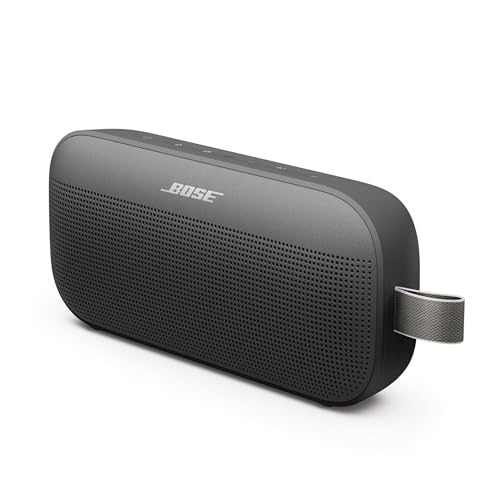
Bose SoundLink Flex 2nd Gen — Best all-rounder
Bose built the SoundLink Flex line around a simple observation: most people own one portable speaker, not a fleet, so that one speaker has to be good at everything without being great at being carried. The second-generation Flex keeps the flat, brick-like shape that slides into a bag’s flat pocket, wraps it in a sealed body the listing describes as waterproof and dustproof, and gives it up to twelve hours of battery life by the maker’s claim. It is the speaker in this guide we would hand to someone who refused to explain their plans, because it has no scenario where it embarrasses itself.
The sound is where the Flex justifies its position at the top of this list. Bose tunes for composure: vocals stay forward and intelligible when a track gets crowded, bass is present without the boomy exaggeration that makes small outdoor speakers tiring after an hour, and the speaker holds together at the high volumes open air demands. On a patio with eight people talking, that composure matters more than raw loudness — a speaker you can still understand at moderate volume is one you do not have to keep turning up. The Flex also handles position gracefully; it sounds respectable standing up, lying flat or tossed on a towel, which suits a product that will rarely be placed with care.
Ownership details are quietly strong. USB-C charging means the cable in your phone kit tops it up. The claimed twelve hours maps to a long day out with charge to spare, or several evenings of balcony listening between charges. What it does not offer is spectacle: no light show, no app-driven equaliser playground, no floating trick for the pool. It is a tool-shaped object that plays music very well and shrugs off weather, and for a great many buyers that restraint is precisely the appeal.
- Format: compact flat portable speaker, sealed body
- Listing states: waterproof and dustproof construction
- Battery: up to 12 hours, per the manufacturer’s listing
- Charging: USB-C
- Sound positioning: hi-fi audio claim in the listing title
Strengths
- Balanced, unforced sound that stays clear when tracks get dense or the volume climbs.
- Flat shape packs better than cylindrical rivals in bags and glove boxes.
- Sealed construction suits rain, dust and beach sand without special handling.
Trade-offs
- Twelve claimed hours trails the marathon batteries elsewhere in this guide.
- No light effects or floatability for buyers who want party features.
- Sits in a higher price tier than the value picks, as Bose products usually do.
Best for: one-speaker households that want a single unit for the garden, the beach and the holiday suitcase. Not suited for: hosts who need one box to fill a large yard with dance-volume sound.

Anker Soundcore 2 — Best value workhorse
The Soundcore 2 has been on sale for years, which in this category is itself a credential: outdoor speakers that disappoint get replaced by newer models, while this one kept its listing, its shape and its audience. Anker’s formula is endurance and simplicity. The listing claims twenty-four hours of playtime, an IPX7 water rating, twelve watts of stereo output and wireless stereo pairing, wrapped in a plain rectangular body with big, glove-friendly buttons on top. Nothing about it is fashionable, and that is rather the point — it is built like site equipment.
IPX7 deserves a sentence of its own, because the Soundcore 2 is a good place to learn the scale. The seven means the speaker was tested submerged in a metre of still, clean water for thirty minutes and kept working. Rain, splashes, a knocked-over drink and a brief accidental dunk are all inside that envelope. What IPX7 does not promise is survival in moving water, soapy water or salt water left to dry in the seals — rinse a beach-used speaker with fresh water and let it dry before charging, whichever model you buy. Judged against that standard, the Soundcore 2’s rating is a genuine outdoor qualification, not decoration.
Sonically it plays the honest middle: clear enough for podcasts on a workday in the garden, punchy enough for playlists at a barbecue, and helped by Anker’s BassUp processing when the music needs low-end encouragement. The stereo pairing is the feature that quietly doubles its usefulness — two Soundcore 2 units placed at opposite ends of a patio give true left-right separation and coverage that a single louder speaker firing from one corner cannot match. For buyers furnishing a whole outdoor space on a budget, that two-unit route is worth pricing before defaulting to one big box.
- Format: rectangular portable speaker with top controls
- Water rating: IPX7, per the listing
- Battery: 24-hour playtime claim in the listing
- Output: 12W stereo sound, per the listing
- Extras: wireless stereo pairing, BassUp processing, Bluetooth 6 per listing
Strengths
- Claimed full-day battery outlasts the rest of the line-up, matched only by the Boom 2.
- Stereo pairing turns a budget speaker into a scalable patio system.
- Simple controls and a tough, plain body suit work and garden use.
Trade-offs
- Sound is capable rather than refined next to the Bose in direct comparison.
- Design is purely functional; it brings no light show or style statement.
- Long model life means buyers should check the listing revision matches the specs quoted.
Best for: gardeners, campers and budget-minded hosts who value battery life and the option to pair a second unit later. Not suited for: listeners who want the most polished sound quality in a single compact speaker.

JBL Go 4 — Best pocket pick
The Go 4 asks a different question from every other speaker here: not how much sound can we make, but how little speaker can still be worth carrying? JBL’s answer is a squared-off puck, small enough for a coat pocket, that the listing describes as waterproof and dustproof, with up to seven hours of built-in battery and a body partly made with recycled materials. In the Squad colourway it looks like a piece of outdoor kit rather than a gadget, which fits its intended life clipped to bags, bikes and beach gear.
Judged as a personal speaker, it succeeds. Within a couple of metres — a towel, a picnic rug, a hotel balcony, a desk at a campsite — it delivers the recognisable JBL tuning: bright, forward and punchier at the low end than its size suggests. Step ten metres away across a breezy field and physics reclaims it; the Go 4 cannot fill open space, and no honest review should pretend otherwise. Its job is to be present. Speakers get left behind when they are bulky, and a speaker that is present at moderate volume beats a powerful one sitting at home, every single outing.
The seven-hour claimed battery is the number to plan around. It covers a beach day or a long hike’s rest stops comfortably, but a full weekend away needs a top-up from a power bank via its charging cable, which most travellers carry anyway. Waterproof and dustproof construction means it can be rinsed after a sandy day and does not fear a rain shower mid-hike. Buy it as a companion, not as a party system, and it is one of the most satisfying products in this guide.
- Format: ultra-portable pocket speaker
- Listing states: waterproof and dustproof construction
- Battery: 7-hour built-in battery, per the listing
- Body: made in part with recycled materials, per the listing
- Sound: JBL Pro Sound tuning with emphasis on punchy bass for its size
Strengths
- Genuinely pocketable, so it actually gets taken along.
- Sealed body shrugs off rain, dust and rinsing after the beach.
- Lively tuning flatters playlists and podcasts at close range.
Trade-offs
- Seven claimed hours is the shortest endurance in this guide.
- Cannot cover a group spread across a yard or a windy shoreline.
- Bass is clever processing around a tiny driver, not the real thing.
Best for: hikers, travellers and beachgoers who listen solo or in pairs and pack light. Not suited for: anyone shopping for the main speaker at an outdoor gathering.

Soundcore Boom 2 — Best for pools and parties
The Boom 2 is the extrovert of this line-up. Anker’s Soundcore team gave it a boombox stance, RGB lighting, a claimed eighty watts of output with BassUp 2.0 processing, an IPX7 rating — and, the detail that changes how people use it, a body that floats. Anyone who has watched a speaker slide off a pool edge knows why floatability matters: a normal speaker sinks and dies, while the Boom 2 bobs at the surface, still playing, waiting to be fished out. Around water, that single trait can be worth more than any equaliser.
The claimed twenty-four hours of playtime is the other headline, and it reshapes the speaker’s role. A unit that can plausibly run a full day of poolside music, then an evening on the patio, then part of the next day, stops being something you manage and becomes something you simply use. The custom equaliser in the Soundcore app is genuinely useful outdoors, too: adding low-end weight for open-air listening and trimming it back when the speaker comes indoors near walls is a two-tap job. USB-C charging keeps it on the same cable standard as the rest of a modern kit bag.
Size is the honest cost. The Boom 2 is a carry-it-in-one-hand boombox, not a slip-it-in-a-pocket companion, and its light show will not suit every setting — though the lights can be part of the fun at a pool party after dark, they can be toned down when the mood is quieter. Its sound is tuned for impact: big, confident and bass-forward, prioritising the energy a gathering needs over the fine detail a quiet listener might chase. For its stated purpose, that is the correct set of priorities.
- Format: boombox-style portable party speaker
- Output: 80W claim in the listing, with BassUp 2.0
- Water rating: IPX7 per listing, and the body floats
- Battery: 24-hour playtime claim in the listing
- Extras: RGB lights, custom EQ via the Soundcore app, USB-C charging
Strengths
- Floating waterproof body removes the biggest pool-deck risk entirely.
- Claimed day-long battery supports weekend gatherings without cable anxiety.
- App equaliser lets one speaker serve both open-air and indoor roles.
Trade-offs
- Boombox bulk rules it out for light-pack travel and hiking.
- Bass-forward tuning favours parties over critical listening.
- Light effects divide opinion and are wasted in daylight settings.
Best for: pool owners, lake-day groups and party hosts who need volume, endurance and water confidence in one box. Not suited for: minimalists who want a speaker that hides in a jacket pocket.

Monster S620 — Best for big open spaces
Monster’s S620 enters this guide as the large-cabinet alternative: a bigger body than the Bose or the little Anker, a listing claim of sixty watts, true wireless stereo pairing, Bluetooth 5.4 and a built-in microphone. The headline that will catch a careful reader’s eye is the IPX8 figure in its listing. On the ingress scale, eight sits above seven and generally denotes submersion beyond a metre under conditions the manufacturer specifies — deeper or longer than the standard IPX7 test. Treat that as the maker’s claim, check the listing’s own stated test conditions before trusting it at depth, and the practical takeaway stands: this speaker is built to be untroubled by serious water exposure.
The larger cabinet is doing real work here. Bass is a moving-air problem, and a bigger box with more internal volume gives the drivers an easier job in open spaces where small speakers strain. For a big garden, a worksite yard or a beach group spread over a wide area, the S620’s approach — size plus claimed output — is a rational one. The built-in microphone adds a use the others largely skip: taking a call through the speaker while your hands are in the garden or the engine bay, then dropping straight back into the music.
Dual pairing, as the listing phrases it, lets a second compatible unit join for stereo or doubled coverage, which is the growth path to consider if one speaker proves almost enough. The compromises are the familiar ones of the class: this is not the speaker you toss in a handbag, and Monster’s tuning historically favours punch and presence over neutrality, which flatters outdoor listening but may not suit acoustic music at close range indoors. As an open-space tool, though, its specification reads like it was written by someone who understood the assignment.
- Format: larger portable outdoor speaker
- Output: 60W claim in the listing, true wireless stereo pairing
- Water rating: IPX8 claim in the listing — check stated test conditions
- Bluetooth: version 5.4 per listing, dual pairing supported
- Extras: built-in microphone for hands-free calls
Strengths
- Big cabinet and high claimed output suit wide, noisy outdoor areas.
- Highest water-resistance claim in this guide, per its listing.
- Microphone support makes it useful for calls during outdoor work.
Trade-offs
- Size and weight work against casual carrying and travel.
- Impact-first tuning is less ideal for quiet, detailed listening.
- IPX8 conditions vary by maker, so the fine print matters more here.
Best for: owners of large gardens, workshops and yards who need one speaker to reach the far fence. Not suited for: travellers counting grams or listeners building a subtle desktop setup.

MIATONE Boombox — Best simple boombox
The MIATONE Boombox is the minimalist’s answer to feature creep. Its listing is strikingly plain — an outdoor portable Bluetooth speaker, waterproof, wireless, black — and the product matches that description: a boombox-shaped speaker that pairs, plays and withstands the weather, without an app ecosystem or a light show competing for your attention. There is a real audience for this. Many outdoor speakers get bought for a specific job — the garage shelf, the allotment, the fishing spot — and in those places, every feature beyond play, pause and survive is decoration.
Because the listing gives so little away, this review will not invent numbers for it. No battery figure or wattage is quoted here, because none is stated in the verified listing title we worked from, and a guide that fabricates specifications to fill a table has stopped being a guide. What can be said fairly is that the boombox format itself carries advantages: a handle-friendly shape, drivers with room to breathe, and a stance that sits stably on grass, gravel or a workbench. Buyers considering it should read the current listing’s full specification section before ordering and weigh the stated figures there against the fully specified rivals above.
Positioned honestly, the MIATONE is the pick for people who distrust fuss. It will not float in the pool, run an equaliser from your phone or pair into an app-managed system. It will play music outside, get rained on, and ask nothing of you. For a second speaker — the one that lives in the garage so the good one does not have to — that simplicity is a legitimate buying argument, and it earns the Boombox its place as the closing pick of this guide.
- Format: boombox-style portable speaker
- Listing states: waterproof outdoor design
- Connectivity: Bluetooth wireless pairing
- Colour: black, per the listing
- Note: confirm battery and output figures in the full listing before buying
Strengths
- Boombox shape sits stably and carries easily around a property.
- No app or account layer between the buyer and the music.
- Weatherproof positioning suits permanent outdoor-adjacent homes like garages.
Trade-offs
- Sparse listing detail means more homework before purchase than rivals need.
- No stated floatability, light show or app equaliser.
- Buyers wanting verified marathon battery claims should compare the Ankers.
Best for: buyers who want a set-and-forget boombox for the garage, garden or fishing spot. Not suited for: spec-driven shoppers who want every figure certified before they commit.
How do the six compare side by side?
| Speaker | Role it plays best | Water claim (listing) | Battery claim (listing) |
|---|---|---|---|
| Bose SoundLink Flex 2nd Gen | Single do-everything speaker | Waterproof and dustproof | Up to 12 hours |
| Anker Soundcore 2 | Budget endurance and pairing | IPX7 | 24 hours |
| JBL Go 4 | Pocket companion | Waterproof and dustproof | 7 hours |
| Soundcore Boom 2 | Pool and party anchor | IPX7, floats | 24 hours |
| Monster S620 | Wide open spaces | IPX8 claim | See listing |
| MIATONE Boombox | Simple garage boombox | Waterproof | See listing |
Read the battery column as a planning tool rather than a promise. Makers typically measure playtime at a fraction of full volume, with lights and extra processing off, playing undemanding material. Real outdoor use — high volume to beat the wind, bass boost engaged, lights running — can halve the figure. The practical rule is to buy for the outing you actually take: if your beach days run six hours, a speaker claiming twelve gives you the margin that real-world conditions will consume. If your gatherings run past dark, the two twenty-four-hour claims in this guide are where your shortlist starts.
The water column needs the same translation. A stated IP code is a test result with a defined meaning; a bare word like waterproof is a marketing summary that may hide anything from splash resistance to full submersion. When a speaker will live near a pool, prioritise a printed code — IPX7 or better — and remember that no code covers hot tubs, soapy water or high-pressure jets. Dust matters too, and it hides in the full IP format: a rating written as IP67 or described as dustproof tells you the seals keep grit out, which is what beach and building-site use actually demand.
Which features actually matter when you shop for outdoor sound?
Start with placement, because placement decides size. Picture where the speaker will spend most of its life. On a table among friends, a mid-sized unit at ear height when seated outperforms a boombox on the ground. On the ground by a pool, the boombox’s upward spread and floatability win. In a rucksack, only the pocket class exists. Shoppers who skip this visualisation buy the speaker that impressed them in a shop demo — a small, reflective room that flatters everything — and then wonder why it disappoints in the garden.
Next, weigh controls you can use with wet or gloved hands. Big physical buttons beat touch panels outdoors, every time. Check whether the speaker can pause, skip and answer calls from its own body, because your phone will be in a dry bag, a pocket or another room. Bluetooth range claims deserve similar realism: walls, bodies and water all shorten range, so a speaker that will sit across the garden from your phone benefits from a recent Bluetooth version and, ideally, a position with line of sight to the source.
Finally, think about the second summer. Sealed speakers cannot have their batteries replaced, so battery health is product life: avoid leaving any of these units baking in a hot car or stored fully flat for months. Rinse salt and chlorine off after water days, dry the charging port before plugging in, and store the speaker half-charged if it will sit through winter. Buyers who want a related corner of this category covered in depth should look at our guide to best waterproof shower speakers, where the same ratings are tested against steam, tiles and daily splashing rather than weather.
How do you set up an outdoor speaker for the best sound?
Elevation is the cheapest upgrade in outdoor audio. A speaker on grass loses energy into the ground and fires its sound at ankle height; the same speaker on a table, a cooler or a wall ledge projects across the listening area and gains clarity for free. Keep it away from corners and walls if you want clean sound, or push it toward a wall deliberately if the party needs more bass — the boundary reinforces low frequencies, outdoors as surely as in a living room.
For gatherings, think in zones rather than volume. One speaker cranked to distortion at the centre of a garden is worse than the same speaker at moderate volume near the people, and far worse than a paired stereo set at two ends of the space, each cruising comfortably. That is the practical case for the pairing features on the Soundcore 2, the Boom 2’s family ecosystem and the S620: coverage through placement beats coverage through loudness. Set levels while standing where your guests will actually be, not beside the speaker, because the difference between those two spots is the whole lesson of outdoor sound.
Before a big day, run a ten-minute rehearsal: pair the speaker, walk the space with your phone to find drop-out spots, charge everything the night before, and download playlists if the venue’s signal is doubtful. Streaming over a congested campsite network is a needless risk when the music can live on the phone itself. For buyers whose outdoor life centres on the pool rather than the patio, our companion guide to best portable party speakers covers the larger, louder end of this same problem.
What mistakes do outdoor speaker buyers keep making?
Judging by shop-demo sound is the most expensive habit. A small speaker in a tiled showroom, two metres away, with walls feeding it bass, tells you almost nothing about that speaker on a breezy beach at eight metres. Demo with the role in mind: hold the speaker at the distance your group will sit, play the music you actually listen to, and be suspicious of any unit that only impresses at full volume — headroom is what separates a relaxed speaker from a straining one.
Ignoring the charging standard causes quieter grief. A speaker that needs a proprietary cable will eventually be dead at the moment it is wanted, its cable lost in a drawer of obsolete leads. USB-C models borrow the household’s existing chargers, which is why this guide notes the standard wherever a listing states it. A related error is storing a speaker discharged: lithium batteries left empty for a season can lose capacity permanently, so a mid-winter top-up is cheap insurance.
And a word about rinsing: waterproof speakers still hate salt crystals and chlorine residue drying inside their grilles and ports. The rinse takes twenty seconds under a tap. Skipping it all summer is how a genuinely waterproof speaker ends up sounding muffled and charging unreliably by autumn.
How does Bluetooth behave once you take it outside?
Bluetooth range figures are quoted for open air with nothing between the phone and the speaker, and outdoors is the one environment where that test condition sometimes actually happens — a clear garden can give you the full advertised reach. The obstacles that shorten range outside are less obvious than walls. Human bodies absorb the signal surprisingly well, so a phone in a back pocket with its owner between it and the speaker can halve the working distance. Water is worse: a speaker floating in a pool with its antenna near the surface may drop a connection that worked perfectly on the deck, because the waterline blocks the path whenever a swimmer’s body crosses it.
Version numbers matter modestly here. Newer Bluetooth revisions, like the 5.4 listed for the Monster S620 and the Bluetooth 6 claimed in the Soundcore 2’s listing, generally hold connections more robustly and sip power more efficiently than older ones, but they cannot repeal physics. The practical habits matter more: keep the phone elevated and in line of sight where you can, avoid burying it in a metal-lined cool bag, and if a garden is long, put the speaker in the middle of the gathering rather than at the far end and ask the connection to cross the whole space twice.
Multi-device households add one more wrinkle. A speaker remembered by three family phones will connect to whichever it sees first, which is how a barbecue ends up playing a teenager’s playlist from indoors. Learn your speaker’s way of clearing its pairing list or forcing pairing mode before the event, not during it. Every model in this guide handles this through its buttons; the two minutes spent finding the sequence in the manual is the cheapest party insurance in this entire article.
Which speaker fits which kind of day out?
Consider the beach first, because it attacks speakers from three directions at once: sand in the seals, salt in the grille and sun on the battery. Dustproof construction is the trait that earns its keep here, which points to the sealed Bose and the Go 4, with a fresh-water rinse afterwards for whichever you take. Volume needs at the beach are modest — your group huddles within a few metres — so portability beats power, and the speaker most likely to be packed is the small one.
The pool deck reverses those priorities. Groups spread out, water noise masks quiet passages, and the drop risk is constant. This is Boom 2 territory, with the S620 as the alternative for very large pool areas where its bigger cabinet reaches the far loungers. The campsite asks for endurance above all: the twenty-four-hour claims of the Soundcore 2 and Boom 2 mean a weekend without rationing music, and the Soundcore 2’s smaller body suits a car already full of tent gear. The worksite and the allotment reward toughness and simplicity — big buttons, no app, no delicate finish — which is the MIATONE’s whole argument, shared with the Soundcore 2 for those who also want certified submersion protection.
The boat deserves its own sentence because it combines every hazard: spray, knocks, confined space and the certainty that anything dropped overboard is gone. A floating speaker or a small speaker on a lanyard loop is the sensible shape here; the Go 4 in a pocket and the Boom 2 bobbing alongside represent the two ends of that logic. Match the speaker to the day you actually have most often, not the most glamorous day you can imagine, and the purchase will feel right all summer.
What should you know about charging and battery care in the field?
A speaker’s battery claim is a laboratory number, and the field rewrites it. Volume is the biggest variable: pushing a speaker near its maximum to fight wind noise can cut playtime to a fraction of the figure measured at gentle levels, because amplifier demand rises steeply at the top of the dial. Bass-heavy music costs more than speech. Cold mornings cost capacity too, which early-season campers notice when a speaker that cruised through August evenings fades faster in October. None of this is a defect; it is the arithmetic every model in this guide obeys, and it is why the endurance picks claim a full day — the margin is the product.
Charging away from home is where USB-C earns its place in three of these listings. A single power bank and the cable already in your phone kit can revive the Bose, the Boom 2 or most modern rivals at a campsite, while a speaker with an older or proprietary connector needs its own lead remembered and packed. Some speakers can also play while charging, which rescues a forgotten overnight charge: plug into the power bank, keep the music going, and let the battery recover as it works. Check the port is dry before any of this — sealed speakers forgive rain, but electricity and standing water in a socket remain enemies.
At home, two habits extend the life of every sealed speaker here. First, avoid the double punishment of a speaker stored discharged in a hot shed; heat plus an empty cell is the fastest route to a battery that will not hold a summer’s charge by its third year. Second, if a speaker will sit unused through winter, leave it roughly half charged in a cool cupboard and give it a brief top-up midway. These are unglamorous details, but the difference between a speaker that serves five summers and one that serves two is almost entirely written by them.
How loud is loud enough for a garden, honestly?
Buyers ask for a number, and the honest answer is a relationship instead: loud enough means the music stays clear at the distance your listeners actually sit, with the speaker working at perhaps two-thirds of its capacity so transients and bass notes still have headroom. A speaker straining at its limit sounds worse than a larger one cruising, even at the same measured volume, because distortion — not decibels — is what makes people ask for music to be turned down. When you compare the picks above, read size as a headroom statement. The Go 4 cruising at a towel is comfortable; the same unit at full tilt across a patio is not, and the Boom 2 exists precisely for the spaces where cruising requires a bigger engine.
Background noise sets the floor. A quiet rural garden needs very little; a garden beside a road, or a beach with surf, needs substantially more, and no pocket speaker will win that fight at distance. Bringing the speaker closer beats buying a bigger one surprisingly often — halving the distance to your listeners gains more clarity than any equaliser preset. That is also why two paired mid-sized speakers, one near each end of a gathering, so often sound better than a single flagship: each covers its own zone gently instead of one box shouting across both.
When does pairing two speakers beat buying one bigger one?
Stereo pairing is the most underused idea in this category. Two modest speakers, separated by a few metres and each playing one channel, create a soundstage with genuine width: instruments sit in places, voices centre themselves, and the music stops sounding like it comes from a box and starts sounding like it occupies the space. A single speaker, however expensive, plays from a point. For seated listening — a patio dinner, a campsite circle — that width is a bigger upgrade than extra wattage, and it is why the Soundcore 2’s pairing feature punches so far above its price tier.
Pairing also solves coverage without volume. At a long garden party, one speaker at each end, each at moderate level, lets conversation happen everywhere while the music remains present everywhere too. The failure mode to avoid is mixing generations or brands and expecting them to cooperate; pairing is a family feature, so buy the second unit from the same line while it remains on sale. Also note that in stereo mode, placement symmetry matters: roughly equal distances to the main listening spot, similar heights, nothing muffling one side. Set up carelessly, a pair can sound lopsided; set up with two minutes of care, it embarrasses single speakers costing far more.
The honest limits deserve stating. Pairing doubles what you carry and what you charge, and outdoors the stereo image only holds for listeners near the middle — wander to one end and you mostly hear the near speaker, which is fine, because at that point it is simply your local zone speaker. Treat pairing as an option the right pick leaves open, not a day-one obligation: buy one good unit, live with it for a season, and let experience tell you whether width or coverage is the thing you are missing.
Final Recommendation
If one speaker must do everything, buy the Bose SoundLink Flex 2nd Gen and stop researching: it is the most complete balance of sound, sealing and portability here. If your outdoors means water and people, the Soundcore Boom 2 is the guide’s party answer, and its floating body is a feature you will appreciate exactly once — on the day it saves the speaker. Budget shoppers and patient builders should start with the Soundcore 2, knowing a second unit later completes the system. Walkers and travellers get the Go 4. Big spaces point to the S620, and the quietly practical get the MIATONE. Choose by the life the speaker will live, and this category stops being confusing: the right outdoor speaker is simply the one still playing, unbothered, when the weather turns and the evening runs long.
Frequently Asked Questions
What does IPX7 actually allow me to do?
IPX7 certifies survival after thirty minutes submerged in one metre of still, clean water. Practically, that covers rain, splashes, poolside accidents and brief drops into a pool or bath. It does not cover swimming with the speaker, holding it under a tap’s jet, hot water, or leaving salt water to dry in its seals. Treat submersion as accident insurance rather than a feature to use daily, and every IPX7 speaker in this guide will live longer for it.
Can two different brands of speaker pair together for stereo?
Generally, no. Stereo and party pairing are brand ecosystems: Anker pairs with Anker, the Monster pairs with its own kind, and cross-brand stereo is not a standard Bluetooth feature. If a paired setup is your plan, commit to one family early — which is why the Soundcore 2’s pairing feature matters so much at its price, since the second unit is an affordable later purchase rather than a stretch.
Why does my speaker sound weaker outside than in my kitchen?
Your kitchen was helping. Walls and ceiling reflect sound back to you, reinforcing bass and volume; open air lets that energy escape in every direction. Wind and conversation then mask what remains. The fixes are placement and expectation: raise the speaker, move it closer to listeners, add a wall behind it if bass feels thin, and choose a speaker sized for the space rather than turning a small one up until it distorts.
Is a higher wattage claim always louder?
No. Wattage figures in listings are often peak claims measured in ways that flatter the number, and loudness also depends on driver size, cabinet volume and tuning. A large-cabinet speaker with a modest claim can outplay a tiny speaker with a heroic one. Use wattage as a rough class indicator only — pocket, portable, boombox — and let the role-based advice in the reviews above carry the decision.
How should I care for a speaker after beach use?
Rinse it gently with fresh water if its rating allows, shake water from the grille, and let it dry fully before charging — a wet charging port is a common cause of corrosion and failed charges. Brush dried sand from seams rather than blowing it deeper in. Store it out of direct sun with a partial charge, and it will start the next season sounding like it did at the end of the last.
Can I leave an outdoor speaker outside all summer?
Water resistance is not weather immunity. A sealed speaker tolerates rain showers and splashes, but months of ultraviolet, heat cycles and damp air will age its seals, fade its finish and stress its battery even if no single storm harms it. The speakers here are built to be taken outdoors, not to live there like the rock speakers in a neighbouring guide. Bring them under cover when the day ends, store them somewhere dry, and they will reward the small effort with years of service. The one exception to fuss about is a speaker in regular pool use: chlorine residue deserves that quick rinse every time, not just when you remember.
Does a speaker need Wi-Fi or an app to be worth buying?
Neither is required, and for outdoor use there is a case that simpler is better: Bluetooth from a phone covers the overwhelming majority of real listening, and physical buttons keep working when an app is logged out or a network is down. An app earns its place only when it adds something you will genuinely use — the Boom 2’s custom equaliser is the example in this guide, because outdoor and indoor listening really do want different bass levels. Judge apps as accessories to the speaker, never as the reason to buy it.
Which of these speakers is best for listening to podcasts and radio outside?
Spoken word rewards clarity over bass, so the Bose Flex and the Soundcore 2 lead here: both keep voices forward and intelligible at the modest volumes speech needs. The Go 4 also serves well for solo listening at close range. The big party speakers can play speech perfectly loudly, but their tuning emphasis sits lower, and voices at a distance across a garden can blur against wind noise.
Related Guides
Rock-shaped speakers that hide in flower beds, shower speakers built for steam and tile, and the rest of this speaker cluster are covered in our guide to best outdoor rock bluetooth speakers, which takes the garden-camouflage route this guide deliberately left aside.


