What's inside
- Key Takeaways
- Quick Picks
- How Did We Choose These 3.5-Inch Picks?
- Why Can’t a 3.5-Inch Speaker Make Bass?
- What Does a High-Pass Filter Actually Do for Dash Speakers?
- How Should You Choose the Best 3.5-Inch Car Speakers for Your Dashboard?
- Where Do 3.5-Inch Speakers Actually Live in Cars?
- Can You Run 3.5-Inch Speakers Without an Amplifier?
- What Should You Listen for in the First Week?
- How Do You Keep Small Dash Speakers Alive for Years?
- How Do Dash Speakers Shape the Soundstage?
- Should Rear Passengers Get 3.5-Inch Speakers Too?
- What Changes When the Car Is a Classic?
- How Do You Test a Dash Speaker Before Committing?
- Comparison Table
- What About the Cars With Two Different Small Sizes?
- What Mistakes Do 3.5-Inch Buyers Keep Making?
- Final Recommendation
- Frequently Asked Questions
- Related Guides
As an Amazon Associate I earn from qualifying purchases. This post may contain affiliate links at no extra cost to you.
gizmoverdict.com is reader-supported. When you buy through links on our site, we may earn an affiliate commission.
Where to buy: Links to listings verified in this site’s product pool sit under three picks below, and all three are genuine 3.5-inch models. The remaining three are prose-only reference classes discussed without links, because no verified listing for them sits in the pool.
Shopping for the best 3.5-inch car speakers usually starts with a disappointment: the factory dash speakers in an older sedan, a compact hatchback or a classic truck have dried out, buzz on talk radio and turn every podcast voice into paper tearing. The 3.5-inch size lives in shallow dashboard corners and a handful of rear-deck and door locations, and it survives there for one reason — nothing larger fits the hole. That single fact should frame every expectation in this guide. A 3.5-inch cone has very little surface area, and surface area is what moves air, and moving air is what bass physically is. No crossover trick, magnet claim or brand heritage repeals that arithmetic.
So the honest promise of this size class is clarity, not weight. A good 3.5-inch replacement transforms the top two-thirds of the music: voices step forward, cymbals stop sounding like static, guitar strings separate from each other, and the navigation prompts you used to miss become plain. What it will never do, on its own, is thump. Owners who understand that division of labour end up delighted with these speakers. Owners who expect door-panel bass from a dashboard trinket end up writing angry reviews of perfectly competent products, and this guide is written to keep you in the first group by pairing every pick with the filtering and system advice the size demands.
The three linked picks below — from Kicker, Infinity and JBL — are the verified core of the current 3.5-inch market, and they differ in voicing more than in purpose. Around them sit three prose-only classes that matter to real shopping trips: the shallow Kenwood class built for tight factory pockets, the custom-fit Pioneer class aimed at specific dashboards, and the higher-output Punch-style class for owners running small amplifiers. Between the six, every realistic 3.5-inch scenario gets covered, from a fifteen-minute dash swap in a commuter car to a deliberate front-stage build in a restored coupe.
Key Takeaways
- A 3.5-inch cone cannot make real bass; buy this size for vocal clarity and treble detail, and let larger speakers or a subwoofer carry the bottom.
- A high-pass filter or bass blockers are close to mandatory — feeding full-range bass into a dash speaker this small wastes power and invites distortion.
- All three linked picks are true 3.5-inch pairs verified in the pool; the Kicker and Infinity are coaxial designs, while the JBL listing describes a two-way component speaker system with no grill.
- Dash locations fire into the windscreen, so treble behaviour and tweeter design matter more here than in almost any other car location.
- Sensitivity deserves attention because most of these speakers will live on modest factory or head-unit power.
- Measure the factory pocket’s depth and tab layout before ordering; 3.5-inch fitment varies more between cars than the nominal size suggests.
Quick Picks
| Pick | Badge | Why it earns its place |
|---|---|---|
| Kicker DSC350 | Forgiving dash all-rounder — 3.5-inch coaxial pair | The warm, easy-going voice of the verified trio, and the gentlest partner for tired factory head units. |
| Infinity Reference 3032CFX | Detail-first voice — 3.5-inch two-way pair | The explicit, articulate member of the trio, for drivers who listen to words and acoustic detail closely. |
| JBL Club 322F | Component-system route — listed as a two-way component speaker system, no grill | The deliberate-install pick: the listing describes a component speaker system, which changes where the treble comes from. |
| Kenwood KFC-835C class | Shallow-pocket specialist class (prose-only) | The depth-first class: built for the factory pockets so shallow that standard 3.5-inch speakers foul the ducting behind them. |
| Pioneer custom-fit 3.5-inch class | Vehicle-specific fitment class (prose-only) | The class that starts from your exact dashboard rather than from a nominal size, tabs and all. |
| High-output Punch-style 3.5-inch class | Amplifier-friendly output class (prose-only) | The class for owners feeding dash speakers from a small amplifier who find the linked picks too polite at speed. |
How Did We Choose These 3.5-Inch Picks?
The pool discipline came first: a pick only carries a purchase link when this site’s own verified pool holds a listing whose title names the exact model and size. That filter left three linked speakers, and it is worth pausing on why the bench is so short. The 3.5-inch class is a legacy fitment kept alive by dashboards designed decades ago, so manufacturers maintain a handful of proven models rather than launching new ones each season. A short bench is not a weakness of this guide; it is an accurate map of the shelf you will actually find in a store.
Within the linked three, the choosing lens was voicing and role. One pick leans warm and forgiving for talk and older recordings, one leans detailed and explicit for listeners who want every consonant, and one arrives as a component-style system for owners willing to place a tweeter deliberately. The prose-only classes then widen the map along the axes the linked three do not cover: mounting depth, vehicle-specific fitment and amplifier headroom. Every pick below also had to survive a practicality test — could a typical owner install it in the location this size actually occupies, with hand tools, without cutting the dashboard apart?

Kicker DSC350 — Forgiving dash all-rounder — 3.5-inch coaxial pair
The Kicker DSC350 is the pick that treats the 3.5-inch job description with the least ego. Its listing describes a 3.5-inch coaxial pair in a 4-ohm load, sold as a pair, and the DS-series character behind that plain description is a speaker voiced to flatter ordinary material played through ordinary electronics. In a dashboard corner, firing up into glass, that forgiveness is a genuine engineering virtue: a speaker that stays composed and slightly soft at the top end will sound musical for hours, where a more aggressive design can turn the windscreen into a magnifying glass for every harsh edge in a recording.
Think about what a dash speaker actually plays all day. It plays voices — presenters, podcasters, audiobook narrators, the passenger reading directions aloud is replaced by the speaker reading them — and it plays the upper harmonics that tell your ear a guitar is nylon or steel, a piano is near or far. The DSC350’s balance puts that information forward without sharpening it into glare. Owners replacing perished factory units in older family cars tend to describe exactly the right reaction: the car sounds awake again, and long drives stop being fatiguing. That is the whole job, done without drama.
The practical notes are equally unglamorous and equally important. As a coaxial pair it asks nothing exotic of the installer: two speakers, factory-style connections, and mounting in the pocket the car already has. Pair it with a sensible high-pass setting so the little cones stop trying to reproduce kick drums, and the DSC350 settles into the role of the set you forget about because nothing about it ever annoys you. In a size class full of compromises, the absence of annoyance is close to a definition of quality.
Ownership of this pick has a particular rhythm worth describing: nothing about it asks for attention after the first week. It does not reward tweaking, punish sources or demand a crossover ritual beyond the basic filter. In a hobby full of equipment that wants managing, a speaker that simply serves is a deliberate pleasure, and it explains why the DS approach keeps its place in the catalogue while flashier small speakers rotate through and vanish.
- Size: 3.5 inch (89mm), true to the guide’s size
- Format: coaxial, sold as a pair
- Impedance: 4 ohm, per the listing title
- Role: dashboard and small factory locations
Strengths
- Warm, fatigue-free voicing that suits talk radio and podcasts beautifully
- Straightforward coaxial swap in most factory 3.5-inch pockets
- Plays happily on modest head-unit power
Trade-offs
- Its gentler top end gives away a little sparkle to the Infinity below
- Like every pick here, it needs bass filtered out to stay clean at volume
- Owners building an amplified front stage will outgrow it first
A word about pairing: the DSC350 is at its best when the rest of the system accepts the same honest division of labour. Let door speakers or a small subwoofer handle everything below the vocal range, set the crossover once, and the little Kickers become specialists. Specialists, in audio as in everything else, sound better than generalists asked to do everything at a third of the necessary size.
Best for: everyday drivers reviving a tired dash with talk, pop and podcasts in heavy rotation. Not suited for: listeners chasing maximum treble detail, or anyone expecting low-end weight from the dash itself.

Infinity Reference 3032CFX — Detail-first voice — 3.5-inch two-way pair
Where the Kicker relaxes, the Infinity Reference 3032CFX pays attention. The listing describes a 3.5-inch two-way pair from Infinity’s Reference line, and the family trait on display is articulation: consonants arrive intact, string attacks have edges, and the small cues that separate a studio recording from a live one survive the journey through a noisy cabin. In a dashboard location this clarity has a practical payoff beyond audiophile pleasure. Spoken directions, hands-free calls routed through the car and late-night talk shows all become easier to follow at lower volumes, which is a safety feature wearing a hi-fi disguise.
That explicitness cuts both ways, and this pick’s section is the place to say so plainly. A detailed speaker in a reflective dash location will faithfully reproduce a poor recording’s flaws and a cheap head unit’s rough edges. Owners whose listening is mostly compressed streaming over a bargain receiver sometimes find the Infinity honest to a fault during the first week, then adjust — either their source habits improve, or a small treble trim settles the partnership. Neither outcome is a defect. They are the predictable consequences of choosing the revealing instrument over the forgiving one.
Installation follows the coaxial pattern: a pair of speakers, a factory pocket, a short afternoon. The Reference earns its keep afterwards, in the thousand small moments when a lyric you have heard for years suddenly resolves into words. Drivers who lean forward in their seat to listen — metaphorically, one hopes — will recognise this as their pick, while drivers who want the car to simply sound pleasant should take the Kicker’s gentler hand instead.
There is a diagnostic bonus hiding in this pick’s honesty. Because the 3032CFX reveals the chain feeding it, owners often discover — and fix — problems they had blamed on recordings for years: a tired head unit’s noisy output, a streaming setting stuck at its lowest quality, a phone connection degrading the signal. The speaker becomes the messenger that improves the whole system, which is a strange and valuable second career for a dash component.
- Size: 3.5 inch (listed as 3-1/2), true to the guide’s size
- Format: two-way coaxial pair
- Line: Infinity Reference series
- Role: clarity-led dash and rear-fill locations
Strengths
- Speech intelligibility is the standout — calls and navigation gain real clarity
- Reveals detail in acoustic and vocal recordings that softer speakers blur
- Reference-line voicing feels a step more refined than entry dash fare
Trade-offs
- Unforgiving of poor recordings and rough budget electronics
- Windscreen reflections can exaggerate its top end in some dashboards
- Still a 3.5-inch cone: bass duties must live elsewhere in the system
Consider the listening triangle before blaming or praising this speaker. A dash-mounted pair fires at glass, and glass returns treble to your ears with interest. If your car’s dash pockets aim the speakers steeply upward, the Infinity’s detail arrives doubled; a degree of treble restraint in the head unit’s tone controls is not a compromise here but correct system tuning for the room — and a car cabin is a room, just a small and oddly shaped one.
Best for: detail listeners, audiobook devotees and anyone whose hands-free calls currently sound underwater. Not suited for: owners of very bright dashboards who already fight treble glare, or bass-first listeners.
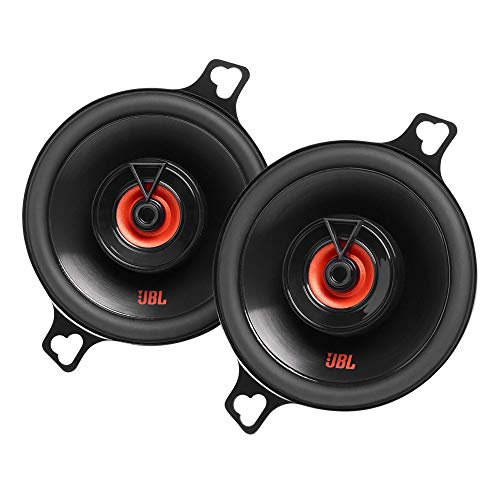
JBL Club 322F — Component-system route — listed as a two-way component speaker system, no grill
Read this pick’s listing title carefully, because this guide follows it exactly: the JBL Club 322F is described as a 3.5-inch two-way component speaker system, supplied with no grill. That wording separates it from the two coaxial picks above in a way that matters. A component arrangement separates the tweeter from the small woofer, which hands the installer a decision the coaxial designs make for you — where the high frequencies enter the cabin. Placed thoughtfully, a separate tweeter can lift the soundstage off the dashboard and reduce the windscreen’s worst reflections, because its aim is a choice rather than an accident of the woofer’s mounting angle.
The trade is effort, and honesty requires pricing that effort in. A component install in a 3.5-inch application means finding or making a home for small tweeters — a sail panel, an A-pillar trim, a discreet dash-top position — and routing their wires with care. For the owner restoring a beloved older car, or building a considered front stage around small dash woofers, that effort buys the most tailored result in this guide. For the owner who simply wants the buzzing to stop before Friday, it buys homework. Both readers exist, and the Club 322F unapologetically serves the first.
The no-grill note in the listing deserves its own sentence of respect: factory dash grilles usually cover these locations anyway, but anyone fitting the 322F in an exposed location should plan protection for the cones. Voicing sits in the JBL Club tradition — present, lively, rhythm-forward — which suits the component concept, since a system you place by hand should reward you with energy rather than politeness. Of the three linked picks, this is the one that treats the installer as a collaborator.
Budget the install honestly and the Club 322F stops looking expensive in effort. The woofer half follows the familiar dash routine; the tweeter half is a placement project of an hour or two for a careful owner, including the listening tests with temporary mounts. Spread across the years the system will serve, that afternoon is a trivial rent for a soundstage shaped by your ears instead of by a moulding drawn decades ago.
- Size: 3.5 inch, per the listing title
- Format: two-way component speaker system, per the listing title
- Grill: none supplied, per the listing title
- Role: tailored dash front stages with placed tweeters
Strengths
- Tweeter placement becomes a tuning tool instead of a fixed accident
- Lively Club voicing rewards a careful install with real presence
- The most customisable result among the verified linked picks
Trade-offs
- Installation effort is the highest here by a wide margin
- No grill in the box means exposed locations need a protection plan
- Overkill for a simple like-for-like dash refresh
If you take this route, mock the tweeter positions up with removable adhesive before committing to a single cut or screw. An evening of listening with tweeters in two or three candidate spots teaches more about your specific dashboard than any general advice can, and the component format’s entire advantage lies in that freedom. Spend it deliberately rather than defaulting to wherever the wire reaches first.
Best for: patient installers and restorers who want to place treble deliberately in a small-dash car. Not suited for: quick weekend swaps, exposed mounting locations without a grill plan, or anyone allergic to wiring.
Kenwood KFC-835C class — Shallow-pocket specialist class (prose-only)
Some dashboards were drawn by people who considered the speaker an afterthought, and the pockets they left are shallow enough to embarrass many nominally correct 3.5-inch speakers. The Kenwood KFC-835C class exists for those cars: a long-running family of slim 3.5-inch dash speakers whose entire design brief is to disappear into tight factory spaces while sounding respectably clear. This guide discusses the class without a purchase link, because the verified pool holds no listing for it — but any owner who has measured a pocket and felt their heart sink needs to know the class exists.
The engineering bargain inside a shallow speaker is worth understanding. Depth is where magnet and voice-coil travel live, so a slim design concedes output and low-end reach before the first note plays. What it protects is fitment itself, which outranks every other specification: the finest speaker in this guide is worthless in a pocket it cannot enter. Owners of older Japanese compacts and economy cars, whose dash corners often hide heating ductwork a finger’s breadth behind the grille, are this class’s natural constituency.
Shopping for the class takes a different discipline from shopping the linked picks. Verify depth with the seller’s own figures, confirm the mounting tab pattern against your factory unit, and treat any listing that will not state dimensions as a listing to skip. The reward for that diligence is a speaker that actually installs — flush, rattle-free, behind the factory grille — and in the shallow-pocket world, installed and adequate beats theoretical and returned, every single time.
One more virtue of the shallow class deserves naming: reversibility. Cars with tight pockets are often cars with some collectability gathering around them, and a speaker that fits the factory space without surgery keeps every future option open. The next owner, the next restorer, even your own change of heart in five years — all inherit a dashboard that was respected rather than modified, and that inheritance has real value in the older-car world.
- Size class: 3.5 inch dash speakers
- Defining trait: shallow mounting depth for tight pockets
- Status in this guide: prose-only, no verified pool listing
- Role: problem-fitment dashboards and older compacts
Strengths
- Solves the depth problem that defeats standard-depth rivals
- Long-running class with wide vehicle coverage knowledge
- Keeps the factory grille and the factory look
Trade-offs
- Shallow engineering concedes output before music starts
- No verified link here means your own listing checks carry the risk
- Voicing aims at competence rather than the linked picks’ character
Measure your pocket the unglamorous way: remove the factory speaker, and measure from the mounting face to the first obstruction with the grille’s clearance included. Write the number down. That single measurement, honestly taken, decides whether this class or the linked picks own your dashboard — and it takes ten minutes that will save a month of returns.
Best for: owners whose dash pockets defeat standard-depth speakers, especially in older compact cars. Not suited for: anyone whose pocket accepts a normal 3.5-inch speaker — the linked picks sound fuller.
Pioneer custom-fit 3.5-inch class — Vehicle-specific fitment class (prose-only)
Nominal sizes lie politely. A 3.5-inch speaker from one brand may carry mounting tabs in places another brand’s 3.5-inch speaker does not, and dashboards — especially the moulded pockets in older American and Japanese cars — were often shaped around one supplier’s tab pattern. The Pioneer custom-fit class built its reputation on respecting those specifics: speakers in this tradition are shaped and tabbed for named applications, so the swap respects the car’s moulding instead of arguing with it. Like the Kenwood class above, it appears here without a link because the verified pool holds no listing for it.
The appeal is strongest in restorations and careful daily drivers, where cutting a dash pad to force a generic speaker in is a small act of vandalism against the car’s future value. A custom-fit unit drops into the intended recesses, uses the intended fasteners and leaves the next owner none the wiser. Sound expectations should stay inside the size’s physics — clarity, presence, no bass miracles — but within that frame, fitment quality is a sound quality: a speaker mounted rigidly and sealed against its pocket rattles less and projects more cleanly than a better speaker wedged in with foam and hope.
Finding the right member of this class means shopping by vehicle rather than by size. Cross-check the application list against your car’s year and trim, because manufacturers changed dash suppliers mid-generation more often than nostalgia admits. A seller who cannot confirm your exact application is selling you a probability, and probabilities are poor things to discover with the dashboard already apart on a Sunday afternoon.
The custom-fit idea also ages gracefully in a way generic installs do not. A speaker seated in its intended recess, on its intended fasteners, stays seated: no foam compressing over summers, no improvised bracket loosening over winters. Ten years on, the difference between a fitted speaker and a forced one is audible as silence — the absence of the buzzes and ticks that loose hardware composes over every rough road.
- Size class: 3.5 inch, application-shaped variants
- Defining trait: tabs and recesses matched to named vehicles
- Status in this guide: prose-only, no verified pool listing
- Role: restorations and no-cut dashboard refreshes
Strengths
- Respects factory mouldings — no cutting, no wedging, no rattles
- Rigid correct mounting quietly improves clarity
- Preserves the car’s originality for future owners
Trade-offs
- Application research is on you, trim level by trim level
- Availability for less-loved models can be patchy
- You pay for fitment engineering, not for extra output
Photograph your factory speaker’s tabs and connector before ordering anything in this class, and keep the photograph beside you while you shop. Tab patterns are the fingerprint of a dash application, and matching a fingerprint beats trusting a size label that three different suppliers interpret three different ways.
Best for: restorers and careful owners who refuse to cut a dashboard for a speaker. Not suited for: shoppers in a hurry, or cars whose pockets accept generic speakers happily.
High-output Punch-style 3.5-inch class — Amplifier-friendly output class (prose-only)
Every guide owes its loud minority a hearing. Some 3.5-inch locations live in convertibles, in work trucks with roaring cabs, in cars whose owners listen over wind and tyre noise with the windows down — environments where the linked picks’ composure matters less than raw ability to stay intelligible at volume. The high-output class in the Punch tradition answers with speakers built to be driven: sturdier construction, an appetite for amplifier power, and voicing that projects. It is discussed without a link here because the verified pool holds no listing for the class, but its use case is real and its buyers know who they are.
The physics tax still applies, and this class pays it in an instructive way. Output at 3.5 inches is bought with excursion and power, and both generate heat and distortion when the cone is asked for bass it cannot make. The owners who succeed with this class are crossover disciplinarians: they high-pass firmly, let a subwoofer or larger speakers carry the low octaves, and spend their amplifier’s watts on the vocal and treble bands where a small cone can genuinely spend them. Configured that way, a high-output dash pair stays startlingly clear at speeds where softer speakers have dissolved into hash.
Configured carelessly, the same class produces the size’s worst failure mode — a loud, hard, distorted shout that fatigues in minutes. The difference is entirely in the setup, which is why this class belongs to owners who enjoy setup. If the phrase gain structure makes you reach for a search engine with enthusiasm rather than dread, the class will reward you. If it makes you close the tab, the Kicker at the top of this guide is your friend.
Noise changes what good means, and this class understands it. In a convertible at speed, a refined speaker’s subtlety is simply deleted by the environment, while projection and presence survive the journey to your ears. Judged in a quiet showroom the class can seem blunt; judged where its owners actually listen, it is the only honest tool for the job, and tools should always be judged at work.
- Size class: 3.5 inch, output-oriented builds
- Defining trait: built to be driven by separate amplification
- Status in this guide: prose-only, no verified pool listing
- Role: noisy cabins, convertibles, deliberate front stages
Strengths
- Stays intelligible at volumes that swamp gentler dash speakers
- Rewards a proper amplifier and crossover setup handsomely
- Construction aims at being driven hard without complaint
Trade-offs
- Punishes sloppy setup with the harshest sound in this guide
- Amplifier and filtering costs dwarf the speakers themselves
- On plain head-unit power its advantages mostly evaporate
Budget honestly for the whole chain before choosing this class: the amplifier, the wiring, the crossover discipline and the time. The speakers are the smallest line item in their own story, and owners who accept that upfront become the class’s happy references. Owners who buy the speakers alone become its cautionary tales.
Best for: amplified builds in loud cabins, run by owners who enjoy tuning a system. Not suited for: head-unit-only cars, quiet listening, or anyone seeking a fit-and-forget swap.
Why Can’t a 3.5-Inch Speaker Make Bass?
Start with the cone. A 3.5-inch driver’s radiating surface is a fraction of what a door-sized speaker offers, and low frequencies demand volume displacement — surface multiplied by excursion. The small cone can move only so far before its suspension and voice coil object, so the product of the two numbers caps out far above the bass region. This is not a quality judgement about any brand; it is geometry. A Formula One engine and a lorry engine differ the same way, and nobody faults the racing engine for failing to haul freight.
The cabin conspires further. Bass in a car benefits from the enclosed volume’s reinforcing effect, but that effect helps speakers that can start the air moving in the first place. Ask a dash speaker to attempt deep notes and it spends its limited travel on the attempt, distorting the midrange it could have played beautifully. That is why filtering is liberation rather than censorship: remove the impossible assignment and the possible one shines. Every recommendation in this guide assumes a system somewhere — doors, rear deck, a compact subwoofer — accepts the bass job the dash declines.
What Does a High-Pass Filter Actually Do for Dash Speakers?
A high-pass filter is a gatekeeper with a slope. Above its chosen frequency, signals pass to the speaker; below it, they are turned away at a rate set by the slope’s steepness. For a 3.5-inch dash speaker, the gate should close somewhere in the region where the cone’s honest ability ends — owners typically land in the low hundreds of hertz, adjusting by ear and by how hard the system plays. Many modern head units include the filter in their speaker settings; inline bass blockers achieve a simpler version of the same protection for factory systems without settings.
The audible result surprises first-time users, because removing bass makes a small speaker sound bigger. Freed from flailing at notes it cannot reproduce, the cone devotes its travel to the bands it owns, distortion falls away, and volume headroom grows. Voices gain body rather than losing it, because the body of a voice lives in the lower midrange, not the sub-bass the filter removed. If you change one thing after installing any pick in this guide, make it this: find the filter, set it thoughtfully, and let the little speakers specialise.
How Should You Choose the Best 3.5-Inch Car Speakers for Your Dashboard?
Begin with the pocket, not the product page. Depth, tab pattern and grille clearance decide which speakers are candidates at all, and a tape measure outperforms a hundred reviews at this stage. Next, interrogate your power source: a factory head unit rewards the forgiving Kicker, a detailed listener with decent electronics earns the Infinity’s clarity, and an installer willing to place tweeters unlocks the JBL component route. Your honest answers to those two questions — what fits, and what feeds it — narrow this guide’s six picks to one or two finalists without any agonising.
Then decide what the rest of the system is doing. A car with healthy door speakers needs its dash pair to add presence and stage height, which is a clarity brief. A car where the dash pair works nearly alone needs every scrap of composure at volume, which is a forgiveness brief. Naming the brief in one sentence — I need presence over good doors, or I need composure from a lone pair — converts shopping from a fog of opinions into a decision you can defend, and it protects you from the internet’s habit of recommending its own car instead of yours.
Where Do 3.5-Inch Speakers Actually Live in Cars?
The classic home is the dashboard corner, where a small speaker can sit near the windscreen base and cover the front seats with high frequencies the door speakers fire at ankles. Some cars add them to rear decks as fill, some older designs place them in doors or kick panels, and a scattering of classics hide them in centre dash positions from the mono era. Each location writes its own brief: dash corners battle glass reflections, rear fill needs restraint so the stage stays in front, and centre antiques often serve a single-speaker system where clarity is the entire product.
Knowing your location also predicts your installation afternoon. Dash-corner pairs in many cars release from above with the grille pried gently upward; others demand glovebox or instrument-cluster gymnastics. Rear-deck examples may involve parcel-shelf trim and patience. None of it is beyond a careful owner, but the wise owner watches one honest installation account for their exact car before the parcel arrives, because the difference between a twenty-minute swap and a three-hour odyssey is always a hidden clip somebody else already found.
Can You Run 3.5-Inch Speakers Without an Amplifier?
Yes — most of them, most of the time, were born for exactly that. Factory and aftermarket head units deliver modest power, and small dash speakers ask modestly in return, provided the bass filter keeps them out of trouble. The picks linked in this guide all make sense on head-unit power, with the Kicker the most content and the Infinity the most revealing of a weak source’s flaws. What head-unit power cannot do is fill a loud cabin at motorway speed through a 3.5-inch aperture; that is the amplified class’s territory, and pretending otherwise ends in distortion that listeners blame on the speakers.
The sensible upgrade ladder runs in this order: speakers first, filtering second, and amplification only when the first two have shown you exactly what is missing. Many owners stop at rung two permanently, because a clear dash pair over filtered head-unit power answers the brief they actually had. The ladder matters because amplification bought before diagnosis is the most common wasted money in small-speaker systems — watts cannot fix a fitment mistake, a missing filter or a source that was the problem all along.
What Should You Listen for in the First Week?
Give new dash speakers a week of ordinary life before judging them: the commute, the school run, the late drive home. Listen first for speech. Can you follow a podcast at a volume that still lets you hear the road? Do hands-free calls sound like people rather than intercoms? Then listen for fatigue — the subtle urge to turn it down or off after forty minutes is data, usually pointing at treble glare from the windscreen or a missing bass filter, and both have remedies cheaper than new speakers.
Also listen for what is absent. Rattles from a loose tab, a grille buzzing on certain notes, one side louder because a connector seated poorly — installation gremlins announce themselves early and forgive easily if caught while the trim tools are still in the house. A week of attentive ordinariness tells you more about a dash speaker than any dramatic audition track, because the dash speaker’s real job is ordinariness, elevated.
How Do You Keep Small Dash Speakers Alive for Years?
Sunlight is the slow enemy: dashboard speakers bake under glass, and foam surrounds perish years before the same speaker would fail in a door. When a pick offers a more sun-tolerant surround material, that unglamorous line in its description is doing real work for a car parked outdoors. A windscreen shade, humble as it sounds, extends dash-speaker life more than any electronic precaution, and garaging helps for the same reason — ultraviolet and heat cycles, not music, kill most of these speakers.
The electrical enemy is the unfiltered bass discussed throughout this guide, which overheats voice coils during enthusiastic listening. Keep the filter set, resist the loudness button’s flattery, and the speakers will outlast the car entertainment formats they were bought to play. Longevity in this size class is rarely about buying the toughest product; it is about refusing the two abuses — sun and sub-bass — that no 3.5-inch design can withstand indefinitely.
How Do Dash Speakers Shape the Soundstage?
Height is the dash pair’s gift to the whole system. Door speakers sit low, firing across footwells, and left alone they drag the perceived stage down to knee level, where music feels like it is being performed by your shoes. Add a competent dash pair and the stage rises: voices stand at windscreen height, instruments arrange themselves across the glass, and the car stops sounding like a corridor. This is why a modest 3.5-inch upgrade so often feels larger than it is — it changes where the music appears to live, not merely how clearly it plays.
That gift comes with a balancing duty. A dash pair set too loud relative to the doors pulls the stage apart, leaving treble floating above a disconnected body of sound. The fix is level, patiently adjusted: raise the dash contribution until the image coheres at ear height, then stop before it separates. Owners who perform this small ritual after installing any pick in this guide consistently report the same surprise — the system sounds designed, rather than accumulated, and the difference cost nothing but ten attentive minutes.
Should Rear Passengers Get 3.5-Inch Speakers Too?
Some cars offer small rear locations, and owners wonder whether the dash recipe should repeat behind them. The answer is a qualified yes with the volume expectations inverted. Rear small speakers succeed as fill — a gentle ambience that keeps back-seat passengers inside the music without pulling the stage backwards for the driver. Chosen for smoothness rather than detail, and run several notches quieter than the front, they complete the cabin. Chosen as a second front stage, they confuse it, and the driver ends up listening to two concerts shaking hands in the middle.
Families have a special case: children in the rear often live on spoken content, films and songs whose words matter more than staging. For them, a clear small rear pair earns its keep on intelligibility alone, and the prose-only classes in this guide — bought by fitment rather than by flagship character — serve perfectly well back there. Spend the linked-pick money up front where the driver sits, and let the rear be competent, clear and calm.
What Changes When the Car Is a Classic?
Classic dashboards raise the stakes of every decision in this guide. The plastic is brittle, the clips are irreplaceable, the wiring colours follow conventions nobody documented, and the car’s value increasingly lives in its originality. The working rules change accordingly: nothing gets cut, every removed part gets bagged and labelled, and disassembly is researched twice and performed once. The custom-fit and shallow prose-only classes exist precisely for this world, and even the linked picks should be fitted with adapters rather than alterations wherever a choice exists.
The reward for that discipline is a classic that sounds awake without looking touched. A period dashboard hiding a clear modern pair, behind its factory grille, playing a navigation voice the original designers never imagined — that is the quiet magic this size class offers older cars. It is also why so many 3.5-inch speakers sell to people who would never call themselves audio enthusiasts: they are not upgrading a stereo, they are keeping a beloved machine usable in a century that talks.
How Do You Test a Dash Speaker Before Committing?
Shop testing for this size is mostly an exercise in resisting theatre. Demonstration boards play loud and bright, neither of which predicts behaviour in your dashboard, so use the board only to catch gross faults: buzzing at moderate volume, one unit sounding different from its pair-mate, treble so aggressive it hurts at arm’s length. The subtler judgements — voicing against glass, balance against your doors — can only happen in your car, which is why a sane returns policy is worth more than a showroom opinion when you choose where to buy.
At home, before the trim goes back, run a slow volume climb on a familiar spoken recording and listen for the moment composure breaks. Every honest 3.5-inch speaker has that moment; the good ones reach it later and break more gracefully. Note where it sits relative to your loudest realistic listening. If ordinary driving volume lives comfortably below the break point with the filter set, you have bought correctly, and the trim can go back with confidence rather than hope.
Comparison Table
Six routes into one small hole in your dashboard, compared on the things that actually separate them: format, fitment character and the job each does best.
| Pick | Format | True size | Character | Status |
|---|---|---|---|---|
| Kicker DSC350 | Coaxial pair | 3.5 inch | Warm and forgiving | Linked, verified pool |
| Infinity Reference 3032CFX | Two-way coaxial pair | 3.5 inch | Detailed and explicit | Linked, verified pool |
| JBL Club 322F | Component speaker system, no grill | 3.5 inch | Lively, placement-led | Linked, verified pool |
| Kenwood KFC-835C class | Shallow coaxial class | 3.5 inch | Depth-first fitment | Prose-only |
| Pioneer custom-fit class | Application-shaped class | 3.5 inch | Tab-true factory fit | Prose-only |
| Punch-style output class | High-output class | 3.5 inch | Amplifier-driven projection | Prose-only |
What About the Cars With Two Different Small Sizes?
Plenty of older cars mix their small speakers: 3.5-inch units in the dash, a different small size in the rear, perhaps a centre oddity besides. Owners understandably want one shopping trip to heal the whole car, but each location deserves its own honest brief, because the dash pair carries speech and stage while rear small speakers mostly add ambience. Spend your linked-pick money where your ears live — the front — and let rear locations take simpler, cheaper medicine. A car is not improved by uniform spending; it is improved by spending that follows the listening.
There is also a sequencing gift hidden in mixed-size cars. Replace the front pair first and live with the result for a fortnight. Half the time, the rear speakers’ sins turn out to have been inaudible all along, masked by the dead dash units’ buzzing. The other half, you shop for the rear with a working front stage as your reference, which makes every subsequent judgement easier and cheaper to reach.
There is a budget logic hiding in that sequence as well. Front pairs carry the highest listening value per unit of money in any small-speaker car, because the driver — usually the person paying — sits in their sweet spot for every mile. Rear locations serve passengers whose gratitude, however sincere, rarely reimburses the invoice. Follow the ears that sign the cheques, upgrade in listening order, and a mixed-size car improves in the sequence its owner will actually notice, mile by mile, rather than all at once and half appreciated.
What Mistakes Do 3.5-Inch Buyers Keep Making?
The founding mistake is expecting bass, and it has been given its own sections above because it ruins more purchases than every other error combined. Close behind comes skipping the filter: owners install a fine speaker, feed it full-range signal, hear distortion at volume and conclude the speaker is junk, when the speaker was simply being assaulted by frequencies it never claimed to play. Third is measuring nothing — ordering by nominal size alone, then discovering tabs, depth or grille clearance disagreeing with the plan while the dashboard sits open.
Fourth, buyers chase peak-power numbers on boxes, a figure with almost no relationship to how a dash speaker behaves on real music from a real head unit. Fifth, they replace speakers to cure problems that live elsewhere: a rattling grille blamed on a cone, a dying head unit’s noise blamed on wiring, a perished rear speaker’s buzz travelling forward in the cabin and indicting the innocent dash pair. Diagnose before you spend, filter before you judge, and measure before you order — three habits that between them prevent nearly every sad story this size class produces.
Final Recommendation
Choose by the job your dashboard actually has. If the car needs to sound pleasant and clear on ordinary electronics for ordinary days, the Kicker DSC350 is the calm centre of this guide and the pick most owners should buy. If your listening leans on words and detail and your source gear can honour them, the Infinity Reference 3032CFX repays its honesty with genuine insight into recordings. If you are building rather than replacing, the JBL Club 322F’s component layout — exactly as its listing describes it — turns tweeter placement into your personal tuning decision. The prose-only classes stand ready for the special cases: shallow pockets, application-specific tabs and amplified noise-fighting. Whichever route you take, set the filter, respect the physics, and let something bigger make the bass — because a 3.5-inch speaker asked to do its own job well will charm you for years, while one asked to do every job will spend those same years apologising.
Frequently Asked Questions
Will 3.5-inch speakers give my car more bass?
No, and any seller implying otherwise is selling you a return. The cone is too small to displace the air bass requires. What you gain is clarity in voices and treble. Pair these picks with healthy door speakers or a compact subwoofer if the low end matters to you.
Do I really need bass blockers or a high-pass filter?
In practice, yes. Filtering the lowest frequencies out of a 3.5-inch speaker’s diet cuts distortion, frees volume headroom and protects the voice coil. Use a head unit’s built-in filter where available, or inline blockers on a factory system.
Are the Kicker and Infinity picks a straight swap for factory dash speakers?
In most 3.5-inch applications they are close to it, but tabs and depth vary by car. Compare your factory unit’s mounting pattern and pocket depth before ordering, and expect the occasional car to want a bracket or a trimmed tab.
Why is the JBL pick described as a component system?
Because its listing title says exactly that: a two-way component speaker system with no grill. This guide follows the listing rather than relabelling the product, so expect a separate tweeter to place as part of the install.
Can I mix brands between the dash and the doors?
Happily. Different locations do different jobs, and a dash pair chosen for clarity can sit over door speakers chosen for midbass warmth. Match levels by ear afterwards so no location shouts over the others.
My dash pockets are too shallow for standard speakers. What now?
That is the shallow class’s entire reason to exist, covered as a prose-only pick above. Measure the pocket’s usable depth precisely, then shop the slim class by that number rather than by nominal size.
Related Guides
Keep building the system around your new dash pair with these companion reads: Choosing a compact subwoofer for a small car Setting crossovers across a whole car system Door speakers that supply the missing midbass



[…] the stay-at-home end of the speaker world, see our roundup of best 2.1 speakers, our desk-focused guide to best 2.1 computer speakers, and our honesty-first look at best 2.1 […]